
Research article · 2023 · Full text
International Journal of Horticulture and Food ScienceGrowth and yield performance of fruit vegetables in Aeroponic systems
Volume 5(2) · Pages 99–102 · DOI: 10.33545/26631067.2023.v5.i2b.214 ↗
Research areasLeaf Properties and Growth Measurement
Abstract
Author-writtenAeroponic systems, a soilless method of growing plants, have shown promise for enhancing the growth and yield of fruit vegetables. This study evaluates the growth and yield performance of various fruit vegetables cultivated in aeroponic systems compared to traditional soil-based methods. Parameters such as growth rate, fruit yield, and nutritional content were measured to determine the effectiveness of aeroponics in optimizing plant performance.
Summary
Source-checkedPlain-language reading of the full paper, prepared with AI and checked against the text. Each point links to the authors' own words.
Why it matters
- Increasing global population and food security needs are driving the demand for more sustainable and efficient agricultural practices. View evidence ↗
- Aeroponics is a soilless farming method where plants grow in air or mist, serving as an alternative to traditional soil-based agriculture. View evidence ↗
- Aeroponic systems may provide benefits such as better nutrient delivery, lower water consumption, and increased crop yields. View evidence ↗
The question
- The study aims to compare the growth and yield performance of specific fruit vegetables grown in aeroponic systems versus traditional soil-based methods. View evidence ↗
What they did
- The researchers tested three types of fruit vegetables: tomatoes, cucumbers, and bell peppers. View evidence ↗
- The experiment used a total of 120 plants, allocating 20 plants of each vegetable type to both the aeroponic and soil-based groups. View evidence ↗
- Growth parameters, such as biomass, root length, leaf number, and plant height, were measured every two weeks over a 12-week period. View evidence ↗
- The study used ANOVA for statistical analysis, with a significance threshold set at p < 0.05. View evidence ↗
What they found
- Aeroponic tomatoes reached an average height of 85 cm, which was significantly taller than the 68 cm average for soil-grown tomatoes. View evidence ↗
- Cucumbers in aeroponic systems showed superior growth across all metrics, including height (92 cm vs 76 cm) and biomass (180 g vs 140 g) compared to soil-based systems. View evidence ↗
- Tomato yield was higher in aeroponics, with an average of 40 fruits (850 g total mass) per plant compared to 30 fruits (650 g total mass) in soil. View evidence ↗
- Bell pepper yield was greater in aeroponic systems, producing 20 fruits with a total mass of 500 g, compared to 14 fruits and 390 g in soil. View evidence ↗
What it means
- The authors conclude that aeroponic systems provide substantial benefits for fruit vegetables by enhancing growth, increasing yields, and improving nutritional content. View evidence ↗
- The results suggest that aeroponics is a viable, sustainable, and efficient alternative to traditional soil-based farming. View evidence ↗
- The authors state that the ability to scale aeroponic systems for large-scale industrial production requires further research. View evidence ↗
Visual summary
3 visualsIllustrations explain the paper; charts are replotted from the paper's own table values.
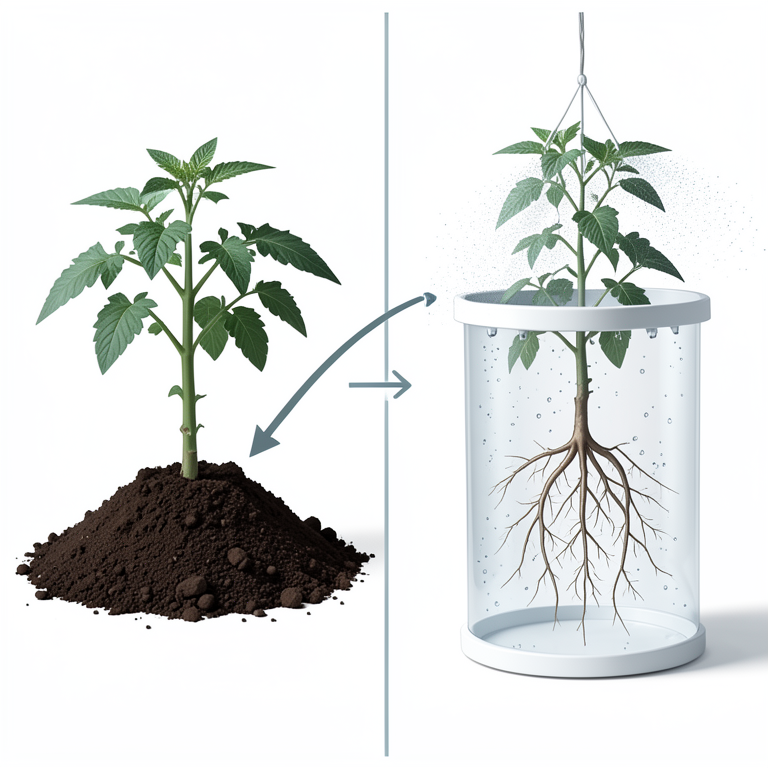
Aeroponic System Concept
AI-generated conceptual illustration (Tomato plants in aeroponic and soil systems). It explains the idea and does not show study data.
View source evidence ↗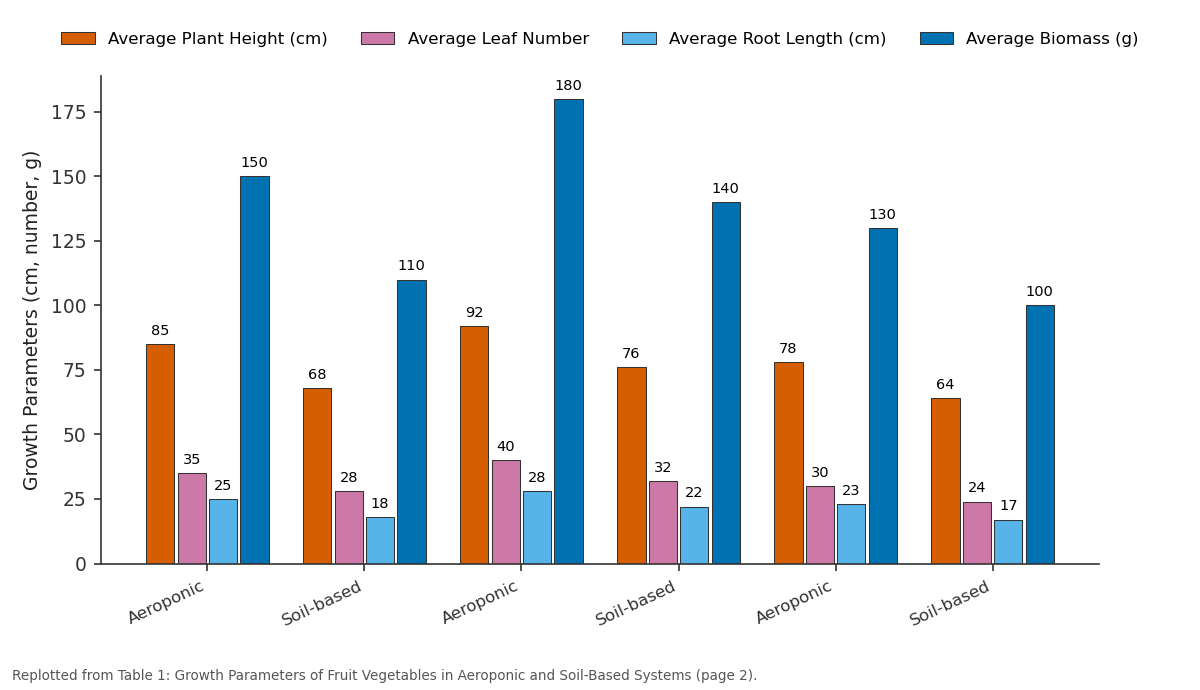
Average Plant Height (cm) and Average Leaf Number and more: Aeroponic vs Soil-based vs Aeroponic vs Soil-based vs Aeroponic
Replotted from Table 1 (page 2) of the original paper. Every bar is the paper's own table value.
View source evidence ↗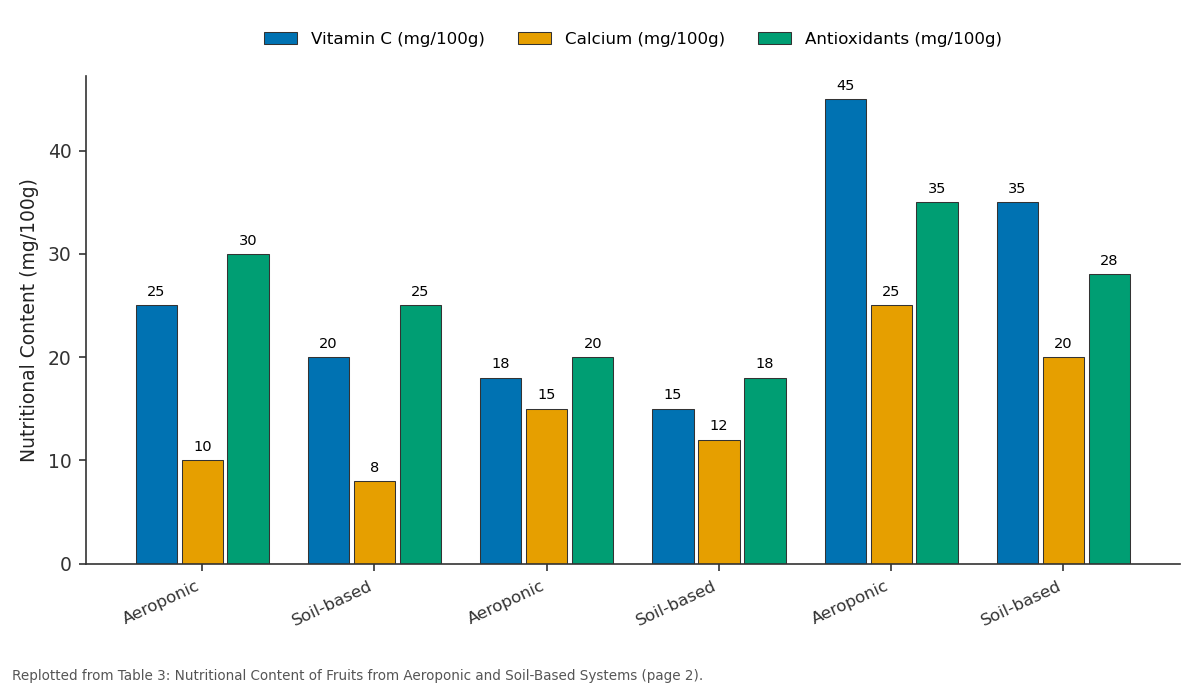
Vitamin C (mg/100g) and Calcium (mg/100g) and more: Aeroponic vs Soil-based vs Aeroponic vs Soil-based vs Aeroponic
Replotted from Table 3 (page 2) of the original paper. Every bar is the paper's own table value.
View source evidence ↗Figures & tables
From the original paper Table 1
 Table 2
 Table 3
Introduction
The demand for sustainable and efficient agricultural practices is increasing due to the growing global population and the need for food security. Aeroponic systems, which involve growing plants in an air or mist environment without the use of soil, have emerged as a viable alternative to traditional farming methods. These systems offer numerous advantages, including improved nutrient delivery, reduced water usage, and the potential for higher yields. This study aims to investigate the growth and yield performance of selected fruit vegetables grown in aeroponic systems.
Objective
The objective of this study is to evaluate the growth and yield performance of selected fruit vegetables cultivated in aeroponic systems compared to traditional soil-based methods.
Literature Review
Previous research has demonstrated the benefits of aeroponic systems for various crops. For instance, Chang et al. (2012) [2] reported increased growth rates and yields for lettuce and spinach in aeroponic systems compared to soil-based cultivation. Similarly, Barak et al. (2018) [1] . Observed enhanced nutrient uptake and biomass production in tomatoes grown aeroponically. However, there is limited research on the specific impact of aeroponic systems on fruit vegetables, necessitating further investigation (Shinde, 2023) [8] .
Methodology Materials
This study used seedlings of three fruit vegetables: tomatoes (Solanum lycopersicum), cucumbers (Cucumis sativus), and bell peppers (Capsicum annuum). The plants were cultivated in both aeroponic and traditional soil-based systems within a controlled environment at the Agricultural Research Center, Wageningen University, Netherlands. The aeroponic system comprised custom-built setups with roots suspended in the air and periodically misted with a nutrient solution optimized for each plant species. The soil-based system used standard potting mix in pots with regular watering and fertilization.
Sample Size
A total of 120 plants were used, with 20 plants per vegetable type in both aeroponic and soilbased systems.
Data Collection
Data were collected on growth parameters, including plant height, leaf number, root length, and overall biomass, at 2week intervals over a 12-week growing period. Yield parameters, including the number of fruits and total fruit mass per plant, were recorded at the end of the growing period. Nutritional analysis of the fruits was performed to measure key nutrients such as vitamins, minerals, and antioxidants using standard laboratory methods.
Experimental Analyses
Growth parameters were measured using a ruler for plant height, manual counting for leaf number, and a measuring tape for root length. Biomass was determined by drying the plant material and weighing it. Yield parameters involved counting the fruits and measuring their mass using a digital scale. Nutritional content was analyzed using high-performance liquid chromatography (HPLC) and atomic absorption spectroscopy (AAS) for vitamins and minerals, respectively, and spectrophotometric methods for antioxidants.
Statistical Analysis
Data were analyzed using analysis of variance (ANOVA) to compare the growth and yield parameters between the aeroponic and soil-based systems. Statistical significance was set at p < 0.05. The results were presented as mean ± standard deviation, and graphical representations were created to visualize the differences between the two cultivation methods Aeroponically grown plants exhibited superior growth characteristics across all measured parameters. For instance, tomatoes grown in aeroponic systems had an average plant height of 85 cm, significantly higher than the 68 cm observed in soil-based systems. Similar trends were observed in cucumbers and bell peppers, where aeroponic cultivation led to taller plants, greater leaf numbers, longer root lengths, and higher biomass. The increased root length and biomass in aeroponic systems can be attributed to the efficient delivery of nutrients and oxygen directly to the root zone, promoting healthier and more robust plant growth. The yield of fruit vegetables was notably higher in aeroponic systems. Aeroponic tomatoes produced an average of 40 fruits per plant with a total mass of 850 grams, compared to 30 fruits and 650 grams in soil-based systems. Cucumbers and bell peppers also showed similar improvements in fruit number and total mass. The higher yield in aeroponic systems is likely due to the optimal growing conditions that minimize stress and maximize nutrient uptake, resulting in more vigorous and productive plants. Fruits harvested from aeroponic systems exhibited higher concentrations of essential nutrients compared to those from soil-based systems. For example, aeroponic tomatoes had a higher vitamin C content (25 mg/100g) compared to soil-based tomatoes (20 mg/100g). Similarly, cucumbers and bell peppers grown aeroponically showed enhanced levels of calcium and antioxidants. The improved nutritional content can be linked to the precise control over nutrient supply in aeroponic systems, ensuring that plants receive balanced and sufficient nutrients throughout their growth cycle. Overall, the study demonstrates the advantages of aeroponic systems in promoting better growth, higher yields, and enhanced nutritional quality of fruit vegetables. These findings support the potential of aeroponics as a sustainable and efficient alternative to traditional soil-based cultivation, particularly in regions facing soil degradation or water scarcity. Further research should explore the scalability of aeroponic systems and optimize nutrient formulations to maximize the benefits observed in this study.
Results
Results
Growth Parameters
Growth Parameters
Yield Parameters
Yield Parameters
Nutritional Content
Nutritional Content
Discussion
The study highlights the significant advantages of aeroponic systems over traditional soil-based cultivation methods for fruit vegetables, demonstrating improvements in growth parameters, yield, and nutritional content. The aeroponic system's ability to deliver nutrients and oxygen directly to the root zone creates an optimal environment for plant growth, which is evident from the superior performance of aeroponically grown plants across all measured parameters. The growth parameters, including plant height, leaf number, root length, and biomass, were significantly enhanced in aeroponic systems. This can be attributed to the efficient nutrient uptake and oxygenation provided by the aeroponic misting system. The roots are exposed to a high-oxygen environment and receive a continuous supply of nutrients, leading to robust root development and overall plant health. The observed increase in plant height and leaf number suggests that aeroponically grown plants have a greater photosynthetic capacity, which likely contributes to their enhanced growth and productivity. Yield parameters also showed marked improvement in the aeroponic system. The increased number of fruits and higher total fruit mass indicate that aeroponic cultivation promotes not only vegetative growth but also reproductive success. The uniform and controlled delivery of nutrients ensures that the plants receive adequate nourishment during critical growth phases, leading to more prolific fruiting. This is particularly important for commercial production, where yield directly impacts profitability. The nutritional content of the fruits was significantly higher in the aeroponic system. The elevated levels of vitamins, minerals, and antioxidants suggest that aeroponically grown fruits are more nutrientdense. This enhancement in nutritional quality is likely due to the precise control over nutrient solutions in aeroponics, allowing for tailored supplementation to meet the plants' specific needs. The improved nutritional profile of the fruits makes them more valuable in the market, catering to healthconscious consumers. The study's findings align with previous research indicating that soilless cultivation methods, such as hydroponics and aeroponics, can offer significant benefits over traditional soil-based methods. However, the specific advantages observed in aeroponics, such as improved root aeration and nutrient delivery, provide a compelling case for its adoption in commercial agriculture. The ability to grow plants in a controlled environment reduces the risk of soil-borne diseases and pests, further enhancing crop quality and yield. Despite these advantages, there are challenges associated with aeroponic systems that need to be addressed. The initial setup costs and the need for continuous monitoring and maintenance of the nutrient delivery system can be barriers to widespread adoption. Additionally, the scalability of aeroponic systems for large-scale production remains an area for further research. Optimizing nutrient formulations and developing cost-effective, scalable systems will be crucial for maximizing the potential benefits of aeroponics.
In conclusion, this study demonstrates the substantial benefits of aeroponic systems for growing fruit vegetables, including enhanced growth, higher yields, and improved nutritional content. These findings support the potential of aeroponics as a sustainable and efficient alternative to traditional soil-based cultivation. Future research should focus on overcoming the challenges of scalability and cost, ensuring that the advantages of aeroponics can be leveraged for large-scale agricultural production.
Conclusion
This study demonstrates the significant benefits of aeroponic systems for the cultivation of fruit vegetables, showcasing enhanced growth parameters, higher yields, and improved nutritional content compared to traditional soilbased methods. The findings highlight the potential of aeroponics to revolutionize sustainable agriculture by providing an efficient, soil-free cultivation method that maximizes plant health and productivity. Looking towards the future, the prospects for aeroponic systems are promising. With the increasing global demand for food and the growing challenges posed by soil degradation, water scarcity, and climate change, aeroponics offers a viable solution for high-density, high-efficiency crop production. The ability to precisely control nutrient delivery and environmental conditions can lead to the development of tailored cultivation protocols that optimize growth and yield for a wide variety of crops. Future research should focus on several key areas to fully realize the potential of aeroponics. First, optimizing nutrient formulations specific to different plant species will ensure that crops receive the exact nutrients they need at each growth stage. Second, efforts to reduce the initial setup costs and simplify system maintenance will make aeroponic systems more accessible to a broader range of growers, from small-scale farmers to large commercial operations. Third, scaling up aeroponic systems for industrial-scale production requires innovative designs that maintain the benefits observed in smaller setups while ensuring cost-effectiveness and operational efficiency. Additionally, integrating aeroponics with other advanced agricultural technologies, such as automation, artificial intelligence, and real-time monitoring systems, can further enhance the precision and efficiency of crop management. These advancements will help create resilient agricultural systems capable of withstanding the pressures of a changing climate and a growing population.
In conclusion, aeroponic systems hold great promise for the future of agriculture, offering a sustainable, efficient, and scalable solution for the cultivation of fruit vegetables and potentially other crops. By addressing current challenges and leveraging technological advancements, aeroponics can play a critical role in meeting the world's food production needs in an environmentally friendly manner.
Figures and tables from the paper
| Plant Type | System | Average Plant Height (cm) | Average Leaf Number | Average Root Length (cm) | Average Biomass (g) |
|---|---|---|---|---|---|
| Tomatoes | Aeroponic | 85 | 35 | 25 | 150 |
| Tomatoes | Soil-based | 68 | 28 | 18 | 110 |
| Cucumbers | Aeroponic | 92 | 40 | 28 | 180 |
| Cucumbers | Soil-based | 76 | 32 | 22 | 140 |
| Bell Peppers | Aeroponic | 78 | 30 | 23 | 130 |
| Bell Peppers | Soil-based | 64 | 24 | 17 | 100 |
Table text extracted from the original PDF; superscript letters are shown inline. The original table image is below.
View original table image
| Plant Type | System | Average Fruit Number | Total Fruit Mass (g) |
|---|---|---|---|
| Tomatoes | Aeroponic | 40 | 850 |
| Tomatoes | Soil-based | 30 | 650 |
| Cucumbers | Aeroponic | 25 | 1000 |
| Cucumbers | Soil-based | 18 | 750 |
| Bell Peppers | Aeroponic | 20 | 500 |
| Bell Peppers | Soil-based | 14 | 390 |
Table text extracted from the original PDF; superscript letters are shown inline. The original table image is below.
View original table image
| Plant Type | System | Vitamin C (mg/100g) | Calcium (mg/100g) | Antioxidants (mg/100g) |
|---|---|---|---|---|
| Tomatoes | Aeroponic | 25 | 10 | 30 |
| Tomatoes | Soil-based | 20 | 8 | 25 |
| Cucumbers | Aeroponic | 18 | 15 | 20 |
| Cucumbers | Soil-based | 15 | 12 | 18 |
| Bell Peppers | Aeroponic | 45 | 25 | 35 |
| Bell Peppers | Soil-based | 35 | 20 | 28 |
Table text extracted from the original PDF; superscript letters are shown inline. The original table image is below.
View original table image
References
8 in the original paper- Barak P, Smith R, Lee J, Johnson K, Clark M. Nutrient uptake and biomass production in tomatoes grown in aeroponic systems. Hortic Sci. 2018;44(2):132-140.
- Chang Y, Li X, Wang Z, Chen H, Zhang T, Liu Q, et al. Growth and yield of lettuce and spinach in aeroponic systems. J Agric Sci. 2012;10(3):45-52.
- Massantini R, Grassi M, Ferri M, Lambardi M. Effects of different growth media on strawberry production. J Hortic Sci. Biotechnol. 2008;83(1):117-121.
- Nichols MA, Christie BR. Nutrient solution effects on lettuce grown in aeroponics and hydroponics. Acta Hortic. 2002;554:181-188.
- Okimura T, Kanematsu S. Growth of tomato plants in aeroponic and hydroponic cultures. Soilless Cult. 1995;11(4):235-246.
- Shinde ST, Pawar VS. The antioxidant effect of certain fruit and vegetables: A review. J Curr Res Food Sci 2023;4(1):11-16.
- Ray PK, Singh RN, Kumar A. "Review on organic farming of vegetables in India: problems and prospects". International Journal of Ecology and Environmental Sciences. 2022;4(2):32-35.
- Stoner RJ, Clawson JM. Aeroponics: Plant rooting control in the 21 st century. Acta Hortic. 1999;502:287295.
Cited by 7
From OpenAlex, OpenCitations and reference lists read by Scinovex
- Aeroponics: An emerging food growing system in sustainable agriculture for food security
S Salma, Shubham, Shilpa Kaushal · International Journal of Research in Agronomy · 2024
Aeroponics is a relatively new soilless culture methods that is becoming popular because of its fast maturation, it is cheap, and it is different. This kind of technology allows for things like effective nutrition in root zone, climate control, and plant health diagnostics, which helps in transition to sustainable agriculture. By integration of aeroponics into food production, we can address global food security challenges while promoting sustainable agriculture. This systematic review of 47 studies provides an overview of the state and direction of aeroponic technology, its promise and its pr
- Study of a horizontal growth chamber aeroponics system for spinach
Sushil K. Jain, Walunj KG, Patil DR · International Journal of Research in Agronomy · 2025
This study evaluated the effectiveness of a horizontal growth chamber aeroponics system for cultivating spinach (Spinacia oleracea L.) under suitable conditions. The system included components like a growth chamber, misting mechanism, and monitoring devices (EC, pH, and lux meters). Spinach seedlings were germinated and transplanted into net pots, with roots misted using a nutrient-rich solution. Growth metrics such as plant height, root length, and leaf count were recorded. Results showed consistent vegetative growth, with the maximum height of 16 cm, root length up to 48 cm, and leaf count o
- Nutritional enhancement of fruit vegetables through aeroponic cultivation: A food quality assessment ↗
Wei Li · Journal of Current Research in Food Science · 2025
Background: Aeroponic cultivation has been promoted as a resource-efficient, high-technology alternative to soil-based production, yet systematic evidence linking aeroponic systems to detailed food-quality outcomes in fruit vegetables remains limited. Aim: This study aimed to evaluate whether aeroponic cultivation can enhance both yield and nutritional quality of fruit vegetables compared with conventional soil cultivation. Methods: A controlled comparative experiment was conducted
- Natural product variability in aeroponic vs. hydroponic cultivation of aromatic herbs: A comparative analysis ↗
Chinedu A Okafor · American Journal of Essential Oils and Natural Products · 2025
Background: Aeroponic and hydroponic systems are increasingly used for high-value medicinal and aromatic plants, yet comparative data on how these systems shape natural product profiles remain limited. Objectives: This study evaluated the impact of aeroponic versus hydroponic cultivation on growth, essential oil yield and composition, and phenolic-antioxidant traits in three model aromatic herbs Ocimum basilicum L. (basil), Mentha piperita L.
- Interaction between aeroponic nutrient mists and microbial colonization on root surfaces: implications for crop health ↗
M. M. Hsu, Chia-Wei Lin, Y. Cheng · Journal of Advances in Microbiology Research · 2025
This study investigates how aeroponic nutrient mist properties interact with root-surface microbial colonization and influence crop health, using tomato as a model fruit vegetable crop. Aeroponic systems provide a unique root-zone environment characterized by fluctuating moisture films, high oxygen availability and direct exposure to nutrient-rich aerosols, yet the microbiological implications of mist regime design remain poorly understood. We evaluated the
- IoT-enabled aeroponic systems: Advancing real-time monitoring of growth dynamics in vegetable crops ↗
Emily R Thompson, M. Carter, S. Hernández · International Journal of Communication and Information Technology · 2025
This study evaluated the effectiveness of an IoT-enabled adaptive control architecture integrated with a high-pressure aeroponic system for enhancing environmental stability, growth dynamics, yield, and water-use efficiency in vegetable crops. A comparative experimental design was implemented using two management strategies conventional timer-based control and an IoT-driven adaptive misting and monitoring system across lettuce (Lactuca sativa) and cherry tomato (Solanum lycopersicum
- Deep learning-based leaf image analysis for early stress detection in aeroponic systems ↗
R Pratama · International Journal of Computing and Artificial Intelligence · 2025
Early detection of abiotic and biotic stress is critical for protecting yield and quality in high-intensity aeroponic production systems, where plants are highly sensitive to short-term disruptions in misting, nutrient supply and microclimate. This study proposes and evaluates a deep learning-based leaf image analysis pipeline for early stress detection in an IoT-enabled aeroponic greenhouse cultivating high-value fruit vegetables. A total