
Research article · 2024 · Full text
International Journal of Research in AgronomyInfluence of herbicides on yield and yield parameters of groundnut in rice-groundnut system under coastal zone of Karnataka
Volume 7(7S) · Pages 84–86 · DOI: 10.33545/2618060x.2024.v7.i7sb.994 ↗
Research areasRice Cultivation and Yield ImprovementAgricultural Economics and PracticesAgricultural Science and Fertilization
Abstract
Author-writtenA field experiment was conducted at Agricultural Research Station, Kumta, Uttar Kannada district of University of Agricultural Sciences, Dharwad to know the impact of herbicide on yield and yield parameters of groundnut in rice-fallow groundnut system. A field experiment was layout in a RCBD design having nine treatments with three replications. The results concluded that, significantly higher number of pods per plant (14.4), pod weight per plant (12.4 g), sound matured kernel (79.2%) and test weight (33.1 g) and kernel yield (1294 kg ha-1) was observed in application of pendimethalin 30% E.C. @ 1.5 kg ha-1 fb one hand weeding at 25 DAS and however on par with T6: pendimethalin 30% E.C. @ 1.5 kg ha-1 fb quizalofop-p-ethyl 5% E.C. @ 50 g ha-1 20-30 DAS. Whereas, significantly lower number of pods per plant (8.1) and pod weight per plant (8.1 g), sound matured kernel (74.8%), test weight (28.5 g) and kernel yield (777 kg ha-1) was observed in un-weeded plot.
Summary
Source-checkedPlain-language reading of the full paper, prepared with AI and checked against the text. Each point links to the authors' own words.
Why it matters
- Groundnut serves as a critical source of vegetable protein and edible oil. View evidence ↗
- Weed infestation is a primary cause of reduced groundnut yields. View evidence ↗
- In India, weeds can cause groundnut production losses ranging from 15% to 75%. View evidence ↗
- Physical weed control is often limited by high labor costs and the unavailability of workers during critical growth periods. View evidence ↗
The question
- The study aimed to identify effective chemical herbicides to improve the yield and yield attributes of groundnut grown in a rice-fallow system. View evidence ↗
What they did
- The field experiment was conducted at the Agricultural Research Station in Kumta, Karnataka, located at 2 m above mean sea level. View evidence ↗
- The research used a Randomized Block Design consisting of nine different treatments, each with three replications. View evidence ↗
- Yield parameters were measured by counting pods from five tagged plants per treatment. View evidence ↗
What they found
- The application of pendimethalin 30% E.C. at 1.5 kg/ha followed by hand weeding at 25 DAS resulted in significantly higher pod weight (12.4 g/plant), pod number (14.4), sound matured kernels (79.2%), and test weight (33.1 g). View evidence ↗
- The un-weeded plot showed significantly lower results, with pod weight at 8.10 g, pod number at 8.1, sound matured kernels at 74.8%, and test weight at 28.5 g. View evidence ↗
- The un-weeded plot had the lowest pod yield (1453 kg/ha) and kernel yield (777 kg/ha), representing a 35.6% reduction in yield compared to the pendimethalin and hand weeding treatment. View evidence ↗
- The results for pendimethalin followed by hand weeding were statistically comparable to those of pendimethalin followed by quizalofop-p-ethyl (5% E.C. @ 50 g/ha). View evidence ↗
What it means
- The authors conclude that pre-emergence pendimethalin (30% E.C. @ 1.5 kg/ha) followed by one hand weeding at 25 DAS is the most effective treatment for increasing groundnut yield in the coastal zone of Karnataka. View evidence ↗
Visual summary
3 visualsIllustrations explain the paper; charts are replotted from the paper's own table values.
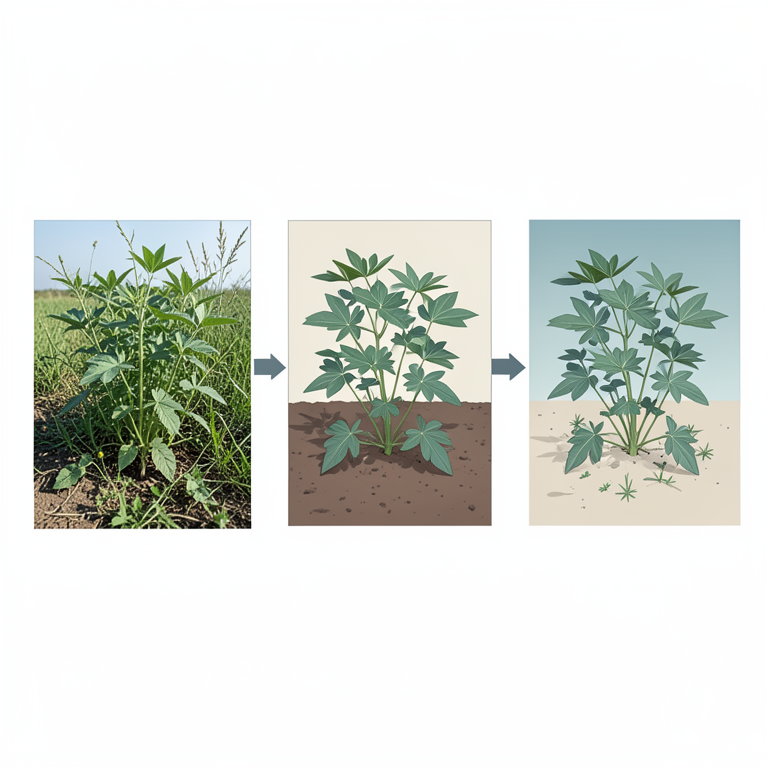
Experimental Treatment Layout
AI-generated conceptual illustration (groundnut plants in a coastal field). It explains the idea and does not show study data.
View source evidence ↗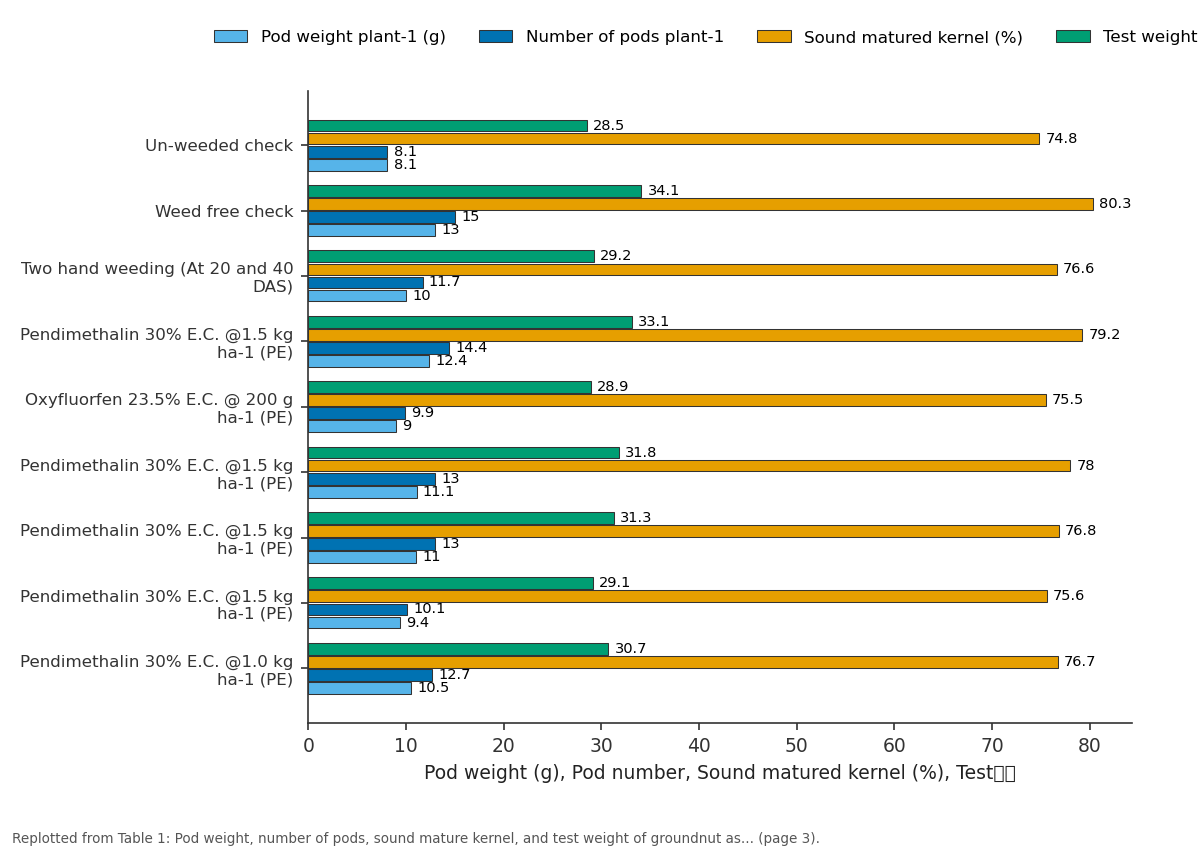
Pod weight plant-1 (g) and Number of pods plant-1 and more: Un-weeded check vs Weed free check vs Two hand weeding (At 20... vs Pendimethalin 30% E.C.... vs Oxyfluorfen 23.5% E.C....
Replotted from Table 1 (page 3) of the original paper. Every bar is the paper's own table value.
View source evidence ↗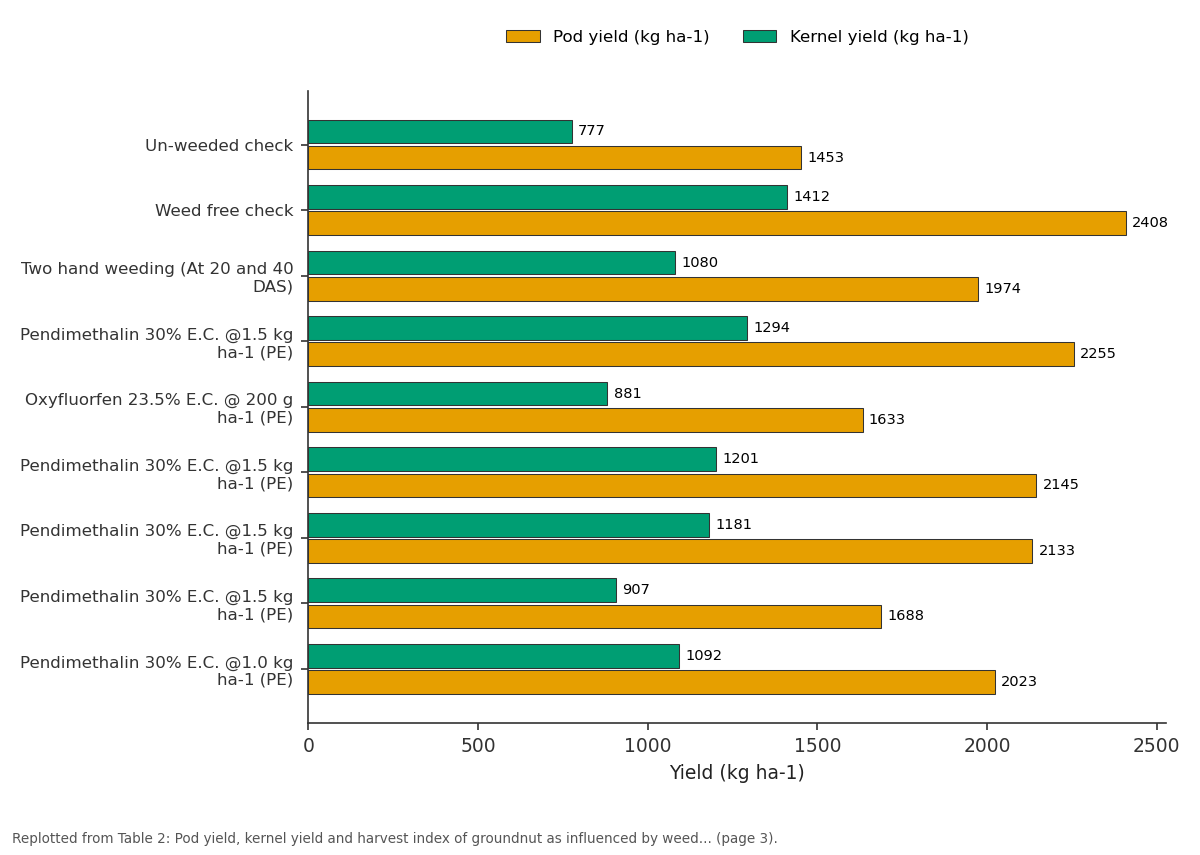
Pod yield (kg ha-1) and Kernel yield (kg ha-1): Un-weeded check vs Weed free check vs Two hand weeding (At 20... vs Pendimethalin 30% E.C.... vs Oxyfluorfen 23.5% E.C....
Replotted from Table 2 (page 3) of the original paper. Every bar is the paper's own table value.
View source evidence ↗Figures & tables
From the original paper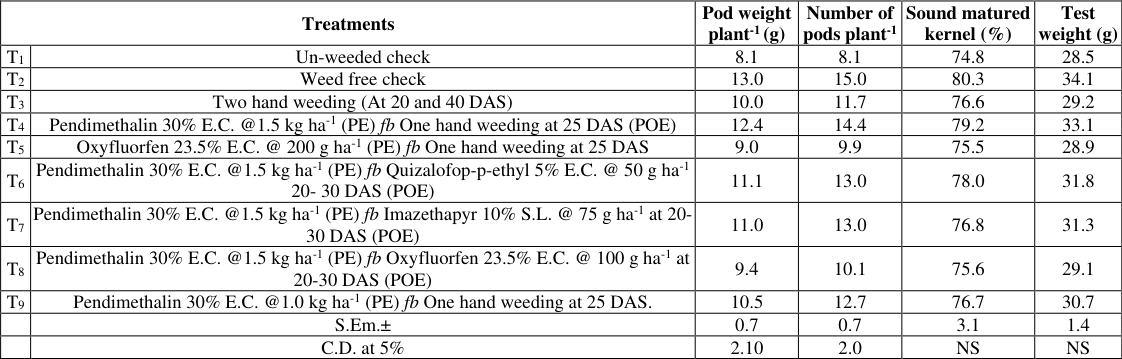 Table 1
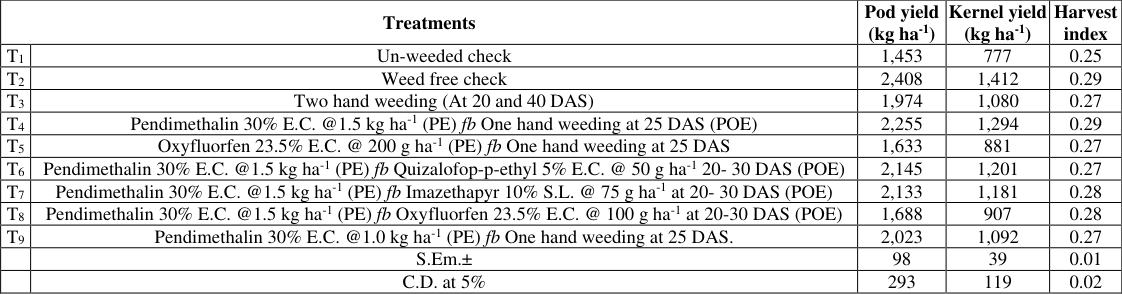 Table 2
Introduction
Groundnut is most important source of edible oil and vegetable protein. In India, the groundnut is cultivated an area about 8.59 m ha. With a production of 6.59 M.tonnes and average yield of 1764 kg ha -1 (Anon., 2015) [1] . The major groundnut growing districts in rabi season in Karnataka are Udupi and Uttara kannada. To meet the growing demand of oilseed production the groundnut cultivation has been extended to rabi/summer or post rainy season in AP, TN, Orissa, Kerala, West Bengal, Karnataka and Jharkhand, where in most of the land remains fallow after kharif rice. Cultivation of pulses (Green gram and black gram) in rice-fallow is a common practice in coastal areas of Andhra Pradesh, Karnataka and Tamil Nadu. Groundnut is one of the alternatives to these pulses in rice-fallows under coastal areas. Groundnut is grown all season in India. The average yield of groundnut is very mainly due to changes in monsoon, non-availability of irrigation facilities, poor nutrient and weed infestation, non-adoption of improved agro technologies. Among these, weed infestation is one of the major factors responsible for lower yield. During the initial stage of crop growth, it encounters severe weed problem, because initially slow growth of crop after words, shoot growth is very less when compared to the root development. The weeds grow very rapidly competing with natural resources like water, nutrients, light and also transpire lot of water from the soil. The initially up to 4 to 8 weeks are critical period of crop weed competition during the crop period (Jat et al., 2011) [3] . In India, 15 to 75 per cent loss of groundnut production due to weeds (Sathya et al., 2013) [7] . Therefore weed control during initial stages is very crucial role for higher yield. The lot of limitations in physical method of weed control are un-availability of labour during weed infestation, cost labour is too high and un-fourable condition during critical period. Under such conditions, chemical control of weed management forms an excellent alternative to manual and mechanical weed control methods. Further, lack of pre-emergence application of herbicide activity have longer period resulted in weed growth for that go for hand weeding at 25-40 DAS. Under such situation go for post emergent application of herbicide were suggested during critical stages of crop growth.
Hence, there is a need to identify the effective chemicals on yield and yield attributes of groundnut in rice-fallow groundnut system.
Materials and Methods
A field experiment was conducted at ARS Kumta, Uttar Kannada, UAS, Dharwad (Karnataka) Kumta is located at 14.2554° N latitude and 74.2516° E longitude and at an altitude of 2 m above the mean sea level. This research station comes under Coastal Zone (Zone 10) of Karnataka which receives average rainfall of 3588 mm. The experiment was laid out in a Randomized Block Design having 9 treatments with 3 replications. Treatment details as follows., T 1: Un-weeded check, T 2: Weed free check, T 3: Two hand weeding (At 20 and 40 DAS), T 4: pendimethalin 30% E.C. @ 1.5 kg ha -1 (PE) fb one hand weeding at 25 DAS, T 5: oxyfluorfen 23.5% E.C. @ 200 g ha -1 (PE) fb one hand weeding at 25 DAS, T 6 : pendimethalin 30% E.C. @ 1.5 kg ha -1 (PE) fb quizalofop-p-ethyl 5% E.C. @ 50 g ha -1 20-30 DAS (POE), T 7: pendimethalin 30% E.C. @ 1.5 k ha -1 (PE) fb imazethapyr 10% S.L. @ 75 g ha -1 20-30 DAS (POE), T 8: pendimethalin 30% E.C. @ 1.5 kg ha -1 (PE) fb oxyfluorfen 23.5% E.C. @ 100 g ha -1 at 20-30 DAS (POE), and T 9 : pendimethalin 30% E.C. @ 1.0 kg ha -1 (PE) fb one hand weeding at 25 DAS. Hand weeding was done as per treatments. In weed free plot throught crop growth period weed free condition was
Yield parameters and yield
Yield parameters and yield
Number of pods per plant
The number of pods per plant was counted from five tagged plant in every treatments and expressed in number of pods per plant.
Weight of pods per plant
The weight of five plants were selected and picked separately and its pod weight per plant recorded.
Hundred kernel weight
Weight of hundred sound kernel of the net plot was recorded and expressed in gram Sound matured kernel 100 g kernel from each treatments in a random manner for welldeveloped and shriveled were separated and counted.
Pod yield
The pod yield in each treatments were dried to constant weight and expressed as pod yield in kg ha -1 .
Kernel yield: Kernel yield for each plot was obtained based on shelling percentage and dry pod yield (kg ha -1 ).
Harvest index: The formula of harvest index was given below
Harvest index: The formula of harvest index was given below
Results and Discussions
The yield parameters of groundnut were differed significantly due to different weed management practices are presented in Table 1. Among the different weed management practices, significantly higher pod weight (12.4 g plant -1 ), number of pods per plant (14.4), sound matured kernel (79.2%) and test weight (33.1 g) was recoded with pre-emergence application of pendimethalin 30% E.C. @ 1.5 kg/ha followed by one hand weeding at 25 DAS. However, it was on par with pendimethalin 30% E.C. at 1.5 kg/ha followed by quizalofop-p-ethyl 5% E.C. @ 50 g/ha at 20-30 DAS). However, weed free plot was recorded higher yield parameters as compared to other treatments. Whereas, significantly lower weight of pods per plant (8.10 g), number of pods per plant (8.1), sound matured kernel (74.8%) and test weight (28.5 g) was recorded in un-weeded plot. The similar results were in conformity with those obtained by Sumathi et al. (2000) [8] and Chaitanya et al. (2013) [2] . Number of pods per plant, pod weight per plant and test weight were significantly less with the un-weeded check than all other treatments which might be due to heavy weed competition which affected plant height and dry matter production resulted in lower yield parameters. Higher yield parameters was observed with pendimethalin 30% EC @ 1.5 kg ha -1 fb one hand weeding at 25 DAS, followed by pendimethalin 30% E.C. @ 1.5 kg ha -1 fb quizalofop-p-ethyl 5% E.C. @ 50 g ha -1 20-30 DAS treatments might be due to no weed free competition created by the application of herbicides at critical period of weed competition which ultimately reflected in yield attributing characters.
| Treatments | — | Pod weight plant-1 (g) | Number of pods plant-1 | Sound matured kernel (%) | Test weight (g) |
|---|---|---|---|---|---|
| T1 | Un-weeded check | 8.1 | 8.1 | 74.8 | 28.5 |
| T2 | Weed free check | 13.0 | 15.0 | 80.3 | 34.1 |
| T3 | Two hand weeding (At 20 and 40 DAS) | 10.0 | 11.7 | 76.6 | 29.2 |
| T4 | Pendimethalin 30% E.C. @1.5 kg ha-1 (PE) fb One hand weeding at 25 DAS (POE) | 12.4 | 14.4 | 79.2 | 33.1 |
| T5 | Oxyfluorfen 23.5% E.C. @ 200 g ha-1 (PE) fb One hand weeding at 25 DAS | 9.0 | 9.9 | 75.5 | 28.9 |
| T6 | Pendimethalin 30% E.C. @1.5 kg ha-1 (PE) fb Quizalofop-p-ethyl 5% E.C. @ 50 g ha-1 20- 30 DAS (POE) | 11.1 | 13.0 | 78.0 | 31.8 |
| T7 | Pendimethalin 30% E.C. @1.5 kg ha-1 (PE) fb Imazethapyr 10% S.L. @ 75 g ha-1 at 20- 30 DAS (POE) | 11.0 | 13.0 | 76.8 | 31.3 |
| T8 | Pendimethalin 30% E.C. @1.5 kg ha-1 (PE) fb Oxyfluorfen 23.5% E.C. @ 100 g ha-1 at 20-30 DAS (POE) | 9.4 | 10.1 | 75.6 | 29.1 |
| T9 | Pendimethalin 30% E.C. @1.0 kg ha-1 (PE) fb One hand weeding at 25 DAS. | 10.5 | 12.7 | 76.7 | 30.7 |
| S.Em.± | 0.7 | 0.7 | 3.1 | 1.4 | |
| C.D. at 5% | 2.10 | 2.0 | NS | NS |
Table text extracted from the original PDF; superscript letters are shown inline. The original table image is below.
View original table image
Pod yield, kernel yield and harvest index
The groundnut yield data were presented in (Table 2). Among the different treatments, pre-emergence application of pendimethalin 30% E. C at 1.5 kg/ha followed by one hand weeding at 25 DAS recorded significantly higher pod yield (22255 kg/ha), kernel yield (1294 kg/ha) and harvest index (0.29). The similar reports were noted by Sailaja et al., (2002) [5] and Sagvekar et al., (2015) [4] . The significantly lower pod yield (1453kg/ha), kernel yield (777 kg/ha) and harvest index (0.25) was observed with un-weeded plot as compared to other treatments and its accounted for 35.6 per cent reduction when compared to pre-emergence application of pendimethalin 30% E.C at 1.5 kg/ha at 25 DAS. The lower yield which might be due to higher weed density, weed dry matter production, which depleted the nutrients and moisture from the soil, which are the most growth and yield limiting factors of crops. The higher yield which might be due to reduction in weed density, weed dry matter resulted in higher growth attributes and these improved growth attributes increases the yield attributes which in turn increased pod and kernel yield of groundnut. The similar results were close conformed with the findings of Sasikala et al. (2006) [6] and Chaitanya et al. (2013) [2] .
| Treatments | — | Pod yield (kg ha-1) | Kernel yield (kg ha-1) | Harvest index |
|---|---|---|---|---|
| T1 | Un-weeded check | 1,453 | 777 | 0.25 |
| T2 | Weed free check | 2,408 | 1,412 | 0.29 |
| T3 | Two hand weeding (At 20 and 40 DAS) | 1,974 | 1,080 | 0.27 |
| T4 | Pendimethalin 30% E.C. @1.5 kg ha-1 (PE) fb One hand weeding at 25 DAS (POE) | 2,255 | 1,294 | 0.29 |
| T5 | Oxyfluorfen 23.5% E.C. @ 200 g ha-1 (PE) fb One hand weeding at 25 DAS | 1,633 | 881 | 0.27 |
| T6 | Pendimethalin 30% E.C. @1.5 kg ha-1 (PE) fb Quizalofop-p-ethyl 5% E.C. @ 50 g ha-1 20- 30 DAS (POE) | 2,145 | 1,201 | 0.27 |
| T7 | Pendimethalin 30% E.C. @1.5 kg ha-1 (PE) fb Imazethapyr 10% S.L. @ 75 g ha-1 at 20- 30 DAS (POE) | 2,133 | 1,181 | 0.28 |
| T8 | Pendimethalin 30% E.C. @1.5 kg ha-1 (PE) fb Oxyfluorfen 23.5% E.C. @ 100 g ha-1 at 20-30 DAS (POE) | 1,688 | 907 | 0.28 |
| T9 | Pendimethalin 30% E.C. @1.0 kg ha-1 (PE) fb One hand weeding at 25 DAS. | 2,023 | 1,092 | 0.27 |
| S.Em.± | 98 | 39 | 0.01 | |
| C.D. at 5% | 293 | 119 | 0.02 |
Table text extracted from the original PDF; superscript letters are shown inline. The original table image is below.
View original table image
Summary and Conclusion
The results concluded that, significantly higher yield and yield parameters were observed with pre-emergence application of pendimethalin 30% E.C. @ 1.5 kg ha -1 (PE) fb one hand weeding at 25 DAS. However, it was at par with application of pendimethalin 30% E.C. @ 1.5 kg/ha followed by quizalfop-pethyl 5% E.C. @ 50 g/ha at 20-30 DAS in rice-fallow groundnut under Coastal Zone of Karnataka.
References
8 in the original paper- Anonymous, Economic survey-Ministry of Agriculture and Co-operation, Govt. of India, 2014-2015, New Delhi.
- Chaitanya, S, Shankaranaryana, V and Nanjappi, HV. Influence of different herbicides on growth and yield of kharif groundnut. Mysore Journal of Agricultural Sciences. 2013;47(2):280-284.
- Jat, RS, Meena, HN, Singh, AL, Surya, JN and Misra JB. Weed management in groundnut (Arachis hypogaea L.) in India -A review. Agricultural Review. 2011;32(3):155-171.
- Sagvekar, VV, Waghmode, BD, Chavan, AP. and Mahadkar, V. Weed management in rabi groundnut (Arachis hypogaea) for Konkan region of Maharashtra. Indian Journal of Agronomy. 2015;60(1):116-120.
- Sailaja, K., Bucha Reddy, B and Devender Reddy, M. Effect of seedbed preparation and weed control practices on growth and yield of groundnut after kharif rice. Indian Journal of Dry Land Agrcultural Research and Development. 2002;17(2):152-157.
- Sasikala, B, Rada Kumari, C, Obulamm, U and Raghava Reddy, C. Studies on effect of herbicides in bunch groundnut, Arachis hypogaea L. Journal of Oilseeds Research.2006;23(1):126-127.
- Sathya, PR, and Manickasundaram, P. New Formulation of oxyfluorfen on weed control of groundnut and its residual effect on succeeding crops. Indian Journal of Applied Research. 2013;3 (6):16-18.
- Sumathi, V, Chandrika, V, Munendra Babu, A and Nagavani, AV. Integrated weed management in rainfed groundnut (Arachis hypogaea). Indian Journal of Agronomy. 2000;45(4):765-770.