
Research article · 2024 · Full text
International Journal of Research in AgronomyEffect of non-genetic factors on lifetime performance attributes of Murrah buffaloes
Volume 7(7S) · Pages 21–24 · DOI: 10.33545/2618060x.2024.v7.i7sa.977 ↗
Research areasLivestock Management and Performance ImprovementAgricultural Economics and Practices
Abstract
Author-writtenThe success of a dairy industry in India is much dependent on buffaloes and the level of lifetime performance traits. These performance traits depend on several genetic and non-genetic factors which introduce biasness in the estimation of genetic value of performance traits. In the absence of accurate phenotypic value of milk production traits, it becomes difficult to estimate genetic parameters of the traits which determine the optimum selection criterion for planned improvement programme of the animals. Also, genetic evaluation of animals requires the assumption that phenotypic measurements are adjusted for non-genetic factors that can affect production efficiency and reproduction traits (ex. Year/period of calving, season of calving, calving order, age at calving, length of lactation) to obtain accurate estimates of the genetic parameters and the breeding value of animals. This research paper aimed to analyse the effect of various non genetic factors on Longeiveity (LV), Milk yield per day of productive life(MY/PL) and Milk yield per day of longeveity (MY/LV). The data on performance records of 2959 Murrah buffaloes, progeny of 220 sires were collected from the pedigree, breeding and performance records from 1992-2015 maintained at Buffalo Research Center (BRC), LUVAS, Hisar and Central Institute for Research on Buffaloes, Hisar. The overall least-squares means for LV, MY/PL and MY/LV were 2738.80±32.07, 4.38±0.08 and 2.03±0.04, respectively.The period of calving had highly significant effect on LV and MY/PL. The LV showed an decreasing trend across the periods. Effect of season of calving was non-significant on all the longevity traits. Regression of age at first calving (linear) had significant effect on LV and MY/LV only. Effect of various non genetic factors help us to provide a deep role of management strategies in improvement of lifetime performance traits in dairy animals and it may also lead to a better progressive strategy for increasing most probable producing ability also of the Murrah buffaloes.
Summary
Source-checkedPlain-language reading of the full paper, prepared with AI and checked against the text. Each point links to the authors' own words.
Why it matters
- The Indian dairy industry relies heavily on buffaloes, making their lifetime performance traits critical for success. View evidence ↗
- Genetic and non-genetic factors can bias the estimation of the genetic value of performance traits in buffaloes. View evidence ↗
- To accurately estimate breeding values and genetic parameters, phenotypic measurements must be adjusted for non-genetic factors such as calving period, season, and age at calving. View evidence ↗
The question
- The study aimed to analyze how various non-genetic factors affect longevity (LV), milk yield per day of productive life (MY/PL), and milk yield per day of longevity (MY/LV) in Murrah buffaloes. View evidence ↗
What they did
- Performance records from 1992 to 2015 were collected for 2,959 Murrah buffaloes (progeny of 220 sires) from the Buffalo Research Center and the Central Institute for Research on Buffaloes in Hisar. View evidence ↗
- Longevity trait data were categorized by parity, season of calving, and period of calving. View evidence ↗
- The researchers used least squares and maximum likelihood programs based on the Henderson method to estimate the effects of tangible factors on the traits. View evidence ↗
What they found
- The overall least-squares means were 2738.80±32.07 days for longevity (LV), 4.38±0.08 kg/day for milk yield per day of productive life (MY/PL), and 2.03±0.04 kg/day for milk yield per day of longevity (MY/LV). View evidence ↗
- The period of calving had a highly significant effect (p<0.01) on longevity, which decreased from a high of 3134.64±167.28 days (1992-95) to a low of 2307.25±119.66 days (2012-15). View evidence ↗
- The period of calving significantly affected (p<0.01) milk yield per day of productive life, peaking at 4.86±0.19 kg/day (2004-07) and reaching a minimum of 4.01±0.19 kg/day (2000-03). View evidence ↗
- The farm had a significant effect (p<0.05) on milk yield per day of longevity, with Farm 1 (2.21±0.07 kg/day) performing better than Farm 2 (1.86±0.06 kg/day). View evidence ↗
- Linear age at first calving (AFC) had a highly significant effect (p<0.01) on milk yield per day of longevity, where each additional day of AFC resulted in a 0.0003 kg/day decrease in MY/LV. View evidence ↗
- The season of calving did not have a significant effect on the longevity of the buffaloes. View evidence ↗
What it means
- The authors conclude that non-genetic factors, particularly the farm and the period of calving, significantly impact the lifetime performance of Murrah buffaloes. View evidence ↗
- The authors suggest that understanding these non-genetic effects can lead to improved management strategies for enhancing animal productivity and longevity. View evidence ↗
- The authors state that future research should integrate both genetic and non-genetic factors to create more comprehensive breeding programs. View evidence ↗
Visual summary
1 visualsIllustrations explain the paper; they do not show study data.
Impact of Calving Period on Performance
AI-generated conceptual illustration (Murrah buffaloes). It explains the idea and does not show study data.
View source evidence ↗Figures & tables
From the original paper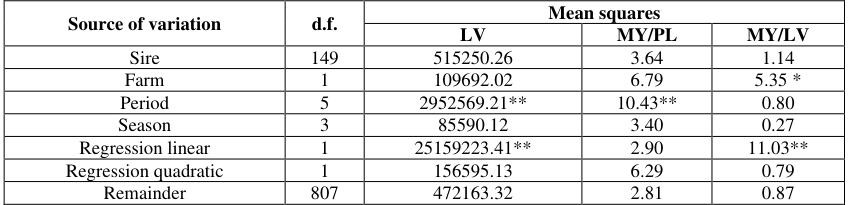 Table 1
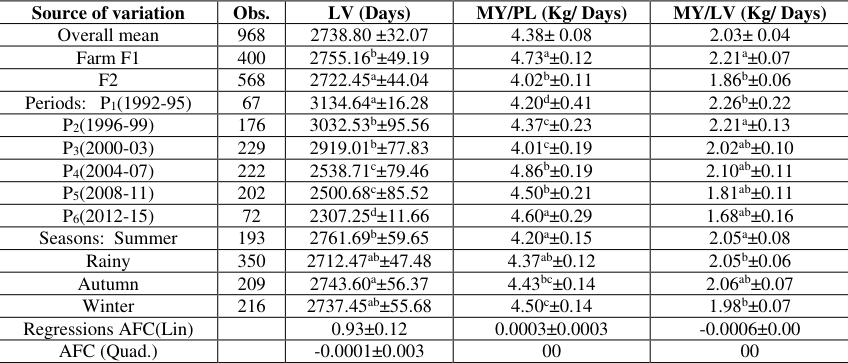 Table 2
Introduction
The dairy industry in India is heavily reliant on buffaloes, particularly the Murrah breed, due to their significant contribution to milk production. Murrah breed of buffalo is considered to be the best milk-cum-meat breed. The home tract of breed is around the Southern part of Haryana comprising the districts of Rohtak, Jind, Hisar, Gurgaon and Delhi. Home tract has relatively hot and dry climate. In any breeding programme it is important to bring about the improvement in production performance traits so as to select the best performing individuals. These production performance traits were influenced by several non-genetic factors like parity, period of calving, season of calving which have significant effect on full expression of these production traits. Difference in season weather summer or winter, availability of fodder in different climatic areas and also different managemental activities of farm manager largely affect the production traits. Therefore, the present investigation was conducted to study the effect various non genetic factors on production performance traits in Murrah buffaloes. The success of this industry is largely determined by the lifetime performance traits of these animals. Accurate phenotypic values of milk production traits are essential for estimating genetic parameters, which are crucial for developing optimal selection criteria in planned improvement programs. Additionally, the genetic evaluation of animals necessitates adjusting phenotypic measurements for non-genetic factors to ensure precise estimates of genetic parameters and breeding values.
This study aims to analyze the effect of various non-genetic factors Longeiveity(LV), Milk yield per day of productive life(MY/PL) and Milk yield per day of longeveity(MY/LV) in Murrah buffaloes.
Materials and Methods
Materials and Methods
Classification of data:
The data on longevity traits was classified according to parity, period of calving and season of calving.
Period of calving: Due to the changes in feeding and management practices over the particular time interval, there might be variation in the expression of different traits of animals in different periods of calving in the farm(s). Assuming that there is not much variation in adjacent years, entire period of twenty-four years will be divided into 6 periods, each consisting of 4 consecutive years:
Statistical analysis
In order to overcome non-orthogonality of the data due to unequal subclass frequencies, least squares and maximum likelihood computer program of Harvey (1990) using Henderson method 111 (Handerson, 1973) will be utilized to estimate the effect of various tangible factors on various traits under study.
The following mathematical model will be used to explain the underlying biology of the traits included in the study.
Where Y ijklmn = is the n th record of individual of the i th sire calved at j th farm, k th period, l th season and m th parity µ = is the overall population mean si = is the random effect of i th sire hj = is the fixed effect of j th farm pk cl rm = is the fixed effect of k th period of calving is the fixed effect of l th season of calving is fixed effect of m th parity b1 and b2 = are linear and quadratic partial regression coefficients of age at first calving on the traits, respectively. Xijklmn = is the age at first calving. X⁻ = is the mean of age at first calving. eijklmn = is the random error associated with each observation and assumed to be normally and independently distributed with mean zero and variance σ 2 e.
Results and Discussion
Results and Discussion
Least squares means and factors affecting different longevity traits
The analysis of variance and least-squares means for longevity traits are presented in the Tables 1 and2, respectively
Longevity (LV)
Longevity is one among the lifetime production traits and higher longevity is one of the indications of fit and healthy herd. A longer mean longevity increases profitability, because it decreases replacement costs and increases the proportion of the most productive mature age groups in the herd. The average longevity (2738.80± 32.07 days) observed in Murrah buffaloes in the current study was comparable to the values reported earlier for Murrah buffaloes. However, higher values for LV were reported by Dev (2015) [3] and Thiruvenkadan et al. (2015) [12] in Murrah buffaloes (a) Farm: The analysis of variance revealed non-significant effect of farm on LV. The longevity was highest on farm 1 (2755.16±49.19 days) as compared to farm 2 (2722.45±44.04 days). The longevity was highest on farm 1 as compared to farm 2. Whereas, Bashir, et al. (2007) [1] reported significant effect of farm on LV.
(b) Effect of period of calving:
The analysis of variance revealed highly significant (p<0.01) effect of period of calving on LV. The longevity was highest (3134.64±167.28 days) in period 1992-95 and lowest (2307.25±119.66 days) in period 2012-15. The longevity showed a decreasing trend across the periods. The longevity showed a decreasing trend across the periods. Dutt and Taneja (1994) [5] reported significant effect of period of calving on LV. However, Dev et al. (2016) [4] reported that effect of period of calving was statistically non-significant on LV.
(c) Effect of season of calving:
The effect of season of calving on LV was non-significant. [6] and Dev et al.
(2016) [4] in Murrah buffaloes.
(d) Regression effect of age at first calving:
Effect of age at first calving (linear as well as quadratic) was found to be nonsignificant on LV. The significant influence of age at first calving on the variation of longevity was reported by Thiruvenkandan et al. (2015) in Murrah buffaloes. However, Gowane and Tomar (2007) [7] reported non-significant effect of age at first calving on this trait.
Milk yield per day of productive life (MY/PL)
The overall least-squares mean for MY/PL was estimated as 4.38±0.08 kg/days. The results were comparable with the findings of Rao and Rao, 1996 [10] ; Kumar et al., 2006 [8] . However, Chander (2002) [2] and Dev et al. (2016) [4] reported higher values for MY/PL in Murrah buffaloes. Results reported by Thiruvenkadan et al. (2015) [12] was on lower side of the present findings.
(a) Farm: The analysis of variance revealed non-significant effect of farm on MY/PL. [6] and Dev et al. (2016) [4] in Murrah buffaloes were in accordance with the present findings.
(d) Regression effect of age at first calving:
Effect of age at first calving was found to be non-significant on MY/PL. Thiruvenkadan et al. (2015) [12] reported non-significant effect of AFC on MY/PL. The regression coefficient (0.0003±0.0003) of AFC on MY/PL indicated that with one day increase in AFC, there will be corresponding increase in 0.00001kg/day in MY/PL.
Milk yield per day of Longevity (MY/LV)
The overall least-squares mean for MY/LV was estimated as 2.03±0.04 kg/days. Kuralkar and Raheja (1997) [9] and Dutt et al. (2001) [6] reported values comparable with the present findings. However, Thiruvenkadan et al. (2015) [12] reported lower value for MY/LV in Murrah buffaloes (a) Farm: The analysis of variance revealed significant (<0.05) effect of farm on MY/LV. The milk yield per day of longevity was highest on farm 1 (2.21±0.07 kg/days) as compared to farm 2 (1.86±0.06 kg/days).
(b) Effect of period of calving:
The analysis of variance revealed non-significant effect of period of calving on MY/LV. The MY/LV was highest (2.26±0.22 kg/days) in period 19920-95 and lowest (1.68±0.16 kg/days) in period 2012-15. The MY/LV showed a decreasing trend across the periods. Dutt et al.
(2001) [6] and Dev et al. (2016) [4] findings were in consonance with the present findings.
( [6] and Dev et al. (2016) [4] in Murrah buffaloes.
(d) Regression effect of age at first calving: Effect of age at first calving (linear) was found to be highly significant (<0.01) on MY/LV. Whereas, effect of age at first calving (quadratic) was non-significant. Thiruvenkadan et al. (2015) [12] reported highly significant (p<0.01) effect on milk yield per day of longevity. The regression coefficient (-0.0006±0.00) of AFC on MY/LV indicated that with one day increase in AFC there would be corresponding decrease in MY/LV by 0.0003 kg/day.
Conclusion
This research demonstrates that non-genetic factors, especially the farm and period of calving, significantly influence the lifetime performance traits of Murrah buffaloes. Understanding these effects can help in devising better management strategies to improve the productivity and longevity of dairy animals. Future research should focus on integrating genetic and nongenetic factors to develop comprehensive breeding programs that enhance the overall performance of Murrah buffaloes in the dairy industry.
Figures and tables from the paper
| Source of variation | d.f. | Mean squares | — | — |
|---|---|---|---|---|
| LV | MY/PL | MY/LV | ||
| Sire | 149 | 515250.26 | 3.64 | 1.14 |
| Farm | 1 | 109692.02 | 6.79 | 5.35 * |
| Period | 5 | 2952569.21** | 10.43** | 0.80 |
| Season | 3 | 85590.12 | 3.40 | 0.27 |
| Regression linear | 1 | 25159223.41** | 2.90 | 11.03** |
| Regression quadratic | 1 | 156595.13 | 6.29 | 0.79 |
| Remainder | 807 | 472163.32 | 2.81 | 0.87 |
Table text extracted from the original PDF; superscript letters are shown inline. The original table image is below.
View original table image
| Source of variation | Obs. | LV (Days) | MY/PL (Kg/ Days) | MY/LV (Kg/ Days) |
|---|---|---|---|---|
| Overall mean | 968 | 2738.80 ±32.07 | 4.38± 0.08 | 2.03± 0.04 |
| Farm F1 | 400 | 2755.16b±49.19 | 4.73a±0.12 | 2.21a±0.07 |
| F2 | 568 | 2722.45a±44.04 | 4.02b±0.11 | 1.86b±0.06 |
| Periods: P1(1992-95) | 67 | 3134.64a±16.28 | 4.20d±0.41 | 2.26b±0.22 |
| P2(1996-99) | 176 | 3032.53b±95.56 | 4.37c±0.23 | 2.21a±0.13 |
| P3(2000-03) | 229 | 2919.01b±77.83 | 4.01c±0.19 | 2.02ab±0.10 |
| P4(2004-07) | 222 | 2538.71c±79.46 | 4.86b±0.19 | 2.10ab±0.11 |
| P5(2008-11) | 202 | 2500.68c±85.52 | 4.50b±0.21 | 1.81ab±0.11 |
| P6(2012-15) | 72 | 2307.25d±11.66 | 4.60a±0.29 | 1.68ab±0.16 |
| Seasons: Summer | 193 | 2761.69b±59.65 | 4.20a±0.15 | 2.05a±0.08 |
| Rainy | 350 | 2712.47ab±47.48 | 4.37ab±0.12 | 2.05b±0.06 |
| Autumn | 209 | 2743.60a±56.37 | 4.43bc±0.14 | 2.06ab±0.07 |
| Winter | 216 | 2737.45ab±55.68 | 4.50c±0.14 | 1.98b±0.07 |
| Regressions AFC(Lin) | 0.93±0.12 | 0.0003±0.0003 | -0.0006±0.00 | |
| AFC (Quad.) | -0.0001±0.003 | 00 | 00 |
Table text extracted from the original PDF; superscript letters are shown inline. The original table image is below.
View original table image
References
10 in the original paper- Bashir MK, Khan MS, Bhatti SA, Iqbal A. Lifetime performance of Nili-Ravi buffaloes in Pakistan. Asian-Aust. J Anim. Sci. 2007;20(5):661-668.
- Dev K, Dhaka SS, Yadav AS, Patil CS. Estimation of genetic parameters of lifetime performance traits in Murrah buffaloes. Journal of Anim. Res. 2016;6(4):645-649.
- Dutt T, Taneja VK. Estimates of phenotypic and genetic parameters of lifetime performance traits in Murrah buffaloes. Indian J Anim. Sci. 1994;64:384-387.
- Dutt T, Bhushan B, Kumar S. Genetic parameters of first lactation performance traits in Murrah buffaloes. Ind. J Anim. Sci. 2001;71(4):394-395.
- Gowane GR, Tomar SS. Genetic and non-genetic factors affecting selective value in a herd of Murrah Buffaloes. Indian J Dairy Sci. 2007;60:25-29.
- Kumar S, Yadav MC, Singh BP, Prasad RB. Relative importance of reproductive traits on herd life milk production and profit in buffaloes. Buffalo Bull. 2006;25:90-94.
- Kuralkar SV, Raheja KL. Relationship among early performance, lifetime production and reproduction traits in Murrah buffaloes. Indian J Anim. Sci. 1997;67:798-801.
- Rao AVN, Rao HRM. Longevity, lactation efficiency and culling pattern of Murrah buffaloes in Andhra Pradesh. Indian Vet. J. 1996;73:1196-1197.
- Singh TP, Singh R, Singh G, Das KS, Deb SM. Performance of production traits in Nili-Ravi buffaloes. Ind. J Anim. Sci. 2011;81(12):1231-1238.
- Thiruvenkadan AK, Panneerselvam, Rajendrean R. Lifetime performance of Murrah buffaloes hot and humid climate of Tamil Nadu, India. Buffalo Bulletin. 2015, 34(1).