
Research article · 2024 · Full text
International Journal of Research in AgronomyGenetic and phenotypic correlations between various production performance and reproduction traits in Murrah buffalo
Volume 7(7S) · Pages 25–27 · DOI: 10.33545/2618060x.2024.v7.i7sa.978 ↗
Research areasGenetic and phenotypic traits in livestockLivestock Farming and ManagementLivestock Management and Performance Improvement
Abstract
Author-writtenThis research investigates both genetic and phenotypic correlations between various production performance and reproduction traits in Murrah buffaloes by using relevant data of 396 animals collected from history cum pedigree sheets over a period of 24 years (1995-2018) from Buffalo research centre, LUVAS, Hisar. Investigation estimate these correlations, providing insights into how these traits are interrelated and can be optimized through breeding and management strategies. The results reveal significant negative correlations between reproductive efficiency and production performance traits, suggesting that reduction in value in reproductive traits can enhance milk production performance. These findings are crucial for developing comprehensive breeding programs aimed at improving both reproductive efficiency and milk yield in buffaloes.
Summary
Source-checkedPlain-language reading of the full paper, prepared with AI and checked against the text. Each point links to the authors' own words.
Why it matters
- Buffaloes serve as a critical part of the livestock industry, especially in areas where they are the main source of milk. View evidence ↗
- To optimize breeding and management, it is essential to understand the genetic and phenotypic correlations between different performance traits to increase buffalo productivity. View evidence ↗
The question
- The study aims to determine the genetic correlations between reproductive traits (service period, dry period, calving interval, and services for conception) and milk yield performance. View evidence ↗
- The research also examines phenotypic correlations among these same traits to fully understand how they relate to one another. View evidence ↗
What they did
- The study analyzed data from 396 Murrah buffaloes collected from pedigree sheets at the Buffalo research centre, LUVAS, Hisar, spanning 24 years from 1995 to 2018. View evidence ↗
- Correlations were estimated using Henderson's Method III via the least squares maximum likelihood computer program of Harvey (1990), with standard errors included for precision. View evidence ↗
- The analysis accounted for non-genetic effects by dividing the study into six four-year periods, with each year further split into four seasons. View evidence ↗
What they found
- Phenotypically, the service period showed a weak negative correlation with average milk yield (-0.06±0.05) and significant negative correlations with milk yield at the first (-0.20**±0.05) and second (-0.15*±0.05) calving intervals. View evidence ↗
- The dry period exhibited significant negative genetic correlations with average milk yield (-0.12*±0.05), first calving interval milk yield (-0.64**±0.04), and second calving interval milk yield (-0.28**±0.05). View evidence ↗
What it means
- The authors conclude that improving reproductive efficiency can lead to an increase in milk production. View evidence ↗
- The authors recommend that breeding programs simultaneously optimize reproductive and milk yield traits to improve overall buffalo productivity. View evidence ↗
Visual summary
1 visualsIllustrations explain the paper; charts are replotted from the paper's own table values.
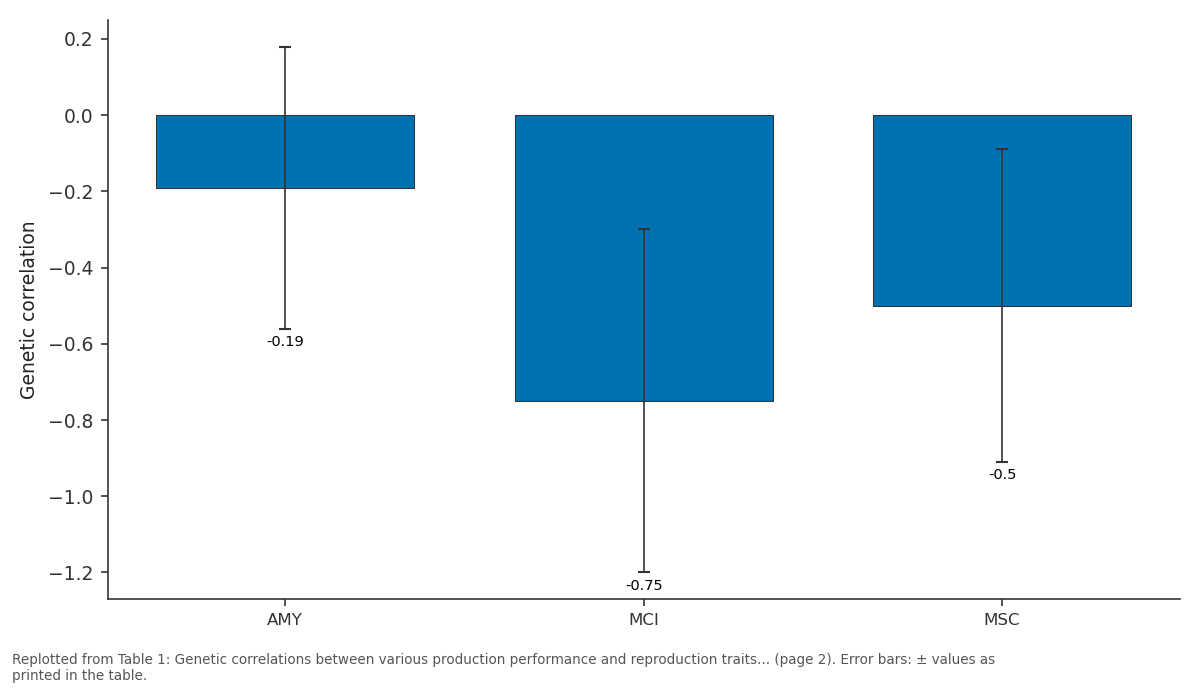
DP: AMY vs MCI vs MSC
Replotted from Table 1 (page 2) of the original paper. Every bar is the paper's own table value.
View source evidence ↗Figures & tables
From the original paper Table 1
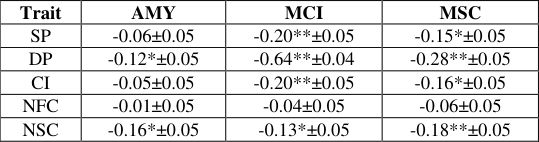 Table 2
Introduction
Buffaloes are a vital component of the livestock industry, particularly in regions where they are primary sources of milk. Enhancing the productivity of buffaloes through better understanding of genetic and phenotypic correlations among various performance traits is essential for optimizing breeding and management practices. This study focuses on genetic correlations among service period, dry period, calving interval, and the number of services required for successful conception with average milk yield, milk per day of the first calving interval, and milk yield per day at the age of second calving interval. Additionally, phenotypic correlations among these traits are examined to provide a comprehensive understanding of their interrelationships.
Materials and Methods
This research investigates both genetic and phenotypic correlations between various production performance and reproduction traits in Murrah buffaloes by using relevant data of 396 animals collected from history cum pedigree sheets over a period of 24 years (1995-2018). Data were collected pertaining to service period (SP), dry period (DP), first calving interval (CI), and the number of services required for first and second successful conception (NFC and NSC) with various production performance milk yield traits including average milk yield (AMY), Milk yield per day of first calving interval (MCI) and Milk yield per day at the age of second calving (MSC). Genetic and Phenotypic correlations were estimated and the estimates were provided with their corresponding standard errors to indicate the precision of the estimates by using least squares maximum likelihood computer program of Harvey (1990) [3] using Henderson's Method III (Henderson, 1973) [4] . Non genetic effects of season and period were also taken into due consideration. Entire study was divided into six periods having four years each and every year was further divided into four seasons. The following mixed mathematical model were used to find the results.
Where; Y ijkl = i th record of individual pertaining to i th sire calved in j th period and k th season, μ = is the overall population mean, S i = is the random effect of i th sire, h j = is the fixed effect of j th period of calving, c k = is the fixed effect of k th season of calving, b 1 &b 2 = are linear and quadratic partial regression coefficients of age at first calving on trait(s), respectively, A ijki = is the age at first calving, Ā = is the mean for age at first calving, e ijkl = is the random error associated with each and every observation and assumed to be normally and independently distributed with mean zero and variance 𝜎 2 e . ). These strong negative correlations suggest that a shorter dry period is beneficial for milk production performance, particularly during the first calving interval.
Results and Discussions
Results and Discussions
Calving Interval:
The genetic correlations of the calving interval with average milk yield (-0.12±0.41), milk per day of the first calving interval (-0.38±0.37), and milk yield per day at the age of the second calving interval (-0.04±0.38) are also negative. This indicates that selecting for shorter calving intervals can lead to improved production performance milk yield traits.
Number of Services Required for First Successful
Conception: The genetic correlations of the number of services required for first successful conception with average milk yield (-0.30±0.53), milk per day of the first calving interval (-0.33±0.43), and milk yield per day at the age of the second calving interval (-0.46±0.53) are negative. This suggests that fewer services for successful conception are associated with higher production performance milk yields.
Number of Services Required for second Successful
Conception: The correlations are generally consistent with the single measure, indicating negative robustness in the association between reproductive efficiency and production performance milk yield.
Phenotypic Correlations 1. Service Period:
The service period has a weak negative correlation with average milk yield (-0.06±0.05), milk yield of the first calving interval (-0.20**±0.05), and milk yield at the age of second calving (-0.15*±0.05). The significant negative correlations for the first and second calving intervals suggest that shorter service periods are associated with higher milk yields during these intervals.
Dry Period:
The dry period exhibits significant negative correlations with average milk yield (-0.12*±0.05), milk yield of the first calving interval (-0.64**±0.04), and milk yield at the age of second calving (-0.28**±0.05). These strong negative correlations indicate that shorter dry periods are associated with higher milk production, particularly during the first calving interval.
Calving Interval:
The calving interval shows weak negative correlations with average milk yield (-0.05±0.05) and significant negative correlations with milk yield of the first calving interval (-0.20**±0.05) and milk yield at the age of second calving (-0.16*±0.05). This suggests that shorter calving intervals are beneficial for milk production during specific calving intervals.
Number of Services for First Conception:
The number of services for first conception has weak and non-significant correlations with average milk yield (-0.01±0.05), milk yield of the first calving interval (-0.04±0.05), and milk yield at the age of second calving (-0.06±0.05). This indicates that the number of services required for first conception is not strongly associated with milk yield traits.
Number of Services Required for Second Conception:
The number of services required for second conception shows significant negative correlations with average milk yield (-0.16*±0.05), milk yield of the first calving interval (-0.13*±0.05), and milk yield at the age of second calving (-0.18**±0.05). This suggests that fewer services for second conception are associated with higher milk yields. [5] in Karanfries (DP with AMY, DP with MCI and CI with MCI) and Dev et al. (2018) [2] in Hardhenu cattle (DP with AMY, DP with MCI and DP with MSC) also obtained similar estimates for genetic and phenotypic correlations between production performance and efficiency traits.
Conclusion
The genetic and phenotypic correlations among various performance traits in buffaloes highlight the significant negative associations between reproductive traits (service period, dry period, calving interval, and number of services required for conception) and milk yield traits efficiency. These findings suggest that improvements in reproductive efficiency can lead to enhanced milk production. Breeding programs should consider these correlations to optimize both reproductive and milk yield traits simultaneously, leading to overall improvements in buffalo productivity.
Summary
This study investigates the genetic and phenotypic correlations among various performance traits in buffaloes, focusing on reproductive traits and Production performance milk yield traits. The findings reveal significant negative correlations, indicating that better reproductive efficiency is associated with higher milk yields per unit time. These results are crucial for developing effective breeding programs that aim to improve both reproductive and milk yield traits in buffaloes. The study underscores the importance of considering these correlations in breeding and management strategies to achieve comprehensive betterment in buffalo productivity.
Acknowledgement
Acknowledgement:Authors acknowledge LUVAS, Hisar for proving essential support and resources for this study.
Figures and tables from the paper
| Traits | SP | DP | CI | NFC | NSC |
|---|---|---|---|---|---|
| AMY | -0.100±0.42 | -0.19±0.37 | -0.12±0.41 | -0.30±0.53 | -0.64±0.45 |
| MCI | -0.36±0.37 | -0.75±0.45 | -0.38±0.37 | -0.33±0.43 | -0.62±0.33 |
| MSC | -0.08±0.39 | -0.50±0.41 | -0.04±0.38 | -0.46±0.53 | -0.32±0.33 |
Table text extracted from the original PDF; superscript letters are shown inline. The original table image is below.
View original table image
| Trait | AMY | MCI | MSC |
|---|---|---|---|
| SP | -0.06±0.05 | -0.20**±0.05 | -0.15*±0.05 |
| DP | -0.12*±0.05 | -0.64**±0.04 | -0.28**±0.05 |
| CI | -0.05±0.05 | -0.20**±0.05 | -0.16*±0.05 |
| NFC | -0.01±0.05 | -0.04±0.05 | -0.06±0.05 |
| NSC | -0.16*±0.05 | -0.13*±0.05 | -0.18**±0.05 |
Table text extracted from the original PDF; superscript letters are shown inline. The original table image is below.
View original table image
References
5 in the original paper- Chakraborty D, Dhaka SS, Pander BL, Yadav AS. Genetic studies on production efficiency traits in Murrah buffaloes. Indian J Anim. Sci. 2010;80(9):898-901.
- Dev K, Dhaka SS, Yadav AS, Patil CS. Estimates of genetic and phenotypic parameters of production performance traits in Hardhenu cattle. Int. J Agric. Sci. 2018;10(16):69036906.
- Mimeograph. Columbia, Ohio, USA. 1990.
- Henderson CR. Sire evaluation and genetic trends in proceedings of the animal breeding and genetics symposium in Honor of Dr. Jay L. Lush, ASAS and ADSA, Champaign, Illionis, 1973, p. 10-41
- Saha S, Joshi BK, Singh A. Generation wise genetic evaluation of various first lactation traits and herd life in Karan Fries cattle. Indian J Anim. Sci. 2010;80(5):451-456.