
Research article · 2024 · Full text
International Journal of Agriculture Extension and Social DevelopmentGenetic parameters of production performance traits in synthetic Hardhenu cattle breed
Volume 7(7) · Pages 01–05 · DOI: 10.33545/26180723.2024.v7.i7a.755 ↗
Research areasGenetic and phenotypic traits in livestockLivestock Farming and Management
Abstract
Author-writtenUnderstanding the genetic parameters of production performance traits in dairy cattle are critical for effective breeding programs. This study examines Heritabilities, genetic correlations and phenotypic correlations among five key production traits in Hardhenu cattle: First lactation 305-day milk yield, First lactation peak milk yield, First lactation average milk yield, Average milk production of first lactation at the first calving interval, and average milk production of first lactation at the age of second calving. Records pertaining to first lactation of 341 cows, the progeny of 51 sires; calved during the year 1995-2018, maintained at Cattle breeding farm, LUVAS, Hisar are collected analysed by using mixed model of Harvey for above traits. Results have shown a moderate to high heritability for traits under study. This might be due to uniform environmental treatment in herd resulting better expose of genetic insight. Corrections suggest the use of traits for generation of selection index. The results highlight significant correlations, offering insights into the genetic architecture of these traits and guiding breeding strategies for enhanced dairy productivity.
Summary
Source-checkedPlain-language reading of the full paper, prepared with AI and checked against the text. Each point links to the authors' own words.
Why it matters
- Milk production traits are essential indicators of dairy cattle performance and directly impact the economic viability of dairy farming. View evidence ↗
- The synthetic Hardhenu cattle breed is a useful model for study because of its milk production capabilities and its ability to perform well in adverse weather, such as the high temperature and humidity of Hisar. View evidence ↗
The question
- The study aims to determine the heritability and the genetic and phenotypic correlations among several key milk production traits in Hardhenu cattle. View evidence ↗
What they did
- The researchers analyzed first lactation records from 341 cows (progeny of 51 sires) calved between 1995 and 2018 at the LUVAS Cattle breeding farm in Hisar using Harvey's mixed model. View evidence ↗
- Genetic and phenotypic correlations were estimated using Henderson's Method III via Harvey's least squares maximum likelihood computer program. View evidence ↗
- The analysis accounted for non-genetic effects by dividing the study into six four-year periods, with each year further divided into four seasons. View evidence ↗
What they found
- First lactation 305-day milk yield showed a heritability of 0.46±0.19, suggesting that nearly half of the variation in this trait is due to genetic differences. View evidence ↗
- A very strong genetic linkage (0.90±0.08) was found between first lactation 305-day milk yield and first lactation average milk yield. View evidence ↗
- A very strong genetic association (0.94±0.08) exists between first lactation 305-day milk yield and average milk production at the first calving interval. View evidence ↗
- A strong genetic link (0.91±0.05) was observed between first lactation 305-day milk yield and average milk production at the age of second calving. View evidence ↗
What it means
- The authors conclude that breeders can improve the productivity and milk quality of Hardhenu cattle by focusing on traits with high heritability and utilizing strong genetic correlations. View evidence ↗
- The authors state that future research is needed to validate these findings across different environmental conditions and diverse populations. View evidence ↗
Visual summary
2 visualsIllustrations explain the paper; charts are replotted from the paper's own table values.
Genetic Linkage Network
AI-generated conceptual illustration (Hardhenu cattle). It explains the idea and does not show study data.
View source evidence ↗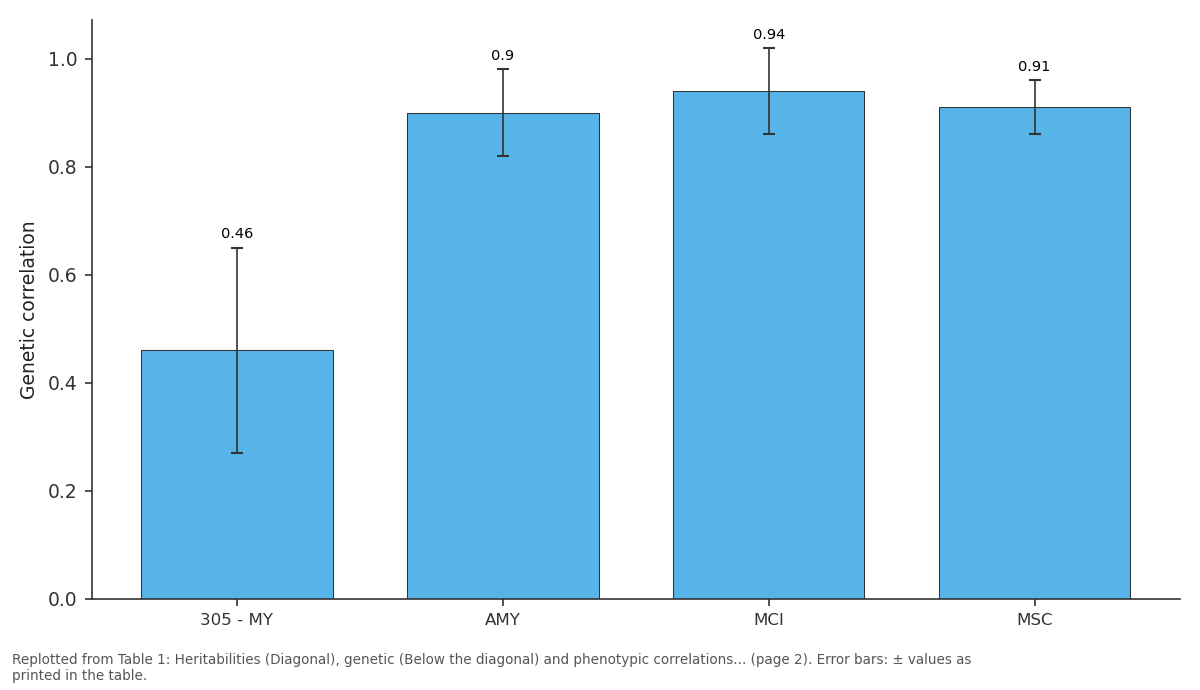
305 - MY: 305 - MY vs AMY vs MCI vs MSC
Replotted from Table 1 (page 2) of the original paper. Every bar is the paper's own table value.
View source evidence ↗Figures & tables
From the original paper Table 1
Introduction
Milk production traits are critical indicators of dairy cattle performance, directly influencing the economic viability of dairy farming. The Hardhenu cattle synthetic breed, known for its adaptability and milk production capabilities, provides a valuable model for studying these traits. The Hardhenu cattle is known to perform well even under adverse weather conditions like high temperature and humidity present in Hisar. This research aims to elucidate the heritability and genetic & phenotypic correlations among several key milk production traits in Hardhenu cattle. By understanding these relationships, breeders can develop more effective selection strategies to improve overall productivity and milk quality.
Materials and Methods
Data for the following Traits under study collected form history pedigree sheets from the Farm. 1. First lactation 305-day milk yield: This is calculated by adding the initial milk production in first lactation up-to initial 305 days. This gives insight of milk production when cow is breed in a way that it brings a calf every year.
First lactation peak milk yield: This trait gives insight
of maximum production of a day on the peak performing stage of that animal.
First lactation average milk yield:
This trait is calculated by dividing the total first lactation milk production to the lactation length. This trait gives insight of average production of animal and indicates profitability of that animal during lactation.
Average milk production of first lactation at the first calving interval:
This trait is calculated by dividing the total first lactation milk production to the calving interval. This trait gives insight of average production of animal and indicates profitability of that animal during first calving; by including dry days along with lactation length.
Average milk production of first lactation at the age of second calving:
This trait is calculated by dividing the total first lactation milk production to the age at second calving. This trait gives insight of average production of animal and indicates profitability of that animal during first calving; by including age at first calving along with calving interval. It tells the profitability of animal in the herd since its birth up to age at second calving.
Statistical Analysis
Records pertaining to first lactation of 341 cows, the progeny of 51 sires; calved during the year 1995-2018, maintained at Cattle breeding farm, LUVAS, Hisar are www.extensionjournal.com collected analysed for above traits. Genetic and Phenotypic correlations were estimated and the estimates were provided with their corresponding standard errors to indicate the precision of the estimates by using least squares maximum likelihood computer program of Harvey (1990) [3] using Henderson's Method III (Henderson, 1973) [4] . Non genetic effects of season and period were also taken into due consideration. Entire study was divided into six periods having four years each and every year was further divided into four seasons. The following mixed mathematical model were used to find the results.
Where Yijkl = ith record of individual pertaining to ith sire calved in jth period and kth season, μ = is the overall population mean, Si = is the random effect of ith sire, hj = is the fixed effect of jth period of calving, ck = is the fixed effect of kth season of calving, b1&b2 = are linear and quadratic partial regression coefficients of age at first calving on trait(s), respectively, Aijki = is the age at first calving, Ā = is the mean for age at first calving, eijkl = is the random error associated with each and every observation and assumed to be normally and independently distributed with mean zero and variance 𝜎2e.
Results
The heritabilities, genetic correlations, and phenotypic correlations among the production traits in Hardhenu cattle are presented in Table. Heritabilities: Heritability estimates indicate the proportion of total variance in a trait attributable to genetic variance. The heritabilities for the traits studied were as follows:
First Lactation 305-day Milk Yield: The high heritability estimate for first lactation 305-day milk yield suggests that nearly half of the variation in this trait can be attributed to genetic differences among individuals. This moderate heritability indicates that selective breeding could effectively improve this trait, as genetic factors play a significant role. The relatively high standard error, however, suggests some uncertainty around this estimate, implying that further studies with larger sample sizes might be necessary to confirm this value more precisely. In Murrah buffalo Jakhar et al. (2016) [5] also reported high heritability.
First Lactation Peak Milk Yield:
The moderate heritability for first lactation peak milk yield indicates that additive genetic factors account for moderate of the variation in this trait, with the remaining variation likely due to environmental influences and other non-genetic factors. This lower heritability suggests that while genetic selection can still play a role in improving peak milk yield, management practices and environmental conditions will also be crucial in achieving higher yields. The considerable standard error points to variability in the estimate, emphasizing the need for additional research. In Hardhenu Dev et al. (2018) [2] reported high heritability for peak milk yield.
First Lactation Average Milk Yield: With a moderate heritability estimate, first lactation average milk yield demonstrates that about one-third of the variability in this trait is genetic. This moderate heritability indicates potential for genetic improvement through selective breeding. The estimate's standard error suggests some level of uncertainty, which could be reduced by increasing the sample size or conducting more studies. This finding supports the value of both genetic selection and optimal management in improving average milk yield.
Average Milk Production at the First Calving Interval:
The moderate heritability for average milk production at the first calving interval indicates that genetic factors explain moderate variation in this trait. This relatively heritability suggests that environmental factors play a more substantial role in determining average milk production over this length of period at this stage. While selective breeding can still contribute to improvements, the focus should also be on enhancing environmental conditions and management practices to maximize milk production during the first calving interval.
Average Milk Production at the Age of Second Calving:
The moderate heritability estimates for average milk production at the age of second calving suggests that genetic factors account for one fourth of the variability in this trait. This heritability indicates that non-genetic factors, such as nutrition, health, and overall management, also have impact on milk production at this stage. Genetic selection can contribute to improvements, but management practices will play a crucial role in achieving higher milk yields by the second calving.
Genetic Correlations First Lactation 305-day Milk Yield with First Lactation
Peak Milk Yield: The genetic correlation of 0.96 between first lactation 305-day milk yield and first lactation peak www.extensionjournal.com milk yield is extremely high, suggesting that the same genes largely influence both traits. This indicates that selecting for higher milk yield in the first 30 days of lactation will almost certainly lead to increased peak milk yield as well. Such a strong correlation is advantageous for breeding programs, as improvements in one trait will likely result in concurrent improvements in the other.
First Lactation 305-day Milk Yield with First Lactation Average Milk Yield: A genetic correlation of 0.90 between first lactation 305-day milk yield and first lactation average milk yield indicates a very strong genetic linkage between these traits. This high correlation suggests that genetic selection for increased milk yield in the first 305 days of lactation will also lead to significant improvements in the average milk yield over the entire lactation period. Breeding programs can leverage this strong relationship to enhance overall milk production efficiency.
First Lactation 305-day Milk Yield with Average Milk Production at the First Calving Interval:
The genetic correlation of 0.94 between first lactation 305-day milk yield and average milk production at the first calving interval suggests a very strong genetic association. This implies that the same genetic factors largely control both traits, and selecting for higher milk yield in the early lactation period will likely result in increased average milk production at the first calving interval. This strong correlation provides a solid basis for genetic improvement strategies aimed at enhancing milk production throughout the first calving interval.
First Lactation 305-day Milk Yield with Average Milk
Production at the Age of Second Calving: A genetic correlation of 0.91 between first lactation 305-day milk yield and average milk production at the age of second calving indicates a strong genetic link between these traits. This high correlation suggests that genetic selection for higher milk yield in the first 305 days of lactation will positively impact milk production at the second as well. Such a relationship is beneficial for breeding programs focused on improving long-term milk production efficiency.
First Lactation Peak Milk Yield with First Lactation Average Milk Yield:
The genetic correlation of 0.88 between first lactation peak milk yield and first lactation average milk yield indicates a strong genetic relationship between these traits. This high correlation suggests that selecting for higher peak milk yield will also lead to significant improvements in average milk yield over the lactation period. This finding supports the use of peak milk yield as a selection criterion in breeding programs aiming to enhance overall milk production.
First Lactation Peak Milk Yield with Average Milk Production at the First Calving Interval:
A genetic correlation of 0.89 between first lactation peak milk yield and average milk production at the first calving interval suggests a strong genetic association. This high correlation indicates that genetic selection for higher peak milk yield will also improve average milk production at the first calving interval. Breeders can use this relationship to enhance milk production efficiency during the critical early stages of lactation.
First Lactation Peak Milk Yield with Average Milk Production at the Age of Second Calving:
The genetic correlation of 0.85 between first lactation peak milk yield and average milk production at the age of second calving indicates a strong genetic linkage. This high correlation suggests that genetic selection for higher peak milk yield will also lead to improvements in milk production at the second calving. This relationship is advantageous for breeding programs aiming to enhance long-term milk production.
First Lactation Average Milk Yield with Average Milk Production at the First Calving Interval:
A genetic correlation of 0.95 between first lactation average milk yield and average milk production at the first calving interval indicates an extremely strong genetic association. This suggests that genetic factors influencing average milk yield during the first lactation are almost identical to those affecting milk production at the first calving interval. Selecting for higher average milk yield will likely result in substantial improvements in milk production throughout the first calving interval.
First Lactation Average Milk Yield with Average Milk Production at the Age of Second Calving:
The genetic correlation of 0.84 between first lactation average milk yield and average milk production at the age of second calving indicates a strong genetic relationship. This high correlation suggests that genetic selection for increased average milk yield during the first lactation will also enhance milk production at the second calving. This finding supports the use of average milk yield as a selection criterion for improving long-term milk production efficiency.
Average Milk Production at the First Calving Interval with Average Milk Production at the Age of Second Calving:
The genetic correlation of 0.85 between average milk production at the first calving interval and average milk production at the age of second calving indicates a strong genetic association. This high correlation suggests that genetic factors influencing milk production at the first calving interval also significantly impact milk production at the second calving. Selecting for higher milk production at the first calving interval will likely lead to improvements in milk production at the second calving, benefiting long-term productivity. Genetic correlations measure the extent to which genetic factors affect two traits simultaneously. The genetic correlations observed in this study were generally high, indicating strong genetic linkages among the traits. These high genetic correlations suggest that selection for one trait is likely to result in correlated responses in other traits, which is beneficial for breeding programs aiming to improve multiple traits simultaneously.
Phenotypic Correlations First Lactation 305-day Milk Yield with First Lactation Peak Milk Yield:
The phenotypic correlation of 0.60 between first lactation 305-day milk yield and first lactation peak milk yield indicates a moderate to strong relationship www.extensionjournal.com between these traits, influenced by both genetic and environmental factors. This significant correlation suggests that cows producing higher milk yields in the first 305 days of lactation tend to have higher peak milk yields as well. This relationship highlights the importance of early lactation management practices in achieving optimal peak milk yield.
First Lactation 305-day Milk Yield with First Lactation Average Milk Yield: A phenotypic correlation of 0.80 between first lactation 305-day milk yield and first lactation average milk yield indicates a strong relationship between these traits. This high correlation suggests that cows with higher milk in the first 305 days of lactation are likely to maintain higher average milk yields throughout the lactation period. This finding emphasizes the value of monitoring early lactation performance as an indicator of overall lactation success.
First Lactation 305-day Milk Yield with Average Milk Production at the First Calving Interval:
The phenotypic correlation of 0.86 between first lactation 305-day milk yield and average milk production at the first calving interval indicates a very strong relationship between these traits. This high correlation suggests that cows with higher milk yields in the first 305 days of lactation are likely to have higher average milk production during the first calving interval. This relationship underscores the importance of early lactation management for improving milk production efficiency during the first calving interval.
First Lactation 305-day Milk Yield with Average Milk Production at the Age of Second Calving:
A phenotypic correlation of 0.93 between first lactation 305-day milk yield and average milk production at the age of second calving indicates an extremely strong relationship between these traits. This high correlation suggests that cows producing more milk in the first 305 days of lactation are likely to have higher milk production by their second calving. This finding highlights the predictive value of early lactation performance for long-term milk production.
First Lactation Peak Milk Yield with First Lactation
Average Milk Yield: The phenotypic correlation of 0.65 between first lactation peak milk yield and first lactation average milk yield indicates a strong relationship between these traits. This significant correlation suggests that cows with higher peak milk yields tend to have higher average milk yields throughout the lactation period. This relationship supports the use of peak milk yield as an indicator for overall lactation performance.
First Lactation Peak Milk Yield with Average Milk
Production at the First Calving Interval: A phenotypic correlation of 0.59 between first lactation peak milk yield and average milk production at the first calving interval indicates a moderate to strong relationship between these traits. This correlation suggests that cows with higher peak milk yields are likely to have higher average milk production during the first calving interval. This finding emphasizes the importance of peak milk yield as a predictor of early lactation performance.
First Lactation Peak Milk Yield with Average Milk
Production at the Age of Second Calving: The phenotypic correlation of 0.55 between first lactation peak milk yield and average milk production at the age of second calving indicates a moderate relationship between these traits. This correlation suggests that cows with higher peak milk yields during their first lactation are likely to have higher milk production by their second calving. This relationship highlights the value of peak milk yield as an indicator of long-term milk production potential.
First Lactation Average Milk Yield with Average Milk Production at the First Calving Interval: A phenotypic correlation of 0.74 between first lactation average milk yield and average milk production at the first calving interval indicates a strong relationship between these traits. This high correlation suggests that cows with higher average milk yields during their first lactation tend to have higher average milk production during the first calving interval. This finding supports the use of average milk yield as a predictor of early lactation performance.
First Lactation Average Milk Yield with Average Milk Production at the Age of Second Calving:
The phenotypic correlation of 0.86 between first lactation average milk yield and average milk production at the age of second calving indicates a very strong relationship between these traits. This high correlation suggests that cows with higher average milk yields during their first lactation are likely to have higher milk production by their second calving. This relationship emphasizes the predictive value of average milk yield for long-term milk production.
Average Milk Production at the First Calving Interval with Average Milk Production at the Age of Second
Calving: A phenotypic correlation of 0.89 between average milk production at the first calving interval and average milk production at the age of second calving indicates a very strong relationship between these traits. This high correlation suggests that cows with higher milk production during the first calving interval are likely to have higher milk production by their second calving. This finding underscores the importance of early lactation performance as a predictor of long-term milk production efficiency. Phenotypic correlations reflect the observable relationship between two traits, encompassing both genetic and environmental factors. The phenotypic correlations in this study were also significant. Dash et al. (2016) [1] reported high genetic and phenotypic correlations between 305 day milk yield and Average milk yield in Karan fries cattle.
Discussion
The high heritability of first lactation 305-day milk yield suggests that this trait can be effectively improved through selective breeding. The strong genetic correlations between first lactation 305-day milk yield and other traits (first lactation peak milk yield, first lactation average milk yield, average milk production at the first calving interval, and average milk production at the age of second calving) indicate that selection for higher milk yield will likely lead to improvements in these correlated traits. This interconnectedness is advantageous for breeders aiming to enhance overall productivity and milk quality in Hardhenu www.extensionjournal.com cattle.
The genetic correlations observed in this study were generally higher than the phenotypic correlations. This discrepancy can be attributed to the influence of environmental factors on phenotypic traits, which are not captured in genetic correlations. Understanding these differences is crucial for developing comprehensive breeding strategies that account for both genetic potential and environmental management.
Conclusion
This study provides a comprehensive analysis of the heritabilities, genetic correlations, and phenotypic correlations among key milk production traits in Hardhenu cattle. The findings highlight significant genetic and phenotypic linkages among these traits, offering valuable insights for dairy cattle breeding programs. By focusing on traits with high heritabilities and leveraging strong genetic correlations, breeders can make more informed decisions to enhance overall productivity and milk quality in Hardhenu cattle. Future research should continue to explore these relationships and validate the findings across diverse populations and environmental conditions.
Acknowledgement
AcknowledgementAuthors acknowledge LUVAS, Hisar for proving essential support and resources for this study.
Figures and tables from the paper
| — | 305 - MY | PMY | AMY | MCI | MSC |
|---|---|---|---|---|---|
| 305 - MY | 0.46±0.19 | 0.60** ±0.04 | 0.80** ±0.03 | 0.86** ±0.03 | 0.93** ±0.02 |
| PMY | 0.96±0.17 | 0.30±0.18 | 0.65** ±0.04 | 0.59** ±0.04 | 0.55** ±0.05 |
| AMY | 0.90±0.08 | 0.88±0.25 | 0.34±0.18 | 0.74** ±0.04 | 0.86** ±0.04 |
| MCI | 0.94±0.08 | 0.89±0.21 | 0.95±0.128 | 0.28±0.18 | 0.89** ±0.02 |
| MSC | 0.91±0.05 | 0.85±0.23 | 0.84±0.19 | 0.85±0.12 | 0.27±0.17 |
Table text extracted from the original PDF; superscript letters are shown inline. The original table image is below.
View original table image
References
3 in the original paper- Dash SK, Gupta AK, Singh A, Chakravarty AK, Mohanty TK, Panmei A, et al. Genetic analysis of first lactation production and fertility traits in Karan Fries cattle. Indian J Anim Sci. 2016;86(10):1159-1164.
- Dev K, Dhaka SS, Yadav AS, Patil CS. Estimates of genetic and phenotypic parameters of production performance traits in Hardhenu cattle. Int J Agric Sci. 2018;10(16):6903-6906.
- Jakhar V, Vinayak AK, Singh KP. Genetic evaluation of performance attributes in Murrah buffaloes. Haryana Vet. 2016;55(1):66-69.