
Research article · 2024 · Full text
International Journal of Research in AgronomyEffect of nitrogen management on growth and yield of maize (Zea mays L.)
Volume 7(7) · Pages 36–38 · DOI: 10.33545/2618060x.2024.v7.i7a.972 ↗
Research areasCrop Yield and Soil Fertility
Abstract
Author-writtenThe experiment was carried out at Raj Mohini Devi College of Agriculture and Research Station Ambikapur (C.G.) during the Kharif 2022-23 season. The experimental laid out in randomized block design with three replication and twelve treatments. Among the different nitrogen management practices, application of 100% RDN (3 split N application) had higher growth as well as yield attributes. Results revealed the 100% RDN (3 split N application) significantly increased all the growth attributes viz. plant height, dry matter accumulation, crop growth rate and the yield attributes viz., cob length, cob girth, number of grain rows cob-1, number of grains row-1, number of cobs. The highest cob yield (8961.2 kg ha-1) and grain yield (7188.8 kg ha-1) were also achieved under T2: 100% RDN (3 split N application) followed by T6: T3 (75% RDN) + Nano urea two spray. T1 (Control) was recorded lowest in term of growth attributes, yield attributes and yield. The highest net return and B:C ratio were also recorded under 100% RDN (3 split N application).
Summary
Source-checkedPlain-language reading of the full paper, prepared with AI and checked against the text. Each point links to the authors' own words.
Why it matters
- Maize is a globally significant food crop that contributes more than 5% of the daily recommended energy intake. View evidence ↗
- Maize has a strong nutritional dependence on mineral nutrients, particularly nitrogen, which directly impacts grain yield. View evidence ↗
- Nano-fertilizers are viewed as tools to enhance crop growth, yield, and quality by increasing nutrient use efficiency. View evidence ↗
The question
- The study aimed to evaluate how different nitrogen management practices affect the growth and yield of maize. View evidence ↗
What they did
- The research used a randomized block design consisting of twelve different treatments and three replications. View evidence ↗
- The experiment utilized maize variety NK30, sown at a seed rate of 18 kg ha-1 with a spacing of 75 x 20 cm. View evidence ↗
- The recommended dose of nitrogen was 150 kg ha-1 of urea, applied at various percentage levels and combined with or without foliar sprays of urea or nano urea. View evidence ↗
- The maize crop received a total of 1519.0 mm of rainfall throughout the growth period. View evidence ↗
What they found
- The application of 100% Recommended Dose of Nitrogen (RDN) in three splits resulted in the highest plant height (221.8 cm) and dry matter accumulation (315 g plant-1). View evidence ↗
- The maximum grain yield (7188.8 kg ha-1) and cob yield (8961.2 kg ha-1) were produced by the 100% RDN (3 split) treatment, followed by the 75% RDN plus two nano urea sprays. View evidence ↗
- The control group (T1) exhibited the lowest values across all measured growth and yield attributes. View evidence ↗
- The 100% RDN (3 split) treatment provided the highest economic benefit in terms of net return and benefit-cost (B:C) ratio. View evidence ↗
What it means
- The authors conclude that applying 100% of the recommended dose of nitrogen in three splits is the most effective practice for increasing grain yield and net returns. View evidence ↗
Visual summary
3 visualsIllustrations explain the paper; charts are replotted from the paper's own table values.
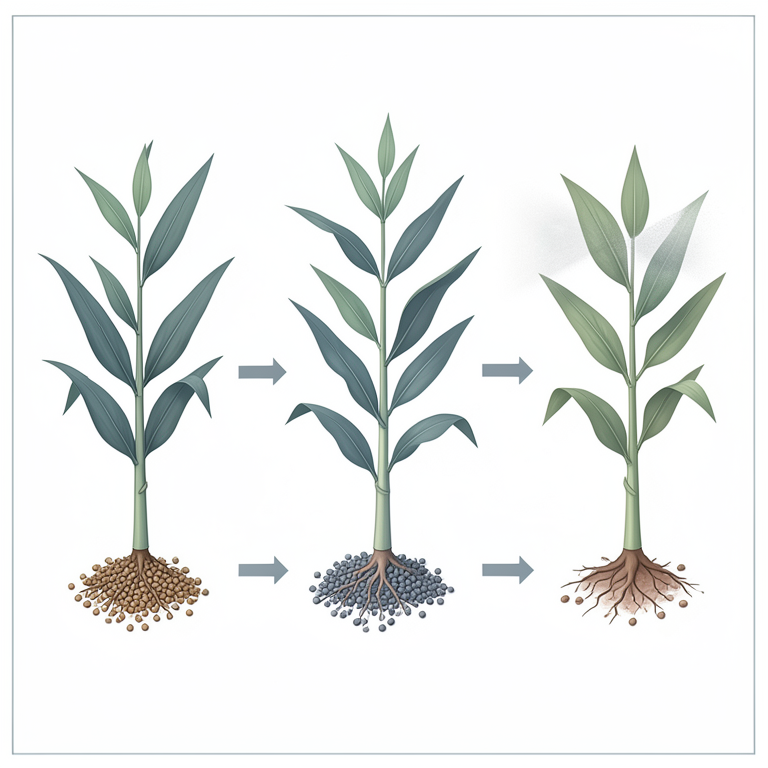
Nitrogen Treatment Comparison
AI-generated conceptual illustration (maize plants (Zea mays L.)). It explains the idea and does not show study data.
View source evidence ↗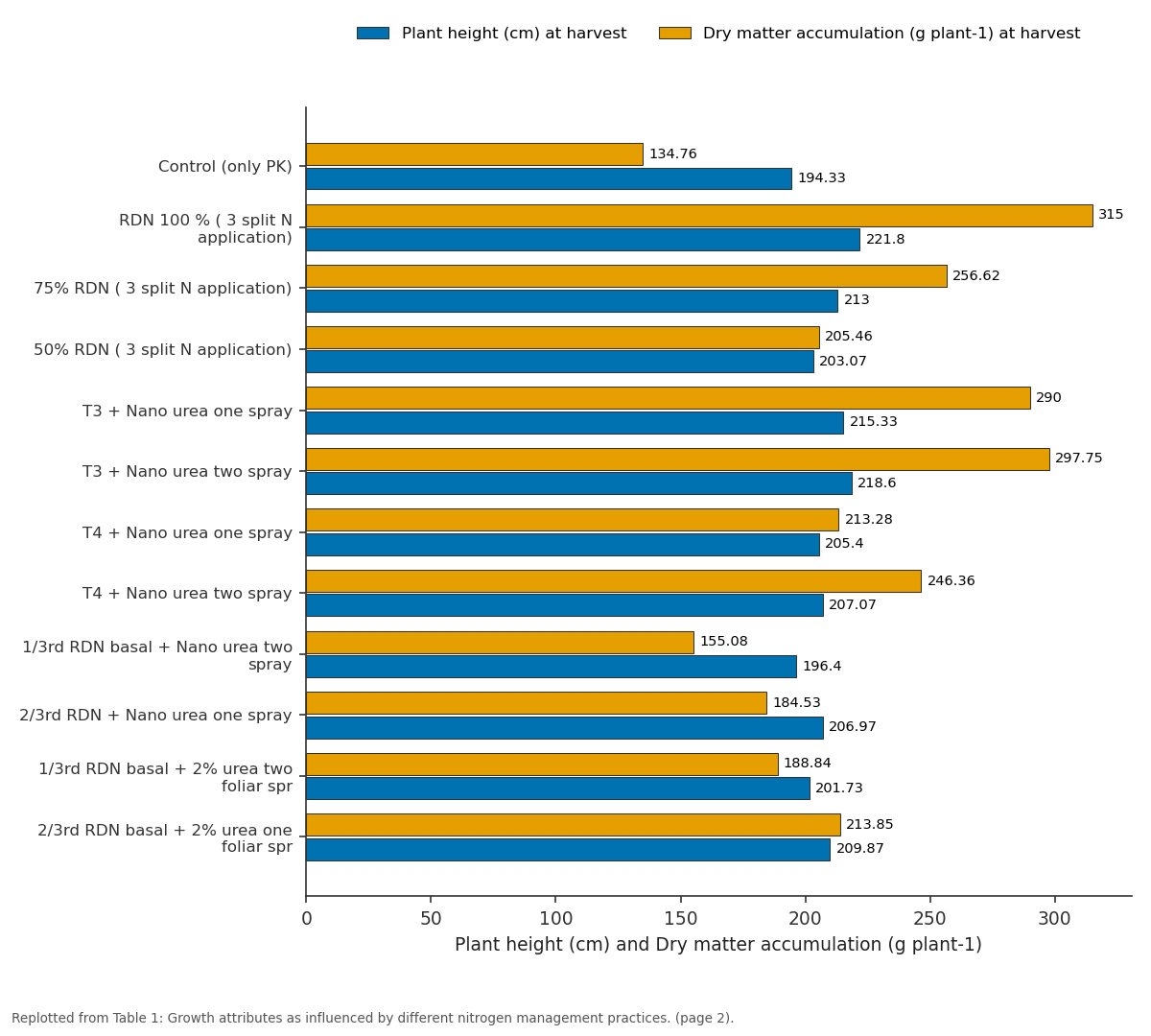
Plant height (cm) at harvest and Dry matter accumulation (g plant-1) at...: Control (only PK) vs RDN 100 % ( 3 split N... vs 75% RDN ( 3 split N... vs 50% RDN ( 3 split N... vs T3 + Nano urea one spra
Replotted from Table 1 (page 2) of the original paper. Every bar is the paper's own table value.
View source evidence ↗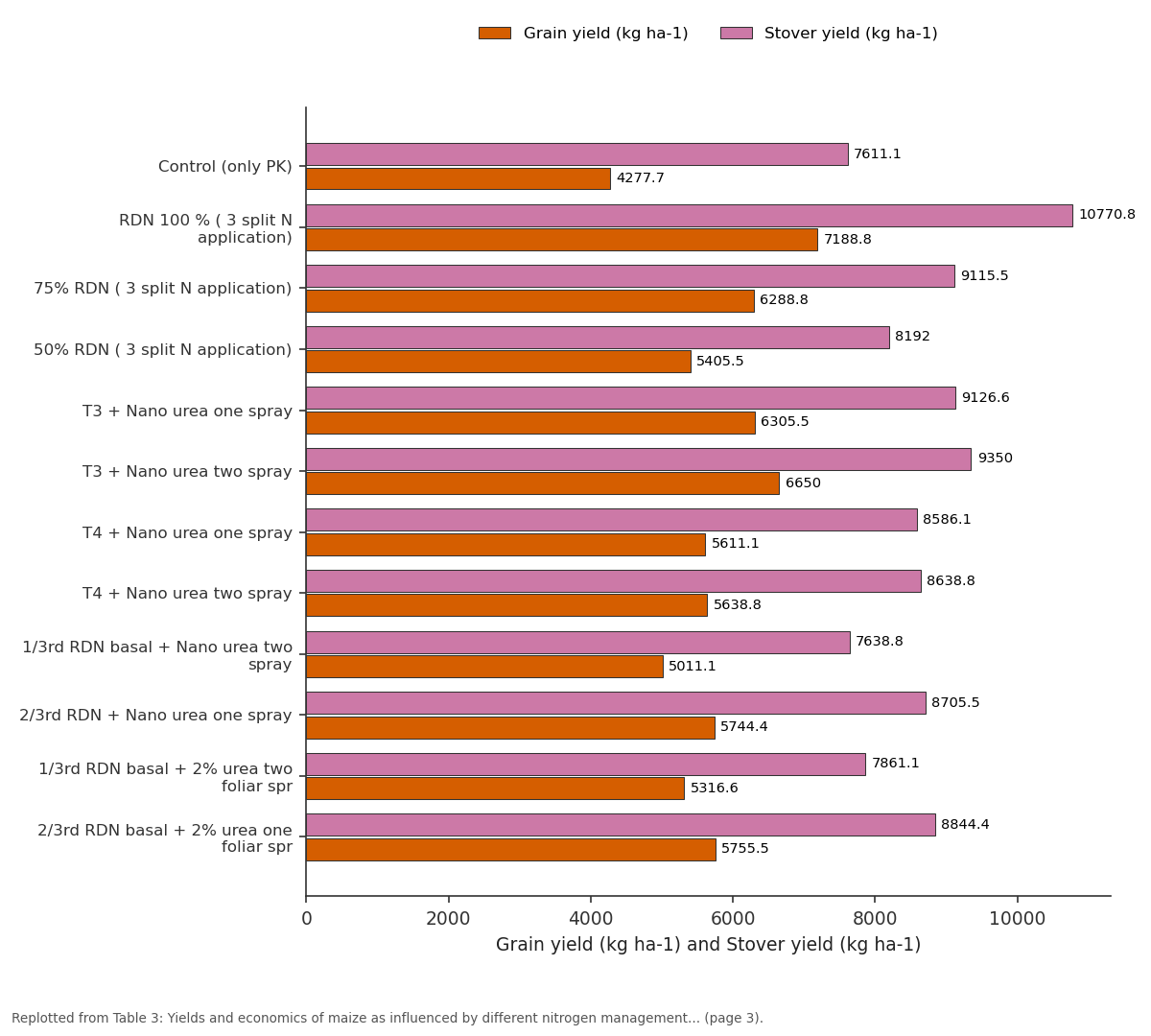
Grain yield (kg ha-1) and Stover yield (kg ha-1): Control (only PK) vs RDN 100 % ( 3 split N... vs 75% RDN ( 3 split N... vs 50% RDN ( 3 split N... vs T3 + Nano urea one spray
Replotted from Table 3 (page 3) of the original paper. Every bar is the paper's own table value.
View source evidence ↗Figures & tables
From the original paper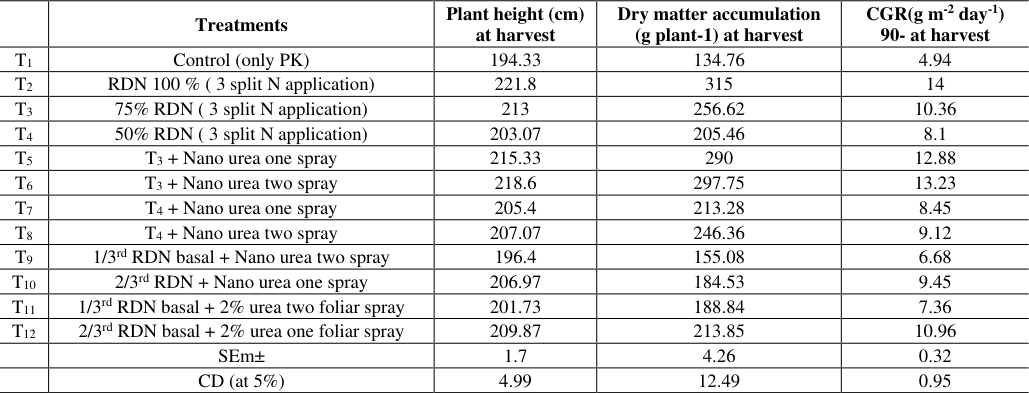 Table 1
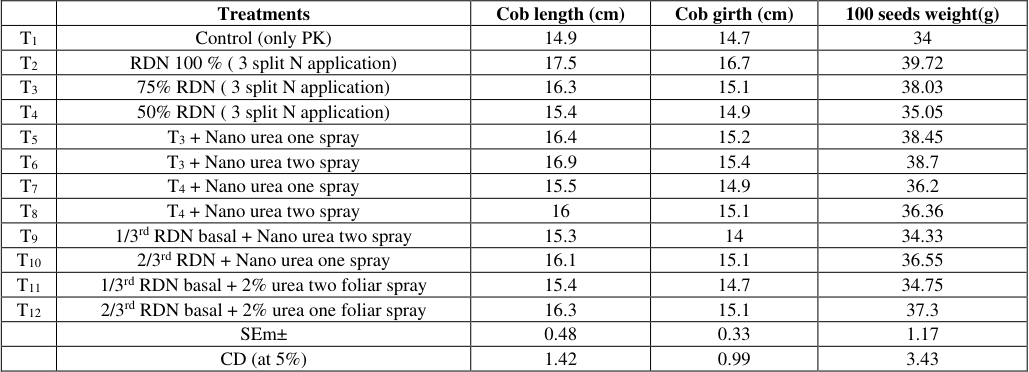 Table 2
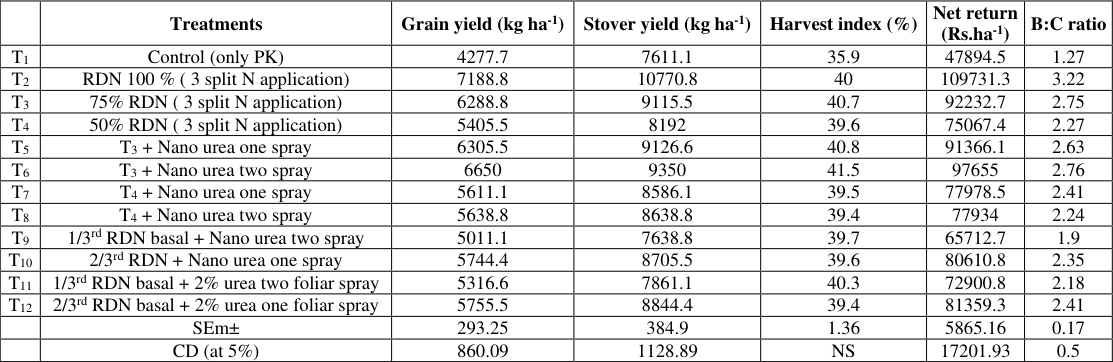 Table 3
Introduction
One of the most significant food crops in the world, maize provides >5% of the daily recommended energy. The relevance of maize may be seen in its wider adaptability, high yield potential, and use as a crop for food, feed, and forage. Although it is grown throughout the year, more than 80% of it is in the rainy or kharif season (July to October). Maize is referred to as the "Queen of Cereals" internationally. Maize production in India significantly increased from just 1.73 million tons in 1950-51 to 27.8 million tons in 2018 -19, an increase of more than 16 times. With a typical output of 2.56 tons/hectare, it currently occupies 9.23 million hectares. Domestically, maize is used for food, starch production, feed for chickens and cows, as well as numerous industrial uses. In Chhattisgarh maize occupies 206.63 thousands hectare area with the productivity of 2789 Kg/ha in Kharif 2020-21. Among the crops of agronomic interest, maize express nutritional dependence, especially of nitrogen. Studies conducted by Taiz and Zeiger (2009) [7] show a direct dependence of maize on mineral nutrients, as large quantities applied reflect positively on grain yield. There are many sources of nitrogenous fertilizer available, however, in India the most used is urea. The urea [CO(NH2)2] has a high nitrogen concentration, high solubility, and lower cost/unit of nutrient, but higher volatilization. From the standpoint of manufacturing, transportation, and direct application, urea has the advantage over other solid nitrogen materials of being cheaper to manufacture and having a higher content of total nitrogen. Recently, IFFCO (Indian Farmers Fertilizer Co-operative) launched the nano Urea fertilizers in India for experiment as well as demonstration purpose. 500 ml of liquid nano Urea fertilizer contain same quantity of N received from 50 kg of Urea fertilizer. Nano fertilizer is an important tool in agriculture to improve crop growth, yield and quality parameters with increased nutrient use efficiency. Nano-fertilizers are applied either to soil and/ or leaves. Foliar application can be done during favourable soil and weather conditions. In addition to this, it promotes the direct entry of nutrients into the plant system, thus reduce the wastage of fertilizer. However, published literatures regarding the use of nano-fertilizer (nano Urea) on growth and yield of crops are rare.
Materials and Methods
The present experiment entitled "Effect of nitrogen management on growth and yield of maize (Zea mays L.)" was conducted during kharif 2022-23 at Research-cum-instructional farm of RMD College of Agriculture and Research Station, Ambikapur, Chhattisgarh. Geographically, Ambikapur is situated in the north of Chhattisgarh and lies between 23°10' North latitude and 83º15' East longitude having an altitude of 623 meter above mean sea level. The maximum rainfall during July to September. The crop received total 1519.0 mm rainfall during entire growth period and the maximum rainfall of 210.4 mm. was recorded during 4 th week of august. The soil of the experimental field was slightly acidic in nature having pH 5.81 Available nitrogen phosphorus and potash was 220, 7.0 and 280 kg ha -1 , respectively. The experiment was layout in a random block design with three replication and twelve treatments. Maize variety NK30 was sown with spacing 75 x 20 cm, seed rate 18 kg ha -1 . Nitrogen was applied in split doses, the first at basal, second 25-30 DAS and third 40-45 DAS. Nitrogen was applied as urea, nano urea and foliar spray of urea. Recommended dose of nitrogen (urea) 150 kg ha -1 was applied in different percent level and with or without foliar spray of urea and nano urea. Different activities of cultural integration such as irrigation, cultivation, pest control and so on are performed as required.
Results and Discussion
Among the different nitrogen management practices, application of 100% RDN (3 split N application) had higher growth as well as yield attributes. Results revealed the 100% RDN (3 split N application) was significantly superior on growth attributes viz., plant height (221.8 cm), dry matter accumulation (315 g plant-1), crop growth rate, and was also superior on yield attributes viz., cob length (17.5 cm), cob girth (16.7 cm), number of grain rows cob-1 (13.5), number of grains row-1 (39.3), and number of cobs (64.6 thousand ha -1 ). The highest cob yield (8961.2 kg ha -1 ) and grain yield (7188.8 kg ha -1 ) were also achieved under T 2 : 100% RDN (3 split N application) followed by T 6 : T 3 (75% RDN) + Nano urea two spray. T 1 (Control) was recorded lowest in term of growth attributes, yield attributes and yield.
Conclusion
From the result, it is concluded that among nitrogen management practices 100% RDN (3 split N application) found effective in enhancing grain (kernel) yield and net return and superior over the rest of the treatments.
Figures and tables from the paper
| — | Treatments | Plant height (cm) at harvest | Dry matter accumulation (g plant-1) at harvest | CGR(g m-2 day-1) 90- at harvest |
|---|---|---|---|---|
| T1 | Control (only PK) | 194.33 | 134.76 | 4.94 |
| T2 | RDN 100 % ( 3 split N application) | 221.8 | 315 | 14 |
| T3 | 75% RDN ( 3 split N application) | 213 | 256.62 | 10.36 |
| T4 | 50% RDN ( 3 split N application) | 203.07 | 205.46 | 8.1 |
| T5 | T3 + Nano urea one spray | 215.33 | 290 | 12.88 |
| T6 | T3 + Nano urea two spray | 218.6 | 297.75 | 13.23 |
| T7 | T4 + Nano urea one spray | 205.4 | 213.28 | 8.45 |
| T8 | T4 + Nano urea two spray | 207.07 | 246.36 | 9.12 |
| T9 | 1/3rd RDN basal + Nano urea two spray | 196.4 | 155.08 | 6.68 |
| T10 | 2/3rd RDN + Nano urea one spray | 206.97 | 184.53 | 9.45 |
| T11 | 1/3rd RDN basal + 2% urea two foliar spray | 201.73 | 188.84 | 7.36 |
| T12 | 2/3rd RDN basal + 2% urea one foliar spray | 209.87 | 213.85 | 10.96 |
| SEm± | 1.7 | 4.26 | 0.32 | |
| CD (at 5%) | 4.99 | 12.49 | 0.95 |
Table text extracted from the original PDF; superscript letters are shown inline. The original table image is below.
View original table image
| — | Treatments | Cob length (cm) | Cob girth (cm) | 100 seeds weight(g) |
|---|---|---|---|---|
| T1 | Control (only PK) | 14.9 | 14.7 | 34 |
| T2 | RDN 100 % ( 3 split N application) | 17.5 | 16.7 | 39.72 |
| T3 | 75% RDN ( 3 split N application) | 16.3 | 15.1 | 38.03 |
| T4 | 50% RDN ( 3 split N application) | 15.4 | 14.9 | 35.05 |
| T5 | T3 + Nano urea one spray | 16.4 | 15.2 | 38.45 |
| T6 | T3 + Nano urea two spray | 16.9 | 15.4 | 38.7 |
| T7 | T4 + Nano urea one spray | 15.5 | 14.9 | 36.2 |
| T8 | T4 + Nano urea two spray | 16 | 15.1 | 36.36 |
| T9 | 1/3rd RDN basal + Nano urea two spray | 15.3 | 14 | 34.33 |
| T10 | 2/3rd RDN + Nano urea one spray | 16.1 | 15.1 | 36.55 |
| T11 | 1/3rd RDN basal + 2% urea two foliar spray | 15.4 | 14.7 | 34.75 |
| T12 | 2/3rd RDN basal + 2% urea one foliar spray | 16.3 | 15.1 | 37.3 |
| SEm± | 0.48 | 0.33 | 1.17 | |
| CD (at 5%) | 1.42 | 0.99 | 3.43 |
Table text extracted from the original PDF; superscript letters are shown inline. The original table image is below.
View original table image
| — | Treatments | Grain yield (kg ha-1) | Stover yield (kg ha-1) | Harvest index (%) | Net return (Rs.ha-1) | B:C ratio |
|---|---|---|---|---|---|---|
| T1 | Control (only PK) | 4277.7 | 7611.1 | 35.9 | 47894.5 | 1.27 |
| T2 | RDN 100 % ( 3 split N application) | 7188.8 | 10770.8 | 40 | 109731.3 | 3.22 |
| T3 | 75% RDN ( 3 split N application) | 6288.8 | 9115.5 | 40.7 | 92232.7 | 2.75 |
| T4 | 50% RDN ( 3 split N application) | 5405.5 | 8192 | 39.6 | 75067.4 | 2.27 |
| T5 | T3 + Nano urea one spray | 6305.5 | 9126.6 | 40.8 | 91366.1 | 2.63 |
| T6 | T3 + Nano urea two spray | 6650 | 9350 | 41.5 | 97655 | 2.76 |
| T7 | T4 + Nano urea one spray | 5611.1 | 8586.1 | 39.5 | 77978.5 | 2.41 |
| T8 | T4 + Nano urea two spray | 5638.8 | 8638.8 | 39.4 | 77934 | 2.24 |
| T9 | 1/3rd RDN basal + Nano urea two spray | 5011.1 | 7638.8 | 39.7 | 65712.7 | 1.9 |
| T10 | 2/3rd RDN + Nano urea one spray | 5744.4 | 8705.5 | 39.6 | 80610.8 | 2.35 |
| T11 | 1/3rd RDN basal + 2% urea two foliar spray | 5316.6 | 7861.1 | 40.3 | 72900.8 | 2.18 |
| T12 | 2/3rd RDN basal + 2% urea one foliar spray | 5755.5 | 8844.4 | 39.4 | 81359.3 | 2.41 |
| SEm± | 293.25 | 384.9 | 1.36 | 5865.16 | 0.17 | |
| CD (at 5%) | 860.09 | 1128.89 | NS | 17201.93 | 0.5 |
Table text extracted from the original PDF; superscript letters are shown inline. The original table image is below.
View original table image
References
11 in the original paper- Ajithkumar K, Kumar Y, Savitha AS, Ajayakumar MY, Narayanaswamy C, Raliya R, et al. Effect of IFFCO nanofertilizer on growth, grain and managing turcicum leaf blight disease in maize. International Journal of Plant and Soil Science. 2021;33(16):19-28.
- Al-Saray MKS, Al-Rubaee FAH. Effect of nano-nitrogen and manufacture organic fertilizer as supplementary fertilizer in the yield and its component for three synthetics of maize (Zea mays L.). Plant Archives. 2019;19(2):14731479.
- Benzon HRL, Rubenecia RU, Ultra VU, Lee SC. Nano fertilizer affects the growth, development, and chemical properties of rice. International Journal of Agronomy and Agricultural Research. 2015;7(1):105-117.
- Harikrishna BL, Dasog GS, Patil PL. Effect of soil depths, N-doses and its split application on maize plant height, LAI and dry matter yield at different growth stages. Karnataka Journal of Agricultural Sciences. 2005;18(2):364.
- Iqbal A, Iqbal MA, Raza A, Akbar N, Abbas RN, Khan HZ. Integrated nitrogen management studies in forage maize. Am Eur J Agric Environ Sci. 2014;14(8):744-7.
- Kousar P, Ali L, Raza A, Maqbool A, Maqbool S, Rasheed S, et al. Effect of different levels of nitrogen on the economic yield of wheat (Triticum aestivum L.) variety Aas-11. International Journal of Agronomy and Agricultural Research. 2015;6(3):7-11.
- Mahil EIT, Kumar BA. (Foliar application of nanofertilizers in agricultural crops-A review. J Farm Sci. 2019;32(3):239249.
- Mehta S, Bharat R. Effect of integrated use of nano and non-nano fertilizers on yield and yield attributes of wheat (Triticum aestivum L.). Int. J Curr. Microbiol. App. Sci. 2019;8(12):598-606.
- Midde SK, Perumal MS, Murugan G, Sudhagar R, Mattepally VS, Bada MR. Evaluation of Nano Urea on Growth and Yield Attributes of Rice (Oryza Sativa L.). Chemical Science Review and Letters. 2021;11(42):211-214.
- Samui S, Sagar L, Sankar T, Manohar A, Adhikary R, Maitra S, et al. Growth and productivity of rabi maize as influenced by foliar application of urea and nano-urea. Crop Research. 2022;57(3):136-140.
- Yomso J, Menon S. Impact of nanofertilizers on growth and yield parameters of rice crop; A Review. J Pharm. Innov. 2021;10:249-253.
Cited by 1
From OpenAlex, OpenCitations and reference lists read by Scinovex
- Response of leaf area ratio, specific leaf weight, grain moisture content and quality traits of spring maize (Zea mays L.) to nitrogen dose and application timing
Kailash Chand Verma, Ashok Kumar, Sanjay Kumar Thakral, R.D. Jat, Manoj Kumar · International Journal of Research in Agronomy · 2026
A field experiment was conducted at Regional Research Station, Uchani, Karnal of CCS Haryana Agricultural University during two consecutive spring seasons. The study aimed to assess the response of leaf area ratio (LAR), specific leaf weight (SLW), grain moisture content and quality traits of spring maize (Zea mays L.) to nitrogen dose and application timing. The experiment comprised four nitrogen doses, N1 (150 kg N ha-1), N2 (165 kg N ha-1), N3 (180 kg N ha-1) and N4 (195 kg N ha-1) assigned to main plots, and four nitrogen application timing were allocated to subplots, S1 (50% at sowing + 2