
Research article · 2024 · Full text
International Journal of Research in AgronomyGenetic variability, heritability and genetic advance studies for yield components in Okra [Abelmoschus esculentus (L.) Moench]
Volume 7(6S) · Pages 572–575 · DOI: 10.33545/2618060x.2024.v7.i6sh.958 ↗
Research areasAgricultural Practices and Plant GeneticsAgricultural pest management studiesAgricultural Science and Fertilization
Abstract
Author-writtenA field examination was carried out with 40 genotypes of okra to study the genetic variability, heritability and genetic advance of fourteen different characters A wide range of variation was observed for all the characters taken under study. The magnitude of phenotypic coefficient of variation was higher than corresponding genotypic coefficient of variation for all the characters studied. The high to moderate genotypic coefficient of variation and phenotypic coefficient of variation was observed for internodal length, number of nodes per plant, green fruit yield per plant, fruit length, number of fruits per plant and plant height, while high heritability (broad sense) values were observed for all the characters taken under study except 10-green fruits weight, number of branches per plant, days to 50 percent flowering, days to last picking, days to first flowering and days to first picking. The high to moderate genetic advance was recorded for green fruit yield per plant, plant height, 10-green fruits weight and internodal length. Green fruit yield per plant and plant height had high heritability and high genetic advance. Fruit width, number of nodes per plant number of fruits per plant, fruit length and number of picking, while it had low heritability coupled with low genetic advance as percent of mean.
Summary
Source-checkedPlain-language reading of the full paper, prepared with AI and checked against the text. Each point links to the authors' own words.
Why it matters
- Okra is a significant vegetable crop cultivated in tropical and subtropical regions, valued for its tender green fruits. View evidence ↗
- The crop is characterized by high nutritive value and potential for export. View evidence ↗
- Genetic variability in crops is typically assessed using parameters like phenotypic and genotypic coefficients of variation, heritability, and genetic advance. View evidence ↗
What they did
- The researchers evaluated 40 okra genotypes using a randomized block design with three replications during the Kharif 2019 season. View evidence ↗
- Genotypes were planted with a spacing of 60 cm by 30 cm. View evidence ↗
- Data were collected from five randomly selected plants per genotype in each replication. View evidence ↗
- GCV and PCV were calculated using Burton and De Vane's formulas, while broad-sense heritability and genetic advance followed Allard's methodology. View evidence ↗
What they found
- Phenotypic coefficients of variation were higher than genotypic coefficients for all studied characters, indicating that environmental factors significantly influenced trait expression. View evidence ↗
- High levels of both genotypic and phenotypic coefficients of variation were found for green fruit yield per plant, number of nodes per plant, and internodal length. View evidence ↗
- Moderate GCV and PCV values were recorded for fruit length, number of fruits per plant, and plant height. View evidence ↗
- High heritability was observed for several traits, including green fruit yield per plant, plant height, fruit length, fruit width, number of fruits per plant, number of nodes per plant, internodal length, and number of pickings. View evidence ↗
- Moderate heritability was found for days to first picking, days to first flowering, days to 50% flowering, days to last picking, number of branches per plant, and 10-green fruits weight. View evidence ↗
- Low genetic advance was observed for traits such as number of fruits per plant, days to last picking, fruit length, days to first picking, days to 50% flowering, number of pickings, days to first flowering, number of branches per plant, and fruit width. View evidence ↗
What it means
- The authors concluded that high heritability values in certain traits suggest a stronger contribution from the genotypic component. View evidence ↗
Visual summary
2 visualsIllustrations explain the paper; charts are replotted from the paper's own table values.
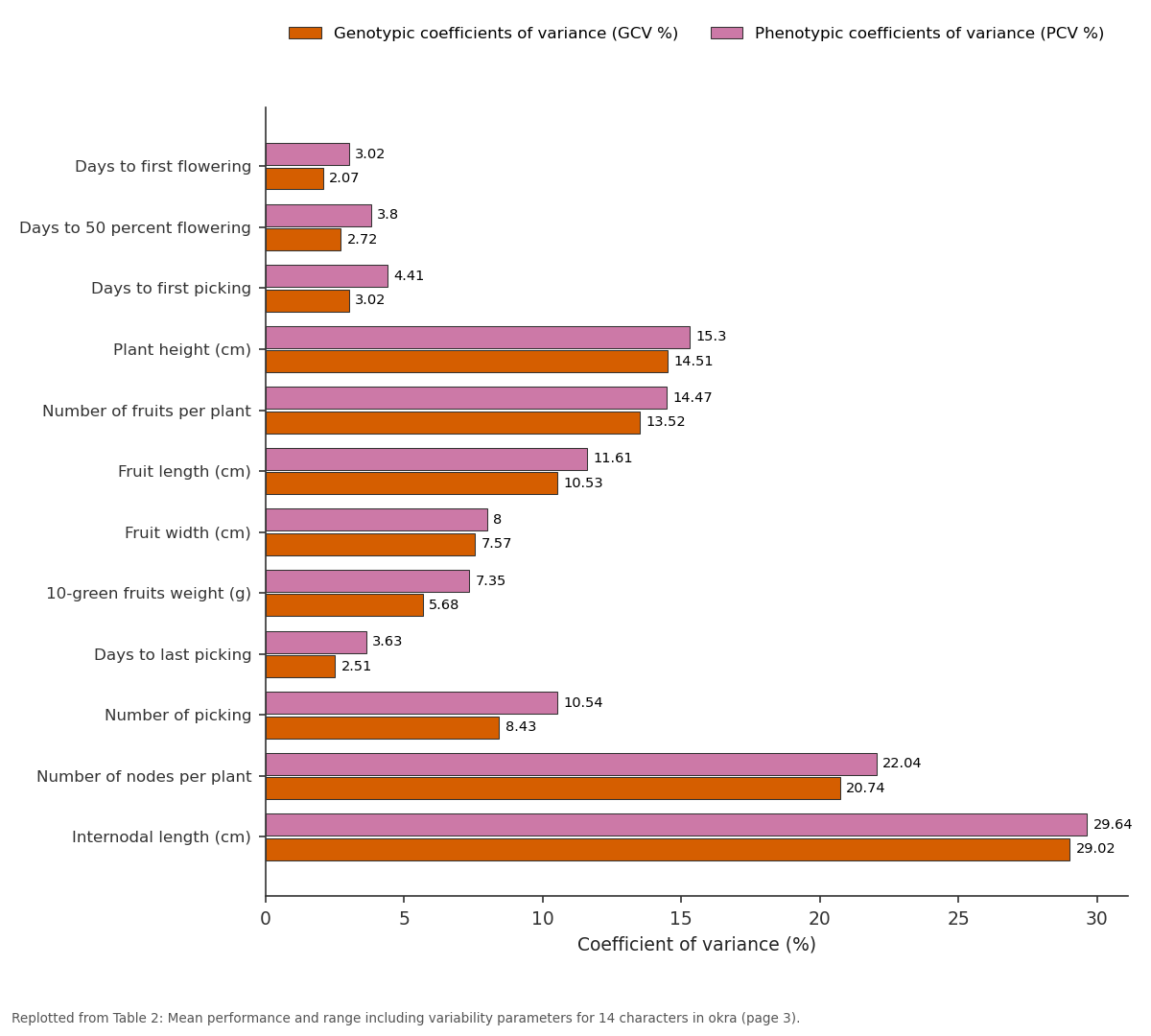
Genotypic coefficients of variance (GCV %) and Phenotypic coefficients of variance (PCV %): Days to first flowering vs Days to 50 percent... vs Days to first picking vs Plant height (cm) vs Number of
Replotted from Table 2 (page 3) of the original paper. Every bar is the paper's own table value.
View source evidence ↗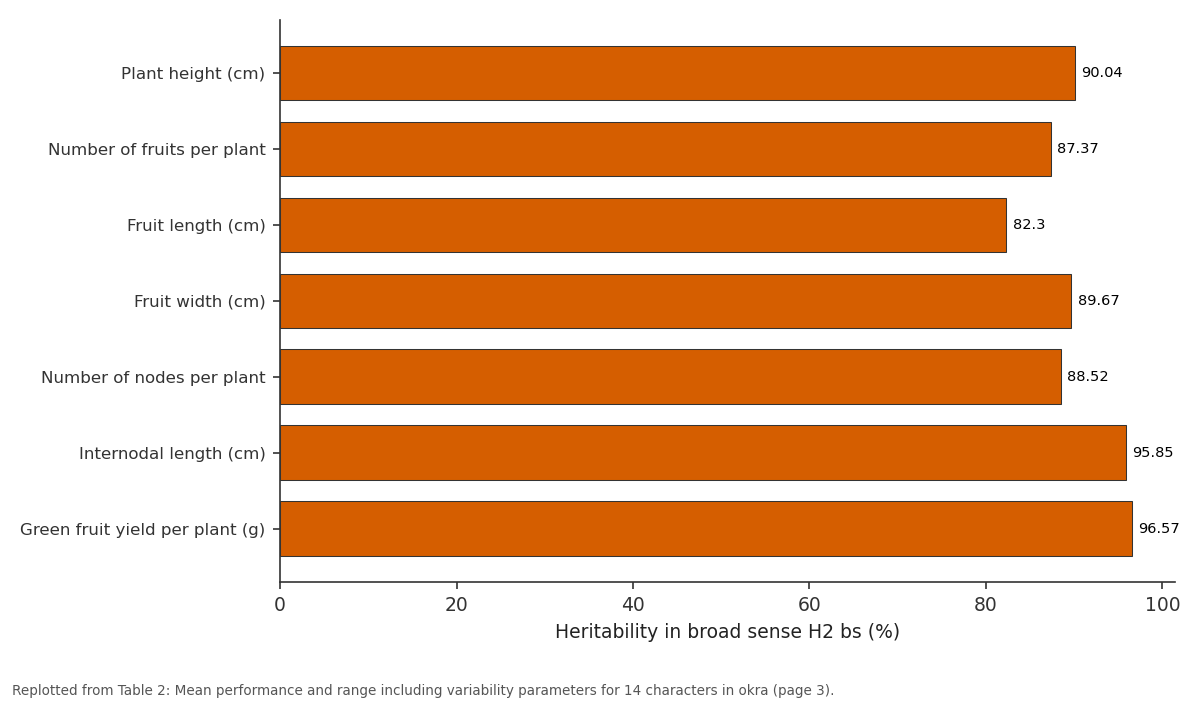
Heritability in broad sense H2 bs (%): Plant height (cm) vs Number of fruits per... vs Fruit length (cm) vs Fruit width (cm) vs Number of nodes per...
Replotted from Table 2 (page 3) of the original paper. Every bar is the paper's own table value.
View source evidence ↗Figures & tables
From the original paper Table 1
 Table 2
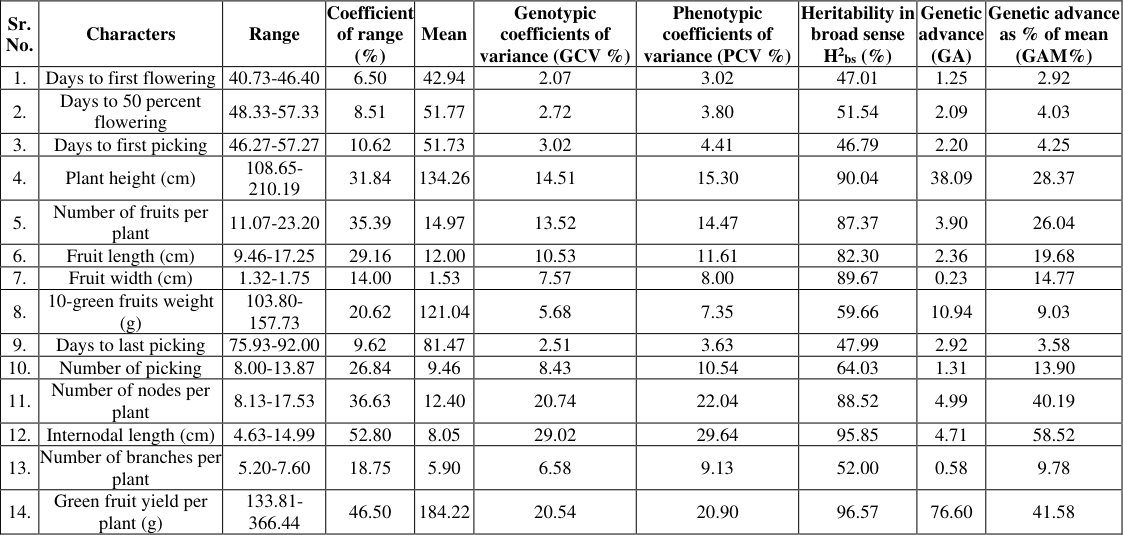 Table 2
Introduction
Okra [Abelmoschus esculentus (L.) Moench] of the family Malvaceae, is an important vegetable crop grown in tropical and subtropical region for its tender green fruits. Okra is also known as bhindi, lady's finger and gumbo. Okra is a polyploid and a often cross pollinated crop. Rate of out crossing to an extent of 4 to19 percent with the maximum of 42.2 percent is observed with the insect assisted pollination. It is a robust crop and can grow with considerable success on a wide range of soils and under adjustable environmental conditions. In the country, a large number of okra varieties are grown, the variation occurs with regards to quantitative and qualitative characters. It has high nutritive value and export potential. This opinion gets its asset from the Sanskrit words 'Tindisha' and 'Gandhmula' found to designate Bhindi. Thus, it is likely that cultigens might have initiated in Asia or it might initially have been present in Africa, and India as a polyphyletic species. The fruits have many medicinal properties too. It is useful in illness, chronic dysentery, and irritable states of genitero. It is good for people suffering from renal colic, leucorrhoea, spermatorrhoea, chronic dysentery and general weakness. Due to high iodine content fruits are considered useful for control of goiter. The stem of the plant is used for cleaning of sugarcane juice and for the extraction of fibers in paper mills. The genetic variability would be determined with the help of certain genetical parameters such as phenotypic co-efficient of variation (PCV), genotypic co-efficient of variation (GCV), heritability estimates (h²) and genetic advance (GA). GCV indicates the relative degree of genetic variability existing for different characters in a population of genotypes. The heritability expresses the relative amount of heritable portion of variation. However, the heritability estimates along with genetic gain is more useful in selecting the best population individual. Keeping in view the importance of these, the present research work has been formulated to study the genetic variability, heritability and genetic advance among different quantitative characters of okra.
Materials and Methods
The experimental material was comprising of 40 genotypes and were evaluated in randomized block design with three replications during Kharif 2019. The seeds of these genotypes were obtained from Vegetable Research Station, Navsari Agricultural University, Navsari and Vegetable Research Station, Junagadh Agricultural University, Junagadh. Each genotype was sown with a spacing of 60 cm × 30 cm. The recommended agronomical practices and plant protection measures were followed for the successful raising of the crop. The observations were recorded on five randomly selected plants in each genotype from each replication. The mean of these five plants and fruits was used for statistical analysis. Analysis of variance was carried out as per methodology given by Panse and Sukhatme (1985) [16] . Genotypic and phenotypic coefficients of variation (GCV and PCV) were calculated by the formula given by Burton and De vane (1952) [4] , heritability in broad sense (h2) and Genetic advance were calculated as per the formula suggested by Allard (1960) [1] .
Results and Discussion
Estimation of component of genetic parameters of variation for fruit yield and its attributes exhibited a wide range for the characters studied (Table 1) and the result indicated that the values of phenotypic variance and phenotypic coefficient of variations were of higher magnitude than that of genotypic variance and genotypic coefficient of variations for all the characters showing, that the environment had an important role in influencing the expressions of the characters. The PCV and GCV ration the extent of variation present in the population in the particular character. In the present inspection, PCV was higher than the respective GCV for all the traits studied, divulge that the environment had a significant role to performance in manipulating the expression of these characters which is in accordance with findings of Bendale et al. (2003) [2] , Dakane et al. (2007) [7] , Singh et al. (2007) [24] , Senapati et al. (2011) [22] and Sharma and Prasad et al. (2015) [23] . The high magnitude of GCV and PCV was observed for internodal length, number of nodes per plant and green fruit yield per plant. This is in relation with the earlier reports of Vijay and Manohar (1990) [26] , Bindu et al. (1997) [3] , Dhall et al. (2002) [9] , Bendale et al. (2003) [2] , Dakane et al. (2007) [7] , Singh et al. (2007) [24] , Das et al. (2012) [8] , Reddy et al. (2012a) [21] , Koundinya et al. (2013) [12] , Pachiyappan and Saravanan (2016) [15] for fruit yield per plant; Chandramouli et al. (2016) [5] for internodal length; Das et al. (2012) [8] for number of nodes per plant. The moderate magnitude of GCV and PCV was observed for plant height, number of fruits per plant and fruit length. This is in accordance with the earlier reports of Bindu et al. (1997) [3] , Dhall et al. (2002) [9] , Dakane et al. (2007) [7] , Singh et al. (2007) [24] , Das et al. (2012) [8] , Nwangburka et al. (2012), Koundinya et al. (2013) [12] for plant height; Hazra and Basu (2000) [11] for number of fruits per plant; Das et al. (2012) [8] for fruit length and number of fruits per plant; Ramanjinappa et al., (2011) [19] , Chandramouli et al., (2016) [5] and Yadav et al., (2016) [27] for number of fruits per plant and Goswami et al. (2012) [29] for internodal length, number of fruits per plant, fruit length. However, low magnitudes of GCV and PCV were recorded for days to first flowering, days to last picking, days to 50 percent flowering, days to first picking, 10-green fruits weight, number of branches per plant and fruit width. The most probable reason could be the phenotypic plasticity occurring in these traits is the main source of variation than the genetic variance. Such result also indicated that selection is not effective for these traits because of the narrow genetic base. Lower magnitude of GCV and PCV were also reported by Dakane et al. (2007) [7] for days to last picking; Rathava et al., (2019) [20] for days to 50 percent flowering; Dakane et al. (2007) [7] , Das et al. (2012) [8] and Koundinya et al. (2013) [12] for days to first flowering and Chandramouli et al., (2016) [5] , for days to 50% flowering. Low magnitude of GCV and moderate magnitude of PCV were recorded for number of picking. In the present study, high heritability estimates were observed for green fruit yield per plant, internodal length, plant height, fruit width, number of nodes per plant number of fruits per plant, fruit length and number of picking. High heritability estimates indicated that the characters were least influenced by the environmental effects. This also suggested that the phenotypes were the true representative of their genotypes for these traits and selection based on phenotypic value could be more reliable. Similar results of high heritability was reported by Bindu et al. (1997) [3] , Hazra and Basu (2000) [11] , Dhall et al. (2000) [30] , Verma et al. (2004) [25] , Dakane et al. (2007) [7] , Singh et al. (2007) [24] , Prashant Kumar et al. (2011) [18] , Das et al. (2012) [8] , Nwangburuka et al. (2012) [14] , Reddy et al. (2012a) [21] , Duggi et al. (2013) [10] , Koundinya et al. (2013) [12] , Yonas et al. (2014) [28] , Phani et al. (2015) [17] and Yadav et al. (2016) [27] for plant height; Bindu et al. (1997) [3] , Hazra and Basu (2000) [11] , Nwangburuka et al. (2012) [14] , Singh et al., (2007) [24] , Das et al. (2012) [8] , Reddy et al. (2012a) [21] , Duggi et al. (2013) [10] , Pachiyappan and Saravannan (2016) [15] and Yadav et al. (2016) [27] for fruit weight; Hazra and Basu (2000) [11] , Dhall et al. (2000) [30] , Naidu et al. (2007) [13] , Singh et al. (2007) [24] , Prashant Kumar et al. (2011) [18] , Das et al. (2012) [8] , Reddy et al. (2012a) [21] , Duggi et al. (2013) [10] , Koundinya et al. (2013) [12] , Phani et al. (2015) [17] and Chandramouli et al. (2016) [5] for number of fruits per plant; Hazra and Basu (2000) [11] , Dakane et al. (2007) [7] , Naidu et al. (2007) [13] , Singh et al. (2007) [24] , Prashant Kumar et al. (2011) [18] , Senapati et al. (2011) [22] , Das et al. (2012) [8] , Reddy et al. (2012a) [21] , Duggi et al. (2013) [10] , Koundinya et al. (2013) [12] , Chandramouli et al. (2016) [5] and Pachiyappan and Saravannan (2016) [15] for fruit yield per plant; Singh et al. (2007) [24] and Phani et al. (2015) [17] for number of pickings; Bindu et al. (1997) [3] , Singh et al. (2007) [24] , Prashant Kumar et al. (2011) [18] and Phani et al. (2015) [17] for number of nodes per plant; Bindu et al. (1997) [3] , Hazra and Basu (2000) [11] , Dhall et al. (2000) [30] , Singh et al. (2007) [24] , Nwangburuka et al. (2012) [14] , Reddy et al. (2012a) [21] and Duggi et al. (2013) [10] for fruit length; Singh et al. (2007) [24] , Das et al. (2012) [8] and Chandramouli et al. (2016) [5] for fruit width, Reddy et al. (2012a) [21] , Koundinya et al. (2013) [12] , Yonas et al. (2014) [28] , Phani et al. (2015) [17] and Chandramouli et al. (2016) [5] for internodal length. The estimates of heritability were moderate for 10-green fruits weight, number of branches per plant, days to 50 percent flowering, days to last picking, days to first flowering and days to first picking. Similar results of moderate heritability was reported by Rathava et al. (2019) [20] for fruit weight. Estimates of genetic advance in general help to predict the extent of improvement that can be achieved in one cycle of selection for improving the different characters. Genetic advance as percentage of mean was calculated to predict the genetic gain. The expected genetic advance value was high for characters green fruit yield per plant, plant height and 10-green fruits weight while, moderate for number of nodes per plant and internodal length. weight. Similar results were also observed by Dhall et al. (2002) [9] , Verma et al. (2004) [25] , Dakane et al. (2007) [7] , Naidu et al. (2007) [13] , Prashant Kumar et al. (2011) [18] , Reddy et al. (2012a) [21] and Koundinya et al. (2013) [12] for the plant height; Dhall et al. (2002) [9] , Dakane et al. (2007) [7] , Naidu et al. (2007) [13] , Prashant Kumar et al. (2011) [18] , Reddy et al. (2012a) [21] and Koundinya et al. (2013) [12] for fruit yield per plant. In the present study, low genetic advance was observed for fruit width, number of branches per plant, days to first flowering, number of picking, days to 50 percent flowering, days to first picking, fruit length, days to last picking and number of fruits per plant. Low genetic advance was also observed by Vijay and Manohar (1990) [26] and Koundinya et al. (2013) [12] for fruit length; Koundinya et al. (2013) [12] for days to first flowering.
| Source | D.F. | Days to first flowering | Days to 50 percent flowering | Days to first picking | Plant height (cm) | Number of fruits per plant | Fruit length (cm) | Fruit width (cm) |
|---|---|---|---|---|---|---|---|---|
| Replications | 2 | 7.15 | 17.50 | 25.08 | 378.05 | 4.45 | 3.18 | 0.01 |
| Genotypes | 39 | 5.03** | 11.61** | 15.62** | 1265.46** | 14.07** | 5.83** | 0.04** |
| Error | 78 | 2.67 | 5.63 | 8.31 | 126.08 | 1.78 | 1.03 | 0.005 |
Table text extracted from the original PDF; superscript letters are shown inline. The original table image is below.
View original table image
Conclusion
The study revealed that the phenotypic coefficient of variation estimates were higher than their corresponding genotypic coefficient of variation for all characters studied due to the environmental condition. The high heritability values were observed for all the fourteen characters except 10-green fruits weight, number of branches per plant, days to 50 percent flowering, days to last picking, days to first flowering and days to first picking. The high heritability values indicated that heritability may be due to higher contribution of genotypic component in these traits. The genetic advance expressed as percentage of mean was found high for green fruit yield per plant, internodal length, plant height, fruit width, number of nodes per plant number of fruits per plant, fruit length and number of picking. It can be resolved from variability parameters that additive gene action was operating for number of fruits per plant, plant height, fruit length, internodal length, number of branches per plant, and green fruit yield per plant.
Figures and tables from the paper
| Source | D.F. | 10-green fruits weight | Days to last picking | Number of picking | Number of nodes per plant | Internodal length (cm) | Number of branches per plant | Green fruit yield per plant (gm) |
|---|---|---|---|---|---|---|---|---|
| Replications | 2 | 297.20 | 37.63 | 3.75 | 2.22 | 2.20 | 0.85 | 453.87 |
| Genotypes | 39 | 237.55** | 26.21** | 2.98** | 22.43** | 17.08** | 0.87** | 4448.17** |
| Error | 78 | 95.83 | 13.63 | 1.07 | 2.57 | 0.71 | 0.42 | 152.35 |
Table text extracted from the original PDF; superscript letters are shown inline. The original table image is below.
View original table image
| Sr. No. | Characters | Range | Coefficient of range (%) | Mean | Genotypic coefficients of variance (GCV %) | Phenotypic coefficients of variance (PCV %) | Heritability in broad sense H2 bs (%) | Genetic advance (GA) | Genetic advance as % of mean (GAM%) |
|---|---|---|---|---|---|---|---|---|---|
| 1. | Days to first flowering | 40.73-46.40 | 6.50 | 42.94 | 2.07 | 3.02 | 47.01 | 1.25 | 2.92 |
| 2. | Days to 50 percent flowering | 48.33-57.33 | 8.51 | 51.77 | 2.72 | 3.80 | 51.54 | 2.09 | 4.03 |
| 3. | Days to first picking | 46.27-57.27 | 10.62 | 51.73 | 3.02 | 4.41 | 46.79 | 2.20 | 4.25 |
| 4. | Plant height (cm) | 108.65- 210.19 | 31.84 | 134.26 | 14.51 | 15.30 | 90.04 | 38.09 | 28.37 |
| 5. | Number of fruits per plant | 11.07-23.20 | 35.39 | 14.97 | 13.52 | 14.47 | 87.37 | 3.90 | 26.04 |
| 6. | Fruit length (cm) | 9.46-17.25 | 29.16 | 12.00 | 10.53 | 11.61 | 82.30 | 2.36 | 19.68 |
| 7. | Fruit width (cm) | 1.32-1.75 | 14.00 | 1.53 | 7.57 | 8.00 | 89.67 | 0.23 | 14.77 |
| 8. | 10-green fruits weight (g) | 103.80- 157.73 | 20.62 | 121.04 | 5.68 | 7.35 | 59.66 | 10.94 | 9.03 |
| 9. | Days to last picking | 75.93-92.00 | 9.62 | 81.47 | 2.51 | 3.63 | 47.99 | 2.92 | 3.58 |
| 10. | Number of picking | 8.00-13.87 | 26.84 | 9.46 | 8.43 | 10.54 | 64.03 | 1.31 | 13.90 |
| 11. | Number of nodes per plant | 8.13-17.53 | 36.63 | 12.40 | 20.74 | 22.04 | 88.52 | 4.99 | 40.19 |
| 12. | Internodal length (cm) | 4.63-14.99 | 52.80 | 8.05 | 29.02 | 29.64 | 95.85 | 4.71 | 58.52 |
| 13. | Number of branches per plant | 5.20-7.60 | 18.75 | 5.90 | 6.58 | 9.13 | 52.00 | 0.58 | 9.78 |
| 14. | Green fruit yield per plant (g) | 133.81- 366.44 | 46.50 | 184.22 | 20.54 | 20.90 | 96.57 | 76.60 | 41.58 |
Table text extracted from the original PDF; superscript letters are shown inline. The original table image is below.
View original table image
References
23 in the original paper- Bendale VW, Atanur SS, Bhave SC, Mehta JL, Pethe UB. Genetic variability and correlation studies in okra. Orissa J. Hort. 2003;31(2):1-4.
- Bindu KK, Manju P, Sreekumar SF. Genetic variability in bhindi. Southi Indian Hort. 1997;45(5&6):286-288.
- Burton GW, De Vane EH. Estimating heritability in tall Fescues (Festuca arundinacea) from replicated clonal material. J Agron. 1952;45:478-481.
- Chandramouli B, Shrihari D, Rao AV, Rao MP. Studies on genetic variability, heritability and genetic advance in okra [Abelmoschus esculentus (L.) Moench]. Plant Archives. 2016;16(2):679-682.
- Das S, Chattopadhyay A, Chattopadhyay SB, Dutta S, Hazra P. Genetic pera meter and path analysis of yield and its components in okra at different sowing dates in the genetic plains of estern India. African J Biotech. 2012;11(95):16132-16141.
- Moench]. Int. J of Agri. Env. Biotech. 2013;6(1):45-50.
- Hazra P, Basu D. Genetic variability, correlation and path analysis in okra. Annals Agric. Res. 2000;21(3):452-453.
- Koundinya AV, Dhankhar SK, Yadav AC. Genetic variability and divergence in okra [Abelmoschus esculentus (L.) Moench]. Indian Journal of Agricultural Sciences. 2013;83(6):685-688.
- Naidu AK, Varma BK, Raut RL. Genetic variability studies of yield and its attributing traits in okra [Abelmoschus esculentus (L.) Moench]. Abstract of International Conference on Sustainable Agriculture for Food, Bioenergy and Livelihood Security, Feb14-16, 2007. 2007;2:467.
- Nwangburuka CC, Denton OA, Kehinde OB, Oio DK, Popoola AR. Gnetic variability and heritability in cultivated okra [Abelmoschus esculentus (L.) Moench]. Plant Archives. 2012;12(1):331-334.
- Pachiyappan R, Saravannan K. Studies on genetic variability and correlation for fruit yield and fruit quantity characters of okra. Asian J Hort. 2016;11(1):101-104.
- Phani KM, Begum H, Rao AM, Kumar S. Estimation of heritability and genetic advance in okra [Abelmoschus esculentus (L.) Moench]. Plant Archives. 2015;15(1):489491.
- Kumar P, Singh V, Dubey RK. Potential of genetic improvement for pod yield and yield related traits in okra [Abelmoschus esculentus (L.) Moench]. Environment and Ecology. 2011;29(4A):2067-2069.
- Ramanjinappa VKH, Arunkumar KH, Ashok Hugar A, Shashibhaskar MS. Genetic variability in okra [Abelmoschus esculentus (L.) Moench]. Plant Archives. 2011;11(1):435-437.
- Rathava D, Patel AI, Vashi JM, Chaudhari BN. Assessment of Genetic Diversity in Elite Genotypes of Okra [Abelmoschus esculentus (L.) Moench]. Int. J Curr. Microbiol. App. Sci. 2019;8(10):2474-2483.
- Senapati N, Mishra HN, Beura SK, Dash SK, Prasad G, Patnaik A, et al. Genetic analysis in okra hybrids. Environment and Ecology. 2011;29(3A):1240-1244.
- Sharma AK, Prasad K. Genetic divergence, correlation and path coefficient analysis in okra [Abelmoschus esculentus (L.) Moench]. Ind. J Agric. Res. 2015;49(1):77-82.
- Singh AK, Ahmed N, Narayan R, Chatto MA. Genetic variability, correlation and path analysis in okra under Kashmir conditions. Indian J Hort. 2007;64(4):472-474.
- Verma BK, Srivatsava RK, Sharma BR, Chandra A. Variability studies of yield components in okra [Abelmoschus esculentus (L.) Moench]. First Indian Horticulture Congress Horticulture Society on India New Delhi, 6-9 Nov 2004; c2004. p. 84-85.
- Vijay OP, Manohar SC. Studies on genetic variability, correlation and path analysis in okra. Indian J Hort. 1990;47(1):97-103.
- Yadav RK, Syamal MM, Pandiyaraj P, Nagarajan K, Nimbolakar PK. Evaluation of Genetic Variation, Heritability and Genetic Advance for Various Traits in okra [Abelmoschus esculentus (L.) Moench]. Int. J of Agri. Env. and Biotech. 2016;9(2):175-180.
- Goswami M. Imaginary futures and colonial internationalisms. The American Historical Review. 2012 Dec 1;117(5):1461-1485.
- Dhall RK, Arora SK, Rani M. Correlation and path analysis in advanced generations of okra [Abelmoschus esculentus (L.) Moench.]. Indian Journal of Horticulture. 2000;57(4):342-346.