
Research article · 2023 · Full text
International Journal of Biology SciencesThe impact of synthetic biology on industrial biotechnology
Volume 5(2) · Pages 92–96 · DOI: 10.33545/26649926.2023.v5.i2b.215 ↗
Research areasCRISPR and Genetic EngineeringBiotechnology and Related FieldsAnimal Genetics and Reproduction
Abstract
Author-writtenSynthetic biology, an interdisciplinary field that combines principles of biology, engineering, and computer science, is revolutionizing industrial biotechnology. This conceptual paper explores the transformative impact of synthetic biology on industrial biotechnology, focusing on the development of novel bioprocesses, the creation of engineered organisms for the production of chemicals, biofuels, and pharmaceuticals, and the advancements in metabolic engineering and systems biology. We discuss the potential benefits, challenges, and future directions of integrating synthetic biology into industrial applications.
Summary
Source-checkedPlain-language reading of the full paper, prepared with AI and checked against the text. Each point links to the authors' own words.
Why it matters
- Synthetic biology is an interdisciplinary field combining biology, engineering, and computer science that is transforming industrial biotechnology. View evidence ↗
- Traditional industrial biotechnology relies on natural organisms and enzymes, which often suffer from limited efficiency, yield, and specificity. View evidence ↗
- Synthetic biology addresses the limitations of natural systems by allowing for the rational design and optimization of organisms to perform specific tasks with high efficiency. View evidence ↗
The question
- The paper aims to explore how synthetic biology transforms industrial biotechnology, specifically regarding novel bioprocesses, engineered organisms for chemicals, biofuels, and pharmaceuticals, and advancements in systems biology and metabolic engineering. View evidence ↗
What they did
- This is a conceptual paper that reviews the impact of synthetic biology on industrial biotechnology through the analysis of bioprocesses and engineered organisms. View evidence ↗
- The authors utilize a review of existing literature to support their analysis of synthetic biology's impact. View evidence ↗
What they found
- Research by Atsumi et al. (2008) showed that E. coli could be engineered to produce the biofuel isobutanol from glucose. View evidence ↗
- Ro et al. (2006) successfully produced artemisinic acid, a precursor to the antimalarial drug artemisinin, by introducing a plant-derived synthetic pathway into S. cerevisiae yeast. View evidence ↗
- Synthetic biology has enhanced the production of bioplastics, such as polyhydroxyalkanoates (PHAs), using engineered strains like Ralstonia eutropha. View evidence ↗
- Jakociunas et al. (2015) used CRISPR-Cas9 to precisely edit multiple genes in S. cerevisiae, resulting in a substantial increase in isobutanol yield. View evidence ↗
- Lee et al. (2014) used genome-scale metabolic models to identify genetic modifications that improved 1,4-butanediol production in E. coli. View evidence ↗
- Li et al. (2016) optimized the production of gamma-aminobutyric acid (GABA) in C. glutamicum by integrating transcriptomic and metabolomic analyses with computational modeling. View evidence ↗
- Wang et al. (2019) identified mutations that significantly improved itaconic acid yield in A. terreus using high-throughput screening of a large library of genetic variants. View evidence ↗
What it means
- The authors conclude that synthetic biology-driven advancements in systems biology and metabolic engineering are poised to revolutionize industrial biotechnology by creating more efficient and sustainable industrial applications. View evidence ↗
- Significant obstacles to the adoption of synthetic biology include biological complexity, the need for standardized genetic parts, regulatory hurdles, and public perception of GMOs. View evidence ↗
- The widespread industrial adoption of synthetic biology depends on ensuring that processes are economically viable and scalable. View evidence ↗
Visual summary
1 visualsIllustrations explain the paper; they do not show study data.
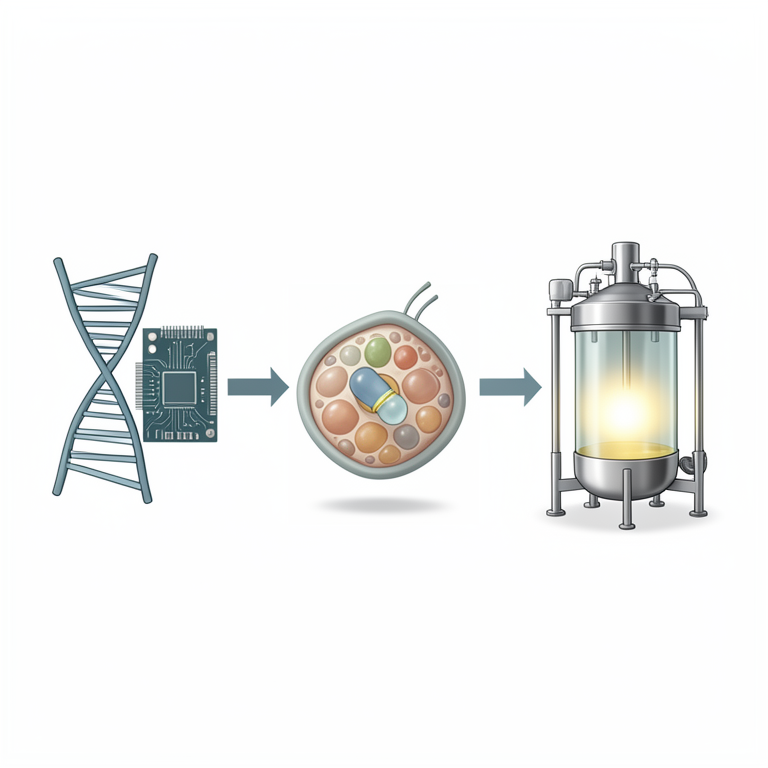
Conceptual Workflow of Synthetic Biology in Industry
AI-generated conceptual illustration (engineered yeast cells in a bioreactor). It explains the idea and does not show study data.
View source evidence ↗Introduction
Synthetic biology, an interdisciplinary field that integrates principles from biology, engineering, and computer science, has emerged as a transformative force in industrial biotechnology. It enables the design and construction of novel biological systems and organisms with tailored functionalities, facilitating the production of chemicals, fuels, pharmaceuticals, and materials in a more efficient, sustainable, and cost-effective manner. By leveraging advanced genetic engineering techniques, synthetic biology holds the promise of revolutionizing traditional bioprocesses and addressing some of the most pressing challenges in various industrial sectors. Industrial biotechnology, which utilizes biological systems for industrial applications, has traditionally relied on natural organisms and enzymes to produce valuable products. However, these natural systems often have limitations in terms of efficiency, yield, and specificity. Synthetic biology overcomes these limitations by enabling the rational design and optimization of biological systems, creating organisms that are finely tuned to perform specific tasks with high efficiency. This capability is driving significant advancements in the development of novel bioprocesses, enhancing the production of a wide range of industrially relevant compounds. One of the key areas where synthetic biology is making a profound impact is in the development of novel bioprocesses for the production of biofuels. Biofuels derived from renewable resources offer a sustainable alternative to fossil fuels, with the potential to reduce greenhouse gas emissions and reliance on finite natural resources. Synthetic biology enables the engineering of microorganisms to efficiently convert biomass into biofuels such as ethanol, butanol, and advanced biofuels. For example, the engineering of Escherichia coli and Saccharomyces cerevisiae for the production of isobutanol and other higher-chain alcohols has demonstrated significant improvements in yield and process efficiency, showcasing the potential of synthetic biology to transform the biofuel industry. In addition to biofuels, synthetic biology is also revolutionizing the production of pharmaceuticals. The traditional production of complex pharmaceuticals often involves elaborate and costly chemical synthesis processes. Synthetic biology offers an alternative by enabling the microbial production of pharmaceutical compounds through engineered biosynthetic pathways. A notable example is the production of the antimalarial drug artemisinin. Traditionally extracted from the sweet wormwood plant, artemisinin's Despite the tremendous potential and advancements, the application of synthetic biology in industrial biotechnology faces several challenges. The complexity of biological systems, the need for standardized genetic parts and assembly methods, regulatory hurdles, and public perception of genetically modified organisms (GMOs) are significant obstacles that must be addressed. Ensuring the scalability and economic viability of synthetic biology-based processes is also critical for their widespread adoption in industrial applications.
In conclusion, synthetic biology is poised to revolutionize industrial biotechnology by enabling the development of novel bioprocesses, the creation of engineered organisms with enhanced capabilities, and the optimization of metabolic pathways for the production of a wide range of industrially relevant compounds. The integration of synthetic biology with metabolic engineering and systems biology is driving significant advancements, promising a future of more efficient, sustainable, and innovative industrial processes. This paper aims to explore the transformative impact of synthetic biology on industrial biotechnology, focusing on key advancements, relevant studies, and future directions in the field.
Main Objective
The main objective of this paper is to explore the transformative impact of synthetic biology on industrial biotechnology, focusing on the development of novel bioprocesses, the creation of engineered organisms for the production of chemicals, biofuels, and pharmaceuticals, and advancements in metabolic engineering and systems biology.
Reviews of Literature
Atsumi et al. (2008) [1] . Demonstrated the potential of synthetic biology in biofuel production by engineering Escherichia coli to produce isobutanol from glucose. This study involved the introduction and optimization of a synthetic pathway, showcasing a significant advancement in the development of sustainable biofuels. The engineered E. coli strains exhibited increased isobutanol production, highlighting the efficiency of synthetic biology in creating novel bioprocesses from renewable feedstocks. The work of Ro et al. (2006) [2] on the production of artemisinic acid in engineered yeast is a pivotal example of synthetic biology's impact on pharmaceutical manufacturing. By introducing a synthetic pathway from the plant Artemisia annua into Saccharomyces cerevisiae, the researchers were able to produce artemisinic acid, a precursor to the antimalarial drug artemisinin. This study not only increased the availability of a critical drug but also demonstrated the potential for scalable and cost-effective pharmaceutical production using microbial hosts. Chen and Patel (2012) [3] . Reviewed the production of bioplastics using engineered microorganisms, emphasizing the role of synthetic biology in creating sustainable alternatives to petroleum-based plastics. The production of polyhydroxyalkanoates (PHAs) by engineered strains such as Ralstonia eutropha was highlighted, showcasing how synthetic biology can enhance bioplastic production from renewable resources. Jakociunas et al. (2015) [5] . Utilized CRISPR-Cas9 technology to enhance the production of isobutanol in Saccharomyces cerevisiae. By precisely editing multiple genes involved in the biosynthetic pathway, the study achieved a substantial increase in isobutanol yield, illustrating the powerful impact of genome-editing tools in metabolic engineering. Lee et al. (2014) [6] employed genome-scale metabolic models to identify genetic modifications that improved the production of 1,4-butanediol in Escherichia coli. This study demonstrated the utility of computational models in guiding the optimization of metabolic pathways, leading to significant improvements in product yield and process efficiency. Li et al. (2016) [9] combined transcriptomic and metabolomic analyses with computational modelling to optimize gamma-aminobutyric acid (GABA) production in Corynebacterium glutamicum. This integrative approach provided insights into the regulatory mechanisms of cellular metabolism and facilitated targeted modifications for enhanced metabolite production. Wang et al. (2019) [10] used high-throughput screening to optimize the production of itaconic acid in Aspergillus terreus. By screening a large library of genetic variants, the study identified mutations that significantly improved yield, demonstrating the effectiveness of high-throughput approaches in metabolic engineering.
Development of Novel Bioprocesses
Synthetic biology has significantly advanced the development of novel bioprocesses, transforming industrial biotechnology by enhancing efficiency, sustainability, and the production of high-value products. By leveraging the principles of genetic engineering and systems biology, synthetic biology enables the design and construction of customized biological systems that can carry out specific bioconversions. This section discusses the detailed aspects of novel bioprocess development enabled by synthetic biology, with relevant studies illustrating these advancements. Synthetic biology allows for the optimization of microbial strains to perform complex biochemical reactions, converting renewable feedstocks into valuable products. This optimization often involves the introduction and modification of metabolic pathways in microorganisms, enabling them to produce desired compounds with high yield and efficiency. One prominent example is the engineering of Escherichia coli and Saccharomyces cerevisiae to produce biofuels from lignocellulosic biomass. Lignocellulosic biomass, derived from plant material, is an abundant and renewable resource that can be converted into bioethanol and biobutanol, sustainable alternatives to fossil fuels. A landmark study by Atsumi et al. (2008) [1] demonstrated the engineering of E. coli for the production of isobutanol, a higher-chain alcohol suitable as a biofuel. The researchers introduced and optimized a synthetic pathway in E. coli, allowing the microorganism to convert glucose into isobutanol efficiently. This study highlighted the potential of synthetic biology to create novel bioprocesses that produce biofuels from renewable resources, reducing reliance on fossil fuels and lowering greenhouse gas emissions. Another significant advancement in novel bioprocess development is the production of pharmaceuticals through synthetic biology. The antimalarial drug artemisinin, traditionally extracted from the sweet wormwood plant, has been successfully produced using engineered yeast. Ro et al. (2006) [2] engineered S. cerevisiae to produce artemisinic acid, a precursor to artemisinin, by introducing a synthetic pathway derived from the plant. This bioprocess not only increased the availability of this crucial drug but also reduced production costs and environmental impact associated with traditional extraction methods. Synthetic biology also facilitates the production of bioplastics, offering a sustainable alternative to petroleum-based plastics. The production of polyhydroxyalkanoates (PHAs), biodegradable polymers, has been enhanced through the engineering of microbial strains. A study by Chen et al. (2015) engineered the bacterium Ralstonia eutropha to produce PHAs from lignocellulosic biomass. By optimizing the metabolic pathways involved in PHA synthesis, the researchers achieved high yields of bioplastic, demonstrating the potential of synthetic biology to develop sustainable bioprocesses for industrial applications. The integration of synthetic biology with metabolic engineering has further accelerated the development of novel bioprocesses. Metabolic engineering involves the systematic modification of cellular pathways to improve the production of specific metabolites. Synthetic biology tools, such as CRISPR-Cas9 for genome editing and computational models for pathway optimization, have enabled precise and efficient modifications of metabolic networks. This integration has led to significant improvements in the production of amino acids, vitamins, and other high-value compounds. For example, Zhang et al. (2016) [9] utilized CRISPR-Cas9 to optimize the production of L-lysine, an essential amino acid, in Corynebacterium glutamicum. By targeting and modifying specific genes involved in the Llysine biosynthetic pathway, the researchers achieved a substantial increase in L-lysine production. This study underscores the impact of synthetic biology in enhancing bioprocess efficiency and yield through targeted metabolic engineering. Despite these advancements, the development of novel bioprocesses using synthetic biology faces several challenges. The complexity of biological systems, the need for standardized genetic parts, and regulatory hurdles are significant obstacles that must be addressed. Additionally, ensuring the scalability and economic viability of these bioprocesses remains a critical consideration. In conclusion, synthetic biology has revolutionized the development of novel bioprocesses in industrial biotechnology. By enabling the design and construction of engineered microorganisms with tailored metabolic pathways, synthetic biology has enhanced the production of biofuels, pharmaceuticals, bioplastics, and other high-value products from renewable resources. Studies such as those by Atsumi et al., Ro et al., and Zhang et al. exemplify the transformative potential of synthetic biology in creating sustainable and efficient bioprocesses. As the field continues to advance, addressing the associated challenges will be crucial for realizing the full potential of synthetic biology in industrial applications.
Advancements in Metabolic Engineering and Systems Biology
Metabolic engineering and systems biology have witnessed significant advancements in recent years, largely driven by the integration of synthetic biology tools and methodologies. These fields aim to optimize and reprogram cellular metabolism for enhanced production of valuable chemicals, fuels, and pharmaceuticals. This section explores the key advancements in metabolic engineering and systems biology, emphasizing their impact on industrial biotechnology. Metabolic engineering focuses on the systematic modification of metabolic pathways within an organism to increase the production of desired metabolites. The advent of synthetic biology has provided a suite of powerful tools, such as CRISPR-Cas9 for precise genome editing, computational modelling for pathway design, and high-throughput screening methods. These tools have revolutionized the ability to engineer microorganisms with tailored metabolic capabilities. One notable advancement is the use of CRISPR-Cas9 technology to precisely edit genes involved in metabolic pathways. This genome-editing tool allows for targeted modifications, such as gene knockouts, insertions, or point mutations, facilitating the optimization of metabolic fluxes. For example, a study by Jakociunas et al. (2015) [5] demonstrated the use of CRISPR-Cas9 in Saccharomyces cerevisiae to enhance the production of the biofuel precursor isobutanol. By targeting and modifying multiple genes involved in the isobutanol biosynthetic pathway, the researchers achieved a significant increase in production, showcasing the potential of CRISPR-Cas9 in metabolic engineering. Another critical advancement is the development of computational models for metabolic pathway design and optimization. These models, often based on genome-scale metabolic networks, allow researchers to simulate and predict the effects of genetic modifications on cellular metabolism. Tools such as Flux Balance Analysis (FBA) and OptKnock have been instrumental in identifying gene targets for improving metabolite production. For instance, Lee et al. (2014) [6] used a genome-scale model of Escherichia coli to identify key genetic modifications that enhanced the production of 1,4-butanediol, a valuable chemical used in the synthesis of plastics and fibers. By implementing the suggested modifications, the researchers achieved a substantial increase in 1,4-butanediol yield. Systems biology, which involves the holistic study of complex biological systems, has also made significant contributions to metabolic engineering. Advances in omics technologies, such as genomics, transcriptomics, proteomics, and metabolomics, have enabled comprehensive analyses of cellular states and responses. Integrating these datasets with computational models provides a deeper understanding of cellular metabolism and its regulation. For example, a study by Li et al. (2016) [9] combined transcriptomic and metabolomic analyses with computational modeling to optimize the production of gamma-aminobutyric acid (GABA) in Corynebacterium glutamicum. By identifying and manipulating key regulatory nodes within the metabolic network, the researchers were able to significantly enhance GABA production. This integrative approach exemplifies the power of systems biology in uncovering regulatory mechanisms and guiding metabolic engineering efforts. The integration of synthetic biology with metabolic engineering and systems biology has also led to the development of synthetic metabolic pathways, which are entirely new pathways designed to produce non-native metabolites. These pathways are constructed by assembling genes from different organisms, creating novel biosynthetic routes that do not exist in nature. A prominent example is the engineering of E. coli to produce the antimalarial drug precursor artemisinic acid, as demonstrated by Ro et al. (2006) [2] . By introducing a synthetic pathway derived from the plant Artemisia annua into E. coli, the researchers were able to produce artemisinic acid in a microbial host, enabling scalable and cost-effective production of this crucial pharmaceutical. Moreover, advancements in high-throughput screening and directed evolution have accelerated the optimization of engineered metabolic pathways. Techniques such as microfluidics and automated liquid handling systems allow for the rapid screening of large libraries of genetic variants. This approach facilitates the identification of the most efficient metabolic configurations, further enhancing production yields. For example, Wang et al. (2019) [10] used high-throughput screening to optimize the production of itaconic acid in Aspergillus terreus. By screening thousands of genetic variants, the researchers identified mutations that improved itaconic acid yield, demonstrating the utility of high-throughput approaches in metabolic engineering. Despite these advancements, several challenges remain in metabolic engineering and systems biology. The complexity of cellular metabolism, the need for precise control over metabolic fluxes, and the potential for unintended side effects pose significant obstacles. However, ongoing research and technological innovations continue to address these challenges, paving the way for more efficient and sustainable bioprocesses. In conclusion, the integration of synthetic biology with metabolic engineering and systems biology has led to remarkable advancements in the optimization and reprogramming of cellular metabolism. Tools such as CRISPR-Cas9, computational modelling, omics technologies, and high-throughput screening have revolutionized the ability to design and construct efficient metabolic pathways. These advancements hold great promise for enhancing the production of biofuels, chemicals, and pharmaceuticals, driving the future of industrial biotechnology.
Conclusion
The integration of synthetic biology with metabolic engineering and systems biology has significantly advanced the field of industrial biotechnology. These advancements have enabled the precise manipulation of metabolic pathways, the creation of novel bioprocesses, and the production of high-value chemicals, biofuels, and pharmaceuticals. The use of powerful tools such as CRISPR-Cas9 for genome editing, computational models for pathway optimization, and high-throughput screening methods has revolutionized our ability to engineer microorganisms with tailored metabolic capabilities. The development of engineered strains capable of converting renewable feedstocks into valuable products has demonstrated the potential of synthetic biology to create sustainable and efficient bioprocesses. Studies such as those optimizing the production of biofuels, pharmaceuticals like artemisinin, and biodegradable polymers have showcased the transformative impact of these technologies. Furthermore, the integration of omics technologies and computational modelling has provided deeper insights into cellular metabolism, enabling the identification and manipulation of key regulatory nodes to enhance metabolite production. Despite these advancements, challenges remain in the complexity of cellular metabolism, the need for precise control over metabolic fluxes, and potential unintended side effects. However, ongoing research and technological innovations continue to address these challenges, paving the way for more efficient and sustainable bioprocesses. In conclusion, the advancements in metabolic engineering and systems biology, driven by synthetic biology, are poised to revolutionize industrial biotechnology. By enabling the design and construction of optimized metabolic pathways and novel bioprocesses, these advancements promise a future of more efficient, sustainable, and innovative industrial applications. The continued development and integration of these technologies will be crucial for realizing the full potential of synthetic biology in addressing global challenges and enhancing industrial productivity.
References
10 in the original paper- Atsumi S, Hanai T, Liao JC. Non-fermentative pathways for synthesis of branched-chain higher alcohols as biofuels. Nature. 2008 Jan 3;451(7174):8689.
- Ro DK, Paradise EM, Ouellet M, Fisher KJ, Newman KL, Ndungu JM, et al. Production of the antimalarial drug precursor artemisinic acid in engineered yeast. Nature. 2006 Apr 13;440(7086):940-943.
- Chen G-Q, Patel MK. Plastics derived from biological sources: Present and future: A technical and environmental review. Chem Rev. 2012 Apr 11;112(4):2082-2099.
- Zhang Y, Werling U, Edelmann W. SLiCE: A novel bacterial cell extract-based DNA cloning method. Nucleic Acids Res. 2012 Apr;40(8):e55.
- Jakociunas T, Bonde I, Herrgård M, Harrison SJ, Kristensen M, Pedersen LE, et al. Multiplex metabolic pathway engineering using CRISPR/Cas9 in International Journal of Biology Sciences https://www.biologyjournal.net Saccharomyces cerevisiae. Metab Eng. 2015 Nov;28:213-222.
- Lee SY, Kim HU, Chae TU, Cho JS, Kim JW, Shin JH, et al. A comprehensive metabolic map for production of bio-based chemicals. Nat Catal. 2019 Jan;2(1):18-33.
- Li Y, Li S, Thodey K, Trenchard I, Cravens A, Smolke CD. Complete biosynthesis of noscapine and halogenated alkaloids in yeast. Proc. Natl. Acad. Sci. U SA. 2018 Apr 24;115(17):E3922-9231.
- Wang S, Zhou J, Chen J, Guo L, Chen Q, Jiao N. Developing and applying genetic and genomic tools for the extremely oligotrophic marine bacterium Pelagibacter ubique. Appl Environ Microbiol. 2017 Sep 15, 83(18).
- Li J, Zhang K, Gao X, Chen W, Liu X, Liang X, et al. Development of a genome-editing CRISPR/Cas9 system for metabolic engineering of Aspergillus niger. Biotechnol. Bioeng. 2016 Aug;113(8):1701-1709.
- Wang G, Zhao Z, Ke J, Engelseth RA, Nagel DA. High-throughput screening using droplet microfluidics for improved production of natural products by Aspergillus terreus. Biotechnol J. 2019 Jan;14(1): e1800200.