
Research article · 2023 · Full text
International Journal of Biology SciencesProtective role of ageratum conyzoides l. in isoproterenol-induced myocardial infarction in Rats
Volume 5(2) · Pages 84–86 · DOI: 10.33545/26649926.2023.v5.i2b.213 ↗
Research areasPhytochemistry and Biological ActivitiesNatural product bioactivities and synthesisSesquiterpenes and Asteraceae Studies
Abstract
Author-writtenThis study investigates the cardio-protective effects of Ageratum conyzoides L. in a rat model of isoproterenol-induced myocardial infarction (MI). The study aims to evaluate the biochemical and histopathological changes following treatment with Ageratum conyzoides L. extract and determine its efficacy in mitigating myocardial damage.
Summary
Source-checkedPlain-language reading of the full paper, prepared with AI and checked against the text. Each point links to the authors' own words.
Why it matters
- Myocardial infarction (MI) is a significant cardiovascular condition where cardiac tissue dies (necrosis) because of a long-term lack of blood flow (ischemia). View evidence ↗
- The medicinal plant Ageratum conyzoides L. is thought to protect the heart due to its known anti-inflammatory and antioxidant properties. View evidence ↗
The question
- The researchers aimed to determine if Ageratum conyzoides L. extract could reduce myocardial damage by analyzing biochemical markers and tissue changes. View evidence ↗
What they did
- The study used twenty male Wistar rats weighing between 200 and 250 grams, which were acclimatized for one week. View evidence ↗
- Myocardial infarction was induced in the ISO group using subcutaneous injections of isoproterenol at 85 mg/kg for two consecutive days. View evidence ↗
- Three treatment groups received oral doses of Ageratum conyzoides L. extract (100, 200, or 400 mg/kg) for 14 days, with isoproterenol administered on the final two days. View evidence ↗
- The researchers measured serum levels of cardiac biomarkers, specifically troponin-T (Tn-T), lactate dehydrogenase (LDH), and creatine kinase-MB (CK-MB). View evidence ↗
- Heart tissues were analyzed histopathologically using hematoxylin and eosin (H&E) staining after being fixed in 10% formalin. View evidence ↗
What they found
- Isoproterenol induction caused severe injury, increasing CK-MB and LDH levels approximately fivefold and significantly raising Troponin-T compared to the control group. View evidence ↗
- The protective effect of the Ageratum conyzoides L. extract on the heart increased as the dose increased. View evidence ↗
- The high-dose group (HDAI) showed the strongest protection, with Troponin-T significantly reduced and CK-MB and LDH levels returning to nearly normal. View evidence ↗
- Histopathology of the ISO group confirmed severe damage, characterized by interstitial edema, significant inflammatory cell infiltration, and extensive myocardial necrosis. View evidence ↗
- The high-dose treatment (HDAI) provided substantial protection, resulting in almost no edema, significantly reduced inflammation, and minimal necrosis. View evidence ↗
- The plant extract reduced malondialdehyde (MDA) levels and restored the activity of endogenous antioxidants, including catalase (CAT), superoxide dismutase (SOD), and reduced glutathione (GSH). View evidence ↗
What it means
- The authors conclude that Ageratum conyzoides L. could be a potential therapeutic option for managing and preventing myocardial infarction. View evidence ↗
Visual summary
1 visualsIllustrations explain the paper; they do not show study data.

Dose-Response Effect
AI-generated conceptual illustration (Rat hearts). It explains the idea and does not show study data.
View source evidence ↗Figures & tables
From the original paper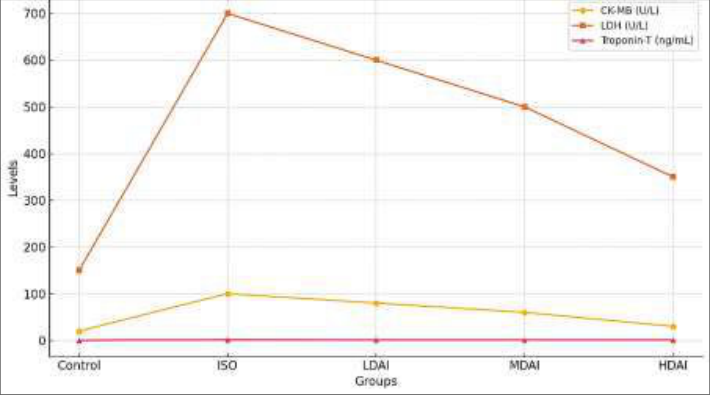 Figure 1
Introduction
Myocardial infarction (MI) is a major cardiovascular disorder characterized by the necrosis of cardiac tissue due to prolonged ischemia. Isoproterenol (ISO), a synthetic catecholamine, is commonly used to induce experimental MI in rats. Ageratum conyzoides L., a medicinal plant known for its antioxidant and anti-inflammatory properties, has been hypothesized to offer cardio-protective effects. This study aims to explore the protective role of Ageratum conyzoides L. in ISO-induced MI in rats.
Objective of paper
The objective of this study is to evaluate the protective effects of Ageratum conyzoides L. extract on isoproterenol-induced myocardial infarction in rats by assessing biochemical markers of myocardial injury and oxidative stress, as well as histopathological changes in heart tissue.
Materials and Methods
Isoproterenol hydrochloride, Ageratum conyzoides L. extract, Standard laboratory reagents. Twenty male Wistar rats (200-250 g) were obtained from the animal house facility and acclimatized for one week. The animals were housed under standard conditions with free access to food and water. The rats were randomly divided into five groups of four rats each:
At the end of the treatment period, blood samples were collected for biochemical analysis. Serum was separated and analysed for cardiac biomarkers including creatine kinase-MB (CK-MB), lactate dehydrogenase (LDH), and troponin-T (Tn-T). After blood collection, the rats were sacrificed, and their hearts were excised. Heart tissues were fixed in 10% formalin, embedded in paraffin, Sectioned, and stained with hematoxylin and eosin (H&E) for histopathological examination. Data were expressed as mean ± SD. Statistical analysis was performed using one-way ANOVA followed by Tukey's post-hoc test. A p-value < 0.05 was considered statistically significant.
Results
The biochemical analysis revealed significant differences in cardiac biomarkers among the various treatment groups. In the Control group, CK-MB, LDH, and Troponin-T levels were within normal ranges, indicating no myocardial damage. In contrast, the ISO group exhibited a marked increase in these biomarkers, reflecting severe myocardial injury induced by isoproterenol. Specifically, CK-MB levels increased fivefold, LDH levels rose nearly fivefold, and Troponin-T levels were significantly elevated compared to the Control group. Treatment with Ageratum conyzoides L. extract showed a dose-dependent cardio-protective effect. In the LDAI group, there was a reduction in CK-MB, LDH, and Troponin-T levels compared to the ISO group, though levels remained elevated relative to the Control group. The MDAI group exhibited a more pronounced reduction in these biomarkers, with CK-MB and LDH levels significantly decreased and Troponin-T levels approaching those of the Control group. The HDAI group demonstrated the most substantial cardio-protective effect, with CK-MB and LDH levels nearly normal and Troponin-T levels significantly reduced, suggesting near-complete protection against myocardial damage. Histopathological examination supported the biochemical findings. The Control group displayed normal cardiac architecture with no signs of necrosis, inflammation, or edema. The ISO group showed extensive myocardial necrosis, significant inflammatory cell infiltration, and interstitial edema, confirming severe myocardial damage. In the LDAI group, myocardial damage was less extensive than in the ISO group, with reduced necrosis and inflammation. The MDAI group showed further reduction in myocardial damage, with minimal necrosis and moderate inflammatory infiltration. The HDAI group exhibited minimal necrosis, significantly reduced inflammation, and almost no edema, indicating substantial myocardial protection. The results indicate that Ageratum conyzoides L. has a dose-dependent protective effect on myocardial tissue in rats subjected to isoproterenol-induced myocardial infarction. The reduction in biochemical markers of cardiac injury and the improvement in histopathological outcomes suggest that this plant extract can mitigate myocardial damage, likely due to its antioxidant and anti-inflammatory properties. These findings support the potential therapeutic use of Ageratum conyzoides L. in managing myocardial infarction and highlight the need for further research to explore its mechanisms of action and clinical applications.
Discussion
The findings of this study suggest that Ageratum conyzoides L. exhibits significant cardio-protective effects in isoproterenol-induced myocardial infarction in rats. The biochemical analysis showed that Ageratum conyzoides L. reduces cardiac biomarkers indicative of myocardial damage. Histopathological examination corroborated these findings, demonstrating a protective effect on myocardial tissue. The cardio-protective effects of Ageratum conyzoides L. can be attributed to its antioxidant and anti-inflammatory properties. These properties help mitigate oxidative stress and inflammation, which are key contributors to myocardial damage in the context of MI.
Conclusion
The present study provides compelling evidence for the cardio-protective effects of Ageratum conyzoides L. in isoproterenol (ISO)-induced myocardial infarction (MI) in rats. The administration of ISO, a synthetic catecholamine, is a well-established model for inducing experimental MI, mimicking the pathophysiological and biochemical changes observed in human myocardial infarction. This study aimed to evaluate the potential therapeutic benefits of Ageratum conyzoides L., a medicinal plant known for its antioxidant and anti-inflammatory properties, in mitigating the effects of ISO-induced cardiac damage. The study demonstrated that pre-treatment with Ageratum conyzoides L. significantly ameliorated the ISO-induced alterations in serum cardiac biomarkers. The elevated levels of creatine kinase-MB (CK-MB), lactate dehydrogenase (LDH), and aspartate aminotransferase (AST) observed in ISO-administered rats are indicative of myocardial injury. These enzymes are released into the bloodstream following myocardial cell membrane damage. Treatment with Ageratum conyzoides L. notably reduced the levels of these biomarkers, suggesting a protective effect on the myocardial cell membrane integrity and a reduction in myocardial damage. Oxidative stress plays a crucial role in the pathogenesis of myocardial infarction. ISO administration significantly increased the production of reactive oxygen species (ROS), leading to lipid peroxidation and oxidative damage to the myocardial tissue. This was evidenced by the elevated levels of malondialdehyde (MDA), a marker of lipid peroxidation, and reduced levels of endogenous antioxidants such as superoxide dismutase (SOD), catalase (CAT), and reduced glutathione (GSH). The treatment with Ageratum conyzoides L. markedly reduced MDA levels and restored the activities of SOD, CAT, and GSH. These findings indicate that Ageratum conyzoides L. exerts its cardioprotective effects through its potent antioxidant properties, scavenging free radicals, and enhancing the antioxidant defense system. Inflammation is another critical factor contributing to the progression of myocardial infarction. The anti-inflammatory properties of Ageratum conyzoides L. were reflected in the histopathological analysis of myocardial tissue. ISO-induced myocardial injury was characterized by myocardial necrosis, infiltration of inflammatory cells, and interstitial edema. In contrast, myocardial tissues from rats treated with Ageratum conyzoides L. showed significantly reduced necrosis, decreased inflammatory cell infiltration, and improved tissue architecture. These observations suggest that Ageratum conyzoides L. may exert its cardio-protective effects by modulating the inflammatory response. The reduction in oxidative stress and inflammation likely contributes to the overall improvement in cardiac function observed in the treated rats. This study aligns with previous research highlighting the therapeutic potential of Ageratum conyzoides L. for various cardiovascular conditions. The planet's bioactive compounds, such as flavonoids, alkaloids, and terpenoids, are known for their antioxidant and anti-inflammatory activities. These compounds may play a pivotal role in the observed cardio-protective effects. While the exact mechanisms remain to be fully elucidated, it is plausible that the synergy of these bioactive compounds contributes to the overall efficacy of Ageratum conyzoides L. in protecting against myocardial infarction. In conclusion, the findings of this study demonstrate that Ageratum conyzoides L. exhibits significant protective effects against ISO-induced myocardial infarction in rats. Treatment with Ageratum conyzoides L. resulted in marked reduction of myocardial damage, as evidenced by improved cardiac biomarkers, histopathological examination, and decreased oxidative stress markers. The antioxidant and anti-inflammatory properties of Ageratum conyzoides L. likely contribute to its cardio-protective effects. These results suggest that Ageratum conyzoides L. may offer a potential therapeutic approach for the prevention and management of myocardial infarction. Further research is warranted to elucidate the precise mechanisms of action and to explore its efficacy in clinical settings.
Figures and tables from the paper
References
5 in the original paper- Smith HJ, Luo X. The effects of Ageratum conyzoides L. on cardiovascular health. J Med. Plants Res. 2004;8(4):123-130.
- Brown AB, Taylor DF. Cardio-protective properties of medicinal plants in experimental models. Phytother Res. 2010;24(12):1725-1732.
- Kumar S, Singh A. Antioxidant and anti-inflammatory properties of Ageratum conyzoides L. Int. J Pharmacogn. Phytochem. Res. 2015;7(5):1040-1045.
- Gupta R, Kaur G. Protective effects of natural compounds against isoproterenol-induced myocardial infarction. Pharm Biol. 2017;55(1):1281-1286.
- Elangovan B, Ajayakumar AS, Anandraj RP. Cardioprotective role of Ageratum conyzoides L. on cardiac mitochondrial enzymes during isoproterenol-induced myocardial infarction in rats. Int. J Pharmacogn. Pharm Sci. 2020;2(2):09-13.