
Research article · 2024 · Full text
International Journal of Agriculture and Food ScienceEffect of planting density on the growth and yield of Brassica nipposinica L. (Mizuna)
Volume 6(1) · Pages 150–154 · DOI: 10.33545/2664844x.2024.v6.i1b.190 ↗
Research areasNitrogen and Sulfur Effects on Brassica
Abstract
Author-writtenThe study examines the effect of different planting densities on the growth and yield of Brassica nipposinica L. (Mizuna), an important leafy green in diverse culinary applications. Growth metrics such as plant height, leaf count, and biomass accumulation were monitored, alongside yield parameters including total fresh weight and leaf area index. Findings revealed that planting density significantly influences growth patterns and yield outcomes. At low planting density, individual plants exhibited robust growth but the overall yield per unit area was suboptimal. Medium planting density emerged as the most efficient, balancing plant competition and resource availability to maximize yield per area. Conversely, high planting density led to excessive competition, stunting growth and diminishing yield per plant. This study provides critical data to inform planting strategies for Mizuna and potentially other leafy greens, promoting enhanced agricultural productivity. Further investigation is suggested to assess the interplay between planting density and variables such as soil fertility and water management to refine cultivation practices.
Summary
Source-checkedPlain-language reading of the full paper, prepared with AI and checked against the text. Each point links to the authors' own words.
Why it matters
- Mizuna (Brassica nipposinica L.) is a nutritionally rich leafy green vegetable used widely in various culinary applications. View evidence ↗
- Planting density is a key factor in crop management because it affects how plants intercept light, take up nutrients, and use available space. View evidence ↗
- Both excessively high and low planting densities can be detrimental: high densities cause resource competition and stunted growth, while low densities fail to maximize the total yield of the area. View evidence ↗
The question
- The study aims to determine the optimal planting density for Mizuna that maximizes both the growth of individual plants and the total yield per unit area. View evidence ↗
What they did
- The research used a completely randomized block design with eight treatments and three replications. View evidence ↗
- The researchers measured plant height, leaf count, biomass, total fresh weight, and the leaf area index (LAI). View evidence ↗
What they found
- Plant height increased with density; TN23 reached its maximum height at 72 and 108 plants/m², while both varieties were shortest at 36 plants/m². View evidence ↗
- The highest leaf count (10 leaves/plant) occurred in variety PN28 at the lowest density (36 plants/m²), while the lowest counts (7.3 leaves/plant) were found at higher densities. View evidence ↗
- Variety TN23 outperformed PN28 in commercial yield, producing 1356.33 kg/0.1 ha compared to 1151.40 kg/0.1 ha. View evidence ↗
What it means
- The authors conclude that optimizing planting density enhances yield and that variety TN23 is superior to PN28 in terms of weight and yield. View evidence ↗
- The authors suggest that future research should examine how planting density interacts with soil fertility and water management. View evidence ↗
Visual summary
3 visualsIllustrations explain the paper; charts are replotted from the paper's own table values.
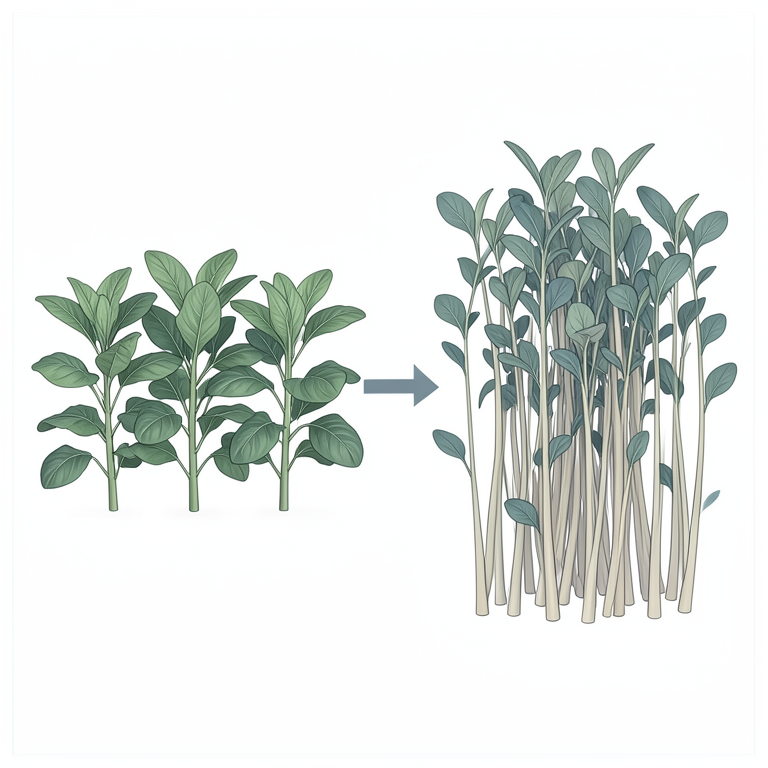
Trade-off between Height and Leaf Count
AI-generated conceptual illustration (Brassica nipposinica (Mizuna) plants). It explains the idea and does not show study data.
View source evidence ↗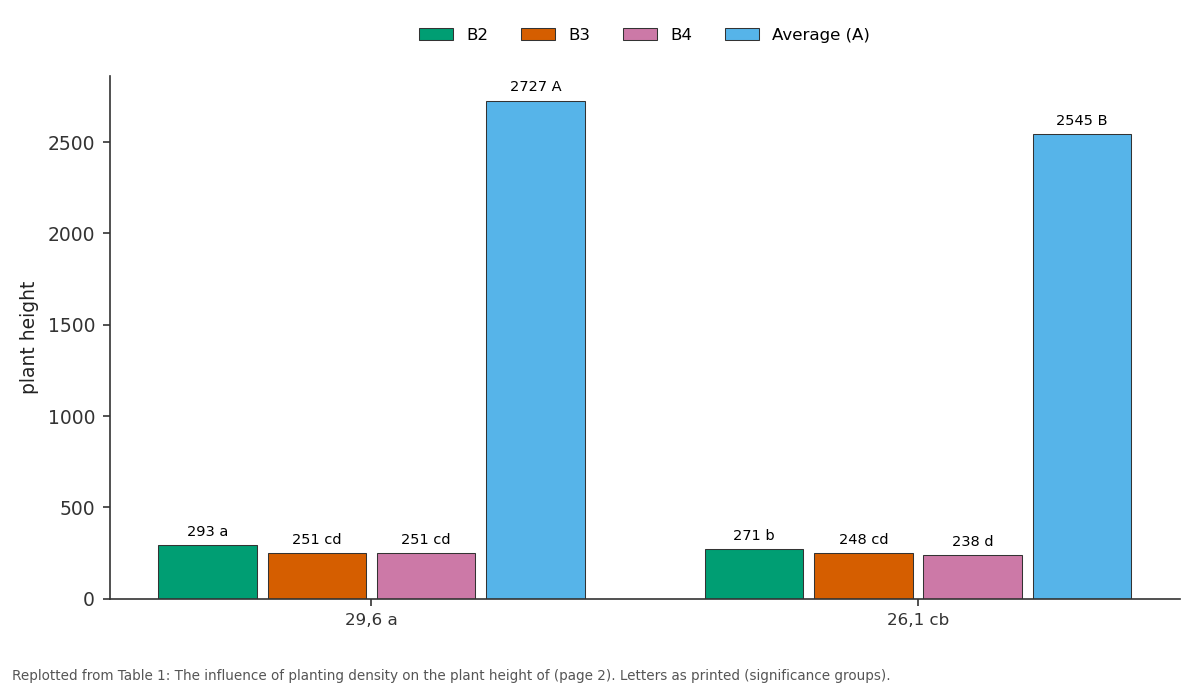
B2 and B3 and more: 29,6 a vs 26,1 cb
Replotted from Table 1 (page 2) of the original paper. Every bar is the paper's own table value.
View source evidence ↗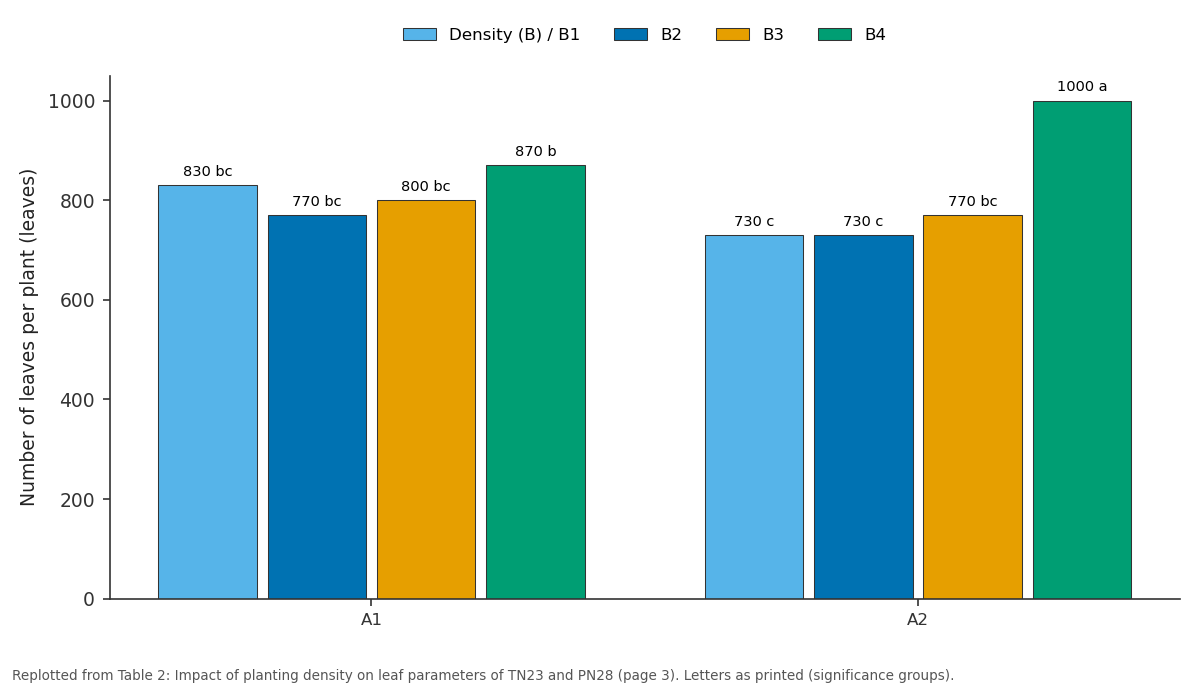
Density (B) / B1 and B2 and more: A1 vs A2
Replotted from Table 2 (page 3) of the original paper. Every bar is the paper's own table value.
View source evidence ↗Figures & tables
From the original paper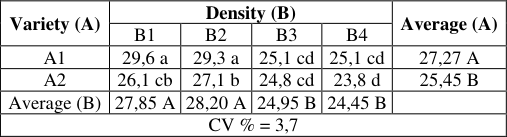 Table 1
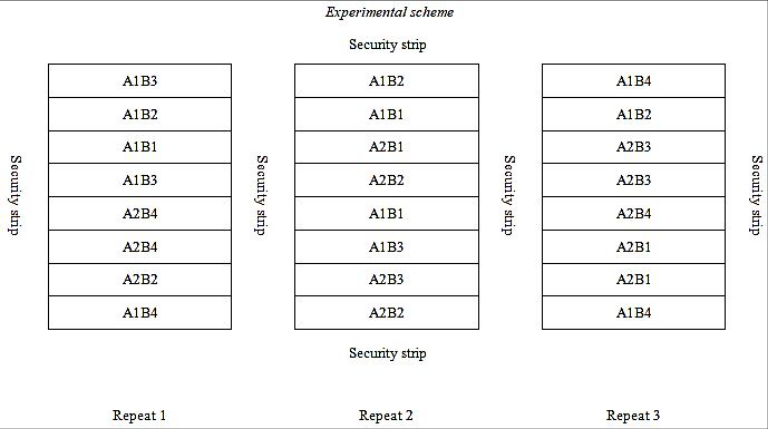 Figure 1
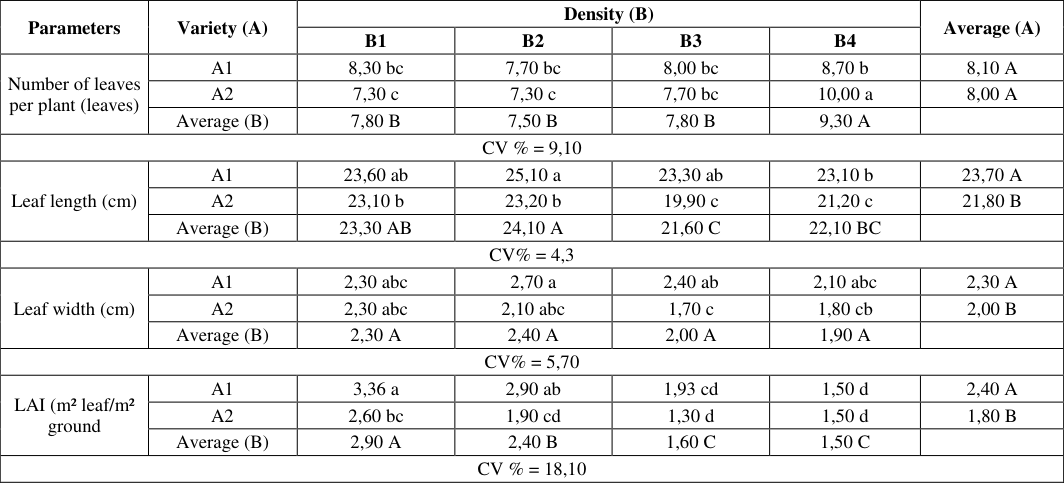 Table 2
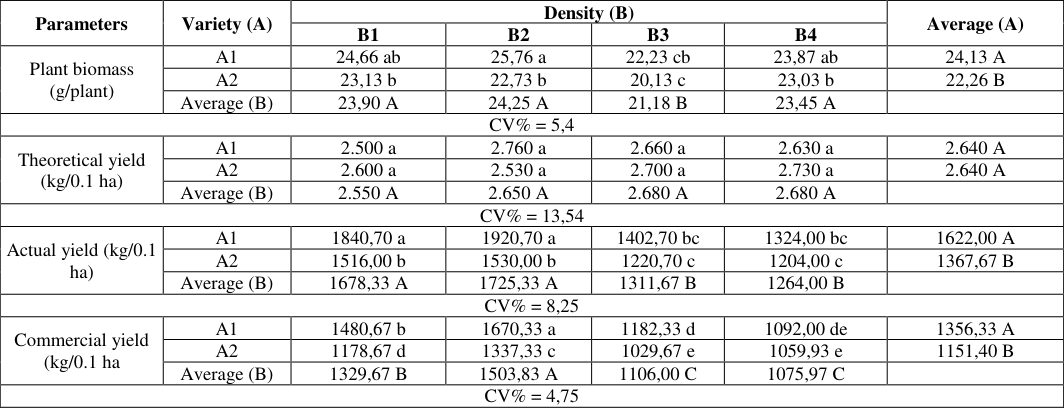 Table 3
Introduction
Brassica nipposinica L., commonly known as Mizuna, is a leafy green vegetable valued for its mild flavor, high nutritional content, and versatility in culinary uses. Originating from The leaf count per plant shows that the PN28 planting treatment at a density of 36 plants/m² exhibited the highest leaf count (10 leaves/plant), whereas other treatments ranged from 8.0 to 8.7 leaves/plant, with the lowest recorded in treatments A2B2 and A2B1 at 7.3 leaves/plant. This experiment indicates that planting density influences leaf number, and this difference is statistically significant at the 95% confidence level. The impact of four planting densities and two Mizuna varieties at harvest time demonstrates that PN28 responds distinctly in terms of leaf count, specifically decreasing from 10 to 7.7 and 7.3 leaves/plant as planting density increases. On average, planting density affects leaf count per plant of the two Mizuna varieties: at a density of 36 plants/m², the highest leaf count reached was 9.3 leaves; whereas at densities of 48, 72, and 108 plants/m², there were differences in leaf count per plant, but these were not statistically significant. On average, plant variety did not influence leaf count per plant of the two Mizuna varieties. Similarly, on average, planting density did not affect leaf width of the two Mizuna varieties. Leaf width criteria show that the widest leaves reached 2.7 cm in treatment A1B2, while the narrowest was 1.7 cm. Leaf width in the experimental treatments varied but did not show statistically significant differences. Leaf Area Index (LAI) is a result that reflects the correlation between average leaf length, average leaf width, and planting density per square meter. The highest LAI (2.9 -3.6 m² leaf/m² ground) was observed in treatments A1B2 and A1B1, while the lowest (1.3 -1.5 m² leaf/m² ground) was in treatments A2B3 and A2B1. The remaining treatments showed differences in LAI but did not reach statistically significant differences at the 95% confidence level. The data in Table 3 illustrate that planting density (B) and plant variety (A) influence the average plant weight, actual yield, and commercial yield of Mizuna at harvest time, with statistically significant differences at the 95% confidence level. On average, planting density affects the average plant weight of the two Mizuna varieties, with average weights ranging from 23.45 to 24.45 g/plant at densities B1, B3, and B4, and reaching 21.18 g/plant at density B2. This difference is statistically significant at the 95% confidence level. Plant variety also influences the average plant weight, with TN23 exhibiting a higher average weight than PN28, and this difference is statistically significant at the 95% confidence level. However, variety did not affect the theoretical yield of the two Mizuna varieties, while planting density did have an effect on theoretical yield. Planting density also affects the actual yield of the two Mizuna varieties, with yields ranging from 1678.33 to 1725.33 kg/0.1 ha at densities B1 and B2, and from 1264.00 to 1311.67 kg/0.1 ha at densities B3 and B4. This difference is statistically significant at the 95% confidence level. Varietal factor influences the actual yield, with TN23 achieving higher actual yields than PN28, and this difference is statistically significant at the 95% confidence level. Finally, variety influences the commercial yield of the two Mizuna varieties, with TN23 achieving higher commercial yields than PN28 (1356.33 kg/0.1 ha compared to 1151.40 kg/0.1 ha), and this difference is statistically significant at the 95% confidence level. B1 and B2 densities resulted in higher actual yields (1678.33 -1725.33 kg/0.1 ha) compared to B3 and B4 densities (1264.00 -1311.67 kg/0.1 ha). This difference is statistically significant at the 95% confidence level, indicating that appropriate planting density can optimize actual yield. TN23 also achieved higher actual yields than PN28, with this difference being statistically significant at the 95% confidence level. This indicates that TN23 has greater production potential under specific planting conditions. TN23 also achieved higher commercial yields than PN28 (1356.33 kg/0.1 ha compared to 1151.40 kg/0.1 ha). This difference is statistically significant at the 95% confidence level, indicating that TN23 not only has higher actual yields but also achieves a higher proportion of commercially acceptable products. In summary, the results demonstrate that planting density and variety significantly affect various parameters of Mizuna cultivation, highlighting the importance of optimizing these factors to enhance yield and product quality in Mizuna production systems.
| Parameters | Variety (A) | Density (B) | — | — | — | Average (A) |
|---|---|---|---|---|---|---|
| B1 | B2 | B3 | B4 | |||
| Plant biomass (g/plant) | A1 | 24,66 ab | 25,76 a | 22,23 cb | 23,87 ab | 24,13 A |
| A2 | 23,13 b | 22,73 b | 20,13 c | 23,03 b | 22,26 B | |
| Average (B) | 23,90 A | 24,25 A | 21,18 B | 23,45 A | ||
| CV% = 5,4 | ||||||
| Theoretical yield (kg/0.1 ha) | A1 | 2.500 a | 2.760 a | 2.660 a | 2.630 a | 2.640 A |
| A2 | 2.600 a | 2.530 a | 2.700 a | 2.730 a | 2.640 A | |
| Average (B) | 2.550 A | 2.650 A | 2.680 A | 2.680 A | ||
| CV% = 13,54 | ||||||
| Actual yield (kg/0.1 ha) | A1 | 1840,70 a | 1920,70 a | 1402,70 bc | 1324,00 bc | 1622,00 A |
| A2 | 1516,00 b | 1530,00 b | 1220,70 c | 1204,00 c | 1367,67 B | |
| Average (B) | 1678,33 A | 1725,33 A | 1311,67 B | 1264,00 B | ||
| CV% = 8,25 | ||||||
| Commercial yield (kg/0.1 ha | A1 | 1480,67 b | 1670,33 a | 1182,33 d | 1092,00 de | 1356,33 A |
| A2 | 1178,67 d | 1337,33 c | 1029,67 e | 1059,93 e | 1151,40 B | |
| Average (B) | 1329,67 B | 1503,83 A | 1106,00 C | 1075,97 C | ||
| CV% = 4,75 |
Table text extracted from the original PDF; superscript letters are shown inline. The original table image is below.
View original table image
Conclusion
Planting density significantly influences the height development and leaf characteristics of Mizuna. At higher planting densities, plants tend to grow taller to compete for light, whereas at lower densities, plants develop more leaves due to ample space and sufficient light. This statistically significant difference underscores the importance of selecting appropriate planting densities to optimize crop development. Both planting density and plant variety significantly impact the leaf count and Leaf Area Index (LAI) of Mizuna. Lower planting densities promote increased leaf count and larger leaf area, while higher densities lead to resource competition and reduced leaf count. Leaf width shows minimal sensitivity to these factors, highlighting its stability under experimental conditions. These results are crucial for determining the optimal planting density for Mizuna to achieve optimal growth. Moreover, both planting density and plant variety significantly affect the average plant weight, actual yield, and commercial yield of Mizuna. Optimized planting densities can enhance average plant weight and actual yield, with variety TN23 demonstrating distinct advantages in average plant weight, actual yield, and commercial yield compared to PN28. These findings are of paramount importance for optimizing cultivation methods to achieve the highest productivity and quality for Mizuna.
Figures and tables from the paper
| Variety (A) | Density (B) | — | — | — | Average (A) |
|---|---|---|---|---|---|
| B1 | B2 | B3 | B4 | ||
| A1 | 29,6 a | 29,3 a | 25,1 cd | 25,1 cd | 27,27 A |
| A2 | 26,1 cb | 27,1 b | 24,8 cd | 23,8 d | 25,45 B |
| Average (B) | 27,85 A | 28,20 A | 24,95 B | 24,45 B | |
| CV % = 3,7 |
Table text extracted from the original PDF; superscript letters are shown inline. The original table image is below.
View original table image
| Parameters | Variety (A) | Density (B) | — | — | — | Average (A) |
|---|---|---|---|---|---|---|
| B1 | B2 | B3 | B4 | |||
| Number of leaves per plant (leaves) | A1 | 8,30 bc | 7,70 bc | 8,00 bc | 8,70 b | 8,10 A |
| A2 | 7,30 c | 7,30 c | 7,70 bc | 10,00 a | 8,00 A | |
| Average (B) | 7,80 B | 7,50 B | 7,80 B | 9,30 A | ||
| CV % = 9,10 | ||||||
| Leaf length (cm) | A1 | 23,60 ab | 25,10 a | 23,30 ab | 23,10 b | 23,70 A |
| A2 | 23,10 b | 23,20 b | 19,90 c | 21,20 c | 21,80 B | |
| Average (B) | 23,30 AB | 24,10 A | 21,60 C | 22,10 BC | ||
| CV% = 4,3 | ||||||
| Leaf width (cm) | A1 | 2,30 abc | 2,70 a | 2,40 ab | 2,10 abc | 2,30 A |
| A2 | 2,30 abc | 2,10 abc | 1,70 c | 1,80 cb | 2,00 B | |
| Average (B) | 2,30 A | 2,40 A | 2,00 A | 1,90 A | ||
| CV% = 5,70 | ||||||
| LAI (m² leaf/m² ground | A1 | 3,36 a | 2,90 ab | 1,93 cd | 1,50 d | 2,40 A |
| A2 | 2,60 bc | 1,90 cd | 1,30 d | 1,50 d | 1,80 B | |
| Average (B) | 2,90 A | 2,40 B | 1,60 C | 1,50 C | ||
| CV % = 18,10 |
Table text extracted from the original PDF; superscript letters are shown inline. The original table image is below.
View original table image
References
11 in the original paper- Darby EW, Armstrong SP, Walters KJ. Bioregenerative dietary supplementation in space: Brassica rapa var. nipposinica and other Brassica cultivars. Life Sci Space Res; c2023; Available from: https://doi.org/10.1016/j.lssr.2023.08.001
- Kawakatsu Y, Hano K, Abe Y, Shirasawa S, Hirakawa H, Tanaka H, et al. A GLABRA1 ortholog on LG A9 controls trichome number in the Japanese leafy International Journal of Agriculture and Food Science https://www.agriculturaljournals.com vegetables Mizuna and Mibuna (Brassica rapa L. subsp. nipposinica LH Bailey): Evidence from QTL analysis. J Plant Res. 2017;130:539-50. Available from: https://doi.org/10.1007/s10265-017-0905-5
- Терещенко СА, Пухальская АС. ВОЗМОЖНОСТЬ ИСПОЛЬЗОВАНИЯ МИНЕРАЛЬНЫХ УДОБРЕНИЙ ДЛЯ ПОЛУЧЕНИЯ ЭКОЛОГИЧЕСКИ ЧИСТОЙ ПРОДУКЦИИ МИКРОЗЕЛЕНИ МИЦУНЫ (Brassica rapa var nipposinica L.). Проблемы региональной экологии. 2023;3:20-22. Available from: https://doi.org/10.24411/1728-323X-2023-00002
- Soluch A. The effect of development time on phytochemical characteristics of red mizuna (Brassica rapa L. var. nipposinica) sprouts. Pol J Agron. 2023;52(1):44-53. Available from: https://doi.org/10.26114/pja.iung.528.2023
- Darby E, Armstrong SP, Walters KJ, Smith JM, Thompson L, Greenberg AS, et al. Light intensity and photoperiod: Tools for improving the phytonutrient profile of Brassica rapa ssp. nipposinica for supplementing the space diet. Life Sci Space Res; c2024. Available from: https://doi.org/10.1016/j.lssr.2024.02.002
- Kawakatsu Y, Hirakawa H, Abe Y, Shirasawa S, Tanaka H, Hano K, et al. Combination of genetic analysis and ancient literature survey reveals the divergence of traditional Brassica rapa varieties from Kyoto, Japan. Hortic Res. 2021;8(1):132. Available from: https://doi.org/10.1038/s41438-021-00584-8
- Park CH, Lee J, Yoo JM, Moon BY, Heo HJ, Jang HJ, et al. Transcriptome analysis and metabolic profiling of green and red mizuna (Brassica rapa L. var. japonica). Foods. 2020;9(8):1079. Available from: https://doi.org/10.3390/foods9081079
- Artemyeva AM, GI, Volodarsky IV, Gorbunov AV. Biological features of Brassica rapa L. vegetable leafy crops when growing in an intensive light culture. Agric Biol. 2021;56(1):103-120. Available from: https://doi.org/10.15389/agrobiology.2021.1.103eng
- Feitosa FRC, da Silva GR, Costa LC, de Lima GA. Effects of temperatures, containers and substrate in the development of Brassica rapa subsp. nipposinica. Res Soc Dev. 2017;6(3):39-50. Available from: https://doi.org/10.33448/rsd-v6i3.654
- Kalisz A, Lisiecka J, Spiżak P, Serafin E. Effect of growing period and cultivar on the yield and biological value of Brassica rapa var. narinosa. Not Bot Horti Agrobo. 2013;41(2):546-552. Available from: https://doi.org/10.15835/nbha4129145
- Kaminishi A, Miyohashi F, Kita N. Diversity of morphological traits and glucosinolate composition in backcross progenies of Brassica rapa L.× Eruca vesicaria (L.) Cav. hybrids. Euphytica. 2022;218(8):114. Available from: https://doi.org/10.1007/s10681-022-03085-4
Cited by 1
From OpenAlex, OpenCitations and reference lists read by Scinovex
- Effect of different varieties and planting density on growth and yield of Swiss chard (Beta vulgaris L. var. cicla)
Anushka A Jadhav, Kirtee K Bhangre, Darshan Shashank Kadam, Manoj D Mali, Ravindra A Karandez · International Journal of Advanced Biochemistry Research · 2026
A field experiment was conducted during the winter season of 2025-26 at the Instructional-cum-Research Farm, Horticulture Section, Rajarshee Chhatrapati Shahu Maharaj College of Agriculture, Kolhapur, to evaluate the effect of different varieties and planting density on the growth and yield of Swiss chard (Beta vulgaris L. var. cicla). The experiment was laid out in a Factorial Randomized Block Design (FRBD) with three replications, comprising five varieties (Barese White, Golden Sunrise, Red Rhubarb, Yellow Dorat and Swiss Chard Green) and three planting densities (45 × 30 cm, 30 × 30 cm and