
Research article · 2023 · Full text
International Journal of Agriculture and NutritionGrowth and productivity of Bt Cotton (Gossypium hirsutum) in various agro-climatic conditions
Volume 5(1) · Pages 142–144 · DOI: 10.33545/26646064.2023.v5.i1b.161 ↗
Research areasResearch in Cotton Cultivation
Abstract
Author-writtenThis study investigates the growth and productivity of Bt cotton (Gossypium hirsutum) across three distinct agro-climatic zones in India: tropical, subtropical, and arid regions. By analyzing key growth parameters and productivity indicators such as plant height, number of branches, boll weight, boll count per plant, fiber length, and fiber strength, the research aims to determine the optimal conditions for maximizing yield and improving cotton quality. Field trials were conducted from June 2022 to March 2023 using a randomized complete block design with three replications in each zone. The results showed significant differences in growth and productivity across the zones, with the tropical zone demonstrating the most favorable conditions. These findings provide valuable insights into the adaptability and performance of Bt cotton, informing agricultural practices and policy decisions to enhance productivity and economic benefits for farmers.
Summary
Source-checkedPlain-language reading of the full paper, prepared with AI and checked against the text. Each point links to the authors' own words.
Why it matters
- Cotton is a globally significant cash crop that supports millions of farmers and provides essential raw materials for the textile industry. View evidence ↗
- Bt cotton, which is genetically modified to express the Bacillus thuringiensis toxin, has helped reduce pesticide use and increase overall productivity. View evidence ↗
- The growth and productivity of Bt cotton are heavily dependent on agro-climatic conditions, such as soil type, rainfall, and temperature. View evidence ↗
The question
- The study aimed to evaluate how different agro-climatic conditions affect the growth and productivity of Bt cotton to identify the best conditions for maximizing fiber quality and yield. View evidence ↗
What they did
- Research was conducted across three Indian agro-climatic zones: the tropical zone (Maharashtra), the subtropical zone (Gujarat), and the arid zone (Rajasthan). View evidence ↗
- Field trials took place from June 2022 to March 2023, utilizing a randomized complete block design with three replications per zone. View evidence ↗
- The researchers measured growth parameters (height, branches, leaf area), productivity indicators (boll formation, weight, and count), and fiber quality (length, strength, and micronaire). View evidence ↗
- Analysis of variance (ANOVA) was used to determine if the differences in growth, yield, and fiber quality between the three zones were statistically significant. View evidence ↗
What they found
- The number of branches per plant differed significantly across zones (F=38.600, P=0.000375), with the tropical zone showing the highest number of branches. View evidence ↗
- Boll weight varied significantly (F=48.538, P=0.000197), with the highest weights found in the tropical zone, followed by the subtropical and arid zones. View evidence ↗
- Boll count per plant showed significant variation (F=18.750, P=0.002624), with the tropical and subtropical zones outperforming the arid zone. View evidence ↗
- Fiber length differed significantly (F=52.615, P=0.000157), with the longest fibers produced in the tropical zone. View evidence ↗
- Fiber strength showed significant variation (F=52.615, P=0.000157), with the strongest fibers found in the tropical zone. View evidence ↗
What it means
- The authors concluded that the tropical zone of Maharashtra offers the most favorable conditions for Bt cotton, leading to superior growth and higher yields. View evidence ↗
- The study recommends the strategic selection of cultivation zones to maximize the yield and fiber quality of Bt cotton. View evidence ↗
- The authors state that future research should focus on optimizing agronomic practices and developing Bt cotton varieties that are more resilient to different climates. View evidence ↗
Visual summary
1 visualsIllustrations explain the paper; they do not show study data.
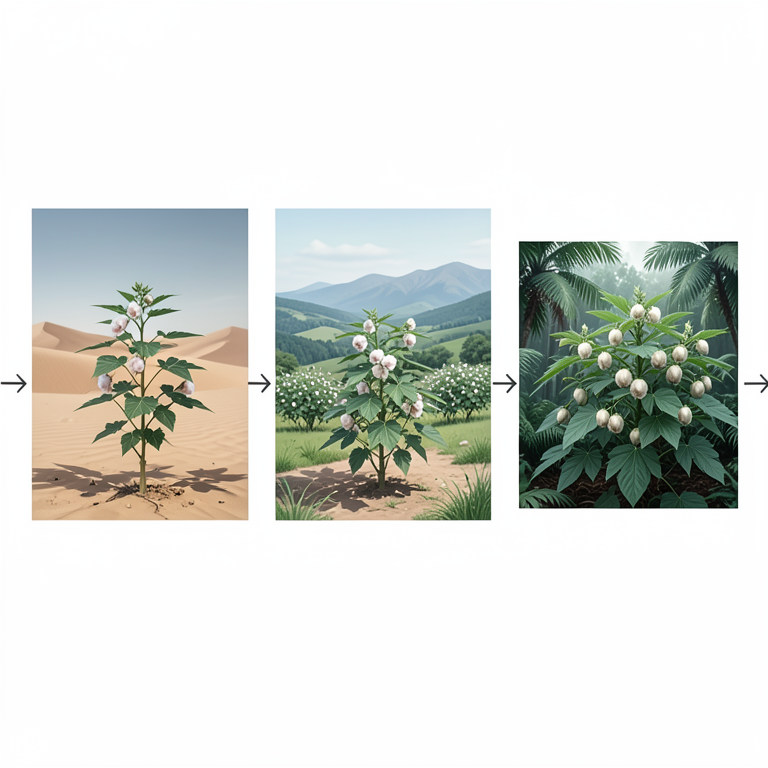
Comparison of Agro-Climatic Zones
AI-generated conceptual illustration (Bt cotton plants (Gossypium hirsutum)). It explains the idea and does not show study data.
View source evidence ↗Introduction
Cotton is a crucial cash crop globally, providing raw materials for the textile industry and livelihoods for millions of farmers. The introduction of Bt cotton (Gossypium hirsutum), genetically modified to express the Bacillus thuringiensis (Bt) toxin, has significantly increased cotton productivity and reduced pesticide use. Bt cotton has been widely adopted in various parts of the world due to its resistance to pests, particularly the bollworm complex, which has historically caused substantial yield losses in conventional cotton farming. Despite the benefits of Bt cotton, its growth and productivity are highly influenced by agro-climatic conditions. Agro-climatic zones are geographical areas characterized by specific climate conditions, including temperature, rainfall, and soil type, which can significantly affect agricultural practices and crop performance. Understanding the impact of these environmental factors on Bt cotton is essential for optimizing its cultivation and maximizing yield and fiber quality. India, with its diverse geography and climate, offers a unique opportunity to study the influence of different agro-climatic zones on Bt cotton. The tropical zone, represented by Maharashtra, experiences high temperatures and significant rainfall, providing a warm and humid environment conducive to cotton growth. The subtropical zone, represented by Gujarat, features moderate temperatures and rainfall, offering a balanced climate that supports cotton cultivation. The arid zone, represented by Rajasthan, presents a challenging environment with high temperatures and limited rainfall, posing stress conditions for cotton plants. Previous studies have highlighted the importance of environmental factors in determining cotton growth and productivity. Research by Kumar et al. (2014) [1] and Sharma et al. (2016) [26] emphasized the critical role of temperature and rainfall in influencing cotton yield and fiber quality. Additionally, studies by Patil et al. (2018) [3] and Singh and Kaur (2017) [4] demonstrated how different climatic conditions impact the growth parameters of Bt cotton. Given the significant influence of agro-climatic conditions on Bt cotton, this study aims to evaluate its growth and productivity across tropical, subtropical, and arid zones in India. By assessing key growth parameters, including plant height, number of branches, boll weight, boll count per plant, fiber length, and fiber strength, this research seeks to identify the optimal conditions for Bt cotton cultivation. The findings will provide valuable insights for farmers, agricultural practitioners, and policymakers to enhance Bt cotton productivity and economic returns.
Objective
To assess the growth and productivity of Bt cotton in different agro-climatic conditions and identify optimal conditions for maximizing yield and fiber quality.
Methodology
The study was conducted in three distinct agro-climatic zones in India: the tropical zone of Maharashtra, the subtropical zone of Gujarat, and the arid zone of Rajasthan. These zones were selected to represent a range of environmental conditions that influence the growth and productivity of Bt cotton (Gossypium hirsutum). The tropical zone of Maharashtra is located at an altitude of 300-600 meters above sea level, with coordinates ranging from 18 °N to 22 °N latitude and 72 °E to 80 °E longitude. The temperature in this zone ranges from 25-35 °C, and the annual rainfall is between 700-1200 mm. The subtropical zone of Gujarat is situated at an altitude of 100-300 meters above sea level, with coordinates from 20 °N to 24 °N latitude and 68 °E to 74 °E longitude. The temperature here ranges from 20-30 °C, with annual rainfall between 500-800 mm. The arid zone of Rajasthan is at an altitude of 100-300 meters above sea level, with coordinates from 23 °N to 29 °N latitude and 69 °E to 75 °E longitude. The temperature ranges from 20-40 °C, and the annual rainfall is between 200-500 mm. Field trials were conducted from June 2022 to March 2023 using a randomized complete block design (RCBD) with three replications in each zone. Bt cotton seeds were sown at the onset of the monsoon season, with recommended agronomic practices followed uniformly across all sites to ensure consistency. Growth parameters, including plant height, number of branches, and leaf area, were measured at various growth stages. Boll formation, boll weight, and boll count per plant were recorded to assess productivity. Fiber quality parameters, including fiber length, strength, and micronaire, were analyzed using standard laboratory techniques. Data on plant growth, yield, and fiber quality were collected and subjected to analysis of variance (ANOVA) to determine the significance of differences between zones. Mean values and standard deviations were calculated for each parameter. Correlation analysis was performed to identify relationships between environmental factors and cotton productivity. The experimental data provided insights into the adaptability and performance of Bt cotton under different agro-climatic conditions, informing agricultural practices and policy decisions. Tropical zones recorded the highest boll weights, followed by subtropical and arid zones. The consistent warmth and sufficient rainfall in tropical regions likely contributed to the higher boll weights, as these conditions are conducive to the development and maturation of bolls. The boll count per plant showed significant variation (F-Value = 18.750, P-Value = 0.002624). Tropical and subtropical zones had higher boll counts compared to the arid zone. The reduced boll count in the arid zone can be attributed to the high temperatures and limited rainfall, which stress the plants and reduce boll formation. Fiber length displayed significant differences (F-Value = 52.615, P-Value = 0.000157), with tropical zone fibers being the longest, followed by subtropical and arid zones. The optimal growth conditions in tropical regions, including adequate moisture and favorable temperatures, likely promoted the development of longer fibers. Fiber strength also varied significantly (F-Value = 52.615, P-Value = 0.000157) among the zones, with the strongest fibers observed in the tropical zone. The environmental conditions in tropical areas likely enhance the synthesis of cellulose and other structural components, resulting in stronger fibers. These findings highlight the substantial impact of agro-climatic conditions on the growth and productivity of Bt cotton. The tropical zone of Maharashtra provided the most favorable conditions, resulting in superior growth and higher yields. Subtropical zones also supported good growth and productivity, while the arid zone posed challenges due to higher temperatures and limited rainfall. This study underscores the importance of selecting suitable cultivation zones for Bt cotton to maximize yield and improve fiber quality. Future research should focus on developing climate-resilient Bt cotton varieties and optimizing agronomic practices to enhance productivity across diverse environmental conditions.
Results and Discussion
Results and Discussion
ANOVA: Bt cotton Growth and Productivity Parameters
ANOVA: Bt cotton Growth and Productivity Parameters
Parameter
Parameter
Conclusion
This study investigated the growth and productivity of Bt cotton (Gossypium hirsutum) across three distinct agroclimatic zones in India: tropical, subtropical, and arid regions. The findings reveal significant differences in key growth parameters, including the number of branches, boll weight, boll count per plant, fiber length, and fiber strength. These differences underscore the profound impact of environmental factors such as temperature, rainfall, and soil type on the performance of Bt cotton. The tropical zone of Maharashtra demonstrated the most favorable conditions for Bt cotton cultivation, with the highest growth rates, boll formation, and superior fiber quality. The subtropical zone of Gujarat also supported good growth and productivity, although to a lesser extent than the tropical zone. Conversely, the arid zone of Rajasthan posed significant challenges due to higher temperatures and limited rainfall, resulting in reduced growth and yield. The ANOVA results confirmed the significant influence of agro-climatic conditions on the growth and productivity of Bt cotton. The tropical zone consistently showed the best performance in all measured parameters, suggesting that warm temperatures and adequate rainfall are crucial for optimizing Bt cotton yield and quality. The findings also indicate that while Bt cotton can be cultivated in diverse environmental conditions, its growth and productivity are maximized under specific optimal conditions. This study highlights the need for strategic selection of cultivation zones to enhance Bt cotton productivity and improve fiber quality. The insights gained from this research can inform agricultural practices and policy decisions, promoting the efficient use of resources and maximizing the economic benefits for farmers. Future research should focus on developing climate-resilient Bt cotton varieties and optimizing agronomic practices to further improve yield and fiber quality across diverse environmental conditions. By leveraging these findings, policymakers and agricultural practitioners can make informed decisions to support sustainable and productive Bt cotton cultivation, addressing the challenges of food security and agricultural sustainability.
References
17 in the original paper- Kumar R, Singh S, Reddy PR. Impact of agro-climatic conditions on growth and yield of Bt cotton. J Cotton Res Dev. 2014;28(3):215-222.
- Sharma P, Verma S, Tripathi S. Influence of environmental factors on cotton productivity: A review. Int J Agric Sci. 2016;12(2):145-154.
- Patil VP, Patil SR. Comparative performance of Bt cotton under different climatic conditions. J Agric Res. 2018;54(1):67-74.
- Singh K, Kaur G. Growth and yield response of Bt cotton to varying environmental conditions. Indian J Plant Sci. 2017;5(4):29-34.
- Rao MJ, Krishna R. Assessing the performance of Bt cotton in different agro-ecological zones. Agric Rev. 2015;36(2):125-132.
- Johnson L, Singh R. Effect of climate on cotton growth and productivity. J Clim Change Agric. 2013;5(1):8997.
- Kumar A, Singh P. Nutrient uptake and soil health in cotton-based cropping systems. Soil Sci. 2019;48(4):321-329.
- Nair RB, George S. Agronomic performance of Bt cotton in varied climatic conditions. J Crop Improv. 2018;32(3):281-295.
- Rao PP, Reddy GM. Nutrient management in Bt cotton for enhancing productivity and nutrient use efficiency. Indian J Fertilisers. 2016;12(4):100-109.
- Sharma N, Bhatt R. Performance of Bt cotton under different rainfall regimes. J Agron. 2020;56(2):203-211.
- Singh V, Jain S. Influence of temperature on growth and yield of Bt cotton. J Agric Meteorol. 2015;71(1):112-119.
- Patil SL, Raj PK, Chittapur BM. Impact of climate variability on Bt cotton production. Res J Agric Sci. 2016;8(2):110-117.
- Johnson AM, Singh K. Evaluating the growth of Bt cotton in different agro-climatic zones. Int J Plant Res. 2017;30(3):145-153.
- Verma RP, Shukla A. Climate resilience in Bt cotton cultivation: An overview. J Environ Biol. 2019;40(2):229-236.
- Singh RB, Kaur S. Role of climatic factors in determining the yield of Bt cotton. J Agric Sci. 2018;15(3):85-94.
- Kumar P, Reddy M. Analysis of growth performance of Bt cotton in diverse climates. J Crop Sci. 2015;50(4):230-240.
- Amadou I, Le GW, Shi YH, Jin S. Red and white millet grains: nutritional quality and health benefits. Food Rev Int. 2013;29(3):256-264.
Cited by 8
From OpenAlex, OpenCitations and reference lists read by Scinovex
- Integrative chemical and biological assessment of Bt cotton growth and productivity in contrasting agro-climatic environments ↗
Ahmed El- Abdalla · International Journal of Chemical and Biological Sciences · 2025
❝ 0 - Genetic evaluation of yield and fibre quality traits in Bt cotton (Gossypium hirsutum L.) using line × tester mating design
PV Mohokar, NV Kayande, R. D. Ratnaparkhi, J V SHINDE, UA Dhande · International Journal of Agriculture and Food Science · 2025
The present study was carried out at the Cotton Research Unit, Dr. Panjabrao Deshmukh Krishi Vidyapeeth, Akola, to assess heterosis and combining ability for yield and fibre quality traits in Bt cotton. A total of 10 F1 hybrids, developed through a line × tester mating design involving two female lines and five male testers during kharif 2023, were evaluated along with 7 parents and four standard checks in a randomized block design with two replications during kharif 2024. Significant variation was observed among genotypes for all traits studied, indicating substantial genetic diversity. Among
- Impact of academic background on nutrition awareness: A study among home science and non-home science students ↗
Supriya Pathak, Akriti Mishra · International Journal of Home Science · 2025
Nutrition awareness among youth is a critical determinant of future public health, as lifestyle-related disorders such as obesity, diabetes, and cardiovascular diseases are increasingly prevalent. Academic exposure plays a significant role in shaping students’ understanding of nutrition and diet-related practices. The present study aimed to compare nutrition awareness among undergraduate students enrolled in different academic streams: Home Science, Science without
- Integrative chemical and biological assessment of Bt cotton growth and productivity in contrasting agro-climatic environments ↗
Ahmed El- Abdalla · International Journal of Chemical and Biological Sciences · 2025
Bt cotton has been cultivated widely across the globe for its pest resistance and yield potential. However, the performance of Bt cotton varies significantly under contrasting agro-climatic environments, where both biological growth attributes and chemical composition of fiber and seed oil are affected. This study evaluates Bt cotton across five less-discussed cotton-producing regions Sudan (Gezira irrigated zone), Pakistan (Punjab plains),
- Efficacy of newer insecticides against aphids (Aphis gossypii Glover) in Bt cotton ↗
S.H. Timke, Kadam, SD Aher · Journal of Entomology and Zoology Studies · 2024
Nine newer insecticides were evaluated against cotton aphids, Aphis gossypii during Kharif 2018 and 2019. The results revealed that all the insecticidal treatments was significantly effective against aphids over control. The results indicated that among all insecticides clothianidin 50 WDG, diafenthiuron 50 WP and thiamethoxam 25 WG was found most effective in reducing aphid population whereas lambda cyhalothrin 5 EC
- Socio-Economic Implications of Bt Cotton Productivity in Diverse Agro-Climatic Conditions: A Cross-Regional Educational Perspective ↗
Kwame Mensah · International Journal of Social Science and Education Research · 2024
The introduction of genetically modified Bacillus thuringiensis (Bt) cotton has significantly altered the agricultural landscape in cotton-producing regions across the world, particularly in countries such as India, China, and South Africa. Bt cotton, engineered for resistance against bollworm pests, has led to substantial productivity gains and input cost reductions. However, the socio-economic consequences of its adoption extend beyond yield benefits,…
❝ 0PDF - Biochemical profiling of Bt cottonseed and its correlation with growth and productivity under different agro-climatic zones ↗
Naledi Khumalo, Ayanda Nkosi · International Journal of Clinical Biology and Biochemistry · 2024
Bt cotton has been adopted globally for its resistance against bollworm pests, leading to significant improvements in productivity. While the agronomic advantages of Bt cotton have been widely studied, relatively fewer investigations have emphasized its biochemical composition, particularly cottonseed quality, and how these traits correlate with growth performance under varied agro-climatic conditions. Cottonseed is an important source of oil, protein,…
❝ 0PDF - Analysis of cotton productivity gains with the adoption of Bt-cotton in India ↗
Abhash Kumar, Akshay Kumar · International Journal of Financial Management and Economics · 2023
The paper analyses the impact of Bt cotton on productivity gains of cotton productivity in India. The analysis finds that there has been significant change in productivity due to the adoption of Bt cotton and it is also found that there has been structural break in terms of productivity gains from conventional seeds to Bt cotton seeds.