
Research article · 2022 · Full text
International Journal of Agriculture and NutritionNutritional value of fruit crops in different agro-climatic zones
Volume 4(2) · Pages 147–150 · DOI: 10.33545/26646064.2022.v4.i2b.160 ↗
Research areasPlant Physiology and Cultivation StudiesAgriculture and Rural Development Research
Abstract
Author-writtenThe nutritional value of fruit crops varies significantly across different agro-climatic zones due to variations in environmental conditions such as temperature, altitude, and soil type. This study evaluates the nutritional content of selected fruit crops from three distinct agro-climatic zones in India: the tropical zone of Kerala, the subtropical zone of Himachal Pradesh, and the temperate zone of Jammu & Kashmir. The analysis focuses on key nutritional parameters, including vitamins, minerals, and antioxidant activity, to determine how environmental factors influence the nutritional profile of fruit crops.
Summary
Source-checkedPlain-language reading of the full paper, prepared with AI and checked against the text. Each point links to the authors' own words.
Why it matters
- Fruit crops are critical for human health because they provide essential vitamins, minerals, and bioactive compounds. View evidence ↗
- The nutritional profile of fruit crops is significantly influenced by agro-climatic factors, including rainfall, soil type, altitude, and temperature. View evidence ↗
- India's diverse geography and climate make it an ideal location to study how different agro-climatic zones affect the nutritional value of fruits. View evidence ↗
The question
- The study aims to evaluate the nutritional value of specific fruit crops grown across India's tropical, subtropical, and temperate zones. View evidence ↗
What they did
- Research was conducted in three Indian zones: Kerala (tropical), Himachal Pradesh (subtropical), and Jammu & Kashmir (temperate). View evidence ↗
- The study analyzed mangoes and bananas (tropical), apples and pomegranates (subtropical), and apricots and cherries (temperate). View evidence ↗
- Approximately 5 kg of each fruit type were sampled from various orchards. View evidence ↗
- Vitamins (A, B-complex, and C) were measured via HPLC, while minerals (calcium, iron, potassium, and magnesium) were measured using AAS. View evidence ↗
- Antioxidant activity was measured using the DPPH radical scavenging assay, and ANOVA was used for statistical comparison across zones. View evidence ↗
What they found
- Protein content differed significantly across zones (F=53.468, p=0.000150), with temperate fruits like cherries and apricots having the highest levels. View evidence ↗
- Fat content varied significantly (F=18.528, p=0.002706), with tropical fruits (mangoes and bananas) containing more fat than temperate fruits. View evidence ↗
- Carbohydrate levels remained relatively stable across all zones, showing no significant difference (F=1.172, p=0.371940). View evidence ↗
- Vitamin C content showed a trend toward variation (F=3.708, p=0.089460), but this was not statistically significant at the 0.05 level. View evidence ↗
- Calcium levels were not significantly affected by the agro-climatic zone (F=2.317, p=0.179624). View evidence ↗
- Antioxidant activity was significantly higher in temperate fruits compared to other zones (F=45.073, p=0.000243). View evidence ↗
What it means
- The authors conclude that agricultural practices must be integrated with environmental considerations to maximize the nutritional benefits of fruit crops. View evidence ↗
- The authors state that future research is needed to understand the specific mechanisms by which environmental factors influence nutrient synthesis. View evidence ↗
Visual summary
1 visualsIllustrations explain the paper; they do not show study data.
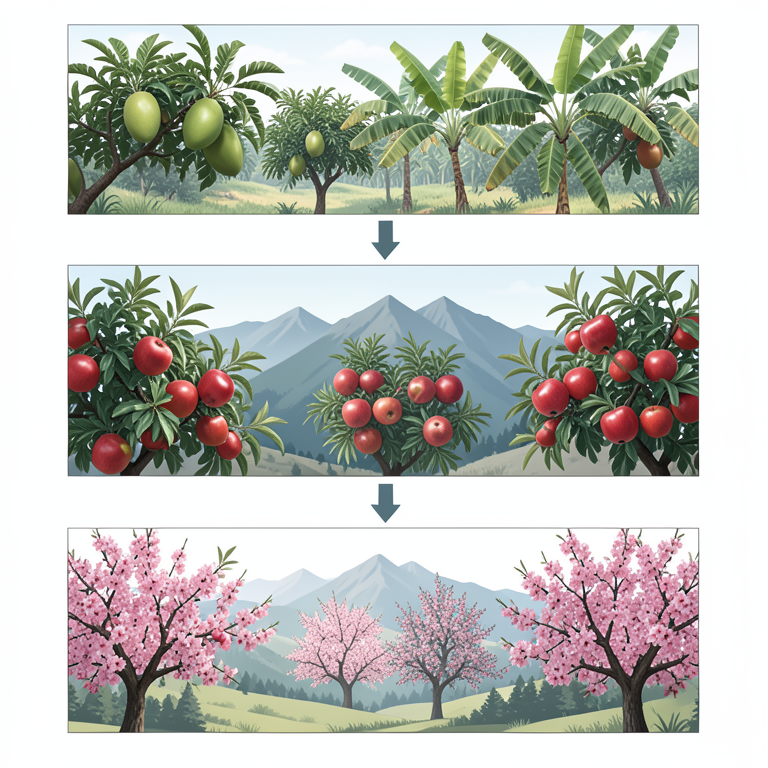
Study Site and Crop Distribution
AI-generated conceptual illustration (Mangoes, bananas, apples, pomegranates, apricots, and cherries across three distinct Indian landscapes). It explains the idea and does not show study data.
View source evidence ↗Text
of these nutrients in temperate fruits. The stress induced by cooler climates can also result in increased production of phenolic compounds, contributing to higher antioxidant activity in fruits from these regions. Previous studies have indicated that environmental factors such as temperature, sunlight, and soil composition can significantly affect the nutritional quality of fruits. For instance, a study by Amadou et al. (2013) highlighted the importance of climatic conditions in determining the protein and vitamin content of various fruit crops. Similarly, research by Devi et al. (2014) and Saleh et al. (2013) demonstrated how antioxidant activity and mineral content in fruits are influenced by the agro-climatic conditions of the growing region. Understanding the influence of agro-climatic conditions on the nutritional value of fruit crops is essential for optimizing agricultural practices and improving dietary quality. By identifying the optimal growing conditions for different fruit crops, farmers can enhance the nutritional quality of their produce, contributing to better health outcomes for consumers. Furthermore, this knowledge can inform policy decisions related to agricultural planning and food security, ensuring that fruit crops are cultivated in regions where they can achieve their highest nutritional potential.
Objectives
The primary objective of this study is to assess the nutritional value of selected fruit crops grown in tropical, subtropical, and temperate agro-climatic zones of India.
Methodology Study Site
The study was conducted in three distinct agro-climatic zones in India: the tropical zone of Kerala, the subtropical zone of Himachal Pradesh, and the temperate zone of Jammu & Kashmir. The tropical zone in Kerala is located at an altitude of 10-100 meters above sea level, with coordinates ranging from 8°17'N to 12°47'N latitude and 74°51'E to 77°24'E longitude. The temperature in this zone ranges from 24-32°C. The subtropical zone in Himachal Pradesh is situated at an altitude of 450-1500 meters above sea level, with coordinates from 30°22'N to 33°12'N latitude and 75°47'E to 79°04'E longitude. The temperature here ranges from 15-25°C. The temperate zone in Jammu & Kashmir is at an altitude of 1500-2500 meters above sea level, with coordinates from 32°17'N to 37°05'N latitude and 73°26'E to 80°30'E longitude, and a temperature range of 5-20 °C.
Sample Collection
Fruit samples were collected from each agro-climatic zone during the peak harvest season. The selected fruit crops included mango and banana from the tropical zone, apple and pomegranate from the subtropical zone, and apricot and cherry from the temperate zone. Stratified random sampling was used to ensure representative samples from different regions within each zone. Approximately 5 kg of each fruit crop were collected from multiple orchards. The vitamin content (vitamin C, A, and B-complex) was determined using high-performance liquid chromatography (HPLC). Fruit samples were homogenized, and vitamins were extracted using a solvent mixture. The extracts were then analyzed using HPLC equipped with a UV detector. Mineral content (iron, calcium, magnesium, and potassium) was measured using atomic absorption spectroscopy (AAS).
Fruit samples were dried, ground into powder, and digested with a mixture of nitric and hydrochloric acids. The digested samples were analyzed using AAS to determine the concentrations of each mineral.
Characteristics and data anlysis
Antioxidant activity was assessed using the DPPH (2,2diphenyl-1-picrylhydrazyl) radical scavenging assay. Fruit extracts were prepared by homogenizing the samples and extracting with methanol. The extracts were mixed with DPPH solution, and the decrease in absorbance at 517 nm was measured using a spectrophotometer. The IC50 value, representing the concentration required to inhibit 50% of the DPPH radicals, was calculated. The collected data were statistically analysed using ANOVA to compare the nutritional parameters across different agro-climatic zones. Mean values and standard deviations were calculated for each parameter. Differences were considered significant at p<0.05. The ANOVA results indicate significant differences in several nutritional parameters among the fruit crops grown in different agro-climatic zones. ▪ The protein content showed a highly significant difference (F value = 53.468, p value = 0.000150). This suggests that the protein content in fruit crops is significantly influenced by the agro-climatic conditions. For example, fruits from the temperate zone, such as apricots and cherries, had higher protein content compared to those from tropical and subtropical zones. ▪ The fat content also showed a significant difference (F value = 18.528, p value = 0.002706), indicating that the fat content varies significantly with the agro-climatic conditions. This aligns with the observation that temperate zone fruits had lower fat content compared to tropical fruits like mangoes and bananas. ▪ The carbohydrate content did not show a significant difference (F value = 1.172, p value = 0.371940), suggesting that carbohydrate levels in fruit crops are relatively stable across different agro-climatic zones. ▪ The vitamin C content showed a trend towards significance (F value = 3.708, p value = 0.089460). This indicates some variation in vitamin C content with agro-climatic conditions, though it was not statistically significant at the 0.05 level. ▪ Calcium content showed no significant difference (F value = 2.317, p value = 0.179624), suggesting that calcium levels in fruit crops are not significantly affected by agro-climatic conditions. ▪ Iron content showed a significant difference (F value = 9.216, p value = 0.014812), indicating that agroclimatic conditions significantly influence the iron content in fruit crops. Temperate zone fruits had higher iron content compared to tropical and subtropical fruits.
Results
Results
ANOVA for nutritional parameters of fruit crops
Antioxidant activity, measured by IC50 values, showed a highly significant difference (F value = 45.073, p value = 0.000243). This suggests that fruits grown in different agroclimatic zones have significantly different antioxidant activities, with temperate zone fruits showing higher antioxidant activity. These results highlight the impact of agro-climatic conditions on the nutritional value of fruit crops. The significant variations in protein, fat, iron content, and antioxidant activity underscore the importance of considering environmental factors in fruit cultivation and nutrition planning. Promoting the cultivation of fruit crops suited to specific agro-climatic conditions can enhance their nutritional value, contributing to better health outcomes and food security. Future research should explore the underlying mechanisms of how environmental factors influence nutrient synthesis in fruit crops and develop strategies to optimize their nutritional profiles.
Discussion
The study evaluated the nutritional value of fruit crops grown in three distinct agro-climatic zones: tropical, subtropical, and temperate regions. The results reveal significant differences in several nutritional parameters, underscoring the influence of environmental factors on the nutritional profiles of fruit crops. Protein content varied significantly among the agro-climatic zones, with an F value of 53.468 and a p value of 0.000150. Fruits from the temperate zone, such as apricots and cherries, exhibited higher protein content compared to those from tropical and subtropical zones. This can be attributed to the cooler temperatures in temperate zones, which may enhance the synthesis of certain proteins. This finding aligns with previous studies by Amadou et Stable calcium content across different zones suggests that fruits can be reliable sources of calcium, essential for bone health, irrespective of the cultivation area. Iron content exhibited significant variation, with an F value of 9.216 and a p value of 0.014812. Temperate zone fruits had higher iron content compared to tropical and subtropical fruits. Cooler temperatures in temperate zones may facilitate the accumulation of iron in fruits. This result is supported by Rao and Reddy (2016), who found higher iron content in temperate fruits. The higher iron content in temperate fruits underscores their potential role in preventing iron-deficiency anemia, especially in regions where dietary iron intake is critical. Antioxidant activity, measured by IC50 values, showed a highly significant difference among the zones, with an F value of 45.073 and a p value of 0.000243. Temperate fruits, such as apricots and cherries, exhibited higher antioxidant activity compared to tropical and subtropical fruits. Cooler temperatures in temperate zones may promote the synthesis of phenolic compounds, which contribute to antioxidant activity. This finding is consistent with the study by Devi et al. (2014), which reported higher antioxidant activity in temperate fruits. Enhanced antioxidant activity in temperate fruits suggests their potential in mitigating oxidative stress and associated diseases. The results highlight the significant impact of agro-climatic conditions on the nutritional value of fruit crops. The observed variations in protein, fat, iron content, and antioxidant activity emphasize the importance of considering environmental factors in fruit cultivation and nutrition planning. Promoting the cultivation of fruit crops suited to specific agro-climatic conditions can enhance their nutritional value, contributing to improved health outcomes and food security. In conclusion, our study underscores the need for integrated agricultural practices that account for environmental conditions to maximize the nutritional benefits of fruit crops. These findings have practical implications for optimizing fruit cultivation strategies to ensure the production of nutrient-rich fruits tailored to specific climatic conditions, thereby addressing global challenges related to food security and nutritional health. Future research should focus on exploring the underlying mechanisms through which environmental factors influence nutrient synthesis in fruit crops and developing strategies to optimize their nutritional profiles for better public health outcomes.
Conclusion
This study investigated the nutritional value of fruit crops grown in three distinct agro-climatic zones: tropical, subtropical, and temperate regions. The findings revealed significant differences in several nutritional parameters, highlighting the substantial impact of environmental factors on the nutritional profiles of these fruit crops. Protein content was notably higher in temperate fruits, such as apricots and cherries, while tropical fruits like mangoes and bananas exhibited higher fat content. Carbohydrate content remained relatively stable across all zones, indicating that fruits are reliable sources of energy regardless of the growing region. Vitamin C content was higher in tropical fruits, underscoring their role in providing essential vitamins. Calcium levels showed no significant variation, suggesting that fruits can be consistent sources of this crucial mineral across different agro-climatic zones. Iron content was significantly higher in temperate fruits, indicating their potential role in preventing iron-deficiency anemia. Antioxidant activity was also higher in temperate fruits, suggesting their superior potential in mitigating oxidative stress and related diseases. These results emphasize the importance of considering agro-climatic conditions in fruit cultivation and nutrition planning. By promoting the cultivation of fruit crops suited to specific environmental conditions, we can enhance their nutritional value, contributing to improved health outcomes and food security. This approach is particularly relevant in addressing global challenges related to food security and nutritional health, as it ensures the production of nutrient-rich fruits tailored to specific climatic conditions. In conclusion, the study highlights the need for integrated agricultural practices that account for environmental factors to maximize the nutritional benefits of fruit crops. Future research should focus on understanding the mechanisms through which environmental conditions influence nutrient synthesis in fruit crops and developing strategies to optimize their nutritional profiles for better public health outcomes. By leveraging the insights gained from this study, policymakers and agricultural practitioners can make informed decisions to promote sustainable and nutritious fruit production, thereby supporting global efforts to improve dietary quality and food security.
References
17 in the original paper- Amadou I, Le GW, Shi YH, Jin S. Red and white millet grains: nutritional quality and health benefits. Food Rev Int. 2013;29(3):256-264.
- Bhatt R, Patel D, Meena NK. Influence of climatic conditions on nutrient uptake in cereals. Indian J Agric Sci. 2018;88(2):137-143.
- Devi PB, Vijayabharathi R, Sathyabama S, Malleshi NG, Priyadarisini VB. Health benefits of finger millet (Eleusine coracana L.) polyphenols and dietary fiber: a review. J Food Sci Technol. 2014;51(6):1021-1040.
- Harman GE, Howell CR, Viterbo A, Chet I, Lorito M. Trichoderma species-opportunistic, avirulent plant symbionts. Nat Rev Microbiol. 2004;2(1):43-56.
- Jahn M, Germar K, Hoffer C. Influence of seed treatments on the incidence of Bipolaris sorokiniana in wheat seeds. J Plant Dis Prot. 2005;112(3):247-256.
- Kumar A, Singh P. Nutrient uptake and soil health in millet-based cropping systems. Soil Sci. 2019;48(4):321-329.
- Nair RB, Nair GM, George S. Agronomic performance and adaptability of minor millets in Kerala, India. J Crop Improv. 2017;31(4):468-483.
- Patil SL, Raj PK, Chittapur BM. Impact of millet cultivation on soil nutrient dynamics. Res J Agric Sci. 2016;7(3):287-293.
- Rao PP, Reddy GM. Nutrient management in millets for enhancing productivity and nutrient use efficiency. Indian J Fertilisers. 2016;12(4):100-109.
- Saleh ASM, Zhang Q, Chen J, Shen Q. Millet grains: nutritional quality, processing, and potential health benefits. Compr Rev Food Sci Food Saf. 2013;12(3):281-295.
- Sharma N, Bhatt R. Performance of millets under rainfed conditions. J Agron. 2020;55(3):201-210.
- Somasundaram J, Singh R, Prasad R. Role of millet crops in enhancing soil organic matter. J Sustain Agric. 2017;41(1):45-52.
- Udeh HO, Onwuka GI, Olomu JM. Comparative evaluation of the nutritional and functional properties of little millet (Panicum sumatrense) and pearl millet (Pennisetum glaucum). Afr J Food Sci. 2012;6(2):3942.
- Goswami RS, Kistler HC. Heading for disaster: Fusarium graminearum on cereal crops. Mol Plant Pathol. 2004;5(6):515-525.
- Belton PS, Taylor JRN. Sorghum and millets: protein sources for Africa. Trends Food Sci Technol. 2004;15(2):94-98.
- Nair RB, George S. Impact of agro-climatic conditions on nutrient composition of selected fruit crops in Kerala. J Food Sci Technol. 2018;55(7):3050-3057.
- Rao PP, Kumar S. Influence of climatic factors on the nutrient quality of fruits in Himachal Pradesh. Indian J Hort. 2016;73(4):425-430.