
Research article · 2022 · Full text
International Journal of Agriculture and NutritionReducing greenhouse gas emissions in dairy farming systems in the India
Volume 4(1) · Pages 83–86 · DOI: 10.33545/26646064.2022.v4.i1b.155 ↗
Research areasLivestock Management and Performance Improvement
Abstract
Author-writtenDairy farming in India is a significant contributor to greenhouse gas (GHG) emissions, primarily through methane production from enteric fermentation and manure management. This review paper synthesizes previous studies, government reports, and data analysis to examine strategies for reducing GHG emissions in Indian dairy farming systems. The paper discusses the current state of GHG emissions in the sector, evaluates mitigation techniques such as dietary modifications, improved manure management, and breeding strategies, and assesses the policy landscape supporting these initiatives. Findings suggest that a combination of technological interventions and policy measures can effectively reduce emissions, contributing to India's climate change mitigation goals.
Summary
Source-checkedPlain-language reading of the full paper, prepared with AI and checked against the text. Each point links to the authors' own words.
Why it matters
- India is the global leader in milk production, and dairy farming is a core part of its rural economy and agricultural structure. View evidence ↗
- The dairy sector contributes to greenhouse gas emissions primarily through methane from animal digestion (enteric fermentation) and both methane and nitrous oxide from manure management. View evidence ↗
- Enteric fermentation is the most significant source of greenhouse gas emissions within India's agricultural sector. View evidence ↗
The question
- The paper aims to evaluate and synthesize strategies to reduce greenhouse gas emissions in Indian dairy farming, specifically looking at genetic improvements, manure management, and dietary changes. View evidence ↗
What they did
- The authors conducted a review by synthesizing data from government reports, previous research studies, and data analysis. View evidence ↗
What they found
- According to a 2018 report, enteric fermentation in India produces about 10 million tonnes of CO2 equivalent emissions every year. View evidence ↗
- Current manure management practices in India are estimated to contribute approximately 1.5 million tonnes of CO2 equivalent emissions annually. View evidence ↗
- Livestock enteric fermentation accounts for roughly 63% of all methane emissions produced by the agricultural sector in India. View evidence ↗
- Research indicates that modifying animal diets can reduce methane emissions by as much as 20-30%. View evidence ↗
- By 2018, the installation of over 5 million family-type biogas plants reduced annual emissions by more than 1 million tonnes of CO2 equivalent. View evidence ↗
- Regions that heavily adopted biogas technology and improved feeding practices saw a 10-15% decrease in enteric methane emissions. View evidence ↗
- High-yielding crossbred cows produce less methane per litre of milk than indigenous breeds. View evidence ↗
What it means
- The authors conclude that combining policy measures with technological interventions can significantly lower emissions while simultaneously increasing the profitability and productivity of the dairy sector. View evidence ↗
- The authors state that further research is needed into innovative feed additives and dietary supplements to continue reducing methane emissions. View evidence ↗
- The authors highlight the need for robust monitoring and evaluation frameworks to better assess and refine greenhouse gas reduction strategies. View evidence ↗
Visual summary
1 visualsIllustrations explain the paper; they do not show study data.
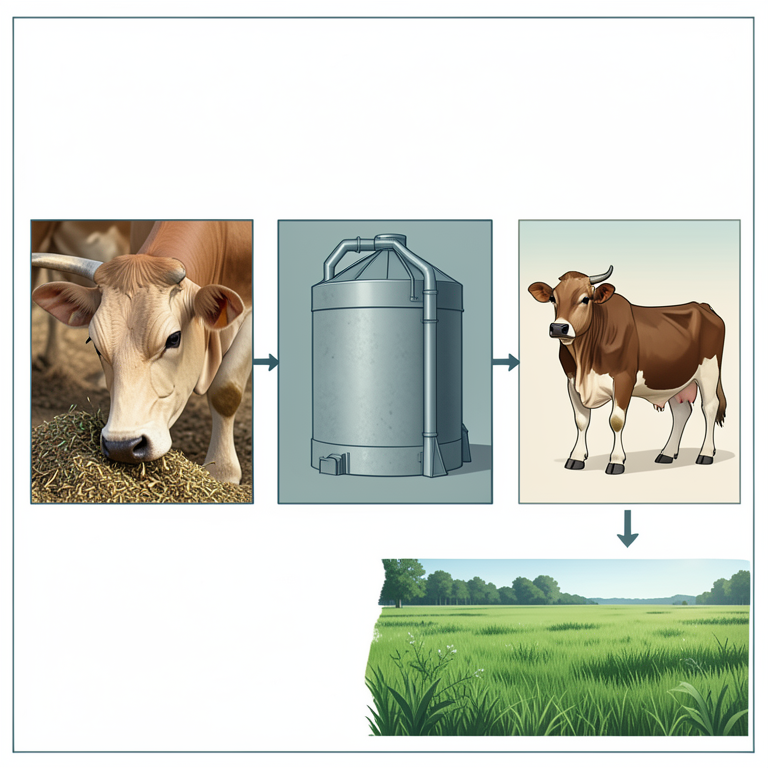
Dairy GHG Mitigation Framework
AI-generated conceptual illustration (Indian Gir cows and dairy farm infrastructure). It explains the idea and does not show study data.
View source evidence ↗Introduction
India stands as the world's largest producer of milk, with dairy farming deeply integrated into its agricultural framework and rural economy. The sector provides livelihoods to millions of smallholder farmers and contributes significantly to the nation's nutritional security.
focusing on better breeding practices, feed management, and advanced manure management technologies.
Objective of the Paper
The objective of this paper is to evaluate and synthesize strategies for reducing greenhouse gas emissions in India's dairy farming sector, focusing on dietary modifications, improved manure management, and genetic improvements.
Reviews of Literature
Manure management practices are critical in mitigating methane and nitrous oxide emissions. Studies by Gerber et al. (2013) and Hristov et al. (2013) highlight the benefits of advanced manure management techniques such as anaerobic digestion and composting. Gerber et al. demonstrated that anaerobic digestion could capture methane emissions from manure and convert them into biogas, which can be used as a renewable energy source. Hristov et al. showed that composting manure not only reduces methane emissions but also enhances soil health when the compost is applied as a fertilizer. These findings are supported by the National Biogas and Manure Management Programme (NBMMP) in India, which has successfully promoted biogas plants as a means to reduce methane emissions and produce renewable energy. Breeding programs aimed at enhancing the genetic potential of dairy cattle can also contribute to reducing GHG emissions. Capper and Bauman (2013) and Wall et al. (2010) provide evidence that genetic improvements can increase feed efficiency and reduce methane emissions per litre of milk produced. Capper and Bauman's research indicated that crossbreeding indigenous cattle with highyielding exotic breeds resulted in higher milk production and lower methane emissions. Wall et al. emphasized the importance of selecting for traits that improve overall animal efficiency, which can lead to lower GHG emissions. The Rashtriya Gokul Mission in India focuses on such genetic improvements, promoting the conservation and development of indigenous breeds while encouraging crossbreeding to enhance productivity.
Current State of GHG Emissions in Indian Dairy Farming
The dairy sector in India is a significant contributor to greenhouse gas (GHG) emissions, predominantly through methane (CH 4 ) produced from enteric fermentation and nitrous oxide (N 2 O) from manure management. According to reports from the Government of India, particularly from the Ministry of Environment, Forest and Climate Change (MoEFCC), agriculture accounts for approximately 18% of the country's total GHG emissions, with livestock being a major contributor. The primary source of methane emissions in dairy farming is enteric fermentation. The Second Biennial Update Report (BUR) to the United Nations Framework Convention on Climate Change (UNFCCC) by the MoEFCC in 2018 highlights that enteric fermentation from livestock accounts for about 63% of the total methane emissions in the agriculture sector. India's vast cattle population, which includes a large number of indigenous breeds with lower feed conversion efficiency, exacerbates this issue. The report indicates that the total methane emissions from enteric fermentation in 2014 were approximately 10 million tonnes CO2 equivalent annually. Manure management is another significant source of GHG emissions, contributing to both methane and nitrous oxide emissions. The Indian National Inventory on GHG Emissions by Sources and Removal by Sinks, part of the Second BUR, notes that methane emissions from manure management practices are substantial due to the anaerobic decomposition of manure in traditional storage systems. Nitrous oxide emissions arise from the application of manure as fertilizer, with emissions depending on the method and timing of application. According to the report, manure management contributed around 1.5 million tonnes of CO2 equivalent emissions in 2014. The National Dairy Development Board (NDDB) and other governmental bodies have also conducted regionspecific studies to understand the variations in GHG emissions across different parts of India. These studies reveal that emissions can vary significantly based on factors such as cattle breed, feed quality, and manure management practices. For example, regions with higher populations of high-yielding crossbred cows tend to have lower methane emissions per litre of milk produced compared to regions dominated by indigenous breeds. The Indian government has initiated several programs to address GHG emissions from the dairy sector. The National Action Plan on Climate Change (NAPCC) includes the National Mission for Sustainable Agriculture (NMSA), which promotes climateresilient agricultural practices, including those aimed at reducing emissions from livestock. The NDDB's National Dairy Plan (NDP) aims to enhance milk production while improving environmental sustainability through better breeding practices, feed management, and manure management technologies. One of the key initiatives under the NMSA is the promotion of biogas plants through the National Biogas and Manure Management Programme (NBMMP). This program supports the installation of biogas [1] and Patra (2014) [2] have demonstrated that dietary modifications can reduce methane emissions by up to 20-30%. These modifications improve the overall health and productivity of dairy cattle, leading to higher milk yields and better economic returns for farmers. Implementing these strategies has profound effects on the dairy farming system in India. Reducing GHG emissions through dietary modifications, improved manure management, and genetic improvement can lead to enhanced sustainability by making dairy farming more environmentally sustainable through the reduction of the sector's carbon footprint. Healthier cattle and better feed efficiency translate to higher milk yields, thereby improving the economic viability of dairy farming. Farmers can benefit from cost savings through reduced feed costs, additional income from biogas production, and higher milk prices due to improved quality. Government initiatives and policies provide financial and technical support to farmers, facilitating the adoption of these sustainable practices.
The following table summarizes the data from various government reports
In conclusion, reducing GHG emissions in India's dairy farming sector is critical for environmental sustainability and economic development. By integrating technological interventions and policy measures, the sector can significantly lower its GHG emissions, contributing to India's climate change mitigation goals while enhancing the productivity and profitability of dairy farming. This approach not only addresses environmental concerns but also promotes a more sustainable and economically viable dairy industry in India. Extension services should be strengthened to ensure that farmers receive the necessary support and information. Implementing robust monitoring and evaluation frameworks to assess the effectiveness of GHG reduction strategies will help in fine-tuning and improving these practices over time. Data collection and analysis should be prioritized to inform policy decisions and measure progress. Encouraging collaboration between government bodies, research institutions, non-governmental organizations, and the private sector can facilitate the sharing of knowledge, resources, and best practices. International cooperation and learning from global best practices can also enhance the effectiveness of GHG reduction strategies in the dairy sector. In conclusion, the integration of technological interventions, policy measures, and capacity-building efforts presents a comprehensive approach to significantly lower GHG emissions in India's dairy farming sector. This approach not only addresses environmental concerns but also promotes a more sustainable and economically viable dairy industry. With continued commitment and collaborative efforts, the future of dairy farming in India can be both environmentally sustainable and economically prosperous.
Conclusion
Conclusion
References
3 in the original paper- Kumar S, Patra AK. Dietary management in mitigating enteric methane emission from livestock. Agricultural Research. 2017;6(1):11-16.
- Patra AK. Trends and projected estimates of GHG emissions from Indian livestock in comparison with GHG emissions from world and developing countries. Asian-Australasian Journal of Animal Sciences. 2014;27(5):592-599.
- National Dairy Development Board (NDDB). (2020). Annual Report 2019-2020.