
Research article · 2023 · Full text
International Journal of Agriculture and NutritionImpact of drip irrigation on water use efficiency and yield in rice (Oryza sativa L.)
Volume 5(2) · Pages 106–109 · DOI: 10.33545/26646064.2023.v5.i2b.166 ↗
Research areasRice Cultivation and Yield ImprovementIrrigation Practices and Water Management
Abstract
Author-writtenRice (Oryza sativa L.) is a staple food crop for more than half of the world's population, predominantly grown in water-intensive paddy fields. However, increasing water scarcity due to climate change and competition for water resources necessitates the adoption of more efficient irrigation techniques. Drip irrigation, known for its high water use efficiency (WUE), is emerging as a viable alternative to traditional flood irrigation methods in rice cultivation. This review examines the impact of drip irrigation on water use efficiency and rice yield. It discusses the benefits, challenges, and potential strategies for optimizing drip irrigation in rice farming.
Summary
Source-checkedPlain-language reading of the full paper, prepared with AI and checked against the text. Each point links to the authors' own words.
Why it matters
- Rice is a critical global staple crop that supports over half of the world's population but typically requires water-intensive cultivation methods. View evidence ↗
- Climate change and competition for resources have increased water scarcity, making the adoption of efficient irrigation techniques necessary. View evidence ↗
- Traditional flood irrigation for rice is inefficient because it leads to substantial water loss via runoff, percolation, and evaporation. View evidence ↗
The question
- The objective of this review is to evaluate how drip irrigation affects water use efficiency (WUE) and yield in rice cultivation. View evidence ↗
What they did
- The authors conducted a review of existing literature to assess the benefits and challenges of drip irrigation in rice farming. View evidence ↗
What they found
- Research in the North China Plain showed that drip irrigation can reduce water usage by 40-50% while maintaining or increasing yields compared to flood irrigation. View evidence ↗
- In water-scarce regions of India, drip irrigation has been reported to reduce water use by up to 60% without compromising yields. View evidence ↗
- Field trials in India indicated that drip-irrigated rice can achieve yields similar to or higher than flood-irrigated fields using significantly less water. View evidence ↗
- Drip irrigation is associated with improved crop health and better nutrient uptake, which contributes to higher productivity. View evidence ↗
- Drip irrigation reduces the occurrence of diseases caused by excess moisture compared to traditional flooding. View evidence ↗
- Using drip systems for deficit irrigation improves water use efficiency by minimizing non-beneficial water losses. View evidence ↗
- The drier soil surface maintained by drip irrigation helps reduce weed pressure and the spread of certain diseases. View evidence ↗
- Drip irrigation can reduce labor requirements because the systems can be largely automated after installation. View evidence ↗
What it means
- The authors conclude that drip irrigation has significant potential to transform rice cultivation by improving water use efficiency and sustainability. View evidence ↗
- Based on observed positive outcomes, the authors recommend the broader adoption of drip irrigation in rice-producing regions. View evidence ↗
- High initial investment costs and maintenance requirements can be barriers to adoption for some farmers. View evidence ↗
- The authors state that more research and field trials are needed to optimize and adapt drip irrigation for various rice-growing conditions. View evidence ↗
Visual summary
1 visualsIllustrations explain the paper; they do not show study data.
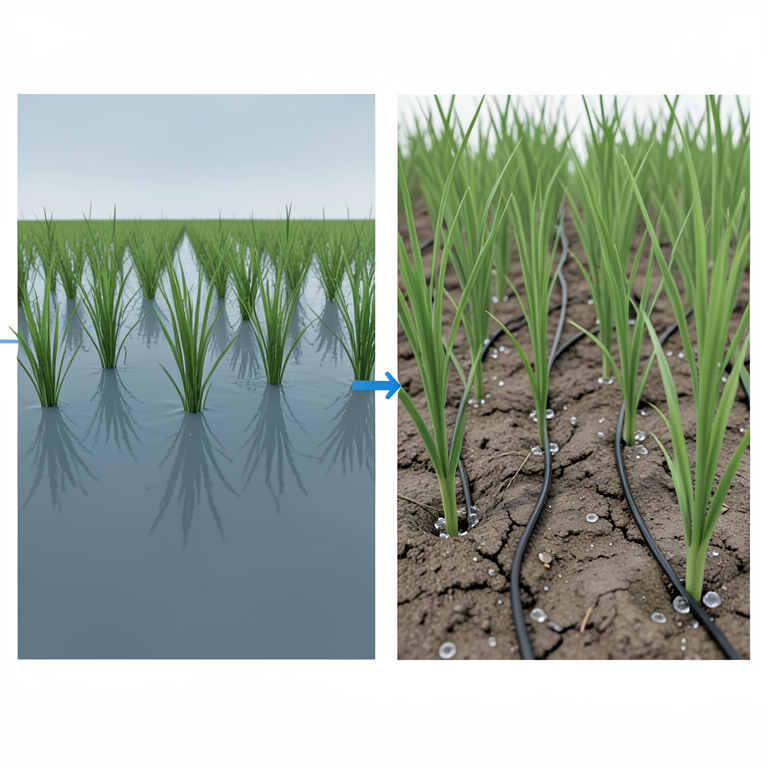
Comparison of Water Delivery Methods
AI-generated conceptual illustration (rice plants (Oryza sativa L.) in a field). It explains the idea and does not show study data.
View source evidence ↗Introduction
Rice (Oryza sativa L.) is one of the most important cereal crops globally, providing a primary food source for over half of the world's population. Traditionally, rice is cultivated in flooded fields, which requires substantial water resources. This method, while effective in controlling weeds and pests, is highly water-intensive and contributes to significant water loss through evaporation, percolation, and surface runoff. Given the increasing scarcity of freshwater resources, there is a critical need to explore more efficient irrigation methods to sustain rice production. Drip irrigation, a micro-irrigation technique that delivers water directly to the root zone of plants through a network of valves, pipes, tubing, and emitters, offers a promising solution. By minimizing water losses and providing precise water application, drip irrigation can significantly enhance water use efficiency (WUE) in rice cultivation. This review aims to assess the impact of drip irrigation on WUE and yield in rice, highlighting its potential benefits, challenges, and strategies for effective implementation.
Objective of the study
To evaluate the impact of drip irrigation on water use efficiency and yield in rice (Oryza sativa L.) cultivation, and to assess the potential benefits and challenges of adopting drip irrigation in rice farming based on a review of existing literature. Bouman et al. (2007) [1] explored the potential of alternative water-saving irrigation methods for rice, including drip irrigation. Their research highlighted the significant reduction in water usage achieved with drip systems compared to traditional flood irrigation, without compromising rice yields. This study set the groundwork for further exploration into the application of drip irrigation in rice cultivation. Li et al. (2015) [6] conducted a detailed study in the North China Plain, comparing the effects of drip irrigation and traditional flood irrigation on rice. They found that drip irrigation reduced water use by 40-50% and achieved similar or higher yields. This study emphasized the efficiency of drip irrigation in conserving water while maintaining crop productivity. Geerts and Raes (2009) [2] examined the concept of deficit irrigation as a strategy to improve WUE in dry areas. Their findings indicated that drip irrigation, when combined with deficit irrigation practices, significantly enhanced WUE by reducing non-beneficial water losses. This study provided insights into optimizing irrigation schedules for better resource management. Hira and Khera (2000) [3] reviewed water management practices in Indian rice cultivation, highlighting the inefficiencies of traditional flood irrigation. They advocated for the adoption of drip irrigation systems to address water scarcity and improve WUE. Their review emphasized the need for modern irrigation techniques in rice farming. Howell (2001) [4] discussed various methods to enhance WUE in irrigated agriculture, including the use of drip irrigation. The study underscored the importance of precise water delivery to the root zone, which is a key advantage of drip irrigation systems. This work provided a theoretical framework for understanding the benefits of drip irrigation. Zheng and Chen (2013) [7] compared different irrigation methods for rice and reported that drip irrigation significantly improved WUE and yield. Their research demonstrated that dripirrigated rice fields achieved higher productivity with less water, reinforcing the potential of this method for sustainable rice cultivation. Molden and Oweis (2007) [12] in their comprehensive assessment of water management in agriculture, highlighted the pathways for increasing agricultural water productivity. They identified drip irrigation as a critical technology for enhancing WUE in water-scarce regions. This assessment provided a global perspective on the importance of efficient irrigation practices. Basu and Mainuddin (2010) [9] modeled the impacts of climate change on hydrology and food production, emphasizing the need for adaptive irrigation strategies like drip irrigation. Their study suggested that drip irrigation could mitigate the adverse effects of climate change on rice production by improving WUE. Cantore et al. (2016) [10] investigated the influence of different drip irrigation regimes on the yield and quality of processing tomatoes, providing insights that can be applied to rice. Their findings on the optimization of water delivery schedules are relevant for improving WUE and yield in rice cultivation. Kumar and Ladha (2011) [11] reviewed recent developments in direct seeding of rice and discussed the integration of drip irrigation to improve WUE. Their review highlighted the synergistic benefits of combining modern agronomic practices with advanced irrigation techniques. Nguy-Robertson and Kovar (2015) [13] studied the effects of subsurface drip irrigation on water use and yield of corn, drawing parallels with rice cultivation. Their research on subsurface drip systems provided valuable information on optimizing water delivery to enhance crop performance. Patanè and Cosentino (2010) [14] examined the effects of soil water deficit on the yield and quality of processing tomatoes under a Mediterranean climate, offering insights into the benefits of drip irrigation under water-limited conditions. Their findings are applicable to rice, particularly in regions facing similar climatic challenges. Roth and Meyer (2009) [15] focused on monitoring soil erosion and conservation in lowland rice-based cropping systems in Southeast Asia using optical sensors. Their study underscored the role of modern technologies, including drip irrigation, in sustainable rice farming practices.
Reviews of Literature
Reviews of Literature
Drip Irrigation in Rice Cultivation
Drip irrigation, traditionally used for high-value horticultural crops, is increasingly being explored for rice (Oryza sativa L.) cultivation due to its potential to significantly improve water use efficiency (WUE).
Traditional rice farming methods involve continuous flooding, which ensures a stable water supply but also leads to substantial water losses through evaporation, percolation, and runoff. With water scarcity becoming a critical issue globally, researchers are investigating the viability of drip irrigation for rice to maintain productivity while conserving water.
Studies have shown promising results for drip irrigation in rice cultivation. For instance, research conducted in the North China Plain demonstrated that drip irrigation could reduce water usage by 40-50% compared to traditional flood irrigation, without compromising yield (Li et al., 2015) [6] . This significant reduction in water use is attributed to the precise delivery of water directly to the plant roots, minimizing losses. Furthermore, the uniform water distribution provided by drip systems ensures that all plants receive adequate moisture, reducing water stress and enhancing growth.
Field trials in India have also highlighted the potential of drip irrigation in rice. In these studies, drip-irrigated rice fields achieved similar or higher yields compared to floodirrigated fields while using significantly less water (Kijne et al., 2003) [5] . The studies noted that drip irrigation not only conserved water but also promoted better nutrient uptake and improved crop health, leading to higher productivity. Additionally, the method was found to reduce the incidence of diseases related to excess moisture, further supporting its adoption.
Water Use Efficiency in Rice Cultivation
Water use efficiency (WUE) is a critical parameter for sustainable agriculture, particularly in water-intensive crops like rice. Traditional flood irrigation methods have low WUE due to high water losses from evaporation, deep percolation, and surface runoff. Improving WUE in rice cultivation is essential for conserving water resources and maintaining crop productivity in the face of growing water scarcity.
Previous studies have consistently shown that drip irrigation can enhance WUE in rice cultivation. For example, a study by Geerts and Raes (2009) [2] demonstrated that deficit irrigation using drip systems improved WUE by reducing non-beneficial water losses. This method involves supplying water below the full crop water requirements, which encourages deeper root growth and improves the plant's ability to extract water from the soil. Similarly, research by Howell (2001) [4] indicated that advanced irrigation scheduling, combined with drip irrigation, could further enhance WUE. By monitoring soil moisture levels and adjusting irrigation schedules accordingly, farmers can ensure that water is applied precisely when and where it is needed, minimizing wastage. The use of soil moisture sensors and automated irrigation systems has been shown to increase WUE significantly.
Studies in various regions have also highlighted the potential of drip irrigation to improve WUE in rice cultivation. For instance, in water-scarce areas of India, drip irrigation systems have been reported to reduce water use by up to 60% while maintaining or increasing yields (Bouman et al., 2007) [1] . These findings underscore the importance of adopting efficient irrigation technologies to achieve
International Journal of Agriculture and Nutrition https://www.agriculturejournal.net sustainable water management in rice farming.
Benefits of Drip Irrigation in Rice Cultivation
Drip irrigation offers several benefits for rice cultivation, particularly in terms of water conservation, yield improvement, and disease management. By delivering water directly to the root zone, drip irrigation systems significantly reduce water losses from evaporation and runoff. This precise water application ensures that rice plants receive adequate moisture throughout their growth stages, leading to better water use efficiency.
One of the key benefits of drip irrigation is its ability to improve crop yields. Studies have shown that drip-irrigated rice fields often achieve higher or comparable yields to those of flood-irrigated fields while using less water (Zheng & Chen, 2013) [7] . This yield improvement is attributed to the consistent and optimal water supply provided by drip systems, which reduces water stress and promotes uniform plant growth. Additionally, drip irrigation allows for better nutrient management, as fertilizers can be applied directly through the irrigation system (fertigation), ensuring efficient nutrient uptake by plants.
Drip irrigation also helps in reducing the incidence of waterborne diseases and pests. Traditional flood irrigation creates a conducive environment for the growth of weeds and the spread of diseases. In contrast, drip irrigation maintains a drier soil surface, which can help reduce weed pressure and the prevalence of certain diseases (Hira & Khera, 2000) [3] . This reduction in disease incidence can lead to lower pesticide use, contributing to more sustainable farming practices. Moreover, the use of drip irrigation can lead to labor savings. Traditional flood irrigation requires significant labor for managing water levels and field maintenance. Drip irrigation systems, once installed, require less manual intervention and can be automated to a large extent, reducing the labor required for irrigation management.
Overall, the adoption of drip irrigation in rice cultivation presents a viable solution for improving water use efficiency, enhancing yields, and promoting sustainable agricultural practices. The benefits observed in various studies suggest that drip irrigation can play a crucial role in addressing the challenges of water scarcity and food security in rice-producing regions.
Conclusion
The adoption of drip irrigation in rice (Oryza sativa L.) cultivation presents a promising solution to the critical challenges of water scarcity and inefficient water use in traditional flood irrigation systems. This review highlights the substantial benefits of drip irrigation, including improved water use efficiency (WUE), enhanced crop yields, and reduced disease incidence. Drip irrigation systems deliver water directly to the root zone, minimizing losses from evaporation, deep percolation, and runoff.
Studies have consistently demonstrated that drip irrigation can reduce water use by 40-50% compared to traditional methods while maintaining or even increasing rice yields. The increased WUE achieved with drip irrigation is particularly important in regions facing severe water shortages. By ensuring that plants receive adequate moisture with minimal wastage, drip irrigation supports sustainable water management practices. Additionally, the uniform distribution of water in drip systems promotes uniform crop growth and development, leading to higher productivity. Drip irrigation also offers significant agronomic benefits, such as better nutrient management through fertigation and reduced weed and pest pressure due to a drier soil surface. These advantages contribute to more sustainable and environmentally friendly rice farming practices. While the initial investment costs and maintenance requirements of drip irrigation systems can be challenging for some farmers, the long-term benefits in terms of water savings, yield improvements, and reduced labor can offset these expenses.
Providing training and support to farmers on the installation, operation, and management of drip irrigation systems is essential to ensure successful adoption. In conclusion, drip irrigation holds significant potential for transforming rice cultivation, enhancing water use efficiency, and ensuring sustainable agricultural practices. The positive outcomes observed in various studies underscore the need for broader adoption of drip irrigation in rice-producing regions, particularly in the context of increasing water scarcity and the need for efficient resource management. Further research and field trials are necessary to optimize drip irrigation techniques and adapt them to different ricegrowing conditions, ultimately contributing to global food security and sustainable agriculture.
References
15 in the original paper- Bouman BAM, Humphreys E, Tuong TP, Barker R. Rice and water. Advances in Agronomy. 2007;92:187237.
- Geerts S, Raes D. Deficit irrigation as an on-farm strategy to maximize crop water productivity in dry areas. Agricultural Water Management. 2009;96(9):1275-1284.
- Hira GS, Khera KL. Water management in rice in India: an overview. Indian Journal of Agricultural Sciences. 2000;70(12):826-832.
- Howell TA. Enhancing water use efficiency in irrigated agriculture. Agronomy Journal. 2001;93(2):281-289.
- Kijne JW, Barker R, Molden D. Improving water productivity in agriculture: Editors' overview. In: Kijne JW, Barker R, Molden D, editors. Water Productivity in Agriculture: Limits and Opportunities for Improvement. Wallingford: CABI; 2003. p. 1-16.
- Li Y, Cui Y, Liu F, Wang Y. Effects of drip irrigation on water use efficiency and yield of rice in the North China Plain. Agricultural Water Management. 2015;161:147-154.
- Zheng F, Chen Q. Effect of different irrigation methods on water use efficiency and yield of rice. Journal of Irrigation and Drainage Engineering. 2013;139(8):604610.
- Bouman BAM, Tuong TP. Field water management to save water and increase its productivity in irrigated lowland rice. Agricultural Water Management. 2001;49(1):11-30.
- Basu S, Mainuddin M. Modeling impacts of climate change and variability on hydrology and food production. Environmental Modelling & Software. 2010;25(12):1470-1481.
- Cantore V, Wassar F, Sellami MH. Influence of different drip irrigation regimes on yield and quality of processing tomato. Agricultural Water Management. 2016;163:57-64.
- Kumar V, Ladha JK. Direct seeding of rice: recent developments and future research needs. Advances in Agronomy. 2011;111:297-413.
- Molden D, Oweis T. Pathways for increasing agricultural water productivity. In: Molden D, editor. Water for Food, Water for Life: A Comprehensive Assessment of Water Management in Agriculture. London: Earthscan; 2007. p. 279-310.
- Nguy-Robertson AL, Kovar JL. Effects of subsurface drip irrigation on water use and yield of corn. Agricultural Water Management. 2015;159:55-63.
- Patanè C, Cosentino SL. Effects of soil water deficit on yield and quality of processing tomato under a Mediterranean climate. Agricultural Water Management. 2010;97(1):131-138.
- Roth CH, Meyer BC. Monitoring soil erosion and conservation in lowland rice-based cropping systems in South East Asia using optical sensors. Agriculture, Ecosystems & Environment. 2009;133(1-2):80-90.
Cited by 9
From OpenAlex, OpenCitations and reference lists read by Scinovex
- Development of a low-cost timer-based drip irrigation system for sustainable Waxy Corn cultivation in El Niño-Prone regions ↗
Muhammad Hasbi, Rahim Darma, Nolila Mohd Nawi, Hamed Noralla Bakheet Ali, Nurul Maulidyah, Kemal Abdul Syakur · Open Agriculture · 2026
Abstract Water scarcity significantly threatens smallholder agriculture in Indonesia, Exacerbated by El Niño and climate change. Traditional irrigation practices often lead to water inefficiencies and yield losses, particularly in drought-prone regions. This study addresses these challenges by developing and evaluating a unique, low-cost, timer-based, semi-automatic drip irrigation system. This system, tailored for waxy corn farming in South Sulawesi, offers a…
❝ 1PDF - Effect of drip irrigation on economics of direct seeded rice (Oryza sativa L.)
Thangjam Churachand Singh, Sajal Debbarma, AK Bhardwaj · International Journal of Advanced Biochemistry Research · 2025
The field experiment was conducted during kharif season of 2012-13 in H-Block of University Farm, G.B. Pant University of Agriculture and Technology, Pantnagar. During the field experiment 8 treatments were taken. Among those treatments five of the treatments were associated with drip irrigation treatment in direct seeded rice which was given in accordance to different per cent of cumulative pan evaporation (CPE) with different days of interval and control treatment was taken as conventional transplanted rice. The results from the experiment revealed that T4- Drip irrigation at 20% CPE on 1 da
- Evaluating Drip Irrigation for Rice Cultivation: A Case Study in Northeast Italy ↗
Lucia Bortolini, Marco Arcieri · Journal of Irrigation and Drainage Engineering · 2026
Abstract In response to increasing water scarcity affecting rice production worldwide, this study presents a field case study evaluating the feasibility of cultivating rice under aerobic soil conditions using surface drip irrigation. The experiment was conducted on a commercial farm in Veneto, northeastern Italy, during the 2021 growing season, where traditional flood irrigation was compared with drip irrigation on two…
❝ 0 - Study of moisture distribution and wetting pattern with mulching under drip irrigation on bitter gourd crop ↗
Rosine Uwase, Georgie Mutuyimana, Meiyappan Valliammai, Eric Derrick Bugenimana, Augustin Nsengimana · The Pharma Innovation · 2025
Soil moisture management is crucial for efficient irrigation, especially in arid and semi-arid regions where water resources are limited. Mulching under drip irrigation has been shown to improve water use efficiency and crop yields. This study evaluated the impact of soil moisture distribution and wetting patterns with mulching under drip irrigation in bitter gourd cultivation. Experiments were carried out at
- Influence of drip irrigation and plastic mulch on crop growth and yield of cucumber (Cucumis sativus L.)
Basavarajappa Bhogi, B. Maheshwara Babu, Nagarajappa Adivappar, Premanand BD, Srinivasa Reddy GV, Dhileepkumar Krishnamurthy · International Journal of Research in Agronomy · 2025
The field experiments was carried out at the Zonal Agricultural and Horticultural Research Station (ZAHRS), Keladi Shivappa Nayaka University of Agricultural and Horticultural Sciences, (KSNUAHS) Navile, Shivamogga during 2020-21 and 2021-22. The experiment, “Effect of drip irrigation and plastic mulch on crop growth, yield of cucumber (Cucumis sativus L.) under protected structure” had nine treatments comprising of three levels of irrigation (60, 80 and 100% crop ET) and three levels of mulching (white, black and without mulch) laid out in factorial random block design. The average crop yield
- Effect of drip irrigation uniformity and soil moisture on growth and yield of chilli (Capsicum annum L.)
L. B. Surnar, SA Ranpise, PK Pawar · International Journal of Horticulture and Food Science · 2025
The present study was conducted at All India Coordinated Research Project on Vegetable Crops, Department of Horticulture, Mahatma Phule Krishi Vidyapeeth, Rahuri, Dist. Ahmednagar during summer and late kharif 2018-19. The experiment was laid out in split plot design with three replications and sixteen treatment combinations, which comprises four levels of irrigation viz., I1-0.7ETc, I2-0.8 ETC, I3-0.9 ETC and I4-1.0ETc by drip irrigation as main plot treatments and four levels of fertigation viz., F1-125, F2-100, F3-75 and F4-50% of RDF through WSF as sub-plot treatments. The control treatmen
- Correlation studies for grain yield with growth parameters in aerobic rice (Oryza sativa L.) genotypes
AV Patil, AB Jadhav, SP Kausalye, GN Ingole · International Journal of Biology Sciences · 2025
Fourteen rice genotypes were evaluated including two check varieties for association of grain yield with growth parameters in upland rice genotypes. This trial was conducted during Kharif 2024 at Quality Seed Production Farm, Shendra ‘A’, Vasantrao Naik Marathwada Krishi Vidyapeeth (VNMKV), Parbhani, Maharashtra. The experiment was laid out in a randomized block design with 14 rice genotypes and three replication. Evaluation performed for correlation studies in fourteen promising rice genotypes. Growth parameters viz. LA, LAI, Plant dry weight, CGR, RGR and NAR varied significantly among the r
- Balancing hydroelectric power generation and agricultural water needs in dam management ↗
Youssef El Amrani, Fatima Zahra Idrissi · International Journal of Hydropower and Civil Engineering · 2024
Balancing hydroelectric power generation and agricultural water needs in dam management remains a critical challenge in water-scarce regions. This study aims to analyze the trade-offs between energy production and agricultural water allocation, evaluate their socio-economic impacts, and propose integrated management strategies. Hydrological data from ten hydroelectric dams, stakeholder surveys, and secondary datasets were analyzed using statistical tools, including correlation analysis,
- Zeolite in agriculture: An amendment in improving physical and chemical properties of soil
Arun C Kanagalabavi, Dayanand Patil, Prem Kumar B, Priyanka HR, Ahalya MS · International Journal of Advanced Chemistry Research · 2024
Zeolites are hydrated aluminosilicate minerals composed of interlinked tetrahedra of alumina (AlO4) and silica (SiO4), possessing a unique three-dimensional crystalline structure. They are classified into natural and synthetic forms. Zeolites are widely utilized in agriculture due to their exceptional cation-exchange capacity, high porosity and ability to retain nutrients and water. Key applications include enhancing nutrient use efficiency, improving soil physical and chemical properties, increasing water use efficiency, boosting crop yields, enhancing organic manure efficiency and mitigating