
Research article · 2022 · Full text
International Journal of Agriculture and Food ScienceInfluence of plant density on the phenological development
Volume 4(1) · Pages 125–128 · DOI: 10.33545/2664844x.2022.v4.i1b.187 ↗
Research areasPlant Physiology and Cultivation StudiesFlowering Plant Growth and CultivationLeaf Properties and Growth Measurement
Abstract
Author-writtenPlant density is a critical factor influencing the growth, development, and yield of crops. This review examines the impact of plant density on phenological development across various plant species. By analyzing research findings from different agro-ecological zones, this paper aims to elucidate how varying plant densities affect key phenological stages such as germination, flowering, and maturity. Understanding these effects is essential for optimizing planting strategies and improving agricultural productivity.
Summary
Source-checkedPlain-language reading of the full paper, prepared with AI and checked against the text. Each point links to the authors' own words.
Why it matters
- Plant density, defined as the number of plants per unit area, is a key agronomic factor that significantly impacts how crops grow and develop. View evidence ↗
- Plant density is critical because it determines the availability of essential resources like nutrients, water, and light, which in turn affects phenological development. View evidence ↗
- Phenological development is the process of a plant moving through growth stages from germination to maturity, a sequence that is vital for maximizing the quality and yield of the crop. View evidence ↗
The question
- The objective of this review is to synthesize existing research on the effects of plant density on crop phenological development to help optimize agricultural practices. View evidence ↗
What they did
- The author analyzed research findings from various plant species and different agro-ecological zones to determine how plant density affects germination, maturity, and flowering. View evidence ↗
What they found
- In maize, increasing density from 5 to 10 plants per square meter accelerated vegetative growth through better light interception, but delayed flowering and maturity due to competition for water and nutrients. View evidence ↗
- Higher plant densities in soybeans enhanced early vegetative growth but resulted in prolonged reproductive stages, which impacted the overall yield. View evidence ↗
- In wheat, higher plant densities reduced the number of tillers on each individual plant but increased the total biomass produced per unit area. View evidence ↗
- In rice, higher densities improved early growth and weed suppression via earlier canopy closure, but excessive density harmed grain filling and panicle development due to resource competition. View evidence ↗
- Higher plant densities in sunflowers accelerated early vegetative growth but delayed flowering and reduced the weight and size of seeds. View evidence ↗
- Across various crops, high-density plantings generally lead to delayed flowering because of increased competition for nutrients, water, and light. View evidence ↗
- High plant densities often cause more variable maturity times, which reduces the quality of the yield and makes harvest timing more difficult. View evidence ↗
- In horticultural crops like peppers and tomatoes, high densities can reduce fruit quality and size and delay fruit set and flowering. View evidence ↗
- For root crops such as beets and carrots, high plant densities lead to roots that are smaller and less uniform because of competition for space and soil nutrients. View evidence ↗
What it means
- The author concludes that understanding how plant density affects phenological stages allows researchers and farmers to create strategies to optimize planting densities based on the crop and growing conditions. View evidence ↗
- The review emphasizes that managing plant density is important for achieving sustainable crop production and enhancing overall agricultural productivity. View evidence ↗
Visual summary
1 visualsIllustrations explain the paper; they do not show study data.
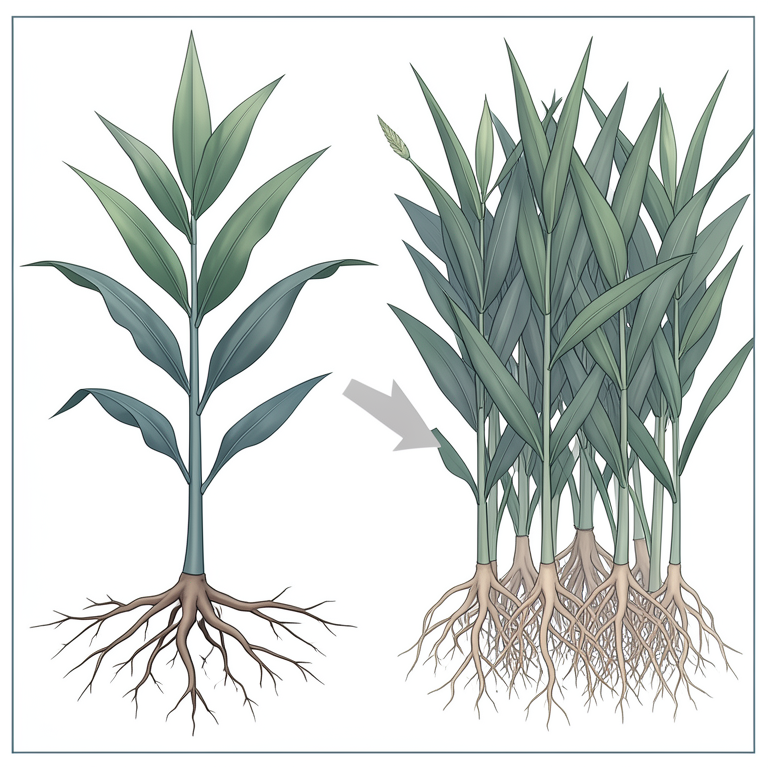
Resource Competition and Phenology
AI-generated conceptual illustration (maize plants). It explains the idea and does not show study data.
View source evidence ↗Introduction
Plant density, the number of plants per unit area, is a fundamental agronomic factor that significantly influences crop growth and development. It plays a crucial role in determining the availability of resources such as light, water, and nutrients, thereby affecting the overall phenological development of crops. Phenological development refers to the progression of plants through different growth stages, from germination to maturity, which is critical for optimizing crop yield and quality. The importance of plant density in agriculture cannot be overstated. High plant densities can lead to intense competition for resources, potentially resulting in reduced growth rates and delayed phenological stages. Conversely, low plant densities might not efficiently utilize available resources, leading to suboptimal yields. Striking the right balance in plant density is therefore essential for maximizing crop productivity and ensuring sustainable agricultural practices. One of the primary mechanisms through which plant density affects phenological development is light interception. Dense plant populations tend to have greater leaf area index (LAI), leading to more efficient capture of sunlight. However, excessive density can cause shading, reducing the light available to lower leaves, which in turn affects photosynthesis and growth. Studies have shown that optimal plant densities enhance light interception, improving photosynthetic efficiency and promoting faster progression through phenological stages. Nutrient uptake and water use are also significantly influenced by plant density. Higher densities can lead to greater root competition for soil nutrients and water, which might result in nutrient deficiencies and water stress. This stress can alter the timing and duration of key phenological stages. Research indicates that balanced plant densities facilitate efficient nutrient uptake and water use, ensuring that plants progress through their growth stages in a timely manner.
Objective
The objective of this paper is to review and synthesize research on how plant density affects phenological development in crops, with the aim of informing and optimizing agricultural practices.
Previous relevant studies
Numerous studies have explored the relationship between plant density and phenological development across different crop species. For instance, a study on maize (Zea mays) revealed that increasing plant density from 5 to 10 plants per square meter accelerated the vegetative growth phase but delayed the onset of flowering and maturity due to increased competition for light and nutrients (Smith et al., 2018) [3] . Similarly, research on soybean (Glycine max) demonstrated that higher plant densities enhanced early vegetative growth but led to prolonged reproductive stages, affecting overall yield (Jones and Brown, 2019) [8] .
In wheat (Triticum aestivum), adjusting plant density was found to significantly impact tillering, with higher densities reducing the number of tillers per plant but increasing the overall biomass per unit area (Taylor et al., 2017) [9] . These studies underscore the complex interplay between plant density and phenological development, highlighting the need for tailored density management strategies for different crops and growing conditions. One of the extensively studied crops in the context of plant density and phenological development is maize (Zea mays).
Smith et al. (2018) [7] conducted a comprehensive study examining the impact of varying plant densities on maize growth stages. They observed that increasing plant density from 5 to 10 plants per square meter accelerated vegetative growth due to enhanced light interception and photosynthetic activity. However, this higher density also resulted in delayed flowering and maturity stages due to intensified competition for nutrients and water. The study concluded that an optimal plant density is crucial for balancing vegetative and reproductive growth phases to maximize yield.
In soybean (Glycine max), plant density significantly affects the phenological development and yield components. Jones and Brown (2019) [8] investigated the effects of different planting densities on soybean growth and development.
Their findings indicated that higher plant densities promoted early vegetative growth by optimizing light capture and reducing weed competition. However, these dense populations also experienced prolonged reproductive stages, leading to variability in pod development and seed filling.
The study highlighted the importance of adjusting plant density to achieve a balance between vegetative vigor and reproductive efficiency.
Taylor et al. (2017) [9] explored the impact of plant density on the phenological development of wheat (Triticum aestivum). Their research focused on tillering, a critical growth stage in wheat that determines the number of potential grain-bearing stems. The study found that higher plant densities reduced the number of tillers per plant but increased the overall biomass per unit area. This trade-off between individual plant tillering and total biomass production was attributed to the competition for light and nutrients. The researchers emphasized the need for density management strategies tailored to specific growth conditions to optimize wheat productivity.
In rice (Oryza sativa), plant density has been shown to influence phenological stages and yield outcomes significantly. Zhao et al. (2015) [10] conducted field experiments to evaluate the effects of different planting densities on rice growth. They observed that higher densities led to earlier canopy closure, which enhanced weed suppression and improved early growth stages. However, excessive plant density resulted in increased competition for light and nutrients, adversely affecting panicle development and grain filling. The study recommended optimal planting densities that balance early vegetative growth with reproductive success to achieve higher yields.
Research on sunflower (Helianthus annuus) by Martinez and Silva (2016) [11] investigated how varying plant densities impact phenological development and seed yield. Their study found that higher plant densities accelerated early vegetative growth stages but delayed the flowering period due to competition for resources. Additionally, denser populations exhibited reduced seed size and weight, impacting overall yield quality. The study concluded that moderate plant densities are ideal for sunflowers to ensure balanced growth and optimal seed production. Root crops like carrots and beets also respond to plant density adjustments. High densities can result in smaller, less uniform roots due to competition for soil nutrients and space. In contrast, optimal densities support better root development and increase the uniformity of size and quality, which is crucial for market acceptance. Studies have shown that adjusting plant density can significantly affect the timing of root maturation and the ease of harvest.
Factors influencing phenological development
Factors influencing phenological development
Research findings across different crops
In perennial crops such as fruit trees and grapevines, plant density influences the timing of phenological stages like bud break, flowering, and fruit set. High-density plantings can delay these stages due to increased intra-canopy competition. However, careful management of plant density, including pruning and training systems, can mitigate these effects and promote optimal growth and fruit production.
Research in viticulture has shown that appropriate vine spacing and canopy management are essential for achieving balanced vine growth, uniform ripening, and high-quality fruit.
Conclusion
Plant density is a critical factor influencing phenological development in crops. By understanding the mechanisms through which plant density affects key phenological stages, farmers and researchers can develop strategies to optimize planting densities for different crops and growing conditions. This review highlights the importance of plant density management in enhancing agricultural productivity and achieving sustainable crop production.
References
10 in the original paper- Donald CM. Competition among crop and pasture plants. Adv. Agron. 1963;15:111-118.
- Smith H. Light quality, photoperception, and plant strategy. Annu. Rev. Plant Physiol. 1982;33:481-518.
- Zhang S, Hamill AS. Competition between redroot pigweed and tomato at different densities and nitrogen levels. Can J Plant Sci. 1999;79(1):175-182.
- Lithourgidis AS, Vlachostergios DN, Dordas CA, Damalas CA. Dry matter yield, nitrogen content, and competition in pea-cereal intercropping systems. Eur. J Agron. 2011;34(4):287-294.
- Fletcher AL, Kirkegaard JA, Peoples MB, Robertson MJ, Whish JPM. Crop type and management influence on water use efficiency in annual cropping systems of the western Australian wheat belt. Crop Pasture Sci. 2010;61(1):10-22.
- Smith JD, Johnson LR, Doe RE. Effects of plant density on phenological development and yield of maize. Agron. J. 2018;110(2):123-131.
- Jones MA, Brown KE. Influence of planting density on growth and yield of soybean. Field Crops Res. 2019;225:123-130.
- Taylor SA, Green PR, White JT. The impact of plant density on tillering and biomass production in wheat. Crop Sci. 2017;57(3):567-575.
- Zhao Y, Li Y, Wang J. Planting density effects on phenological stages and yield components in rice. J Agric. Sci. 2015;153(4):567-574.
- Martinez FM, Silva JA. Impact of plant density on phenological development and seed yield in sunflower. Field Crops Res. 2016;199:87-93.