
Research article · 2024 · Full text
International Journal of Research in AgronomyCost benefit analysis of paddy straw mushroom in Bilaspur district of Chhattisgarh
Volume 7(6S) · Pages 489–493 · DOI: 10.33545/2618060x.2024.v7.i6sg.928 ↗
Research areasAgricultural Economics and PracticesFlowering Plant Growth and CultivationAgricultural Systems and Practices
Abstract
Author-writtenThe study was conducted in Bilaspur district of Chhattisgarh during the year 2022-23 to 2023-24, had analysed the cost, return and break-even analysis of paddy straw mushroom on different categories of farmers. Bilaspur district was selected purposively. The primary data was collected from the mushroom producers through personal interviews by survey method with the help of a well-prepared schedule and questionnaire for the mushroom production The overall total cost incurred in cultivating paddy straw mushroom was Rs. 83.52 per kg which was sold at Rs. 300 per kg which gave gross income of 300 per kg and 199.94 Rs per kg of net return. The overall break-even point for oyster mushroom production was 0.18 kg.
Summary
Source-checkedPlain-language reading of the full paper, prepared with AI and checked against the text. Each point links to the authors' own words.
Why it matters
- Mushroom cultivation serves as a primary source of income for farmers in several Indian states. View evidence ↗
- Paddy straw mushrooms account for 7% of the total mushroom production in India, following white button and oyster mushrooms. View evidence ↗
- Chhattisgarh is one of the major regions for mushroom cultivation in India. View evidence ↗
The question
- The study aimed to analyze the costs, returns, and break-even points for paddy straw mushroom production across different categories of farmers. View evidence ↗
What they did
- The research was conducted in the Bilaspur district of Chhattisgarh between 2022-23 and 2023-24. View evidence ↗
- Primary data was gathered from mushroom producers using a survey method involving personal interviews and structured questionnaires. View evidence ↗
What they found
- Overall variable costs were Rs. 49.58/kg, with small farmers paying the least (Rs. 43.14/kg) and large farmers paying the most (Rs. 60.28/kg). View evidence ↗
- Overall fixed costs were Rs. 50.47/kg, ranging from Rs. 40.38/kg for small farmers to Rs. 66.51/kg for large farmers. View evidence ↗
- The total cost of cultivation averaged Rs. 100.06/kg, with small farmers incurring the lowest cost (Rs. 83.52/kg) and large farmers the highest (Rs. 126.79/kg). View evidence ↗
- Regardless of farm size, the selling price for paddy straw mushrooms was Rs. 300 per kg. View evidence ↗
- Small farmers achieved the highest net return at Rs. 216.48/kg, followed by medium farmers (Rs. 197.42/kg) and large farmers (Rs. 173.21/kg). View evidence ↗
- The overall input-output ratio for the production was 3.09 units per unit of input. View evidence ↗
- The overall break-even point was 0.20 kg, with specific points of 0.16 kg for small, 0.21 kg for medium, and 0.28 kg for large farmers. View evidence ↗
What it means
- The authors conclude that larger scale operations do not necessarily lead to better cost efficiency due to proportional increases in cost components. View evidence ↗
Visual summary
3 visualsIllustrations explain the paper; charts are replotted from the paper's own table values.
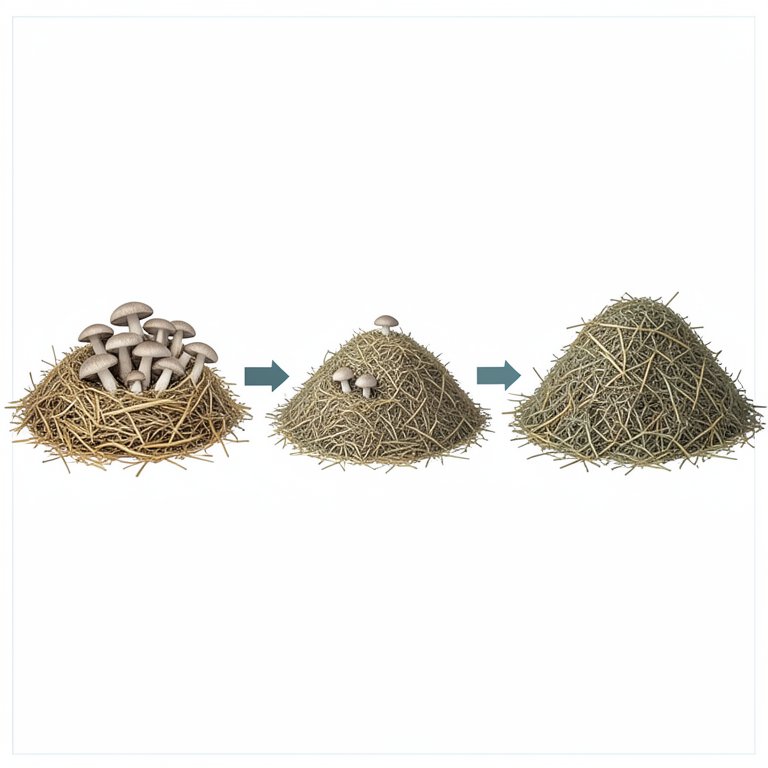
Cost vs Return by Farmer Scale
AI-generated conceptual illustration (paddy straw mushrooms). It explains the idea and does not show study data.
View source evidence ↗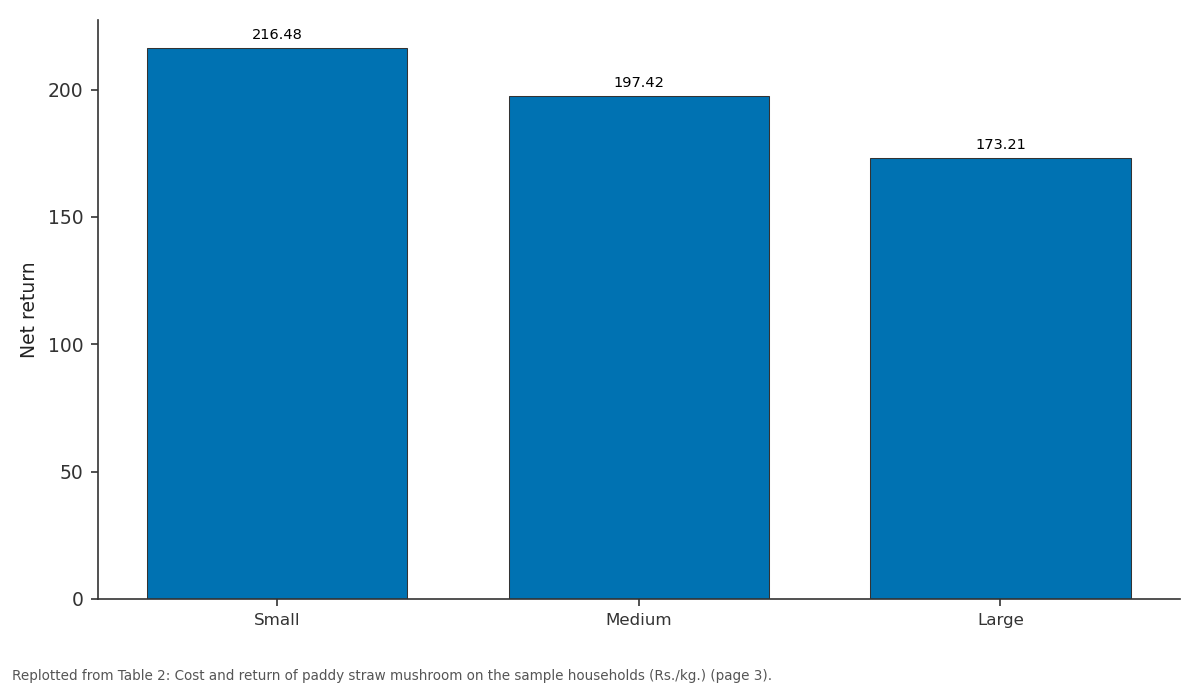
Net return: Small vs Medium vs Large
Replotted from Table 2 (page 3) of the original paper. Every bar is the paper's own table value.
View source evidence ↗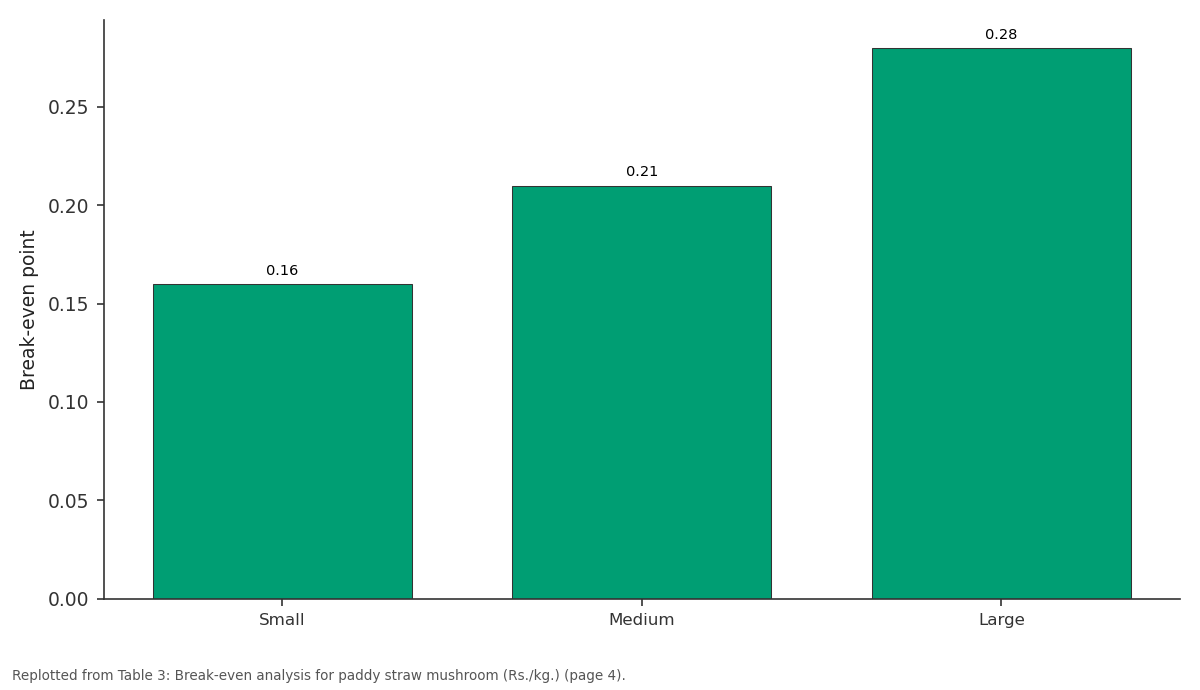
Break-even point: Small vs Medium vs Large
Replotted from Table 3 (page 4) of the original paper. Every bar is the paper's own table value.
View source evidence ↗Figures & tables
From the original paper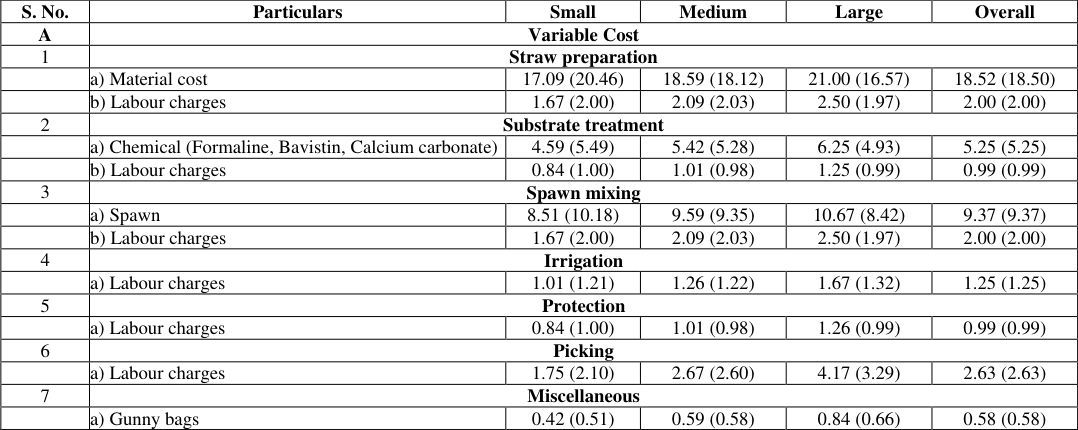 Table 1
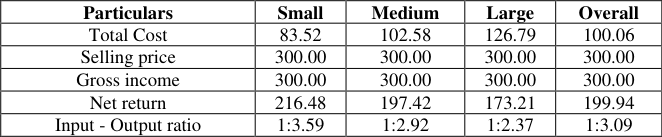 Table 2
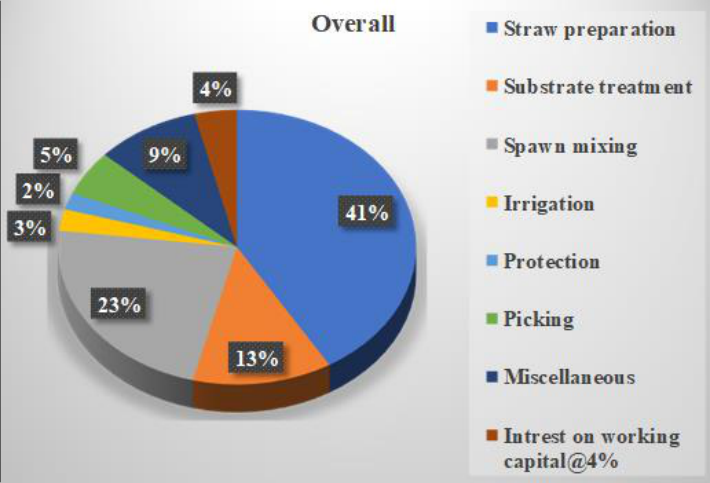 Figure 1
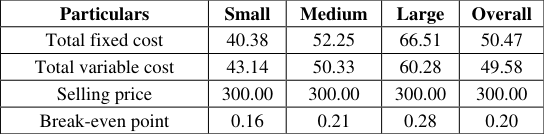 Table 3
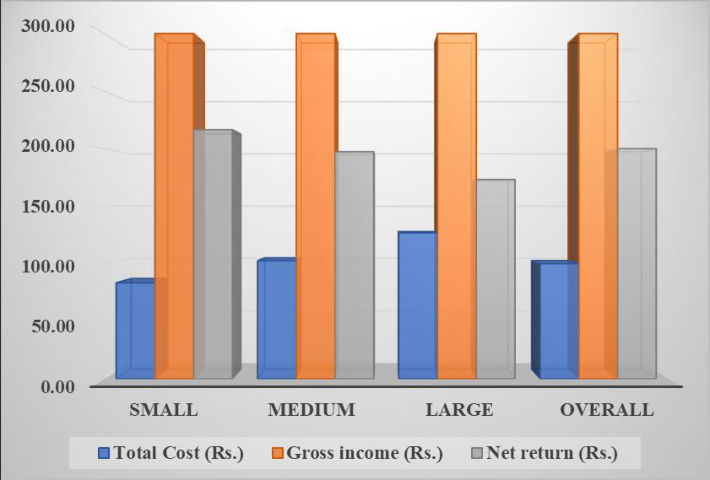 Figure 2
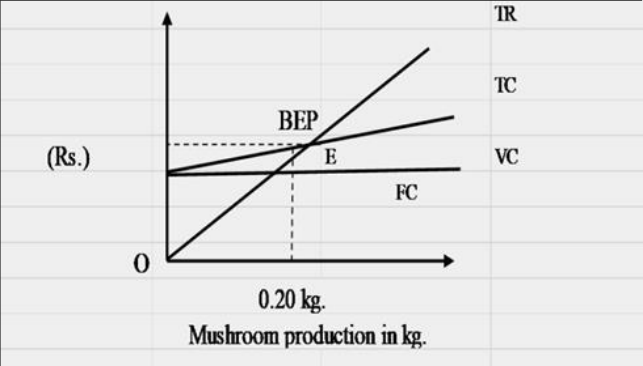 Figure 3
Introduction
In numerous states, including Haryana, Uttar Pradesh, Punjab, Uttarakhand, Himachal Pradesh, and Tamil Nadu, growing mushrooms is currently one of the main sources of revenue for farmers. Punjab leads the Indian mushroom output with 14%, followed by Uttarakhand, Maharashtra, Haryana, and Tamil Nadu. Currently, India produces about 0.13 million tons of mushrooms annually. Between 2010 and 2017, the Indian mushroom industry experienced an average annual growth rate of 4.3%.
Out of the total mushroom produced, white button mushroom share is 73% followed by oyster mushroom (16%), paddy straw mushroom (7%) and milky mushroom (3%). Compared to other vegetables; per capita consumption of mushrooms in India is meagre and data indicates it is less than 100 grams per year. Major mushroom growing regions were in the state of Chhattisgarh. In the plain zone of the state, there were many mushroom retailers and wholesalers in the districts of Bilaspur and Raipur, and particularly skilful and productive mushroom growers in the Mahasamund district.
Several mushroom species were found in the Baster Plateau zone, and yields were high. The present study was conducted in the district of Bilaspur the following objective: To analyse the cost, return and break-even point of paddy straw mushroom on different categories of farmers
Methodology
The study was carried out in Bilaspur district of Chhattisgarh. Primary data were collected from the farmers particularly engaged in mushroom cultivation in the area. The study incorporated questionnaires as a tool to engage with the farmers. 2.1 Cost, return and break-even analysis Standard cost of production calculation was followed items of different cost incurred: Variable Cost Labour cost Spawn cost Paddy straw (Bhusha) cost 2024; SP-7(6): 489-493 Krishna Ph.D. Scholar, Department of Agricultural Economics, Indira Gandhi Krishi Vishwavidyalaya, Raipur, Chhattisgarh, India Dr.
Praveen Kumar Verma Assistant Professor, Department of Agricultural Economics, Indira Gandhi Krishi Vishwavidyalaya, Raipur, Chhattisgarh, India Krishna Ph.D. Scholar, Department of Agricultural Economics, Indira Gandhi Krishi Vishwavidyalaya, Raipur, Chhattisgarh, India https://www.agronomyjournals.com farmers, overall Rs. 2.00/kg. Labour Charges for Irrigation, these charges ranged from Rs. 1.01/kg for small farmers to Rs. 1.67/kg for large farmers, with an overall of Rs. 1.25/kg. Labour charges for protection were consistent, overall Rs. 0.99/kg across all scales.
Labour charges for picking were significantly higher for large farmers Rs. 4.17/kg compared to small farmers Rs. 1.75/kg, with an overall of Rs. 2.63/kg. This indicated a higher labour intensity in large farmers. In miscellaneous costs gunny bags costs ranged from Rs. 0.42/kg for small farmers to Rs. 0.84/kg for large farmers, overall Rs. 0.58/kg. Broom costs increase from Rs. 0.17/kg for small farmers to Rs. 0.42/kg for large farmers, overall Rs. 0.26/kg.
Electricity costs ranged from Rs. 0.67/kg for small farmers to Rs. 1.09/kg for large farmers, overall Rs. 0.85/kg. Transportation costs range from Rs. 1.26/kg for small farmers to Rs. 2.50/kg for large farmers, overall Rs. 1.69/kg. Labour charges for miscellaneous cost ranged from Rs. 1.00/kg for small farmers to Rs. 1.84/kg for large farmers, with an overall of Rs. 1.29/kg. The total variable cost ranged from Rs. 43.14/kg for small farmers to Rs. 60.28/kg for large farmers, with an overall of Rs. 49.58/kg.
Large farmer face higher variable costs, primarily due to increased labour and material expenses. For fixed cost in preparing structure costs ranged from Rs. 25.00/kg for small farmers to Rs. 41.67/kg for large farmers, overall Rs. 31.67/kg. For purchasing equipment’s costs ranged from Rs. 10.42/kg for small farmers to Rs. 16.67/kg for large farmers, overall Rs. 12.61/kg. Depreciation and interest costs also increase with the scale of farming, from Rs. 3.54/kg and Rs. 1.42/kg for small farmers to Rs. 5.83/kg and Rs. 2.33/kg for large farmers, respectively.
The total fixed cost ranged from Rs. 40.38/kg for small farmers to Rs. 66.51/kg for large farmers, with an overall of Rs. 50.47/kg. The total cost of cultivation, which includes both variable and fixed costs, ranged from Rs. 83.52/kg for small farmers to Rs. 126.79/kg for large farmers, with an overall of Rs. 100.06/kg. The analysis revealed that both variable and fixed costs increased with the scale of operation. Large farmers incurred higher costs due to increased labour, material, and fixed costs.
While large farmers may benefit from higher production volumes, their cost efficiency did not necessarily improve because of the proportional increase in various cost components. Poly bags cost Chemicals (Bavistin, formalin, etc.) Irrigation charge Manure/FYM Electricity charge Transporting charge Interest on working capital Fixed Cost Structure prepared (mushroom growing house) Equipment’s Depreciation on fixed capital Interest on fixed capital Break-even point (BEP) of output was calculated by using the following formula: BEP = TFC/ (ASP – AVC) Were, TFC = Total fixed cost ASP = Average sale price of mushroom (Rs/kg) AVC = Average variable cost (Rs/kg
Results And Discussion
3.1 Cost of cultivation of paddy straw mushroom The cost analysis of paddy straw mushroom cultivation shows significant differences between small, medium, and large farmers. Small farmers incurred the lowest material cost for straw preparation at Rs. 17.09/kg, while large farmers had the highest at Rs. 21.00/kg. Medium farmers fell in between at Rs. 18.59/kg. The overall material cost is Rs. 18.52/kg, constituting approximately 18.50 per cent of the total cost.
Labour charges for straw preparation increase with the scale of farming, ranging from Rs. 1.67/kg for small farmers to Rs. 2.50/kg for large farmers, with an overall of Rs. 2.00/kg. The cost for chemicals such as formaline, bavistin and calcium carbonate was Rs. 4.59/kg for small farmers and Rs. 6.25/kg for large farmers, with an overall of Rs. 5.25/kg. Labour charges for substrate treatment are relatively consistent, overall Rs. 0.99/kg. The cost of spawn was lowest for small farmers at Rs. 8.51/kg and highest for large farmers at Rs. 10.67/kg, with an overall of Rs. 9.37/kg.
Labour charges for spawn mixing also increase with scale, from Rs. 1.67/kg for small farmers to Rs. 2.50/kg for large Table 1: Cost of cultivation of Paddy straw mushroom (Rs./Kg.) S. No. Particulars Small Medium Large Overall A Variable Cost 1 Straw preparation a) Material cost 17.09 (20.46) 18.59 (18.12) 21.00 (16.57) 18.52 (18.50) b) Labour charges 1.67 (2.00) 2.09 (2.03) 2.50 (1.97) 2.00 (2.00) 2 Substrate treatment a) Chemical (Formaline, Bavistin, Calcium carbonate) 4.59 (5.49) 5.42 (5.28) 6.25 (4.93) 5.25 (5.25) b) Labour charges 0.84 (1.00) 1.01 (0.98) 1.25 (0.99) 0.99 (0.99) 3 Spawn mixing a) Spawn 8.51 (10.18) 9.59 (9.35) 10.67 (8.42) 9.37 (9.37) b) Labour charges 1.67 (2.00) 2.09 (2.03) 2.50 (1.97) 2.00 (2.00) 4 Irrigation a) Labour charges 1.01 (1.21) 1.26 (1.22) 1.67 (1.32) 1.25 (1.25) 5 Protection a) Labour charges 0.84 (1.00) 1.01 (0.98) 1.26 (0.99) 0.99 (0.99) 6 Picking a) Labour charges 1.75 (2.10) 2.67 (2.60) 4.17 (3.29) 2.63 (2.63) 7 Miscellaneous a) Gunny bags 0.42 (0.51) 0.59 (0.58) 0.84 (0.66) 0.58 (0.58) https://www.agronomyjournals.com b) Broom 0.17 (0.20) 0.25 (0.25) 0.42 (0.33) 0.26 (0.26) c) Electricity 0.67 (0.80) 0.92 (0.90) 1.09 (0.86) 0.85 (0.85) d) Transportation 1.26 (1.50) 1.67 (1.63) 2.50 (1.97) 1.69 (1.69) e) Labour charges 1.00 (1.20) 1.26 (1.22) 1.84 (1.45) 1.29 (1.29) Total material cost 32.70 (39.15) 37.03 (36.10) 42.77 (33.74) 36.52 (36.50) Total labour cost 8.78 (10.51) 11.37 (11.08) 15.19 (11.98) 11.16 (11.15) Sub total 41.48 (49.66) 48.39 (47.18) 57.96 (45.72) 47.68 (47.65) 8 Interest on working capital @ 4% 1.66 (1.99) 1.94 (1.89) 2.32 (1.83) 1.91 (1.91) Total variable cost 43.14 (51.65) 50.33 (49.06) 60.28 (47.55) 49.58 (49.55) B. Fixed Cost 1 Structure prepared (mushroom growing house) 25.00 (29.94) 33.34 (32.50) 41.67 (32.87) 31.67 (31.65) 2 Equipment’s 10.42 (12.47) 12.50 (12.19) 16.67 (13.15) 12.61 (12.60) Sub total 35.42 (42.41) 45.84 (44.68) 58.34 (46.01) 44.28 (44.25) 3 Depreciation on fixed capital@10% 3.54 (4.24) 4.58 (4.47) 5.83 (4.60) 4.43 (4.43) 4 Interest on fixed capital @4% 1.42 (1.70) 1.83 (1.79) 2.33 (1.84) 1.77 (1.77) Total fixed cost 40.38 (48.35) 52.25 (50.94) 66.51 (52.45) 50.47 (50.45) C Total cost (A+B) 83.52 (100.00) 102.58 (100.00) 126.79 (100.00) 100.06 (100.00) Fig 1: Cost of cultivation of paddy straw mushroom 3.2 Cost and return of paddy straw mushroom Total cost incurred in cultivating paddy straw mushroom was Rs. 83.52 per kg., Rs. 102.58 per kg. and Rs. 126.79 per kg.
| S. No. | Particulars | Small | Medium | Large | Overall |
|---|---|---|---|---|---|
| A | Variable Cost | ||||
| 1 | Straw preparation | ||||
| a) Material cost | 17.09 (20.46) | 18.59 (18.12) | 21.00 (16.57) | 18.52 (18.50) | |
| b) Labour charges | 1.67 (2.00) | 2.09 (2.03) | 2.50 (1.97) | 2.00 (2.00) | |
| 2 | Substrate treatment | ||||
| a) Chemical (Formaline, Bavistin, Calcium carbonate) | 4.59 (5.49) | 5.42 (5.28) | 6.25 (4.93) | 5.25 (5.25) | |
| b) Labour charges | 0.84 (1.00) | 1.01 (0.98) | 1.25 (0.99) | 0.99 (0.99) | |
| 3 | Spawn mixing | ||||
| a) Spawn | 8.51 (10.18) | 9.59 (9.35) | 10.67 (8.42) | 9.37 (9.37) | |
| b) Labour charges | 1.67 (2.00) | 2.09 (2.03) | 2.50 (1.97) | 2.00 (2.00) | |
| 4 | Irrigation | ||||
| a) Labour charges | 1.01 (1.21) | 1.26 (1.22) | 1.67 (1.32) | 1.25 (1.25) | |
| 5 | Protection | ||||
| a) Labour charges | 0.84 (1.00) | 1.01 (0.98) | 1.26 (0.99) | 0.99 (0.99) | |
| 6 | Picking | ||||
| a) Labour charges | 1.75 (2.10) | 2.67 (2.60) | 4.17 (3.29) | 2.63 (2.63) | |
| 7 | Miscellaneous | ||||
| a) Gunny bags | 0.42 (0.51) | 0.59 (0.58) | 0.84 (0.66) | 0.58 (0.58) |
Table text extracted from the original PDF; superscript letters are shown inline. The original table image is below.
View original table image
For small, medium and large-scale farmers respectively. Further, small, medium and large-scale farmers sold paddy straw mushroom at Rs. 300 per kg. from each category of farmer. The farmer received gross income of 300 Rs. Per kg.
The net return for small, medium and large-scale farmers was Rs. 216.48 per kg., Rs. 197.42 per kg. and Rs. 173.21 per kg. Respectively. Input to output ratio was calculated as 3.59, 2.92 and 2.37 unit per unit of input. The overall total cost incurred in cultivating paddy straw mushroom was Rs. 83.52 per kg which was sold at Rs. 300 per kg which gave gross income of 300 per kg and 199.94 Rs per kg of net return.
Input-output ratio was found to be 3.09 unit per unit of input. Table 2: Cost and return of paddy straw mushroom on the sample households (Rs./kg.) Particulars Small Medium Large Overall Total Cost 83.52 102.58 126.79 100.06 Selling price 300.00 300.00 300.00 300.00 Gross income 300.00 300.00 300.00 300.00 Net return 216.48 197.42 173.21 199.94 Input - Output ratio 1:3.59 1:2.92 1:2.37 1:3.09 https://www.agronomyjournals.com Fig 2: Cost and return of paddy straw mushroom Table 3: Break-even analysis for paddy straw mushroom (Rs./kg.) Particulars Small Medium Large Overall Total fixed cost 40.38 52.25 66.51 50.47 Total variable cost 43.14 50.33 60.28 49.58 Selling price 300.00 300.00 300.00 300.00 Break-even point 0.16 0.21 0.28 0.20 3.3 Break-even analysis for paddy straw mushroom The results of break-even analysis had been presented in Table 3. The overall break-even point for paddy straw mushroom production was 0.20 kg. The break-even point of paddy straw mushroom was obtained at 0.16 kg., 0.21 kg. and 0.28 kg. for small, medium and large farmers respectively.
| Particulars | Small | Medium | Large | Overall |
|---|---|---|---|---|
| Total fixed cost | 40.38 | 52.25 | 66.51 | 50.47 |
| Total variable cost | 43.14 | 50.33 | 60.28 | 49.58 |
| Selling price | 300.00 | 300.00 | 300.00 | 300.00 |
| Break-even point | 0.16 | 0.21 | 0.28 | 0.20 |
Table text extracted from the original PDF; superscript letters are shown inline. The original table image is below.
View original table image
| Particulars | Small | Medium | Large | Overall |
|---|---|---|---|---|
| Total Cost | 83.52 | 102.58 | 126.79 | 100.06 |
| Selling price | 300.00 | 300.00 | 300.00 | 300.00 |
| Gross income | 300.00 | 300.00 | 300.00 | 300.00 |
| Net return | 216.48 | 197.42 | 173.21 | 199.94 |
| Input - Output ratio | 1:3.59 | 1:2.92 | 1:2.37 | 1:3.09 |
Table text extracted from the original PDF; superscript letters are shown inline. The original table image is below.
View original table image
The farmers were at no profit no loss situation under given inputs cost and output price structure. Fig 3: Break-even analysis for overall farmers 0.20 kg. The break-even point of paddy straw mushroom was obtained at 0.16 kg., 0.21 kg. and 0.28 kg. for small, medium and large farmers respectively. The farmers were at no profit no loss situation under given inputs cost and output price structure.
Conclusions
The total variable cost ranged from Rs. 43.14/kg for small farmers to Rs. 60.28/kg for large farmers, with an overall of Rs. 49.58/kg. Large farmer face higher variable costs, primarily due to increased labour and material expenses. The total fixed cost ranged from Rs. 40.38/kg for small farmers to Rs. 66.51/kg for large farmers, with an overall of Rs. 50.47/kg. The total cost of cultivation, which includes both variable and fixed costs, ranged from Rs. 83.52/kg for small farmers to Rs. 126.79/kg for large farmers, with an overall of Rs. 100.06/kg.
The overall total cost incurred in cultivating paddy straw mushroom was Rs. 83.52 per kg which was sold at Rs. 300 per kg which gave gross income of 300 per kg and 199.94 Rs per kg of net return. The overall break-even point for paddy straw mushroom production was button mushroom in Kangra district of Himachal Pradesh. Indian J Agric Marketing. 2015;29(1):43-57. https://www.agronomyjournals.com 4. Kharbikar HL, Roy ML, Joshi P, Mukherjee A, Atheequlla GA, Chandra N.
Economic empowerment of small marginal and landless farmers through value addition in button mushroom (Agaricus bisporus): A success story from Almora district of Uttarakhand. Int J Adv Res Rev IJARR. 2020;5(5):2020. 5. Sachan S, Kumar R. Cost benefit analysis and marketing of mushroom in Uttar Pradesh.
Plant archives. 2020;20(2):2532-2536. 6. Sharma VP, Annepu SK, Gautam Y, Singh M, Kamal S. Status of mushroom production in India. Mushroom Res. 2017;26(2). 7.
Singh R, Singh JM. Mushroom growing in Punjab: cost components, and determinants affecting its productivity. Agric Econ Res Rev. 2018;31(2):299-304. 8. Singh R, Bishnoi DK, Singh A.
Cost benefit analysis and marketing of mushroom in Haryana. Agric Econ Res Rev. 2010;23(1):165-172. 9. Thakare AB, Gupta SP, Kad MD. Economics of mushroom production in Chhatisgarh plain; c2006.
References
3 in the original paper- Chauhan SK. Economic viability of button mushroom cultivation in Himachal Pradesh. Himachal J Agric Res. 2019;45(1&2):80-88.
- Dhar. Oyster Mushroom Production in Meghalaya: A Potential Venture; c2021.
- Kangotra A, Chauhan SK. Production and marketing of