
Research article · 2024 · Full text
International Journal of Agriculture Extension and Social DevelopmentPerformance analysis of farmer producer organisations of Uttarakhand
Volume 7(6) · Pages 276–282 · DOI: 10.33545/26180723.2024.v7.i6d.709 ↗
Research areasAgricultural Economics and PracticesLivestock Management and Performance ImprovementAgricultural risk and resilience
Abstract
Author-writtenSmall and marginal farmers face many challenges in agricultural production and agricultural marketing. One of the effective and efficient ways of addressing these challenges is bringing them together as group by forming Farmer Producer Company (FPC). Farmer Producers Company reduces the cost of production by providing various services and inputs, establishing market linkages and enhancing income via collective bargaining. Considering this, a study was undertaken to analyse the performance of eight FPOs in Uttarakhand. The findings revealed that four FPOs were performing very well with a score of >75 and were ready for credit linkages. One FPO was in the range of 60-75 per cent and required capacity building for credit linkage. It was also found that two FPOs were in Grade C, with score ranging from 50-60 and require capacity building. Laksar Agro FPC was the only FPC in Grade D with a score of <50 and needed detailed assessment for further capacity building.
Summary
Source-checkedPlain-language reading of the full paper, prepared with AI and checked against the text. Each point links to the authors' own words.
Why it matters
- Agriculture is a critical part of the Indian economy, contributing 15.87% of the GDP. View evidence ↗
- Farmer Producer Companies (FPCs) are used as a strategy to help small and marginal farmers overcome production and marketing challenges through collective action. View evidence ↗
- Despite government efforts to promote them, many producer companies struggle to remain viable. View evidence ↗
The question
- The study aimed to analyze the performance of Farmer Producer Organisations (FPOs) located in Uttarakhand. View evidence ↗
What they did
- The researchers used a census method to select all eight FPOs across two randomly selected districts in Uttarakhand: Haridwar and Pithoragarh. View evidence ↗
- FPO performance was evaluated using a 15-parameter Performance Grading Tool developed by NABARD. View evidence ↗
What they found
- Four of the studied FPOs achieved a performance score greater than 75, indicating they were performing very well and were ready for credit linkages. View evidence ↗
- One FPO was graded B, while two others (Jai Chamu Baba and Nanda Mayya) were graded C with scores between 50% and 60%, indicating a need for capacity building. View evidence ↗
- Laksar Agro Farmer Producer Company was the lowest performer, scoring below 50% (Grade D), which necessitates intensive capacity building and detailed assessment. View evidence ↗
- Annual turnover varied significantly, ranging from a high of Rs. 3.5 crores for Jivamrit Organic FPC to a low of Rs. 1,12,000 for Nanda Maiya Swayatt Sahkarita. View evidence ↗
- In five of the FPOs, more than 75% of members utilized the services provided, such as input supply and advisory services. View evidence ↗
- The age of the FPO did not correlate with its performance; for example, Bhuamrit FPC was one of the youngest (2-3 years) but was the best performing. View evidence ↗
What it means
- The authors conclude that FPO performance can be improved through training in market linkages, business planning, attracting financial aid, and developing processing and storage infrastructure. View evidence ↗
Visual summary
1 visualsIllustrations explain the paper; they do not show study data.
FPO Performance Grading Spectrum
AI-generated conceptual illustration (Agricultural produce and farming infrastructure in Uttarakhand, India). It explains the idea and does not show study data.
View source evidence ↗Figures & tables
From the original paper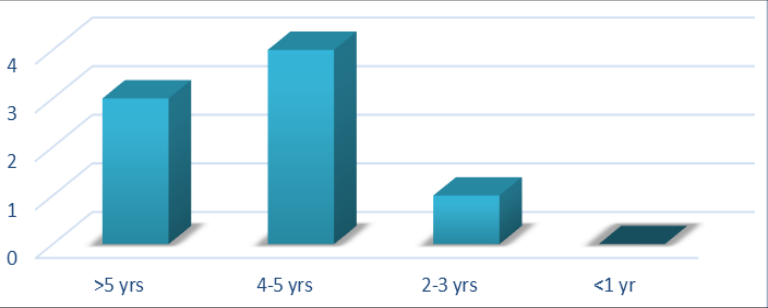 Figure 1
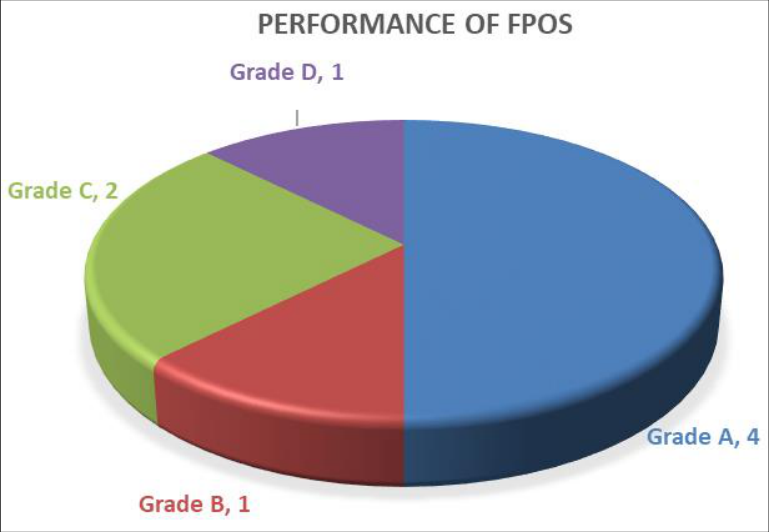 Figure 4
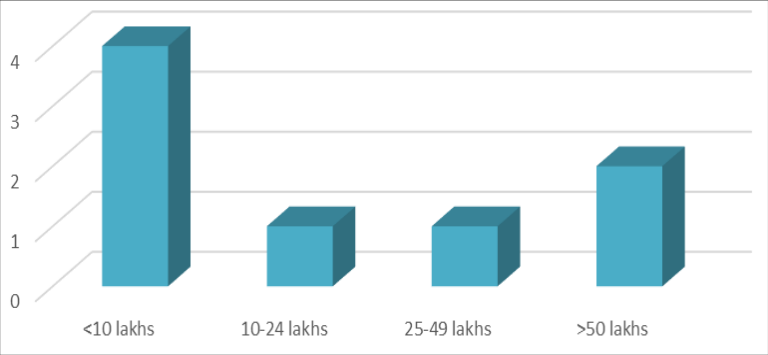 Figure 3
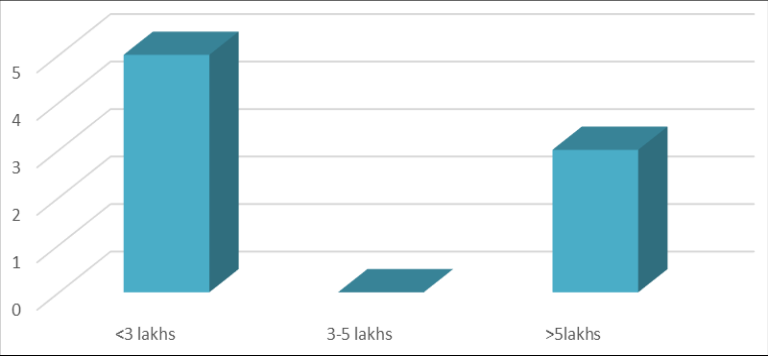 Figure 2
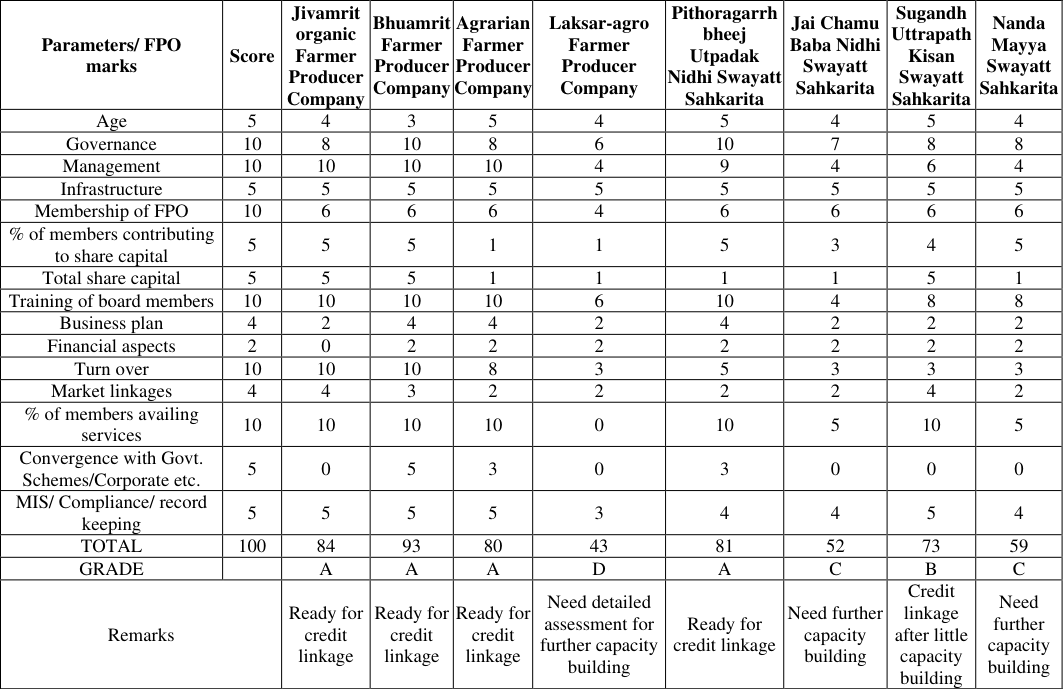 Table 1
Introduction
Agriculture in India is predominantly production oriented and plays a pivotal role in the Indian economy as it contributes 15.87 percent of GDP. It provides employment to around 53 percent of the Indian work force, contributes to overall growth of the economy and reduces poverty by providing employment and food security to majority of the population. Further, it is spread over a large number of small and fragmented holdings. As per estimates, about 1.5 to 2.0 million new marginal and small farms are being added every year in the country due to continued land fragmentation (NAC Draft Document 2012-13 by the Working Group). Small and marginal farmers in India are vulnerable to risks associated with the sector. There are several organisational prototypes that have emerged to integrate small and marginal farmers into the value chain and enhancing their income and reducing transaction costs. One such alternative is the Farmer Producer Organization (FPO). Farmer Producer Organization (FPO) can help farmers in successfully dealing with a range of challenges that small producers face (Salokhe, 2016) [9] . FPOs are emerging as a structure, which is indispensible in the development arena of agriculture and rural development programmes (Venkattakumar et al., 2019) [13] . Department of Agriculture and Cooperation, Ministry of Agriculture, Government of India has identified Farmer Producer Organisation registered under the special provisions of the Companies Act, 1956, as the most appropriate institutional form to mobilize farmers and build their capacity to collectively leverage their production and marketing strengths. Producer Organisations can help farmers improve their productivity and profitability by strengthening their bargaining position in the supply chain, by better responding to changing consumer preferences (environment, food quality) or by reducing the transaction costs of inputs and increasing market access (Cook and Plunkett, 2006 and Alho, 2015) [3,1] . Producer organizations, in general, are found to be well positioned through innovative approaches to transform market arrangements in favour of marginal and small farmers. The studies indicate that the performance of the company depends on various factors such as the member-shareholders, total net profit, annual turnover (Chauhan, 2015 and Yadav et al., 2018) [4,14] , the role of professionals and office bearers, participation in general body meetings, heterogeneity in membership (Vedasri, 2018) [11] , organizing training programs, business planning, market linkages and convergence of government schemes for financial help. Experience and exposure to the changing trends in agriculture has also influenced the performance of the Farmer Producer Organization's (Kavin and Divya, 2019) [7] . The studies also showed that the significant factors affecting the performance were the number of FPOs promoting institutions in the area, ease of doing business, number of markets, KCC per operational holding and rural literacy (Manaswi et al, 2018) [8] . In light of this, various efforts are being made by the government to promote FPOs for the well-being of small and marginal farmers. Inspite of the government's vision and efforts, it has been observed that, at many places, producer companies are struggling to survive. Hence, a study was conducted to analyze the performance of the Farmer Producer Organisations of Uttarakhand. www.extensionjournal.com
Methodology
For the study, two districts from Uttarakhand state viz. Haridwar district from Garhwal region and Pithoragarh district from Kumaon region were selected randomly. Census method was used and all the four FPOs from Haridwar (Jivamrit Organic Farmer Producer Company, Bhuamrit Farmer Producer Company, Agrarian Farmer Producer Company and Laksar Agro Farmer Producer Company) and of Pithoragarh district (Pithoragarh Bheej Utpadak Nidhi Swayatt Sahkarita, Sugandh Uttrapath Kisan Swayatt Sahkarita, Jai Chamu Baba Nidhi Swayatt Sahkarita and Nanda Mayya Swayatt Sahkarita Birthi) were selected for the study. Simple random sampling method was used to select individual respondents. From each FPO, five office bearers, ten member farmers and ten non member farmers were selected. The data was collected using structured and semi-structured interview schedules and the FPO records. The performance of FPOs was measured using the Performance Grading Tool developed by the National Bank for Agriculture And Rural Development (NABARD). Table 1 summarizes the status of all eight FPOs across these parameters and gives the final score of all the FPOs. The Performance Grading tool developed by NABARD comprises of 15 parameters. For each parameter, scores were given according to the set standards and the score of each FPO was obtained after summing up the scores of all the given 15 parameters. On the basis of total score, the FPOs were categorized into four categories i.e. A, B, C and D as depicted in Table 1.
| Parameters/ FPO marks | Score | Jivamrit organic Farmer Producer Company | Bhuamrit Farmer Producer Company | Agrarian Farmer Producer Company | Laksar-agro Farmer Producer Company | Pithoragarrh bheej Utpadak Nidhi Swayatt Sahkarita | Jai Chamu Baba Nidhi Swayatt Sahkarita | Sugandh Uttrapath Kisan Swayatt Sahkarita | Nanda Mayya Swayatt Sahkarita |
|---|---|---|---|---|---|---|---|---|---|
| Age | 5 | 4 | 3 | 5 | 4 | 5 | 4 | 5 | 4 |
| Governance | 10 | 8 | 10 | 8 | 6 | 10 | 7 | 8 | 8 |
| Management | 10 | 10 | 10 | 10 | 4 | 9 | 4 | 6 | 4 |
| Infrastructure | 5 | 5 | 5 | 5 | 5 | 5 | 5 | 5 | 5 |
| Membership of FPO | 10 | 6 | 6 | 6 | 4 | 6 | 6 | 6 | 6 |
| % of members contributing to share capital | 5 | 5 | 5 | 1 | 1 | 5 | 3 | 4 | 5 |
| Total share capital | 5 | 5 | 5 | 1 | 1 | 1 | 1 | 5 | 1 |
| Training of board members | 10 | 10 | 10 | 10 | 6 | 10 | 4 | 8 | 8 |
| Business plan | 4 | 2 | 4 | 4 | 2 | 4 | 2 | 2 | 2 |
| Financial aspects | 2 | 0 | 2 | 2 | 2 | 2 | 2 | 2 | 2 |
| Turn over | 10 | 10 | 10 | 8 | 3 | 5 | 3 | 3 | 3 |
| Market linkages | 4 | 4 | 3 | 2 | 2 | 2 | 2 | 4 | 2 |
| % of members availing services | 10 | 10 | 10 | 10 | 0 | 10 | 5 | 10 | 5 |
| Convergence with Govt. Schemes/Corporate etc. | 5 | 0 | 5 | 3 | 0 | 3 | 0 | 0 | 0 |
| MIS/ Compliance/ record keeping | 5 | 5 | 5 | 5 | 3 | 4 | 4 | 5 | 4 |
| TOTAL | 100 | 84 | 93 | 80 | 43 | 81 | 52 | 73 | 59 |
| GRADE | A | A | A | D | A | C | B | C | |
| Remarks | Ready for credit linkage | Ready for credit linkage | Ready for credit linkage | Need detailed assessment for further capacity building | Ready for credit linkage | Need further capacity building | Credit linkage after little capacity building | Need further capacity building |
Table text extracted from the original PDF; superscript letters are shown inline. The original table image is below.
View original table image
Results and Discussion
Performance of FPOs across each parameter has been discussed below 1. Age profile of FPO It refers to the number of years elapsed since the date of registration of the FPO. The FPOs were divided into four categories based on age i.e. more than 5 years, 4-5 years, 2-3 years and less than 1 year (Figure 1). Three FPOs had been working for more than 5 years (Agrarian Farmer Producer Company, Pithoragarh Bheej Utpadak Nidhi Swayatt Sahkarita and Sugandh Uttrapath Kisan Swayatt Sahkarita), four FPOs were found to be in the category of 4-5 years and one FPO i.e. Bhuamrit Farmer Producer Company was in 2-3 year category. However, it was observed that the number of years for which the FPO had been registered was not a reflection of its performance. Some FPOs like Laksar Agro Farmer Producer Company, Jai Chamu Baba Nidhi Swayatt Sahkarita and Nanda Mayya Swayatt Sahkarita Birthi were not well performing well even though they had been operating for 4-5 years. On the other hand, given proper management and direction even new FPOs (like Bhuamrit Farmer Producer Company) were successful in achieving their goals.
Governance
Governance is the non financial determinant of performance and viability of Producer Organizations (Dey, 2018) [5] . Governance of the FPOs was assessed using four sub parameters. Composition of the Board: This aspect pertained to the extent of bias in the selection of board members and reference to presence of blood relations, representation to women, experience/ professional qualification of board members and representatives of farmers' association. It was found that, all the eight FPOs had unbiased Board of Directors and all the criteria were taken into consideration during board formation. Extent of strategic support: This was mainly concerned with the support received by the FPOs from the promoters or promoting organization. It was found that three FPOs (Bheej Utpadak Nidhi Swayatt Sahkarita, Bhuamrit Farmer Producer Company and Sugandh Uttrapath Kisan Swayatt Sahkarita) received support from their promoters in form of assistance in developing business plans, assessing production and marketing, etc. and the rest did not receive any support from the promoters.
Regular conduct of board meetings and quorum:
Board meetings of all the FPOs were conducted regularly and in addition, special meetings were held when ever required. Annual general body meetings (AGMs) were conducted once a year, mostly after annual audit and accounts (Badatya et al, 2018) [2] . Quality of agenda and decisions/ decision making:
The quality of agenda and decision making process was found to be satisfactory in all the FPOs as they all were involved in and were able to take a decision for the welfare of the company, except Laksaragro Farmer Producer Company. In this case, the BODs and the CEO of the company were not able to come to a consensus on how to run the business. Company, which arranged these on its own.
Membership of FPO
The membership of the FPOs was studied under six categories. The categories were below 50, between 50-100, between 101-200, between 201-500, between 501-1000 and more than 1000. All the FPOs had members in the category range of 201-500, exception Laksar Agro Farmer Producer Company, whose membership was in the range of 101-200.
The membership was less in case of Laksar Agro Farmer Producer Company because it was not active and did not have a business plan to attract the farmers. In case of Jivamrit organic FPC, it was observed that the membership was already about 500, but more farmers wanted to join the FPC. However, they could not be given membership as the upper limit for organic farmers group is restricted to 500. Studies indicate that large heterogeneous groups/ FPOs perform better (Vedasri, 2018) [11] . This may explain the success of Jivamrit Organic Farmer Producer Company and Bhuamrit Farmer Producer Company.
Business plan
It was found that in case of five FPOs (Jivamrit Organic Farmer Producer Company, Laksaragro Farmer Producer Company, Jai Chamu Baba Nidhi Swayatt Sahkarita, Sugandh Uttrapath Kisan Swayatt Sahkarita and Nanda Mayya Swayatt Sahkarita Birthi) the business plan including financial plan was prepared for one year. In case of remaining three FPOs, the business plan was made for three years and this plan was further divided into annual plans and then sub divided into monthly targets.
Financial aspects
It was found that all the FPOs (except Jivamrit Organic Farmer Producer Company) received financial assistance from the Producer Organisation Promoting Institution (POPI). Jivamrit Organic Farmer Producer Company neither received nor applied for grant or financial support from NABARD, as it was financially robust since the beginning. Some of the FPOs that had received financial assistance in the initial stages were still expecting further financial help from the POPIs. Jai Chamu Baba Nidhi Swayatt Sahkarita, Nanda Mayya Swayatt Sahkarita Birthi and Laksar Agro Farmer Producer Company had scaled down their business to a great extent as the financial assistance from POPI through NABARD has come to an end. However, they are still waiting for funds from NABARD to revive their activities. It has been reported that dependence on POPIs leads to low performing FPOs (Singh, 2016) [10] .
Annual turnover
The annual turnover of the FPOs was divided into four categories i.e. less than Rs. 10 lakhs, Rs. 10-24 lakhs, Rs. 25-49 lakhs and above Rs. 50 lakhs. It was found that the turnover of two FPOs (Jivamrit Organic Farmer Producer Company and Bhuamrit Farmer Producer Company) was above Rs. 50 lakhs (Figure 3). Agrarian Farmer Producer Company had an annual turnover in the range of Rs. 25-49 lakhs and Beej Utapdak FPO in range of Rs. 10-24 lakhs. Turnover of four FPOs (Sugandh Uttrapath Kisan Swayatt Sahkarita, Laksar Agro Farmer Producer Company, Nanda Mayya Swayatt Sahkarita Birthi and Jai Chamu Baba Nidhi Swayatt Sahkarita) was less than ten lakhs. Earlier studies also indicated that more than 50% of the FPOs have turnover in the range of one lakh to 50 lakh. The highest turnover of Rs. 3.5 crores was reported in case of Jivamrit Organic Farmer Producer Company. This was partly due to well established processing units and strong market linkages. The least annual turnover i.e. Rs. 1,12,000/-was in case of Nanda Maiya Swaytt Sahkarita as there were no ongoing business activities.
Market linkage
It was found that five FPOs (Agrarian Farmer Producer Company, Laksaragro Farmer Producer Company, Pithoragarh Bheej Utpadak Nidhi Swayatt Sahkarita, Jai Chamu Baba Nidhi Swayatt Sahkarita and Nanda Mayya Swayatt Sahkarita Birthi) were dependent on local markets for sale of their products and were not able to create assured market linkages with companies or big processors. Jivamrit Organic Farmer Producer Company, Bhumarit Farmer Producer Company and Sugandh Uttrapath Kisan Swayatt Sahkarita had well established market linkages with corporate buyers, processors and they even used various online platforms for sale of their products.
Percentage of members availing services
The FPO provides its members with a wide range of services such as input supply, advisory services, custom hiring services, trainings, exposure visits, etc. It was found that in case of five FPOs (Jivamrit Organic Farmer Producer Company, Bhuamrit Farmer Producer Company, Pithoragarh Beej Utapadak Nidhi Swayatt Sahkarita, Agrarian Farmer Producer Company and Sugandh Uttrapath Kisan Swayatt Sahkarita), over 75 percent of the members had utilized the services provided by the FPO. It was also seen that all the five FPOs supplied inputs to the members at a price lower than the market price by procuring inputs in bulk. The members were satisfied with the quality of inputs, rate and other services being provided to them by the FPO.
In case of Jai Chamu Baba Nidhi Swayatt Sahkarita and Nanda Mayya Swayatt Sahkarita Birthi, over 25 percent of the members were availing the services provided by FPO, whereas in case of Laksar Agro Farmer Producer Company, their number was less than 10 percent, as the FPC was not active and provided no services to its members. Similar findings were reported by Venkattakumar et al. (2019) [13] and Yadav et al. (2018) [14] .
MIS/Compliance/ record keeping
The performance of the FPO also depends on robust record keeping and transparency in its activities (Venkatesan et al, 2017) [12] . Scores were assigned under each head as per the categories given in the Performance Grading Tool. The FPOs were categorised into four grades i.e. A, B, C and D (Table 1, Figure 4)) based on the total score obtained. The final score revealed that four FPOs were in Grade A, which indicates that their performance was very good and they were ready for credit linkages.
Conclusion
FPO's are proven pathway for farmers to increase investment in agriculture, improve their bargaining power, move up the value chain and improve access to technology, markets, leading to greater income generation through teamwork and cooperation. Various efforts and initiatives are being put forward by government to promote FPO's, inspite of this, it has been observed that, at many places producer companies are struggling with low performance. It can be concluded that performance of the FPO's can be enhanced by training the FPO's on developing better market linkages, creating cropping belts, developing the business sense by selecting activity portfolio, focusing on attracting financial assistance and gaining policy support from the government and developing storage and processing facilities. Other measures include extension activities specifically aimed at members of FPOs, increasing awareness about the role of FPOs in enhancing the income of farming community, and developing entrepreneurship training modules for FPOs.
Figures and tables from the paper
References
12 in the original paper- Alho E. Farmers' self-reported value of cooperative membership. Evidence from heterogeneous business and organization structures. Agric Food Econ. 2015;3(1):1-22.
- Badatya KC, Ananthi S, Sethi Y. An exploratory study on Farmer Producer Organisations in Maharashtra. Reserve Bank of India, Pune; c2018. p. 1-74. Available from: https://cab.rbi.org.in/docs/Special_Study/An%20Explor atory%20Study%20on%20Farmer%20Producer%20Or ganizations(FPOs)%20in%20Maharashtra.pdf. Accessed on 15 October 2020.
- Cook ML, Plunkett B. Collective entrepreneurship: an emerging phenomenon in producer-owned organizations. J Agric Appl Econ. 2006;38(2):421-428.
- Chauhan S. Producer Companies in Madhya Pradesh: An Evaluative Study. Int J Recent Res Aspects. 2015;2(3):66-77.
- Dey K. Farmer Producer Companies in India: www.extensionjournal.com Determinants of Performance and Viability. Econ Political Wkly. 2018;53(35):44-52.
- Joshi SK, Choudhary VK. Performance of Farmer Producer Organisations (FPOs) in Different Regions of Chhattisgarh State: A Case Study. Indian J Agric Econ. 2018;73(3):399-406.
- Kavin A, Divya K. Performance of farmer producer organization based on socio-economic factors in western region of Tamil Nadu. Int J Chem Stud. 2019;7(3):4434-4437.
- Manaswi BH, Kumar P, Prakash P, Anbukkani P, Kar A, Jha GK, Rao DUM. Progress and Performance of States in Promotion of Farmer Producer Organisations in India. Indian J Ext Educ. 2018;54(2):108-113.
- Salokhe S. Farmers producer organization for effective linkage of small producers with market. Int J Appl Res. 2016;2(10):142-146.
- Vedasri R. A study on Performance of Farmer Producer Organizations in Krishna district of Andhra Pradesh. Thesis, M.Sc. Acharya N.G. Ranga Agricultural University, Bapatla; 2018. 125p.
- Venkattakumar R, Mysore S, Venugopalan R, Balakrishnan B, Narayaswamy B, Atheequlla GA, et al. Performance of Farmers Producers Organizations (FPOs) and Associated Factors in Karnataka: Producers' Perspectives. Indian Res J Ext Educ. 2019;19(2 and 3):7-12.
- Yadav S, Joshi SK, Gauraha AK. Management status of Farmer Producer Organisations of Chhattisgarh plains. J Pharmacogn Phytochem. 2018;7(3):3288-3290.