
Research article · 2024 · Full text
International Journal of Agriculture Extension and Social DevelopmentA study on role performance of farmer producer’s organization staff in Telangana state
Volume 7(6) · Pages 255–258 · DOI: 10.33545/26180723.2024.v7.i6d.705 ↗
Research areasAgricultural Economics and PracticesLivestock Management and Performance ImprovementAgricultural risk and resilience
Abstract
Author-writtenFarmer’s producer organizations are those in which farmers become members of the organization to reap the benefits of collective purchase of inputs, machinery and use of resources, new technology and practices, thereby eliminating the middle men returning high profits to the farmers. As employees are considered as the resource of an organization, it is necessary to look at their job performance, identify the gap and take necessary steps to improve their performance. The present study was carried out in zone III i.e., Rajanna Siricilla of state Telangana which comprising of five districts. Both the state and zone were selected purposively on the basis of the largest number of FPOs in the country. Of the 66 FPOs in the zone, 40 FPOs were selected proportionately from each district and randomly within the district. From each FPO, 5 respondents were randomly selected making a total sample of 200 respondents. Data was collected through personal interview following a structured schedule. Based on the data analysis, it was found that majority of the respondents have medium role performance (52.50%), followed by low (34.00%) and high (13.50%) role performance. The variables experience, departmental working environment, extension activities, interpersonal communication, achievement motivation, job involvement, job satisfaction and job stress were found to be significant with the role performance of the staff.
Summary
Source-checkedPlain-language reading of the full paper, prepared with AI and checked against the text. Each point links to the authors' own words.
Why it matters
- Farmer Producer Organizations (FPOs) allow farmers to collectively purchase inputs and technology, which helps eliminate intermediaries and increase profits. View evidence ↗
- Small and marginal farmers, who own less than 2 hectares, often struggle with limited access to quality inputs, financing, and markets. View evidence ↗
- The overall success of an FPO is dependent on the efficiency and effectiveness of its staff. View evidence ↗
The question
- The study aimed to evaluate the role performance of staff working within Farmer Producer Organizations. View evidence ↗
What they did
- The sample consisted of 200 respondents, selected by randomly picking 5 staff members from each of 40 proportionately selected FPOs. View evidence ↗
- Staff performance was measured using a 14-statement schedule scored on a three-point scale (Always, Sometimes, Never). View evidence ↗
What they found
- The majority of FPO staff exhibited medium role performance (52.50%), while 34.00% had low and 13.50% had high performance. View evidence ↗
- Providing market information was the activity most consistently performed, with 62.50% of respondents doing so 'always'. View evidence ↗
- Providing required inputs in a timely manner was more frequently done 'sometimes' (57.50%) than 'always' (40.00%). View evidence ↗
- Role performance was positively correlated with experience, working environment, extension activities, communication, motivation, job involvement, and job satisfaction. View evidence ↗
- Job stress was found to have a significant negative correlation with the role performance of the staff. View evidence ↗
- Factors such as age, education, and attitude toward the delegation of authority did not significantly impact role performance. View evidence ↗
What it means
- The authors recommend that government and supporting organizations provide targeted training to improve employee efficiency and FPO development. View evidence ↗
- The study was limited to a single zone; the authors suggest future research explore social, psychological, and political influences on performance. View evidence ↗
Visual summary
1 visualsIllustrations explain the paper; charts are replotted from the paper's own table values.
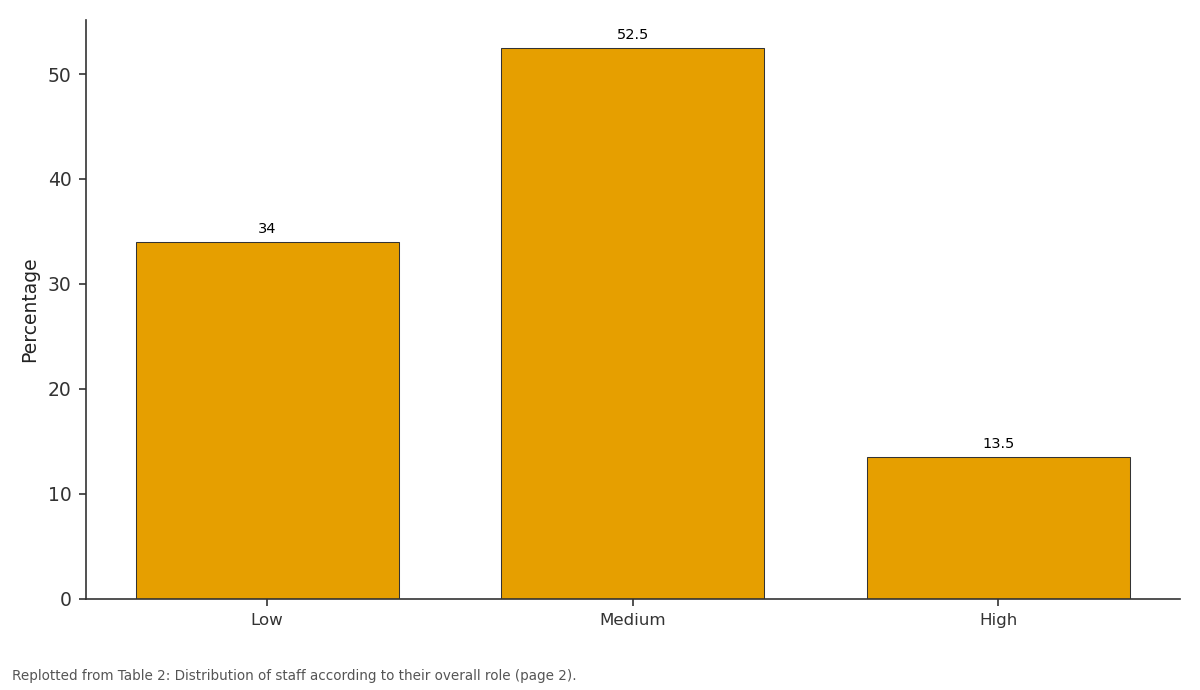
Percentage: Low vs Medium vs High
Replotted from Table 2 (page 2) of the original paper. Every bar is the paper's own table value.
View source evidence ↗Figures & tables
From the original paper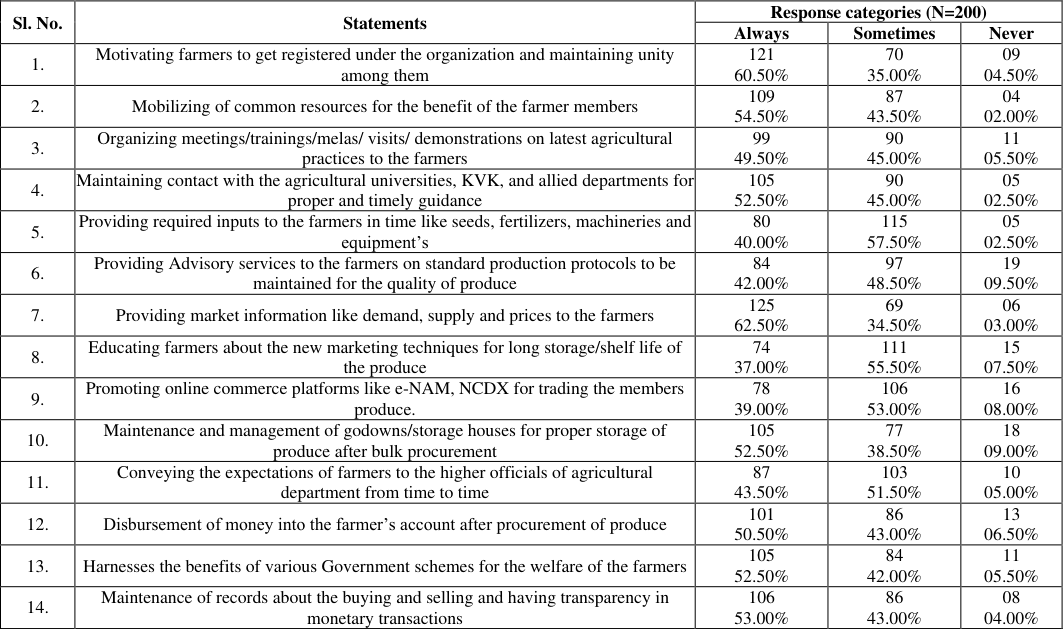 Table 1
 Table 2
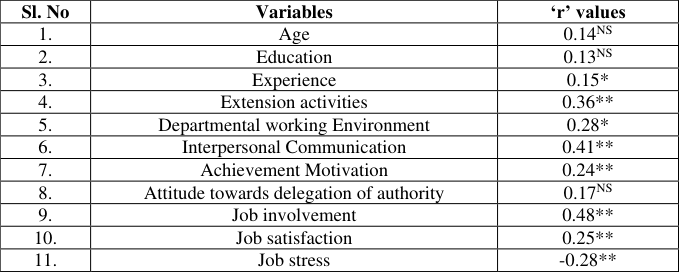 Table 3
Introduction
Farmers Producer Organization (FPO) is an association of producers in which farmers are members. It is formed by the farmers, for the farmers and with the farmers. The institutions like, NABARD, the National Bank for Agricultural and Rural Development and SFAC, the Small Farmers Agribusiness Consortium help advance FPOs with technical and financial support (Kumar et al., 2023) [5] . FPO is a generic term for a group of producers who produce all types of products including agricultural, forest based, artisanal, forestry, animal, etc. Small and marginal farmers (less than 2 hectares) constitute majority of farm owners in the country who face many obstacles during and after production, including lack of access to equipment, technology, services, inputs, machinery of high quality at reasonable prices, loans, seed production and technology, value addition, processing, investments and, above all, lack of access to markets (Adhikari et al., 2021; Amitha et al., 2021; Priyanka et al., 2023) [1,2,8] . This makes small producers lacking of inputs, finance and storage services necessary to benefit from the economies of scale (Priyanka et al., 2024b) [10] which has been worsened by a long chain of intermediaries who are operating invisibly in the market chain leading to a situation where the producer receives only a small portion of the value paid by the end customer (Priyanka et al., 2024a) [9] . To overcome these problems, Indian government has launched a central sector program with a budget of Rs 6,865 crores "Formation and promotion of 10,000 new FPOs" by 2027-28. By organizing and mobilizing farmers into FPOs, they can be benefitted from economies of scale (Kumar et al., 2020; Singh et al., 2021) [3, 13] improving their bargaining power through collective action and also helps to link them with large buyers, producers and suppliers of raw materials in the market. The fundamental objective of the FPO is to provide better income to farmers through its own organization. The success of the organization depends on the efficiency and effectiveness of its employees as they are the backbone of the organization. The objectives set forth by the organization can be achieved only when the people working in it are satisfied in their job leading to increased job performance (Sarnaik et al., 2020) [12] . Keeping the above points in mind, an attempt has been made to study the role performance Farmer Producer Organization staff.
Methodology
Ex-post facto research design was chosen for the study. The present study was conducted in Telangana state and zone III i.e., Rajana Siricilla (out of seven and the zone has five districts, namely Kamareddy, Karimnagar, Medak, Rajanna www.extensionjournal.com Siricilla and Siddipet) which were purposively selected as they have highest number of FPOs. Among the 66 FPOs in the zone, 40 FPOs were selected through proportionate sampling from each district and randomly within the district. From each FPO, 5 respondents were interviewed in person with the help of a structured schedule adding up a total sample of 200 respondents. Performance was studied using a 14 statement schedule and responses were scored along a three-point continuum with scores of 3 for always, 2 for Sometimes, and 1 for Never. An individual's total score was obtained by summing up the total of all statements and participants were divided into low, medium, and high categories based on the class interval technique. Correlation was analyzed using Pearson moment correlation.
Results and Discussion
The efficacy of an organization can be measured by the performance of its employees/staff. It is operationally defined as the extent to which the staffs of farmer producer's organization are expected to perform according to the criteria set forth to their jobs. Based on the study, table 1 represents the activities that are done always such as 'motivating farmers to get registered under the organization and maintaining unity among them' (60.50%), 'mobilizing of common resources for the benefit of the farmer members' (54.50%), 'organizing meetings/trainings/melas/visits/ demonstrations on latest agricultural practices to the farmers' (49.50%), 'maintaining contact with the agricultural universities, KVK, and allied departments for proper and timely guidance' (52.50%), 'providing market information like demand, supply and prices to the farmers' (62.50%), 'maintenance and management of godowns/storage houses for proper storage of produce after bulk procurement' (52.50%), 'disbursement of money into the farmer's account after procurement of produce' (50.50%), 'harnesses the benefits of various government schemes for the welfare of the farmers' (52.50%) and 'maintenance of records about the buying and selling and having transparency in monetary transactions' (53.00%). The other activities which were done sometimes were 'providing required inputs to the farmers in time like seeds, fertilizers, machineries and equipment's' (57.50%), 'providing advisory services to the farmers on standard production protocols to be maintained for the quality of produce' (48.50%), 'educating farmers about the new marketing techniques for long storage/shelf life of the produce' (55.50%), 'promoting online commerce platforms like e-NAM, NCDX for trading the members produce' (53.00%) and 'conveying the expectations of farmers to the higher officials of agricultural department from time to time' (51.50%).
| Sl. No. | Statements | Response categories (N=200) | — | — |
|---|---|---|---|---|
| Always | Sometimes | Never | ||
| 1. | Motivating farmers to get registered under the organization and maintaining unity among them | 121 60.50% | 70 35.00% | 09 04.50% |
| 2. | Mobilizing of common resources for the benefit of the farmer members | 109 54.50% | 87 43.50% | 04 02.00% |
| 3. | Organizing meetings/trainings/melas/ visits/ demonstrations on latest agricultural practices to the farmers | 99 49.50% | 90 45.00% | 11 05.50% |
| 4. | Maintaining contact with the agricultural universities, KVK, and allied departments for proper and timely guidance | 105 52.50% | 90 45.00% | 05 02.50% |
| 5. | Providing required inputs to the farmers in time like seeds, fertilizers, machineries and equipment’s | 80 40.00% | 115 57.50% | 05 02.50% |
| 6. | Providing Advisory services to the farmers on standard production protocols to be maintained for the quality of produce | 84 42.00% | 97 48.50% | 19 09.50% |
| 7. | Providing market information like demand, supply and prices to the farmers | 125 62.50% | 69 34.50% | 06 03.00% |
| 8. | Educating farmers about the new marketing techniques for long storage/shelf life of the produce | 74 37.00% | 111 55.50% | 15 07.50% |
| 9. | Promoting online commerce platforms like e-NAM, NCDX for trading the members produce. | 78 39.00% | 106 53.00% | 16 08.00% |
| 10. | Maintenance and management of godowns/storage houses for proper storage of produce after bulk procurement | 105 52.50% | 77 38.50% | 18 09.00% |
| 11. | Conveying the expectations of farmers to the higher officials of agricultural department from time to time | 87 43.50% | 103 51.50% | 10 05.00% |
| 12. | Disbursement of money into the farmer’s account after procurement of produce | 101 50.50% | 86 43.00% | 13 06.50% |
| 13. | Harnesses the benefits of various Government schemes for the welfare of the farmers | 105 52.50% | 84 42.00% | 11 05.50% |
| 14. | Maintenance of records about the buying and selling and having transparency in monetary transactions | 106 53.00% | 86 43.00% | 08 04.00% |
Table text extracted from the original PDF; superscript letters are shown inline. The original table image is below.
View original table image
Overall role performance of FPO staff
Table 2 represents the overall role performance of the FPO staff. More than half of the respondents had medium (52.50%) role performance, followed by low (34.00%) and high (13.50%) role performance, respectively. The possible reason for the presence of medium to low performance among staff was that they were not clear about their job role and the activities to be undertaken to improve their performance as well as the organization. This was accompanied by low experience and lack of trainings from the related organizations/institutions, lack of adequate facilities, job stress and low motivation to succeed which makes them unable to fully fulfill their role. Purnima et al., (2018) [11] in her study revealed that majority of the respondents were under moderate to high category of role performance. The results were also found to be consistent with the studies conducted by Dharmaraj (2019) [4] , Maina et al. (2019) [7] .
| Sl. No. | Category | Class Interval | Frequency | Percentage |
|---|---|---|---|---|
| 1. | Low | 27-31 | 68 | 34.00 |
| 2. | Medium | 32-36 | 105 | 52.50 |
| 3. | High | 37-41 | 27 | 13.50 |
Table text extracted from the original PDF; superscript letters are shown inline. The original table image is below.
View original table image
Training institutions like BIRD, Lucknow, NABARD and SFAC must impart need based training and provide employees with necessary resources that help them improve their job performance. This can be improved by organizing workshops, conferences, case studies, experiential learning and exposure visits to other successful FPOs (Kumari et al., 2023) [5] .
Correlation between independent variables and role performance (dependent variable)
Table 3 represents the relationship between the independent variables and role performance. Variables such as experience and departmental working environment showed a positive correlation with a significance level of 5%, while extension activities, interpersonal communication, achievement motivation, job involvement and job satisfaction showed positive correlation at 1% level of significance. Age, education and attitude towards delegation of authority were found non-significant with the role performance. The variable job stress showed a negative correlation at 1% level of significance.
| Sl. No | Variables | ‘r’ values |
|---|---|---|
| 1. | Age | 0.14NS |
| 2. | Education | 0.13NS |
| 3. | Experience | 0.15* |
| 4. | Extension activities | 0.36** |
| 5. | Departmental working Environment | 0.28* |
| 6. | Interpersonal Communication | 0.41** |
| 7. | Achievement Motivation | 0.24** |
| 8. | Attitude towards delegation of authority | 0.17NS |
| 9. | Job involvement | 0.48** |
| 10. | Job satisfaction | 0.25** |
| 11. | Job stress | -0.28** |
Table text extracted from the original PDF; superscript letters are shown inline. The original table image is below.
View original table image
Conclusion
The success and failure of an organization depends on the satisfaction of its employees with effects their performance. The study found that employees had medium level of role performance followed by low level of role performance. The independent variables which had correlation with the role performance were experience, departmental working environment, extension activities, interpersonal communication, achievement motivation, job involvement and job satisfaction. Supporting and promotional organizations like BIRD, Lucknow, NABARD, SFAC, NGOs and government should be more active and provide necessary training on various aspects for effective and efficient functioning of the employees which leads to development of the organization. The limitations of the study were the study was conducted in only one zone and future researchers can focus on studying the social, psychological and political factors that influence the performance.
References
10 in the original paper- Adhikari A, Pradhan K, Chauhan JK, Reddy SK. Analysing the Perceived Impact of Farmers' Producer Organization (FPOs) on Sustainable Economic Development. Indian Res J Ext Edu. 2021;21(2&3):8082.
- Amitha CD, Savitha B, Sudha rani V, Laxminarayana P. Evaluation of Performance of Farmer Producer Organizations (FPOs) in Medak District of Telangana State. Indian Res J Ext Edu. 2021;21(4):24-29.
- Kumar S, Rao DUM, Thombare P, Kale P. Small and marginal farmers of Indian agriculture: prospects and extension strategies. Indian Res J Ext Edu. 2020;20(1):35-41.
- Kumar S, Kumar R, Meena PC, Kumar A. Determinants of performance and constraints faced by farmer producer organizations (FPOs) in India. Indian J Ext Edu. 2023;59(2):01-05.
- Kumari N, Bisht K, Naberia S. Capacity Building Strategies to Enhance Core Managerial Competencies of Farmer Producer Companies of NCR of Delhi. Indian Res J Ext Edu. 2023;23(3):01-05.
- Maina V, Bishi K, Singh SP, Raghuwanshi S. Role Performance of Krishak Mitra. Int J Curr Microbiol App Sci. 2019;8(01):747-754.
- Priyanka V, Singh VK, Singh LB, Singh DK, Vivek, Singh B, Prajapathi C. Relation between personal profile characteristics of the staff and their attitude towards the farmer producers organization. Asian J Agric Ext Econ Sociol. 2023;41(10):53-60.
- Purnima KS, Bhagyalakshmi K, Lalitha A. Role performance of extension functionaries of agriculture and allied departments of South India. Indian Res J Ext Edu. 2018;18(4):51-55.
- Sarnaik SD, Bhople PP, Tekale VS, Katole RT. Association of job performance and job satisfaction with the job related factors of subject matter specialists of Krishi Vigyan Kendra. Indian Res J Ext Edu. 2020;20(2&3):98-102.
- Singh M, Tiwari D, Singh G. Attitude of the farmers towards farmer producer organizations (FPOs) in Punjab. Indian Res J Ext Edu. 2021;21(2):42-45.