
Research article · 2024 · Full text
International Journal of Agriculture Extension and Social DevelopmentA study on account holder’s awareness about Sukanya Samaruddi Yojana
Volume 7(6) · Pages 289–291 · DOI: 10.33545/26180723.2024.v7.i6d.711 ↗
Research areasIslamic Finance and Banking StudiesCOVID-19 Pandemic Impacts
Abstract
Author-writtenSukanya Samriddhi Yojana is an initiative by Indian government. It is a small saving scheme launched on 22nd January 2015 in Panipat, Haryana by honorable Prime Minister Narendra Modi. This is a girl child prosperity scheme under Beti Bachao Beti Padao program of PM Narendra Modi. The idea behind the scheme is to ensure a bright future to girl child in India by providing financial support for their education and marriage. This scheme also supports the economic development of the country by supporting the girl education. It also increases the literacy rate of females, which helps in increase of the incomes and standard of living of people. This scheme leads to overall development of country, as the girls education also helps in decreasing the population. Problem of study was medium awareness about the scheme. The findings will be helps to identify the awareness level of Sukanya Samridhi Yojana scheme between public.
Summary
Source-checkedPlain-language reading of the full paper, prepared with AI and checked against the text. Each point links to the authors' own words.
Why it matters
- The Sukanya Samriddhi Yojana (SSY) is an Indian government initiative designed to provide financial support for the education and marriage of girl children to ensure their future prosperity. View evidence ↗
- By supporting female education, the SSY scheme aims to increase female literacy rates, which in turn improves incomes, living standards, and overall national economic development. View evidence ↗
- The scheme was introduced to change the perception of girl children being viewed as a financial burden by parents or guardians. View evidence ↗
The question
- The primary objective of the study was to identify the level of awareness among account holders regarding the Sukanya Samriddhi Yojana scheme. View evidence ↗
- The study also aimed to determine the socio-economic status of the individuals holding SSY accounts. View evidence ↗
What they did
- The research was conducted in the Chikkamalligawad and Doddamalligawad villages of the Dharwad district in Karnataka state. View evidence ↗
- Data was collected from 35 randomly selected respondents using a structured interview schedule and analyzed via frequency, percentage, class intervals, and indices. View evidence ↗
What they found
- The vast majority of respondents were in the young age group (94.28%), while 5.74% were in the middle age group. View evidence ↗
- Nearly half of the respondents (48.57%) were illiterate. View evidence ↗
- The most common occupation among respondents was wage labor (42.5%), followed by agriculture (25.71%) and housewives (17.14%). View evidence ↗
- A high percentage of respondents (94.29%) knew that SSY registration takes place at banks or post offices. View evidence ↗
- 80% of the respondents were aware that the minimum annual deposit for the scheme is Rs 250. View evidence ↗
- Awareness was significantly lower regarding the maximum annual deposit of Rs 1,50,000, with only 25.71% of respondents knowing this limit. View evidence ↗
- Overall, most respondents (54.29%) demonstrated a medium level of awareness about the scheme, while 45.71% had a high level of awareness. View evidence ↗
What it means
- Because the overall awareness level was found to be medium, the authors conclude that the government needs to take steps to improve the advertisement of the scheme. View evidence ↗
Visual summary
2 visualsIllustrations explain the paper; charts are replotted from the paper's own table values.
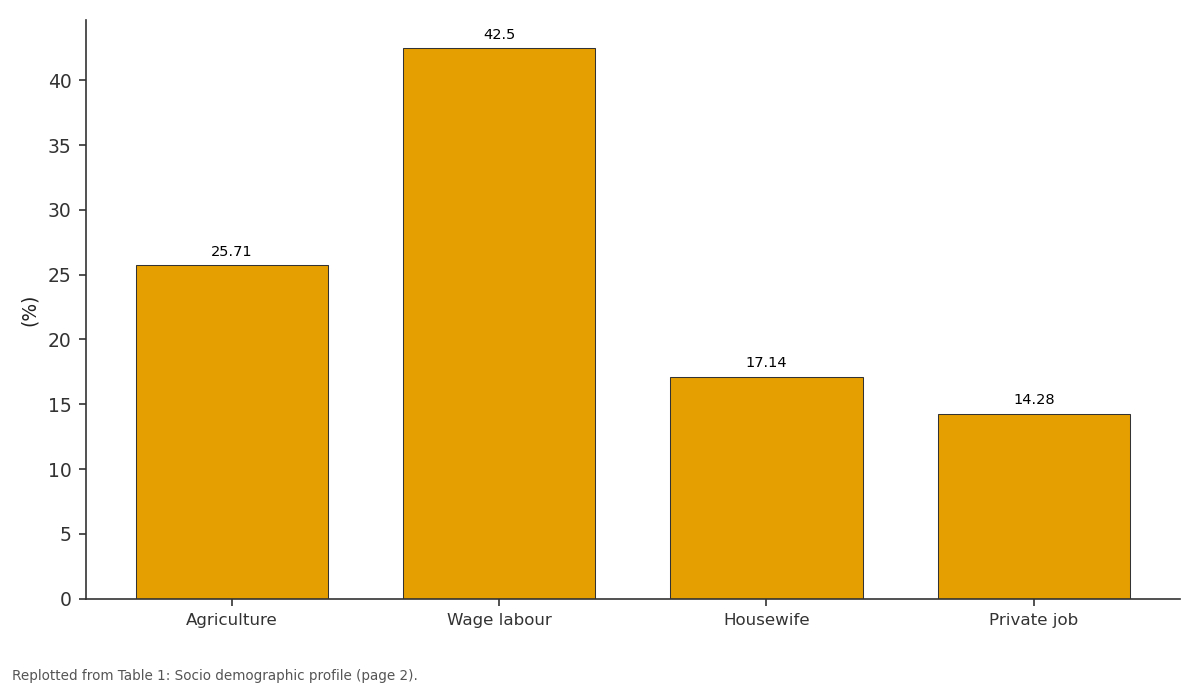
(%): Agriculture vs Wage labour vs Housewife vs Private job
Replotted from Table 1 (page 2) of the original paper. Every bar is the paper's own table value.
View source evidence ↗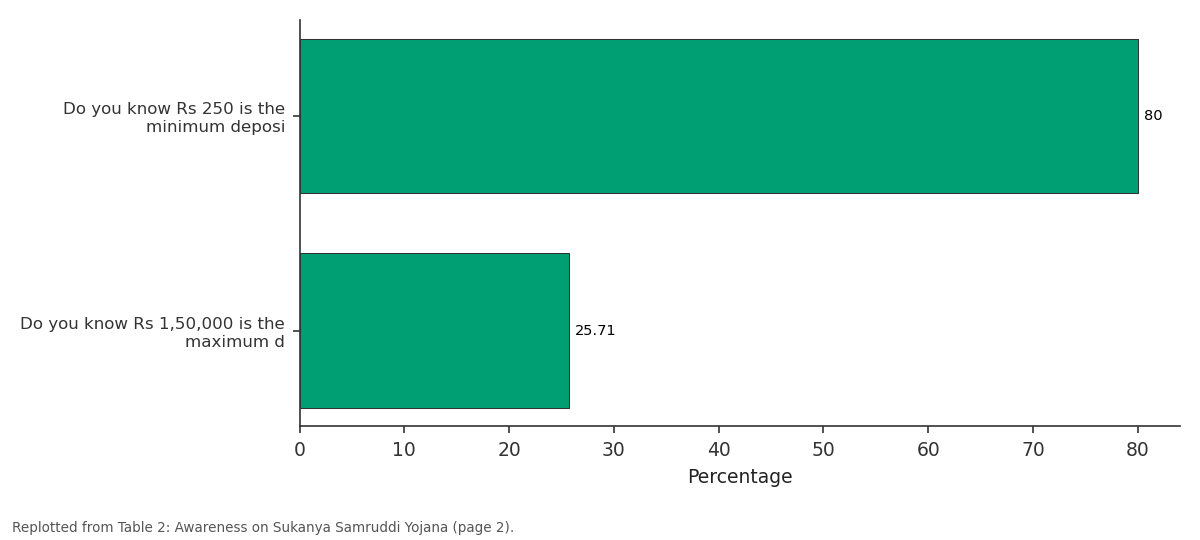
Percentage: Do you know Rs 250 is... vs Do you know Rs 1,50,000...
Replotted from Table 2 (page 2) of the original paper. Every bar is the paper's own table value.
View source evidence ↗Figures & tables
From the original paper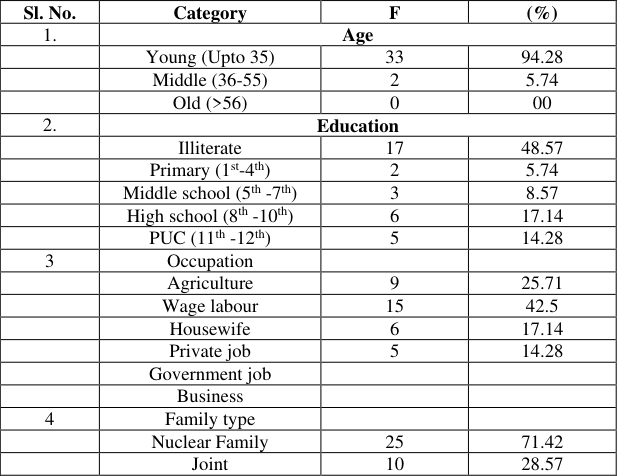 Table 1
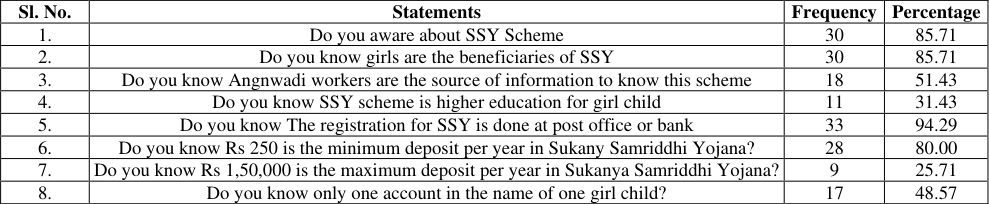 Table 2
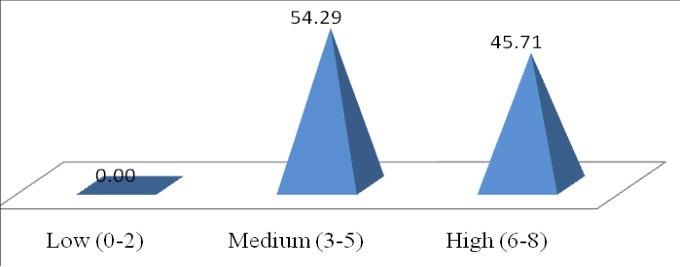 Figure 1
Introduction
Sukanya Samridhi Yojana (SSY) was introduced by our honorable Prime Minister Mr. Narendra Modi on January 22, 2015. The Sukanya Samriddhi Yojana was launched as an apart of beti bachao, beti padho. This scheme was brought because no parents or guardian should think girl child as a financial burden. It is a small deposit scheme in which one can deposit maximum of Rs. 1.50 lakh during the particular financial year. But the minimum amount deposited should not be less than Rs. 250. Apart from the parents, a legal guardian at will, also permitted to open the account for the welfare of a girl child. A guardian can hold only one account in the name of one girl child and maximum of two accounts in the name of two different children. Account can be opened up to the age of ten years only. Nomination is not allowed it in this account. Minimum amount for opening of account is Rs. 1,000 and subsequent deposit should be made in multiples of Rs. 100. There is no limit to make number of deposit either in a month or in a financial year just like a saving account. Partial withdrawal maximum up to 50% of the balance standing at the end of the proceedings financial year can be taken after the account holder is attaining the age of 18 years. Account will be closed when the account holder completes her 21 years of age and if it is not closed on maturity, the balance amount standing on the maturity date will continue to earn interest as specified until withdrawal.
Objectives of the study
To know the socio-economic status of the sample respondents of SSY account. To identify the awareness level of respondents about SSY scheme.
Methodology
The present study was conducted in Karnataka state of Dharwad district at Chikkamalligawad and Doddamalligawad village. A total of 35 respondents were selected through random sampling method, data was collected by using structured interview schedule and analyzed by using frequency, percentage, class interval and indices.
Results and Discussion
Table 1. Indicated that, most (94.28%) of the respondents belonged to young age group, 5.74 per cent belonged to middle age group. Majority of the respondents were Illiterate (48.57%). 14.28% fall under PUC (11 th -12 th ), (17.14%) of the respondents are comes under High school (8 th -10 th ). Form above it was clear that, Most (42.5%) of the respondents were wage labour, (25.71%) of the respondents are agriculture, (17.14%) of the respondents are house wife. Most of the respondents live as nuclear family (71.42%) three to four members in their family and 28.57 percentages of the respondents were belong to joint family. www.extensionjournal.com Table 2 it is indicated that 94.29% of the respondents are aware about the registration for SSY is done at post office or bank and 85.71% of the respondents are aware about Sukanya Samriddhi Yojana and they were aware about know girls are the beneficiaries of SSY. 80% of the respondents aware about the Rs 250 is the minimum deposit per year in Sukany Samriddhi Yojana. 51.43% of the respondents said that Angnwadi workers are the source of information to know this scheme. 25.71% of the respondents aware about the Rs 1, 50,000 is the maximum deposit per year in Sukanya Samriddhi Yojana and 31.43% of the respondents know SSY scheme is higher education for girl child. From the above figure it is found that most (54.29%) of the respondents had medium level aware of the scheme, (45.71%) of the respondents had high level awareness. It reveals that most of the respondents had medium level of awareness. The findings of the study is similar to the study of Arunpriya and Revathi (2020) [5] .
| Sl. No. | Statements | Frequency | Percentage |
|---|---|---|---|
| 1. | Do you aware about SSY Scheme | 30 | 85.71 |
| 2. | Do you know girls are the beneficiaries of SSY | 30 | 85.71 |
| 3. | Do you know Angnwadi workers are the source of information to know this scheme | 18 | 51.43 |
| 4. | Do you know SSY scheme is higher education for girl child | 11 | 31.43 |
| 5. | Do you know The registration for SSY is done at post office or bank | 33 | 94.29 |
| 6. | Do you know Rs 250 is the minimum deposit per year in Sukany Samriddhi Yojana? | 28 | 80.00 |
| 7. | Do you know Rs 1,50,000 is the maximum deposit per year in Sukanya Samriddhi Yojana? | 9 | 25.71 |
| 8. | Do you know only one account in the name of one girl child? | 17 | 48.57 |
Table text extracted from the original PDF; superscript letters are shown inline. The original table image is below.
View original table image
| Sl. No. | Category | F | (%) |
|---|---|---|---|
| 1. | Age | ||
| Young (Upto 35) | 33 | 94.28 | |
| Middle (36-55) | 2 | 5.74 | |
| Old (>56) | 0 | 00 | |
| 2. | Education | ||
| Illiterate | 17 | 48.57 | |
| Primary (1st-4th) | 2 | 5.74 | |
| Middle school (5th -7th) | 3 | 8.57 | |
| High school (8th -10th) | 6 | 17.14 | |
| PUC (11th -12th) | 5 | 14.28 | |
| 3 | Occupation | ||
| Agriculture | 9 | 25.71 | |
| Wage labour | 15 | 42.5 | |
| Housewife | 6 | 17.14 | |
| Private job | 5 | 14.28 | |
| Government job | |||
| Business | |||
| 4 | Family type | ||
| Nuclear Family | 25 | 71.42 | |
| Joint | 10 | 28.57 |
Table text extracted from the original PDF; superscript letters are shown inline. The original table image is below.
View original table image
Conclusion
This study helps to understand account holders awareness about Sukanya Samridhi Yojana scheme. It was long term saving scheme started by central government and also providing financial independents to the girl child and her account holders. The scheme related awareness program
Acknowledgement
www.extensionjournal.com was medium, so the governments have to take necessary steps to improve the advertisement. The schemes are helps to generate nation development.
Figures and tables from the paper
References
5 in the original paper- Kameswari Harini V, Rampal P. Financial Inclusion-A Study on Sukanya Samriddhi Yojana. Int J Bus Manag. 2018;1(3):420-425.
- Vani U. Customer preference towards Sukanya Samridhi Scheme in Coimbatore city. Int J Manag Technol Eng. 2019;6(3):448-455.
- Venkatachalam V, Ravindra Kumar G. An analysis of account holder's acceptability and satisfaction towards Sukanya Samriddhi Account. J Bus Manag Soc Sci Res. 2018;7(5):33-39.
- Vinod Kumar Sharma. Sukanya Samriddhi Account Scheme: A SWOT Analysis. Int Bus J. 2015;17(21):5560.
- Arunpriya S, Revathi N. A study on account holders awareness and satisfaction towards Sukanya Samriddhi Yojana scheme with special reference to Tirupur District. International Journal of Commerce and Management Research. 2020;6(1):73-77.