
Research article · 2024 · Full text
International Journal of Research in AgronomyNano fertilizers and its effect on nutrient use efficiency in rice
Volume 7(6) · Pages 413–416 · DOI: 10.33545/2618060x.2024.v7.i6f.902 ↗
Research areasRice Cultivation and Yield ImprovementAgricultural Science and FertilizationCrop Yield and Soil Fertility
Abstract
Author-writtenRice is the most important agricultural crop which sustains more than 60% of the world's population as a dietary staple. Nano urea produced and patented by Indian Farmers Fertiliser Cooperative Limited [IFFCO] is developed to replace conventional urea and it can curtail the requirement by at least 50 percent and it will increase the nutrient use efficiency (NUE) by 80-90 percent. The main aim of the experiment was to assess the effect of nano fertilizers on the growth and yield of rice. The eight treatment combinations were T1- Nano urea (foliar) at active tillering & panicle initiation, T2 - Urea spray at active tillering & panicle initiation, T3 - Nano Urea followed by nano K (foliar) at active tillering & panicle initiation, T4- Nano K (foliar) at active tillering & panicle initiation, T5- Nano NPK (foliar) at active tillering & panicle initiation, T6 - 19:19:19 spray at active tillering & panicle initiation, T7- 90:45:45 kg N, P2O5 & K2O (KAU POP) and T8- Absolute control. The results showed that the application of nano urea @ 4ml/L as foliar topdressing at active tillering & panicle initiation recorded statistically similar results as that of 90:45:45 kg N, P2O5 & K2O (KAU POP) in terms of growth, yield and nutrient use efficiency in rice.
Summary
Source-checkedPlain-language reading of the full paper, prepared with AI and checked against the text. Each point links to the authors' own words.
Why it matters
- Rice is a critical global cereal crop, providing over 50% of the world's staple diet and 27% of its energy supply. View evidence ↗
- Conventional granular urea has a nitrogen content of 46%, but its efficiency is low (30-50%) due to leaching, volatilization, and rapid chemical transformation. View evidence ↗
- Nanofertilizers are designed to improve nutrient use efficiency through properties such as controlled release, stability, high solubility, and targeted delivery. View evidence ↗
The question
- The study aimed to evaluate how nano fertilizers affect the growth and yield of rice. View evidence ↗
What they did
- The experiment was conducted at the Department of Agronomy, College of Agriculture, Vellanikkara, from September 2022 to January 2023. View evidence ↗
- The researchers used a randomized block design with eight different treatment combinations, each replicated three times. View evidence ↗
- Treatments included various foliar applications of nano urea, nano K, and nano NPK, as well as conventional urea spray, a 19:19:19 spray, a standard KAU POP recommendation (90:45:45 kg N, P2O5 & K2O), and an absolute control. View evidence ↗
- The study utilized the rice variety Uma (MO 16). View evidence ↗
What they found
- Nano urea foliar spray (T1) and the KAU POP treatment (T7) resulted in a statistically superior leaf area index at both 70 days after transplanting and at harvest. View evidence ↗
- Total dry matter production was statistically similar between the KAU POP treatment (8591 kg ha-1) and the nano urea foliar spray (8270 kg ha-1). View evidence ↗
- The highest number of panicles per m2 was produced by KAU POP (350.7), which was statistically on par with nano urea foliar spray (335). View evidence ↗
- The highest grain yield was recorded in the KAU POP treatment (4173 kg ha-1), which was comparable to the yield from nano urea foliar spray (3981 kg ha-1). View evidence ↗
- Nano urea foliar spray (T1) achieved the highest agronomic and recovery efficiency (48.30 kg kg-1), followed by the nano urea and nano potash combination (T3) at 37.64 kg kg-1. View evidence ↗
- The highest physiological efficiency (59.25 kg kg-1) was recorded in the treatment combining nano urea followed by nano potash. View evidence ↗
What it means
- The authors concluded that nano urea foliar spray and KAU POP treatments both provided superior growth and yield metrics. View evidence ↗
- The results highlight the potential of nano fertilizers to optimize nutrient management and crop production. View evidence ↗
Visual summary
3 visualsIllustrations explain the paper; charts are replotted from the paper's own table values.
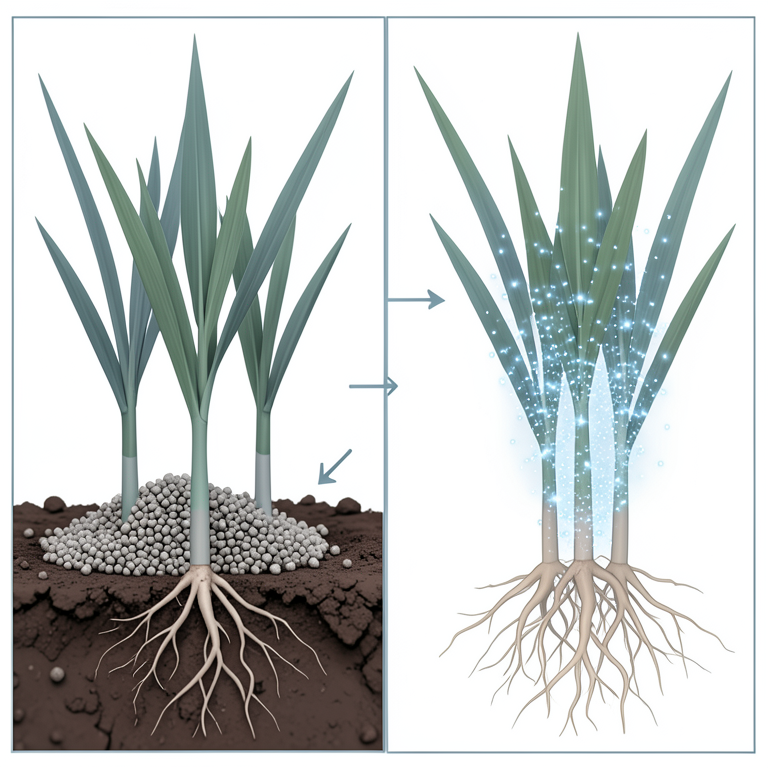
Nano Fertilizer Delivery Mechanism
AI-generated conceptual illustration (rice plants). It explains the idea and does not show study data.
View source evidence ↗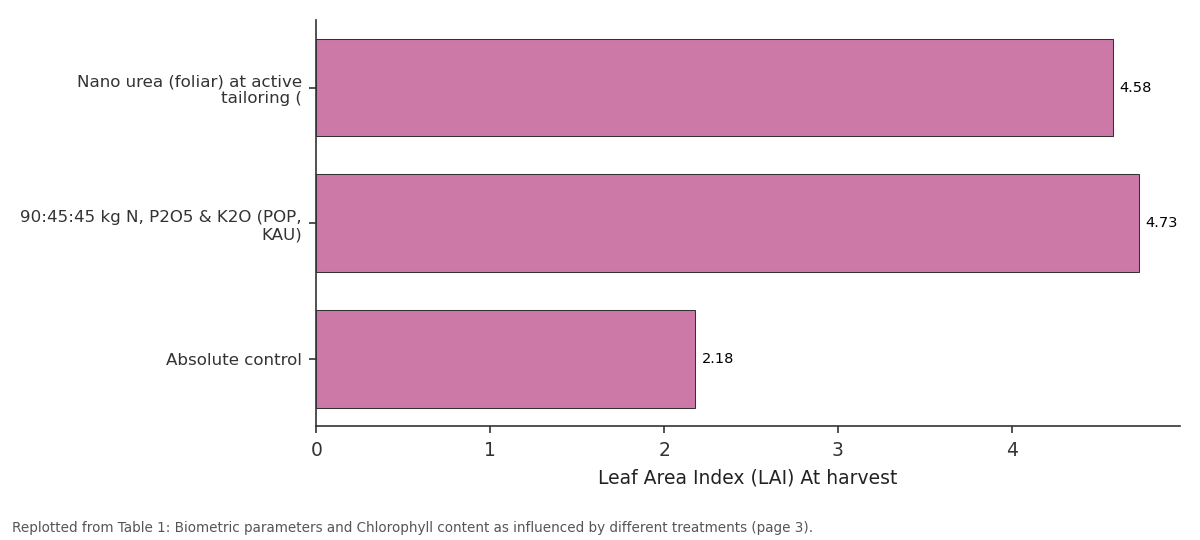
Leaf Area Index (LAI) At harvest: Nano urea (foliar) at... vs 90:45:45 kg N, P2O5 &... vs Absolute control
Replotted from Table 1 (page 3) of the original paper. Every bar is the paper's own table value.
View source evidence ↗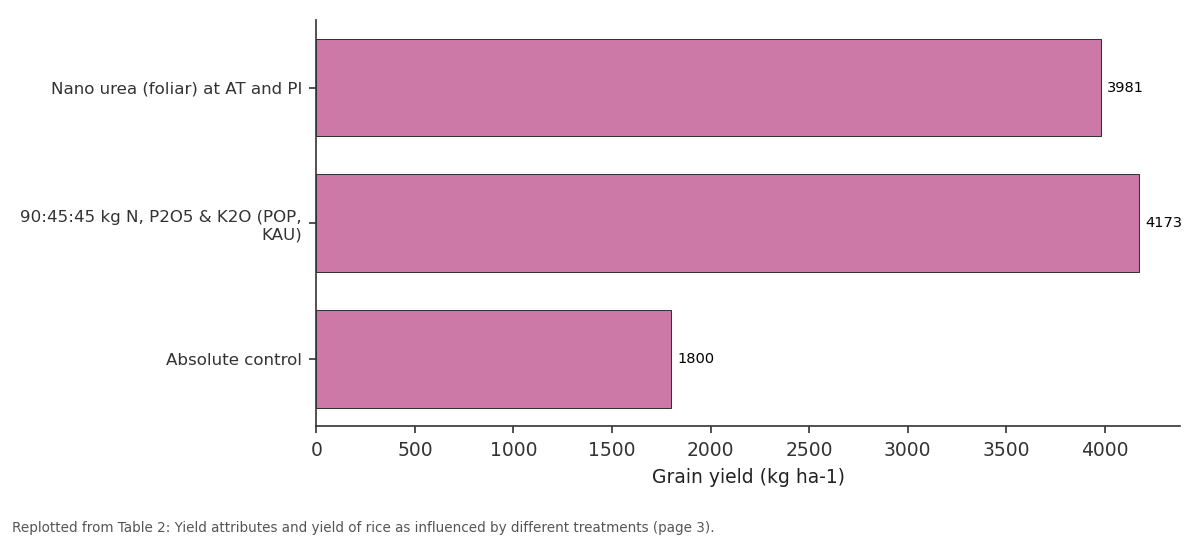
Grain yield (kg ha-1): Nano urea (foliar) at... vs 90:45:45 kg N, P2O5 &... vs Absolute control
Replotted from Table 2 (page 3) of the original paper. Every bar is the paper's own table value.
View source evidence ↗Figures & tables
From the original paper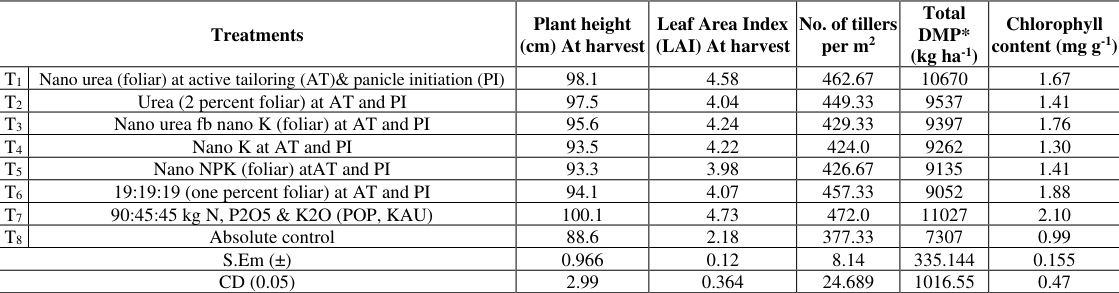 Table 1
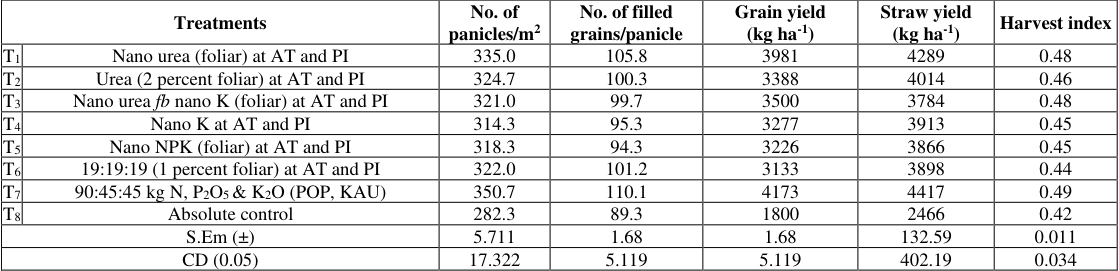 Table 2
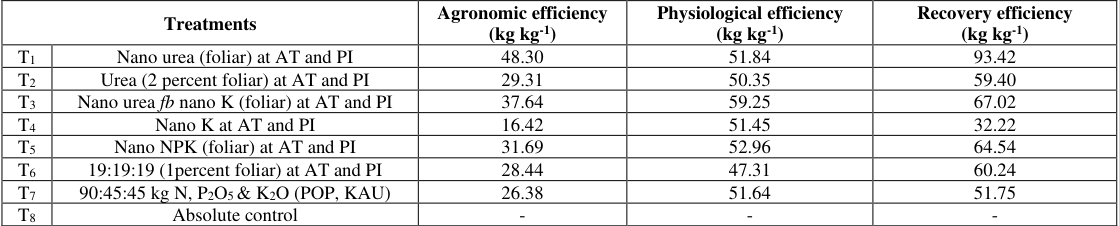 Table 3
Introduction
Rice (Oryza sativa L.) is the most important cereal crop providing more than 50 percent of the world's staple diet and 27 percent of energy supply. Conventional fertilizers are effective in nourishing high yielding varieties of crops because it provide essential nutrients in plant available form. However, unscrupulous application of fertilizers can result in soil quality deterioration due to many factors such as altering the soil physical and chemical properties and reduced microbial activity. Fertilizers can also cause pollution of water bodies by leaching and eutrophication. Soil application of fertilizers as basal and top dressing is the general practice in rice. Conventional granular urea is one of the most important nitrogenous fertilizers in the country, with nitrogen content of 46 percent but the efficiency of applied nitrogen is only 30-50 percent due to rapid chemical transformation, leaching and volatilization losses. Nanotechonology resulted in production of nanoparticles of metabolically important nutrients which are designed to improve fertilizer uptake and thereby minimizing loss of nutrients. Nanofertilizers have high nutrient use efficiency due to its properties like high solubility, stability, targeted delivery and controlled release (Solanki et al., 2015) [10] . Nanofertilizers being foliar applied have high penetrative power and improves the crop growth, yield and nutrient use efficiency reducing fertilizer cost and emission risks (El-sadony et al., 2021) [3] . In this context, the current study was undertaken with the objective to evaluate nano nutrient formulations on growth, yield and nutrient use efficiency of rice.
Materials and Methods
The present study was carried out in Department of Agronomy, College of Agriculture, Vellanikkara during September 2022 to January 2023. The soil type of experimental site was sandy loam with pH 5.69 (moderately acidic), and organic carbon content of 0.55 percent. The primary nutrients viz., nitrogen (alkaline permanganate method), phosphorus (Olsen method) and potassium (neutral normal ammonium acetate method) content in the soil were 325 kg ha -1 , 40 kg ha -1 and 240 kg ha -1 respectively before starting the experiment.
The experiment was laid in randomized block design with eight treatment combinations replicated thrice. The eight treatment combinations were T1-Nano urea (0.4% foliar) at active tillering & panicle initiation, T2 -Urea (2% foliar) at active tillering & panicle initiation,T3 -Nano Urea followed by nano K (0.4% foliar) at active tillering & panicle initiation, T4-Nano K (0.4% foliar) at active tillering & panicle initiation, T5-Nano NPK (0.4% foliar) at active tillering & panicle initiation, T6 -19:19:19 (1% foliar) at active tillering & panicle initiation, T7-90:45:45 kg N, P2O5 & K2O (KAU POP) T8-Absolute control [without manures & fertilisers]. The plot size was 5 m x 4 m and transplanting was done at a spacing of 20 cm x 10 cm at 20 days after sowing. The rice variety used was Uma (MO 16) developed by M. S. Swaminathan Rice Research Station, Moncombu under Kerala Agricultural University. In all treatments except absolute control, FYM @ 5 t/ha, full dose of P, half N & K will be applied as basal as soil application according to KAU POP (90:45:45 kg N, P2O5 & K2O). IFFCO nano urea, Tag nano potash and Nano NPK (Tropical Agro) were applied @ 4 ml L -1 as top dressing at active tillering & panicle initiation. In T3, nano K was given 5 days after nano urea application. Different nutrient use efficiencies were worked out to find out the efficiency of nanofertilisers used. Recovery efficiency is the proportion/ratio of nutrient uptake by the crop to nutrient applied (kg). Physiological efficiency is the ability of plants to transform acquired nutrients into economic yield and is impacted by partitioning, environment and management. It is the ratio of yield to total N uptake. Agronomic efficiency is expressed as increase in yield per unit of nutrient applied.
Results and Discussion
Taller plants were observed in nano urea foliar spray (T1), 2% urea foliar (T2) and T7 (KAU POP) which were statistically on par with T3 (nano urea followed by nano potash foliar spray) at harvest. The increased plant height in nanourea applied plants can be attributed to efficient release of nano-encapsulated nitrogen which in turn facilitated nutrient uptake, its transportation and absorption in plants (Midde et al. 2021) [8] . The plants in treatment nano urea as foliar spray (T1), and T7 (KAU POP) recorded statistically superior leaf area index (LAI) followed by treatments T3 (nano urea followed by nano potash) and T4 (nano K foliar spray) at 70 days after transplanting as well as at harvest. The application of nano urea spray @ 4 ml L -1 at active tillering and panicle initiation resulted in higher leaf area index can be due to improved nutrient absorption and utilization. The nanoscale composition facilitates more effective nutrient penetration and absorption through the leaves, fostering the expansion of leaves and overall canopy growth (Sharma et al., 2022) [1] . The treatments nano urea foliar spray (T1), urea foliar spray (T2), 19:19:19 foliar spray (T6) and KAU POP (T7) were found to be superior in number of tillers at 70 days after transplanting. The data revealed that total dry matter production in treatment KAU POP (8591 kg ha -1 ) where total recommended dose of nitrogen is soil applied as basal and treatment T1 (nano urea foliar spray), where 50 percent of the recommended dose of nitrogen is soil applied along with two foliar application of nano urea at active tillering and panicle initiation produced statistically similar results (8270 kg ha -1 ). The treatment absolute control (T8) recorded the lowest dry matter production of 4267 kg ha -1 . At 70 days after transplanting, the highest recorded value of chlorophyll (2.101 mg/g) was observed in treatment KAU POP, and this value is statistically comparable to those of treatments T1, T3, and T6. Yield attributes in rice were significantly influenced by different treatments. The treatment KAU POP, produced highest number of panicles per m 2 (350.7 panicles m -2 ) which was on par with treatment nano urea foliar spray (T1) (335 panicles m -2 ). This result is in consistent with Attri et al. (2022) [1] and may be due to the fact that nutrition in the early stages of plant life provided enough time for good nutrition which gave greater chance of increasing number of panicles and filled grains (Jassim et al., 2019) [6] . The number of filled grains per panicle was found to be higher in treatment KAU POP (110) which was found to be statistically on par with treatment nano urea foliar spray (105). It might be due to increased enzyme activity such as those required for the CO2 assimilation pathway and chlorophyll biosynthesis, which could result in the production and transportation of photosynthates to sink which in turn increased the number of grains per panicle (Gewaily et al., 2019) [4] . The average 1000 grain weight was 24.42 g. KAU POP (T7) recorded highest grain yield of 4173 kg ha -1 , comparable to the yield of 3981 kg ha -1 in treatment nano urea foliar spray (T1). Treatment KAU POP recorded highest straw yield of 4289 kg ha -1 , which was comparable to the yields obtained from treatments T1, T2, T4, T5 and T6. Synergistic interaction between conventional and nanofertilizers was observed by Benzon et al. (2015) [2] and this leads to better absorption of nutrients, accumulation of photosynthates and translocation to economic parts resulted in increased grain yield. The higher yield obtained could also be a reflection of higher chlorophyll content as suggested by Hopkins and Hurner (2008) [5] . The highest harvest index, was observed in KAU POP (0.49), and is comparable to the harvest indices of treatments T1, T2, T3, T4 and T5. This was due to the positive effect of nano nitrogen in production and partitioning of photosynthates towards sink. Nutrient use efficiency is an important concept for evaluating the efficiency of fertilisers applied with respect to crop production. Highest agronomic efficiency (of nitrogen fertilizer) and recovery efficiency was recorded in nano urea foliar spray (T1) (48.30 kg kg -1 ) followed by the treatment nano urea followed by nano potash (T3) (37.64 kg kg -1 ). The treatment nano urea followed by nano potash recorded higher physiological efficiency (59.25 kg kg -1 ). The improved performance of rice treated with two nano sprays can be attributed to the lower dosage of nano fertilisers applied as well as its effect on higher production in terms of yield. The features of nano fertilisers facilitate its targeted uptake, allowing them to penetrate deep into the leaves and thereby enhanced nutrient use efficiency. Nano fertilizers, in particular, exhibit superior transport and nutrient delivery through plasmodesmata, which are nano-sized channels (50-60 nm) between cells, as observed by Mahanta et al. (2020) [7] . The results of the study revealed that the application of nano urea @ 4 ml L-1 at active tillering and panicle initiation along with soil application of K at panicle initiation was better in terms of yield and nutrient use efficiency and it was on par with treatment applied with KAU POP (90: 45:45 kg ha -1 ).
Conclusion
The study found that plants treated with nano urea foliar spray (T1) and KAU POP (T7) exhibited superior growth and yield metrics. These treatments resulted in taller plants, higher leaf area indices, and greater dry matter production, attributed to the efficient nutrient uptake facilitated by nano-encapsulated nitrogen. The number of tillers, panicles per square meter, and filled grains per panicle were significantly higher in these treatments, contributing to increased grain yields. The highest grain and straw yields were recorded in the KAU POP treatment, closely followed by the nano urea spray treatment. Nano fertilizers demonstrated enhanced nutrient use efficiency, with T1 showing the highest agronomic efficiency. This improved performance underscores the potential of nano fertilizers in optimizing crop production and nutrient management.
Figures and tables from the paper
| Treatments | — | Plant height (cm) At harvest | Leaf Area Index (LAI) At harvest | No. of tillers per m2 | Total DMP* (kg ha-1) | Chlorophyll content (mg g-1) |
|---|---|---|---|---|---|---|
| T1 | Nano urea (foliar) at active tailoring (AT)& panicle initiation (PI) | 98.1 | 4.58 | 462.67 | 10670 | 1.67 |
| T2 | Urea (2 percent foliar) at AT and PI | 97.5 | 4.04 | 449.33 | 9537 | 1.41 |
| T3 | Nano urea fb nano K (foliar) at AT and PI | 95.6 | 4.24 | 429.33 | 9397 | 1.76 |
| T4 | Nano K at AT and PI | 93.5 | 4.22 | 424.0 | 9262 | 1.30 |
| T5 | Nano NPK (foliar) atAT and PI | 93.3 | 3.98 | 426.67 | 9135 | 1.41 |
| T6 | 19:19:19 (one percent foliar) at AT and PI | 94.1 | 4.07 | 457.33 | 9052 | 1.88 |
| T7 | 90:45:45 kg N, P2O5 & K2O (POP, KAU) | 100.1 | 4.73 | 472.0 | 11027 | 2.10 |
| T8 | Absolute control | 88.6 | 2.18 | 377.33 | 7307 | 0.99 |
| S.Em (±) | 0.966 | 0.12 | 8.14 | 335.144 | 0.155 | |
| CD (0.05) | 2.99 | 0.364 | 24.689 | 1016.55 | 0.47 |
Table text extracted from the original PDF; superscript letters are shown inline. The original table image is below.
View original table image
| Treatments | — | No. of panicles/m2 | No. of filled grains/panicle | Grain yield (kg ha-1) | Straw yield (kg ha-1) | Harvest index |
|---|---|---|---|---|---|---|
| T1 | Nano urea (foliar) at AT and PI | 335.0 | 105.8 | 3981 | 4289 | 0.48 |
| T2 | Urea (2 percent foliar) at AT and PI | 324.7 | 100.3 | 3388 | 4014 | 0.46 |
| T3 | Nano urea fb nano K (foliar) at AT and PI | 321.0 | 99.7 | 3500 | 3784 | 0.48 |
| T4 | Nano K at AT and PI | 314.3 | 95.3 | 3277 | 3913 | 0.45 |
| T5 | Nano NPK (foliar) at AT and PI | 318.3 | 94.3 | 3226 | 3866 | 0.45 |
| T6 | 19:19:19 (1 percent foliar) at AT and PI | 322.0 | 101.2 | 3133 | 3898 | 0.44 |
| T7 | 90:45:45 kg N, P2O5 & K2O (POP, KAU) | 350.7 | 110.1 | 4173 | 4417 | 0.49 |
| T8 | Absolute control | 282.3 | 89.3 | 1800 | 2466 | 0.42 |
| S.Em (±) | 5.711 | 1.68 | 1.68 | 132.59 | 0.011 | |
| CD (0.05) | 17.322 | 5.119 | 5.119 | 402.19 | 0.034 |
Table text extracted from the original PDF; superscript letters are shown inline. The original table image is below.
View original table image
| Treatments | — | Agronomic efficiency (kg kg-1) | Physiological efficiency (kg kg-1) | Recovery efficiency (kg kg-1) |
|---|---|---|---|---|
| T1 | Nano urea (foliar) at AT and PI | 48.30 | 51.84 | 93.42 |
| T2 | Urea (2 percent foliar) at AT and PI | 29.31 | 50.35 | 59.40 |
| T3 | Nano urea fb nano K (foliar) at AT and PI | 37.64 | 59.25 | 67.02 |
| T4 | Nano K at AT and PI | 16.42 | 51.45 | 32.22 |
| T5 | Nano NPK (foliar) at AT and PI | 31.69 | 52.96 | 64.54 |
| T6 | 19:19:19 (1percent foliar) at AT and PI | 28.44 | 47.31 | 60.24 |
| T7 | 90:45:45 kg N, P2O5 & K2O (POP, KAU) | 26.38 | 51.64 | 51.75 |
| T8 | Absolute control | - | - | - |
Table text extracted from the original PDF; superscript letters are shown inline. The original table image is below.
View original table image
References
9 in the original paper- Attri M, Sharma N, Sharma BC. Effect of foliar application of nano urea on productivity and profitability of fine rice under irrigated subtropics of Jammu region. Indian Journal of Ecology. 2022;49(5):1935-1938.
- Benzon HRL, Rubenecia MRU, Ultra Jr VU, Lee SC. Nano-fertilizer affects the growth, development, and chemical properties of rice. International Journal of Agronomy and Agricultural Research. 2015;7(1):105-117.
- El-Saadony MT, ALmoshadak AS, Shafi ME, Albaqami NM, Saad AM, El-Tahan AM, et al. Vital roles of sustainable nano-fertilizers in improving plant quality and quantity-an updated review. Saudi Journal of Biological Sciences. 2021;28(12):7349-7359.
- Gewaily EE, Ghoneim AM, Khattab EA. Nano silicon and nitrogen foliar spray affects the growth, yield and nutrients content of rice. World Journal of Agricultural Sciences. 2019;15(6):367-375.
- Jassim RA, Kadhem HN, Nooni GB. Impact of levels and time of foliar application of nano fertilizer (Super micro plus) on some components of growth and yield of rice (Oryza sativa L.). Plant Archives. 2019;19(1):1279-1283.
- Mahanta N, Damble AS, Raj C. Nutrient use efficiency through nano nitrogen. Journal of Environmental Biology. 2020;7(3):2839-2842.
- Midde SK, Perumal MS, Murugan G, Sudhagar R, Mattepally VS, Bada MR. Evaluation of nano urea on growth and yield attributes of rice (Oryza sativa L.). Chemical Science Review and Letters. 2021;11(42):211214.
- Sharma SK, Sharma PK, Mandeewal RL, Sharma V, Chaudhary R, Pandey R. Effect of foliar application of nano-urea under different nitrogen levels on growth and nutrient content of pearl millet (Pennisetum glaucum L.). International Journal of Plant and Soil Science. 2022;34(20):149-155.
- Solanki P, Bhargava A, Chhipa H, Jain N, Panwar J. Nanofertilizers and their smart delivery system. Nanotechnologies in Food and Agriculture. 2015;16(2):81101.
Cited by 2
From OpenAlex, OpenCitations and reference lists read by Scinovex
- Nano-fertilizers for climate-smart agriculture: Resource efficiency across soil-plant-environment systems ↗
Md. Asadujjaman Rasel, Sayma Salam, Md. Moshiul Islam · Climate smart agriculture. · 2026
Climate change is intensifying constraints on agricultural productivity by amplifying nutrient losses, yield instability, and environmental degradation. Climate-smart agriculture (CSA) seeks to address these challenges by integrating productivity, resilience, and sustainability; however, conventional fertilizer practices remain inefficient and environmentally burdensome. Recent advances in nano-fertilizer technologies offer new opportunities to improve nutrient management within CSA frameworks. Nano-fertilizers enhance nutrient delivery through…
❝ 3PDF - Assessment of herbicide-nano-fertilizer compatibility and its impact on weed dynamics and yield performance in direct-seeded rice ↗
Vijay Kumar Choudhary, M.P. Sahu, Vikash Singh, Badal Verma, J.S. Mishra · Journal of Agriculture and Food Research · 2026
Weed management and supplementary nutrient supply are important for maintaining crop competitiveness in direct-seeded rice (DSR), but information on the agronomic response of different post-emergence herbicide programmes when integrated with foliar nano-fertilizers remains limited. A two-year field experiment was conducted during the kharif seasons of 2023 and 2024 at the ICAR-Directorate of Weed Research, Jabalpur, India, to evaluate three post-emergence…
❝ 0PDF