
Research article · 2024 · Full text
International Journal of Research in AgronomyIchthyofaunal diversity of Milak, a small river of Nagaland
Volume 7(6S) · Pages 250–253 · DOI: 10.33545/2618060x.2024.v7.i6sd.891 ↗
Research areasFish Biology and Ecology StudiesFish Ecology and Management StudiesSouth Asian Studies and Conflicts
Abstract
Author-writtenThe present study is targeted to investigate the fish diversity, their present IUCN conservation status, and economic value of Milak, a small river of Nagaland. Milak River originated in Langpangkong of Mokokchung and is effectively marked by the moderate and progressing flow towards the plains. Tuli is one of the most populous towns that are located near this river district in Nagaland. Tsurong is a major tributary of the Milak River.
Summary
Source-checkedPlain-language reading of the full paper, prepared with AI and checked against the text. Each point links to the authors' own words.
Why it matters
- Nagaland is a small hilly state in northeastern India covering 16,579 sq. km and is located within the Indo-Burma Biodiversity Hotspot. View evidence ↗
- Fish are significant biological resources used for food, the aquarium trade, and the sports industry. View evidence ↗
- Freshwater ecosystems are among the most endangered in the world, despite covering only about 0.01% of the Earth's surface water. View evidence ↗
The question
- The study aimed to investigate the fish diversity, economic value, and IUCN conservation status of species in the Milak River of Nagaland. View evidence ↗
What they did
- The survey was conducted in the Milak River of the Mokokchung district of Nagaland during the winter and pre-monsoon seasons. View evidence ↗
- Fish specimens were collected using cast nets with the assistance of local artisanal fishers. View evidence ↗
- Specimens were preserved in 10% formalin, and measurements were recorded to 0.1 mm using digital calipers. View evidence ↗
- The conservation status of the identified fish species was determined using the IUCN Red List. View evidence ↗
What they found
- The study identified a total of 20 fish species belonging to five families: Cyprinidae, Sisoridae, Channidae, Mastacembelidae, and Badidae. View evidence ↗
- The species Olyra kempi was listed as Data Deficient (DD). View evidence ↗
- Danio aequipinnatus was recorded as Not Evaluated (NE) for its conservation status. View evidence ↗
- The authors noted that two species within the genera Garra and Badis appear to be new to science, though this requires further research for confirmation. View evidence ↗
What it means
- The authors recommend immediate fish conservation measures and more frequent exploratory surveys to document diversity before species go extinct. View evidence ↗
- Further research is required to confirm whether the identified specimens of Garra sp. and Badis sp. are indeed new species. View evidence ↗
Figures & tables
From the original paper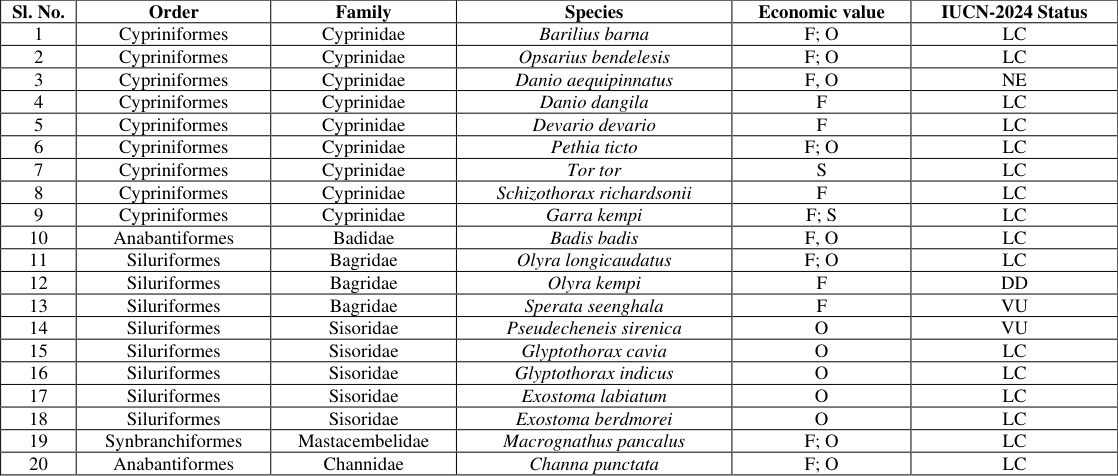 Table 1
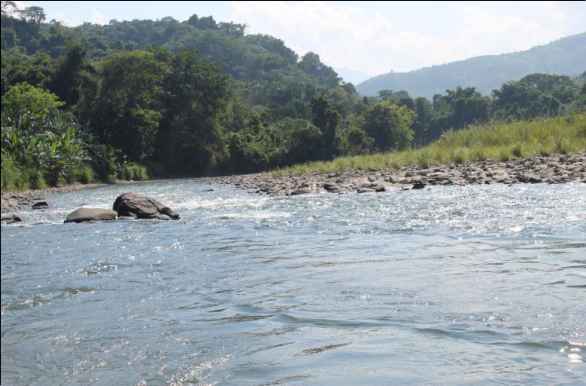 Figure 1
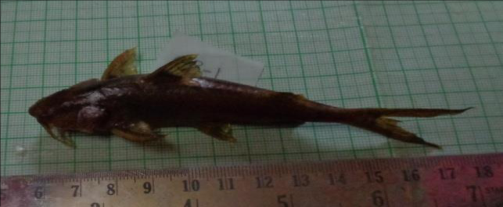 Figure 1
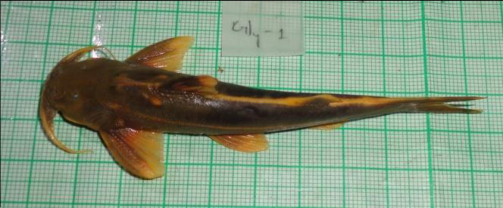 Figure 1
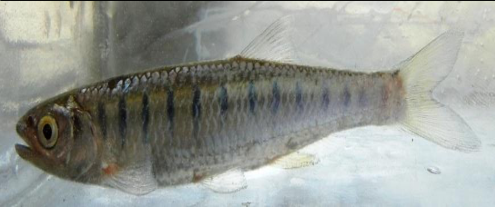 Figure 2
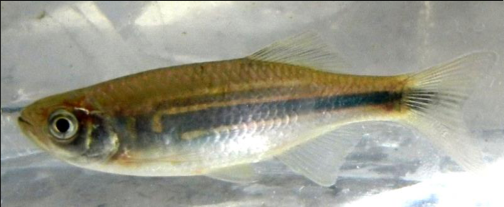 Figure 2
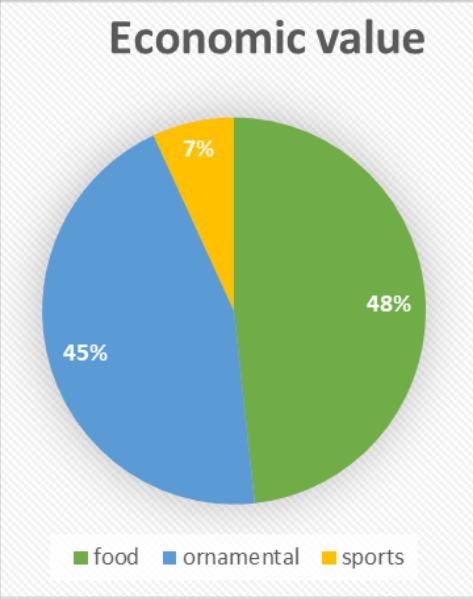 Figure 3
Introduction
Nagaland, a small hilly state (area of 16,579 sq. km) in northeastern India, is a part of the Indo- Burma Biodiversity Hotspot. The state is bordered by Arunachal Pradesh to the North, Manipur to the South, and Myanmar and Assam to the east and west, respectively. The diversity of topographic and climatic conditions has made the state rich with various flora and fauna. Fish is one of the important bioresources which can be used as food, in Aquarium fish, and sports industry (1).
In the present study, we provide a preliminary checklist of the fish fauna of Milak River. A rigorous collection of fish from the river obtained a good number of species diversity as the area lies in a hotspot.
Materials And Methods
Study site: The survey was carried out at of Milak River of Mokokchung district of Nagaland (Fig: 1). The study period was during the pre-monsoon and winter seasons. Specimens were collected with the help of a cast net along with local artisanal fishers. All the essential data such as place of collection, number of fish, body color, and body marking were recorded.
The collected specimens were preserved in 10% formalin for further analysis. The descriptions are based on formalin-preserved specimens. Measurements were taken point to point with digital calipers to 0.1 mm. For identification and classification, (2) and (3) were followed.
The conservation status of the fish species the conservation status of the fish species is based on the IUCN (www.iucnredlist.org.in). Table 1 shows the list of fish recorded from Milak River along with their economic value and the IUCN 2024 status. https://www.agronomyjournals.com Table 1: Showing the IUCN data Sl. No. Order Family Species Economic value IUCN-2024 Status 1 Cypriniformes Cyprinidae Barilius barna F; O LC 2 Cypriniformes Cyprinidae Opsarius bendelesis F; O LC 3 Cypriniformes Cyprinidae Danio aequipinnatus F, O NE 4 Cypriniformes Cyprinidae Danio dangila F LC 5 Cypriniformes Cyprinidae Devario devario F LC 6 Cypriniformes Cyprinidae Pethia ticto F; O LC 7 Cypriniformes Cyprinidae Tor tor S LC 8 Cypriniformes Cyprinidae Schizothorax richardsonii F LC 9 Cypriniformes Cyprinidae Garra kempi F; S LC 10 Anabantiformes Badidae Badis badis F, O LC 11 Siluriformes Bagridae Olyra longicaudatus F; O LC 12 Siluriformes Bagridae Olyra kempi F DD 13 Siluriformes Bagridae Sperata seenghala F VU 14 Siluriformes Sisoridae Pseudecheneis sirenica O VU 15 Siluriformes Sisoridae Glyptothorax cavia O LC 16 Siluriformes Sisoridae Glyptothorax indicus O LC 17 Siluriformes Sisoridae Exostoma labiatum O LC 18 Siluriformes Sisoridae Exostoma berdmorei O LC 19 Synbranchiformes Mastacembelidae Macrognathus pancalus F; O LC 20 Anabantiformes Channidae Channa punctata F; O LC DD- Data Deficient, LC-Least concern, NE- Not evaluated, VU- Vulnerable, F-Food, O-Ornamental, S-Sport
| Sl. No. | Order | Family | Species | Economic value | IUCN-2024 Status |
|---|---|---|---|---|---|
| 1 | Cypriniformes | Cyprinidae | Barilius barna | F; O | LC |
| 2 | Cypriniformes | Cyprinidae | Opsarius bendelesis | F; O | LC |
| 3 | Cypriniformes | Cyprinidae | Danio aequipinnatus | F, O | NE |
| 4 | Cypriniformes | Cyprinidae | Danio dangila | F | LC |
| 5 | Cypriniformes | Cyprinidae | Devario devario | F | LC |
| 6 | Cypriniformes | Cyprinidae | Pethia ticto | F; O | LC |
| 7 | Cypriniformes | Cyprinidae | Tor tor | S | LC |
| 8 | Cypriniformes | Cyprinidae | Schizothorax richardsonii | F | LC |
| 9 | Cypriniformes | Cyprinidae | Garra kempi | F; S | LC |
| 10 | Anabantiformes | Badidae | Badis badis | F, O | LC |
| 11 | Siluriformes | Bagridae | Olyra longicaudatus | F; O | LC |
| 12 | Siluriformes | Bagridae | Olyra kempi | F | DD |
| 13 | Siluriformes | Bagridae | Sperata seenghala | F | VU |
| 14 | Siluriformes | Sisoridae | Pseudecheneis sirenica | O | VU |
| 15 | Siluriformes | Sisoridae | Glyptothorax cavia | O | LC |
| 16 | Siluriformes | Sisoridae | Glyptothorax indicus | O | LC |
| 17 | Siluriformes | Sisoridae | Exostoma labiatum | O | LC |
| 18 | Siluriformes | Sisoridae | Exostoma berdmorei | O | LC |
| 19 | Synbranchiformes | Mastacembelidae | Macrognathus pancalus | F; O | LC |
| 20 | Anabantiformes | Channidae | Channa punctata | F; O | LC |
Table text extracted from the original PDF; superscript letters are shown inline. The original table image is below.
View original table image
Results And Discussion
Freshwater ecosystems contain only around 0.01% of the world’s surface water cover; meanwhile, freshwater ecosystems have become the most endangered ecosystems in the world, and the biodiversity that they support is vulnerable due to human activities and environmental changes. However, the Eastern Himalaya region has been identified as a freshwater biodiversity hotspot (4) and (5). The current study is the result of an exploration of fish diversity of Milak, a small river in Nagaland. A total of 20 species from the families Cyprinidae, Sisoridae, Channidae, Mastacembelidae, and Badidae were collected.
A greater number of species of the genera Danio, Opsarius, Devario, Badis, Schizothorax, Exostoma, and Glyptothorax were collected in present fish explorations. Due to the importance of taxonomical confirmation of species, the present study was conducted in a small river named Milak of the Brahmaputra basin revealing the existence of some ambiguous fish species that seem to be new to science. The study reveals the presence of twenty species belonging to 4 orders, 7 families and 16 genera. Cypriniformes dominated by 9 species followed by 8 siluriformes and each one of anabantiformes and synbranchiformes.
A greater number of species of the genera Garra, Opsarius, Psilorhynchus, Devario, Badis, Schizothorax, Exostoma, Garra and Glyptothorax (Fig-2) were recorded abundantly from the river. Suggesting more frequent fish exploratory surveys to know the valuable fish diversity before extinction and the need of immediate fish conservation implementations. https://www.agronomyjournals.com Fig 1: One of the sampling locations of Milak River Fig 2: Some collected species from Milak river https://www.agronomyjournals.com Fig 3: Percentage of fishes according to their importance in Fisheries
Conclusions
Total 20 Fish species Identified and recorded from Milak river of Nagaland. Among the Genus Garr sp. and Badis sp. Two seems to be new species, further research work required for confirmation. Suggesting more frequent fish exploratory surveys to know the valuable fish diversity before extinction and the need of immediate fish conservation implementations.
Acknowledgments
The authors extend their thankfulness to the Vice Chancellor, Central Agricultural University, Imphal, India and the Dean, College of Fisheries, Central Agricultural University, Tripura for providing the necessary facilities for carrying out the study.
References
5 in the original paper- Gurumayum SD, Kosygin L, Tamang L. Ichthyofaunal diversity of Arunachal Pradesh, India: A part of Himalaya biodiversity hotspot. Int J Fish Aquat Stud. 2016;4(2):337- 346.
- Nath P, Dey SC. Fish and Fisheries of Northeastern India. Vol. I: Arunachal Pradesh. 1st ed.; c2000. p. 217.
- Vishwanath W. Freshwater fishes of the Eastern Himalayas. Elsevier Academic Press; c2021. p. 431.
- Das BK, Boruah P, Kar D. Fish diversity and drainage analysis of River Siang, East Siang district of Arunachal Pradesh. Biosci Discov. 2014;6(1-I):16-20.
- IUCN. IUCN Red List of Threatened Species. Version 2023-2024. [Internet]. Available from: <www.iucn.redlist.org>. Accessed 2024.