
Research article · 2024 · Full text
International Journal of Research in AgronomyInfluence of organic manure and sulphur on growth and yield attributes of groundnut
Volume 7(6S) · Pages 416–418 · DOI: 10.33545/2618060x.2024.v7.i6sf.893 ↗
Research areasPeanut Plant Research StudiesRice Cultivation and Yield Improvement
Abstract
Author-writtenA field experiment was conducted during Kharif 2023 at Crop Research Farm, Department of Agriculture, Ideal college of Arts and Sciences, Vidyut Nagar, Kakinada, Andhra Pradesh. The experiment was laid out in Randomized Block Design with ten treatments which are replicated thrice on the basis of one year experimentation. The treatments consisted of 3 levels of farm yard manure (2 t/ha, 4 t/ha, 6 t/ha), and sulphur (20 kg/ha, 40 kg/ha, 60 kg/ha) and a control. Application of Farm yard manure (6 t/ha) + sulphur 60 kg/ha (Treatment 9) recorded maximum.
Summary
Source-checkedPlain-language reading of the full paper, prepared with AI and checked against the text. Each point links to the authors' own words.
Why it matters
- Groundnut is a critical oilseed crop in India, ranking first in area and second in production after soybean. View evidence ↗
- Optimizing mineral nutrition is essential for groundnut production because the crop has high nutrient requirements, which are further increased by high-yielding varieties. View evidence ↗
- In India, the world's largest groundnut producer, nutritional disorders can reduce yields by 30% to 70% depending on the soil type. View evidence ↗
The question
- The study aimed to evaluate how the application of organic manures and sulphur affects the growth and yield of groundnut. View evidence ↗
What they did
- The field experiment took place during the Kharif 2023 season at the Crop Research Farm in Kakinada, Andhra Pradesh. View evidence ↗
- The researchers used a Randomized Block Design with ten treatments, each replicated three times over one year. View evidence ↗
- Treatments included three levels of farm yard manure (2, 4, and 6 t/ha) and three levels of sulphur (20, 40, and 60 kg/ha), plus a control group. View evidence ↗
What they found
- The highest plant height (65.80 cm) was achieved with 6 t/ha farm yard manure and 60 kg/ha sulphur, compared to the lowest in the control plot (60.00 cm). View evidence ↗
- The maximum plant dry weight (29.74 g) occurred with 6 t/ha farm yard manure and 60 kg/ha sulphur, while the control plot had the minimum (24.62 g). View evidence ↗
- The highest number of nodules per plant (58.50) was found in the 6 t/ha farm yard manure and 60 kg/ha sulphur treatment, compared to 52.70 in the control. View evidence ↗
- The combination of 6 t/ha farm yard manure and 60 kg/ha sulphur produced the most pods (2.00) and seeds per pod (33.23), whereas the control produced the fewest (1.60 pods and 28.11 seeds). View evidence ↗
- The treatment of 4 t/ha farm yard manure and 60 kg/ha sulphur (65.00 cm) was statistically similar to the top-performing treatment (T9) in terms of plant height. View evidence ↗
What it means
- The authors conclude that organic manure management is vital for sustainable agriculture and improving the yield and quality of groundnut. View evidence ↗
- The authors recommend that farmers select organic manures based on their specific soil type, crop needs, and available resources. View evidence ↗
Visual summary
3 visualsIllustrations explain the paper; charts are replotted from the paper's own table values.
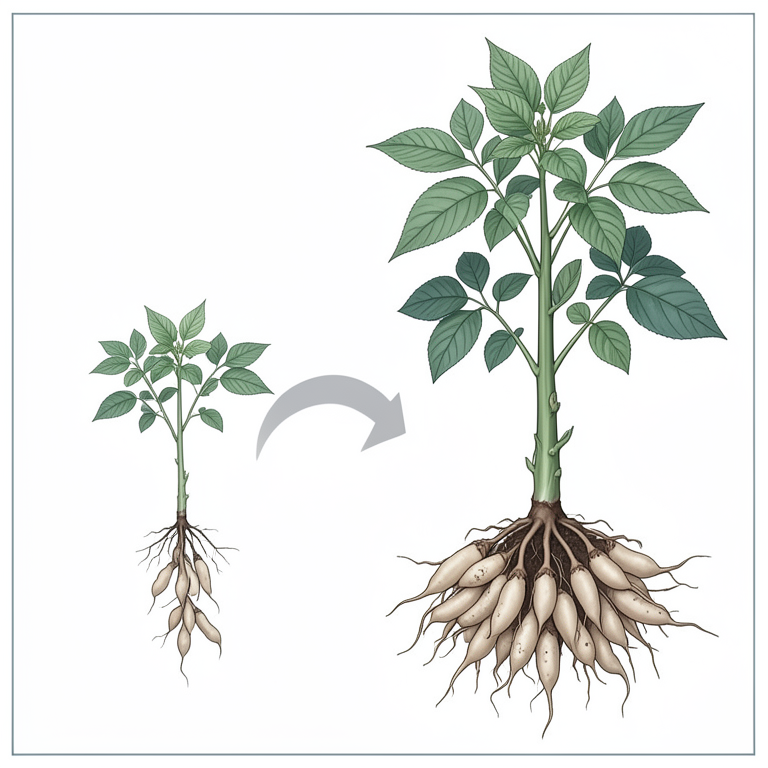
Effect of Manure and Sulphur on Groundnut
AI-generated conceptual illustration (groundnut plants (Arachis hypogaea)). It explains the idea and does not show study data.
View source evidence ↗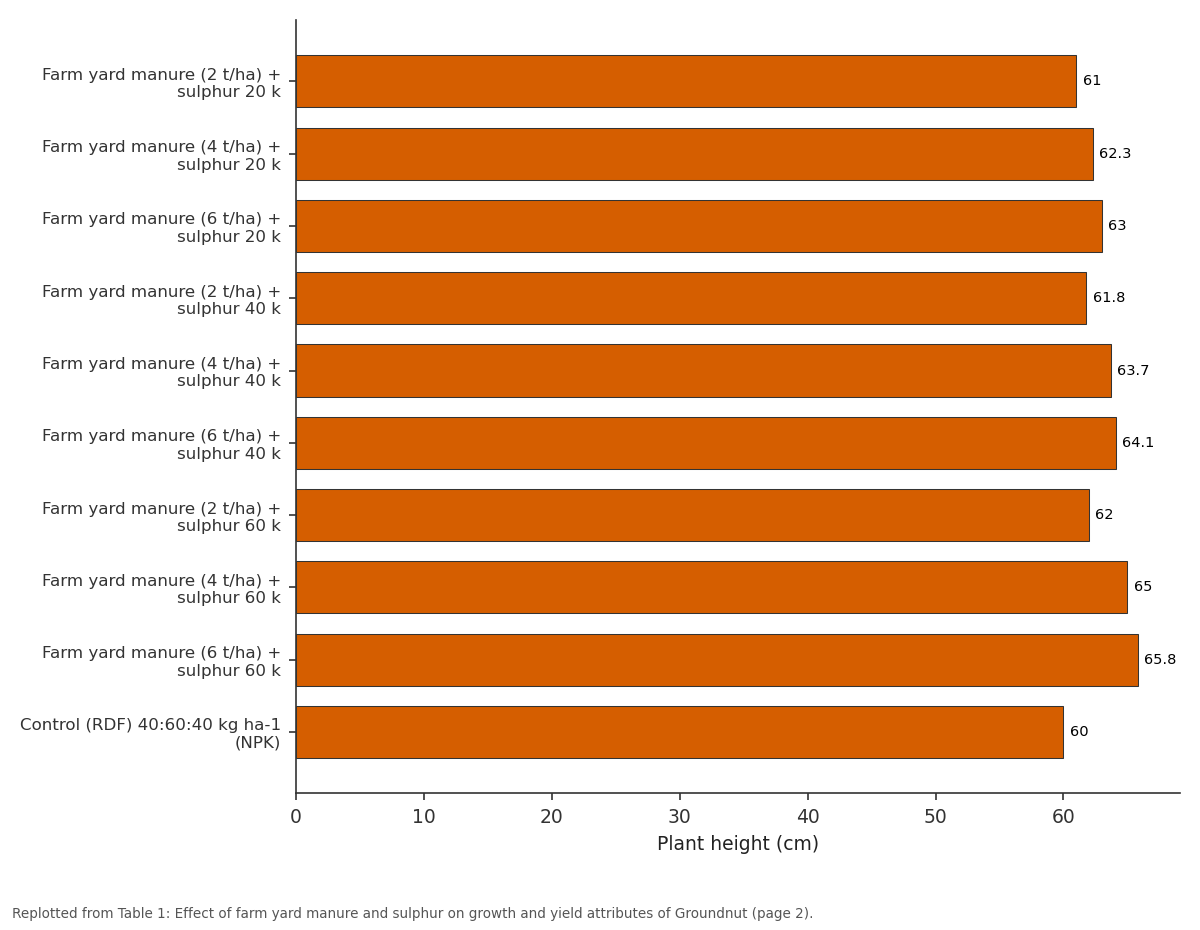
Plant height: Farm yard manure (2... vs Farm yard manure (4... vs Farm yard manure (6... vs Farm yard manure (2... vs Farm yard manure (4...
Replotted from Table 1 (page 2) of the original paper. Every bar is the paper's own table value.
View source evidence ↗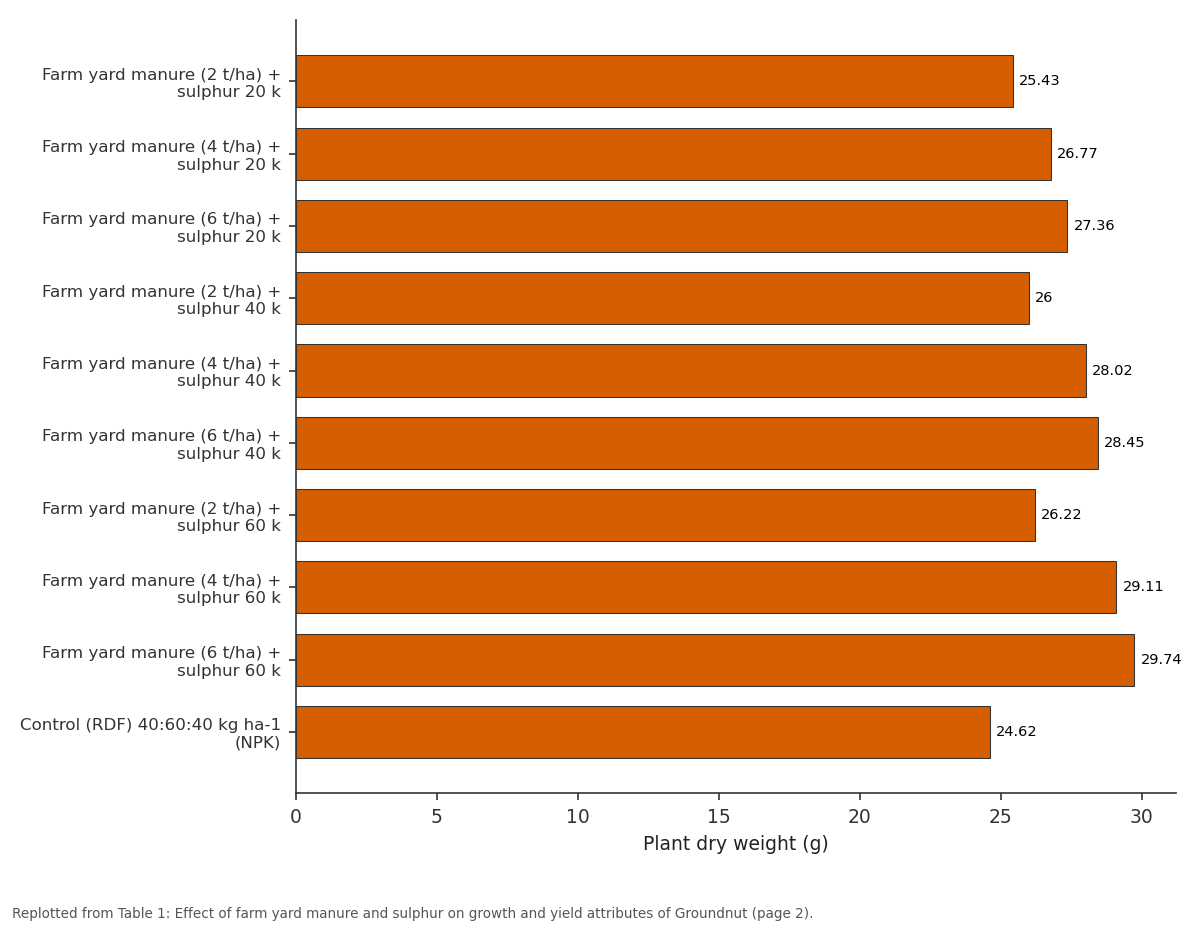
Plant dry weight: Farm yard manure (2... vs Farm yard manure (4... vs Farm yard manure (6... vs Farm yard manure (2... vs Farm yard manure (4...
Replotted from Table 1 (page 2) of the original paper. Every bar is the paper's own table value.
View source evidence ↗Figures & tables
From the original paper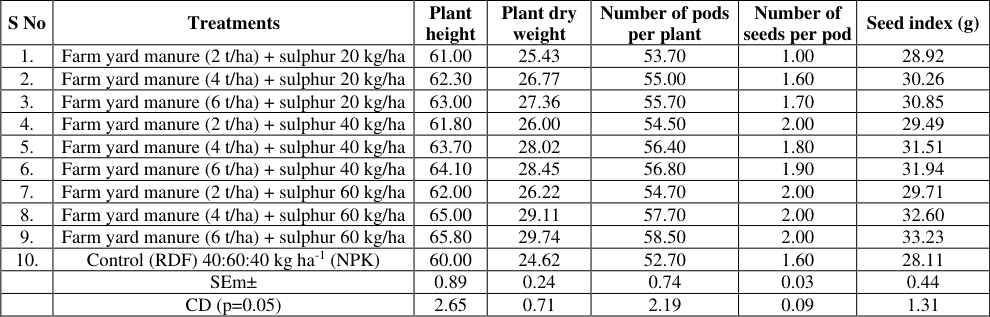 Table 1
Introduction
Groundnut (Arachis hypogaea L.) is also known as "The king of oilseeds". Groundnut is an important oilseed crop in India which occupies first position in terms of area and second position in terms of production after soyabean. China ranks first in groundnut production with 17.57 million tonnes followed by India 6.73 million tonnes. According to the all India kharif crop coverage report, Government of India, as on 17th September 2021, groundnut was sown in around 49.14 lakh hectares as compared to last year (50.97 lakh ha). Among the states, Gujarat stood first in area coverage with 19.09 lakh ha followed by Rajasthan (7.76 lakh ha), Andhra Pradesh (6.27 lakh ha), Karnataka (4.75 lakh ha) and Madhya Pradesh (3.82 lakh ha) (Groundnut Outlook -November 2021). The optimization of the mineral nutrition is the key to optimize the production of groundnut, as it has very high nutrient requirement and the recently released high yielding groundnut varieties remove still more nutrients from the soil. On contrary groundnut farmers, most part of the semi-arid region use very less nutrient fertilizer and sometime only one or two nutrients resulting in severe mineral nutrient deficiencies due to inadequate and imbalance use of nutrients is one of the major factors responsible for low yield in groundnut. India is the world's largest producer of groundnut where nutritional disorders cause yield reduction from 30 to 70% depending upon the soil types. Thus it is high time to look into the mineral nutrition aspects of groundnut for achieving high yield and advocate the suitable package of practices for optimization of yield (Veeramani et al., 2012) [12] . Many studies have shown that organic farming methods can produce even higher yields than conventional methods. Significant difference in soil health indicators such as nitrogen mineralization potential and microbial abundance and diversity, which were higher in the organic farms can also be seen. Keeping the points in view field experiment entitled "Effect of organic manures and sulphur on growth and yield of groundnut (Arachis hypogaea L.)".
Materials and Methods
The experiments on the effect of farm yard manure and sulphur along with recommended dose of fertilizers (RDF) on the growth and yield enhancement of groundnut were conducted at kharif season of 2023 at Crop Research Farm, Department of Agriculture, Ideal college of Arts and Sciences, Vidyut Nagar, Kakinada, Andhra Pradesh. Before seed sowing operation, it was ensured that sufficient moisture for germination of seed is present in the soil. The seed was sown at the rate of 8 kg/ha and seeds were treatment with liquid organic manure (Beejamrutham 10%). In the lines at spacing of 45 x 20cm. Immediately after sowing the lines were closed with soil and slightly pressed so as to have good contact of seed with soil to ensure good germination.
Results
Plant height: maximum plant height was reported in Farm yard manure (6 t/ha) + sulphur 60 kg/ha with (65.80 cm) and minimum was reported in control plot (60.00 cm), there was significant change in between the treatments and Farm yard manure (4 t/ha) + sulphur 60 kg/ha (65.00 cm) was statistically at par with T 9 .
Plant Dry weight: maximum plant dry weight was reported in Farm yard manure (6 t/ha) + sulphur 60 kg/ha with (29.74 g) and minimum was reported in control plot (24.62 g), there was significant change in between the treatments and Farm yard manure (4 t/ha) + sulphur 60 kg/ha g) was statistically at par with T 9 .
Number of nodules per plant: higher number of nodules were reported in Farm yard manure (6 t/ha) + sulphur 60 kg/ha with (58.50) and minimum was reported in control plot (52.70), there was significant change in between the treatments and Farm yard manure (4 t/ha) + sulphur 60 kg/ha (57.70) was statistically at par with T 9 .
Number of pods and seeds per pod
higher number of pods and seeds per pod were reported in Farm yard manure (6 t/ha) + sulphur 60 kg/ha with (2.00 and 33.23) and minimum was reported in control plot (1.60 and 28.11), there was significant change in between the treatments and Farm yard manure (4 t/ha) + sulphur 60 kg/ha (2.00 and 32.60) was statistically at par with T 9 .
Discussion
The optimum growth of the plant due to favourable nutritional environment and higher uptake of nutrients might have favoured significant increase in number of pegs per plant and thus a greater number of pods per plant. However, Panwar and Singh (2003) [4] , and Zalate and Padmani (2009) [10] reported same. The important growth and yield contributing characters viz., plant spread, number of branches, dry matter accumulation, number of pods and kernels and their weight and thousand kernel weight were significantly increased with the application of Psolubilizer treatments with poultry manure due to additional nitrogen and phosphorous uptake, resulting in increased dry pod yield. Increase in root nodules due to P-solubilizer and nitrifying bacteria also helped in increasing better root development and dry pod yield by fixing more nitrogen and consequently increasing its absorption. These results were found to be in conformity with Raychaudari et al. (2003) [6] . Sarkar and Banik (2002) [7] and Raja et al., (2007) [5] in sesame. Sulphur in the form of sulphate is involved in various metabolic and enzymatic activities of plant. It is also a constituent of glutathione, a compound supposed to play part in plant respiration and synthesis of oils (Jordon and Reisenaur, 2003) [2] . Further, sulphur also plays a vital role in chlorophyll formation as it is constituent of succynyl Co-A which is involved in chlorophyll synthesis (Pirson, 2005) [3] . The higher content of sulphur in plants is known to have role in better development and thickening of xylem and collenchyma tissues. The improved nutritional environment at the cellular level and leaf chlorophyll content appears to have increased the photosynthetic rate.
Conclusion
Organic manure management is an important aspect of sustainable agriculture, and it can play a vital role in improving the yield and quality of groundnut crops. The use of organic manure helps to improve soil fertility, enhance crop growth and yield, reduce soil erosion, and reduce the incidence of pests and diseases. Different types of organic manure can be used, including farmyard manure, compost, green manure, and vermicompost. Farmers should choose the appropriate type of organic manure based on their soil type, crop requirements, and availability of resources.
Figures and tables from the paper
| S No | Treatments | Plant height | Plant dry weight | Number of pods per plant | Number of seeds per pod | Seed index (g) |
|---|---|---|---|---|---|---|
| 1. | Farm yard manure (2 t/ha) + sulphur 20 kg/ha | 61.00 | 25.43 | 53.70 | 1.00 | 28.92 |
| 2. | Farm yard manure (4 t/ha) + sulphur 20 kg/ha | 62.30 | 26.77 | 55.00 | 1.60 | 30.26 |
| 3. | Farm yard manure (6 t/ha) + sulphur 20 kg/ha | 63.00 | 27.36 | 55.70 | 1.70 | 30.85 |
| 4. | Farm yard manure (2 t/ha) + sulphur 40 kg/ha | 61.80 | 26.00 | 54.50 | 2.00 | 29.49 |
| 5. | Farm yard manure (4 t/ha) + sulphur 40 kg/ha | 63.70 | 28.02 | 56.40 | 1.80 | 31.51 |
| 6. | Farm yard manure (6 t/ha) + sulphur 40 kg/ha | 64.10 | 28.45 | 56.80 | 1.90 | 31.94 |
| 7. | Farm yard manure (2 t/ha) + sulphur 60 kg/ha | 62.00 | 26.22 | 54.70 | 2.00 | 29.71 |
| 8. | Farm yard manure (4 t/ha) + sulphur 60 kg/ha | 65.00 | 29.11 | 57.70 | 2.00 | 32.60 |
| 9. | Farm yard manure (6 t/ha) + sulphur 60 kg/ha | 65.80 | 29.74 | 58.50 | 2.00 | 33.23 |
| 10. | Control (RDF) 40:60:40 kg ha-1 (NPK) | 60.00 | 24.62 | 52.70 | 1.60 | 28.11 |
| SEm± | 0.89 | 0.24 | 0.74 | 0.03 | 0.44 | |
| CD (p=0.05) | 2.65 | 0.71 | 2.19 | 0.09 | 1.31 |
Table text extracted from the original PDF; superscript letters are shown inline. The original table image is below.
View original table image
References
10 in the original paper- Chavan AP, Jain NK, Mahadkar UV. Direct and residual effects of fertilizers and biofertilizers on yield, nutrient uptake and economics of groundnut (Arachis hypogaea L.)- rice (Oryza sativa) cropping system. Indian J Agron. 2014;59(1):53-58.
- Jordon HV, Reisenaur HM. Sulphur and soil fertility. In: Soil Year Book Agriculture. Washington, DC: USDA; 2003. p. 107-111.
- Pirson A. Functional aspects of mineral nutrition of green plant. Rev Plant Physiol. 2005;6:71-144.
- Panwar AS, Singh NP. Effect of conjunctive use of phosphorus and bio-organics on growth and yield of groundnut (Arachis hypogaea L.). Indian J Agron. 2003;48(3):214-216.
- Raja A, Hattab KO, Guruswamy L, Vembu G, Suganya S. Sulphur application on growth, yield and quality of sesame varieties. Int J Agric Res. 2007;2(7):599-606.
- Raychandhuri M, Ngachan SV, Raychaudhari S, Singh AL. Yield response of groundnut (Arachis hypogaea L.) to dual inoculation and liming of an acid hill ultisol of Manipur. Indian J Agric Sci. 2003;73(2):86-88.
- Sarkar RK, Banik P. Effect of planting geometry, direction of planting and sulphur application on growth and productivity of sesame (Sesamum indicum L.). Indian J Agric Sci. 2002;72(2):70-73.
- Satpute AV, Patil JB, Ghule NS, Patil MJ. Effect of inorganic and bio-fertilizers on yield attributes, yield and economics of summer groundnut (Arachis hypogaea L.). Int J Chem Stud. 2020;9(1):3289-3293.
- Veeramani P, Subrahmaniyan K, Ganesaraja V. Organic manures management on groundnut: A review. Woodpecker J Agric Res. 2012;1(7):238-243.
- Zalate PY, Padmani DR. Effect of organic manure and biofertilizers on growth, yield attributes and economics of kharif groundnut (Arachis hypogaea L.). GAU Res J. 2009;34:106-108.