
Research article · 2024 · Full text
International Journal of Veterinary Sciences and Animal HusbandrySerotonin profile in balinese kintamani dogs
Volume 9(3) · Pages 544–547 · DOI: 10.22271/veterinary.2024.v9.i3h.1470 ↗
Research areasNeuroendocrine regulation and behaviorHuman-Animal Interaction Studies
Abstract
Author-writtenDogs have various behaviors, such as docile, spoiled, quiet and fierce (Aggressive). Kintamani dogs have behavior that is not too aggressive but also not too tame. The results of previous research show that aggressive behavior is related to serotonin levels in the blood. Serotonin is a protein compound that functions as a neurotransmitter. The lack of research on serotonin levels that underlie aggressive behavior in Kintamani dogs, Bali, is the reason this proposal was made. The research will be carried out on 15 male and 15 female Kintamani dogs. The aim of the research was to determine the profile of normal serotonin levels in the blood of Kintamani dogs. The Elisa method is used to determine serotonin levels in the blood. Student's T-test was used to compare serotonin levels between males and females. A significance level of 5% was used. Data analysis using SPSS for Windows version 25. The results show serotonin levels in male Kintamani dogs 248.7 ng/ml, SD. 60.5 and females 303.2 ng/ml. SD. 58.9. The t test shows that it is significantly difference.
Summary
Source-checkedPlain-language reading of the full paper, prepared with AI and checked against the text. Each point links to the authors' own words.
Why it matters
- Previous research indicates a link between blood serotonin levels and aggressive behavior in dogs. View evidence ↗
- Serotonin is a protein compound that acts as a neurotransmitter in the body. View evidence ↗
- Kintamani dogs are characterized by behavior that is neither overly aggressive nor overly tame. View evidence ↗
The question
- The study aimed to establish the normal blood serotonin level profile for Kintamani dogs. View evidence ↗
What they did
- The study used a sample of 30 Kintamani dogs (15 males and 15 females) aged 2-4 years in good clinical condition. View evidence ↗
- The research was conducted in Sukawana village, Bali, Indonesia. View evidence ↗
- Serotonin levels were measured using the indirect Enzyme-linked Immunosorbent Assay (ELISA) method. View evidence ↗
- A Student's T-test with a 5% significance level was used to compare serotonin levels between male and female dogs. View evidence ↗
What they found
- The average serotonin level in male Kintamani dogs was 248.7 ng/ml (SD 60.5), while females averaged 303.2 ng/ml (SD 58.9). View evidence ↗
- The difference in serotonin levels between male and female Kintamani dogs was found to be statistically significant. View evidence ↗
- Male Kintamani dogs had significantly lower serotonin levels than female dogs (p < 0.05). View evidence ↗
What it means
- The authors concluded that the normal average serotonin levels for Kintamani dogs are 248.7 ng/ml for males and 303.2 ng/ml for females. View evidence ↗
- The authors suggest that the observed differences in serotonin levels may be influenced by factors such as environmental conditions. View evidence ↗
Visual summary
2 visualsIllustrations explain the paper; charts are replotted from the paper's own table values.
Serotonin Level Comparison
AI-generated conceptual illustration (Balinese Kintamani dogs). It explains the idea and does not show study data.
View source evidence ↗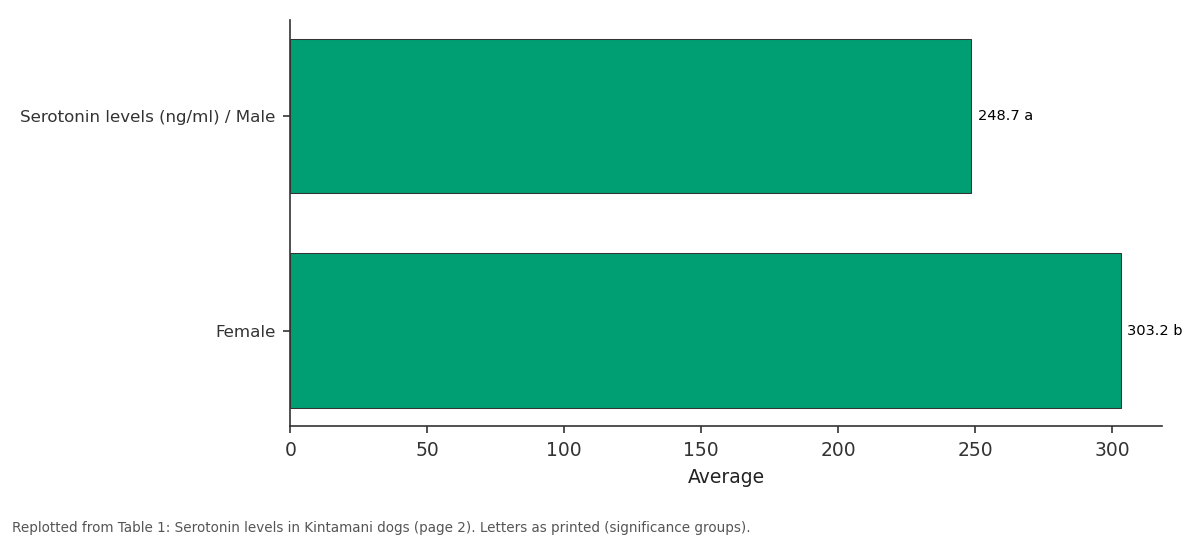
Average: Serotonin levels... vs Female
Replotted from Table 1 (page 2) of the original paper. Every bar is the paper's own table value.
View source evidence ↗Figures & tables
From the original paper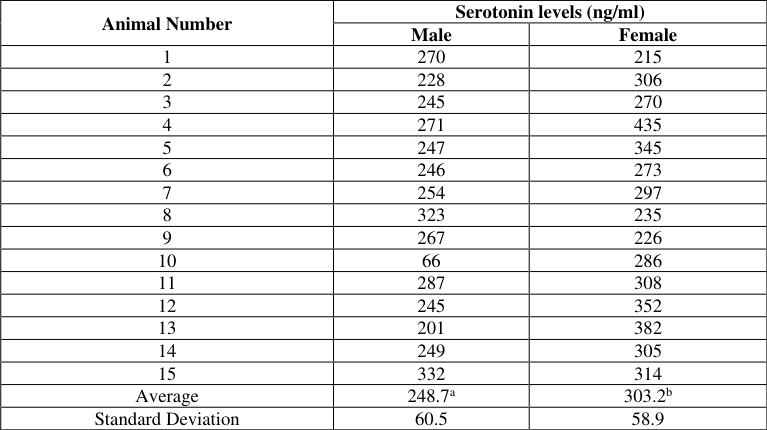 Table 1
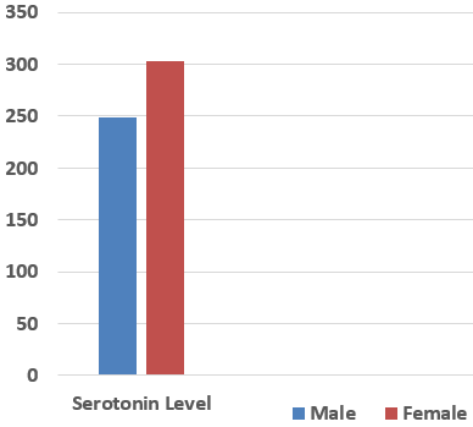 Figure 1
Introduction
Previous research shows that serotonin compounds are related to dogs' aggressiveness. Research by Cakiroğlu, et al., (2007) [1] , Rosado et al., (2010) [2] , Amat et al., (2013) [3] and Alberghina et al., (2016) [4] found that aggressive dogs had low serotonin levels. Serotonin is a neurotransmitter, which is formed in neurons. Much research has been carried out on Kintamani dogs, such as behavior by Puja et al., (2000) [5] and exterior characteristics of Balinese Kintamani dogs (Sanjaya et al., 2016) [6] and Gunawan, et al., (2012) [7] regarding problematic behavior in Kintamani dogs. However, there is still little observation of the serotonin profile in the blood. Serotonin is a monoamine chemical substance (C10H12N2O) that functions as a neurotransmitter. This compound is synthesized in serotonergic neurons in the central nervous system and enterochromaffin cells in the digestive tract. Serotonin, a blood protein, is a complex molecular organic substance composed of amino acids (Hughes, 2013) [8] . Serotonin is produced by nerve cells, is found mostly in the digestive system, some is also found in platelets and throughout the central nervous system. Serotonin functions as a messenger and biochemical regulator, while in the nervous system it acts as a local neurotransmitter at the synapse. As a paracrine or hormonal modulator, serotonin is involved in the blood coagulation process. Serotonin is synthesized from the essential amino acid Ltryptophan. In its function as a neurotransmitter which is basically a chemical messenger, serotonin is responsible for carrying, enhancing and modulating signals between neurons (Hillman, et al., 2005) [9] . Serotonin is formed when the amino acid L-tryptophan is broken down in the liver by the enzyme tryptophan hydroxylase. This breakdown process produces 5-hydroxytryptophan (5-HTP), which is a direct precursor of serotonin. Most serotonin in the body is produced in the gastrointestinal (GI) tract and taken up by intestinal cells (Enterochromaffins) and blood platelets. As a hormone in the body, serotonin is involved in a variety of functions including digestion and appetite control, blood clotting, and sexual function. Serotonin's greatest effect on the digestive tract is facilitating peristalsis, the rhythmic contractions of the intestine that occur during digestion. Only 10% of serotonin in the body is made in the brain. After the breakdown of tryptophan, 5-HTP travels through the bloodstream, crosses the blood brain barrier, and enters brain tissue. Once in the brain, 5-HTP is converted into 5hydroxytryptamine ( [10] . Serotonin, which is used in the brain as a neurotransmitter, must be produced in the brain, because this compound cannot pass through the blood-brain barrier. Sometimes, concentration decreases due to chronic stress, medical conditions, and lifestyle habits. In these cases, serotonin boosters such as 5-HTP supplements, which are able to cross the blood brain barrier, can be used to try to increase serotonin. Serotonin will be broken down by the monoamine oxidase enzyme to form 5-hydroxyindoleacetic acid (5hydroxyindoleacetic acid = 5-HIAA) (Fitzgerald et al., 1990) [11]
Materials and Methods Animal
The research was conducted in Sukawana village, Kintamani subdistrict, Bangli district, Bali province, Indonesia. The total sample used was 30 Kintamani dogs, including 15 males and 15 females. Dogs aged 2-4 years in good clinical condition. The use of dogs as an experiment was approved by the Animal Ethics Committee of the Faculty of Veterinary Medicine, Udayana University.
Sample Collection
Sampel darah diambil dari vena cephalica sebanyak kurang lebih 2 mililiter menggunakan spuit ukuran 3 mililiter. Selanjutnya darah dipindahkan ke dalam tabung penampung darah (Blood collecting tube) berantikoagulan EDTA kapasitas 3 ml. Ditaruh dalam cooling box dan dibawa ke laboratorium untuk ditentukan kadar serotoninnya. Kadar serotonin dan monoamin oksidase a ditentukan menggunakan metode Enzyme-linked Immunosorbent Assay (ELISA) indirect.
Enzyme-linked Immunosorbent Assay (ELISA)
Samples were analyzed immediately after collection by indirect Enzyme-linked Immunosorbent Assay (ELISA) method according to the manufacturer's protocol. Analysis was carried out at the Veterinary Center, Denpasar, Bali, Indonesia.
Data analysis
Student's T-test was used to compare serotonin levels between males and females. A significance level of 5% was used. Data analysis using SPSS for Windows version 25.
Results and Discussion
The results show serotonin levels in male Kintamani dogs 248.7 ng/ml SD. 60.5 and females 303.2 ng/ml, SD. 58.9. The t test shows that it is significantly difference. Complete results are presented in Table 1. below. The t test for serotonin levels showed a significant difference (p<0.05) in male dogs' serotonin levels being lower than female dogs. This difference is because males and females have different serotonin profiles. Scandurra, et al., (2018) [13] stated that aggressiveness and boldness are described as behavioral syndromes, where males are more aggressive and bold than females. Genetically, male dogs have more aggressive behavior than female dogs. This picture shows that the serotonin levels of male Kintamani dogs are lower than those of females. In research conducted by Alberghina et al., (2016) [4] the results showed that serum 5-HT levels were not significantly influenced by gender, age, or environmental conditions. However, our research shows that serotonin levels in male dogs are significantly lower in females. This difference can be caused by other factors such as different environmental conditions. Recently, Bochiș et al., (2022) [12] stated in research that small, medium to large body dogs had serotonin levels between 89.61 ng/mL in aggressive dogs and 112.78 ng/mL in calm dogs. Meanwhile, our research showed that serotonin levels in Kintamani Bali dogs averaged 248.7 ng/ml in males and 303.2 in females. This difference in results does not indicate that all Kintamani dogs have a calm character, but it seems that serotonin levels in various types of dogs have a varied picture, according to their respective genes. Rossado et al., (2010) [2] in their research found that aggressive dogs were 278.5 ng/ml and non-aggressive 387.4 ng/ml) and Amat et al., (2013) [3] stated serotonin levels in English cocker spaniels 318 ng/ml. Serotonin is commonly associated with aggressive behavior and anxiety, for example, attention deficit, hyperactivity, disorder-like (ADHD-like). González-Martínez et al., (2023) [14] stated that dogs clinically classified as ADHD-like showed lower concentrations of serotonin and dopamine. This opinion supports that serotonin affects aggression in dogs.
| Animal Number | Serotonin levels (ng/ml) | — |
|---|---|---|
| Male | Female | |
| 1 | 270 | 215 |
| 2 | 228 | 306 |
| 3 | 245 | 270 |
| 4 | 271 | 435 |
| 5 | 247 | 345 |
| 6 | 246 | 273 |
| 7 | 254 | 297 |
| 8 | 323 | 235 |
| 9 | 267 | 226 |
| 10 | 66 | 286 |
| 11 | 287 | 308 |
| 12 | 245 | 352 |
| 13 | 201 | 382 |
| 14 | 249 | 305 |
| 15 | 332 | 314 |
| Average | 248.7a | 303.2b |
| Standard Deviation | 60.5 | 58.9 |
Table text extracted from the original PDF; superscript letters are shown inline. The original table image is below.
View original table image
Conclusion
It was concluded that normally the average serotonin level of male Kintamani dogs is 248.7 ng/ml, while that of females is 303.2 ng/ml.
Conflict of Interest Not available
Conflict of Interest Not available
Financial Support
Financial Support
Figures and tables from the paper
References
8 in the original paper- Cakiroğlu D, Meral Y, Sancak AA, Cifti G. Relationship Between the Serum Concentrations of Serotonin and Lipids and Aggression in Dogs. Vet Rec. 2007 Jul 14;161(2):59-61.
- Rosado B, García-Belenguera S, Leónb M, Chacóna G, Villegasa A, Palacioa J. Blood Concentrations of Serotonin, Cortisol and Dehydroepiandrosterone in Aggressive Dogs. Appl Anim Behav Sci. 2010 Mar;123(3-4):124-130. https://doi.org/10.1016/j.applanim.2010.01.009.
- Amat M, Brech SL, Camps T, Torrente C, Mariotti MV, Ruiz JL, et al. Differences in Serotonin Serum Concentration between Aggressive English Cocker Spaniels and Aggressive Dogs of Other Breeds. J Vet Behav. 2013 Jan-Feb;8(1):19-25.
- Alberghina D, Rizzo M, Piccione G, Gannetto C, Panzera M. An Exploratory Study about the Association between Serum Serotonin Concentrations and Canine-Human Social Interactions in Shelter Dogs (Canis familiaris). J Vet Behav. 2017 Mar-Apr;18:96-101.
- Puja IK. Maternal Behavior of Kintamani Bitches During the Lactation Periods. Media Kedokteran Hewan. 2000 Aug;16(2):83-85. ISSN. 20158930.
- Gunawan IWNF, Sukada IM, Puja IK. Behavior Problems In Kintamani Dog. Bull Vet Udayana. 2012 Aug;4(2):95-100. ISSN: 2085-2495.
- Fitzgerald LW, Kaplinsky L, Kimelberg HK. Serotonin Metabolism by Monoamin oksidase in Rat Primary Astrocyte Cultures. J Neurochem. 1990 Dec;55(6):200814.
- Bochiș TA, Imre K, Marc S, Vaduva C, Florea T, Dégi J, et al. The Variation of Serotonin Values in Dogs in Different Environmental Conditions. Vet Sci. 2022 Oct;9(10):523. DOI: 10.3390/vetsci9100523.