
Research article · 2024 · Full text
International Journal of Research in AgronomyGrowth, yield and weed control of summer sesamum (Sesamum indicum L.) under varying sowing dates and weed management practices
Volume 7(6S) · Pages 301–306 · DOI: 10.33545/2618060x.2024.v7.i6sd.858 ↗
Research areasSesame and Sesamin ResearchSunflower and Safflower CultivationSoybean genetics and cultivation
Abstract
Author-writtenAn investigation was carried out during summer season of 2020-21 at College Farm, Department of Agronomy, N. M. College of Agriculture, Navsari Agricultural University, Navsari to study the “Performance of summer sesamum (Sesamum indicum L.) under varying sowing dates and weed management practices”. The experiment was laid out in Split Plot Design having three main plot treatments (D1: 2nd Week of February, D2: 3rd Week of February and D3: 4th Week of February) and six sub plot treatments [W1: Control (Weedy check), W2: Weed free, W3: Hand weeding (HW) at 20 DAS and 40 DAS, W4: Pendimethalin @ 0.75 kg a.i/ha as pre-emergence (PE), W5: Pendimethalin @ 0.75 kg a.i/ha as pre-emergence (PE) + one hand weeding (HW) at 30 DAS, W6: Quizalofop-ethyl @ 0.05 kg a.i/ha as post-emergence (PoE) at 20 DAS] with four replications. Among various sowing dates, significantly the highest values of growth and yield attributes viz., plant height at harvest (97.64 cm), no. of primary branches per plant at harvest (3.04 no.), no. of capsule per plant at harvest (39.59 no.), no. of seeds per capsule at harvest (52.38 no.), seed yield (792.25 kg/ha) and stalk yield (1490.23 kg/ha) were recorded under sowing during 3rd Week of February (D2). Whereas, in case of weed management practices, significantly higher values of growth and yield attributes viz., plant height at harvest (99.65 cm), no. of primary branches per plant at harvest (3.34 no.), no. of capsule per plant at harvest (39.94 no.), no. of seeds per capsule (53.57 no.) at harvest seed yield (844.07 kg/ha) and stalk yield (1744.64 kg/ha) were recorded under the treatment of weed free (W2) which remained at par with the treatments W5 and W3. Lower weed index and higher weed control efficiency were recorded in the treatment W5 followed by the treatment W3. Economics of the experiment show that among the sowing dates, the maximum benefit cost ratio (BCR) (2.45) were obtained under the sowing date D2 (3rd Week of February). While, in case of weed management practices, the treatment W5 (2.18) recorded significantly maximum BCR. Based on experimental results, it can be concluded that to obtain higher profitable yield and effective weed control in summer sesamum, it should be sown during 3rd week of February and spraying of pendimethalin @ 0.75 kg a.i./ha as pre-emergence (PE) + one hand weeding at 30 DAS or hand weeding at 20 DAS and 40 DAS under South Gujarat condition.
Summary
Source-checkedPlain-language reading of the full paper, prepared with AI and checked against the text. Each point links to the authors' own words.
Why it matters
- Sesame is a significant oilseed crop in India, valued for its high-grade protein content. View evidence ↗
- Weeds are a major obstacle to sesame production because they compete for essential resources, potentially reducing crop output by 50% to 75%. View evidence ↗
- Selecting the correct sowing date is critical for maximizing sesame yield by aligning plant growth stages with favorable climatic conditions. View evidence ↗
The question
- The study aimed to investigate how different sowing dates and weed management practices affect the growth, yield, and economic returns of summer sesame. View evidence ↗
What they did
- The experiment was conducted during the 2020-21 summer season at the College Farm of Navsari Agricultural University in Navsari, India. View evidence ↗
- The study used a split-plot design with three sowing dates (2nd, 3rd, and 4th weeks of February) and six weed management treatments, including a weedy control, weed-free, hand weeding, and various herbicide applications, with four replications. View evidence ↗
- The researchers used the sesame variety 'Gujarat Til 3' sown at a rate of 2.5 kg/ha. View evidence ↗
What they found
- Sowing in the 3rd week of February (D2) resulted in the highest plant height at harvest (97.64 cm), while the 2nd week of February (D1) produced the lowest (87.45 cm). View evidence ↗
- The 3rd week of February sowing (D2) achieved the highest number of primary branches per plant (3.04), compared to the lowest in the 2nd week of February (D1) at 2.71. View evidence ↗
- The highest seed yield (792.25 kg/ha) was recorded for the 3rd week of February sowing (D2), while the lowest (698.40 kg/ha) occurred in the 2nd week of February (D1). View evidence ↗
- The weed-free treatment (W2) produced the highest seed yield (844.07 kg/ha), which was statistically similar to the results of W5 (835.15 kg/ha) and W3 (823.71 kg/ha), and significantly higher than the weedy control (W1) at 557.17 kg/ha. View evidence ↗
- The most effective weed control efficiency (84.42%) was achieved using Pendimethalin pre-emergence plus one hand weeding at 30 DAS (W5), followed by hand weeding at 20 and 40 DAS (W3) at 57.40%. View evidence ↗
- The maximum benefit-cost ratio (BCR) of 2.45 was obtained when sowing occurred in the 3rd week of February (D2). View evidence ↗
- Among weed management practices, treatment W5 (Pendimethalin PE + one hand weeding) provided the highest benefit-cost ratio of 2.18. View evidence ↗
What it means
- The authors conclude that for profitable yield and effective weed control in summer sesame, sowing should be done in the 3rd week of February using either Pendimethalin pre-emergence with one hand weeding at 30 DAS or hand weeding at 20 and 40 DAS. View evidence ↗
Visual summary
2 visualsIllustrations explain the paper; charts are replotted from the paper's own table values.
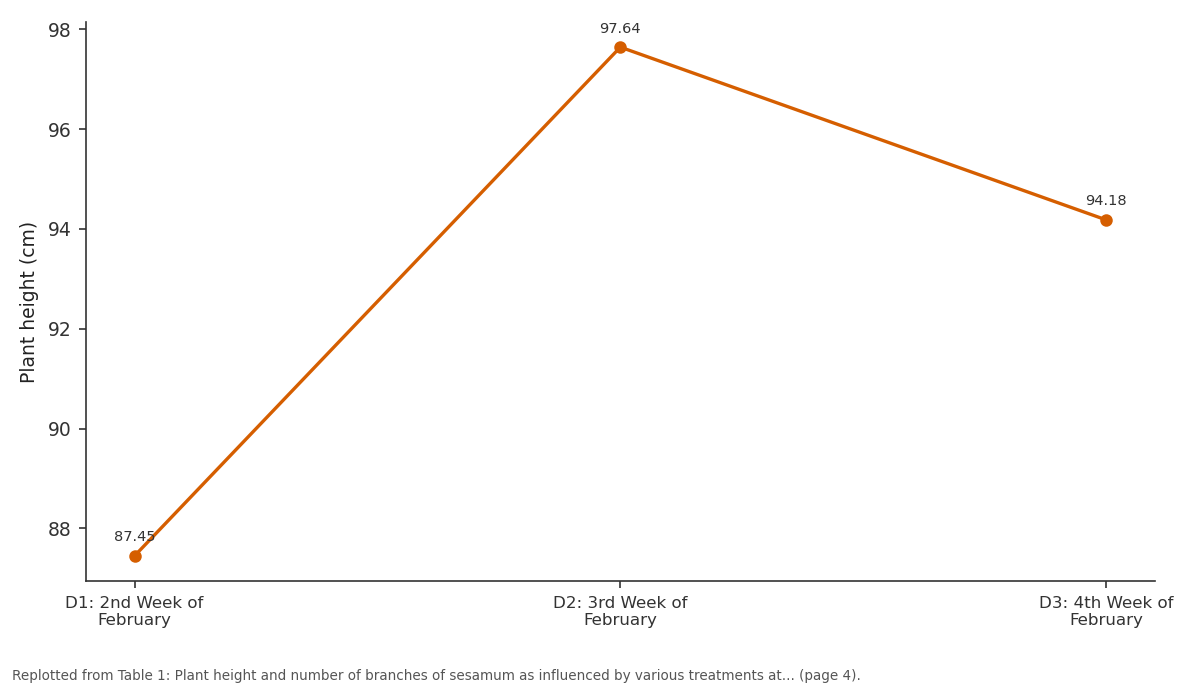
Plant height (cm) / At harvest: D1: 2nd Week of February vs D2: 3rd Week of February vs D3: 4th Week of February
Replotted from Table 1 (page 4) of the original paper. Every bar is the paper's own table value.
View source evidence ↗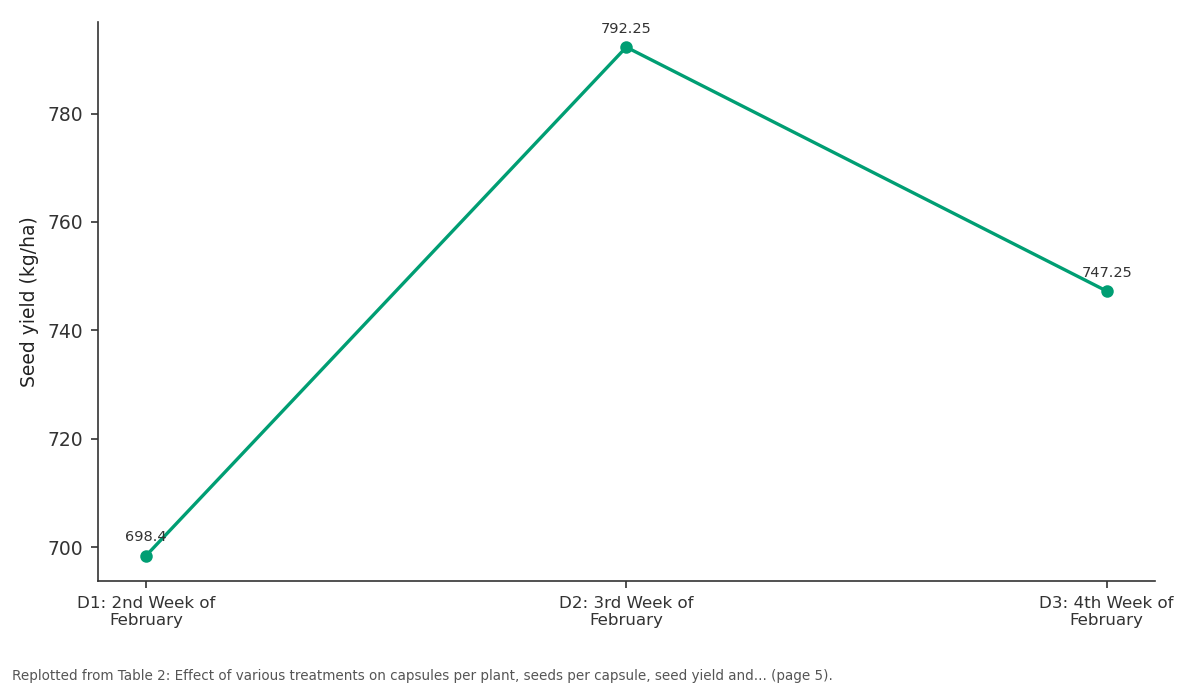
Seed yield (kg/ha): D1: 2nd Week of February vs D2: 3rd Week of February vs D3: 4th Week of February
Replotted from Table 2 (page 5) of the original paper. Every bar is the paper's own table value.
View source evidence ↗Figures & tables
From the original paper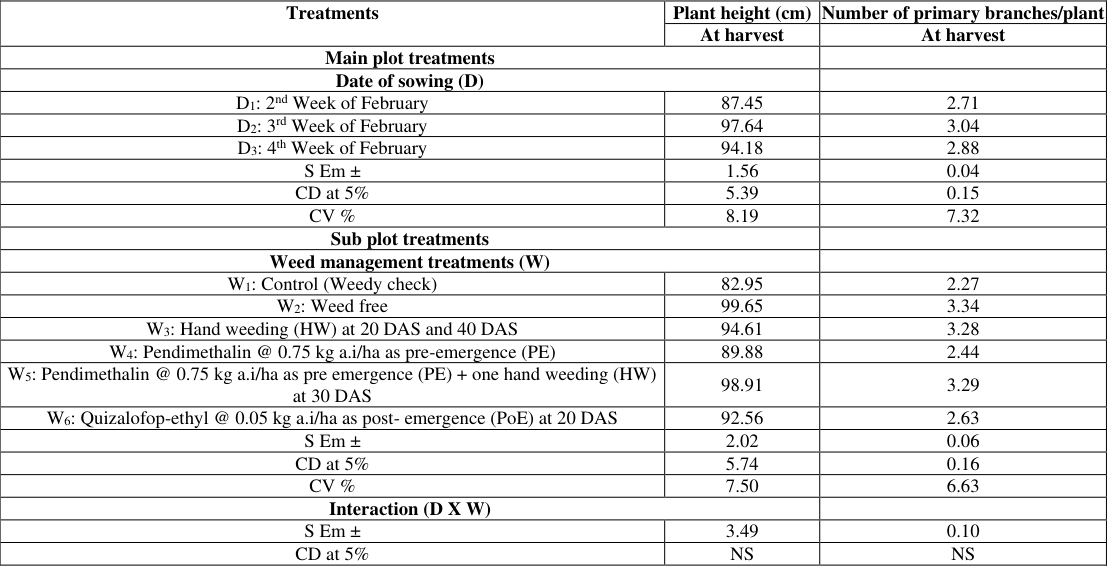 Table 1
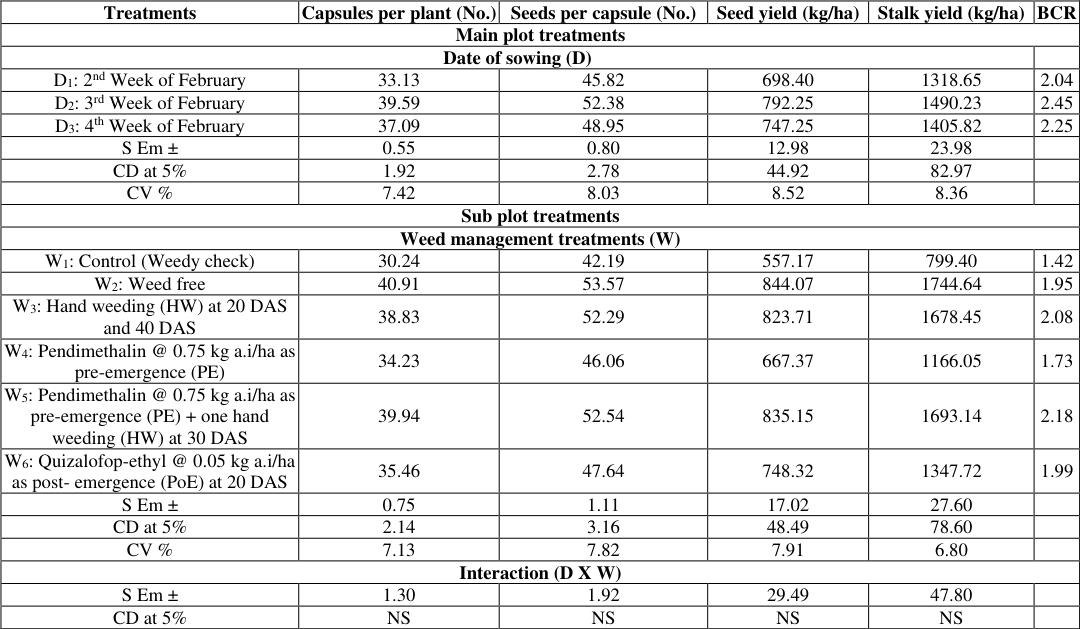 Table 2
 Table 3
Introduction
India's agricultural economy has been based primarily on oilseed crops. In India, sesame is not only a major oilseed crop but also a valuable crop of high-grade protein. Climate change has reduced plant productivity and raised issues with food security. In this regard, sesamum reveals intriguing components that set it apart as a special oilseed crop to satisfy the oilseed requirement. The "queen of oil seeds," sesamum, is a stress-tolerant crop that yields several chemical components that are not found in other edible oil crops and offer protection against oxidative rancidity. Achieving optimal yield requires synchronising distinct stages of plant growth with climatic circumstances, and one of the most crucial influencing variables is choosing the right time to sow. It is desirable to digest stored seeds by choosing the right sowing period, varying plant growth phases, and environmental conditions that maximise photosynthesis. A key element in guaranteeing a good return on sesamum investment is choosing a cultivar with a high average yield and figuring out the best time to sow, which in turn enhances unit land area utilisation.
According to reports in the literature, planting later than the ideal date can result in lower yields. This drop in yield could be caused by modifications in the photoperiodism of sesamum [1] . According to [2] , sowing time had a considerable impact on sesamum cultivars' seed yield, and there was also a highly significant interaction between cultivars and sowing dates. Growers become discouraged due to the low yield of sesamum under delayed planted conditions, which ultimately results in a decrease in the area under sesamum cultivation. Finding the ideal sowing date is therefore essential to getting the most yield possible from sesame. One of the major obstacles to raising the yield is weeds. In sesamum, weed competition peaks between 15 and 45 DAS [3] . Throughout the summer, weeds can grow quickly because of the increased temperature and the availability of sufficient moisture from irrigation. One of the main causes of the sesamum crop's low production is weeds, which compete with the crop plants for moisture, nutrients, light, and space. Weeds can reduce the output of sesamum crops by 50-75% [4] . If weeds are allowed to take over, they can lower yields in many fields by 79-80% [5] . Efficient methods are needed to keep the weeds under control. Even while hand weeding and inter-culturing are successful, they are always linked to weed regeneration since they necessitate regular cultural operations, which are not only expensive but also impractical because of the physical characteristics of the soil. It is discovered that chemical weed management is cost-effective and efficient during the early stages of growth. However, due to their selectivity, herbicides cannot completely eradicate weeds on their own. Furthermore, the issues with residual toxicity were made worse by the ongoing use of herbicides alone, even at greater dosages. In light of this, it is imperative to determine the ideal planting date and use weed control techniques in order to inhibit weed growth and maximise productivity. Thus, an experiment was designed to investigate the impact of weed control techniques as well as the effects of sowing dates on sesamum growth, yield, and economics.
Materials and Methods
A field experiment was carried out during the summer season of the year 2020-21 on Plot No. 24, Block-E of College Farm, N. M. College of Agriculture, Navsari Agricultural University, Navsari (Gujarat). The soil of the experimental field was clayey in texture, low, medium and high in available nitrogen (188.26 kg/ha), phosphorus (50.23 kg/ha) and potassium (456.25 kg/ha), respectively and slightly alkaline in reaction with normal electrical conductivity. Treatments were assigned randomly to each plot in each replication. The experiment was laid out in Split Plot Design having three main plot treatments (D 1 : 2 nd Week of February, D 2 : 3 rd Week of February and D 3 : 4 th Week of February) and six sub plot treatments [W 1 : Control (Weedy check), W 2 : Weed free, W 3 : Hand weeding (HW) at 20 DAS and 40 DAS, W 4 : Pendimethalin @ 0.75 kg a.i/ha as pre-emergence (PE), W 5 : Pendimethalin @ 0.75 kg a.i/ha as pre-emergence (PE) + one hand weeding (HW) at 30 DAS, W 6 : Quizalofopethyl @ 0.05 kg a.i/ha as post-emergence (PoE) at 20 DAS] with four replications. The variety used was sesamum cv. Gujarat Til 3 with seed rate @ 2.5 kg/ha. Plot wise quantity of seed was weighted and sown manually at the depth of 2 cm in one side of furrows. Entire dose of FYM (farm yard manure) 10 t/ha was applied manually as basal dose whereas entire dose of phosphorous (25 kg/ha) was applied manually as basal dose in the form of SSP. Application of 50 per cent dose of nitrogen was applied as a basal dose and remaining 50 per cent nitrogen was applied at 30 days after sowing in the form of urea. Seeds were covered properly with soil and irrigation was given carefully in each plot immediately after sowing. After the maturity of the crop, randomly-selected plants, previously tagged from each net plot were first harvested for recording necessary post-harvest observations and then the produce was added to the respective net plots. The border lines were harvested first and were removed from the experimental area. Then the net area was harvested separately and kept in respective plots for 10 days in erect position for sun drying. After satisfactory drying, the plot wise threshing and cleaning were done manually. Seeds per net plot thus collected, winnowed, cleaned, weighted and converted on hectare basis. At the same time, the stalk yield was also recorded separately for each plot. The response of the crop to the treatment application under the present investigation was evaluated on the basis of biometric and biochemical studies, various biometric observations were recorded on five randomly selected plants from each net plot.
The bamboo peg was fixed with labels near selected plants for their easy location.
Plant height
The mean plant height for each of the treatment plot was worked out at 30, 60 DAS and at harvest and recorded separately which was expressed in cm.
Number of branches per plant
Selected five plants were used for counting the number of primary branches per plant. The primary branches of these five plants were counted at 60 DAS and at harvest. The average number of primary branches per plant for each treatment was worked out and recorded separately.
Number of capsules per plant
The total number of capsules from previously tagged five plants was counted, their average value per plant was worked out and recorded for each treatment separately.
Number of seeds per capsule
From the previously tagged five plants, five developed capsules were taken from each plant and counted the number of seed per capsule. Then average value was worked out and recorded separately for each treatment.
Seed yield
The produce of each net plot area was threshed separately. The seeds were cleaned and weighed to record seed yield per plot and the same was converted to seed yield per hectare which was expressed in kg/ha.
Stalk yield
Stalk which is a part left after removal of seeds from the harvested plants was also weighed and recorded separately for each treatment. It was converted on hectare basis and recorded in kg/ha.
Weed control efficiency (WCE)
Weed control efficiency (WCE) is defined as the efficiency to control the weed in term of dry matter accumulation in treated plot compared to unweeded control plot and expressed in percentage. Weed control efficiency (%) was calculated by using the following formula [6] .
Where, WCE = Weed Control Efficiency (%) DM c = Dry weight of weeds in weedy check (Control) DM t = Dry weight of weeds in treated plot
Weed index (WI)
Weed index for different weed management practices was calculated based on the seed yield as per following formula suggested by [7] .
Where WI = Weed index (%) X = Yield from the weed free plot Y = Yield from the treated plot for which weed competition index is to be estimated.
Benefit: Cost Ratio (BCR)
The Benefit: Cost ratio (BCR) was calculated with the help of following formula.
Statistical analysis
The statistical analysis of data recorded for different characters during the course of investigation was carried out through the procedure appropriate to the Split Plot Design. Significance of variances was tested by 'F' test [8] . Summary tables for treatment effects have been prepared and furnished with standard error of mean (S.Em.±) and critical difference (C.D) at 5 per cent level of probability have also been given where the treatment differences were significant. Coefficient of variance (C.V. %) was calculated and presented in the respective tables.
Results and Discussion
The overall soil condition at the time of sowing of sesamum was found favourable for good germination as reveal from the optimum plant population in all the experimental plots. As a result, the crop was normal and hence the entire outcome of the crop was a result of the treatments effect only.
Growth Attributes
Plant height D2 (3rd Week of February) recorded significantly higher plant height at harvest (97.64 cm) which was statistically at par with D3 (4th Week of February) (94.18 cm) at harvest (Table 1). Whereas, 2nd Week of February (D1) recorded significantly the lowest plant height at harvest (87.45 cm). Taller plants observed with D2 (3rd Week of February) might be due to favourable weather conditions during the crop growth period resulting in higher rate of photosynthesis which directly influenced the plant height [9] . Among the weed management practices (Table 1), the treatment W2 (Weed free) recorded significantly higher plant height at harvest (99.65 cm) which was statistically at par with the treatments W5 (Pendimethalin @ 0.75 kg a.i./ha as preemergence (PE) + one hand weeding (HW) at 30 DAS) (98.91 cm) and W3 (Hand weeding (HW) at 20 DAS and 40 DAS) (94.61 cm). While, the treatment W1 (Weedy check) recorded significantly the lowest plant height at harvest (82.95 cm). Significantly higher plant height might be due to better control of weeds at an early stage which reduced weed competition [10] and ultimately leads to more nutrient and soil moisture available to the crop which enhanced vegetative growth in terms of plant height of sesamum under these treatments (W2, W5 and W3) [11].
| Treatments | Plant height (cm) | Number of primary branches/plant |
|---|---|---|
| At harvest | At harvest | |
| Main plot treatments | ||
| Date of sowing (D) | ||
| D1: 2nd Week of February | 87.45 | 2.71 |
| D2: 3rd Week of February | 97.64 | 3.04 |
| D3: 4th Week of February | 94.18 | 2.88 |
| S Em ± | 1.56 | 0.04 |
| CD at 5% | 5.39 | 0.15 |
| CV % | 8.19 | 7.32 |
| Sub plot treatments | ||
| Weed management treatments (W) | ||
| W1: Control (Weedy check) | 82.95 | 2.27 |
| W2: Weed free | 99.65 | 3.34 |
| W3: Hand weeding (HW) at 20 DAS and 40 DAS | 94.61 | 3.28 |
| W4: Pendimethalin @ 0.75 kg a.i/ha as pre-emergence (PE) | 89.88 | 2.44 |
| W5: Pendimethalin @ 0.75 kg a.i/ha as pre emergence (PE) + one hand weeding (HW) at 30 DAS | 98.91 | 3.29 |
| W6: Quizalofop-ethyl @ 0.05 kg a.i/ha as post- emergence (PoE) at 20 DAS | 92.56 | 2.63 |
| S Em ± | 2.02 | 0.06 |
| CD at 5% | 5.74 | 0.16 |
| CV % | 7.50 | 6.63 |
| Interaction (D X W) | ||
| S Em ± | 3.49 | 0.10 |
| CD at 5% | NS | NS |
Table text extracted from the original PDF; superscript letters are shown inline. The original table image is below.
View original table image
Number of branches
Data presented in Table 1 clearly indicate that among the sowing dates, D2 (3rd Week of February) recorded significantly the highest number of branches per plant at harvest (3.04). Whereas, 2nd Week of February (D1) recorded significantly the lowest number of primary branches per plant at harvest (2.71). Among the weed management practices, the treatment W2 (Weed free) recorded significantly higher number of branches per plant at harvest (3.34) which was statistically at par with the treatments W5 (Pendimethalin @ 0.75 kg a.i./ha as pre-emergence (PE) + one hand weeding (HW) at 30 DAS) (3.29) and W3 (Hand weeding (HW) at 20 DAS and 40 DAS) (3.28). While, the treatment W1 (Weedy check) recorded significantly the lowest number of branches per plant at harvest (2.27) [12] reported that more number of primary branches per plant at harvest were observed with D2 (3rd Week of February) sown crop might be due to favourable weather conditions during the crop growth period, resulting in higher rate of plant growth leads to increase in number of branches per plant.
Yield indices Number of capsules/plant
D2 (3rd Week of February) recorded significantly the highest number of capsules per plant (Table 2) at harvest (39.59). Whereas, 2nd Week of February (D1) recorded significantly the lowest number of capsules per plant at harvest (33.13). The possible reason could be that the crop sown at 3rd week of February has prolonged photoperiod which utilized more assimilates in producing of capsules as compared to other sowing dates [1] . Analysis of data indicate (Table 2) that among the weed management practices, the treatment W2 (Weed free) recorded significantly higher number of capsules per plant at harvest (40.91) which was statistically at par with the treatments W5 (Pendimethalin @ 0.75 kg a.i./ha as pre-emergence (PE) + one hand weeding (HW) at 30 DAS) (39.94) and W3 (Hand weeding (HW) at 20 DAS and 40 DAS) (38.83). While, the treatment W1 (Weedy check) recorded significantly the lowest number of capsules per plant at harvest (30.24). Higher number of capsules per plant under weed management treatments recorded (W2, W5 and W3) might be due to effective control of weeds during critical stages of crop [13] which enhanced the availability of growth resources to the crop leading to higher number of capsules per plant [14] in sesamum. ). This may be due to crop sown at 3rd week of February might be owing to better translocation of assimilates from source to the sink. Another reason could be that the crop sown at 3rd week of February has prolonged photoperiod which utilized more assimilates in producing higher number of seeds per capsule as compared to other sowing dates [2] . Treatment W2 (Weed free) recorded significantly higher number of seeds per capsules at harvest (53.57) which was statistically at par with the treatments W5 (Pendimethalin @ 0.75 kg a.i./ha as preemergence (PE) + one hand weeding (HW) at 30 DAS) (52.54) and W3 (Hand weeding (HW) at 20 DAS and 40 DAS) (52.29). While, the treatment W1 (Weedy check) recorded significantly the lowest number of seeds per capsules at harvest (42. 19). All these weed management practices (W2, W5 and W3), [15] reported that higher number of seeds per capsule were effective against weed flora associated with sesamum which facilitated favourable environment for enhanced translocation of photosynthates from source to developing seeds.
| Treatments | Capsules per plant (No.) | Seeds per capsule (No.) | Seed yield (kg/ha) | Stalk yield (kg/ha) | BCR |
|---|---|---|---|---|---|
| Main plot treatments | |||||
| Date of sowing (D) | |||||
| D1: 2nd Week of February | 33.13 | 45.82 | 698.40 | 1318.65 | 2.04 |
| D2: 3rd Week of February | 39.59 | 52.38 | 792.25 | 1490.23 | 2.45 |
| D3: 4th Week of February | 37.09 | 48.95 | 747.25 | 1405.82 | 2.25 |
| S Em ± | 0.55 | 0.80 | 12.98 | 23.98 | |
| CD at 5% | 1.92 | 2.78 | 44.92 | 82.97 | |
| CV % | 7.42 | 8.03 | 8.52 | 8.36 | |
| Sub plot treatments | |||||
| Weed management treatments (W) | |||||
| W1: Control (Weedy check) | 30.24 | 42.19 | 557.17 | 799.40 | 1.42 |
| W2: Weed free | 40.91 | 53.57 | 844.07 | 1744.64 | 1.95 |
| W3: Hand weeding (HW) at 20 DAS and 40 DAS | 38.83 | 52.29 | 823.71 | 1678.45 | 2.08 |
| W4: Pendimethalin @ 0.75 kg a.i/ha as pre-emergence (PE) | 34.23 | 46.06 | 667.37 | 1166.05 | 1.73 |
| W5: Pendimethalin @ 0.75 kg a.i/ha as pre-emergence (PE) + one hand weeding (HW) at 30 DAS | 39.94 | 52.54 | 835.15 | 1693.14 | 2.18 |
| W6: Quizalofop-ethyl @ 0.05 kg a.i/ha as post- emergence (PoE) at 20 DAS | 35.46 | 47.64 | 748.32 | 1347.72 | 1.99 |
| S Em ± | 0.75 | 1.11 | 17.02 | 27.60 | |
| CD at 5% | 2.14 | 3.16 | 48.49 | 78.60 | |
| CV % | 7.13 | 7.82 | 7.91 | 6.80 | |
| Interaction (D X W) | |||||
| S Em ± | 1.30 | 1.92 | 29.49 | 47.80 | |
| CD at 5% | NS | NS | NS | NS |
Table text extracted from the original PDF; superscript letters are shown inline. The original table image is below.
View original table image
Seed yield D2 (3 rd Week of February) recorded significantly the highest seed yield of sesamum (792.25 kg/ha). Whereas, sowing on 2nd Week of February (D1) recorded significantly the lowest seed yield (698.40 kg/ha). The higher seed yield is attributed to the yield attributing parameters viz., higher no. of capsules per plant, higher no of seeds per capsule and capsule length etc. and also higher dry matter accumulation which results in better translocation of assimilates from source to the sink which were due to favourable weather conditions under the sowing dates of D2 (3rd week of February). W2 (Weed free) recorded significantly higher seed yield of sesamum (844.07 kg/ha) but, it remained statistically at par with the treatments W5 (Pendimethalin @ 0.75 kg a.i./ha as pre-emergence (PE) + one hand weeding (HW) at 30 DAS) (835.15 kg/ha) and W3 (Hand weeding (HW) at 20 DAS and 40 DAS) (823.71 kg/ha). While, the treatment W1 (Weedy check) recorded significantly the lowest seed yield of sesamum (557.17 kg/ha). The higher seed yield (Table 2) under the weed management treatments, W2, W5 and W3 might be due to least competition offered by weeds for nutrients and moisture at crucial growth stages ultimately improved all yield attributes and increased rate of N, P and K absorption as evident from nutrient uptake studies cumulatively helped the crop plants to produce more surface area for high photosynthetic rate as well as maximum translocation of photosynthates from source to sink. These findings are in accordance with those of [11,16] .
Stalk yield
The results (Table 2) reveal that among the sowing dates, D2 (3rd Week of February) recorded significantly the highest stalk yield of sesamum (1490.23 kg/ha). Whereas, sowing on 2nd Week of February (D1) recorded significantly the lowest stalk yield of sesamum (1318.65 kg/ha). [17,18] stated that the positive influence of production of stalk yield under the sowing date D2 (3rd Week of February) might be due to favourable weather conditions, harnessing of more solar radiation which results in better growth parameters like plant height and number of branches per plant. W2 (Weed free) recorded significantly higher stalk yield (1744.64 kg/ha) which was statistically at par with the treatments W5 (Pendimethalin @ 0.75 kg a.i./ha as preemergence (PE) + one hand weeding (HW) at 30 DAS) (1693.14 kg/ha) and W3 (Hand weeding (HW) at 20 DAS and 40 DAS) (1678.45 kg/ha). While, the treatment W1 (Weedy check) recorded significantly the lowest stalk yield (799.40 kg/ha). The higher stalk yield of sesamum under the weed management treatments W2, W5 and W3 might be due to effective weed control obtained by these weed management treatments which improved growth parameters like plant height and number of branches per plant leads to higher stalk yield.
The data clearly indicate (Table 3) that the highest weed control efficiency (84.42%) was recorded under the treatment W5 (Pendimethalin @ 0.75 kg a.i./ha as pre-emergence (PE) + one hand weeding (HW) at 30 DAS) followed by the treatment W3 (Hand weeding (HW) at 20 and 40 DAS) (57.40%). This might be due to effective weed control achieved under efficient method of weed management in terms of lower weed population per unit area which reduced biomass production of weeds and ultimately higher weed control efficiency was obtained. While the lowest weed control efficiency was observed under the treatment W1 (Weedy check) (0%). The weed control efficiency was observed in the order W2> W5> W3> W6> W4> W1 (Table 3). These results have confirmed the findings of [11,16] .
| Treatments | Weed control efficiency (WCE) (%) | Weed index (WI) (%) |
|---|---|---|
| Weed management treatments (W) | ||
| W1: Control (Weedy check) | - | 33.99 |
| W2: Weed free | 100 | - |
| W3: Hand weeding (HW) at 20 DAS and 40 DAS | 57.40 | 2.41 |
| W4: Pendimethalin @ 0.75 kg a.i/ha as pre-emergence (PE) | 50.13 | 20.93 |
| W5: Pendimethalin @ 0.75 kg a.i/ha as pre-emergence (PE) + one hand weeding (HW) at 30 DAS | 84.42 | 1.05 |
| W6: Quizalofop-ethyl @ 0.05 kg a.i/ha as post- emergence (PoE) at 20 DAS | 51.2 | 11.34 |
Table text extracted from the original PDF; superscript letters are shown inline. The original table image is below.
View original table image
The data presented in Table 3 show prominent influence of various weed management treatments on weed index. An appraisal of data reveal that the treatment W5 (Pendimethalin @ 0.75 kg a.i./ha as pre-emergence (PE) + one hand weeding (HW) at 30 DAS) recorded lower weed index (1.05%) and was found effective for controlling the weeds. This might be due to effective weed control achieved under this weed management treatment in terms of lower weed population per unit area which reduced biomass production of weeds and higher weed control efficiency was obtained [11] . Ultimately, the treatment W5 gave more yield of crop and recorded lower weed index [16] . The highest weed index was observed under the treatment W1 (Weedy check) (33.99%). The weed index was observed in the order W2< W5< W3< W6< W4< W1. Similar reports were observed by [19] .
Benefit cost ratio
Maximum B:C ratio (Table 2) was also observed under the sowing date D2 (3rd Week of February) (2.45). It might be due to the significant increase in seed and stalk yield under the sowing date D2 (3 rd Week of February). B:C ratio was also observed maximum (Table 2) under the treatment W5 (Pendimethalin @ 0.75 kg a.i./ha as pre-emergence (PE) + one hand weeding (HW) at 30 DAS) (2.18) followed by the treatment W3 (Hand weeding (HW) at 20 DAS and 40 DAS) (2.08). The maximum net return and B:C ratio were found under the treatment W5 (Pendimethalin @ 0.75 kg a.i./ha as preemergence (PE) + one hand weeding (HW) at 30 DAS) might be due to higher seed and stalk yield and comparatively lower cost of cultivation under this treatment [20] noticed similar results.
Conclusion
Based on experimental results, it can be concluded that to obtain higher profitable yield and effective weed control in summer sesamum, it should be sown during 3 rd week of February and spraying of pendimethalin @ 0.75 kg a.i./ha as pre-emergence (PE) + one hand weeding at 30 DAS or hand weeding at 20 DAS and 40 DAS.
Acknowledgement
AcknowledgmentThis project study was supported by my advisor, committee members and Navsari Agricultural University, Gujarat.
References
19 in the original paper- Sarkar MA, Salim M, Islam N, Rahman MM. Effect of sowing date and time of harvesting on the yield and yield contributing characters of sesamum (Sesamum indicum L.) seed. International Journal of Sustainable Crop Production. 2007;2(6):31-35.
- El Mahdi ARA, El-Amin SEM, Ahmed FG. Effect of sowing date on the performance of sesame (Sesamum indicum L.) genotypes under irrigation conditions in northern Sudan. African Crop Science Conference Proceedings. 2007;8:1943-1946.
- Duary B, Hazra D. Determination of critical period of cropweed competition in sesame. Indian Journal of Weed Science. 2013;45(4):253-256.
- Bhadauria N, Yadav KS, Rajput RL, Singh VB. Integrated weed management in sesamum. Indian Journal of Weed Science. 2012;44:235-237.
- Shaalan AM, Abou-zied KA, El Nass MK. Productivity of sesame as influenced by weeds competition and determination of critical period of weed control. Turkish Journal of Field Crops. 2014;11(2):54-61.
- Mani VSML, Mala KC, Gautam, Das B. Weed killing chemicals and potato cultivation. Indian Farming. 1973;XVII(8):17-18.
- Gill GS, Kumar V. Weed index-A new method for reporting weed control trials. Indian Journal of Agronomy. 1969;14:96-98.
- Muneshwar SR, Kote GM, Awasarmal VB. Response of sowing dates and fertilizer levels on growth, yield and quality of sesamum (Sesamum indicum L.). International Journal of Current Microbiology and Applied Science. 2019;8(11):1704-1709.
- Svathi A, Rammohan J, Nadanassababady T, Chellamuthu V. Influence of sowing methods and weed management on sesame (Sesamum indicum) yield under irrigated condition. Journal of Crop and Weed. 2005;2(1):4-7.
- Mathukia RK, Sagarka BK, Jadav CN. Efficient and economical weed management in summer sesamum (Sesamum indicum L.). Research and Reviews: Journal of Agriculture Science and Technology. 2018;2(3):1-4.
- Tahir M, Saeed U, Ali A, Hassan I, Naeem M, Ibrahim M, Javeed HMR. Optimizing sowing date and row spacing for newly evolved sesamum (Sesamum indicum L.) variety TH6. Pakistan Journal of Life and Social Sciences. 2012;10(1):1-4.
- Sujithra P, Hemalatha M, Joseph M, Sobhana E. Effect of different weed management practices on yield of rainfed sesamum (Sesamum indicum L.) under vertisol. International Journal of Advances in Agricultural Science and Technology. 2018;5(7):24-29.
- Sutradhar JHUM, Lokho A, Das AP. Allelopathic effects of Trianthema portulacastrum L. (Aizoaceae) on seed germination and early growth of sesamum (Sesamum indicum L.) seedlings. Bionano Frontiers. 2017;10(2):28-35.
- Ambika M, Sundari A. Weed management in irrigated sesamum (Sesamum indicum L.). World Scientific News. 2019;131:272-278.
- Mruthul T, Halepyati AS, Chittapur BM. Chemical weed management in sesamum (Sesamum indicum L.). Karnataka Journal of Agriculture Science. 2015;28(2):151-154.
- Monpara BA, Vaghasia DR. Optimizing sowing time and row spacing for summer sesamum growing in semi-arid environments of India. International Journal of Current Research and Academic Review. 2016;4(1):122-131.
- Chongdar S, Singharoy A, Saha A, Chhetri B. Performance of summer sesame (Sesamum indicum L.) cultivars under varying dates of sowing in prevailing agro-climatic condition of North Bengal. Scientific Research and Essays. 2015;10(12):411-420.
- Hossain J, Ali MO, Islam MA, Alam MS, Islam MR, Rahman J. Seed yield and yield components of sesame as affected by various weed control methods. Bangladesh Agronomy Journal. 2020;23(1):107-116.
- Sangeetha K, Chinnamuthu TSC. Effect of chemical weed management practices on economics of irrigated sesamum cultivation in western zone of Tamil Nadu. International Journal of Chemical Studies. 2019;7(4):144-147.
Cited by 3
From OpenAlex, OpenCitations and reference lists read by Scinovex
- Influence of sowing time and weed management practices on weed dynamics and weed control parameters in summer sesame
J Rakesh, BC Patra, P Bandhopadhay, SK Dey, S. Banerjee · International Journal of Research in Agronomy · 2026
A field investigation entitled “Effect of dates of sowing and weed management practices on summer sesame in the New Alluvial Zone of West Bengal” was carried out during the summer seasons of 2022 and 2023 at the Instructional Farm, Jaguli, Bidhan Chandra Krishi Viswavidyalaya, Mohanpur, West Bengal. The experimental field had a clay loam soil texture, was nearly neutral in soil reaction (pH 6.5), and non-saline in nature with an electrical conductivity of 0.3 dS m⁻¹. The soil contained medium organic carbon (0.68%), low available nitrogen (196.76 kg ha⁻¹), and high levels of available phosphor
- Influence of sowing dates and weed management practices on yield of summer sesame in New Alluvial Zone of West Bengal
J Rakesh, BC Patra, P Bandhopadhay, SK Dey, S. Banerjee · International Journal of Advanced Biochemistry Research · 2026
A field experiment entitled “Effect of dates of sowing and weed management practices on summer sesame in the New Alluvial Zone of West Bengal” was conducted during the summer seasons of 2022 and 2023 at the Instructional Farm, Jaguli, Bidhan Chandra Krishi Viswavidyalaya, Mohanpur, West Bengal. The soil of the experimental site was clay loam in texture, nearly neutral in reaction (pH 6.5) and non-saline (EC 0.3 dS m⁻¹). The soil contained medium organic carbon (0.68%), low available nitrogen (196.76 kg ha⁻¹), and high available phosphorus (24 kg P₂O₅ ha⁻¹) and potassium (294.5 kg K₂O ha⁻¹). Th
- Effect of integrated weed management practices on weed control efficiency in rabi sunflower (Helianthus annuus L.)
G Prasanna Laxmi, M Ramesh Naik, K Ramesh, G. Kiran Reddy · International Journal of Research in Agronomy · 2026
Weed infestation is a major constraint reducing sunflower productivity due to competition for nutrients, moisture, light and space. Integrated weed management combining herbicides with intercultivation may provide effective weed suppression and improve crop performance. An experiment was performed during rabi 2025-26 season to evaluate the effectiveness of integrated weed management approaches on weed control efficiency of sunflower (Helianthus annuus L.). The experiment was laid out in a Randomized Block Design (RBD) with three replications. Weed management practices significantly influenced