
Research article · 2024 · Full text
International Journal of Research in AgronomyAssessment of groundnut variety for rainfed tract of southern agro-climatic region in Theni District
Volume 7(6) · Pages 224–226 · DOI: 10.33545/2618060x.2024.v7.i6d.871 ↗
Research areasPeanut Plant Research StudiesRice Cultivation and Yield ImprovementAgricultural Economics and Practices
Abstract
Author-writtenThe on-farm trial evaluated different groundnut varieties for pod and haulm yields under rainfed conditions, highlighting their economic viability. TCGS 1694 exhibited superior performance with 61.85% higher pod yield and 48.66% higher total yield compared to local farmer practices (JL 24). Varieties like VRI 10 also showed significant improvements in yield metrics, reflecting their genetic adaptability and disease tolerance, corroborated by previous studies. Moreover, these varieties demonstrated robust haulm yields essential for animal feed, further enhancing their economic appeal with higher gross and net returns. The findings underscored the suitability of these varieties for adoption, driven by market demand for both pods and haulms, making them favorable choices for farmers.
Summary
Source-checkedPlain-language reading of the full paper, prepared with AI and checked against the text. Each point links to the authors' own words.
Why it matters
- Groundnut, often called the 'King of Oilseeds', is a critical oilseed crop for India and other tropical and subtropical regions. View evidence ↗
- The crop supports sustainable agriculture by fixing nitrogen in the soil, which improves fertility and boosts the productivity of following crops. View evidence ↗
- In the Theni district of Tamil Nadu, where groundnut is grown across a significant area, most cultivation occurs under rainfed conditions. View evidence ↗
The question
- The study aimed to evaluate high-yielding improved groundnut varieties under rainfed conditions during the kharif season in Theni district to determine farmer preferences based on yield and economics. View evidence ↗
What they did
- The experiment was conducted across various farmers' fields in Theni District, Tamil Nadu, during the 2023-2024 kharif season. View evidence ↗
- The trial plots featured red sandy loam soil with an average area rainfall of 832 mm and specific nutrient levels for nitrogen (248-281 kg/ha), phosphorus (11.2-13.7 kg/ha), and potassium (157-179 kg/ha). View evidence ↗
- The study used a randomized block design with three replications, comparing five improved varieties (VRI 9, VRI 10, TCGS-1694, K1812, BSR 2) against the local farmer's practice (JL 24). View evidence ↗
- Researchers measured several parameters, including germination percentage, pods per plant, pod and haulm yields, gross and net returns, and the benefit-cost ratio (BCR). View evidence ↗
What they found
- TCGS 1694 produced the most filled pods per plant (34.20), which was 61.85% higher than the farmer's practice (JL 24). View evidence ↗
- TCGS 1694 achieved the highest pod yield at 2783 kg/ha, representing a 48.66% increase over the farmer's practice (JL 24). View evidence ↗
- VRI 10 recorded the highest haulm yield at 4587 kg/ha, followed by VRI 9 at 4486 kg/ha. View evidence ↗
- TCGS 1694 achieved the highest benefit-cost ratio (BCR) of 3.24. View evidence ↗
- TCGS 1694 demonstrated a higher tolerance to root wilt compared to other varieties. View evidence ↗
What it means
- The authors conclude that TCGS 1694 is the best option for the southern tract of Theni district due to its high pod count, root wilt tolerance, superior yield, and economic profitability under rainfed conditions. View evidence ↗
Visual summary
3 visualsIllustrations explain the paper; charts are replotted from the paper's own table values.
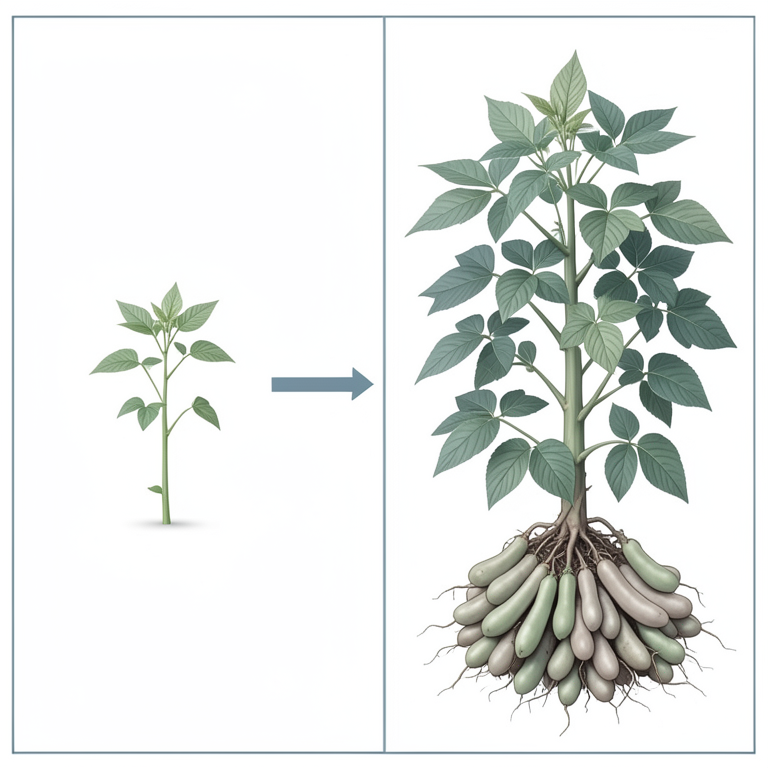
Comparative Performance of TCGS 1694 vs Local Practice
AI-generated conceptual illustration (groundnut plants (Arachis hypogaea)). It explains the idea and does not show study data.
View source evidence ↗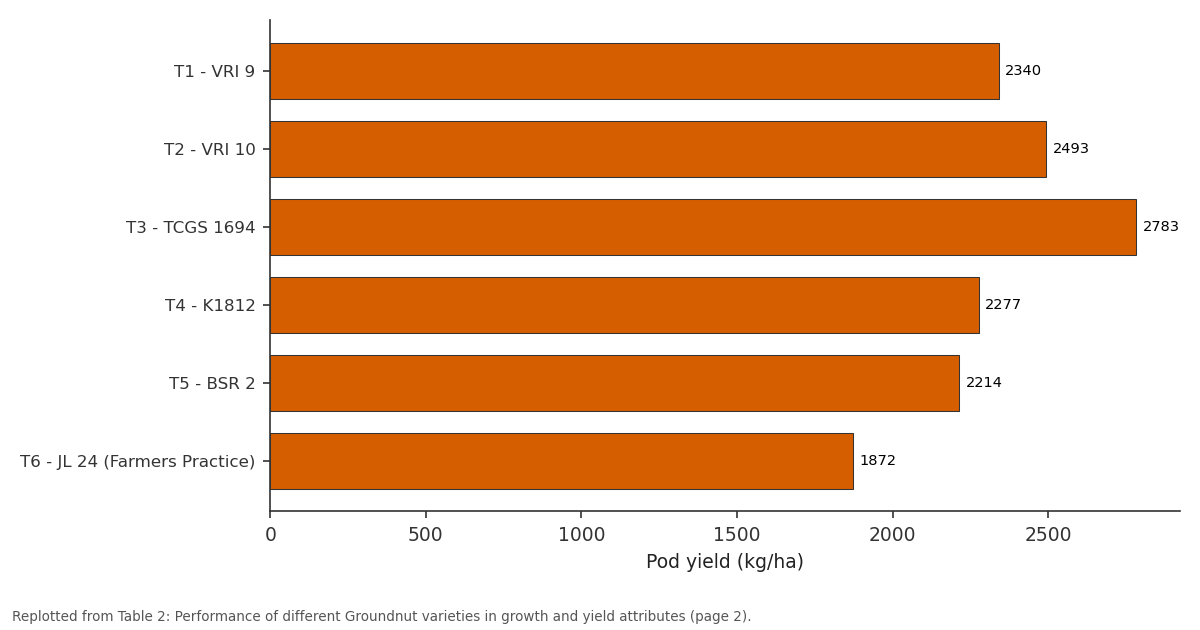
Pod yield (kg/ha): T1 - VRI 9 vs T2 - VRI 10 vs T3 - TCGS 1694 vs T4 - K1812 vs T5 - BSR 2
Replotted from Table 2 (page 2) of the original paper. Every bar is the paper's own table value.
View source evidence ↗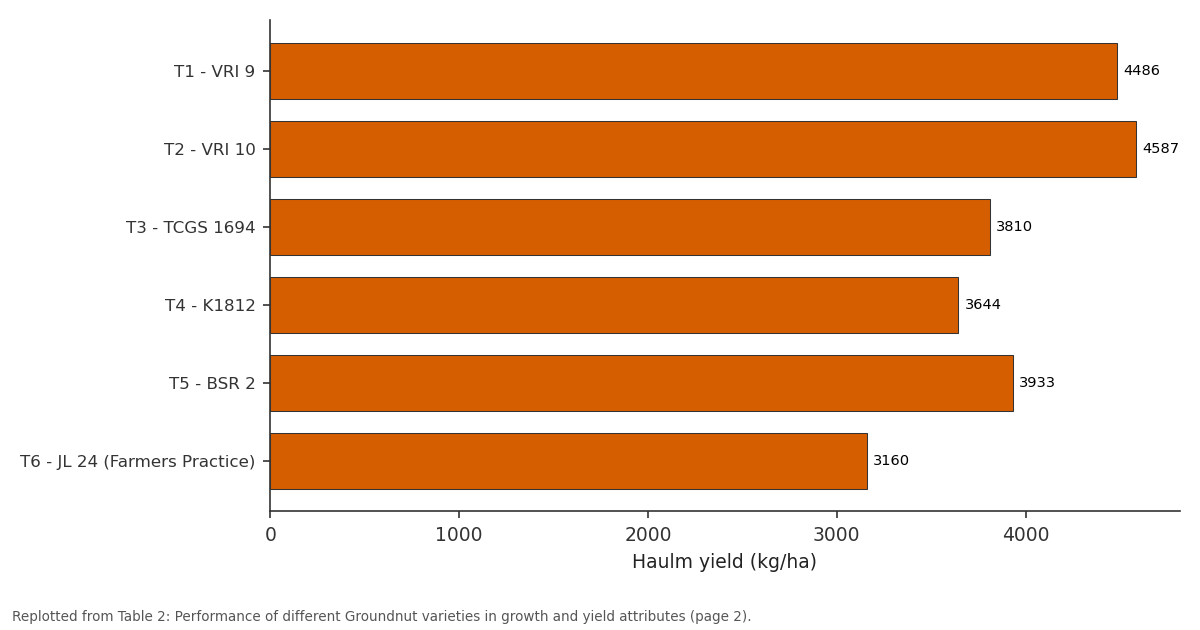
Haulm yield (kg/ha): T1 - VRI 9 vs T2 - VRI 10 vs T3 - TCGS 1694 vs T4 - K1812 vs T5 - BSR 2
Replotted from Table 2 (page 2) of the original paper. Every bar is the paper's own table value.
View source evidence ↗Figures & tables
From the original paper Table 1
 Table 2
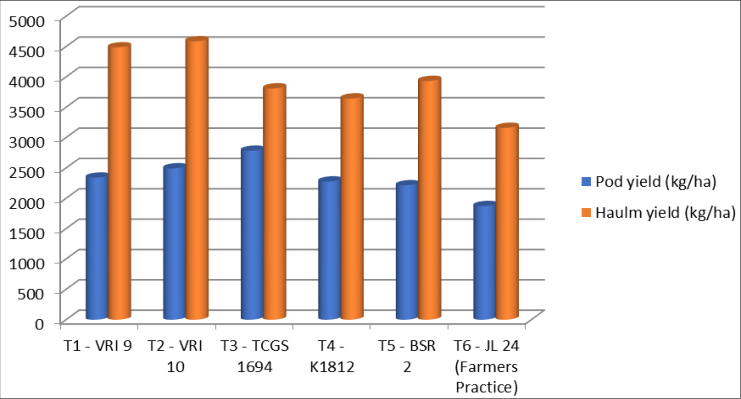 Figure 1
 Table 3
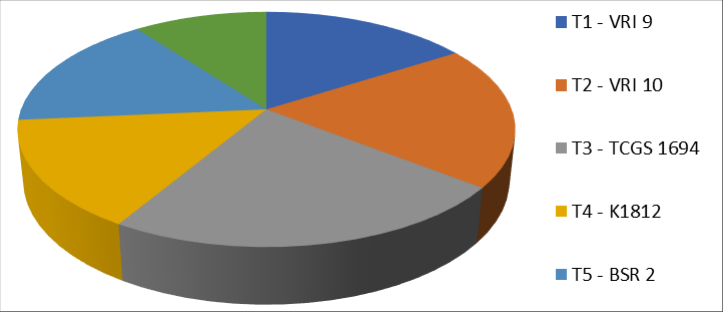 Figure 2
Introduction
Groundnut (Arachis hypogaea L.) is also known as peanut and considered the "King of Oilseeds", is a primary oilseed crop in India and an important oilseed crop found in tropical and subtropical region of the world. Groundnut cultivated in 32.7 m ha area with the production of 53.9 m t in 2021 (ICRISAT, 2023). The leading producer of groundnut in the world are China followed by India. In India groundnut cultivated mainly in kharif season under rainfed condition with minimum quantity of inputs incidence of climatic variance and weed infestation. The major Groundnut growing states are Gujarat, Andhra Pradesh, Tamil Nadu, Karnataka and Rajasthan. Groundnut versatility and adaptability are most important factors making it a reliable crop for farmers across different agro-climatic area. The adaptability enables groundnut to thrive in varying environment condition. About 50% of the world's groundnut crop is used for oil extraction, whereas 35% is used directly for human consumption. The remaining 15% is used for seed and animal feed. Groundnut plays an important role in sustainable agriculture through nitrogen fixation in soils. It improves the soil fertility and making it an ideal rotational crop for enhancing the productivity of subsequent crops. In Tamil Nadu, most of the groundnut was grown under rainfed and irrigated condition in an area of 6.5 lakh ha. In, Theni district most of the area is under the rainfed situation. The ICAR introduce the On Farm Testing for evaluation of location specific technologies to enhance the yield and income of the farmers. The main objective of the trail is newly released varieties, technologies and management practices at farmers field under real farming situation. As farmers were growing different local Groundnut varieties during kharif season registered lower yield and income. Hence the study was planned with the objectives to evaluate improved groundnut with high yield under rainfed condition in kharif season in Theni district through on farm trails and workout the farmers preference based on yield and economics in Theni District.
Materials and Methods
The field experiment was conducted in the various farmers fields in Theni District, Tamil Nadu during kharif season 2023-2024. The experiment site located at southern agro-climatic region of Tamil Nadu. The average rainfall of the area is 832 mm. the soil type of the trail plot is red sandy loam with low organic carbon (0.19-.039%), available N 248-281 kg/ha, available P 11.2-13.7 kg/ha, available K 157-179 kg/ha.
The experimental plot was laid out in randomized Block Design and replicated in thrice with following treatments T1-VRI 9, T2-VRI 10, T3-TCGS-1694, T4-K1812, T5-BSR 2 and T6-JL 24 (Farmers practice). There are five improved varieties are used for evaluation of suitable variety along with farmer's practice. The recommended dose of fertilizer and other need-based practices applied as per packages of practices of TNAU (Crop Production Guide, 2022) [1] . Observation on germination percentage, number of pods/plant, pod yield, haulm yield, gross return (Rs/ha), net return (Rs/ha) and BCR were recorded in randomly selected plants. The data on various parameters were subjected to statistical analysis following the method of analysis of variance for the simple randomized block design (Panse and Sukhatme, 1978) [3] .
Results and Discussion
The performance of different Groundnut varieties in growth and yield attributes under rainfed condition was showed in Table 2. The on-farm trail revealed that the highest number of filled pods recorded in T3-TGCS 1694 (34.20) followed by VRI 10 (28.54). This is 61.85% and 34.92% higher than the farmers practice (T6-JL 24). Other Groundnut varieties VRI 9, K1812 and BSR 2 recorded more number of pods per plant 26.17%, 27.78% and 23.04% respectively than the farmer's practices. This was due to the genetic nature, adaptability of this particular location. This result was also agreed with Sahaja deva et al. 2023 [4] and Ganesan et al. 2019 [2] . The higher pod yield of 2783 kg/ha recorded in TCGS 1694 followed by VRI 10 (2493 kg/ha) which was 48.66% and 33.17% higher than the farmers practice JL 24 (1872 kg/ha). The other varieties VRI 9 (2340 kg/ha), K 1812 (2277 kg/ha) and BSR 2 (2214 kg/ha) recorded 25.00%, 21.63% and 18.26% higher than farmers practice respectively. The yield of different Groundnut varieties constructed on early growth, low incidence of diseases, adaption in rainfed situation, tolerance to drought and percentage of filled pods. This result was Sahaja deva et al. 2023 [4] and Ganesan et al 2019 [2] .
| Variety name | No. of Pods/Plant | No. of filled pods/plant | Root rot incidence (%) | Pod yield (kg/ha) | Haulm yield (kg/ha) |
|---|---|---|---|---|---|
| T1 - VRI 9 | 35.40 | 26.66 | 3.73 | 2340 | 4486 |
| T2 - VRI 10 | 39.00 | 28.51 | 3.16 | 2493 | 4587 |
| T3 - TCGS 1694 | 43.33 | 34.20 | 4.83 | 2783 | 3810 |
| T4 - K1812 | 44.66 | 27.00 | 3.16 | 2277 | 3644 |
| T5 - BSR 2 | 36.00 | 26.00 | 4.06 | 2214 | 3933 |
| T6 - JL 24 (Farmers Practice) | 26.66 | 21.13 | 7.16 | 1872 | 3160 |
| S Ed | 1.33 | 0.90 | 0.54 | 57.75 | 62.24 |
| CD (5%) | 2.96 | 2.02 | 1.22 | 128.69 | 138.69 |
Table text extracted from the original PDF; superscript letters are shown inline. The original table image is below.
View original table image
During kharif season incidence of root rot during early stage affects the growth and yield of Groundnut. The TCGS 1694 was shown higher tolerance to root wilt. The haulm yield was also important under rainfed situation. the animal feed majorly meets out by farmers from crop source only. The highest haulm yield of 4587 kg/ha was recorded in VRI 10 followed by VRI 9 (4486 kg/ha). The other groundnut varieties of TCGS 1694, K 1812 and BSR 2 recorded haulm yield of 3810 kg/ha, 3644kg/ha and 3933 kg/ha respectively. The result revealed that higher Gross return (Rs.128080/ha) and Net return (Rs.88479/ha) recorded in TCGS 1694 followed by VRI 10 (Rs.114523 and Rs.75294). The lowest net income of Rs.39354 was recorded in farmer practice (JL 24). This was due to higher market preference of Groundnut pods in market and haulms preferred by milch animals. The pods of TCGS 1694 and VRI 10 highly preferred by consumers as compared to other varieties. The haulm of VRI 10, VRI 9 and TCGS 1694 highly preferred by the fodder traders as well as milch animal growers. The highest BCR of 3.24 was recorded in TCGS 1694 followed by VRI 10.
Conclusion
Overall, from the research trail, TCGS 1694 recorded higher more number of filled pods/plant, low incidence of root wilt and higher yield and economics compared to VRI 9, VRI 10, K 1812 and BSR 2 varieties. It Also have higher ability to withstand in rainfed condition. So, it could be considered as a better option for achieving higher productivity and profitability under the rainfed condition of Southern tract of Theni district.
Figures and tables from the paper
| Variety name | Cost of Cultivation (Rs. /ha) | Gross income (Rs. /ha) | Net income (Rs. /ha) | BCR | Market preference (pods) |
|---|---|---|---|---|---|
| T1 - VRI 9 | 41686 | 102986 | 61310 | 2.48 | Moderate |
| T2 - VRI 10 | 39283 | 114523 | 75294 | 2.86 | High |
| T3 - TCGS 1694 | 39583 | 128080 | 88479 | 3.24 | High |
| T4 - K1812 | 38816 | 96621 | 57523 | 2.42 | Moderate |
| T5 - BSR 2 | 39523 | 101666 | 62231 | 2.56 | High |
| T6 - JL 24 (Farmers Practice) | 39141 | 78547 | 39354 | 2.04 | Moderate |
Table text extracted from the original PDF; superscript letters are shown inline. The original table image is below.
View original table image
References
3 in the original paper- Ganesan KN, Meenakumari B, Veerabadhiran P, Binodh AK, Devanand PS, Pushpam R, et al. A new high yielding Spanish bunch groundnut variety BSR 2. Electronic Journal of Plant Breeding. 2019;10(4):1495-1500.
- Sahaja D, Prasanna Lakshmi R, Jyosthna MK. Performance evaluation of Groundnut variety Kadiri Lepakshi for growth, yield and economics in Chittoor district. The Journal of Research ANGRAU. 2023;51(2):33-38.
- Chandrika V, Parameswari P, Sreenivas G. Effect of sowing time and rainfall distribution on yield of rainfed groundnut (Arachis hypogea L.) in southern agro-climatic zone of Andhra Pradesh. Legume Research-An International Journal. 2008;31(1):54-56.