
Research article · 2024 · Full text
International Journal of Research in AgronomyStudies on forms of sulphur in the soils of North Saurashtra agro-climatic zone of Gujarat
Volume 7(6S) · Pages 337–342 · DOI: 10.33545/2618060x.2024.v7.i6se.865 ↗
Research areasAgricultural Science and FertilizationAgricultural Economics and PracticesRice Cultivation and Yield Improvement
Abstract
Author-writtenThe present investigation was for evaluating status of sulphur in the soils of North Saurashtra Agro-climatic Zone of Gujarat state and interrelations among the forms of sulphur, for these four hundred eighty samples (10 soil samples from each taluka) were collected from the cultivated fields. The soil samples were analyzed for different forms of sulphur viz., Total S, organic S, non-sulphate S, available-S, sulphate S and water-soluble S. Mean value of 25.72 mg kg-1 available sulphur in North Saurashtra Agro-climatic Zone of Gujarat was seen and it was ranged from 2.82 mg kg-1 to 84.23 mg kg-1. The overall value of range of Total S in North Saurashtra Agro-climatic Zone of Gujarat was 104.2-3381 mg kg-1 with mean value of 867.70 mg kg-1. On the basis of overall data organic S in North Saurashtra Agro-climatic Zone of Gujarat ranged from 77.6 mg kg-1 to 3284 mg kg-1 with mean value of 824.2 mg kg-1. Non-sulphate S overall ranged from 2.6 to 224.6 mg kg-1 in North Saurashtra Agro-climatic Zone of Gujarat was observed with mean value of 26.31 mg kg-1. The overall range of sulphate S in North Saurashtra Agro-climatic Zone of Gujarat was recorded as 0.53-66.39 mg kg-1 with mean value of 17.59 mg kg-1. The water- soluble S ranged from 0.95 mg kg-1 to 92.27 mg kg-1 in North Saurashtra Agro-climatic Zone of Gujarat was observed with mean value of 20.52 mg kg-1. Altogether, the soils of North Saurashtra Agro-climatic Zone of Gujarat had nutrient index values of 2.46 for available sulphur. As per data obtained, it can be concluded based on nutrient index value the soils of North Saurashtra Agro-climatic Zone of Gujarat were medium to high fertility class for available S while the Jamnagar, Amreli and Morbi districts were comparatively deficient in available sulphur on contrary to this Bhavnagar, Rajkot, Dwarka and Surendranagar were surplus in available sulphur content. It can be also concluded that decreasing order for reading of different fractions of sulphur in TS > OS> NSS > AS >WSS > SS. OS contributed maximum to TS.
Summary
Source-checkedPlain-language reading of the full paper, prepared with AI and checked against the text. Each point links to the authors' own words.
Why it matters
- Sulphur is considered the fourth key nutrient for plant growth and development, alongside nitrogen, phosphorus, and potassium. View evidence ↗
- Intensive farming and the use of chemical fertilizers without sulphur have led to increased sulphur deficiency in soils globally and specifically in India. View evidence ↗
- Sulphur deficits in both plants and soils have been documented in various regions of India, including the state of Gujarat. View evidence ↗
The question
- The study aimed to evaluate the status of sulphur and the interrelationships between its different forms in the soils of the North Saurashtra Agro-climatic Zone of Gujarat. View evidence ↗
What they did
- The analysis focused on six forms of sulphur: total, organic, non-sulphate, available, sulphate, and water-soluble sulphur. View evidence ↗
- Standard methods from Chaudhary and Cornfield (1966), Bardsley and Lancaster (1965), and Williams and Steinbergs (1959) were used to determine the various sulphur fractions. View evidence ↗
What they found
- Available sulphur in the region had a mean value of 25.72 mg kg-1, with values ranging from 2.82 mg kg-1 to 84.23 mg kg-1. View evidence ↗
- Total sulphur ranged from 104.2 to 3381 mg kg-1, with an overall mean of 867.70 mg kg-1. View evidence ↗
- Organic sulphur showed a mean value of 824.2 mg kg-1 and ranged from 77.6 mg kg-1 to 3284 mg kg-1. View evidence ↗
- Non-sulphate sulphur had a mean value of 26.31 mg kg-1 and ranged from 2.6 to 224.6 mg kg-1. View evidence ↗
- Sulphate sulphur ranged from 0.53 to 66.39 mg kg-1, with a mean value of 17.59 mg kg-1. View evidence ↗
- Water-soluble sulphur ranged from 0.95 mg kg-1 to 92.27 mg kg-1, with a mean value of 20.52 mg kg-1. View evidence ↗
- The soils generally fell into the medium to high fertility class for available sulphur, though Jamnagar, Amreli, and Morbi were deficient, while Bhavnagar, Rajkot, Dwarka, and Surendranagar were surplus. View evidence ↗
- The fractions of sulphur were found in the decreasing order of Total S > Organic S > Non-sulphate S > Available S > Water-soluble S > Sulphate S, with organic sulphur contributing the most to total sulphur. View evidence ↗
What it means
- The authors concluded that the soils in the North Saurashtra Agro-climatic Zone are alkaline and calcareous. View evidence ↗
Visual summary
1 visualsIllustrations explain the paper; they do not show study data.
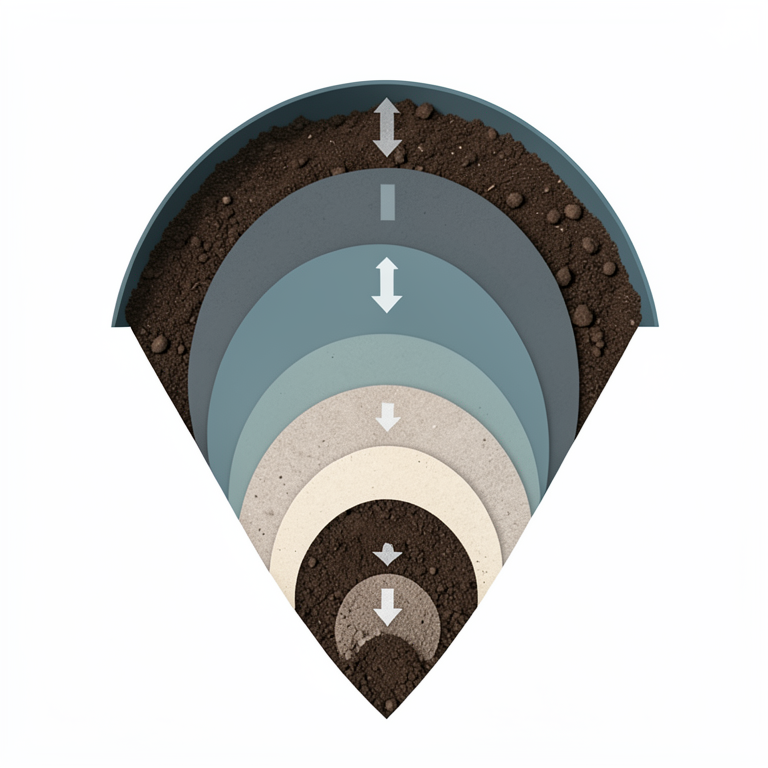
Hierarchy of Sulphur Forms
AI-generated conceptual illustration (Soil profile from the North Saurashtra agro-climatic zone). It explains the idea and does not show study data.
View source evidence ↗Figures & tables
From the original paper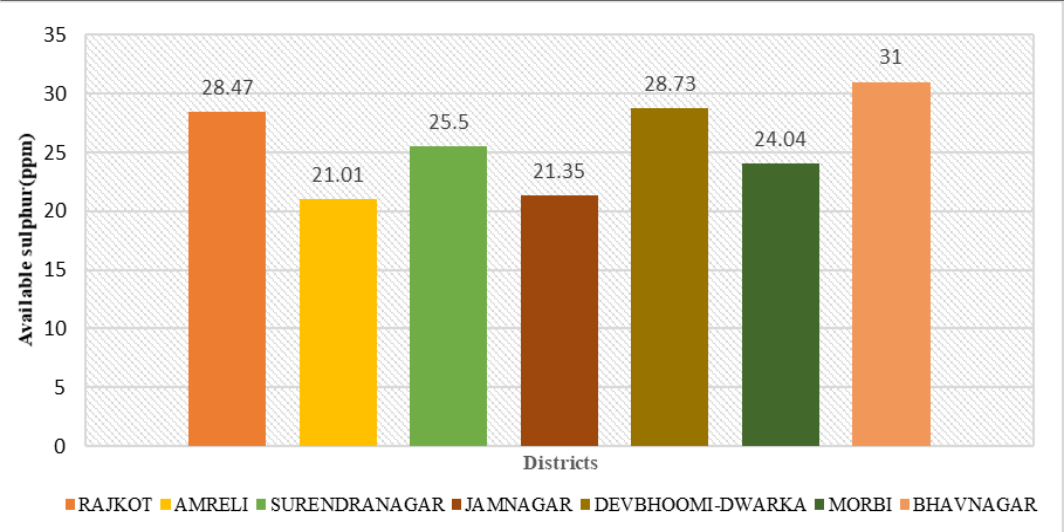 Figure 1
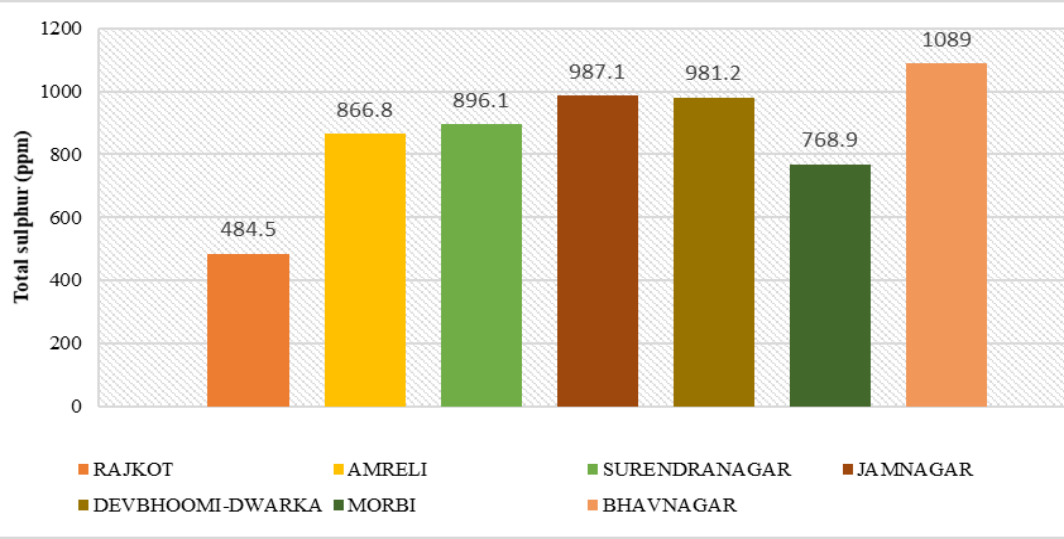 Figure 2
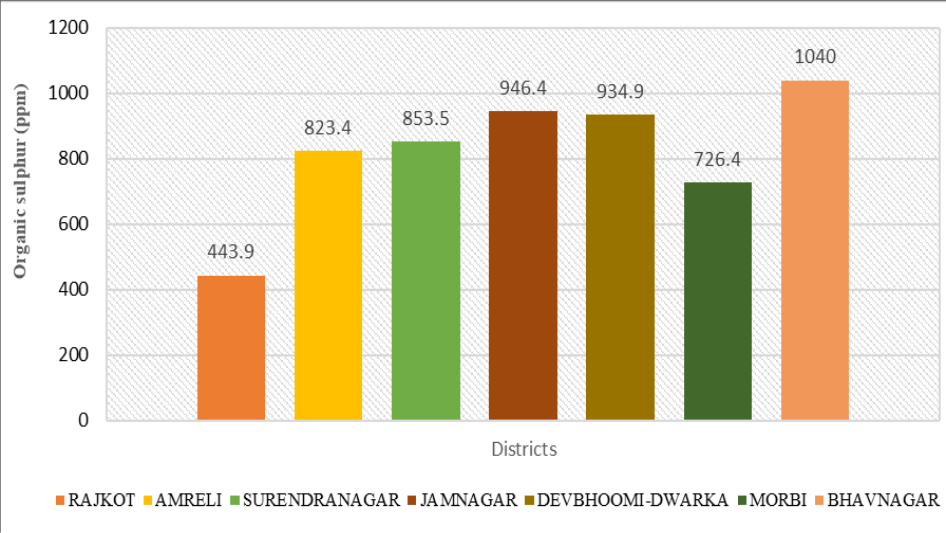 Figure 3
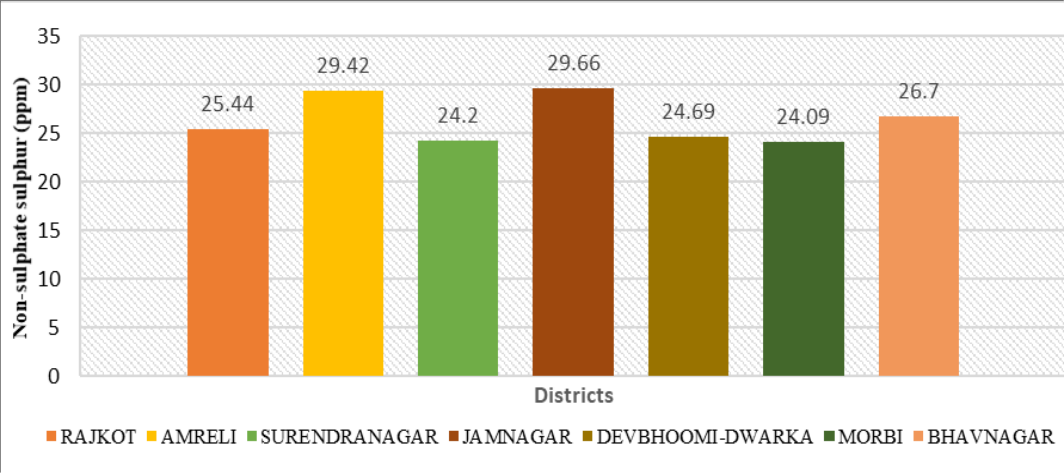 Figure 4
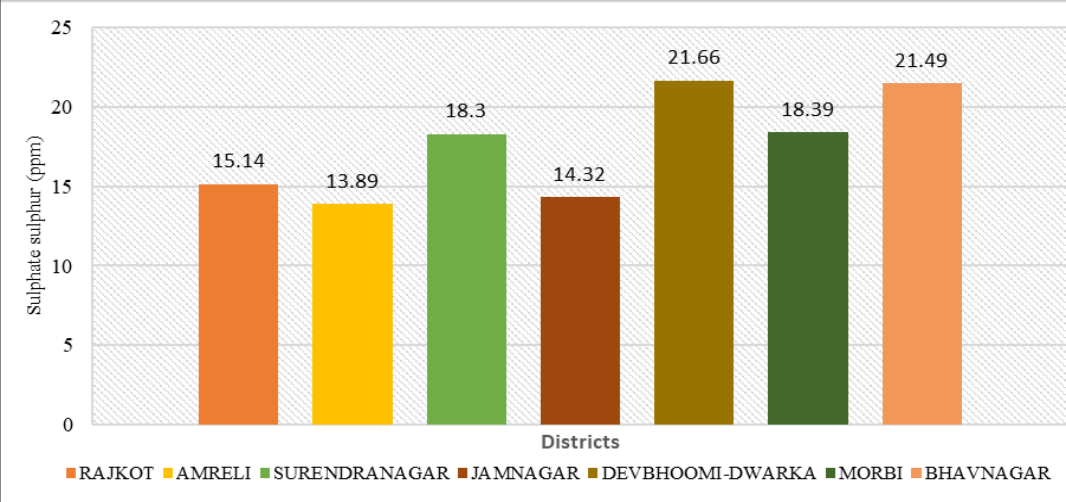 Figure 5
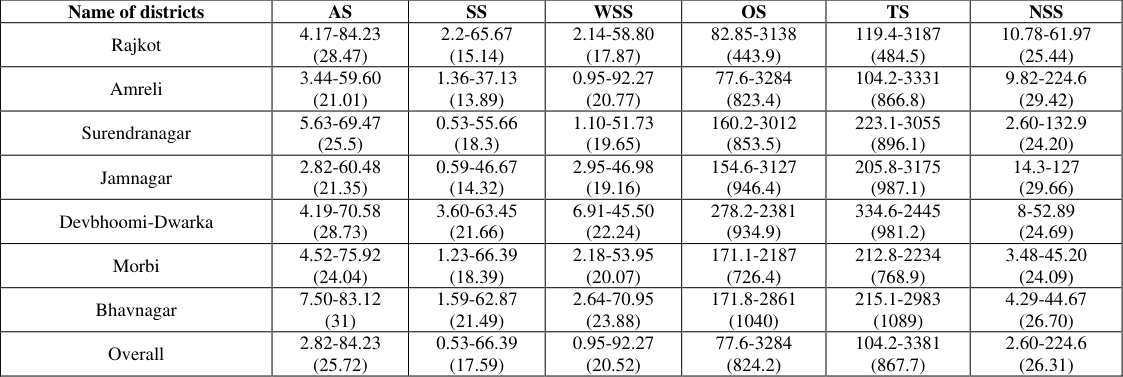 Table 1
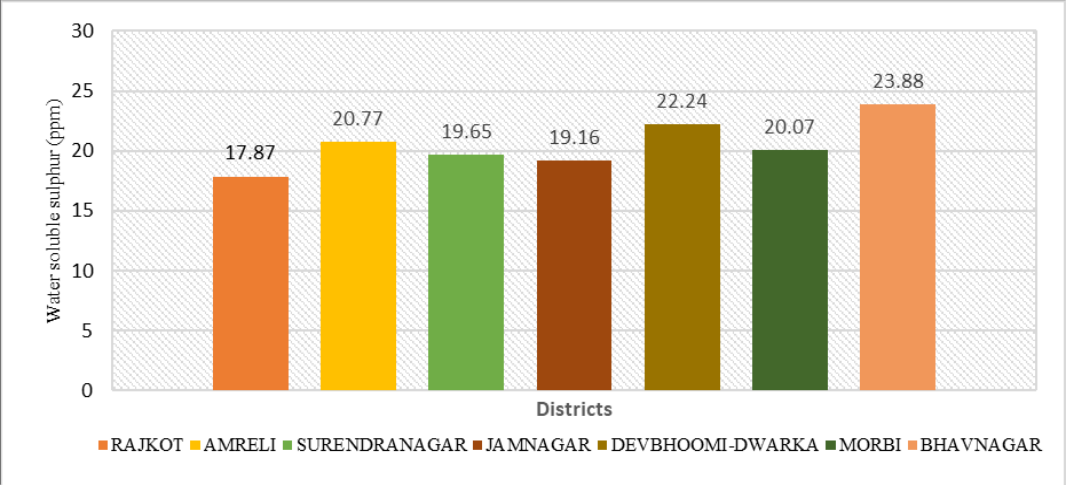 Figure 6
Introduction
Sulphur is an important ingredient for plant growth and development. In addition to nitrogen, phosphorus and potassium, it is currently considered as the fourth key nutrient. Excessive mining of sulphur from soils has resulted in increased sulphur deficiency reports globally, especially in India, due to intensive farming systems and the use of S-free chemical fertilizers (Singh, 2001) [1] . Rice-based cropping systems have showed good responsiveness to S application in the Indo-Gangatic plain. Sulphur mining from soil has substantially increased as a result of the usage of high-analysis chemical fertilizers and the use of high-yielding and hybrid kinds of cereal crops for crop production (Kumar et al. 1994) [2] . The importance of secondary nutrients, particularly sulphur (S), and micronutrients is becoming more widely recognized as a result of a rise in their deficiency in numerous crops, resulting in yield and quality losses. In addition to nitrogen, phosphorus, and potassium, sulphur is currently considered the fourth key nutrient. Sulphur deficit in soils and plants has been recorded in numerous parts of the country, including Gujarat. As a result, research on various features of sulphur, such as its status and interrelationships with other forms of sulphur, is critical to better understanding sulphur as a nutrient in this region's soil, so that it does not become a limiting factor in improving crop yields. As a result, efforts have been made in the current investigation to compile systematic and comprehensive information on the sulphur status and interrelationships among the forms of sulphur in various soils using a large number of surface samples from each taluka in the North Saurashtra Agroclimatic Zone.
Materials and Methods
The present investigation was undertaken by conducting soil survey of North Saurashtra Agro-climatic Zone of Gujarat state and analysis at the Department of Soil Science and Agricultural Chemistry, College of Agriculture, Junagadh Agricultural University, Junagadh. Different soil fractions of sulphur viz, total sulphur, organic sulphur, sulphate sulphur, water soluble sulphur, heat soluble sulphur and non-sulphate sulphur were analyzed. Ten surface soil samples were collected from Rajkot, Paddhari, Lodhika, Jam Kandorna, Kotda Sangani, Jasdan, Vinchiya, Gondal talukas of Rajkot district, Jamnagar, Jam Jodhpur, Jodiya, Dhrol, Lalpur, Kalavad of Jamnagar district, Dwarka, Bhanvad, Kalyanpur, Jam khambhaliya of Devbhumi-Dwarka, Morbi, Tankara, Halvad (zone 5), Wankaner, Maliya-Miana of Morbi district, Surendranagar, Chuda, Chotila, Dhrangadhra, Lakhatar, Limbdi, Muli, Patli, Sayla and Thangadh of Surendranagar district, Amreli, Babra, Dhari, Khambha, Kunkavav-Vadia, Lathi, Lilia, Savarkundla of Amreli district and Bhavnagar, Gariadhar, Jesar, Palitana, Sihor, Umrala, Vallabhipur of Bhavnagar district. All the soil samples collected were analyzed for different forms of sulphur by using standard methods. Total sulphur was determined by using method given by Chaudhary and Cornfield (1966) [3] while organic sulphur was determined by using method given by Bardsley and Lancaster (1965) [4] Sulphate sulphur, water soluble sulphur and heat soluble sulphur was determined by using method given by Williams and Steinbergs (1959) [5]. The non-sulphate sulphur is estimated by difference between the total sulphur and sum of organic and sulphate sulphur.
Results and Discussion
Results and Discussion
Status of heat-soluble or available sulphur in North Saurashtra Agro-climatic Zone of Gujarat
The overall range of available S in North Saurashtra Agroclimatic Zone of Gujarat was 2.82-84.23 mg kg -1 with mean value of 25.72 mg kg -1 . The data revealed that lowest mean value of available S (21.01 mg kg -1 ) was obtained from the samples of Amreli district and highest mean value of available S (31 mg kg -1 ) was found in samples of Bhavnagar district (Fig. 1).
Whatever the outcomes of available sulphur came it was comparable to that obtained by Gupta and Submaria (1997) [6] findings in accessible sulphur concentration in the soils of Jammu area of Jammu and Kashmir, Khamparia et al. (2000) [7] findings as available sulphur status ranged from 0.7 -110.8 mg kg -1 soil with a mean value of 27.7 mg kg -1 , Jetpara et al. (2009) [18] studied as available sulphur over a cycle of ten years in the soils of Saurashtra agro-climatic zone of Gujarat during the year 1990 and 2000, Singh et al. (2009) [9] findings as available S varied from 4.6 to 118.4 mg kg -l , Patel et al. (2011) [10] in soil of Banaskantha district of Gujarat were also giving the result comparable to research findings and Sutaria et al. (2016) [11] observation as available S ranged from 3.6 to 141.8 mg kg -1 .
Status of total sulphur in North Saurashtra Agro-climatic Zone of Gujarat
The overall value of range of Total S in Northern Saurashtra Agro-climatic Zone was 104.2-3381 mg kg -1 with mean value of 867.7 mg kg -1 . The data revealed that lowest mean value of total S (484.5 mg kg -1 ) was obtained from the samples of Rajkot district and highest mean value of total S (1089 mg kg -1 ) was found in samples of Bhavnagar district (Fig. 2).
The data obtained for total sulphur during analysis was in line to that obtained by Lande et al. (1977) [12] as total sulphur in saline soils ranged from 425.7 to 1057 ppm, with an average of 840.4 ppm, demonstrating that total sulphur in saline soils was much higher than in normal soils, Douli and Bandyopadhyay (1983) [13] found that total sulphur content ranged from 368 to 2206 ppm, with a mean of 1011 ppm, Bhatnagar et al. (2003) [14] reported that the total sulphur in surface soil of Vertisols ranged from 798 to 987 mg kg -1 with mean value of 892 mg kg -1 and total S content in soils of the Osmanabad district of Maharashtra varied between 300-2500 mg kg -1 with a mean value of 1654 mg kg -1 in vertisols, according to Narale et al. (2017) [15] .
Status of organic sulphur in North Saurashtra Agro-climatic Zone of Gujarat
The overall range of organic S in North Saurashtra Agroclimatic Zone of Gujarat recorded as 77.6-3284 mg kg -1 with mean value of 824.2 mg kg -1 . The data revealed that lowest mean value of organic S (443.9 mg kg -1 ) was recorded from the soil samples of Rajkot district and highest mean value of organic S (1040 mg kg -1 ) was recorded in soil samples of Bhavnagar district (Fig. 3).
The result obtained for organic sulphur is agree with to that obtained by Trivedi et al. (2000) [16] studied organic sulphur in soil profiles of Madhya Pradesh, Jat and Yadav (2006) [17] findings and the result of Pareek (2007) [18] findings in soil samples of Pantnagar, Uttarakhand.
Status of non-sulphate sulphur in North Saurashtra Agroclimatic Zone of Gujarat
The overall range of non-sulphate S in North Saurashtra Agroclimatic Zone of Gujarat was 2.6-224.6 mg kg -1 with mean value of 26.31 mg kg -1 . The data revealed that lowest mean value of non-sulphate S (24.09 mg kg -1 ) was obtained from the samples of Morbi district and highest mean value of non-sulphate S (29.66 mg kg -1 ) was found in samples of Jamnagar (Fig. 4).
The result obtained was in line with to that obtained by Douli and Nayek (1981) [19] as they reported that non-sulphate sulphur ranged from 13 to 70 ppm (mean 29.14 ppm), Singh (2015) [20] observed as non-SO 4 sulphur concentration ranging from 25 to 105 mg kg -1 in soils from Agra, Uttar Pradesh, with mean of 60 mg kg -1 , In the soils of Rajkot agro-climatic zone of Gujarat, Sutaria et al. (2016) [11] detected as 3.6 to 157.1 mg kg -1 nonsulphate sulphur (mean 31.2 mg kg -1 ) in the soils of Rajkot of Gujarat.
Status of sulphate sulphur in North Saurashtra Agroclimatic Zone of Gujarat
The overall range of sulphate S in North Saurashtra Agroclimatic Zone of Gujarat was recorded as 0.53-66.39 mg kg -1 with mean value of 17.59 mg kg -1 . The data revealed that lowest mean value of sulphate S (13.89 mg kg -1 ) was obtained from the samples of Amreli district and highest mean value of sulphate S (21.66 mg kg -1 ) was recorded in samples of Devbhoomi Dwarka (Fig. 5). The result obtained is similar to Arora et al. (1988) [21] stated that the CaCl 2 extractable sulphate sulphur ranged from 5.1 to 46.0 ppm in major soil series in Punjab, Sharma et al. (2000) [22] studied that respective ranges of calcium chloride extractable (sulphate) sulphur were 10.1 to 47.5, 3.7 to 56.2 and 3.7 to 47.5 mg kg -1 in Alfisols, Inceptisols and Mollisols in some parts of Western Uttar Pradesh, Jat and Yadav (2006) [17] studied eighty surface soil samples and observed that sulphate sulphur ranged from 4.1 to 39.95 mg kg -1 and Kour et al. (2010) [23] found sulphate S concentrations ranged from 5.5 to 43.7 mg kg -1 , with an average of 20.6 mg kg -1 .
Status of water soluble sulphur in North Saurashtra Agroclimatic Zone of Gujarat
The overall range of water-soluble S in North Saurashtra Agroclimatic Zone of Gujarat was observed as 0.95-92.27 mg kg -1 with mean value of 20.52 mg kg -1 . The data revealed that lowest mean value of water soluble S (19.16 mg kg -1 ) was obtained from the samples of Jamnagar district and highest mean value of water soluble S (23.88 mg kg -1 ) was found in samples of Bhavnagar district (Fig. 6). The result obtained is similar to Karwasara et al. (1986) [24] observed that water soluble sulphur content varied from 14.0 to 85.6 ppm with an average of 31.1 ppm in Hisar soils. According to Balanagoudar and Satyanarayana (1990) [25] , the amount of water-soluble sulphur ranges from 1.4 to 230.6 ppm, with a mean value of 28.7 ppm and Kour et al. (2010) [23] found a wide range of water-soluble sulphur (12 to 66.5 mg kg -1 ), with a mean of 32.1 mg kg -1 .
Conclusion
The soils of North Saurashtra Agro-climatic Zone of Gujarat are calcareous in nature and alkaline in reaction. Based on nutrient index values of soils and the criteria suggested by Parker et al. (1951) [26] the soils of Northern Saurashtra were medium to high fertility class for available S while the Jamnagar, Amreli and Morbi districts were comparatively deficient in available sulphur. As per data obtained, it can be concluded that decreasing order for reading of different fractions of sulphur in TS > OS> NSS > AS >WSS > SS. Among the fractions OS contributed maximum to TS.
Figures and tables from the paper
References
25 in the original paper- Singh MV. Importance of sulphur in balanced fertilizer used in India. Fertilizer News. 2001;46(10):13-35.
- Kumar A, Datta SP, Singh RP, Singh KP, Sarkar AK. Available sulphur and micronutrients status of dominant soil series of south Chotanagpur in Bihar. Journal of Indian Society of Soil Science. 1994;42(4):649-651.
- Chaudhary IA, Cornfield AH. The determination of total sulphur in soils and plant materials. Analyst. 1966;91(1085):586-589.
- Williams CH, Steinbergs A. Soil sulphur fractions as chemical indices of available sulphur in some Australian soils. Australian Journal of Agricultural Research. 1959;10(3):340-352.
- Gupta JP, Submaria NM. Analytical sampling of soils of Jammu region of J and K for sulphur content. Research and Development Reporter. 1997;14(1-2):26-29.
- Khamparia RS, Pandey RL, Bapat PN, Vaishya UK. Distribution of available sulphur and micronutrient cations in skeletal soils (Lithic Ustochrepts) of Madhya Pradesh. Jawaharlal Nehru Krishi Vishwa Vidyalaya Resources Journal. 2000;31(1/2):6-9.
- Jetpara PI, Sakarvadia HL, Parmar KB. Status and depletion of sulphur in the soils of Saurashtra region of Gujarat. Asian Journal of Soil Science. 2009;4(1):156-157.
- Singh SP, Singh R, Srivastava PC, Singh P. Different forms of sulphur in soils of Udham Singh Nagar district, Uttarakhand and their relationship with soil properties. Agropedology. 2009;19(1):68-74.
- Patel JM, Patel MV, Jadav NJ, Patel VR. Sulphur fraction and relationship with soil properties in Banaskantha district, Gujarat. Agropedology. 2011;21(2):35-40.
- Sutaria GS, Vora VD, Talpada MM, Hirpara DS, Vekaria PD, Akbari KN. Studies on sulphur fractions in soils of Rajkot district, Gujarat. International Journal of Agricultural Science and Research. 2016;6(1):61-68.
- Lande MG, Varade SB, Badhe NN. Sulphur status and relationship with physicochemical properties of Marathwada soils. Journal of Maharashtra Agricultural University. 1977;2(3):195-201.
- Douli AK, Bandopadhyay A. Distribution of sulphur and carbon nitrogen, sulphur relationships of some coniferous forest soils profiles of North Bengal. Indian Agriculture. 1983;27(2):169-175.
- Bhatnagar RK, Bansal KN, Trivedi SK. Distribution of sulphur in some profiles of Shivpuri District of Madhya Pradesh. Journal of Indian Society of Soil Science. 2003;51(1):74-76.
- Narale SH, Pawar YS, Gourkhede PH. Evaluation of different fractions of N and S in soils of Tuljapur tahsil of Osmanabad district. International Journal of Tropical Agriculture. 2017;35(3):0254-8755.
- Trivedi S, Bansal KN, Tomar RAS, Verma RS. Vertical distribution of forms of sulphur in some profiles of Morena and Bhind districts of Madhya Pradesh. Journal of Indian Society of Soil Science. 2000;48(2):238-241.
- Jat JR, Yadav BL. Different forms of sulphur and their relationship with properties of Entisols of Jaipur district (Rajasthan) under mustard cultivation. Journal of Indian Society of Soil Science. 2006;54(2):208-212.
- Pareek N. Soil mineralizable sulphur: A sulphur availability index. Journal of Indian Society of Soil Science. 2007;55(3):289-293.
- Dolui AK, Nayek AK. Distribution of different forms of sulphur in some red and lateritic soil profiles of West Bengal. Indian Agriculturist. 1981;25(3):185-189.
- Singh S. Forms of sulphur in relation to soil properties under pearl millet cultivation in soils of Agra, Uttar Pradesh. Annals of Plant and Soil Research. 2015;17(4):362-365.
- Arora BR, Ghoi VK, Hundal HS. Distribution of sulphur in benchmark soils of Punjab. Journal of Indian Society of Soil Science. 1988;36(2):367-368.
- Sharma YK, Gangwar MS, Srivastava PC. Sulphur fractions and carbon, nitrogen and sulphur relationships in Alfisols, Inceptisols and Mollisols in some parts of western UP. Journal of Indian Society of Soil Science. 2000;48(3):477486.
- Kour S, Arora S, Jalali VK, Mondal AK. Soil sulphur forms in relation to physical and chemical properties of midhill soils of North India. Communications in Soil Science and Plant Analysis. 2010;41(3):277-289.
- Karwasara SPS, Bharti A, Khera AP. Sulphur status of some soils of Haryana. Journal of Indian Society of Soil Science. 1986;34(3):617-618.
- Balanagoudar SR, Satyanarayana T. Depth distribution of different forms of sulphur in Vertisols and Alfisols. Journal of Indian Society of Soil Science. 1990;38(4):634-640.
- Parker FW, Nelson WL, Miller IE. The broad interpretation of soil test information. Agronomy Journal. 1951;43(3):105112.