
Research article · 2024 · Full text
International Journal of Veterinary Sciences and Animal HusbandryThe effect of supplementing different levels of chicory and yeast to growing dairy goats fed on Rhodes grass basal diet on feed intake and weight gain
Volume 9(3) · Pages 484–488 · DOI: 10.22271/veterinary.2024.v9.i3g.1463 ↗
Research areasRabbits: Nutrition, Reproduction, HealthFood and Agricultural SciencesRuminant Nutrition and Digestive Physiology
Abstract
Author-writtenThis study explored the impact of supplementing Chicory and yeast in varying proportions to the diets of weaned dairy goats primarily fed a Rhodes grass basal diet. The study was conducted at Egerton University's Tatton Agricultural Park (TAP), Njoro. The feeds were formulated into eight diets and offered to 24 crossbred (Saanen × Toggenburg) weaned dairy goats (14±0.5 Kg) using a CRD with a (4x2) factorial design. The diets were Rhodes grass hay and chicory supplementation at (T1:0, T2:10, T3:20, and T4:30%) as the main effects and yeast, with (+) and without yeast (-) as interaction levels. The findings suggest that including yeast and Chicory has a significant effect (p
Summary
Source-checkedPlain-language reading of the full paper, prepared with AI and checked against the text. Each point links to the authors' own words.
Why it matters
- Rhodes grass is a common basal feed for ruminants in Kenya, but its low protein content limits the growth and production of dairy goats. View evidence ↗
- Chicory is a potential supplement because it has a crude protein content over 19% and contains inulin, a prebiotic fiber that supports animal health. View evidence ↗
- Yeast (Saccharomyces cerevisiae) is used as a probiotic to improve rumen fermentation and overall animal health and productivity. View evidence ↗
The question
- The study aimed to evaluate how different levels of chicory supplementation, with or without yeast, affected the voluntary feed intake and weight gain of growing dairy goats fed a Rhodes grass basal diet. View evidence ↗
What they did
- The experiment used 24 weaned crossbred (Saanen × Toggenburg) dairy goats with an initial weight of 14±0.5 kg, arranged in a (4x2) factorial completely randomized design. View evidence ↗
- The eight dietary treatments consisted of four levels of chicory supplementation (0%, 10%, 20%, and 30%) combined with the presence (+) or absence (-) of yeast. View evidence ↗
- Yeast was administered at a rate of 10g per goat per day for the supplemented groups. View evidence ↗
- Data were collected over a four-week period following a 14-day adaptation phase. View evidence ↗
What they found
- Goats on the basal Rhodes grass diet without yeast (T1-) lost weight at a rate of -7.14 g/day, while adding yeast alone (T1+) increased the ADG to 28.21 g/day. View evidence ↗
What it means
- The authors conclude that the optimal combination for promoting growth in dairy goats is 30% chicory supplementation and 10 g/day of yeast. View evidence ↗
- The authors state that further research is required to determine the economic feasibility and long-term effects of these supplements in lactating dairy goats. View evidence ↗
Visual summary
3 visualsIllustrations explain the paper; charts are replotted from the paper's own table values.
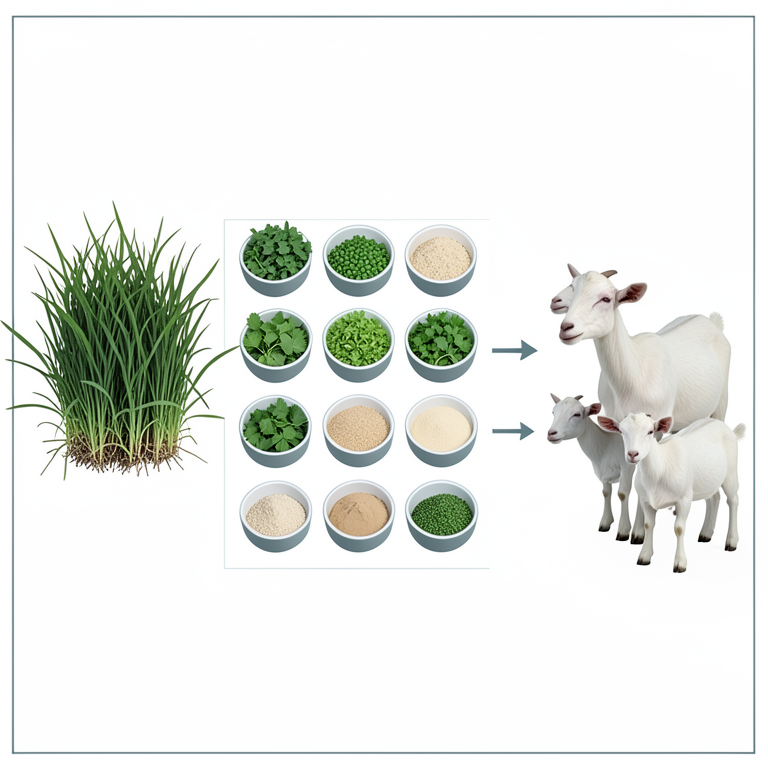
Experimental Diet Matrix
AI-generated conceptual illustration (growing dairy goats). It explains the idea and does not show study data.
View source evidence ↗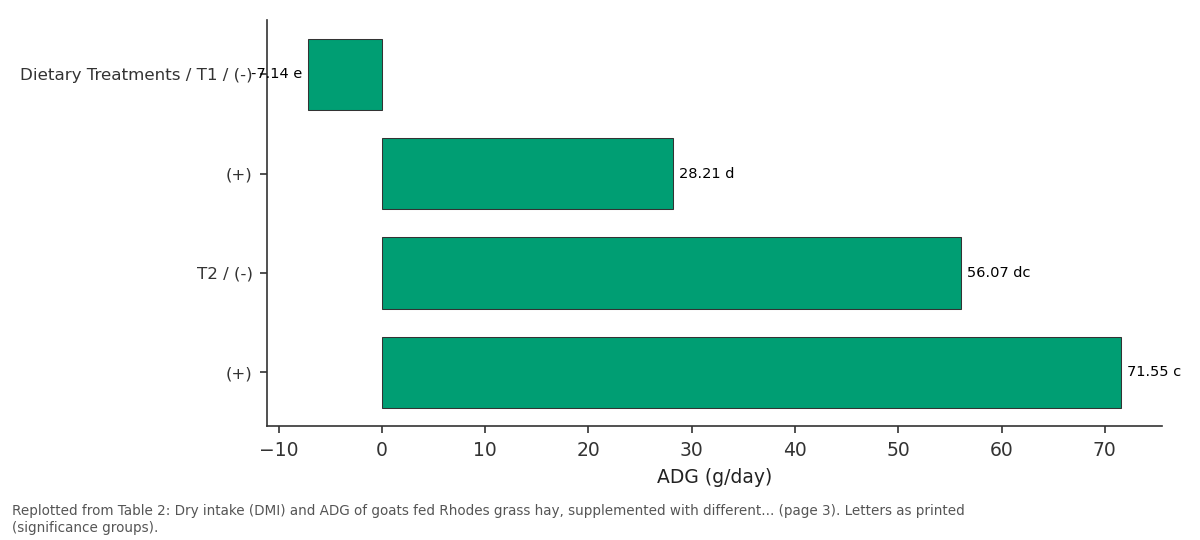
ADG (g/day): Dietary Treatments / T1... vs (+) vs T2 / (-) vs (+)
Replotted from Table 2 (page 3) of the original paper. Every bar is the paper's own table value.
View source evidence ↗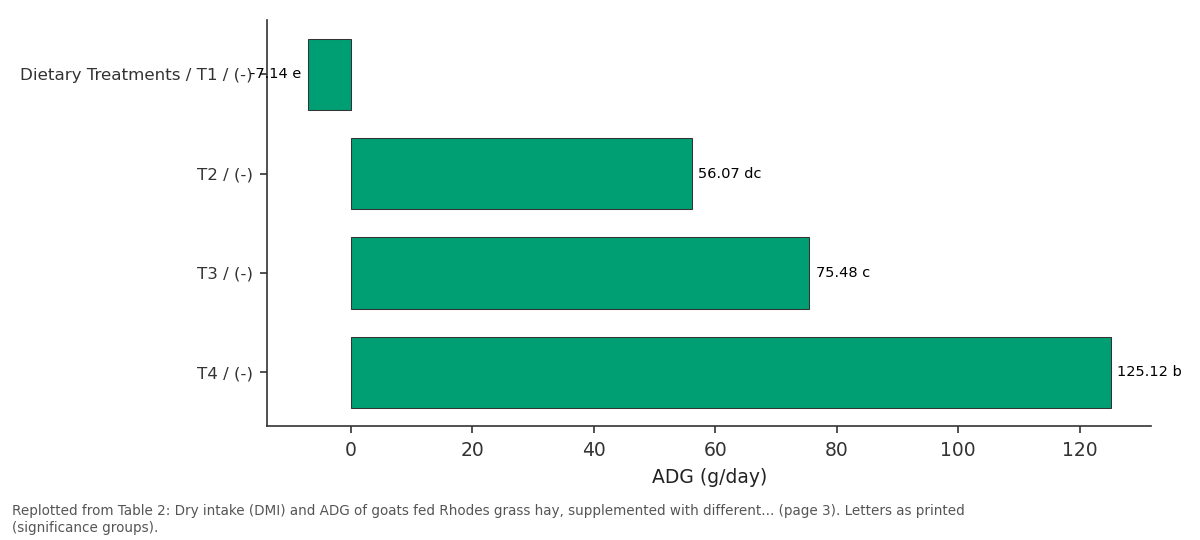
ADG (g/day): Dietary Treatments / T1... vs T2 / (-) vs T3 / (-) vs T4 / (-)
Replotted from Table 2 (page 3) of the original paper. Every bar is the paper's own table value.
View source evidence ↗Figures & tables
From the original paper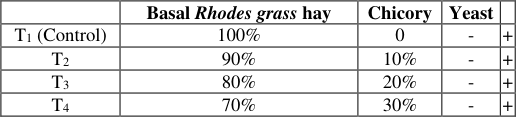 Table 1
 Table 2
Introduction
Effective management of dairy goats' nutrition is essential in the ever-changing realm of livestock production as it ensures the well-being of the animals and the development of highquality dairy products (Silva et al., 2022) [22] . In addition to having a higher concentration of medium-chain fatty acids, goat milk is safer for individuals with lacto-albumin allergies. Despite these advantages, the production of dairy goats is constrained by many challenges ranging from inadequate management, nutritional deficiencies, inferior genotypes, and a scarcity of quality replacement stock and breeding opportunities. In particular, the scarcity of high-quality fodder is a significant impediment to the expansion of the dairy goat industry. Rhodes grass (Chloris gayana) is regarded as an important ruminant basal feed because of its appealing taste and rich nutritional content (Van Soest, 1994) [21] . Rhodes grass is a commonly utilized primary feed in Kenya but is inadequate for optimal growth development, and production due to its low protein content. To enhance its utilization by ruminants, it should be supplemented with protein sources such as herbaceous legumes, multipurpose trees, oil seed cakes, and Chicory. In recent years, Chicory has become a widely recognized substitute for legumes and is also increasingly popular because of its therapeutic, gastronomic, and nutritional attributes. The crude protein content of this forage is more than 19%, and therefore being 1.6-2.4 times greater than that found in conventional cereal grains such as wheat, rice, corn, and barley (Vandeputte et al., 2017) [22] . Chicory also contains a high amount of phytochemicals, such as inulin, which is a type of soluble dietary fibre. Inulin acts as a prebiotic, enhancing animal nutrition by promoting good health.
Inulin is associated with immune system activation, decreased levels of pathogenic microorganisms, alleviation of constipation, decreased susceptibility to osteoporosis, and reduced likelihood of developing atherosclerosis (Vandeputte et al., 2017) [22] . Chicory is cultivated in Kenya, specifically on fertile and well-drained soils ideal for cool temperature zones. The nutritional and therapeutic characteristics of this forage also enhance the reproductive capacity of goats. Yeast (Saccharomyces cerevisiae) is a probiotic substance that is extensively utilized in animal feeds to improve rumen fermentation, promote health, increase milk production, and aid in adapting to heat stress (Henderson et al., 2015) [6] . The yeast is cost-effective and can enhance animal productivity without incurring significant extra expenses. Yeast is also advantageous for dairy goat nutrition as it enhances their rumen fermentation parameters and improves their nutritional value (Chaucheyras-Durand & Durand, 2010) [2] . Yeast and Chicory (Cichorium intybus) are two potential options that contain distinct bioactive compounds capable of influencing the delicate equilibrium between the ruminant digestive system and metabolic processes. Further research is needed to understand how probiotics like yeast and prebiotics like chicory-inulin affect animal health and performance. Therefore, the objective of this study was to determine the effect of supplementing different levels of Chicory with (+) and without (-) yeast to growing dairy goats fed on Rhodes grass basal diet on voluntary feed intake and weight gain.
Materials and Methods
Materials and Methods
Study Site
The study was conducted at Egerton University's Tatton Agricultural Park (TAP), Njoro. The farm is situated in Kenya in Njoro Sub-County, Nakuru County in the Rift Valley of East Africa, on the eastern slopes of the Mau Escarpment. Its latitude and longitude are 0º 23'S, longitude 35º57'E, respectively and an altitude of 2,200 to 2,280 meters above sea level. The region experiences a bimodal rainfall pattern with long rains coming from March to May and short rains from September to November.
Experimental Animals
The experimental animals for this study consisted of twentyfour (24) crossbreed (Saanen and Toggenburg) weaned dairy goats with initial weights of 14±0.5 Kg and ages between 3-4 months. Each goat's initial weight was determined by averaging it over three days.
Experimental Diets
The basal diet comprised Rhodes grass (Chloris gayana) hay, with chicory leaves and yeast serving as supplements. The hay was obtained from the Njoro area. A tractor-driven forage shredder was used to shred the well-cured Rhodes grass hay into 2 cm size and then stored in gunny sacks. Chicory was grown at the Egerton University farm and harvested, then dried. It was then cut into 2 cm size using an electric power fodder chopper and kept in gunny bags. Two weeks before the start of the trial, the feeds were transported to the experimental site. The feeds were kept in a clean, dry store at room temperature with plenty of ventilation throughout the experiment. Each feed sample was hammer-milled to pass through a 1-2 mm screen before being placed in sampling bottles for later chemical analyses. The experimental diets consisted of (T 1 ) as the control comprising of Rhodes grass hay and basal plus chicory included at three levels T 2 (10%), T 3 (20%) and T 4 (30%), and with all four dietary treatments being with (+) at a rate of 10g/goat. Day and without (-) yeast (Table 3.2). The higher DMI figure recorded for goats was used to compute dry matter intake, which was 5% of the live weight of each goat. The supplement diets were fed at 10, 20, and 30% of the expected daily DM intake, whereas the base diet was provided ad libitum. The amount fed was modified at the start of each week to account for changes in body weight. It was fed to them before their ad libitum to the base diet to guarantee that the goats eat the entire supplement.
Experimental Design
The experimental design was a completely randomized design (CRD) in a (4x2) factorial arrangement replicated thrice with eight dietary treatments. The dietary treatments were as shown in Table 3.2 with four levels of Chicory at 0, 10, 20 and 30% with and without yeast. The animals were confined in individual, slatted-floor, well-ventilated pens. Every fortnight the experimental animals were drenched with 10% Albendazole (anti-helminthic) to prevent internal parasites, while the acaricide was used to control external parasites. Data collection was done for four weeks after a 14-day adaptation period. The eight dietary treatments were allocated to the animals in a randomized manner. The animals were fed the experimental diets twice daily, in the morning at 08:00 hr and 14:00 hr. In the morning diet, supplements were prioritized in feeding, followed by the basal diet. In the afternoon diet (14:00 hr), the basal diet was offered to the experimental animals concerning the 08:00 hr basal diet intake. Each animal's basal and supplement diet intake was recorded daily. The refusals from the previous day's feed were collected, weighed, and recorded. At the end of every week, the weights of the experimental animals were taken before morning diets, and all weights were recorded.
Feed Intake and Weight Gain
Voluntary feed intake was determined by summing up the animal's voluntary intake concerning the basal and supplemental diets, less refusal, all in DM. Total dry matter intake (TDMI) = DMI of the basal diet (g) + DMI of the supplemental diets (g).
To establish the weight gain, the initial weight of each goat before the commencement of the feeding process was deducted from the weekly recordings of weights during the feeding experiment.
Weekly weight gain (WG) = Weekly weight recorded (WWR) -Initial weight recorded (IWR).
Statistical analysis
The values of the measured parameters (DMI, ADG, crude fibre, minerals, IVOMD, ME) were determined by analysis of variance (ANOVA) using the general linear model (GLM) procedure of statistical analysis system (SAS, 2002). Significant differences in means were separated using the least significance difference (LSD) at (p<0.05).
Statistical model
Statistical model
Yijk
Yijk
Discussion 4.1 Voluntary Feed Intake
The present study showed that there was a significant increase in DM intake when weaned dairy goats were fed with Chicory and yeast. Goats whose primary diet consisted of only a basal diet of Rhodes grass hay without yeast (T 1 -) recorded the lowest feed intake, 359.21 g/day, while T 4 + goats recorded the maximum intake, 591.7 g/day. These results corroborate the findings by Murney et al. (2019) [9] who also reported a significant increase in DMI when housed goats were supplemented with yeast and Chicory. According to their findings, adding yeast to the diet stimulates rumen microorganisms, leading to enhanced fibre digestion and as a result greater feed DM intake. Elghandour et al. (2022) [5] demonstrated that goat kids not given yeast supplementation exhibited a reduced average daily gain compared to those given 2.5 and 5 g/day of yeast. In addition, Salem et al. (2023) [18] noted that incorporating a yeast culture with monensin (a common prebiotic and probiotic combination) into the diet of lambs resulted in enhanced body weight gain. The incorporation of probiotics into animal diets appeared to enhance the growth of lambs, resulting in increased live weight gain and improved feed conversion ratio (Soliman et al., 2016) [20] . The increased intake may have been due to the additional provision of rumen-degradable nitrogen supplied by the addition of Chicory. This enhances the activity of the bacteria in the rumen, thus enhancing the digestibility of organic matter and, consequently promoting higher feed dry matter intake (Soliman et al., 2016) [20] . The increased feed intake by the goats may be attributed to the palatability of Chicory in diets containing it, as opposed to diets lacking Chicory like in T 1 -in this study. This is in agreement with the findings by Perović et al. (2021) [15] , which also noted that Chicory has a diverse range of nutrients, such as fibre, vitamins, and minerals. Chicory's high nutritional content is likely to fulfil the nutritional needs of growing goats. Chicory's other nutritional beneficial components, like inulin, may positively impact on rumen microbial activity and gut health, which could enhance digestion and the nutritive value of the diet Perović et al. (2021) [15] . Chicory contains both soluble and insoluble fibres, which are within the required levels of ruminants (291 g kg -1 DM). Sufficient dietary fibre promotes rumination and increased saliva flow and is crucial for preserving the well-being of the rumen and for optimal digestion in ruminant animals. The high NDF content (732 gkg -1 ) of Rhodes grass hay is a factor that led to decreased feed intake in the nonsupplemented goats compared to the supplemented animals whose diets had low NDF levels. This is because the level of NDF in an animal ration typically affects their feed consumption as it brings about a faster rumen fill. It also implies that the supplemental diets had a higher feeding value than Rhodes grass hay as the higher proportion of cell contents is a good index of the nutritional value of a feed. Additionally, Niderkorn et al. (2019) [11] found that the digestibility of Chicory has a significant role in determining its effect on feed consumption. Enhanced nutrient absorption and increased animal performance can result from high digestibility and intake of feed. Nwafor et al. (2017) [13] opine that because of its relatively high digestibility, Chicory can enhance the efficient utilization of nutrients by developing goats, hence positively impacting their growth and development.
The combination of Chicory and yeast may synergistically impact the amount of feed consumed by goats. From this study, non-supplemented goats recorded the lowest intake (359.21 g/day) while supplemented ones, particularly in the diet with yeast addition (T 2 +, T 3 +, and T 4 +), improved intake at 476.51 g/day, 503.82 g/day and 591.70 respectively. These results are also in agreement with those of who reported that probiotic supplementation has a beneficial impact on feed intake after weaning. This effect may be attributed to an increase in the quantity and proportion of cellulolytic bacteria in the rumen, as well as an improvement in ruminal pH. These improvements are likely to result in better fiber digestion and therefore enhanced feed intake. Similarly, Ogbuewu & Mbajiorgu (2022) [14] found that the DM intake of Saanen goats increased when they were given 0.2 g/head. Day of Saccharomyces. cerevisiae (CNCMI-1077) over 12 weeks. The enhanced digestive process may result in a higher feed consumption since goats can more nutrients from the combined chicory and yeast diet. The use of Chicory and yeast may also enhance nutrient absorption in goats. The process of yeast fermentation can increase the accessibility of nutrients in the rumen. At the same time, the nutritional composition of Chicory has the potential to contribute to a well-balanced diet. The improvement in DM intake has also been reported before. In contrast, there has also been a report of yeast culture not having any beneficial impact on the dry matter intake and live weight gain in finishing lambs.
Average Daily Gain
The average daily gains (ADG) of non-supplemented animals (-7.14 g/day) were consistent with findings by Kenana (2022) [8] , who noted that goats fed with basal Rhodes grass alone recorded weight gain of -20 g/day. The ADG of supplemented goats was greater than that of non-supplemented goats. The basal diets that received the highest supplementation of Chicory (30%) exhibited a greater average daily gain (ADG). T 4 + (Rhodes grass + 30% chicory + yeast) and T 4 -(Rhodes grass + 30% chicory no yeast) had ADGs of 154.64 g/day and 125.12 g/day, respectively. The enhanced growth relative to non-supplemented diets may have been caused by higher protein (CP) and energy levels from supplementation, which may have contributed to the higher ADG observed in supplemented diets. The basal diet without yeast T 1 -had a negative ADG (-7.14g/day) compared to one with yeast T 1 +, which recorded positive results (28.21 g/day). These results are consistent with the findings of Sawsan et al. (2012) [19] who reported that the fibre-degrading properties of specific yeast isolates may increase the digestibility of fibre in Rhodes grass when yeast supplementation is used. This may result in enhanced utilization of nutrients by the goats. Furthermore, Conte et al. (2018) [3] reported that growth performance was improved as noted by the higher final body weight and average daily gain. Moreover, according to Alugongo et al. (2017) [1] , yeast has been linked to enhanced immune activity in livestock. This may enhance the health well-being and development of a growing goat as a whole. The current study found that enhanced nutrient intake can increase weight gain efficiency in growing goats as indicated by high DMI (591.70 g/day) resulting in high ADG (154.64 g/day). These results are also in agreement with those reported by Pradhan et al. (2018) [16] , who reported that supplementing sure goat kids with active dried yeast (S. cerevisiae CNCM I-1077) at a rate of 2% of dry matter intake resulted in enhancement of growth, feed conversion efficiency, and a reduction in feeding cost. The potential contribution of Chicory to gut health, combined with the excellent influence of yeast on digestion, may improve overall growth performance, as shown by the results of this study. The synergistic impact of Chicory and yeast on feed intake, nutrient digestibility, and gut health can enhance growth and overall performance in growing goats, is also supported by findings by Gangadoo et al. (2018). Moreover, opine that yeast and Chicory may exert synergistic effects on the health of the digestive tract. Chicory's prebiotic characteristics and the yeast's probiotic impacts can synergistically establish a harmonious and salubrious microbial environment within the goat's gastrointestinal tract. This can lead to better nutrient utilization and stimulate development in growing goats. The potential efficacy of Chicory's ant-parasitic properties may result in a diminished parasite burden within the gastrointestinal tract of goats, thereby providing additional support for their growth and general well-being.
Conclusion
The optimal concentration of Chicory for promoting the growth of dairy goats is 30% when supplemented with 10 g/goat. Day of yeast. To achieve feed efficiency and strong development, farmers may add Chicory and yeast to the diets of growing goats to improve productivity. Further investigation is needed to explore the possible long-term effects and economic feasibility of adding Chicory and yeast to the diet of lactating dairy goats.
Acknowledgement
I would also like to express my gratitude to Ruforum, who generously funded my research study through the Master Card Foundation in partnership with Transforming African Agricultural Universities to meaningfully contribute to Africa's Growth and Development Program (TAG Dev).
Conflict of Interest
Conflict of Interest
Not available
Not available
Financial Support
Financial Support
Figures and tables from the paper
| — | Basal Rhodes grass hay | Chicory | Yeast | — |
|---|---|---|---|---|
| T1 (Control) | 100% | 0 | - | + |
| T2 | 90% | 10% | - | + |
| T3 | 80% | 20% | - | + |
| T4 | 70% | 30% | - | + |
Table text extracted from the original PDF; superscript letters are shown inline. The original table image is below.
View original table image
| — | Dietary Treatments | — | — | — | — | — | — | — | — |
|---|---|---|---|---|---|---|---|---|---|
| T1 | T2 | T3 | T4 | ||||||
| Parameter | (-) | (+) | (-) | (+) | (-) | (+) | (-) | (+) | P-Value |
| DMI (g/day) | 359.21f | 424.40e | 451.20de | 476.51dc | 488.57dc | 503.82bc | 533.39b | 591.70a | <.0001 |
| INWT (Kg) | 14.23a | 14.07a | 13.87a | 13.73a | 14.33a | 14.13a | 14.17a | 14.13a | 0.2262 |
| FWT (Kg) | 14.03f | 14.86ef | 15.44de | 15.74de | 16.44dc | 17.24bc | 17.67ab | 18.46a | <.0001 |
| WTG (Kg) | -0.20e | 0.60de | 0.63cd | 1.48cd | 1.77c | 3.10b | 3.63ab | 4.17a | <.0001 |
| ADG (g/day) | -7.14e | 28.21d | 56.07dc | 71.55c | 75.48c | 110.83b | 125.12b | 154.64a | <.0001 |
Table text extracted from the original PDF; superscript letters are shown inline. The original table image is below.
View original table image
References
16 in the original paper- Alugongo GM, Xiao JX, Chung YH, Dong SZ, Li SL, Yoon I, et al. Effects of Saccharomyces cerevisiae fermentation products on dairy calves: Performance and health. Journal of Dairy Science. 2017;100(2):1189-99.
- Durand CF, Durand H. Probiotics in animal nutrition and health. Beneficial Microbes. 2010;1(1):3-9.
- Conte G, Ciampolini R, Cassandro M, Lasagna E, Calamari L, Bernabucci U, et al. Feeding and nutrition management of heat-stressed dairy ruminants. Italian Journal of Animal Science. 2018;17(3):604-20.
- Dhingra D, Michael M, Rajput H, Patil RT. Dietary fiber in foods: A review. Journal of Food Science and Technology. 2012;49(3):255-66.
- Henderson G, Cox F, Ganesh S, Jonker A, Young W, Janssen PH. Rumen microbial community composition varies with diet and host, but a core microbiome is found across a wide geographical range. Scientific Reports. 2015;5:14567.
- Hristov AN, Oh J, Giallongo F, Frederick TW, Harper MT, Weeks HL, et al. An inhibitor persistently decreased enteric methane emission from dairy cows with no negative effect on milk production. Proceedings of the National Academy of Sciences. 2013;110(34):14063-8.
- Murney R, Burggraaf V, Mapp N, Ganche E, King W. The effect of cultivated mixed-species green fodder on intake, milk production, and milk composition of housed dairy goats. Animal. 2019;13(12):2802-10.
- Ngunjiri VW. Evaluation of performance of growing dairy goats fed Rhodes grass hay, supplemented with dried Calliandra leaves and common Vetch Hay [MSc Thesis]. Egerton University; 2020.
- Niderkorn V, Martin C, Bernard M, Morvan LA, Rochette Y, Baumont R. Effect of increasing the proportion of Chicory in forage-based diets on intake and digestion by sheep. animal. 2019;13(4):718-26.
- Ogbuewu IP, Mbajiorgu CA. Meta-analytic effect of Saccharomyces cerevisiae on dry matter intake, milk yield, and components of lactating goats. Frontiers in Veterinary Science. 2022;9:1014977.
- Perović J, Šaponjac VT, Kojić J, Krulj J, Moreno DA, Viguera GC, et al. Chicory (Cichorium intybus L.) as a food ingredient-nutritional composition, bioactivity, safety, and health claims: A review. Food Chemistry. 2021;336:127676.
- Pradhan SK, Choubey M, Patel VR, Kharadi VB, Dabas VS. Effect of dietary supplementation of yeast on growth, feed conversion efficiency and cost of feeding in Surti goat kids. International Journal of Current Microbiology and Applied Sciences. 2018;7(9):2032-5.
- Russell JB, Rychlik JL. Factors that alter rumen microbial ecology. Science. 2001;292(5519):1119-22.
- Sawsan M, Tawila MA, Abou Ward GA, Salama R, ElNaggar S. Determine the proper level of yeast with different levels of roughages to improve the nutritive value of lamb's ration. Life Science Journal. 2012;9(3):1773-80.
- Soliman SM, El-Shinnawy AM, El-Morsy AM. Effect of probiotic or prebiotic supplementation on the productive performance of Barki lambs. Journal of Animal and Poultry Production. 2016;7(10):369-46.
- Vandeputte D, Falony G, Silva VS, Tito RY, Joossens M, Raes J. Stool consistency is strongly associated with gut microbiota richness and composition, enterotypes, and bacterial growth rates. Gut. 2017;65(1):57-62.