
Research article · 2024 · Full text
International Journal of Agriculture Extension and Social DevelopmentExamining the relationship and predictors of farmer’s awareness on ICT tools in agriculture: A correlation and regression analysis
Volume 7(6) · Pages 38–41 · DOI: 10.33545/26180723.2024.v7.i6a.695 ↗
Research areasAgricultural Innovations and PracticesTechnology Adoption and User Behaviour
Abstract
Author-writtenAgriculture in India holds promise for leveraging Information and Communication Technology (ICT) to propel socio-economic development in rural farming communities. Information and communication have always been crucial in agriculture, guiding timely decision-making. However, farmers, particularly smallholders in developing countries, encounter obstacles in accessing, efficiently utilizing, and affording agricultural information. In this connection, a study was conducted in Karnataka to examine the relationship and predictors of farmers’ awareness on ICT tools in agriculture. In total 120 samples were considered for the study. The results reveal that, predictors like, Educational status, Information seeking behavior, Extension agency contact, Mass media exposure, Innovativeness, Possession of modern electronic gadgets, Internet usage, and Attitude towards e-media demonstrated a notable positive association with awareness at a one percent level of significance. Maximum R squared value is obtained when three independent variables viz., internet usage, information seeking behaviour and Perception of mobile phone in farming were included in the model (i.e., model 3). These variables together contributed to 60.10 percent.
Summary
Source-checkedPlain-language reading of the full paper, prepared with AI and checked against the text. Each point links to the authors' own words.
Why it matters
- Information and Communication Technology (ICT) is seen as a promising tool for driving socio-economic development within India's rural farming communities. View evidence ↗
- Smallholder farmers in developing countries face significant barriers regarding the cost, efficiency, and accessibility of agricultural information, which hinders productivity. View evidence ↗
- Previous research indicates that a lack of skills and a lack of awareness are primary constraints for farmers using ICT tools. View evidence ↗
The question
- The study aimed to identify the predictors and examine the relationship between various factors and farmers' awareness of agricultural ICT tools in Karnataka. View evidence ↗
What they did
- The research was conducted in the Koppal district of Karnataka, specifically covering the blocks of Koppal, Gangavathi, Kustahi, and Yalaburga. View evidence ↗
- A sample of 120 respondents was selected using a multi-stage random sampling technique, with 15 individuals from two villages per block. View evidence ↗
- Data analysis was performed using SPSS, employing correlation analysis, multiple regression, and stepwise multiple regression. View evidence ↗
What they found
- Age, occupational status, social participation, and the perception of mobile phones in farming did not show a significant relationship with awareness. View evidence ↗
- The most effective predictive model (Model 3) used internet usage, information seeking behavior, and perception of mobile phones to explain 60.10% of awareness. View evidence ↗
- In the final model, a one-unit increase in internet usage was associated with a 5.44 unit increase in awareness. View evidence ↗
- A one-unit increase in the perception of mobile phones in farming resulted in a 0.51 unit decrease in awareness, possibly because mobile advisory services have not reached farmers effectively. View evidence ↗
What it means
- The authors conclude that internet usage behavior is the most significant predictor of awareness among the variables studied. View evidence ↗
Visual summary
2 visualsIllustrations explain the paper; charts are replotted from the paper's own table values.
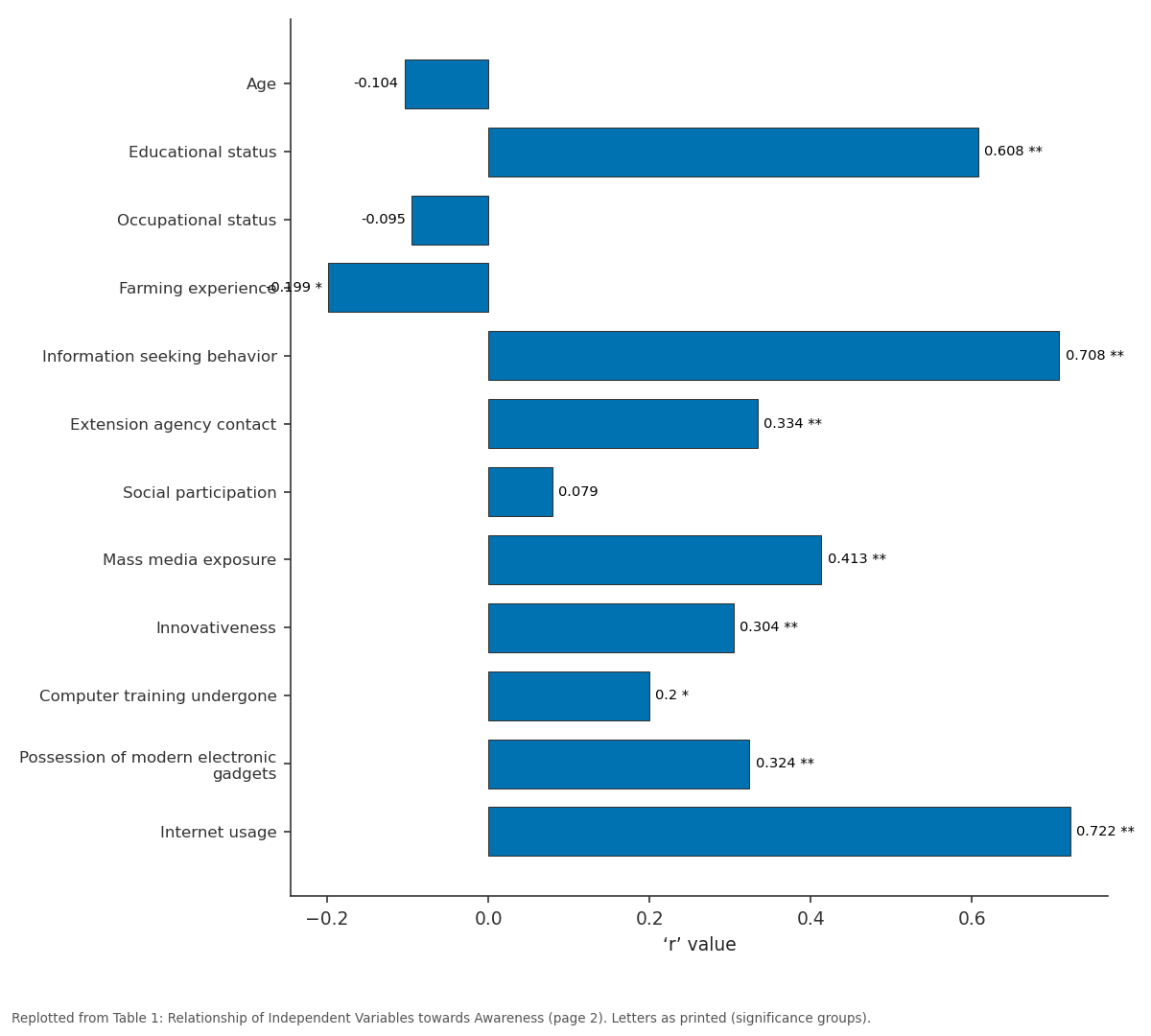
‘r’ value: Age vs Educational status vs Occupational status vs Farming experience vs Information seeking...
Replotted from Table 1 (page 2) of the original paper. Every bar is the paper's own table value.
View source evidence ↗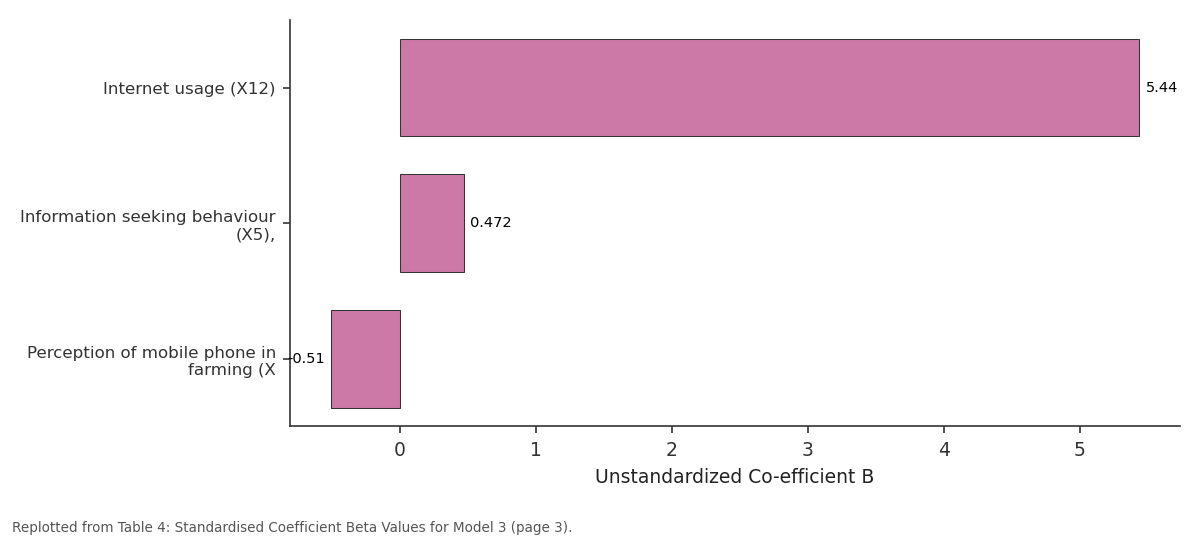
Unstandardized Co-efficient B: Internet usage (X12) vs Information seeking... vs Perception of mobile...
Replotted from Table 4 (page 3) of the original paper. Every bar is the paper's own table value.
View source evidence ↗Figures & tables
From the original paper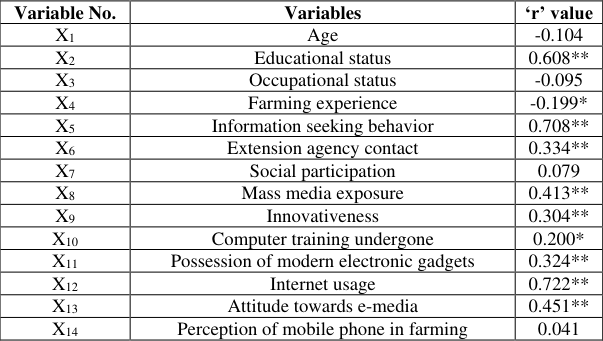 Table 1
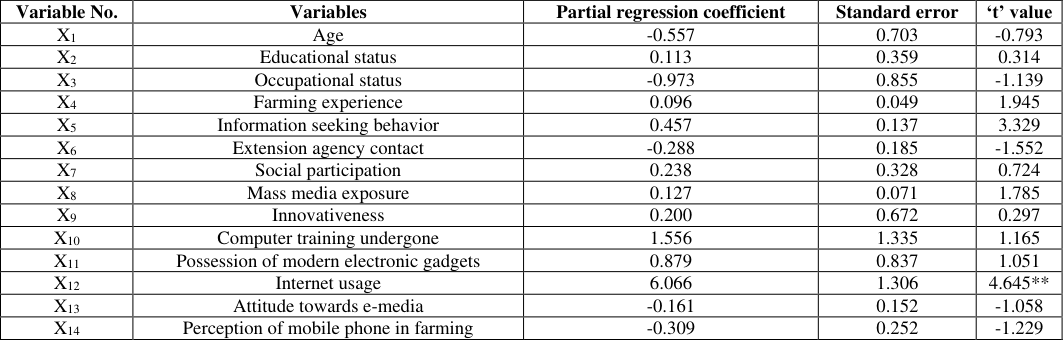 Table 2
 Table 3
 Table 4
Introduction
Agriculture in India can be viewed as a promising sector for the effective application of Information and Communication Technology (ICT), to harness the socio-economic development of India's rural farming community. Information and communication have always been vital components in agriculture for taking appropriate timely decisions. ICTs explicitly include the field of electronic communication, in addition to IT. The term IT is defined as "the study, design, development, implementation, support or management of computer-based information systems, particularly software applications and computer hardware." IT deals with the use of electronic computers and computer software to convert, store, protect, process, transmit and retrieve information, securely. (Insha et al., 2020) [2] . Farmers face daily decisions amidst numerous risky and uncertain situations. These decisions must be made based on the information accessible to them at that moment. However, the accessibility, efficiency, and affordability of agricultural information remain significant obstacles in enhancing agricultural productivity, especially among smallholders in developing countries. (Nagesh, N.S. and Saravanan, R. 2019) [6] . It was recorded (Manjuprakash et al., 2020) [5] that, majority of the respondents faced lack of adequate skills in using ICT tools as a major constraint. More than three-fourths of the respondents faced lack of awareness about ICT tools as a second most constraint followed by lack of trainings on usage of ICT tools. Less than half of them felt that, high cost of ICT tools as major constraint followed by high cost of internet charges were the economic factors contributing as constraints in using ICT tools and services. One-fourth of the farmers feared to use modern electronic gadgets or internet. Experiences of integration of ICTs in the agricultural institutes have been showing encouraging results and also complementing conventional communication methods (Bisht et al., 2010; Kale et al., 2015) [1,3] . Though there are number of ICT initiatives available to cater various solutions to the agricultural problems, farmers are not aware of several existing services. (Manjuprakash et al., 2017) [4] . This study examines the relationship and predictors of farmers' awareness on ICT schemes and projects in Karnataka
Research Methodology
Koppal district in Karnataka was deliberately chosen as the focal point of this study due to its noticeable integration of Information and Communication Technology (ICT) tools into everyday communication practices. The study encompassed four blocks: Koppal, Gangavathi, Kustahi, and Yalaburga. A total of 120 respondents were selected, with 15 individuals chosen from two villages in each of the four blocks using a multi-stage random sampling technique. An www.extensionjournal.com ex-post facto design was adopted to fulfill the research objectives. To gather primary data, a pre-tested and comprehensive interview schedule was utilized. Subsequently, computerbased statistical software, particularly the Statistical Package for Social Sciences (SPSS), was employed for data analysis and interpretation. Statistical techniques including correlation analysis, multiple regression analysis, and stepwise multiple regression analysis were utilized to analyze and interpret the data.
Correlation Analysis
Table 1 reveals that out of the fourteen variables examined, eight showed a significant positive correlation with awareness. Specifically, factors such as Educational status (X 2 ), Information seeking behavior (X 5 ), Extension agency contact (X 6 ), Mass media exposure (X 8 ), Innovativeness (X 9 ), Possession of modern electronic gadgets (X 11 ), Internet usage (X 12 ), and Attitude towards e-media (X 13 ) demonstrated a notable positive association with awareness at a one percent level of significance. Additionally, Computer training undergone (X 10 ) displayed positive significance at a five percent level. Conversely, Farming experience (X 4 ) exhibited a negative significant association with awareness at a five percent level. On the contrary, Age (X 1 ), Occupational status (X 3 ), Social participation (X 7 ), and Perception of mobile phone in farming (X 14 ) were found to lack a significant relationship with awareness. 1 illustrates that educational status was positively and significantly associated with awareness level. This can be attributed to over 50.00 percent of the respondents being educated, thus having a heightened awareness of the scheme and ICT-enabled services. Conversely, occupational status exhibited a negative and significant association with awareness level. This trend stems from the majority of respondents relying on agriculture for their livelihood over an extended period. Older farmers, with considerable experience, tend to prefer traditional information sources, leading to lower awareness of ICT tools in agriculture.
| Variable No. | Variables | ‘r’ value |
|---|---|---|
| X1 | Age | -0.104 |
| X2 | Educational status | 0.608** |
| X3 | Occupational status | -0.095 |
| X4 | Farming experience | -0.199* |
| X5 | Information seeking behavior | 0.708** |
| X6 | Extension agency contact | 0.334** |
| X7 | Social participation | 0.079 |
| X8 | Mass media exposure | 0.413** |
| X9 | Innovativeness | 0.304** |
| X10 | Computer training undergone | 0.200* |
| X11 | Possession of modern electronic gadgets | 0.324** |
| X12 | Internet usage | 0.722** |
| X13 | Attitude towards e-media | 0.451** |
| X14 | Perception of mobile phone in farming | 0.041 |
Table text extracted from the original PDF; superscript letters are shown inline. The original table image is below.
View original table image
Farming experience also demonstrated a negative significant association at the five percent level. This could be attributed to veteran farmers relying on traditional wisdom and interpersonal networks for information, whereas less experienced farmers exhibit a greater inclination towards seeking information from various sources, including ICT tools.
Information-seeking behavior displayed a positive significant association at the five percent level. This can be attributed to farmers' curiosity in exploring new methods to access farming-related information, leading to their engagement with modern ICT tools and services. Likewise, extension agency contact exhibited a positive significant association at the five percent level with awareness level. Farmers with moderate to high levels of contact with extension agencies were likely informed about the availability and utility of various ICT tools, thereby enhancing their awareness towards these technologies.
Mass media exposure has shown a positive significance with awareness. Mass media encompasses newspapers, magazines, radio, television, and the internet. Exposure to these mediums enhances farmers' awareness of ICT tools and services. Innovativeness demonstrated a positive significance at the five percent level towards awareness. Innovativeness reflects the degree to which individuals are early adopters of innovation. Farmers with a high level of innovativeness are inclined towards novelty and experimentation, contributing to their positive association with awareness. Possession of modern electronic gadgets also exhibited a positive significance at the five percent level. Owning modern ICT gadgets such as mobile phones, laptops, and computers encourages farmers to explore new tools and services available online and through ICT-enabled platforms.
Similarly, internet usage displayed a positive significance at the five percent level towards awareness. The internet serves as a crucial medium for accessing ICT-enabled extension services, thereby positively influencing awareness levels.
Attitude towards e-media has shown positively significant at five percent towards awareness level. Attitude is a positive or negative feeing one has, positive attitude of the farmers towards e-media might have shown the result of positive significant www.extensionjournal.com
Multiple Regression Analysis
In order to identify the relative influence of each independent variable towards awareness, multiple regression analysis was performed and the results are presented in Table 2. It could be discerned from Table 2 that the R 2 value was 0.646 which indicated that 64.60 percent variation in the awareness was explained by the given fourteen independent variables and remaining 35.40 percent of the variation in dependent variables unexplained. The 'F' value was significant at one percent level probability. Thus, the cause& effect relationship between the dependent and independent variables are fitted at one percent level of significance. The fitted regression equation is given below, Y 1 = 29.338 -0.557X 1 +0.113 X 2 -0.973 X 3 + 0.096 X 4 + 0.457 X 5 -0.288 X 6 + 0.238 X 7 + 0.127 X 8 +0.200 X 9 + 1.556X 10 +0.879 X 11 + 6.066**X 12 -0.161 X 13 -0.309 X 14.
| Variable No. | Variables | Partial regression coefficient | Standard error | ‘t’ value |
|---|---|---|---|---|
| X1 | Age | -0.557 | 0.703 | -0.793 |
| X2 | Educational status | 0.113 | 0.359 | 0.314 |
| X3 | Occupational status | -0.973 | 0.855 | -1.139 |
| X4 | Farming experience | 0.096 | 0.049 | 1.945 |
| X5 | Information seeking behavior | 0.457 | 0.137 | 3.329 |
| X6 | Extension agency contact | -0.288 | 0.185 | -1.552 |
| X7 | Social participation | 0.238 | 0.328 | 0.724 |
| X8 | Mass media exposure | 0.127 | 0.071 | 1.785 |
| X9 | Innovativeness | 0.200 | 0.672 | 0.297 |
| X10 | Computer training undergone | 1.556 | 1.335 | 1.165 |
| X11 | Possession of modern electronic gadgets | 0.879 | 0.837 | 1.051 |
| X12 | Internet usage | 6.066 | 1.306 | 4.645** |
| X13 | Attitude towards e-media | -0.161 | 0.152 | -1.058 |
| X14 | Perception of mobile phone in farming | -0.309 | 0.252 | -1.229 |
Table text extracted from the original PDF; superscript letters are shown inline. The original table image is below.
View original table image
From the equation it is clear that intercept Internet usage behaviour (X 12 ) is significant at one percent level. Thus, if Internet usage (X 12 ) increases one unit from the mean level then the awareness will increase 6.06 unit from the mean level. The use of majority of the ICT tools requires internet. Which provide all kind of information from all over the world. This might be the reason for internet usage has positively correlated.
Stepwise analysis was carried out to eliminate the independent values whose contribution to the dependent variable was considered minimum and to select those variables to be used in the prediction equation. The results of the stepwise regression are presented in the Table 3. the results of stepwise analysis show that the maximum R squared value is obtained when three independent variables viz., internet usage (X 12 ), information seeking behaviour (X 4 ) and Perception of mobile phone in farming (X 14 ) were included in the model (i.e., model 3). These variables together contributed to 60.10 percent, which shows that the contribution by the eliminated variables was only to the tune of 4.50 percent. Hence, the unstandardized B coefficients of model 3 are to be used to predict the awareness. (Table 4). The standardized coefficient beta values of the independent variables in model (Table 4) indicate that a unit increase in internet usage, ceteris paribus, would result in increase in awareness by 5.44 units and vice versa. A unit increase in Information seeking behavior ceteris paribus, would result in an increase of 0.472 units of awareness and vice versa. Respondent who have more information seeking behaviour would have the tendency to increase awareness about ICT tools. A unit increase in perception of mobile phone in farming ceteris paribus, would result in a decrease in 0.51 units of awareness and vice versa. This might be due to the mobile based advisory services still not reached to the farmers very effectively. Through majority of them have mobile phones. The fitted equation, therefore, is as follows: Y = 31.600 + 5.44 X 12 + 0.472 X 5 -0.51X 14 Conclusion Among the 14 independent variables analyzed for ICT usage, eight variables, including Educational status, Information seeking behavior, Extension agency contact, Mass media exposure, Innovativeness, Possession of modern electronic gadgets, Internet usage, and Attitude towards e-media, exhibited a positive and significant association with awareness level at the five percent level. However, Occupational status and Farming experience showed a negative and significant association with awareness level at the same level. Notably, only Internet usage behavior demonstrated a significant association with awareness level at the one percent level.Maximum R squared value is obtained when three independent variables viz., internet usage, information seeking behaviour and Perception of mobile phone in farming were included in the model (i.e., model 3). These variables together contributed to 60.10 percent.
| Model | Unstandardized Co-efficient B | Standardised Coefficient Beta | ‘t’ values |
|---|---|---|---|
| (Constant) | 31.600 | ||
| Internet usage (X12) | 5.440 | 0.480 | 5.322 |
| Information seeking behaviour (X5), | 0.472 | 0.367 | 4.164 |
| Perception of mobile phone in farming (X14) | -0.510 | -0.128 | -2.107 |
Table text extracted from the original PDF; superscript letters are shown inline. The original table image is below.
View original table image
References
5 in the original paper- Bisht S, Mishra YD, Bharadwaj N, Mishra R. Utilization pattern of information communication technology (ICT) among agricultural scientists. J Community Mobilization Sustainable Dev. 2010;5(1):90-95.
- Insha Javeed, Sumati Narayan, Ajaz A. Malik, Anil Kumar, Rihana Rahman, Shemoo Nisar, Afroza Akhter, Sayed AzrahIndrabi, Amreena Sultan. Role of Information and Communication Technology in Agriculture. Int J Curr Microbiol Appl Sci. 2020;11:2028-2037.
- Kale RB, Babu GP, Mohammad A, Meena MS, Vairagar VG, Kad SV. Perceived effect of information and communication technology use in the performance of dairy scientists. Int J Appl Res Inf Technol Comput. 2015;6(1):38-43.
- Manjuprakash H, Philip, Sriram N. Farmers' Awareness Level about ICT Tools and Services in Karnataka. J Extension Educ. 2017;29(2):5870-5874.
- Manjuprakash H, Philip, Sriram N. Maladies and Remedies in Using Information and Communication Technology Tools for Agricultural Information in Karnataka. Asian J Agric Extension Econ Sociol. 2020;38(6):26-31.
Cited by 1
From OpenAlex, OpenCitations and reference lists read by Scinovex
- Profile of Sugarcane Growers of Southern Karnataka and their Association with Crisis Management Behaviour ↗
V. C. Sanjay, Sabita Mondal, Chandan Kumar Hui, Ushia Rai, Birat Rai · International Journal of Bio-resource and Stress Management · 2025
The study was conducted during October, November month of 2022 and January month of 2023 in Mandya and Mysore districts, Karnataka state, India to study the profile of sugarcane growers and to find out the association between the profile of the sugarcane growers and their crisis management behaviour in Southern Karnataka. Mandya and Mysore districts of Karnataka were purposively selected…
❝ 0PDF