
Research article · 2024 · Full text
International Journal of Agriculture Extension and Social DevelopmentDesign and development of solar powered, bluetooth controlled seed metering mechanism
Volume 7(6) · Pages 220–223 · DOI: 10.33545/26180723.2024.v7.i6c.698 ↗
Research areasIoT-based Smart Home SystemsSmart Agriculture and AI
Abstract
Author-writtenA solar-powered, Bluetooth-controlled seed metering mechanism is developed to make the machines sustainable and easy to use. Using Bluetooth devices like smart phones reduces the cost of machines and gives a high yield. It replaces the fuel-powered seed metering mechanism, which has lots of environmental problems and labour costs. In a developed machine, the machine is powered by solar energy, which is stored in a battery. At the same time, the machine's motors are rotating using this power, and directions are controlled by Bluetooth devices like a smart phone. For the travel of the machine, we used two DC motors and direction control. The front wheels are connected to a bearing, and where the rear wheel movement is high or rotation is high, the front wheel rotates that side. For the metering mechanism, we used a metallic geared servo motor 360, which is controlled by an Arduino UNO using a Bluetooth module. Chickpea is metered using this machine and gave 83% field efficiency, 0.48 and 0.40 hac/hr theoretical and actual field capacity.
Summary
Source-checkedPlain-language reading of the full paper, prepared with AI and checked against the text. Each point links to the authors' own words.
Why it matters
- Traditional fuel-powered seed metering mechanisms are associated with high labor costs and various environmental issues. View evidence ↗
- Using solar energy for seed metering offers a more sustainable farming method for controlling machine speed and direction. View evidence ↗
- Bluetooth integration allows farmers to manage sowing operations remotely via smartphones. View evidence ↗
The question
- The study aims to develop a solar-powered, Bluetooth-controlled seed metering mechanism to improve sustainability and ease of use. View evidence ↗
What they did
- The machine is powered by a 20-volt solar panel charging two 12-volt, 7.1Ah batteries, which supply power to the motors and the Arduino Uno microcontroller. View evidence ↗
- Two DC motors connected via chain and sprocket are used to drive the wheels, providing the high torque necessary for field work. View evidence ↗
- The seed metering mechanism utilizes a metallic geared 360-degree servo motor controlled by an Arduino UNO and a Bluetooth module. View evidence ↗
- The machine's base frame was fabricated from square iron pipes with dimensions of 120 cm in length and 80 cm in width. View evidence ↗
- The developed mechanism was tested using chickpea seeds for metering. View evidence ↗
What they found
- The developed mechanism achieved a field efficiency of 82.55%. View evidence ↗
- The machine demonstrated a theoretical (potential) field capacity of 0.48 ha/hr and an actual field capacity of 0.40 ha/hr. View evidence ↗
- Energy consumption was measured at 59 watt-hours for two hours of daily use and 413 watt-hours per week. View evidence ↗
What it means
- The authors conclude that the solar-powered mechanism outperforms typical fuel-powered implements regarding environmental impact and operating efficiency. View evidence ↗
- The authors state that this development contributes to a more efficient and greener agricultural future by reducing reliance on fossil fuels. View evidence ↗
Visual summary
1 visualsIllustrations explain the paper; they do not show study data.
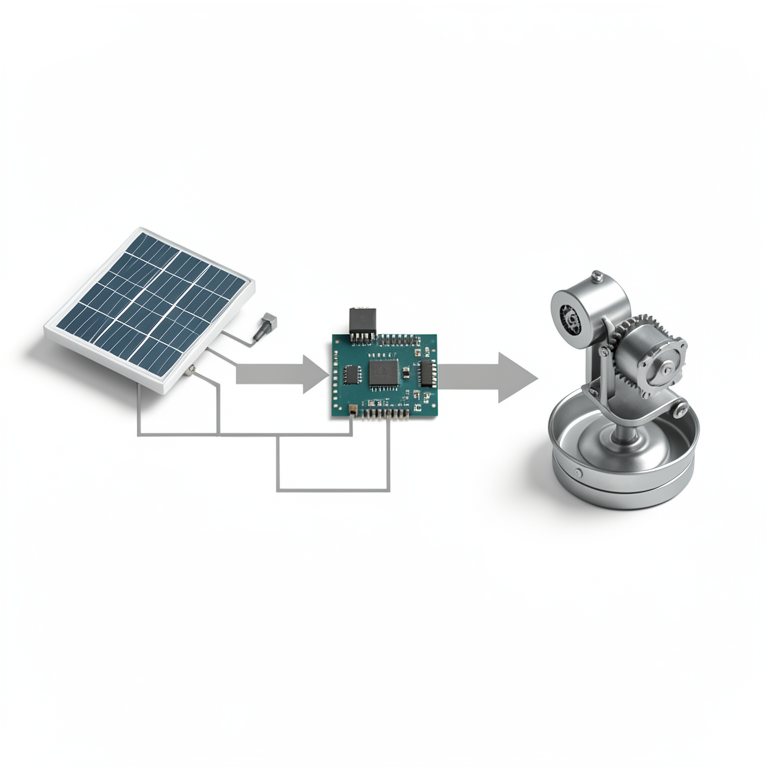
System Architecture
AI-generated conceptual illustration (Solar-powered seed metering mechanism with Arduino Uno, Bluetooth module, and motors). It explains the idea and does not show study data.
View source evidence ↗Figures & tables
From the original paper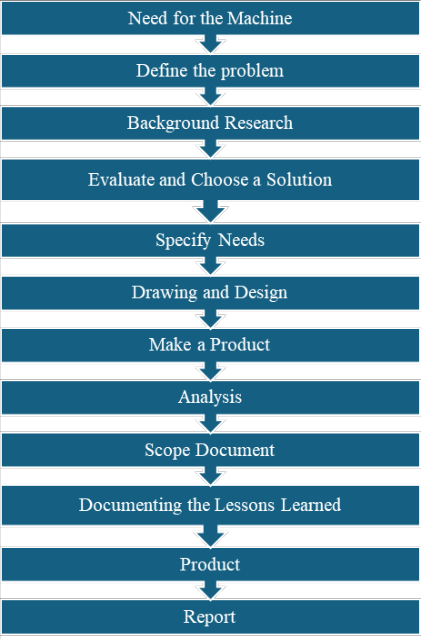 Figure 1
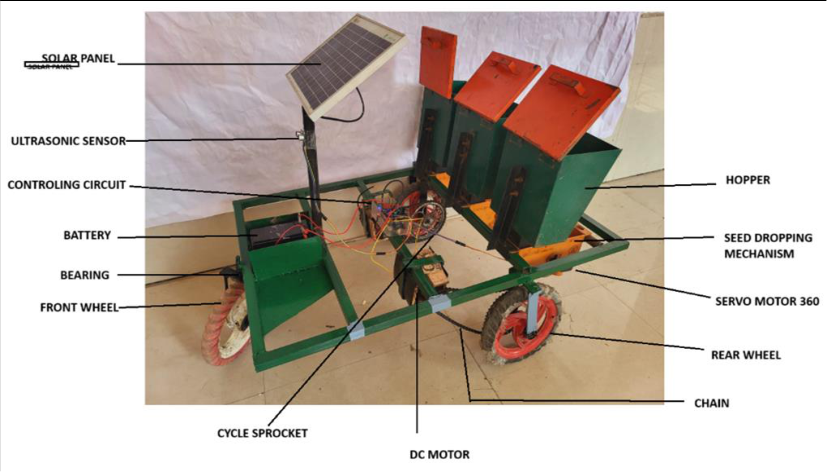 Figure 2
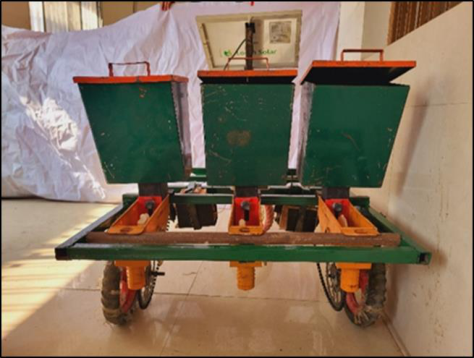 Figure 3
Introduction
A solar-powered seed metering mechanism is used to distribute seeds of various sizes and shapes in the field. There is a cool new idea: using sunlight and Bluetooth to control the sowing of seeds. The system is powered by sunlight and hence does not require fuel to function [1] . Farmers can control anything from their smart phones using Bluetooth, allowing them to make changes without even being in the field. This machine is a collaboration of machine and wireless control of machine. In this machine, Arduino Uno is used as a microcontroller that controls the dc motor speed, direction, speed of the servo motor [2] , and Bluetooth module. A Bluetooth module is used to connect the control of a machine to a smart phone using mobile apps like RC cars, Arduino cars, etc. Bluetooth can be easily available on any model or version of smart phone and is available to all farmers at present. This machine provides sustainable farming methods of metering the seeds using solar energy to measure and control the speed and direction of the machine [3] . A solar panel is used in front of the machine, which collects the photons and stores the electrons on a battery. The stored electrons are used to run the machine through a microcontroller and a Bluetooth module. This machine is very useful to the farmers to increase the productivity of crops while reducing the cost of farming using sustainable methods [5] . It uses solar energy, so no environmental pollution occurs using this machine, and it is eco-friendly for the environment and for farmers.
Materials and Methods
The design and fabrication of a solar-powered, Bluetoothcontrolled seed metering mechanism required the following materials: solar panel, 12v battery, square iron rod, geared dc motor, servo motor 360, motor driver, Arduino Uno, jumper wire, Bluetooth module, wheels, bearing, shaft, nut & bolt, seed metering assembly, etc. Fabrication of the machine: various parts of the machine are fabricated, then welded or finally assembled one by one. The parts arebody frame, solar panel stand, wheels, supporting rod, axle with bearing attached, seed metering assembly (hopper, shaft, seed metering, seed groove, drop tube, and servo motor), front wheel with bearing on top, plate for keeping batteries and electronic components safe, etc., and all parts are welded and bolted to a suitable size. Electric circuits relate to various sensors, batteries, solar panels, dc motors, and bluetooth modules. For coding, we used the Arduino IDE software, in which code was written to control the dc motor using a Bluetooth-connected device in various directions (forward, backward, left, right, etc.) and to control the servo motor speed and direction. www.extensionjournal.com
The components of the machine are shown below
S. No. Components Description 1
Body-frame This is the base of the machines on which different parts are assembled. Loads of the parts and seeds are transferred to the wheels via the body frame, which is important for the stability, load distribution, and assembly of various parts.
2 Solar panel A 20-volt solar panel is used to charge the 12-volt, 7.1Ah battery. Which is bolted on a stand that is tilted at some angle and connected to the battery using a diode.
3 Battery two 12-volt, 7.1 AH batteries are used in this machine to run the dc motors, servo motor, and 5-volt supply to the microcontroller (Arduino Uno).
Dc motor
Two dc motors are used in this machine, which are connected by chain and sprocket (alternate pulley and belt), which reduces the speed of the wheels and gives high torque, which is important for the machine while using in-field work.
Servo motor 360
It is used to rotate the shaft of the seed metering. By rotating the shaft, seeds are distributed into the field via the seed groove and drop tube.
The front wheel is connected through the bearing to control the direction of travel of the machine. Rotating the machine in the left direction, in this condition, the smartphone commands come, the left dc motor stops, the right motor runs, and the front wheel automatically rotates to the left. Same for the right turn. Rear wheels are connected to the shaft and sprocket, which are powered by DC motors and transfer the load of the machine to the soil.
7
Chain and sprocket It is used to transmit the motion from the DC motor to the wheel by reducing the speed and increasing the torque.
8 Arduino Uno This is a microcontroller used to control the various functions of the machine-like direction and speed of the dc and servo motors by Bluetooth. It provides a pulse width modulation feature to control the speed of the DC motor. 9 Bluetooth module This module is used to connect the machine's control to a smart phone using Bluetooth.
10 Motor driver This component is used to supply an equal amount of voltage to dc motors as well as a 5-volt supply to the microcontroller (Arduino Uno), and the input power source is a battery.
11
11
Hopper and metering assembly
Hopper, which is used to keep the seeds and fall to the seed metering mechanism at a controlled rate, and then seed metering, seed grooves keep the seed and fall to the drop tube via a rotating shaft, rotated by a servo motor 360
Methodology
The different steps involved in assembling the parts for the machine are here: -The project's assembly process includes of lots of essential parts, beginning with the fabrication of the base frames using square iron pipes measuring 120 cm in length and 80 cm in width. Various components and rods are welded, nutted, and bolted to this frame. A bearing-welded shaft with two "U"-shaped rods attached that allow continuous rotation of the wheels, is welded to the frame. The wheels have been fixed to this shaft to ensure synchronized its rotation. Further, a sprocket is welded to the inner portion of the shaft and connected to a DC motor via a chain, as was the case for the other rear wheel. The front wheel, which is intended to revolve freely, is connected to a shaft with its end welded to a rod that is attached to the bearing's outer surface. An iron rod is pushed and welded into the inner circle of the bearing, as well as the machine's frame. A further square iron rod is welded to the front of the frame, which consists of a 40 cm stand and a 10 cm rod inclined at a 25-30-degree inclination to support a solar panel. Two parallel plates welded to the base of the framework support the battery. Another square iron rod is welded to the back of the frame to support the seed metering assembly, with precision-drilled holes for mounting nuts and bolts. The seed metering equipment received from the college, is mounted, and attached to a servo motor 360 to facilitate rotation of the seed metering and seed grooves. For the DC motor setup, two rods with plates have been welded to the extra rod which holds the seed metering assembly. The DC motor placed on this structure is linked to the rear wheel's sprocket via a chain. The Arduino Uno is programmed using IDE software, and the Bluetooth module is connected to the board through its correct pins. The motor driver and servo motor 360 have been connected to the Arduino Uno, according to in the code. The motor driver has been connected to the battery, with the positive and negative terminals exact matched. The Arduino obtains a 5-volt supply through jumper wires connected to Gnd to Gnd and +5V to Vin. Once powered on, the Bluetooth has a connection with an app which enables control of the DC motors and servo motor, including speed regulation.
Working
This machine is controlled by Bluetooth devices; for this machine, we used a smartphone to control the machine's direction and speed, as well as a servo motor. Solar energy is stored in the battery through the solar panel. We used a 20-volt solar panel and a forward-biased diode to stop the reverse charge flow to the solar panel, and the stored energy is used to run the machine [5] . The battery is connected to the motor driver's positive to positive and negative to negative terminals. In the motor driver, we can use two dc motors, so both dc motors are connected, and then a 5-volt supply for the Arduino Uno is connected by connecting Gnd to Gnd and +5 volts to Vin on the Arduino Uno board, and all components are connected using jumper wire [6]. After connecting the circuit and power supply, we need to connect the Bluetooth to the smartphone via mobile application. We used "RC CAR HP-05" to control the direction and speed of the machine. Fill the hopper with seeds, and then start the machine to run in the field to measure the seeds [4]. For turning right or left, we need to give a command from the smartphone, and controlling the servo motor speed can also be done from the smartphone. Formula used for calculation of capacity and efficiency of the machine [7] Source code The code used in the Arduino Uno to control the motors, servo motor, and Bluetooth module is here:
Figures and tables from the paper
References
6 in the original paper- Kumar R, Garg P, Jain A. Design and fabrication of solar operated seed sowing machine. International Journal of Research in Advent Technology (IJRAT). 2019;7(9):187-191.
- Singh S, Singh A, Garg N. Design and development of solar seed drill. International Journal of Engineering Research & Technology (IJERT). 2020;9(02):242-247.
- Kumar P, Verma P, Singh D. Design and fabrication of solar operated seed sowing machine. International Journal of Engineering Research and General Science. 2018;6(3):1-6.
- Tripathi V, Singh A, Garg N. Design and development of solar operated seed sowing machine. International Journal of Engineering Research & Technology (IJERT). 2017;6(11):198-203.
- Gupta R, Singhal N, Sharma V. Development of solar operated seed drill. International Journal of Engineering Research & Technology (IJERT). 2021;9(08):18-24.
- Patel R, Patel R, Patel R. Solar operated seed drill machine. International Journal of Engineering and Advanced Technology (IJEAT). 2019;9(1):287-292.