
Research article · 2024 · Full text
International Journal of Research in AgronomyEffect of enriched organic manures and micronutrients on yield attributes and yield of groundnut (Arachis hypogaea L.)
Volume 7(6S) · Pages 176–179 · DOI: 10.33545/2618060x.2024.v7.i6sc.839 ↗
Research areasPeanut Plant Research StudiesAgriculture, Plant Science, Crop ManagementCrop Yield and Soil Fertility
Abstract
Author-writtenIntegrated use of organic and inorganic fertilizers can improve crop productivity and sustain soil health and fertility. The present research was conducted at Rallakothur village, Ambur taluk of Thirupathur district, during Karthigaipattam (Nov 2022-Mar 2023) to study the effect of integrated nutrient management on yield attributes and yield of groundnut. The results of the experiment revealed that application of N & K2O + Enriched poultry manure @ 750 kg ha-1 + ZnSO4 @ 15 kg ha-1 + Borax @ 10 kg ha-1 (Basal application) + Humic acid @ 2% on 25 and 45 DAS(T6) shown its supremacy by registering better yield attributes viz., number of pods plant-1 (20.83), shelling percentage (70.49), 100 kernel weight (37.52) and yield viz., pod yield (2165 kg ha-1) and haulm yield (3259 kg ha-1). This treatment is on par with application of N & K2O + Enriched poultry manure @ 750 kg ha-1 + ZnSO4 @ 15 kg ha-1 + Borax @ 10 kg ha-1 (Basal application) +Seaweed extract @ 5% on 25 and 45 DAS (T9).
Summary
Source-checkedPlain-language reading of the full paper, prepared with AI and checked against the text. Each point links to the authors' own words.
Why it matters
- Groundnut is a critical oilseed crop in tropical and subtropical regions, often called the 'King of Oilseed Crops' because of its high oil content, which ranges from 45% to 50%. View evidence ↗
- Careful fertilizer management is necessary to increase production while avoiding the soil degradation and productivity declines caused by the continuous use of chemical fertilizers. View evidence ↗
- Combining organic and inorganic fertilizers is considered the most effective method for maintaining soil fertility and ensuring sustainable crop productivity. View evidence ↗
The question
- The study aimed to evaluate how different combinations of enriched organic manures, micronutrients (zinc and boron), and bio-stimulants (humic acid and seaweed extract) affect groundnut yield. View evidence ↗
What they did
- The field experiment took place in Rallakothur village, Tamil Nadu, from November 2022 to March 2023. View evidence ↗
- The researchers used a Randomized Block Design (RBD) with three replications for the trial. View evidence ↗
- The standard recommended dose of fertilizer used was 25 kg of nitrogen, 50 kg of phosphorus, and 75 kg of potash per hectare. View evidence ↗
- The study measured several yield attributes at harvest, including the number of pods per plant, shelling percentage, 100-kernel weight, pod yield, and haulm yield. View evidence ↗
What they found
- The highest number of pods per plant (20.83) and 100-kernel weight (37.52 g) were achieved using enriched poultry manure combined with zinc, boron, and humic acid (T6). View evidence ↗
- Treatment T6 (enriched poultry manure, zinc, boron, and humic acid) also resulted in the maximum shelling percentage of 70.49%. View evidence ↗
- The highest pod yield (2165 kg ha-1) and haulm yield (3259 kg ha-1) were significantly recorded in treatment T6. View evidence ↗
- The results for treatment T6 were statistically comparable to treatment T9, which replaced humic acid with a 5% seaweed extract. View evidence ↗
- Increasing zinc fertilizer application improved yield and yield attributes, likely by enhancing growth parameters and nodulation through enzyme activation. View evidence ↗
What it means
- The authors conclude that the combination of enriched poultry manure, zinc, boron, and humic acid (T6) is a successful integrated nutrient management practice that increases groundnut productivity and nutrient uptake. View evidence ↗
- Because the inputs were affordable, treatment T6 provided the highest net returns and benefit-cost (B:C) ratio. View evidence ↗
Visual summary
3 visualsIllustrations explain the paper; charts are replotted from the paper's own table values.
Nutrient Treatment Components
AI-generated conceptual illustration (groundnut plants (Arachis hypogaea L.)). It explains the idea and does not show study data.
View source evidence ↗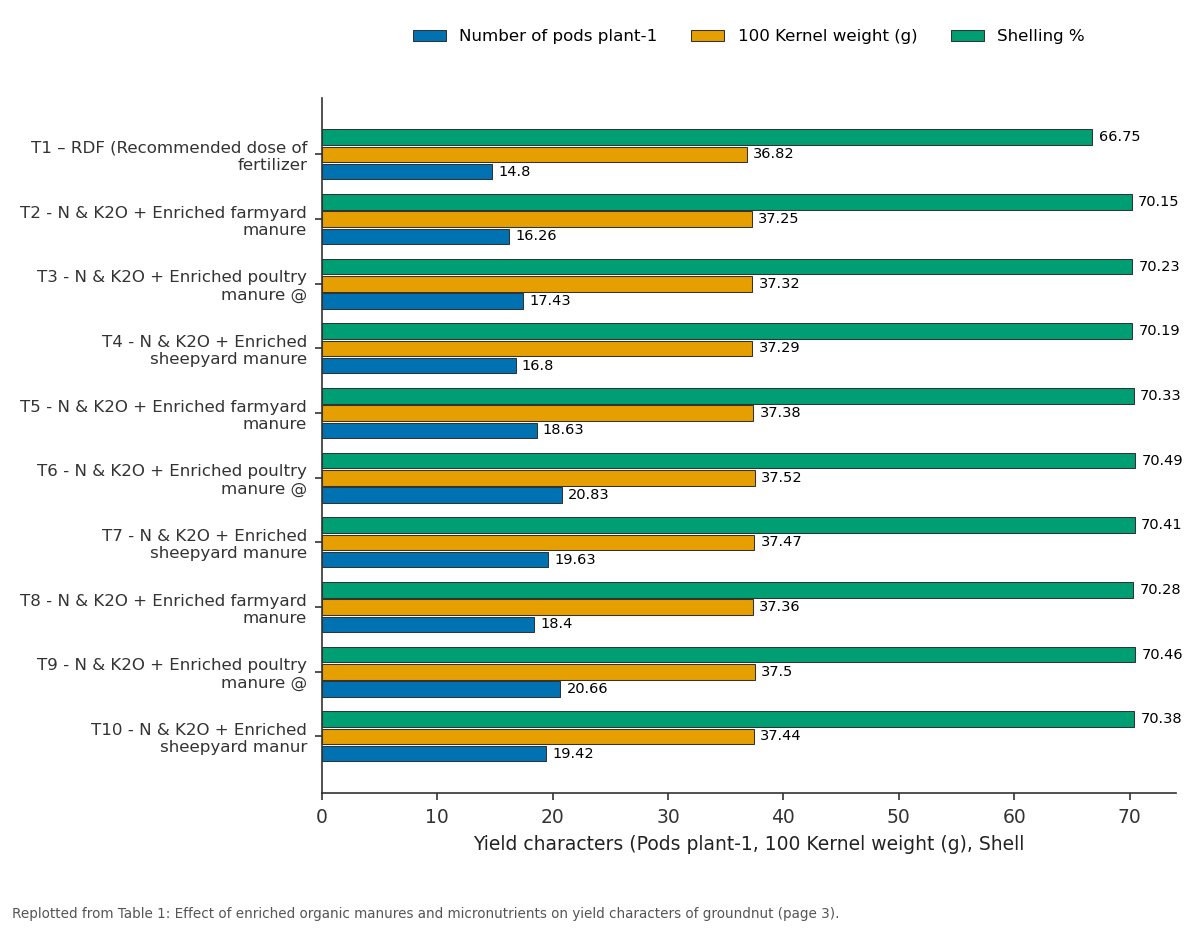
Number of pods plant-1 and 100 Kernel weight (g) and more: T1 – RDF (Recommended... vs T2 - N & K2O + Enriched... vs T3 - N & K2O + Enriched... vs T4 - N & K2O + Enriched... vs T5 - N & K2O + Enriched
Replotted from Table 1 (page 3) of the original paper. Every bar is the paper's own table value.
View source evidence ↗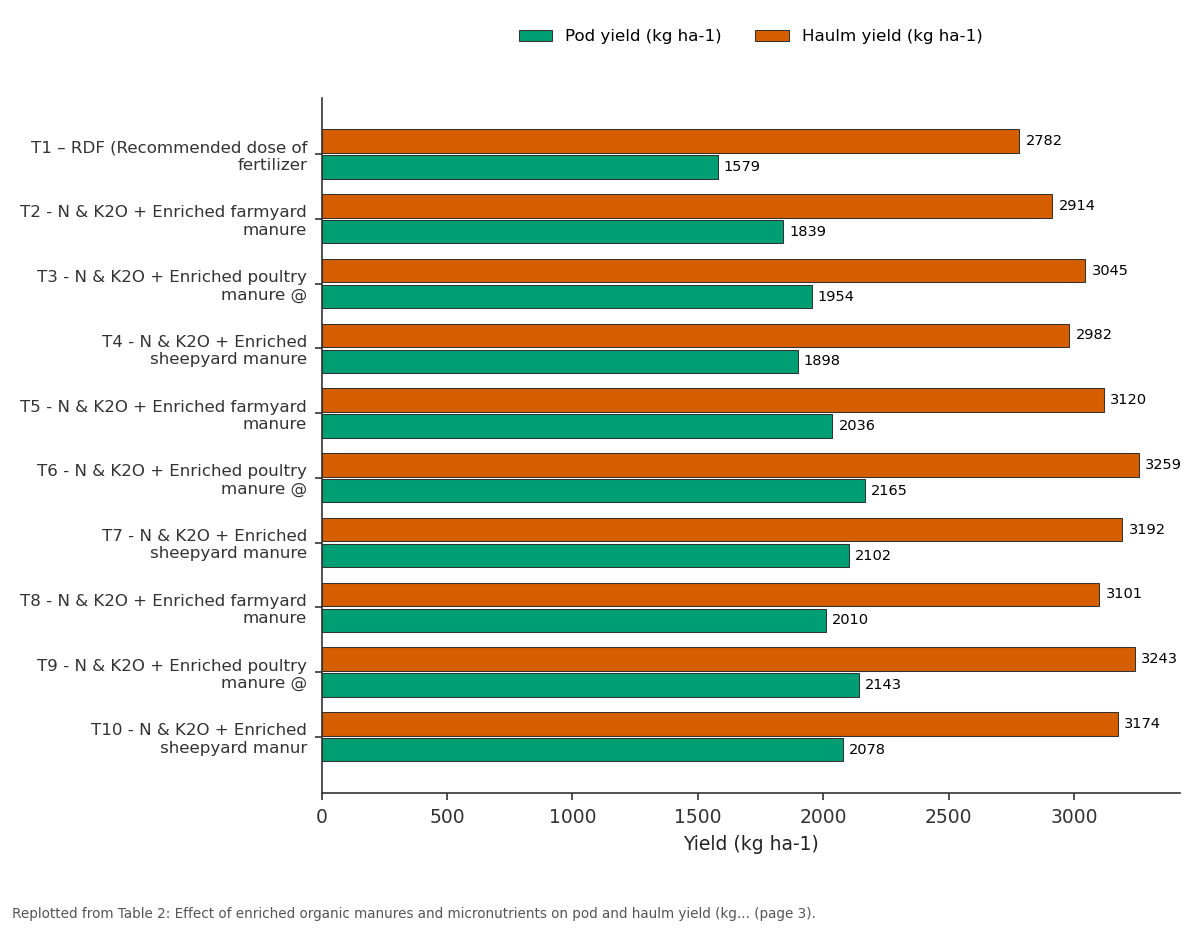
Pod yield (kg ha-1) and Haulm yield (kg ha-1): T1 – RDF (Recommended... vs T2 - N & K2O + Enriched... vs T3 - N & K2O + Enriched... vs T4 - N & K2O + Enriched... vs T5 - N & K2O + Enriched...
Replotted from Table 2 (page 3) of the original paper. Every bar is the paper's own table value.
View source evidence ↗Figures & tables
From the original paper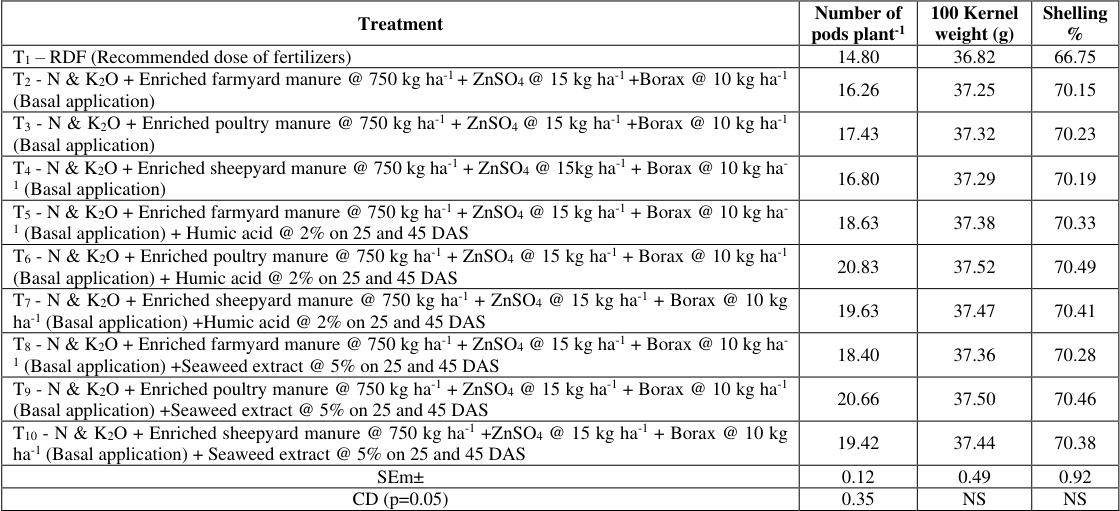 Table 1
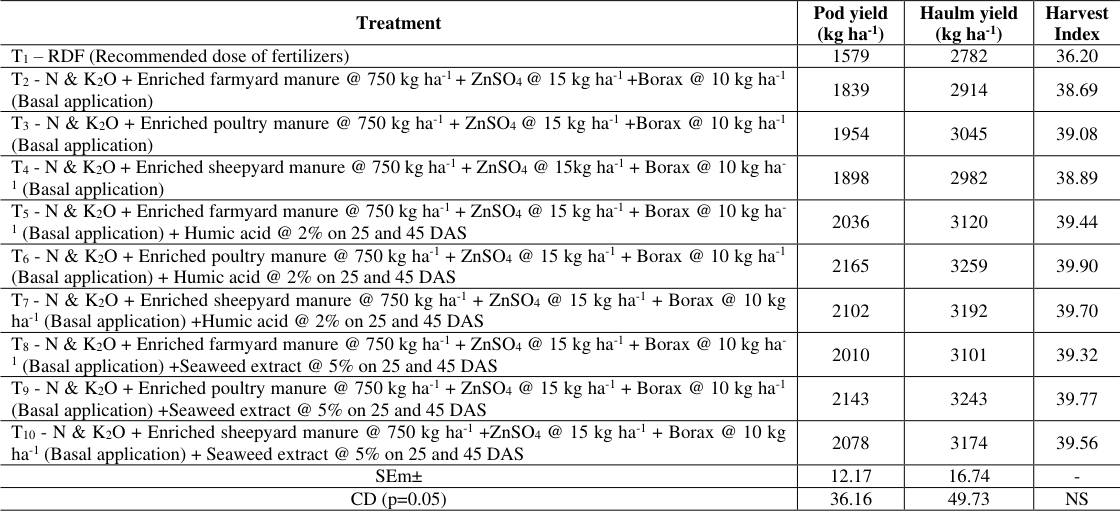 Table 2
Introduction
Groundnut (Arachis hypogaea L.) is one of the most important oilseed crops in tropical and subtropical countries. Groundnut is considered the "King of Oilseed Crops" due to its high oil content (45-50%) and is also known as the poor man's nut or earth nut, monkey nut, goober peas, jack nuts, manila nuts and pig nuts (Solaimalai et al., 2020) [13] . Among India, Gujarat is the leading producer of groundnut with a share of 33% followed by Rajasthan and Tamilnadu. Globally, groundnut is cultivated over an area of 30.69 million hectares, with a production of 51.89 million metric tonnes and a productivity of 1.69 metric tonnes ha -1 annually (USDA, 2022) [15] . In India, groundnut occupies an area of 5.75 million hectares with a production of 10.11 million tonnes and a productivity of 1759 kg ha -1 (MAFW, 2022) [7] , whereas in Tamil Nadu, groundnut is cultivated over an area of 0.37 million hectares with a production of 0.95 million tonnes and a productivity of 2553 kg ha -1 (MAFW, 2022) [7] . Among the various agronomic practices, nutrient management has an important role in maximizing the pod yield of groundnut. Judicial use of fertilizers is crucial in increasing agricultural production and reduce environmental pollution because continuous use of chemical fertilizers has deleterious effects on soil which in turn cause decline in productivity. Use of organics alone does not result in spectacular increase in crop yields, due to their low nutrient status (Chaudhari et al., 2018) [4] . None of the sources of nutrient alone can meet the total plant nutrients. Thus, Integrated use of organic and inorganic fertilizers is the most efficient way to supply plant nutrients for sustained crop productivity and improved soil fertility (Chaudhari and Bhanwaria, 2018) [4] . To evaluate the potentiality of various source of nutrients in increasing the yield of groundnut the following organic and inorganic amendments viz., organic manures (Enriched farmyard manure, Enriched sheepyard manure, Enriched poultry manure), Micronutrients (ZnSO 4 , Boron) and Bio-stimulants (Humic acid, Seaweed extract) were subjected to field trails.
Materials and Methods
A field experiment was conducted at Rallakothur village, Ambur taluk of Thirupathur district, during karthigaipattam (Nov 2022-Mar 2023) to study the effect of integrated nutrient management on yield attributes and yield of groundnut. The experimental field was geographically situated at 12.81 o N latitude, 78.67 o E longitude with an altitude of +290 meters above mean sea level. It is located at North-Eastern agro-climate zone of Tamil Nadu. The soil of the experimental field was sandy loam in texture. The soil was low in available nitrogen, medium in available phosphorus and medium in available potassium with a pH and EC of 7.4 and 0.18/dSm, respectively. The experiment was laid out in Randomized Block Design (RBD) with three replications. The details of the field treatments were T 1 -Control (100% recommended dose of fertilizers), T 2 -N & K 2 O + Enriched farmyard manure @ 750 kg ha -1 + ZnSO 4 @ 15 kg ha -1 + Borax @ 10 kg ha -1 (Basal application), T 3 -N & K 2 O + Enriched poultry manure @ 750 kg ha -1 + ZnSO 4 @ 15 kg ha -1 +Borax @ 10 kg ha -1 (Basal application), T 4 -N & K 2 O + Enriched sheepyard manure @ 750 kg ha -1 + ZnSO 4 @ 15 kg ha -1 + Borax @ 10 kg ha -1 (Basal application), T 5 -N & K 2 O + Enriched farmyard manure @ 750 kg ha -1 + ZnSO 4 @ 15 kg ha -1 + Borax @ 10 kg ha -1 (Basal application) + Humic acid @ 2% on 25 and 45 DAS, T 6 -N & K 2 O + Enriched poultry manure @ 750 kg ha - 1 + ZnSO 4 @ 15 kg ha -1 + Borax @ 10 kg ha -1 (Basal application) + Humic acid @ 2% on 25 and 45 DAS, T 7 -N & K 2 O + Enriched sheepyard manure @ 750 kg ha -1 + ZnSO 4 @ 15 kg ha -1 + Borax @ 10 kg ha -1 (Basal application) +Humic acid @ 2% on 25 and 45 DAS, T 8 -N & K 2 O + Enriched farmyard manure @ 750 kg ha -1 + ZnSO 4 @ 15 kg ha -1 + Borax @ 10 kg ha -1 (Basal application) + Seaweed extract @ 5% on 25 and 45 DAS, T 9 -N & K 2 O + Enriched poultry manure @ 750 kg ha -1 + ZnSO 4 @ 15 kg ha -1 + Borax @ 10 kg ha -1 (Basal application) +Seaweed extract @ 5% on 25 and 45 DAS, T 10 -N & K 2 O + Enriched sheepyard manure @ 750 kg ha -1 +ZnSO 4 @ 15 kg ha -1 + Borax @ 10 kg ha -1 (Basal application) + Seaweed extract @ 5% on 25 and 45 DAS. The experimental field was ploughed twice to ensure fine tilth. Beds and channels were formed by manual labour and individual plots were demarked and levelled. The 100 per cent recommended dose of fertilizer viz., 25 kg nitrogen, 50 kg phosphorus and 75 kg potash per hectare were followed. The entire dose of P 2 O 5 applied through enriching process or as basal (through fertilizer -T 1 ), half dose of K 2 O and 50 percent N were applied as basal and the remaining 50 percent N and K 2 O were applied in two equal splits at 20 DAS and 45 DAS. In addition to this, zinc sulphate @ 15 kg ha -1 and 10 kg Borax was applied as basal. For enhancing the crop growth, 2% Humic acid or 5% Sea weed extract was sprayed at 25 and 45 DAS, based on the treatment schedule. Required quantities of well decomposed organic manures such as phosphate enriched farmyard manure, phosphate enriched sheepyard manure, phosphate enriched poultry manure were incorporated in the soil at the time of last ploughing as basal based on the treatment schedule. The standard crop management practices were followed during the cropping period. Five representative plant samples in each plot were marked randomly for recording biometric observations. At harvest yield characters viz., number of pods plant -1 , shelling percentage, 100 kernel weight) and yield viz., pod yield and haulm yield were recorded. The estimated data were analyzed as per the procedure outlined by Gomez and Gomez (1994) [6] and critical difference was worked out at 5 per cent probability level for significant results. The treatment differences which were not significant were denoted as "NS".
Results and Discussion
Results and Discussion
Number of pods plant -1 and 100 Kernel weight
The maximum number of pods plant -1 (20.83) and 100 kernel weight (37.52) was observed under application of N & K 2 O + Enriched poultry manure @ 750 kg ha -1 + ZnSO 4 @ 15 kg ha -1 + Borax @ 10 kg ha -1 (Basal application) + Humic acid @ 2% on 25 and 45 DAS (T 6 ) which is on par with N & K 2 O + Enriched poultry manure @ 750 kg ha -1 + ZnSO 4 @ 15 kg ha -1 + Borax @ 10 kg ha -1 (Basal application) +Seaweed extract @ 5% on 25 and 45 DAS (T 9 ). Adequate supply of N, P, K, humic acid and poultry manure enhanced availability at critical growth stages, resulting in enhanced yield characters viz., number of pods plant - 1 , weight of pods plant -1 and 100 kernel weight are presented in (Table 1). These results are in agreement with Shankar Lal Choudhary et al. (2017) [11] and (Rajkumar and Paramasivan, 2019) [8] . Uko et al. (2016) [14] stated that application of poultry manure produced a higher number of pods plant -1 , which culminated in higher yields as a result of vigorous foliar growth and increased meristematic and physiological activities in the plant, resulting in higher production of assimilates used in the formation of pods. The increased yield attributes might be due to higher nutrient uptake and increased photosynthetic efficiency, as evident from increased LAI values. This increase in the number of pods plant -1 and kernel weight could be explained by the fact that the application of recommended dose of mineral fertilizers and humic acid foliar spray increased the uptake of nutrients by plants and consequently increased growth rate. The beneficial interaction effects of those fertilizers could be attributed to their ability to enhance the easy release of nutrients into soil solutions and to encourage their penetration through plant roots, as well as their antagonistic impacts on pests and plant diseases (Salwa and Eisa, 2011) [10] .
| Treatment | Number of pods plant-1 | 100 Kernel weight (g) | Shelling % |
|---|---|---|---|
| T1 – RDF (Recommended dose of fertilizers) | 14.80 | 36.82 | 66.75 |
| T2 - N & K2O + Enriched farmyard manure @ 750 kg ha-1 + ZnSO4 @ 15 kg ha-1 +Borax @ 10 kg ha-1 (Basal application) | 16.26 | 37.25 | 70.15 |
| T3 - N & K2O + Enriched poultry manure @ 750 kg ha-1 + ZnSO4 @ 15 kg ha-1 +Borax @ 10 kg ha-1 (Basal application) | 17.43 | 37.32 | 70.23 |
| T4 - N & K2O + Enriched sheepyard manure @ 750 kg ha-1 + ZnSO4 @ 15kg ha-1 + Borax @ 10 kg ha- 1 (Basal application) | 16.80 | 37.29 | 70.19 |
| T5 - N & K2O + Enriched farmyard manure @ 750 kg ha-1 + ZnSO4 @ 15 kg ha-1 + Borax @ 10 kg ha- 1 (Basal application) + Humic acid @ 2% on 25 and 45 DAS | 18.63 | 37.38 | 70.33 |
| T6 - N & K2O + Enriched poultry manure @ 750 kg ha-1 + ZnSO4 @ 15 kg ha-1 + Borax @ 10 kg ha-1 (Basal application) + Humic acid @ 2% on 25 and 45 DAS | 20.83 | 37.52 | 70.49 |
| T7 - N & K2O + Enriched sheepyard manure @ 750 kg ha-1 + ZnSO4 @ 15 kg ha-1 + Borax @ 10 kg ha-1 (Basal application) +Humic acid @ 2% on 25 and 45 DAS | 19.63 | 37.47 | 70.41 |
| T8 - N & K2O + Enriched farmyard manure @ 750 kg ha-1 + ZnSO4 @ 15 kg ha-1 + Borax @ 10 kg ha- 1 (Basal application) +Seaweed extract @ 5% on 25 and 45 DAS | 18.40 | 37.36 | 70.28 |
| T9 - N & K2O + Enriched poultry manure @ 750 kg ha-1 + ZnSO4 @ 15 kg ha-1 + Borax @ 10 kg ha-1 (Basal application) +Seaweed extract @ 5% on 25 and 45 DAS | 20.66 | 37.50 | 70.46 |
| T10 - N & K2O + Enriched sheepyard manure @ 750 kg ha-1 +ZnSO4 @ 15 kg ha-1 + Borax @ 10 kg ha-1 (Basal application) + Seaweed extract @ 5% on 25 and 45 DAS | 19.42 | 37.44 | 70.38 |
| SEm± | 0.12 | 0.49 | 0.92 |
| CD (p=0.05) | 0.35 | NS | NS |
Table text extracted from the original PDF; superscript letters are shown inline. The original table image is below.
View original table image
Shelling percentage
Among the different treatments, application of N & K 2 O + Enriched poultry manure @ 750 kg ha -1 + ZnSO 4 @ 15 kg ha-1 + Borax @ 10 kg ha -1 (Basal application) + Humic acid @ 2% on 25 and 45 DAS (T 6 ) recorded maximum shelling percentage (70.49) are presented in (Table 1). Foliar application of humic acid significantly increased the shelling percentage. It has been speculated that an increase in shelling percentage of groundnut might be due to the fact that humic substances might have various biochemical effects either at the cell wall or membrane level in the cytoplasm, which in turn result in enhanced photosynthesis. These results corroborate the findings of Bakry et al. (2014) [2] and Reddy et al. (2020) [9] . T5 -N & K2O + Enriched farmyard manure @ 750 kg ha -1 + ZnSO4 @ 15 kg ha -1 + Borax @ 10 kg ha - 1 (Basal application) + Humic acid @ 2% on 25 and 45 DAS 18.63 37.38 70.33 T6 -N & K2O + Enriched poultry manure @ 750 kg ha -1 + ZnSO4 @ 15 kg ha -1 + Borax @ 10 kg ha -1 (Basal application) + Humic acid @ 2% on 25 and 45 DAS 20.83 37.52 70.49 T7 -N & K2O + Enriched sheepyard manure @ 750 kg ha -1 + ZnSO4 @ 15 kg ha -1 + Borax @ 10 kg ha -1 (Basal application) +Humic acid @ 2% on 25 and 45 DAS 19.63 37.47 70.41 T8 -N & K2O + Enriched farmyard manure @ 750 kg ha -1 + ZnSO4 @ 15 kg ha -1 + Borax @ 10 kg ha - 1 (Basal application) +Seaweed extract @ 5% on 25 and 45 DAS 18.40 37.36 70.28 T9 -N & K2O + Enriched poultry manure @ 750 kg ha -1 + ZnSO4 @ 15 kg ha -1 + Borax @ 10 kg ha -1 (Basal application) +Seaweed extract @ 5% on 25 and 45 DAS 20.66 37.50 70.46 T10 -N & K2O + Enriched sheepyard manure @ 750 kg ha -1 +ZnSO4 @ 15 kg ha -1 + Borax @ 10 kg ha - .20 T2 -N & K2O + Enriched farmyard manure @ 750 kg ha -1 + ZnSO4 @ 15 kg ha -1 +Borax @ 10 kg ha -1 (Basal application) 1839 2914 38.69 T3 -N & K2O + Enriched poultry manure @ 750 kg ha -1 + ZnSO4 @ 15 kg ha -1 +Borax @ 10 kg ha -1 (Basal application) 1954 3045 39.08 T4 -N & K2O + Enriched sheepyard manure @ 750 kg ha -1 + ZnSO4 @ 15kg ha -1 + Borax @ 10 kg ha - 1 (Basal application) 1898 2982 38.89 T5 -N & K2O + Enriched farmyard manure @ 750 kg ha -1 + ZnSO4 @ 15 kg ha -1 + Borax @ 10 kg ha - 1 (Basal application) + Humic acid @ 2% on 25 and 45 DAS 2036 3120 39.44 T6 -N & K2O + Enriched poultry manure @ 750 kg ha -1 + ZnSO4 @ 15 kg ha -1 + Borax @ 10 kg ha -1 (Basal application) + Humic acid @ 2% on 25 and 45 DAS 2165 3259 39.90 T7 -N & K2O + Enriched sheepyard manure @ 750 kg ha -1 + ZnSO4 @ 15 kg ha -1 + Borax @ 10 kg ha -1 (Basal application) +Humic acid @ 2% on 25 and 45 DAS 2102 3192 39.70 T8 -N & K2O + Enriched farmyard manure @ 750 kg ha -1 + ZnSO4 @ 15 kg ha -1 + Borax @ 10 kg ha - 1 (Basal application) +Seaweed extract @ 5% on 25 and 45 DAS 2010 3101 39.32 T9 -N & K2O + Enriched poultry manure @ 750 kg ha -1 + ZnSO4 @ 15 kg ha -1 + Borax @ 10 kg ha -1 (Basal application) +Seaweed extract @ 5% on 25 and 45 DAS 2143 3243 39.77 T10 -N & K2O + Enriched sheepyard manure @ 750 kg ha -1 +ZnSO4 @ 15 kg ha -1 + Borax @ 10 kg ha -
Pod and Haulm yield
Among the different treatments, application of N & K 2 O + Enriched poultry manure @ 750 kg ha -1 + ZnSO 4 @ 15 kg ha -1 + Borax @ 10 kg ha -1 (Basal application) + Humic acid @ 2% on 25 and 45 DAS (T 6 ) significantly recorded the highest pod yield of (2165 kg ha -1 ) and haulm yield (3259 kg ha -1 ) are presented in (Table 2) which is on par with N & K 2 O + Enriched poultry manure @ 750 kg ha -1 + ZnSO 4 @ 15 kg ha -1 + Borax @ 10 kg ha -1 (Basal application) +Seaweed extract @ 5% on 25 and 45 DAS (T 9 ). The increase in pod and haulm yield might due to increased growth and yield attributes. This might be due to an adequate and steady supply of all nutrients to plants at all stages of crop growth. This corroborates the earlier reports of Snehal et al. (2014) [12] , Basu et al. (2008) [3] and Rajkumar and Paramasivan (2019) [8] . Higher economical and biological yields in poultry manure might be due to the fact that ammonium-N (NH 4 -N) is a significant part of total N in poultry manure, which additionally contains uric acid. Uric acid metabolizes rapidly to NH 4 -N in most soils, and the net result of the high NH 4 -N and uric acid contents in poultry waste is that a large percentage of N can be converted to nitrate-N (NO 3 -N) within a few weeks. Poultry manure improves the number of pods plant -1 , pod yield and haulm yield in groundnut (Veeramani et al. 2012) [16] . The increase in pod, haulm, and kernel production was attributable to the fact that humic acid increased the permeability of the cell membrane, allowing more potassium to enter the cell, thereby increasing the pressure within the cell and facilitating cell division. Increased energy within the cells, on the other hand, leads to increased chlorophyll production and higher photosynthesis rates. The growth process then quickened, nitrogen absorption into the cells increased, nitrate generation might have decreased, and production was eventually enhanced.
| Treatment | Pod yield (kg ha-1) | Haulm yield (kg ha-1) | Harvest Index |
|---|---|---|---|
| T1 – RDF (Recommended dose of fertilizers) | 1579 | 2782 | 36.20 |
| T2 - N & K2O + Enriched farmyard manure @ 750 kg ha-1 + ZnSO4 @ 15 kg ha-1 +Borax @ 10 kg ha-1 (Basal application) | 1839 | 2914 | 38.69 |
| T3 - N & K2O + Enriched poultry manure @ 750 kg ha-1 + ZnSO4 @ 15 kg ha-1 +Borax @ 10 kg ha-1 (Basal application) | 1954 | 3045 | 39.08 |
| T4 - N & K2O + Enriched sheepyard manure @ 750 kg ha-1 + ZnSO4 @ 15kg ha-1 + Borax @ 10 kg ha- 1 (Basal application) | 1898 | 2982 | 38.89 |
| T5 - N & K2O + Enriched farmyard manure @ 750 kg ha-1 + ZnSO4 @ 15 kg ha-1 + Borax @ 10 kg ha- 1 (Basal application) + Humic acid @ 2% on 25 and 45 DAS | 2036 | 3120 | 39.44 |
| T6 - N & K2O + Enriched poultry manure @ 750 kg ha-1 + ZnSO4 @ 15 kg ha-1 + Borax @ 10 kg ha-1 (Basal application) + Humic acid @ 2% on 25 and 45 DAS | 2165 | 3259 | 39.90 |
| T7 - N & K2O + Enriched sheepyard manure @ 750 kg ha-1 + ZnSO4 @ 15 kg ha-1 + Borax @ 10 kg ha-1 (Basal application) +Humic acid @ 2% on 25 and 45 DAS | 2102 | 3192 | 39.70 |
| T8 - N & K2O + Enriched farmyard manure @ 750 kg ha-1 + ZnSO4 @ 15 kg ha-1 + Borax @ 10 kg ha- 1 (Basal application) +Seaweed extract @ 5% on 25 and 45 DAS | 2010 | 3101 | 39.32 |
| T9 - N & K2O + Enriched poultry manure @ 750 kg ha-1 + ZnSO4 @ 15 kg ha-1 + Borax @ 10 kg ha-1 (Basal application) +Seaweed extract @ 5% on 25 and 45 DAS | 2143 | 3243 | 39.77 |
| T10 - N & K2O + Enriched sheepyard manure @ 750 kg ha-1 +ZnSO4 @ 15 kg ha-1 + Borax @ 10 kg ha-1 (Basal application) + Seaweed extract @ 5% on 25 and 45 DAS | 2078 | 3174 | 39.56 |
| SEm± | 12.17 | 16.74 | - |
| CD (p=0.05) | 36.16 | 49.73 | NS |
Table text extracted from the original PDF; superscript letters are shown inline. The original table image is below.
View original table image
These results are in agreement with the findings of Reddy et al. (2020) [9] . Increasing the application of zinc fertilizer increased the yield and yield attributes, which might be due to the significant improvement in growth parameters leading to improved nodulation through activation of various enzymes and the basic metabolic rate in plants, which in turn enhanced the pod yield due to greater availability of nutrients and photosynthates. Similar finding was reported by Aboyeji et al. (2019) [1] .
Conclusion
Based on the results of the experiment it can be concluded that application of N & K 2 O + Enriched poultry manure @ 750 kg ha -1 + ZnSO 4 @ 15 kg ha -1 + Borax @ 10 kg ha -1 (Basal application) + Humic acid @ 2% on 25 and 45 DAS increased growth and yield attributes, which greatly led to higher productivity and nutrient uptake of groundnut besides improving soil available nutrients after harvest. Due to the affordable cost of inputs, the treatment also recorded the highest net returns and B:C ratio. Furthermore, it has been discovered to be a successful integrated nutrient management practice for boosting yield of groundnut growers.
References
14 in the original paper- Aboyeji C, Dunsin O, Adekiya AO, Chinedum C, Suleiman KO, Okunlola FO, et al. Zinc sulphate and boron-based foliar fertilizer effect on growth, yield, minerals, and heavy metal composition of groundnut (Arachis hypogaea L.) grown on an alfisol. Int. J Agron. 2019, 1-7.
- Bakry AB, Taha MH, Abdelgawad ZA, Abdallah MMS. The role of humic acid on growth, chemical constituents and yield quantity of three flax cultivars grown under saline soil conditions. Agric. Sci. 2014;5:1566-1575.
- Basu M, Bhadoria PBS, Mahapatra SC. Growth, nitrogen fixation, yield and kernel quality of peanut in response to lime, organic and inorganic fertilizer levels. Bioresour. Technol. 2008;99(11):4675-4683.
- Chaudhari PK, Chaudhari PP, Desai NH. Yield and quality of kharif groundnut (Arachis hypogaea L.) as influenced by organic and inorganic sources of nutrients. Int. J Agric. Sci. 2018;10(6):5424-5426.
- Chaudhari R, Bhanwaria R. Influence of organic manures and iron on growth and yield of groundnut (Arachis hypogaea L.). Trends in Biosci. 2018;11(9):1945-1949.
- Gomez KA, Gomez AA. Statistical produce for Agricultural research, 11 th edition John Wiley and Sons., New York, 1994, p. 68.
- MAFW. Agricultural Statistics at a Glance. Ministry of Agriculture and Farmers Welfare, Department of Agriculture, Cooperation and Farmers welfare, Directorate of Economics and Statistics, Government of India, 2022. https://agriwelfare.gov.in/ Documents/CWWGDATA/Agricultural_Statistics_at_a_Gl ance_2022_0.pdf.
- Rajkumar A, Paramasivan M. An effect of organic and inorganic nutrients on growth, yield of groundnut (Arachis hypogaea L.) and soil fertility in an alfisol of tamiraparani tract. Int. J Agric. Sci. Res. 2019;9(4):131-136.
- Reddy KS, Bhuvaneswari R, Karthikeyan PK. effect of foliar application of dap, humic acid and micronutrients on growth characters of groundnut (Arachis hypogaea L.) var. tmv 7 in sandy loam soil. Plant Arch. 2020;20(1):514-520.
- Salwa A, Eisa AI. Effect of amendments, humic and amino acids on increases soils fertility, yields and seeds quality of peanut and sesame on sandy soils. Res. J Agric. Biol. Sci. 2011;7(1):115-125.
- Shankar Lal Choudhary, Sharma OP, Gora MK, Choudhary RR. Effect of organic manures and molybdenum on growth, yield and quality of groundnut. Int. J Curr. Microbiol. Appl. Sci. 2017;6(1):736-742.
- Snehal Patil R, Swati Kadam R, Kalegore NK, Dadgale PR. Effect of inorganic and biofertilizers on growth and yield of summer groundnut. Adv. Res. J Crop Improv. 2014;5(1):2325.
- Solaimalai A, Jayakumar M, Baskar K, Senthilkumar M. Sulfur fertilization in groundnut crop in India: A review. J. Oilseeds Res. 2020;37(1):1-10.
- Veeramani P, Subrahmaniyan K, Ganesaraja V. Organic manure management on groundnut; A review. Wudpecker J Agric. Res. 2012;1(7):238-243.
Cited by 1
From OpenAlex, OpenCitations and reference lists read by Scinovex
- Enhancing productivity and profitability of chickpea (Cicer arietinum L.) as influenced by enriched organic manures and liquid foliar management practices
K Sathish Babu, G.K.N. Reddy, B. Sahadeva Reddy, TNVKV Prasad, M. Raveendra Reddy, P Lavanya Kumari · International Journal of Research in Agronomy · 2025
During two successive rabi seasons of 2022-23 and 2023-24 at Regional Agricultural Research Station, Nandyal, Acharya N.G. Ranga Agricultural University, Andhra Pradesh, conducted a field experiment titled “Enhancing productivity and profitability of chickpea (Cicer arietinum L.) as influenced by enriched organic manures and liquid foliar feeder’s management practices”. The soil of the experimental field was clayey loam in texture, alkaline in soil reaction, low in organic carbon and available nitrogen, medium in phosphorus and high potassium. Sixteen treatments, consisting of four organic man