
Research article · 2024 · Full text
International Journal of Research in AgronomyComparative efficacy of organic manures on growth of finger millet Var. VL Mandua 379
Volume 7(6) · Pages 216–219 · DOI: 10.33545/2618060x.2024.v7.i6c.843 ↗
Research areasLeaf Properties and Growth MeasurementPlant Growth and Agriculture Techniques
Abstract
Author-writtenA field experiment was conducted at Himalayan University farm, Itanagar, Arunachal Pradesh, during the kharif season of 2023 with 8 treatments replicated thrice in randomized block design, to determine the effect of organic manures on growth of finger millet (Eleusine coracana L.). The experiment included the following treatments T1- Control , T2- Castor oilcake at 2.5 kg/ha+ Poultry manure at 2.5 kg/ha, T3- Bone meal at 2.5 kg/ha + Poultry manure at 2.5 kg/ha, T4- Mustard oilcake at 2.5 kg/ha + Goat manure at 2.5 kg/ha, T5- Bone meal at 2.5 kg/ha + Neem oilcake at 2.5 kg/ha + Fym at 2.5 kg/ha, T6- Neem oilcake at 2.5 kg/ha + Goat manure at 2.5 kg/ha, T7- Mustard oilcake at 2.5 kg/ha + Poultry manure 2.5 kg/ha, and T8- Bone meal at 2.5 kg/ha + Goat manure at 2.5 kg/ha. The highest plant height recorded was 31.33 cm at 30 DAT, 77.26 cm at 60 DAT, 99.23 cm at 90 DAT, and 100.83 cm at harvest. The highest number of leaves per plant recorded was 25.15 at 30 DAT, 33.54 at 60 DAT, 37.83 at 90 DAT, and 31.66 at harvest. The highest number of tillers per plant recorded was 2.36 at 30 DAT, 2.86 at 60 DAT, 3.93 at 90 DAT, and 4.16 at harvest. In addition, plant dry weight recordings of 8.11 g plant-1 at 30 DAT, 20.21 g plant-1 at 27.89 g plant-1 at 60 DAT, 40.74 g plant-1 at 90 DAT, and 50.04 g plant-1 at harvest were observed with treatment T5 – Bone meal at 2.5 kg/ha + Neem oilcake 2.5 kg/ha + Fym at 2.5 kg/ha . Overall performance under treatment T5 was better than rest of the treatments.
Summary
Source-checkedPlain-language reading of the full paper, prepared with AI and checked against the text. Each point links to the authors' own words.
Why it matters
- Finger millet is recognized as one of the oldest domesticated food crops and the first cereal grain used for domestic purposes. View evidence ↗
- Organic farming is becoming more important because it provides benefits for soil health, fertility, and long-term productivity. View evidence ↗
- There is a lack of research regarding the use of liquid organic manures, either alone or combined with solid organic manures, for finger millet cultivation. View evidence ↗
The question
- The study aimed to determine how different organic manure treatments affect the growth of finger millet. View evidence ↗
What they did
- The research was a field experiment conducted during the 2023 kharif season at Himalayan University farm in Arunachal Pradesh, using a randomized block design with eight treatments replicated three times. View evidence ↗
- The eight treatments ranged from a control (T1) to various combinations of oilcakes (castor, mustard, neem), manures (poultry, goat, FYM), and bone meal, typically applied at 2.5 kg/ha per component. View evidence ↗
- Growth was measured at 30, 60, 90 days after transplanting (DAT) and at harvest, tracking plant height, leaf number, tiller number, and dry weight (dried at 60 °C). View evidence ↗
What they found
- Treatment T5 (Bone meal + Neem oilcake + FYM) produced the maximum plant height, reaching 31.33 cm at 30 DAT and 100.83 cm at harvest. View evidence ↗
- The maximum number of leaves per plant was observed in T5, peaking at 37.83 leaves at 90 DAT. View evidence ↗
- T5 resulted in the highest number of tillers per plant, increasing from 2.36 at 30 DAT to 4.16 at harvest. View evidence ↗
- The highest dry weight was achieved by T5, recording 8.11 g at 30 DAT and 50.05 g at harvest. View evidence ↗
- The control group (T1) exhibited the lowest values across all measured growth parameters due to the absence of fertilizer. View evidence ↗
What it means
- The authors conclude that the combination of Bone meal, Neem oilcake, and FYM (T5) is the most effective treatment for maximizing the growth parameters of finger millet. View evidence ↗
- The authors further state that T5 also provided the best Crop Growth Rate (CGR) and Relative Growth Rate (RGR). View evidence ↗
Visual summary
1 visualsIllustrations explain the paper; they do not show study data.
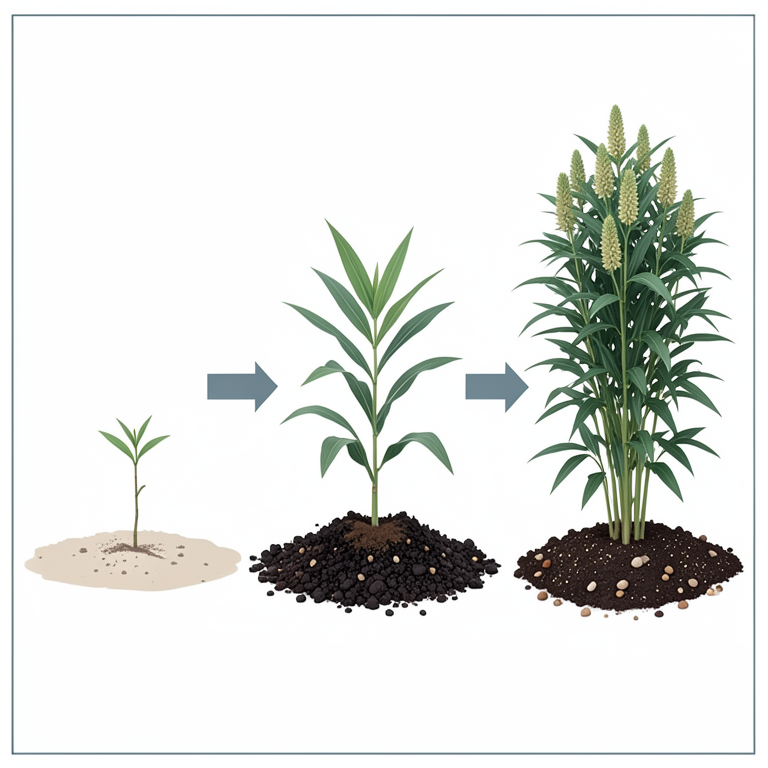
Treatment Comparison Concept
AI-generated conceptual illustration (finger millet plants (Var. VL Mandua 379)). It explains the idea and does not show study data.
View source evidence ↗Figures & tables
From the original paper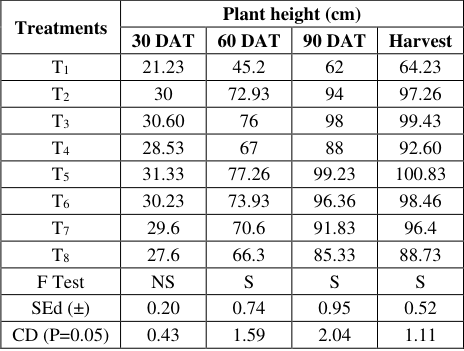 Table 2
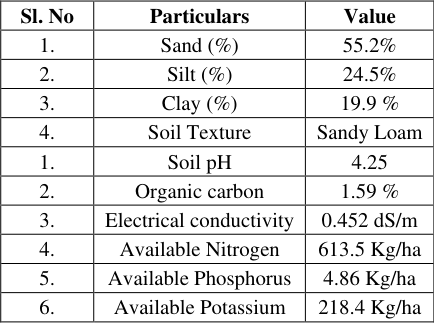 Table 1
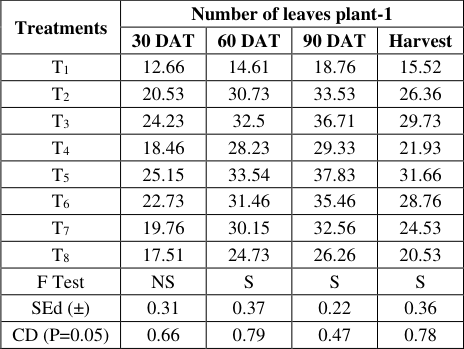 Table 3
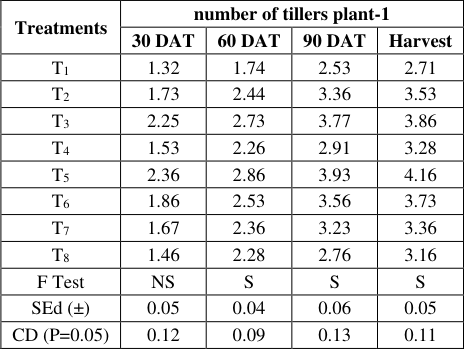 Table 4
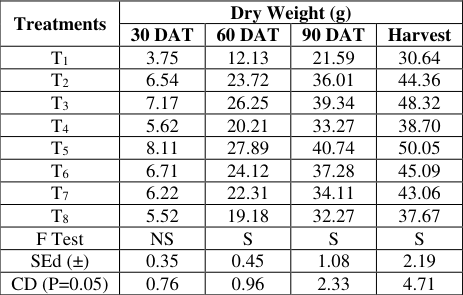 Table 5
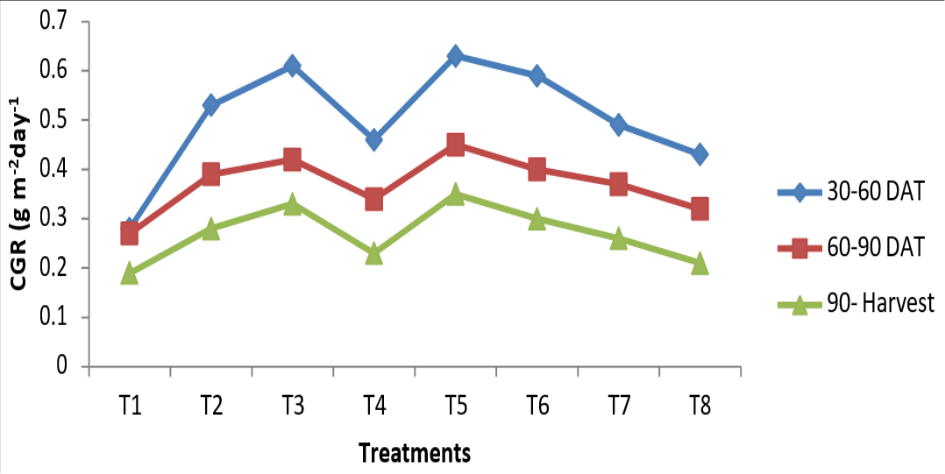 Figure 1
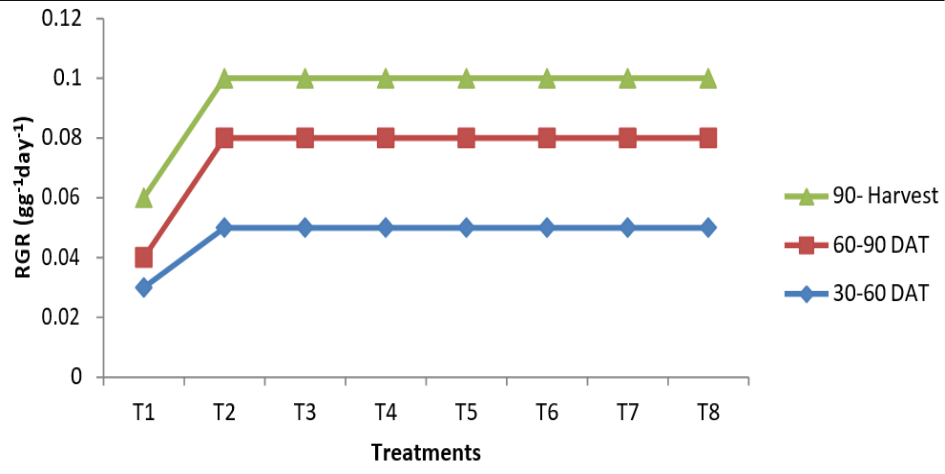 Figure 2
Introduction
Finger millet (Eleusine coracana) is the oldest food and first cereal grain used for domestic purpose. Cultivated Finger millet was domesticated about 5000 years ago from the wild was then also farmed in the lowlands of Africa. It is one of the oldest crops India is referred as "nrtta-kondaka" in the ancient Indian Sanskrit literature, which means "Dancing grain", was also addressed as "rajika" or "markatak". Earliest report of finger millet comes from Hallur in Karnataka of India dating approximately 2300 BC (Singh, 1991) [9] . Organic farming practices are gaining importance as farmers realized benefits in terms of soil fertility, soil health and sustainable productivity. Most of the research on organic production of finger millet was applied with utilization of FYM, green manures, compost, neem cake, etc. Less number of researches was done on the effect of liquid organic manures like panchagavya, jeevamrutham, and beejamrutham alone or together with solid organic manures in finger millet organic liquid formulations like jeevamrutham and panchagavya helps for quick build-up of soil fertility through enhanced activity of micro flora and fauna.
Materials and Methods
The experiment was conducted during the Kharif season of 2023 at Himalayan University in Itanagar. The Crop Research Farm is located in Jollang on the university campus, situated at 27.14°N latitude and 93.62°E longitude, and an altitude of 320 meters above sea level. The site belongs to the Eastern Himalayan region, and the agro-climatic zone falls under the sub-tropical zone of Arunachal Pradesh. The growth parameters were calculated by following methods. Plant height (cm) from the ground level till the apex of the top leaf was noted at 30, 60, 90 DAT and at harvest, are expressed in cm.
Then number of leaves plant-1 was recorded from the five selected tagged plants at 30, 60, 90 DAT and at harvest. The average number of leaves plant-1 was worked out. The total number of tillers plant-1 was counted from five hills at different growth stages and the average was worked out. After completion for dry weight (g) the sample was collected from five randomly selected hills from the destructive sampling area was used to record the dry matter production. The plant was uprooted and its roots were removed. The aerial parts were chopped and put in a brown paper bag. Then it was dried in the thermostatically controlled oven at 60 °C till the sample was dried and constant weight was recorded
Results and Discussions
At 30, 60, 90 DAT and at harvest in plant height was found to be statistically significant in treatment T 5 (Bone meal at 2.5 kg/ha+ Neem oilcake at 2.5 kg/ha+ Fym at 2.5 kg/ha) was found to be statistically at par with T 3 (Bone meal at 2.5 kg/ha+ Poultry manure at 2.5 kg/ha). The probable reason for recording higher plant height in T 5 (Bone meal at 2.5 kg/ha+ Neem oilcake at 2.5 kg/ha+ Fym at 2.5 kg/ha) is due to the application of Bone meal is rich source of phosphorus and calcium which improves the plant growth, whereas neem oilcake and fym are rich in plant nutrients, which results in higher plant height Srinivasan et al.
(2020). There are scientific evident that limonoid content of neem oilcake and the double action of neem oilcake as natural fertilizer and pesticidal effect on insect and pest which result in the significantly higher tiller number in the treatment which receives (Bone meal at 2.5 kg/ha+ Neem oilcake at 2.5 kg/ha+ Fym at 2.5 kg/ha) i.e. T 5 . Significantly higher plant leaves under the treatment T 5 (Bone meal at 2.5 kg/ha+ Neem oilcake at 2.5 kg/ha+ Fym at 2.5 kg/ha) is due to the integration of Bone meal, neem oilcake and fym. Higher dry matter accumulation under treatment T 5 (Bone Meal at 2.5 kg/ha + Neem Oilcake at 2.5 kg/ ha + FYM at 2.5 kg/ha) is due to the application of Neem cake as neem cake reduced the loss of nutrients from the soil, whereas bone meal and fym are rich in plants nutrients that enhance the fertility of the soil. It result plant to grow profusely, rapid initiation of leaves and their expansion ultimately resulted in high rate of photosynthesis besides higher dry matter accumulation of the individual plants. A sigmoidal but marginal decrease in RGR was found during the successive growth intervals it may be due to application of various organic manures, as they are rich in plant nutrient which improves the fertility and enhance physiological, metabolic processes and overall growth and development of the plant. Higher rate of CGR in T 5 (Bone meal at 2.5 kg/ha+ Neem oilcake at 2.5 kg/ha+ Fym at 2.5 kg/ha) due to the application of neem oilcake as neem cake reduce nutrients loss from soil and increase soil fertility, whereas bone meal and fym are rich in plant nutrient that enhance the overall growth and developments of the plants Basavaraj (2017) [2] . The treatment under T 1 (Control) were found least values in every growth parameters, it may be due to no application of any fertilizer.
Conclusion
Considering the salient findings in perspective, the study revealed that the treatments with the combinations of Bone meal at 2.5 kg/ha + Neem oilcake at 2.5 kg/ha + Fym at 2.5 kg/ha (T 5 ) was found to be best combination for maximizing growth parameters (plant height, number of leaves, number of tillers, dry weight) of the finger millet. It is observed that the rate of CGR and RGR were also best in the treatment with the combination of Bone meal at 2.5 kg/ha + Neem oilcake at 2.5 kg/ha + Fym at 2.5 kg/ha (T 5 ).
Figures and tables from the paper
| Treatments | Plant height (cm) | — | — | — |
|---|---|---|---|---|
| 30 DAT | 60 DAT | 90 DAT | Harvest | |
| T1 | 21.23 | 45.2 | 62 | 64.23 |
| T2 | 30 | 72.93 | 94 | 97.26 |
| T3 | 30.60 | 76 | 98 | 99.43 |
| T4 | 28.53 | 67 | 88 | 92.60 |
| T5 | 31.33 | 77.26 | 99.23 | 100.83 |
| T6 | 30.23 | 73.93 | 96.36 | 98.46 |
| T7 | 29.6 | 70.6 | 91.83 | 96.4 |
| T8 | 27.6 | 66.3 | 85.33 | 88.73 |
| F Test | NS | S | S | S |
| SEd (±) | 0.20 | 0.74 | 0.95 | 0.52 |
| CD (P=0.05) | 0.43 | 1.59 | 2.04 | 1.11 |
Table text extracted from the original PDF; superscript letters are shown inline. The original table image is below.
View original table image
| Sl. No | Particulars | Value |
|---|---|---|
| 1. | Sand (%) | 55.2% |
| 2. | Silt (%) | 24.5% |
| 3. | Clay (%) | 19.9 % |
| 4. | Soil Texture | Sandy Loam |
| 1. | Soil pH | 4.25 |
| 2. | Organic carbon | 1.59 % |
| 3. | Electrical conductivity | 0.452 dS/m |
| 4. | Available Nitrogen | 613.5 Kg/ha |
| 5. | Available Phosphorus | 4.86 Kg/ha |
| 6. | Available Potassium | 218.4 Kg/ha |
Table text extracted from the original PDF; superscript letters are shown inline. The original table image is below.
View original table image
| Treatments | Number of leaves plant-1 | — | — | — |
|---|---|---|---|---|
| 30 DAT | 60 DAT | 90 DAT | Harvest | |
| T1 | 12.66 | 14.61 | 18.76 | 15.52 |
| T2 | 20.53 | 30.73 | 33.53 | 26.36 |
| T3 | 24.23 | 32.5 | 36.71 | 29.73 |
| T4 | 18.46 | 28.23 | 29.33 | 21.93 |
| T5 | 25.15 | 33.54 | 37.83 | 31.66 |
| T6 | 22.73 | 31.46 | 35.46 | 28.76 |
| T7 | 19.76 | 30.15 | 32.56 | 24.53 |
| T8 | 17.51 | 24.73 | 26.26 | 20.53 |
| F Test | NS | S | S | S |
| SEd (±) | 0.31 | 0.37 | 0.22 | 0.36 |
| CD (P=0.05) | 0.66 | 0.79 | 0.47 | 0.78 |
Table text extracted from the original PDF; superscript letters are shown inline. The original table image is below.
View original table image
| Treatments | number of tillers plant-1 | — | — | — |
|---|---|---|---|---|
| 30 DAT | 60 DAT | 90 DAT | Harvest | |
| T1 | 1.32 | 1.74 | 2.53 | 2.71 |
| T2 | 1.73 | 2.44 | 3.36 | 3.53 |
| T3 | 2.25 | 2.73 | 3.77 | 3.86 |
| T4 | 1.53 | 2.26 | 2.91 | 3.28 |
| T5 | 2.36 | 2.86 | 3.93 | 4.16 |
| T6 | 1.86 | 2.53 | 3.56 | 3.73 |
| T7 | 1.67 | 2.36 | 3.23 | 3.36 |
| T8 | 1.46 | 2.28 | 2.76 | 3.16 |
| F Test | NS | S | S | S |
| SEd (±) | 0.05 | 0.04 | 0.06 | 0.05 |
| CD (P=0.05) | 0.12 | 0.09 | 0.13 | 0.11 |
Table text extracted from the original PDF; superscript letters are shown inline. The original table image is below.
View original table image
| Treatments | Dry Weight (g) | — | — | — |
|---|---|---|---|---|
| 30 DAT | 60 DAT | 90 DAT | Harvest | |
| T1 | 3.75 | 12.13 | 21.59 | 30.64 |
| T2 | 6.54 | 23.72 | 36.01 | 44.36 |
| T3 | 7.17 | 26.25 | 39.34 | 48.32 |
| T4 | 5.62 | 20.21 | 33.27 | 38.70 |
| T5 | 8.11 | 27.89 | 40.74 | 50.05 |
| T6 | 6.71 | 24.12 | 37.28 | 45.09 |
| T7 | 6.22 | 22.31 | 34.11 | 43.06 |
| T8 | 5.52 | 19.18 | 32.27 | 37.67 |
| F Test | NS | S | S | S |
| SEd (±) | 0.35 | 0.45 | 1.08 | 2.19 |
| CD (P=0.05) | 0.76 | 0.96 | 2.33 | 4.71 |
Table text extracted from the original PDF; superscript letters are shown inline. The original table image is below.
View original table image
References
12 in the original paper- Apoorva KB, Prakash SS, Rajesh NL, Nandini B. STCR approach for optimizing integrated plant nutrient supply on growth, yield and economics of finger millet. European Journal of Biomedical and Pharmaceutical Sciences. 2010;4:19-27.
- Basavaraj NT, Kumar NH, Suresh KP. Nutrient management practices for organic cultivation of finger millet (Eleusine coracana L.) under southern transitional zone of Karnataka, India. International Journal of Current Microbiology and Applied Sciences. 2017;6(11):3371-3376.
- Basavaraju TB, Purushotham S. Integrated nutrient management in rainfed ragi (Eleusine coracana L. Gaertn.). Mysore Journal of Agricultural Sciences. 2009;43(2):366368.
- Gawade MB, Mahadkar UV. Effects of organic manures, sources and levels of fertilizers on yield attributes and yield of finger millet (Eleusine coracana). International Journal of Agricultural Sciences. 2013;9(2):795-798.
- Narayan H, Ramachandrappa BK, Thimmegouda MN. Yield and economics of finger millet with establishment methods under different Planting geometry and nutrient Source. Indian Journal of Dryland Research and Development. 2018;33(1):54-58.
- Poornesh AS, Reddy VC, Murthy KN. Effect of urban garbage compost and sewage sludge on yield of ragi and soil properties. Environment and Ecology. 2004;22(3):720723.
- Pore MS, Magar NG. Nutrient composition of hybrid varieties of finger millet. Indian Journal of Agricultural Sciences. 1979;4(7):526-531.
- Prakasha G, Kalyana KN, Rohani NM, Prathima AS. Effect of spacing and nutrient levels on growth and attributes and yield of finger millet (Eleusine coracana (L.) Gaertn) under guni method of planting in red sandy loamy soil of Karnataka, India. International Journal of Current Microbiology and Applied Sciences. 2018;7(5):1337-1343.
- Singh RV, Arya MPS. Effect of enriched farmyard manure and fertility levels on yield of finger millet under rainfed condition. Annals of Agriculture Research. 1991;12(3):292294.
- Tsado K, Daniya E. Performance of finger millet as influenced by nutrient sources in the southern Savanna and Northern Guinea. Direct Research Journals. 2016;4(70):182-192.
- Venkateswaran V, Vijayalakshmi G. Finger millet economically viable source for antihypercholesterolemic metabolites production by Monascus purpureus. Journal of Food Science and Technology. 2010;47(40):426-431.
- Virupaksha TK, Ramachandra G, Nagarju D. Seed proteins of finger millet and their amino acid composition. Journal of the Science of Food and Agriculture. 1975;26:1237-1246.