
Research article · 2024 · Full text
International Journal of Research in AgronomyUnderstanding the relationship and determinants of farmers knowledge on ICT in agriculture
Volume 7(6) · Pages 337–340 · DOI: 10.33545/2618060x.2024.v7.i6e.856 ↗
Research areasAgricultural Innovations and PracticesICT in Developing CommunitiesAgricultural Development and Management
Abstract
Author-writtenInformation Communication Technology (ICT) encompasses a wide range of services and technologies crucial for economic development, particularly in agriculture and rural areas. Mobile phones are widely utilized by farmers for communication and accessing agricultural information, including market prices and advisory services. Despite its benefits, barriers to adoption persist, such as lack of training and infrastructure. Nonetheless, ICT plays a significant role in advancing human civilization, utilizing various technologies like computer programs and communication networks. Against this backdrop, a study was conducted in Karnataka to explore the relationship and determinants of farmers' knowledge on ICT in agriculture. The result revealed that, Educational status, Information seeking behavior, Extension agency contact, Mass media exposure, Innovativeness, Possession of modern electronic gadgets, and Internet usage displayed positive and significant associations with knowledge at a one percent level. R2 value was 0.486 which indicated that 48.60 percent variation in the knowledge was explained by the given fourteen independent variables and remaining 51.40 percent of the variation in dependent variables unexplained.
Summary
Source-checkedPlain-language reading of the full paper, prepared with AI and checked against the text. Each point links to the authors' own words.
Why it matters
- Information Communication Technology (ICT) is considered essential for the economic development of rural areas and the agricultural sector. View evidence ↗
- Mobile phones are the most common ICT tool used by farmers to communicate and access information, especially regarding the marketing of their produce. View evidence ↗
- The adoption of ICT-based extension services is hindered by poor network connectivity, lack of training, and inadequate infrastructure. View evidence ↗
The question
- The study aimed to identify the factors that determine and relate to farmers' knowledge of ICT in agriculture within Karnataka. View evidence ↗
What they did
- The research was conducted in the Koppal district of Karnataka, specifically covering the blocks of Yalaburga, Kustahi, Gangavathi, and Koppal. View evidence ↗
- A multi-stage random sampling technique was used to select 120 respondents, with 15 people chosen from two villages in each of the four blocks. View evidence ↗
- Primary data was gathered using a comprehensive interview schedule that had been pre-tested. View evidence ↗
- The data was analyzed using SPSS software through correlation analysis, multiple regression, and stepwise multiple regression. View evidence ↗
What they found
- Factors such as age, occupational status, and computer training did not show a significant relationship with the farmers' knowledge of ICT. View evidence ↗
- The fourteen independent variables explained 48.60% of the variation in farmers' knowledge (R² = 0.486), leaving 51.40% unexplained. View evidence ↗
- Stepwise regression revealed that internet usage and educational status together contributed to 42.40% of the farmers' knowledge of ICT tools. View evidence ↗
- According to the final model, a one-unit increase in internet usage results in a 2.67-unit increase in knowledge, holding other factors constant. View evidence ↗
- A one-unit increase in educational status results in a 0.516-unit increase in knowledge, holding other factors constant. View evidence ↗
What it means
- The authors conclude that eight of the fourteen variables studied have a positive and significant association with farmers' knowledge of ICT. View evidence ↗
Figures & tables
From the original paper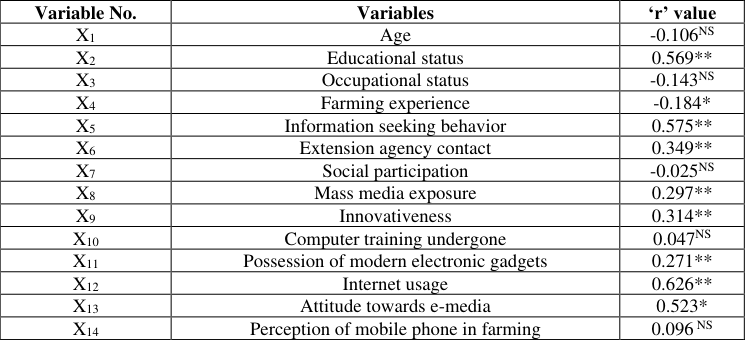 Table 1
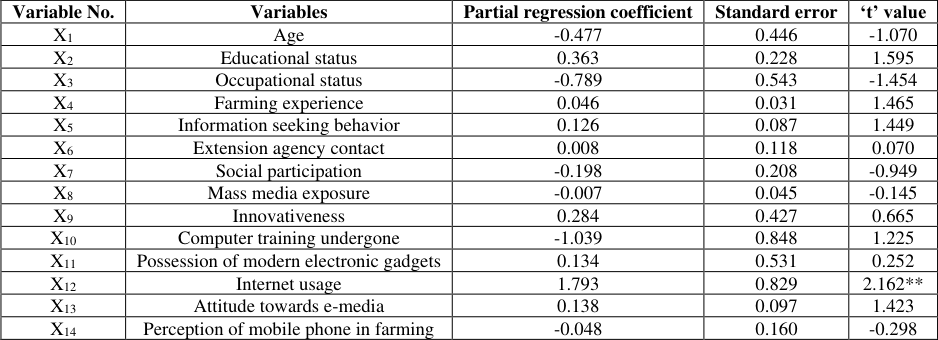 Table 2
 Table 3
 Table 4
Introduction
Information Communication Technology (ICT) is a comprehensive term encompassing a diverse array of services, applications, and technologies, facilitated through various types of equipment and software. These tools are increasingly recognized as pivotal for the economic development of nations. The information is vital for development of agriculture and wellbeing of the rural masses. The fact has been well recognized in the form of a number of initiatives taken to disseminate information on agriculture and related aspects by government, non-government, private and co-operatives. Mobile phones were found as the most widely accessed tool among the farmers for communication and for accessing agriculture-related information particularly for the marketing of produce. Researchers also reported that, Majority (71.70 %) of the respondents were aware of mobile advisory services by APMC (Agricultural Produce Market Committee) in regardof agricultural commodity prices and market for the various commodities and Almost two-thirds (65.00 %) of the respondents were aware of KCC service. (Manjuprakash et al., 2017) [4] . Further, it was also reported that, more than half (53.30 %) of the respondents comprehended that ICT are potentials in agricultural sectors. The reason might be due to that government and corporate sectors are in to cyber extension service mode by developing various apps to support agriculture and allied sectors. The enormous growth of ICT renders great support to the farmers in decision making. ICT could also help to manage resources effectively through resource management system. Farmers felt that ICT could be imbibed to implement precision farming successfully through various technologies like GPRS, sensors, remainders, forecast and warnings. (Manjuprakash et al., 2020) [8] . Syiem and Raj (2015) [7] reported mobile as the most frequently used ICT. According to them, the Mobile phones were widely used by the farmers for social communication, contacting middle men for the marketing of produce and contacting experts on real time basis for getting agricultural advisories. Major barriers for adoption of ICT based extension services were lack of training, poor infrastructural development and poor network connectivity. (Nagesh and Saravanan, 2019) [6] .
However, ICT has a significant impact on the advancement and growth of human civilization. Computer programmes, databases, communication networks, analysis and design methodologies, programming languages, artificial intelligence, knowledge bases, etc. are some of the technologies utilized in ICT. (Dutta and Anand 2023; Kakar et al., 2022) [5,3] . In this background, the current investigation was made in Karnataka to understand the relationship and determinants of farmers' knowledge on ICT in agriculture.
Research Methodology
Koppal district in Karnataka as the focal point of this study was selected deliberately. The study covered four blocks within the district viz., Koppal, Gangavathi, Kustahi, and Yalaburga. A sample of 120 respondents was chosen using a multi-stage random sampling technique, with 15 individuals selected from two villages in each of the four blocks. An ex-post facto design was adopted to meet the research objectives. Primary data collection involved the use of a pre-tested and comprehensive interview schedule. Subsequently, data analysis and interpretation were conducted using computer-based statistical software, specifically the Statistical Package for Social Sciences (SPSS). Statistical techniques such as correlation analysis, multiple regression analysis, and stepwise multiple regression analysis were applied to analyze and interpret the data.
Results and Discussion
Results and Discussion
Relationship of Independent Variables towards Knowledge
The findings presented in Table 1 indicate that, among the fourteen variables examined, seven displayed a positive significant relationship with knowledge. Educational status (X 2 ), Information seeking behavior (X 5 ), Extension agency contact (X 6 ), Mass media exposure (X 8 ), Innovativeness (X 9 ), Possession of modern electronic gadgets (X 11 ), and Internet usage (X 12 ) exhibited positive and significant associations with knowledge at a one percent level of probability. Conversely, Farming experience (X 4 ) showed a negative significant association, while Attitude towards e-media (X 13 ) displayed a positive significant association with knowledge at a five percent level of probability. The negative significance of farming experience towards knowledge could be attributed to the farmers' extensive experience and older age, which might hinder their adoption of ICT and mobile phone usage due to their attachment to conventional information access methods. They may also prefer personal interaction with extension agencies over ICT interventions. On the other hand, Age (X 1 ), Occupational status (X 3 ), Social participation (X 7 ), Computer training undergone (X 10 ), and Perception of mobile phone in farming (X 14 ) showed non-significant relationships with knowledge. Educational status exhibited a positive and significant association with knowledge at one percent level. Individuals with higher levels of education tend to actively seek out the latest information through various channels, thus contributing to their enhanced knowledge levels. Conversely, farming experience displayed a negative significance at the five percent level towards knowledge level. As farming experience increases, farmers typically age, and their reliance on traditional information sources like friends and relatives becomes more pronounced. Consequently, they may have lower knowledge levels regarding ICT tools.
| Variable No. | Variables | ‘r’ value |
|---|---|---|
| X1 | Age | -0.106NS |
| X2 | Educational status | 0.569** |
| X3 | Occupational status | -0.143NS |
| X4 | Farming experience | -0.184* |
| X5 | Information seeking behavior | 0.575** |
| X6 | Extension agency contact | 0.349** |
| X7 | Social participation | -0.025NS |
| X8 | Mass media exposure | 0.297** |
| X9 | Innovativeness | 0.314** |
| X10 | Computer training undergone | 0.047NS |
| X11 | Possession of modern electronic gadgets | 0.271** |
| X12 | Internet usage | 0.626** |
| X13 | Attitude towards e-media | 0.523* |
| X14 | Perception of mobile phone in farming | 0.096 NS |
Table text extracted from the original PDF; superscript letters are shown inline. The original table image is below.
View original table image
Information seeking behavior demonstrated a positive significance at the one percent level towards knowledge. Farmers, in their quest for information, are inclined to explore modern ICT tools as a means of obtaining relevant information, thereby contributing to their knowledge acquisition process. Extension agency contact showed a positive significance at the one percent level towards knowledge. This can be attributed to the efforts of extension agencies in organizing demonstrations and trainings related to ICT tools usage, thus enhancing farmers' knowledge in this domain.
Similarly, mass media exposure demonstrated a positive significance at the one percent level towards knowledge. Exposure to mass media platforms enables farmers to better understand ICT tools and services, contributing to their knowledge. Moreover, innovativeness exhibited a positive significance at the one percent level towards knowledge. Individuals with a high level of innovativeness are more likely to possess knowledge about ICT tools, given their propensity for adopting new technologies.
Possession of modern electronic gadgets also displayed a positive significance at the five percent level towards knowledge. Farmers owning modern electronic devices tend to engage more with ICT-enabled extension services, leading to a greater depth of knowledge regarding ICT tools. Furthermore, internet usage demonstrated a positive significance at the one percent level towards knowledge. Access to the vast repository of information available online facilitates knowledge acquisition about ICT tools among farmers.
Additionally, attitude towards e-media showed a positive significance at the five percent level towards knowledge. A positive attitude towards electronic media aids farmers in acquiring more knowledge about ICT tools and services. Farmers may not fully recognize the potential of mobile phones in farming activities. Their perception of mobile phones might be limited to basic communication purposes rather than utilizing them for accessing agricultural information or ICT tools. Hence, perception of mobile phone in farming (X 14 ) showed nonsignificant relationships with knowledge. It could be discerned from Table 2 that the R 2 value was 0.486 which indicated that 48.60 percent variation in the knowledge was explained by the given fourteen independent variables and remaining 51.40 percent of the variation in dependent variables unexplained. The 'F' value was significant at one percent level probability. Thus, the cause & effect relationship between the dependent and independent variables are fitted at one percent level of significance. The fitted regression equation is given below, Y1 = -3.326 -0.477X1 + 0.363 X2 -0.789 X3 + 0.046 X4 + 0.126X5 + 0.008 X6-0.198 X7 -0.007 X8+0.284 X9-1.039X10 +1.134 X11 + 1.793**X12 + 0.138 X13 -0.048 X14.
| Variable No. | Variables | Partial regression coefficient | Standard error | ‘t’ value |
|---|---|---|---|---|
| X1 | Age | -0.477 | 0.446 | -1.070 |
| X2 | Educational status | 0.363 | 0.228 | 1.595 |
| X3 | Occupational status | -0.789 | 0.543 | -1.454 |
| X4 | Farming experience | 0.046 | 0.031 | 1.465 |
| X5 | Information seeking behavior | 0.126 | 0.087 | 1.449 |
| X6 | Extension agency contact | 0.008 | 0.118 | 0.070 |
| X7 | Social participation | -0.198 | 0.208 | -0.949 |
| X8 | Mass media exposure | -0.007 | 0.045 | -0.145 |
| X9 | Innovativeness | 0.284 | 0.427 | 0.665 |
| X10 | Computer training undergone | -1.039 | 0.848 | 1.225 |
| X11 | Possession of modern electronic gadgets | 0.134 | 0.531 | 0.252 |
| X12 | Internet usage | 1.793 | 0.829 | 2.162** |
| X13 | Attitude towards e-media | 0.138 | 0.097 | 1.423 |
| X14 | Perception of mobile phone in farming | -0.048 | 0.160 | -0.298 |
Table text extracted from the original PDF; superscript letters are shown inline. The original table image is below.
View original table image
From the equation it is clear that intercept Internet usage (X 12 ) is significant at one percent level. Thus, if Internet usage (X 12 ) increases one unit from the mean level then the participation will increase 1.793 unit from the mean level. Use of internet to access the needy information is paramount importance, hence internet usage has positively correlated. Stepwise multiple regression analysis was carried out to eliminate the independent values whose contribution to the dependent variable was considered minimum and to select those variables to be used in the prediction equation. The results of stepwise analysis (Table 3) show that the maximum R squared value is obtained when two independent variables viz., internet usage (X 12 ), Educational status (X 2 ) were included in the model (i.e., model 2). These variables together contributed to 42.40 percent of the knowledge of farmers towards ICT tools in agriculture, which shows that the contribution by the eliminated variables was only to the tune of 6.20 percent. Hence, the unstandardized B coefficients of model 2 are to be used to predict the knowledge. (Table 4). The standardized coefficient beta values of the independent variables in model. (Table 4) indicate that a unit increase in internet usage, ceteris paribus, would result in increased knowledge by 2.67 units and vice versa. The internet is a part and parcel of ICT, hence, the farmer with high level of internet usage would more knowledge on ICT tools.
| Model | Unstandardized Co-efficient B | Standardised Coefficient Beta | ‘t’ values |
|---|---|---|---|
| (Constant) | -1.680 | ||
| Internet usage (X12) | 2.670 | 0.447 | 4.524 |
| Educational status (X2), | 0.516 | 0.254 | 2.567 |
Table text extracted from the original PDF; superscript letters are shown inline. The original table image is below.
View original table image
| Model No. | Variables | R | R2 | Adjusted R2 | Std. Error of the Estimate |
|---|---|---|---|---|---|
| 1. | (Constant), Internet usage (X12) | 0.626(a) | 0.392 | 0.387 | 2.32697 |
| 2. | (Constant), Internet usage (X12), Education status (X2) | 0.651(b) | 0.424 | 0.414 | 2.27372 |
Table text extracted from the original PDF; superscript letters are shown inline. The original table image is below.
View original table image
A unit increase in Educational status ceteris paribus, would result in an increase of 0.516 units of knowledge and vice versa. The educational status has directly related with increasing knowledge of any person. The farmers who possessed more educational status would have more knowledge on ICT tools.
The fitted equation, therefore, is as follows Y = -1.680+ 2.670X 12 + 0.516X 2
Conclusion
In case of ICT usage, out of 14 independent variables, eight variables viz., Educational status, Information seeking behaviour, Extension agency contact, mass media exposure, Innovativeness, Possession of modern electronic gadgets, Internet usage and Attitude towards e-media were found to have positive and significant association with knowledge.R 2 value was 0.486 which indicated that 48.60 percent variation in the knowledge was explained by the given fourteen independent variables and remaining 51.40 percent of the variation in dependent variables unexplained.
References
8 in the original paper- Chhachhar AR, Querestic B, Khushk GM, Ahmed S. Impact of ICTs in Agriculture Development. Journal of Basic and Applied Scientific Research. 2014;4(1):281-288.
- Javeed I, Narayan S, Malik AA, Kumar A, Rahman R, Nisar S, Akhter A, AzrahIndrabi S, Sultan A. Role of Information and Communication Technology in Agriculture. International Journal of Current Microbiology and Applied Sciences. 2020;11:2028-2037.
- Kakar N, Manjula N, Nadeerpoor MA, Yousafzai I. Teachers' perceptions of factors encouraging the use of information and communication technology (ICT) in agricultural education. South Asian J Agric Sci. 2022;2(2):90-93.
- Manjuprakash H, Philip S, Sriram N. Farmers' Awareness Level about ICT Tools and Services in Karnataka. Journal of Extension Education. 2017;29(2):5870-5874.
- Dutta M, Anand K. Role of Information Communication Technology In Agriculture. International Journal of Novel Research and Development. 2023;8(10).
- Nagesh NS, Saravanan R. Impact of ICTs on Agriculture growth and Development Case studies from Karnataka Region. Discussion Paper 9, MANAGE-Centre for Agricultural Extension Innovations, Reforms and Agripreneurship, National Institute for Agricultural Extension Management (MANAGE), Hyderabad, India. 2019.
- Syiem R, Raj S. Access and Usage of ICTs for Agriculture and Rural Development by the tribal farmers in Meghalaya State of North-East India. Journal of Agricultural Informatics. 2015;6(3):24-41.
- Manjuprakash H, Philip S, Sriram N. Farmers Perceived Effectiveness of Information and Communication Technology (ICT) Tools in Karnataka, India. Int J Curr Microbiol App Sci. 2020;9(06):3545-3550.
Cited by 1
From OpenAlex, OpenCitations and reference lists read by Scinovex
- Attitude of farmers towards i-khedut portal regarding agricultural development in Saurashtra region
PM Suriya, PS Gorfad, PG Sankhat, SK Kandoliya · International Journal of Agriculture Extension and Social Development · 2026
Information and Communication Technology (ICT) has emerged as an important tool for accelerating agricultural development by facilitating timely dissemination of information and improving farmers’ access to agricultural services. In this context, the Government of Gujarat launched the i-khedut portal to provide farmers with information on agricultural schemes, subsidies, weather forecasts, market prices, crop insurance and modern farming technologies. The present study entitled “Attitude of Farmers towards i-khedut Portal Regarding Agricultural Development in Saurashtra Region” was undertaken