
Research article · 2024 · Full text
International Journal of Agriculture Extension and Social DevelopmentImpact of vocational training courses on tribal farm women of Dediapada
Volume 7(6) · Pages 41–43 · DOI: 10.33545/26180723.2024.v7.i6a.694 ↗
Research areasLivestock Management and Performance Improvement
Abstract
Author-writtenThe study is based on vocational training programmes and its impact on Tribal woman in Narmada district of Gujarat comprising from one block. total number of 120 farm women from Neeghat, Gopaliya, Khokraumar, Besana, Jamini, Sejpur, Jergam from Dediapada block for the study. A self structured personal interview schedule was used to collect the data to see the effect of skill development training on the socio -economic status of tribal farm women. The data was analyzed by using frequency, percentage etc. that Psychological, cultural, social and economic empowerment like 95.83 percent tribal farm women shown self confidence 91.66 percent think about career reliance, 87.50 percent have Liberty for attending marriage ceremony and 95.83 had freedom to work outside family also 96.66 percent women participation shown in decision about marketing of farm produce.
Summary
Source-checkedPlain-language reading of the full paper, prepared with AI and checked against the text. Each point links to the authors' own words.
Why it matters
- Women's involvement in activities that generate income is thought to improve their power in society and their socio-economic status. View evidence ↗
- Providing productive employment opportunities to farm women is considered essential for addressing the problem of poverty. View evidence ↗
- Krishi Vigyan Kendra (KVK) was established by the Indian Council of Agricultural Research (ICAR) to provide vocational education in agriculture and related subjects to rural dropouts and farmers. View evidence ↗
The question
- The objective of this study was to evaluate how skill development training affects tribal farm women. View evidence ↗
What they did
- The study included 120 farm women from seven villages (Neeghat, Gopaliya, Khokraumar, Besana, Jamini, Sejpur, and Jergam) within the Dediapada block. View evidence ↗
- The researchers analyzed the collected data using percentages and frequencies. View evidence ↗
- The KVK provided various vocational training programs, including fruit preservation, millet processing, handicraft preparation, dress designing, mushroom cultivation, and health and hygiene. View evidence ↗
What they found
- Among the respondents, 32.23% had received organizational training, while 44.56% had not. View evidence ↗
- Psychologically, 95.83% of the tribal farm women (115 individuals) reported increased self-confidence. View evidence ↗
- Regarding career ambition, 91.66% of the women (110 individuals) reported thinking about career reliance. View evidence ↗
- In terms of cultural empowerment, 87.50% of the women (105 individuals) reported having the liberty to attend marriage ceremonies. View evidence ↗
- Socially, 95.83% of the women (115 individuals) reported having the freedom to work outside the family. View evidence ↗
- Economically, 96.66% of the women (116 individuals) participated in decisions regarding the marketing of farm produce. View evidence ↗
What it means
- The authors conclude that vocational training courses positively empower rural women, increasing their socio-economic status, psychological confidence, and decision-making ability within the family. View evidence ↗
- The authors state that KVK training programs helped improve livelihood security by increasing knowledge, awareness, and self-confidence. View evidence ↗
Visual summary
2 visualsIllustrations explain the paper; charts are replotted from the paper's own table values.
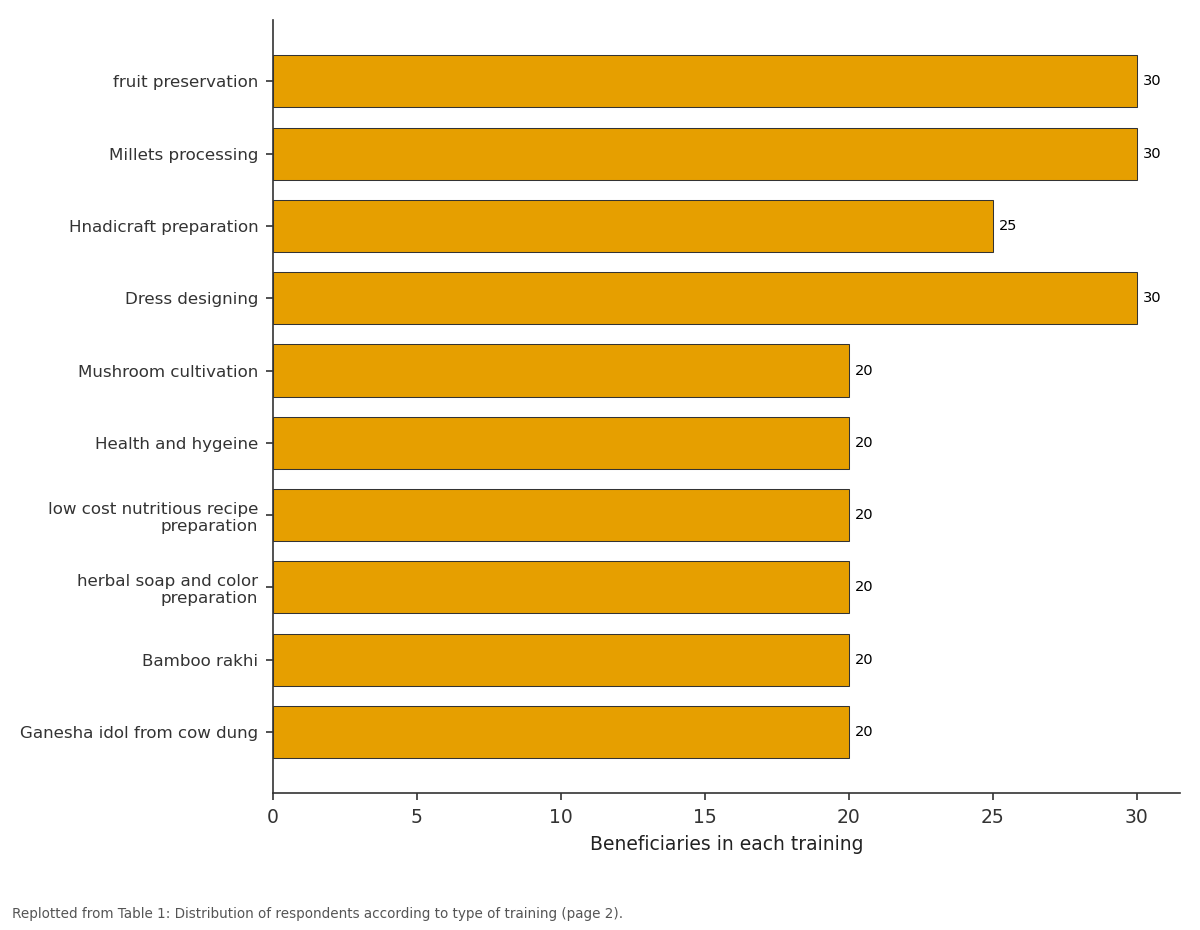
Beneficiaries in each training: fruit preservation vs Millets processing vs Hnadicraft preparation vs Dress designing vs Mushroom cultivation
Replotted from Table 1 (page 2) of the original paper. Every bar is the paper's own table value.
View source evidence ↗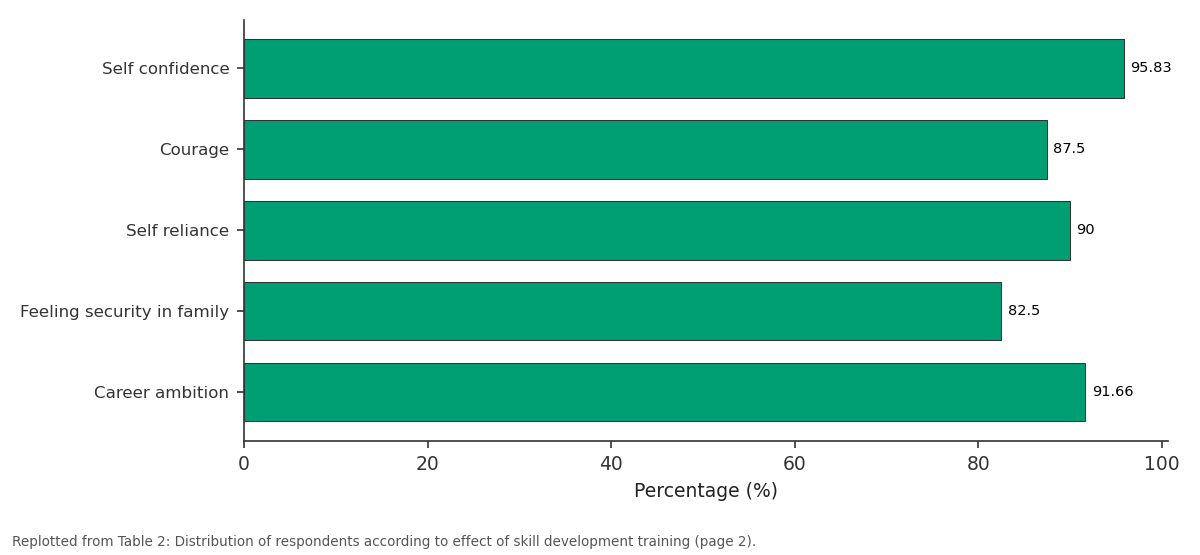
%: Self confidence vs Courage vs Self reliance vs Feeling security in... vs Career ambition
Replotted from Table 2 (page 2) of the original paper. Every bar is the paper's own table value.
View source evidence ↗Figures & tables
From the original paper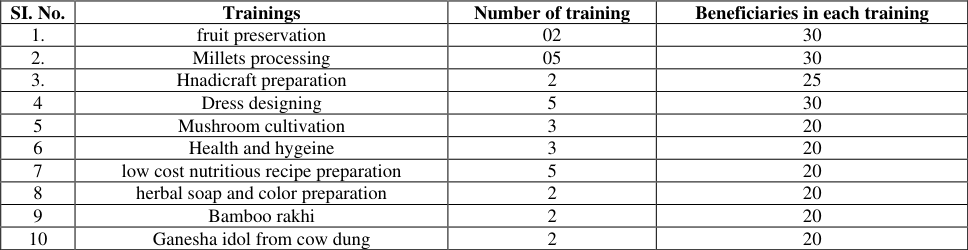 Table 1
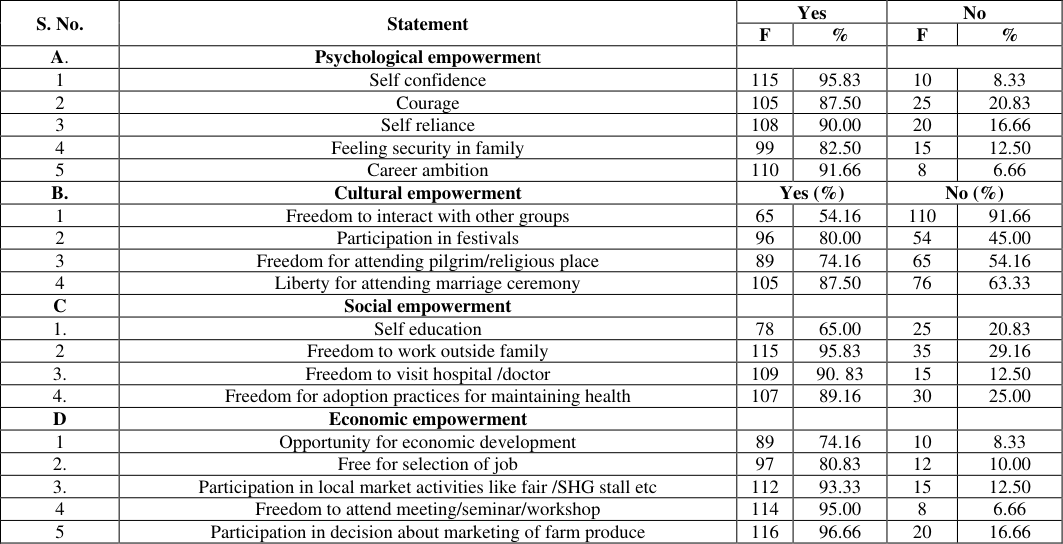 Table 2
Introduction
It is known that women’s participation in income generating activities is believed to increase their socio-economic status and power in the society. The economic contribution of women is related to their status and role in the family and in the society. If women are economically parasite, they can never claim an equal status with men. The problem of poverty cannot be tackled without providing opportunities of productive employment to farm women.
Economic independence of women will create far reaching social changes and prove a necessary weapon for them to face injustice and discrimination. If women are to be economically empowered they should be provided with alternative forms of informal credit, training, employment, management skills and social security. Taking the importance of above context, several approaches have been tried to encourage and inspire formation of thrift and credit group in Gujarat to canalized the various poverty elevations and social development programmes for farm/rural women and KVK is one of them. Krishi Vigyan Kendra (KVK) is an innovative transfer of technology project of Indian Council of Agricultural Research (ICAR).
Need for its establishing was for providing vocational education in agriculture and allied subject aimed at the farmers and dropout rural people. This institution was found to be useful in reducing the time lag between generations of technologies, their transfer to farmer and to get trained skilled workers and technicians. This institute also caters to the training needs of the farm community i.e. farmers, farm women, school dropouts as well as field level personnel. It is essential that KVK be able to follow the results of their efforts and understand how the training they imported fit into the complex pattern of socio economic status change in which all farm/rural women participate.
Keeping the above facts in view the present study was designed with following specific objective Objective To assess the effect of Skill development training on tribal farm women.
Methodology
A total number of 120 farm women from Neeghat, Gopaliya, Khokraumar, Besana, Jamini, Sejpur, Jergam from Dediapada block for the study. A self-structured personal interview schedule was used to collect the data to see the effect of skill development training on the socio - economic status of tribal farm women. The data was analyzed by using frequency, percentage etc.
Results And Discussion
Krishi vigyan kendra conducted various programmes for the development of tribal women like fruit preservation, Millets processing, Handicraft preparation, dress designing, Mushroom cultivation, health and hygeine, low cost nutritious recipie preparation, kitchen garden, herbal soap and color preparation, bamboo rakhi, Ganesha idol from cow dung etc. The study says that there were 44.56 percent of the respondents do not have any organizational training, while 32.23 percent respondents had organizational training. 75 https://www.extensionjournal.com Table 1: Distribution of respondents according to type of training SI. No. Trainings Number of training Beneficiaries in each training 1. fruit preservation 02 30 2.
| SI. No. | Trainings | Number of training | Beneficiaries in each training |
|---|---|---|---|
| 1. | fruit preservation | 02 | 30 |
| 2. | Millets processing | 05 | 30 |
| 3. | Hnadicraft preparation | 2 | 25 |
| 4 | Dress designing | 5 | 30 |
| 5 | Mushroom cultivation | 3 | 20 |
| 6 | Health and hygeine | 3 | 20 |
| 7 | low cost nutritious recipe preparation | 5 | 20 |
| 8 | herbal soap and color preparation | 2 | 20 |
| 9 | Bamboo rakhi | 2 | 20 |
| 10 | Ganesha idol from cow dung | 2 | 20 |
Table text extracted from the original PDF; superscript letters are shown inline. The original table image is below.
View original table image
Millets processing 05 30 3. Hnadicraft preparation 2 25 4 Dress designing 5 30 5 Mushroom cultivation 3 20 6 Health and hygeine 3 20 7 low cost nutritious recipe preparation 5 20 8 herbal soap and color preparation 2 20 9 Bamboo rakhi 2 20 10 Ganesha idol from cow dung 2 20 Its noticeable from the table 1 that out of total Tribal farm women of KVK, 30 respondents in fruit preservation, Dress designing, value addition in millets. 25 respondents had attended the training programme of handicraft. 20 respondents in mushroom cultivation, health and hygiene, low cost receipies, herbal soap preparation, bamboo rakhi and ganesha idol making had attended the said training programme Table 2: Distribution of respondents according to effect of skill development training (N = 120) training programmes and adopting the recommended techniques became socially, economically psychologically empowered. KVK had organised 10 number of vocational training programmes which incresed their socio-economic status. Positive impact of training in their living status was also visible.
| S. No. | Statement | Yes | — | No | — |
|---|---|---|---|---|---|
| F | % | F | % | ||
| A. | Psychological empowerment | ||||
| 1 | Self confidence | 115 | 95.83 | 10 | 8.33 |
| 2 | Courage | 105 | 87.50 | 25 | 20.83 |
| 3 | Self reliance | 108 | 90.00 | 20 | 16.66 |
| 4 | Feeling security in family | 99 | 82.50 | 15 | 12.50 |
| 5 | Career ambition | 110 | 91.66 | 8 | 6.66 |
| B. | Cultural empowerment | Yes (%) | No (%) | ||
| 1 | Freedom to interact with other groups | 65 | 54.16 | 110 | 91.66 |
| 2 | Participation in festivals | 96 | 80.00 | 54 | 45.00 |
| 3 | Freedom for attending pilgrim/religious place | 89 | 74.16 | 65 | 54.16 |
| 4 | Liberty for attending marriage ceremony | 105 | 87.50 | 76 | 63.33 |
| C | Social empowerment | ||||
| 1. | Self education | 78 | 65.00 | 25 | 20.83 |
| 2 | Freedom to work outside family | 115 | 95.83 | 35 | 29.16 |
| 3. | Freedom to visit hospital /doctor | 109 | 90. 83 | 15 | 12.50 |
| 4. | Freedom for adoption practices for maintaining health | 107 | 89.16 | 30 | 25.00 |
| D | Economic empowerment | ||||
| 1 | Opportunity for economic development | 89 | 74.16 | 10 | 8.33 |
| 2. | Free for selection of job | 97 | 80.83 | 12 | 10.00 |
| 3. | Participation in local market activities like fair /SHG stall etc | 112 | 93.33 | 15 | 12.50 |
| 4 | Freedom to attend meeting/seminar/workshop | 114 | 95.00 | 8 | 6.66 |
| 5 | Participation in decision about marketing of farm produce | 116 | 96.66 | 20 | 16.66 |
Table text extracted from the original PDF; superscript letters are shown inline. The original table image is below.
View original table image
Hence vocational training programmes organized by KVKs especially for tribal farm women had very beneficial and improve their livelihood.
Conclusion
Training programmes conducted by KVK had good role in creating awareness, increasing the knowledge, self- confidence, and providing improved skills which will help in the betterment of their livelihood security. Vocational training courses play a positive role in the empowerment of rural women. Majority of the tribal farm women were able to increase their socio economic status, psychological confidence and became more able to take decisions in their family. Majority of farm women after attending vocational (Rural). [Accessed Date Unknown].
Available from: http://w.w.w.researchgate.Net/post/How-do-you classify-people-regard-to their –Socio-Economic Status 1964. 3. Rao S. Vocational Training on nutrition gardening for 76 https://www.extensionjournal.com women Alites. Maharashtra J Extension. 2007;16:254- 257. 4.
RAU. Report. Rajendra Agricultural University, Annual Report. c2007. 5. Nair TS, Shankar B.
Livelihoods and Financial Behaviour of Tribal Households: Linking Experience and Strategies. InTribal Development in Western India. Routledge India; c2015. p. 267-284. 77
References
7 in the original paper- Ahmad N, Singh SP, Parihar P. Farmers’ Assessment of KVK Training Programme. J Extension Educ. 2012;1.
- Pareek U, Trivedi V. Socio-Economic Status Scale S. No. Statement Yes No F % F % A. Psychological empowerment 1 Self confidence 115 95.83 10 8.33 2 Courage 105 87.50 25 20.83 3 Self reliance 108 90.00 20 16.66 4 Feeling security in family 99 82.50 15 12.50 5 Career ambition 110 91.66 8 6.66 B. Cultural empowerment Yes (%) No (%) 1 Freedom to interact with other groups 65 54.16 110 91.66 2 Participation in festivals 96 80.00 54 45.00 3 Freedom for attending pilgrim/religious place 89 74.16 65 54.16 4 Liberty for attending marriage ceremony 105 87.50 76 63.33 C Social empowerment
- Self education 78 65.00 25 20.83 2 Freedom to work outside family 115 95.83 35 29.16
- Freedom to visit hospital /doctor 109 90. 83 15 12.50
- Freedom for adoption practices for maintaining health 107 89.16 30 25.00 D Economic empowerment 1 Opportunity for economic development 89 74.16 10 8.33
- Free for selection of job 97 80.83 12 10.00
- Participation in local market activities like fair /SHG stall etc 112 93.33 15 12.50 4 Freedom to attend meeting/seminar/workshop 114 95.00 8 6.66 5 Participation in decision about marketing of farm produce 116 96.66 20 16.66 It is reported from table 2 that Psychological, cultural, social and economic empowerment like 95.83 percent tribal farm women shown self-confidence 91.66 percent think about career reliance, 87.50 percent have Liberty for attending marriage ceremony and 95.83 had freedom to work outside family also 96.66 percent women participation shown in decision about marketing of farm produce.
Cited by 1
From OpenAlex, OpenCitations and reference lists read by Scinovex
- Spatial variations in multidimensional empowerment of tribal women through self- help groups: A study of Daringbadi block in Kandhamal, Odisha
Malaya Ranjan Pradhan, Narayan Bar, Mahamaya Prasad Nayak, Jeebanjyoti Behera · International Journal of Agriculture Extension and Social Development · 2026
The study is based on Self-Help Group (SHG) participation and its impact on tribal women in Kandhamal district of Odisha comprising Daringbadi block. Total number of 120 tribal women from Dasingbadi, Badabanga, Bramhunigam, Gadapur, Simanbadi and Sraniketa of Daringbadi block were selected for the study. A self-structured personal interview schedule was used to collect the data to see the spatial variation in multidimensional empowerment of tribal women through SHG participation across selected villages. The data was analyzed by using frequency, percentage etc. that psychological, political, s