
Research article · 2024 · Full text
International Journal of Agriculture and NutritionIntellectual capital management and its relationship to building a learning organization from the point of view of workers in the agricultural extension and training department/Iraq
Volume 6(1) · Pages 113–120 · DOI: 10.33545/26646064.2024.v6.i1b.150 ↗
Research areasIntellectual Capital and Performance Analysis
Abstract
Author-writtenThe research aims to identify the level of intellectual capital management and its relationship to building the learning organization from the point of view of workers in the Agricultural Extension and Training Department/Iraq in the areas of research. To achieve the aim of the study, the questionnaire was used as a research tool after presenting it to a group of experts to accomplish the research objectives. It was tested initially to achieve the research objectives, and to ensure its validity, which reached (0.898). The number of paragraphs was (54) according to the research axes regarding intellectual capital as the dependent variable (human capital, structural capital, and relational capital), Regarding the learning organization as the independent variable (organizational aspect, leadership aspect, participation aspect), a random sample of (153) employees was selected, representing (25%) of the number of employees working in the Agricultural Extension and Training Department, which numbered (612), and the statistical program SPSS was used. This was in April 2024. The most important results of the research were that the level of intellectual capital management was average according to the scale prepared for this, meaning that there is an effort to develop the level of intellectual capital management in the agricultural extension organization, but no efforts are being made to maintain it. The level of building the educated organization was average in general, and this considers the agricultural extension organization flexible and capable of facing rapid environmental changes with qualified workers to obtain knowledge and benefit from it, The research recommends the need to pay attention to qualified workers with minds that carry knowledge to achieve the ability to provide the best according to distinct outputs that benefit the organization, and the need to protect them from leaking and moving away from the organization.
Summary
Source-checkedPlain-language reading of the full paper, prepared with AI and checked against the text. Each point links to the authors' own words.
Why it matters
- Developing countries struggle to keep pace with agricultural advancements in developed nations, partly due to a lack of knowledge in managing the agricultural sector. View evidence ↗
- The Agricultural Extension Organization is tasked with transmitting new ideas and skills to workers through training and global experience. View evidence ↗
- A learning organization is defined as one where employees solve problems to enable constant experimentation and improvement for growth. View evidence ↗
The question
- The study aims to determine the level of intellectual capital management and how it relates to building a learning organization within Iraq's Agricultural Extension and Training Department. View evidence ↗
What they did
- The study used a random sample of 153 employees, representing 25% of the total population of 612 employees with at least a bachelor's degree. View evidence ↗
- Data was collected via a 54-item questionnaire divided into intellectual capital management (27 items) and building a learning organization (27 items). View evidence ↗
- A five-point Likert scale was used to measure responses, ranging from strongly disagree to strongly agree. View evidence ↗
What they found
- The level of building a learning organization was also average, with a general arithmetic mean of 434.17 and a weighted mean of 2.89. View evidence ↗
- A positive significant correlation (r = 0.317, p < 0.01) was found between intellectual capital management and the building of a learning organization. View evidence ↗
- The majority of respondents held a bachelor's degree (86.27%) and had 1-12 years of job experience (64.05%). View evidence ↗
What it means
- The authors conclude that while there are efforts to develop intellectual capital management, there are no efforts to maintain it. View evidence ↗
- The authors recommend focusing on qualified workers and implementing measures to prevent the loss of knowledgeable staff from the organization. View evidence ↗
Figures & tables
From the original paper Table 1
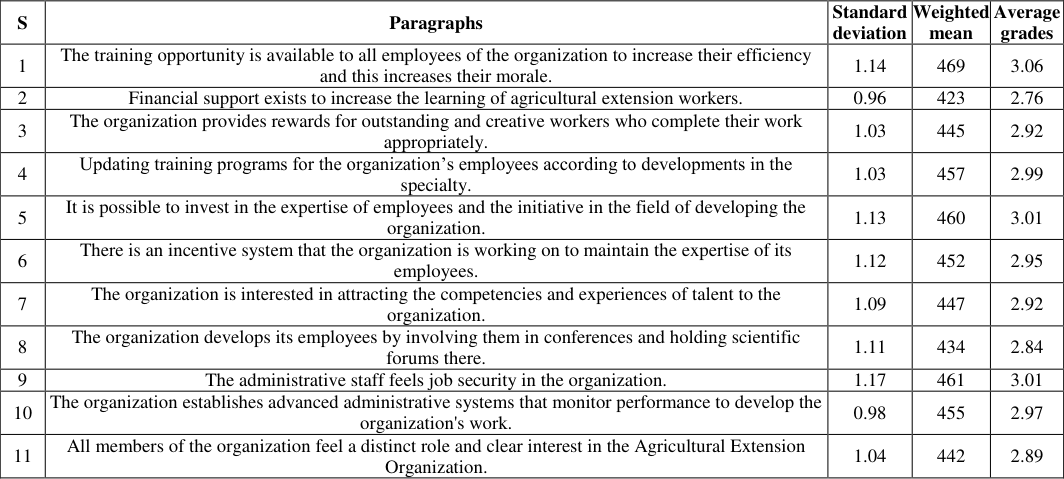 Table 2
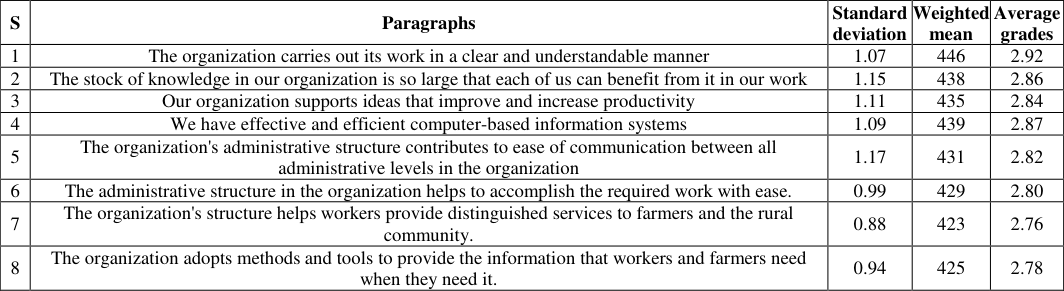 Table 3
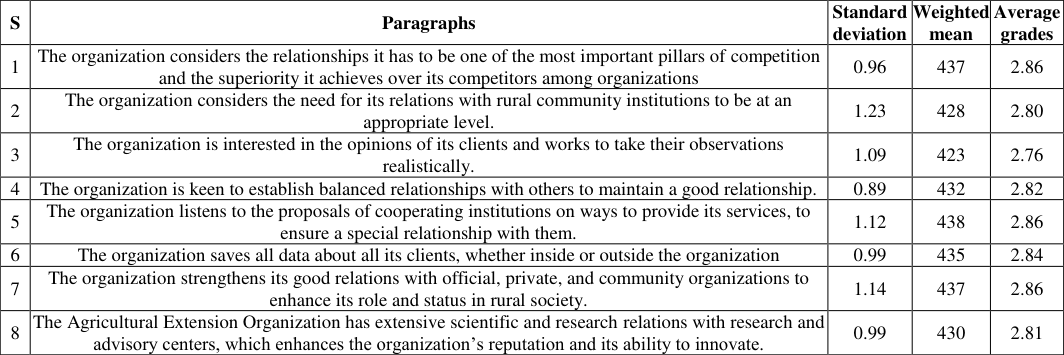 Table 4
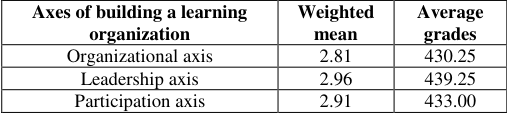 Table 5
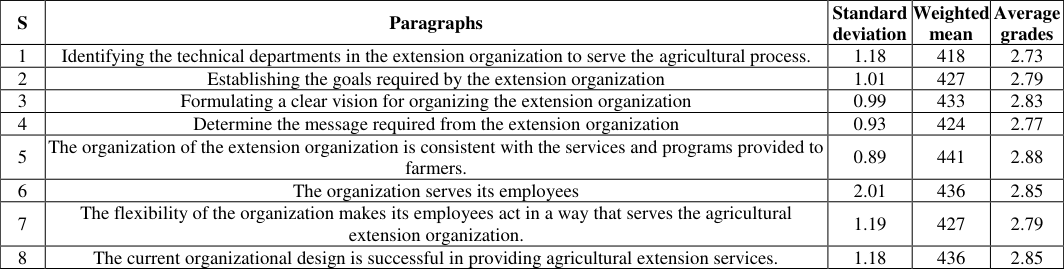 Table 6
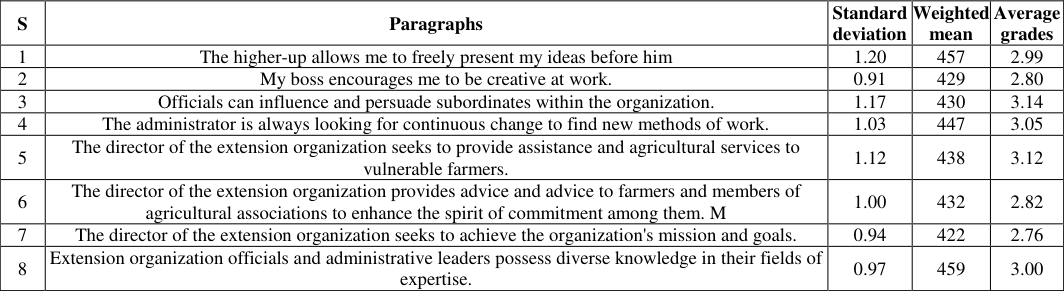 Table 7
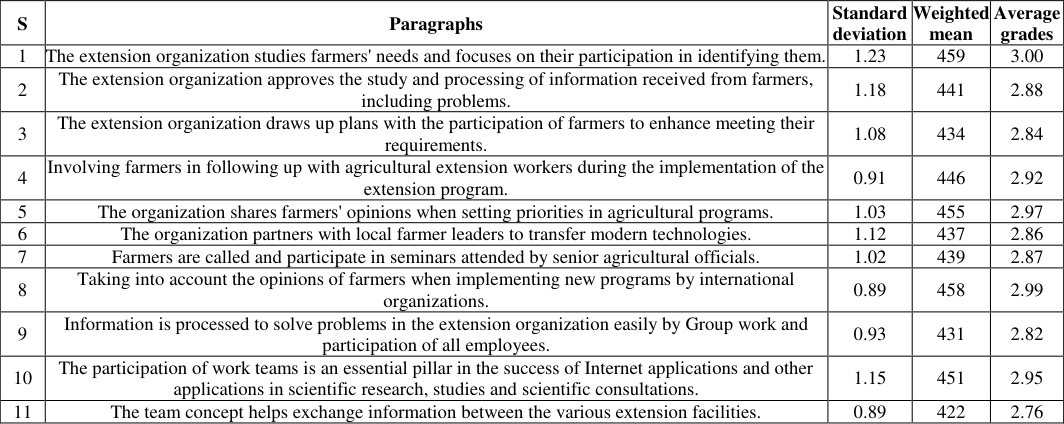 Table 8
 Table 9
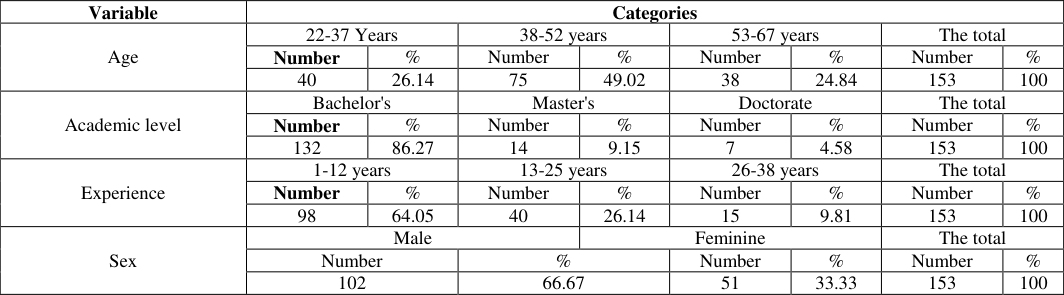 Table 10
Introduction
Today, agriculture has become unable to meet the ambitions of the countries of the world, especially developing countries, and it cannot keep pace with the development taking place in developed countries, for many reasons, including these reasons for those in charge of those governments, due to their lack of knowledge in managing the agricultural sector, especially the management of those organizations, the lack of their development, the use of advanced technology, and the survival of those organizations. Trapped in old laws and instructions, one of those agricultural organizations is the Agricultural Extension Organization, which is responsible for transmitting what is new in the rapidly developing world with ideas and skills and for its workers to use everything new through training and exposure to world experiences. Organizations at present, while performing their work, have faced many challenges and a set of difficulties and problems because the nature of their work is skilled and executive, and based on the principle of specialization and traditional division of labor, in addition to relying on routine, stereotypical performance that does not require extensive information and knowledge, and in light of the new transformations of organizations. Problems have emerged from its commodity production situation to its knowledge-service production it has an urgent need for a new qualitative type of organization, the need to be in harmony with new technical and cognitive changes, to move away from traditional isolated organizations, and to produce a new model of human resources capable of building an effective organization for what is new in the rapidly progressing world, a model of its qualified workers that achieves the organization's aspirations and has Knowledge capital, and the educated organization has emerged today that achieves this (Salehi and Boukhkham, 2018: p. 94) [1] . A learning organization in which each employee identifies and solves problems in a way that makes the organization able to constantly experiment, change, and improve to increase its ability to grow, learn, and achieve its goals. Leadership is considered one of the characteristics of a learning organization and it adopts new roles other than the traditional roles of management and new skills. It is consistent with policies and strategies, motivates individuals to learn, provides care and support to them, and builds a shared vision (Daft, 2003: p. 42) [2] . A learning organization is one in which learning is constantly taking place through continuous testing of experiences and transforming these experiences into knowledge as well as adopting long-term strategies for continuous development (Song, 2008: p 14) [3] . The characteristics of a learning organization, as mentioned by Al-Hawajra (2010: p. 10) [4] , is the participation of all employees in solving the problems that stand in the way of the organization. As well as investing in knowledge instead of purchasing resources through continuous development of the capabilities of its individuals and providing appropriate financial and material resources. Openness to external expertise by building alliances with suppliers, customers, and even competitors. The presence of administrative values that encourage individuals and urge them to experiment, take risks, and not be afraid of mistakes, as well as solve problems by the ideas of learning theory and by adopting appropriate statistical tools, trying new approaches to learning things, not being afraid of new ideas, and embracing risk; Benefit from the experiences of others, especially successful ones, and learn from them. Benefiting from the lessons of the organization's previous experiences and lessons, finally allowing the transfer of knowledge within the organization through training programs and seminars. The learning organization, as Al-Daihani (2015, 21) [5] defines it, is the organization that meets conditions that distinguish it from other organizations in terms of leadership and organization associated with reciprocal educational processes between leaders and followers, enabling workers to participate and allowing opportunities to exchange knowledge, information, and organizational culture. When linking the management of intellectual capital and building a learning organization, it is necessary to shed light on intellectual capital, which expresses a group of workers who possess mental capabilities whose components are knowledge, skill, experience, and values, which can be employed and invested in increasing intellectual contributions, to improve the performance of the organization's operations and develop the space for its creativity. In a way that achieves effective relationships with all parties dealing with it, and makes its value great (Al-Anazi and Saleh, 2009: p. 175) [6] . Also, the intellectual capital of the organization is of great importance when invested, it has a return in the long term, and for this return to be achieved, there must be a sacrifice and an upfront cost to obtain it, and it does not suffer from the problem of scarcity, but rather it is a growing cumulative resource that can be used to generate and develop new ideas. Thus, intellectual capital began to be viewed as the real capital on which the success of the organization depends or not (Al-Shaabani, 2011: p. 7) [7] . Al-Saeed (2008:22) [8] defines intellectual capital as a set of intangible values that are part of an organization's capital, and include components:
(Human capital, structural capital, and relational capital); It contributes to the production of new and innovative ideas, as it helps the organization to survive, improve its work in the future, and maximize its competitive ability. Intellectual capital is not concentrated at a specific administrative level but rather represents a set of distinct cognitive capabilities. Intellectual capital consists of (knowledge, skills, experiences, and achievements) possessed by a group of people within different organizations, which contributes to the development of work inside and outside the organization, while giving them a competitive advantage over other organizations, and also increases their value among organizations, which It is reflected in the development of the entire society (Najm, 2014: p. 218) [9] . The study by Grammon (2010: p. 34) [10] focused on the interest in striving for excellence and providing all learning opportunities for employees, by integrating the philosophy of building and developing human resources into the core of the policies and strategies of the merged organizations, and avoiding the common mistakes of using distinguished individuals in work that is below their abilities and levels of thinking to ensure benefit. The real value added to intellectual capital. Youssef's study (2019, p. 502) [11] concluded that providing the appropriate climate for employees to unleash their energies and abilities, encouraging them to move away from stereotypes, motivating them towards engaging in work characterized by high risk, and providing their intellectual capital with a material and legal incentive befitting their status and cognitive abilities, and this comes through incentives, Continuous material and moral. Given the importance of intellectual capital, which is considered the most valuable asset in the twentieth century, it represents scientific forces capable of introducing fundamental changes in the work of organizations. It is also considered one of the most important indicators that reflect the development of contemporary administrative thought (Abdel Hamid, 2014: 135) [12] . Intellectual capital is the most important resource needed to develop performance in organizations. The production, transfer, and application of knowledge depends primarily on how intellectual capital is invested in all institutions and managed, as it is an important economic resource that is more important than physical capital, which ensures their survival, continuity, and competition. And achieving excellence, in addition to increasing its ability and enhancing its competitive position, and the most important indicators of intellectual capital are human resources through the capabilities of employees to lead the strategy of the organization, as well as the ability of employees to create and innovate what is new, and employees' attitudes and belief in the organization's values (Saleh, 2009: 15) [6] .
Recently, the prevailing belief was that only material assets were capable of creating wealth, which was the main factor in organizations, but with the entry of the age of technology and knowledge, Researching the human element in the success of organizations, as traditional concepts changed and were replaced by new concepts that depend mainly on knowledge and competencies. Methods of acquiring and investing in it, the human element (Which is considered a container for those skills and knowledge), and the basic axis on which the organization's assets are based, among these concepts are (Intellectual and human capital, of which competencies are an important part) which aims to maintain and increase the value of the organization's employees (Bin Hamid, 2018: 12) [14] . Based on the above, an organization in which individuals constantly work to increase their awareness of achieving the results they desire by adopting patterns of collective thinking and ambition, and everyone constantly learns how to learn together. Structural capital is about the organizational capabilities of the organization that can share, transfer, and enhance knowledge through intellectual and structural assets represented by information systems, patents, and copyrights. It represents all the values that remain in the organization when the lights go out on the last working day. Structural capital also expresses the organization's system and structure. When an organization possesses strong, cohesive structural capital, and improves its management and dealing with it in a way that serves and is consistent with the organization's ruling strategy, and its ability to provide a suitable work environment capable of using human capital, mobilizing it, and benefiting from it to the fullest extent. His energies. It can also be said that structural capital in itself represents the knowledge that can be developed, modeled, and shared with others, which helps in enhancing both the human and structural capital and relationships of the organization. Since the Agricultural Extension Organization is an educational and training organization, intellectual capital is a cornerstone for its development and creativity in launching its workers to acquire modern ideas and mental skills, consolidating the values of the learning organization to invest the energies of its workers to compete and excel among organizations, and here research questions can be raised of which:
Research hypothesis
There is no relationship between the level of the field of intellectual capital management and the level of the field of the learning organization from the point of view of the respondents in the Department of Agricultural Extension and Training/Iraq.
Research Methodology
This research comes within the framework of research that falls within the descriptive approach, as this approach describes what exists in the current situation and interprets it by collecting data on the level of opinions, positions, and reactions regarding the issue of intellectual capital for workers in agricultural extension (Al-Sammak, 2019: 189) [15] .
Search area
The Department of Agricultural Extension and Training in Iraq was chosen as a research area because of its great importance in agriculture, through which agricultural extension work is carried out in Iraq and is the source of decision-making. It consists of 16 technical departments that deal with farmers.
Research community and sample
The research population included all employees of the Agricultural Extension and Training Organization, numbered (612) agricultural employees who held a bachelor's degree or above. A random sample of 25% of them was drawn to conduct the research, so the research sample became (153) agricultural employees.
Research method
The questionnaire consisted of three parts. The first part contained a description of the personal variables of workers in the Agricultural Extension and Training Department, such as (Age, educational level, number of years of service (Experience), and gender). In contrast, the second part consisted of 27 items distributed on the axis of intellectual capital management. Which included (The human capital axis, which consists of 11 paragraphs, the structural capital axis, which consists of 8 paragraphs, and the relations capital axis, which consists of 8 paragraphs), and the third part consists of 27 paragraphs distributed on the axis of building the learning organization, which includes (The organizational axis that It consists of 8 paragraphs, the leadership axis consists of 8 paragraphs, and the participation axis consists of 11 paragraphs). The number of paragraphs in the research became 54 paragraphs.
Reliability of the research tool:
There was a pilot sample that was tested on 25 employees, outside the study sample from the research population. The Cronbach's alpha coefficient was used for the two axes of the study, and the reliability of the intellectual capital axis was 0.895, the reliability of the learning organization axis was 0.901, and the total reliability was 0.898. Research data was collected by personal interviews with respondents in February 2024.
Data analysis
After completing the data collection process, it was transcribed through Excel and SPSS programs to analyze and process the data statistically, such as percentage, arithmetic mean, weighted mean, and Cronbach's alpha coefficient. After that, the data was organized into tables for the results to be presented and interpreted, and the process of tabulating and analyzing the data was for the dependent variable. The five-point LIKERT scale was adopted to measure the intellectual capital management of the respondents. The scale consisted of five levels (strongly disagree, disagree, neutral, agree, strongly agree), and weights were given to them (5, 4, 3, 2, 1) respectively, Thus, the degrees of the theoretical scale became according to the range law, which is the difference between the highest value and the lowest value in the scale, 5-1 = 4, and the length of the category, which divides the range by the number of categories, 4/5 = 0.8, and this value is added to the lowest value on the scale, which is (+1). To determine the upper limit for the first category and determine the upper limits for the remaining five categories of the scale.
Results
Results
Identify
Identify
A. Human capital management axis
It is clear from Table 2. that the respondents' opinions on human capital management were average, reaching 449.55 degrees according to the scale items. This indicates that the guiding organization is working to develop the human resources in the organization, as paragraph 1 stated that the training opportunity is available to all employees in the organization to increase their efficiency. This raises their morale. Paragraph 9 the administrative staff feels job security in the organization.
| S | Paragraphs | Standard deviation | Weighted mean | Average grades |
|---|---|---|---|---|
| 1 | The training opportunity is available to all employees of the organization to increase their efficiency and this increases their morale. | 1.14 | 469 | 3.06 |
| 2 | Financial support exists to increase the learning of agricultural extension workers. | 0.96 | 423 | 2.76 |
| 3 | The organization provides rewards for outstanding and creative workers who complete their work appropriately. | 1.03 | 445 | 2.92 |
| 4 | Updating training programs for the organization’s employees according to developments in the specialty. | 1.03 | 457 | 2.99 |
| 5 | It is possible to invest in the expertise of employees and the initiative in the field of developing the organization. | 1.13 | 460 | 3.01 |
| 6 | There is an incentive system that the organization is working on to maintain the expertise of its employees. | 1.12 | 452 | 2.95 |
| 7 | The organization is interested in attracting the competencies and experiences of talent to the organization. | 1.09 | 447 | 2.92 |
| 8 | The organization develops its employees by involving them in conferences and holding scientific forums there. | 1.11 | 434 | 2.84 |
| 9 | The administrative staff feels job security in the organization. | 1.17 | 461 | 3.01 |
| 10 | The organization establishes advanced administrative systems that monitor performance to develop the organization's work. | 0.98 | 455 | 2.97 |
| 11 | All members of the organization feel a distinct role and clear interest in the Agricultural Extension Organization. | 1.04 | 442 | 2.89 |
Table text extracted from the original PDF; superscript letters are shown inline. The original table image is below.
View original table image
Table 2:
Between items, weighted mean, and average scores of the human capital management axis.
S Paragraphs Standard deviation
S Paragraphs Standard deviation
Weighted mean
The training opportunity is available to all employees of the organization to increase their efficiency and this increases their morale. Identifying the level of the field of building the learning organization in the axes (Organizational axis, leadership axis, participation axis).
The research results showed that the general arithmetic mean of the respondents was 434.17 degrees in the field of building a learning organization, with a standard deviation of 1.07, and a weighted mean of 2.89 degrees. The average score of the respondents in the organizational axis was 439.25 degrees, in the leadership axis 439.25 degrees, and in the participation axis 433.00 degrees, as in Table 5. It can be concluded from Table 5. That the level of the learning organization's construction of the agricultural extension organization, and according to the opinions of the respondents in the extension organization, the arithmetic mean was used as an indicator of the level of the learning organization's construction of an organization according to the research axes. The respondents' answers were 434.17 degrees, approaching the general arithmetic mean of 405 degrees, with a mean Weighted 2.89. This means that the guiding organization is working to build an educated organization in the leadership aspect, and the leadership axis scored a high score among the axes. This means that the subordinates record their satisfaction with their leaders. A-The organizational axis in building a learning organization Table 6 showed that the respondents' opinions on the organizational axis were average, reaching 430.25 degrees according to the scale items. This indicates that the extension organization is working to develop the organization and what is consistent with the work of the employees who work in it, as paragraph 5 stated: The organization of the extension organization is compatible with the services and programs. Provided to farmers. Paragraph 8 states that the current organizational design is successful in providing agricultural extension services, and this is consistent with the organization's current work, as
| S | Paragraphs | Standard deviation | Weighted mean | Average grades |
|---|---|---|---|---|
| 1 | Identifying the technical departments in the extension organization to serve the agricultural process. | 1.18 | 418 | 2.73 |
| 2 | Establishing the goals required by the extension organization | 1.01 | 427 | 2.79 |
| 3 | Formulating a clear vision for organizing the extension organization | 0.99 | 433 | 2.83 |
| 4 | Determine the message required from the extension organization | 0.93 | 424 | 2.77 |
| 5 | The organization of the extension organization is consistent with the services and programs provided to farmers. | 0.89 | 441 | 2.88 |
| 6 | The organization serves its employees | 2.01 | 436 | 2.85 |
| 7 | The flexibility of the organization makes its employees act in a way that serves the agricultural extension organization. | 1.19 | 427 | 2.79 |
| 8 | The current organizational design is successful in providing agricultural extension services. | 1.18 | 436 | 2.85 |
Table text extracted from the original PDF; superscript letters are shown inline. The original table image is below.
View original table image
| Axes of building a learning organization | Weighted mean | Average grades |
|---|---|---|
| Organizational axis | 2.81 | 430.25 |
| Leadership axis | 2.96 | 439.25 |
| Participation axis | 2.91 | 433.00 |
Table text extracted from the original PDF; superscript letters are shown inline. The original table image is below.
View original table image
shown in Table 6. 7. Shows that the opinions of the respondents on the leadership axis were average, reaching 439.25 degrees according to the items on the scale. This indicates that the guiding organization works to ensure that its leadership axis is effective and in a way that is proportional to the employees in the organization. Paragraph 1: The senior official allows me to present my thoughts freely before him. Paragraph 8: Officials in the extension organization and administrative leaders in the organization possess diverse knowledge in their field of specialization. 8. Showed that the respondents' opinions on the participation axis were average, reaching 433.00 degrees according to the scale items. This indicates that the extension organization is working to ensure that its participation axis is effective and in a way that is proportional to the employees in the organization, as paragraph 1 stated the extension organization studies the needs of farmers. It focuses on their participation in defining it. Paragraph 8: Taking into account the opinions of farmers when implementing new programs by international organizations. The relationship between the level of the field of intellectual capital management and the level of the field of building the learning organization from the point of view of the respondents in the Department of Agricultural Extension and Training/Iraq.
The results of the research showed the relationship between the field of intellectual capital management and the field of building the learning organization from the point of view of workers in the Agricultural Extension and Training Department/Iraq, as shown in Table 9. It is concluded that the level of intellectual capital management was average according to the scale prepared for this, meaning that there is an effort to develop the level of intellectual capital management in the agricultural extension organization, but no efforts are being made to maintain it. 2. It is concluded that human capital is not of much use in the agricultural extension organization, that the level of structural capital seeks to reach the best, and that the level of relational capital in the organization is average and rises to the best. 3. It is concluded that the level of building the learning organization was overall average, and this considers the agricultural extension organization flexible and capable of facing rapid environmental changes with qualified workers to obtain knowledge and benefit from it. On the organizational side, it is described as average and seeks to develop, and that building the learning organization on the leadership side gives Better importance compared to the rest of the axes, and that the participation came at a moderate level in building effective participation with the agricultural extension environment. 4. It is concluded that there is a significant relationship between the level of intellectual capital management and organization building, which can be benefited from.
| Dependent variable/ Independent variable | Intellectual capital themes | Intellectual capital themes | — | — | — |
|---|---|---|---|---|---|
| Human capital | Structural capital | Capital relations | Tabular t value | ||
| The field of building a learning organization | 0.691 | 0.592 | 0.585 | 0.393 | 2.576 |
| Calculated t value | 3.932 | 4.817 | 3.962 | 3.931 | Correlation value |
| Relationship type | There is a positive, significant correlation at the level of 0.01 for all aspects of intellectual capital. | 0.317 |
Table text extracted from the original PDF; superscript letters are shown inline. The original table image is below.
View original table image
The employees of the Agricultural Extension
Organization in Iraq have youthful qualities and have appropriate service, as well as experience that needs to be developed. benefit the organization, and the need to protect them from leaking and moving away from the organization. 2. Relying on modern technology to develop the organization that supports the knowledge carried by employees. 3. Providing material and moral support to employees that helps them brainstorm to produce and benefit from their intellectual capital.
Figures and tables from the paper
| Intellectual capital themes | Weighted mean | Average grades |
|---|---|---|
| Human capital | 2.94 | 449.55 |
| Structural capital | 2.06 | 433.25 |
| Capital relations | 2.82 | 432.50 |
Table text extracted from the original PDF; superscript letters are shown inline. The original table image is below.
View original table image
| S | Paragraphs | Standard deviation | Weighted mean | Average grades |
|---|---|---|---|---|
| 1 | The organization carries out its work in a clear and understandable manner | 1.07 | 446 | 2.92 |
| 2 | The stock of knowledge in our organization is so large that each of us can benefit from it in our work | 1.15 | 438 | 2.86 |
| 3 | Our organization supports ideas that improve and increase productivity | 1.11 | 435 | 2.84 |
| 4 | We have effective and efficient computer-based information systems | 1.09 | 439 | 2.87 |
| 5 | The organization's administrative structure contributes to ease of communication between all administrative levels in the organization | 1.17 | 431 | 2.82 |
| 6 | The administrative structure in the organization helps to accomplish the required work with ease. | 0.99 | 429 | 2.80 |
| 7 | The organization's structure helps workers provide distinguished services to farmers and the rural community. | 0.88 | 423 | 2.76 |
| 8 | The organization adopts methods and tools to provide the information that workers and farmers need when they need it. | 0.94 | 425 | 2.78 |
Table text extracted from the original PDF; superscript letters are shown inline. The original table image is below.
View original table image
| S | Paragraphs | Standard deviation | Weighted mean | Average grades |
|---|---|---|---|---|
| 1 | The organization considers the relationships it has to be one of the most important pillars of competition and the superiority it achieves over its competitors among organizations | 0.96 | 437 | 2.86 |
| 2 | The organization considers the need for its relations with rural community institutions to be at an appropriate level. | 1.23 | 428 | 2.80 |
| 3 | The organization is interested in the opinions of its clients and works to take their observations realistically. | 1.09 | 423 | 2.76 |
| 4 | The organization is keen to establish balanced relationships with others to maintain a good relationship. | 0.89 | 432 | 2.82 |
| 5 | The organization listens to the proposals of cooperating institutions on ways to provide its services, to ensure a special relationship with them. | 1.12 | 438 | 2.86 |
| 6 | The organization saves all data about all its clients, whether inside or outside the organization | 0.99 | 435 | 2.84 |
| 7 | The organization strengthens its good relations with official, private, and community organizations to enhance its role and status in rural society. | 1.14 | 437 | 2.86 |
| 8 | The Agricultural Extension Organization has extensive scientific and research relations with research and advisory centers, which enhances the organization’s reputation and its ability to innovate. | 0.99 | 430 | 2.81 |
Table text extracted from the original PDF; superscript letters are shown inline. The original table image is below.
View original table image
| S | Paragraphs | Standard deviation | Weighted mean | Average grades |
|---|---|---|---|---|
| 1 | The higher-up allows me to freely present my ideas before him | 1.20 | 457 | 2.99 |
| 2 | My boss encourages me to be creative at work. | 0.91 | 429 | 2.80 |
| 3 | Officials can influence and persuade subordinates within the organization. | 1.17 | 430 | 3.14 |
| 4 | The administrator is always looking for continuous change to find new methods of work. | 1.03 | 447 | 3.05 |
| 5 | The director of the extension organization seeks to provide assistance and agricultural services to vulnerable farmers. | 1.12 | 438 | 3.12 |
| 6 | The director of the extension organization provides advice and advice to farmers and members of agricultural associations to enhance the spirit of commitment among them. M | 1.00 | 432 | 2.82 |
| 7 | The director of the extension organization seeks to achieve the organization's mission and goals. | 0.94 | 422 | 2.76 |
| 8 | Extension organization officials and administrative leaders possess diverse knowledge in their fields of expertise. | 0.97 | 459 | 3.00 |
Table text extracted from the original PDF; superscript letters are shown inline. The original table image is below.
View original table image
| S | Paragraphs | Standard deviation | Weighted mean | Average grades |
|---|---|---|---|---|
| 1 | The extension organization studies farmers' needs and focuses on their participation in identifying them. | 1.23 | 459 | 3.00 |
| 2 | The extension organization approves the study and processing of information received from farmers, including problems. | 1.18 | 441 | 2.88 |
| 3 | The extension organization draws up plans with the participation of farmers to enhance meeting their requirements. | 1.08 | 434 | 2.84 |
| 4 | Involving farmers in following up with agricultural extension workers during the implementation of the extension program. | 0.91 | 446 | 2.92 |
| 5 | The organization shares farmers' opinions when setting priorities in agricultural programs. | 1.03 | 455 | 2.97 |
| 6 | The organization partners with local farmer leaders to transfer modern technologies. | 1.12 | 437 | 2.86 |
| 7 | Farmers are called and participate in seminars attended by senior agricultural officials. | 1.02 | 439 | 2.87 |
| 8 | Taking into account the opinions of farmers when implementing new programs by international organizations. | 0.89 | 458 | 2.99 |
| 9 | Information is processed to solve problems in the extension organization easily by Group work and participation of all employees. | 0.93 | 431 | 2.82 |
| 10 | The participation of work teams is an essential pillar in the success of Internet applications and other applications in scientific research, studies and scientific consultations. | 1.15 | 451 | 2.95 |
| 11 | The team concept helps exchange information between the various extension facilities. | 0.89 | 422 | 2.76 |
Table text extracted from the original PDF; superscript letters are shown inline. The original table image is below.
View original table image
| Variable | Categories | — | — | — | — | — | — | — |
|---|---|---|---|---|---|---|---|---|
| Age | 22-37 Years | 38-52 years | 53-67 years | The total | ||||
| Number | % | Number | % | Number | % | Number | % | |
| 40 | 26.14 | 75 | 49.02 | 38 | 24.84 | 153 | 100 | |
| Academic level | Bachelor's | Master's | Doctorate | The total | ||||
| Number | % | Number | % | Number | % | Number | % | |
| 132 | 86.27 | 14 | 9.15 | 7 | 4.58 | 153 | 100 | |
| Experience | 1-12 years | 13-25 years | 26-38 years | The total | ||||
| Number | % | Number | % | Number | % | Number | % | |
| 98 | 64.05 | 40 | 26.14 | 15 | 9.81 | 153 | 100 | |
| Sex | Male | Feminine | The total | |||||
| Number | % | Number | % | Number | % | |||
| 102 | 66.67 | 51 | 33.33 | 153 | 100 |
Table text extracted from the original PDF; superscript letters are shown inline. The original table image is below.
View original table image
References
7 in the original paper- Salehi A, Mohamed AM, Boukhkham AF. The impact of adopting the concept of the learning organization on intellectual capital at the Jijel electricity production station. Journal of Economic Studies. 2018;5(1):123135.
- Al-Hawajra KM. The learning organization and perceived organizational readiness for strategic change. Journal of Human Sciences. 2010;7(23):376-397.
- Al-Dhuwaihi A, Alzahrani Y, Abdulrahman I, Faisal B, Arabia S. The degree of achievement of learning organisation dimensions in the schools of the royal commission in jubail by using senge's model. International Journal of Innovation, Creativity and Change. 2020;14(12):181-202.
- Al-Shaabani SIY. The impact of intellectual capital on technological mastery and its implications for cost reduction by application to the National Company for Home Furniture Industries (S.A.) mixed in Nineveh. A Anbar University Journal for Economics & Administration Sciences. 2011;7(4):143-158
- Youssef SMM. A field study on telecommunications companies: the impact of performance-oriented training on developing intellectual capital. Journal of International Commerce, Economics. 2019;6(2):45-58.
- Attia SKI. A proposed model for managing intellectual capital in higher education institutions and the requirements for its application. Journal of Educational Administration. 2018;18:13-27.
- Bin Hamid AG. The role of intellectual capital in achieving outstanding organizational performance of organizations. Afaq Journal of Student Research. 2018;(1):14-25.