
Research article · 2024 · Full text
International Journal of Veterinary Sciences and Animal HusbandryChildren bond with companion animal and association with psychosocial health
Volume 9(3S) · Pages 224–226 · DOI: 10.22271/veterinary.2024.v9.i3sd.1449 ↗
Research areasHuman-Animal Interaction StudiesAnimal and Plant Science Education
Abstract
Author-writtenAuthor(s): Dr. Mukesh Kumar Swami, Dr. Dileep Singh, Dr. Dharam Navadiya, Dr. Abhishek Singh Tomar and Dr. MM Islam
Summary
Source-checkedPlain-language reading of the full paper, prepared with AI and checked against the text. Each point links to the authors' own words.
Why it matters
- Childhood and adolescence are critical periods because they influence a person's lifelong health, behavior, and emotional stability. View evidence ↗
- Social relationships are considered essential for the development of children and adolescents according to relationship psychology and attachment theory. View evidence ↗
- Companion animals, such as dogs, cats, horses, and rodents, can potentially support healthy emotional development in youth. View evidence ↗
The question
- The study aims to examine the complex bonds between children and companion animals and the positive effects these ties have on mental health. View evidence ↗
What they did
- The authors conducted a review drawing on a range of existing studies to explore how child-animal connections form and the benefits they provide. View evidence ↗
What they found
- In a study of American children aged 4–10, those with pet dogs had a lower likelihood of general anxiety (12%) compared to those without dogs (21%). View evidence ↗
- Homeless youth aged 15–23 who owned pets reported lower loneliness (UCLA score 1.8) and fewer depression symptoms than non-pet owners (UCLA score 2.3). View evidence ↗
- Children who maintained a relationship with the same dog for five years demonstrated a stronger attachment. View evidence ↗
- Gender differences in animal bonding appear by age; girls aged 11–14 reported stronger links than boys, whereas no difference was found in children aged 6–10. View evidence ↗
- Children from single-parent households were found to bond more strongly with dogs than children from two-parent households. View evidence ↗
- Owning goats was associated with improved self-image, resilience, coping mechanisms, and community social engagement in children. View evidence ↗
- Some measurements, such as the Paediatric Symptom Checklist 17, found no significant effect of dog ownership on depressive symptoms in young children. View evidence ↗
What it means
- The authors conclude that pet ownership may enhance the social, emotional, cognitive, behavioral, and educational development of children and adolescents. View evidence ↗
- The authors note that many of the studies reviewed to date contain methodological flaws. View evidence ↗
- There is currently limited knowledge regarding how different types of pets specifically impact behavioral, psychological, and societal outcomes. View evidence ↗
Visual summary
1 visualsIllustrations explain the paper; they do not show study data.
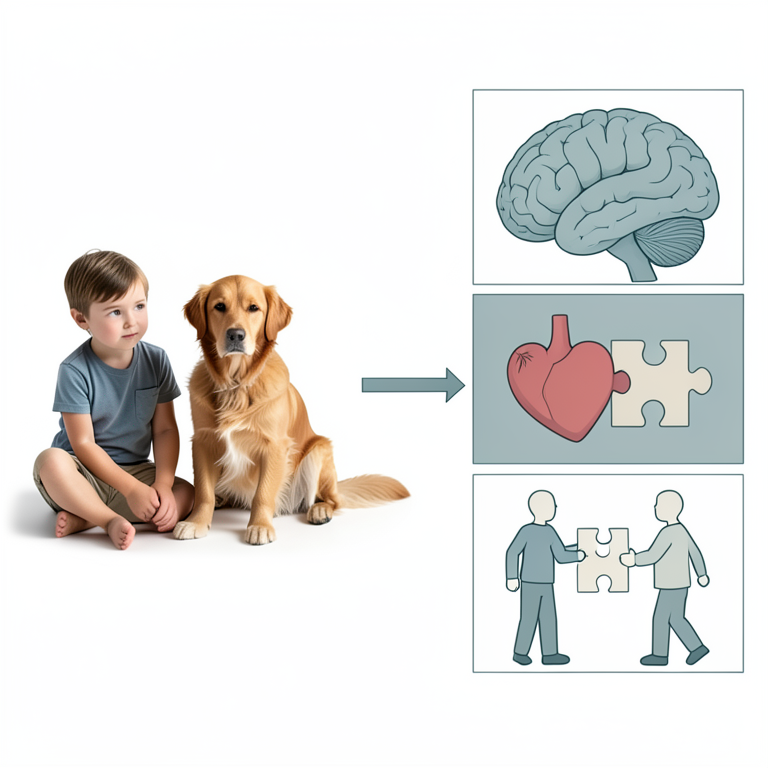
Holistic Benefits of Pet Ownership
AI-generated conceptual illustration (a child and a domestic dog). It explains the idea and does not show study data.
View source evidence ↗Introduction
Pets are present in almost half of households in developed countries. About half of homes in developed countries have pets. Pet ownership has been linked to both health advantages and hazards, according to studies on human-animal interaction. For demonstration and to understand the relationship between owner and pets first we require adequate knowledge. Childhood and adolescence are important life stages because of their impact on learning, behaviour, emotional stability, and overall health throughout life. Attachment theory and relationship psychology both contend that social relationships are essential to a child's and adolescent's development. However, most of the research on child development has focused on how kids interact and relate to other people. Nonetheless, owning pets is widespread. According to recent data, 46% of homes in Britain and 68% of households in the United States Hazards associated with pet ownership include zoonotic infections, bites, and allergies and asthma. The emotional, behavioural, cognitive, educational, and social components of human development may all be impacted by interactions with animals. According to research in Human-Animal Interactions (HAI), which examines the mutual and dynamic relationships between people and animals and the ways in which these interactions may affect the physical and psychological health and well-being of both people and their pets, companion animals (including horses, dogs, cats, rabbits, and other rodents) have the potential to promote healthy emotional youth development in many ways. Numerous health practices have been linked to demographic factors as age, gender, socioeconomic level, and ethnicity. The term "youth" development in this study refers to all age groups that fall into the following categories: 0-2 years, 2-5 years, 6-12 years, and 13-18 years for adolescents. There is growing proof that when kids are upset, depressed, or happy, they go to their dogs for consolation, assurance, and emotional support. Therefore, it stands to reason that having companion animals around could promote improved mental health and lessen symptoms of anxiety and despair. This decrease in psychological stress for people who interact with animals may be partially explained by physiological processes, such as the activation of the oxytocin system. If the primary carer consistently satisfies the pet attachment behaviours of the child, the child develops secure internal working models, which are the building blocks of their capacity to form and sustain close relationships and form affectionate bonds with others. Researchers studying public health have recently become particularly interested in the connection between dog ownership and physical exercise. It has been suggested that walking a dog increases physical activity associated with dog ownership. Numerous studies have indicated that walking your dog can lead to an increase in physical activity among individuals. In the case of the research on the health benefits of dog walking, for instance, there might be variations between dog owners and non-owners, resulting in seemingly causal relationships with health outcomes; for instance, healthier, more active individuals might have a higher likelihood of owning a dog. Very few HAI investigations have been able to sufficiently account for potential confounding variables in their conception or analysis.
Relations between child-companion animal attachment/bond and psychosocial health Emotional Health Outcomes
A wide range of emotional health benefits from childhood pet ownership were identified. Anxiety: Anxiety was detected in two investigations as a result of young people owning pets. In an American study of children aged 4-10 years in a paediatric primary care setting, having a pet dog was linked to a lower likelihood of general anxiety (12% of children with dogs met the clinical cut-off value for anxiety compared with 21% of children without dogs), as measured by widely used and validated mental health assessment tools, specifically Panic ("My child gets really frightened for no reason at all"), Separation Anxiety ("My child is afraid to be alone in the house"), and Social phobia/anxiety ("My child is shy").For Generalised Anxiety ("People tell me that my child worries too much") and Significant School Avoidance ("My child is scared to go to school"), there was, however, no indication that there was a difference. On the other hand, pet owners (dog and cat) and nonowners did not vary on validated social anxiety measures in Croatian research of children aged 10 to 15 years. Depression: The impact of pet ownership on depressive symptoms in children and adolescents is another area where research is conspicuously lacking. It is important to exercise caution when interpreting the findings of the research included in this review, as there is probably a tenuous relationship between pet ownership and depression that may be mediated by loneliness or low self-esteem. In addition, there was no difference in the histories of diagnosed mental health issues between children who owned dogs and those who did not. The Paediatric Symptom Checklist 17 (internalising symptoms subscale) used to measure the impact of dog ownership on depressive symptoms in younger children did not reveal any significant effects. Consequently, it is possible to hypothesise that having an animal companion has greater psychological benefits than just owning a pet. Self-Esteem: It has been studied how owning goats affects young people's psycho-social wellness in Western Kenyan society. A qualitative study employing theme analysis discovered that the ownership of goats significantly enhanced the development of pride, selfconcept, and self-worth in orphaned 12-to 17-year-old youngsters. Children who own goats, which are usually kept as property rather than pets, are able to develop better self-images and perspectives on life, as well as more resilience and coping mechanisms, as well as improved social engagement in the community. It is important to acknowledge, though, that owning a goat in this instance may indicate a gain in affluence; as a result, interactions with the animals may not have had a direct impact on child welfare, but rather an escape from poverty. Loneliness: Low self-esteem, anxiety, and depression are probably preceded by loneliness. There is some evidence that having a pet might shield young people from social isolation and loneliness, which may help to ward against depression. Homeless teenagers between the ages of 15 and 23 who owned pets showed lower levels of depression symptoms as well as less symptoms of loneliness overall (UCLA Loneliness Scale score of 1.8, compared to 2.3 among non-pet owners) than their peers who did not own pets. Due to the therapeutic nature and importance of companion animals, a significant number of these young people (53%) recognised the use of pets as a coping mechanism for loneliness.
Factors affecting to psychology and health of children Duration of the bond between children and their companion animals:
Unknown is the possibility that the amount of time kids spend with their companion animals correlates with the strength of their attachment. The children in the trial who had the same dog for five years showed a stronger attachment with them. Additionally, stability was discovered in a six-month period by Mueller et al. (2021) [8] . Longer periods of time spent with companion animals tend to lead to stability or a stronger attachment, according to two longitudinal studies by Endenburg et al. (2014) [2] and Mueller et al. (2021) [8] . Children's age: Examined the relationship between children's age and their attachment to companion animals. They discovered that there was no difference in the level of attachment to companion animals between children ages 6-10 and 11-14 using the IPPA (adapted to companion animals). Children's gender: In the Hirschenhauser et al. (2017) [7] study, girls in the age group of 11-14 did indicate a stronger link, while boys and girls aged 6-10 did not report any differences. In comparison to girls of the same age, just one study found that kindergarten-age boys had a greater attachment with companion animals. For kids aged 6 to 11, this study did not find a gender difference in the bond's strength, nevertheless. Additionally, among the youngsters aged 11 and above, girls reported a closer relationship with companion animals than boys did. Family characteristics: According to Bodsworth and Coleman (2001) [1] , kids from single-parent households bonded with dogs more than kids from two-parent households did. The degree of the companion animal attachment was unrelated to the number of siblings. In the Westgarth et al. ( 2013) [11] study, children who were raised alone reported a closer bond with their favourite companion animal than did children who had siblings.
Mechanisms behind the Benefits
Biophilia Hypothesis: According to the biophilia concept, people are inherently drawn to engage with other living things and the natural world. This relationship can lessen stress and improve psychological well-being. Pets can satisfy this innate desire because they are part of nature and can promote emotional stability and mental wellness. Attachment Theory: As per the principles of attachment theory, dogs can function as comfort and security figures for youngsters. youngsters may develop close relationships with their pets in a similar way to how they do with their parents or other primary carers. These relationships can provide youngsters with resilience and emotional support.
Conclusions
Having a pet is a typical feature of living spaces that could have an impact on health. It is incorrect to think that the factors connected to pet ownership are the same for all types of pets. The emotional, cognitive, behavioural, social, educational, and cognitive development of children and adolescents may be enhanced by pet ownership. Companion animals may benefit and perhaps contribute to the healthy development of children and adolescents, even though most studies conducted to yet have methodological flaws. This is indicated by the pattern of findings across age groups and subpopulations. To yet, little is known about the potential differences in impact that certain pet types may have on behavioural, psychological, and societal issues.
References
11 in the original paper- Bodsworth W, Coleman GJ. Child-companion animal attachment bonds in single and two-parent families. Anthrozoos. 2001;14(4):216-223. doi:10.2752/089279301786999391
- Endenburg N, van Lith HA, Kirpensteijn J. Longitudinal study of Dutch children's attachment to companion animals. Society & Animals: Social Scientific Studies of the Human Experience of Other Animals. 2014;22(4):390-414. doi:10.1163/15685306-12341344
- Esposito L, McCune S, Griffin JA, Maholmes V. Directions in human-animal interaction research: Child development, health, and therapeutic interventions: Human-animal interaction research. Child Development Perspectives. 2011;5(3):205-211. doi:10.1111/j.17508606.2011. 00175.x
- Fogel A. Developing through Relationships: Origins of Communication, Self, and Culture. Chicago, IL, USA: University of Chicago Press, 1993.
- Food UKP. (n.d.). UK pet industry statistics. Retrieved May 31, 2024, from Org.uk website: http://www.pfma.org.uk/statistics/
- Gadomski AM, Scribani MB, Krupa N, Jenkins P, Nagykaldi Z, Olson AL. Pet dogs and children's health: Opportunities for chronic disease prevention? Preventing Chronic Disease. 2015;12(150204):E205. doi:10.5888/pcd12.150204
- Hirschenhauser K, Meichel Y, Schmalzer S, Beetz AM. Children love their pets: Do relationships between children and pets co-vary with taxonomic order, gender, and age? Anthrozoos. 2017;30(3):441-456. doi:10.1080/08927936.2017.1357882
- Mueller MK, Richer AM, Callina KS, Charmaraman L. Companion animal relationships and adolescent loneliness during COVID-19. Animals: An Open Access Journal from MDPI. 2021;11(3):885. doi:10.3390/ani11030885
- Rew L. Friends and pets as companions: strategies for coping with loneliness among homeless youth. Journal of Child and Adolescent Psychiatric Nursing: Official Publication of the Association of Child and Adolescent Psychiatric Nurses, Inc, 2000;13(3):125-132. doi:10.1111/j.1744-6171. 2000.tb00089.x
- Voith VL. The impact of companion animal problems on society and the role of veterinarians. The Veterinary Clinics of North America. Small Animal Practice. 2009;39(2):327-345. doi: 10.1016/j.cvsm.2008.10.014
- Westgarth C, Boddy LM, Stratton G, German AJ, Gaskell RM, Coyne KP, et al. A cross-sectional study of frequency and factors associated with dog walking in 910-year-old children in Liverpool, UK. BMC Public Health. 2013;13(1). doi:10.1186/1471-2458-13-822