
Research article · 2024 · Full text
International Journal of Agriculture Extension and Social DevelopmentProblems of women entrepreneurs in India: A review of literature
Volume 7(6) · Pages 193–204 · DOI: 10.33545/26180723.2024.v7.i6c.690 ↗
Research areasAgricultural Economics and PracticesIndian Economic and Social DevelopmentSocial and Economic Development in India
Abstract
Author-writtenWomen entrepreneurship in India has emerged as a crucial component of the country's economic growth and development. This paper is based on a detailed examination of research papers published between 2010 and 2023. The studies reviewed employed a variety of methodologies, including structured questionnaires, personal interviews, secondary data analysis, and mixed-method approaches. Data sources ranged from primary data collected through surveys and interviews to secondary data obtained from conference papers, academic journals, research articles, books, and websites. Financial constraints, socio-cultural barriers, lack of education and training, and limited government support are recurring themes that hinder the entrepreneurial potential of women. Despite these obstacles, women exhibit strong motivation driven by the desire for independence and economic empowerment. There is need for a multifaceted approach to foster a supportive environment for women entrepreneurs. Improved access to finance through inclusive policies, enhanced training and education, effective communication and implementation of government policies can unlock the untapped potential of women entrepreneurs, leading to substantial economic growth and societal progress.
Summary
Source-checkedPlain-language reading of the full paper, prepared with AI and checked against the text. Each point links to the authors' own words.
Why it matters
- Women's entrepreneurship is considered a vital element for the economic growth and development of India. View evidence ↗
- In India, a woman enterprise is officially defined as one where a woman owns and controls at least 51% of the capital and 51% of the employment is provided to women. View evidence ↗
- Despite an increase in women venturing into business, various challenges continue to limit their full economic impact and potential. View evidence ↗
The question
- The aim of this paper is to assess the problems faced by women entrepreneurs in India by reviewing existing research studies. View evidence ↗
What they did
- The authors conducted a detailed review of 20 research papers published from 2010 to 2023. View evidence ↗
- The reviewed studies used diverse methods, such as personal interviews, structured questionnaires, mixed-method approaches, and secondary data analysis. View evidence ↗
- The reviewed literature provides a broad perspective by covering rural, semi-urban, and urban areas across India. View evidence ↗
What they found
- Financial constraints, specifically difficulties in accessing capital and financial resources, are consistently identified as a major barrier for women entrepreneurs. View evidence ↗
- Socio-cultural barriers, including familial responsibilities, societal expectations, and gender inequality, significantly hinder entrepreneurial pursuits. View evidence ↗
- A common problem is the lack of awareness among women entrepreneurs regarding available entrepreneurial opportunities, financial assistance programs, and government schemes. View evidence ↗
- Women entrepreneurs frequently struggle with product marketing and face intense competition from larger enterprises dominated by men. View evidence ↗
- Despite the barriers, women are strongly motivated to pursue entrepreneurship by a desire for economic empowerment and independence. View evidence ↗
- In one study of rural women, 25% were engaged in agricultural activities and 22% in food businesses. View evidence ↗
- One study found that 26% of the respondents lacked financial security. View evidence ↗
What it means
- The authors conclude that unlocking the potential of women entrepreneurs requires a multifaceted approach including inclusive financial policies, better education and training, and effective implementation of government policies. View evidence ↗
- The authors recommend the use of mentorship programs and community support to improve the success rates of women entrepreneurs. View evidence ↗
Figures & tables
From the original paper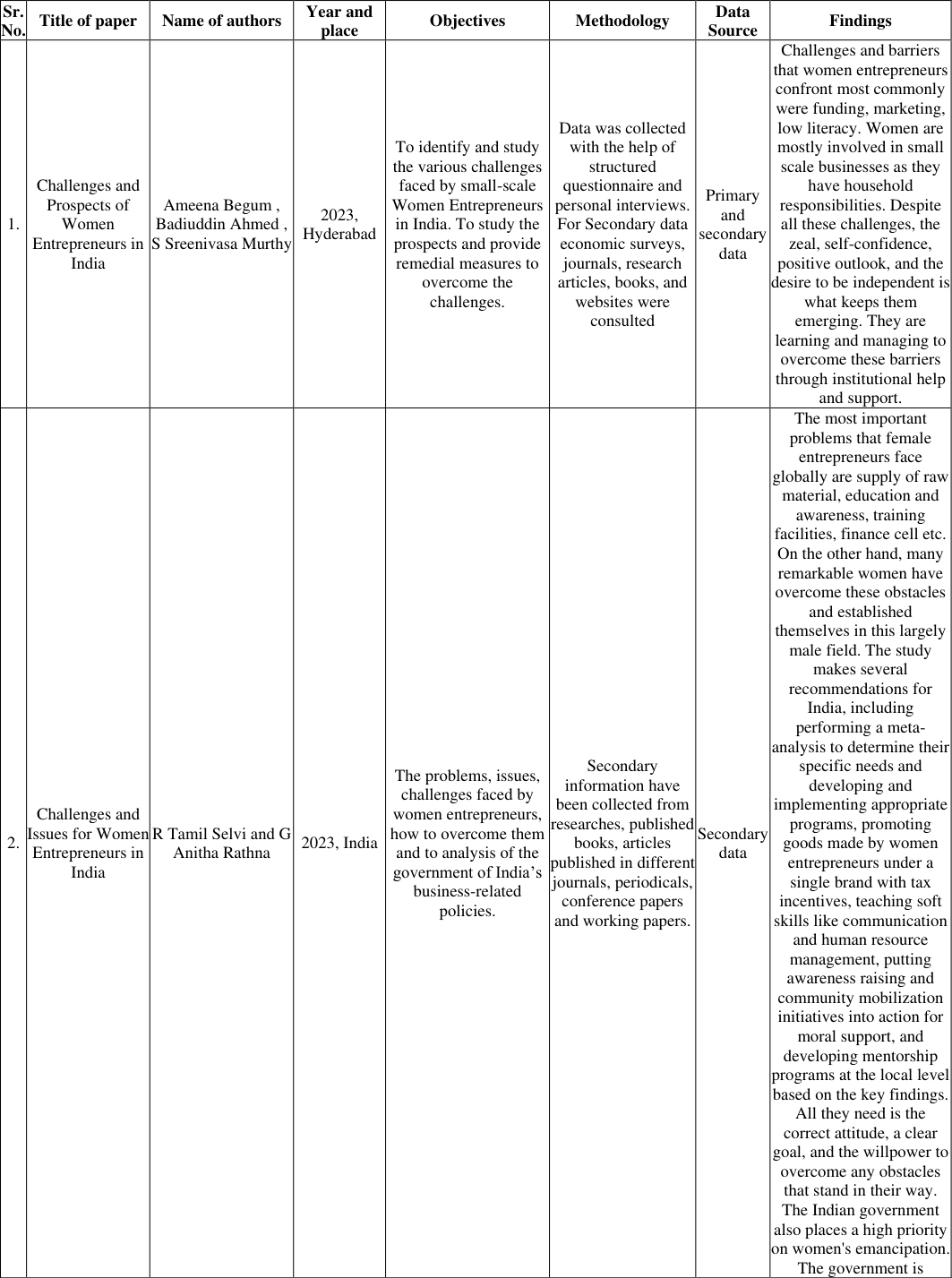 Table 1
Introduction
Women entrepreneurship in India has emerged as a crucial component of the country's economic growth and development. Over the past few decades, there has been a significant increase in the number of women venturing into entrepreneurial activities, driven by a combination of factors including economic necessity, education, and a desire for independence and self-fulfillment. The Government of India defines a woman enterprise as one that is owned and controlled by a woman, with a minimum financial interest of 51% of the capital and providing at least 51% of the generated employment to women. Globally, onethird of entrepreneurial ventures are led by women entrepreneurs. In India, there has been a significant increase in woman entrepreneurship due to economic progress, improved access to education, urbanization, the spread of liberal and democratic culture, and societal recognition. The Indian government has implemented special incentives and initiatives to support the growth of women entrepreneurs, such as the Start-up India and Stand-up schemes, which specifically aim to promote entrepreneurial drive among women. Despite this positive trend, women entrepreneurs continue to face a myriad of challenges that hinder their full potential and impact on the economy (Kaur and Kaur 2020, Kaur and Verma 2021, Murumkar 2015) [8,9,14] . The landscape of women entrepreneurship in India is characterized by diverse socio-economic, cultural, and institutional barriers. These barriers include limited access to finance, inadequate support systems, lack of education and training, socio-cultural constraints, and balancing family responsibilities. Understanding these challenges and identifying effective strategies to overcome them is essential for fostering an environment that supports and nurtures women entrepreneurs. So this paper has been planned to assess the problems encountered by women entrepreneurs in India by reviewing the various studies already done.
Methodology
This paper is based on a detailed examination of 20 research papers published between 2010 and 2023. The studies reviewed employed a variety of methodologies, including structured questionnaires, personal interviews, secondary data analysis, and mixed-method approaches. Data sources ranged from primary data collected through surveys and interviews to secondary data obtained from conference papers, academic journals, research articles, books, and websites. The reviewed papers cover diverse geographical locations within India, including urban, semi-urban, and rural areas, providing a broad perspective on the challenges faced by women entrepreneurs in different contexts. Interview method has been followed to collect primary data from the women entrepreneurs. The secondary sources like books, office records, journals, website etc.., were also used to collect the information needed for this study.
Results and Discussion
Results and Discussion
Both primary and secondary data
There are many women in India who are very successful. Those who take the risk and built their business in proper way will win the race. Some common problems arise in entrepreneurship are due to family and society. Education has helped many women to realize their potential and work accordingly. Development of technology also made women smarter and they also found many innovative opportunities to flourish their business.
There is a significant change in women's attitude towards entrepreneurship, most of them have a positive attitude and wants to open their own business in future.
8. The study analyzes the constraints and challenges faced by the women entrepreneurs in the urban and semi-urban areas of Indore district. The constraints faced by the women entrepreneurs in urban as well as rural/ semi urban areas are quite identical in nature but the degree of intensity varies with regard to different parameters. Among various constraints, the insufficient finance and liquidity along with poor managerial skills are some of the major areas of concern which pose as a big challenge for entrepreneurial development in the region amongst the women.
Exploring
Exploring
Secondary data
Study revealed that woman in advanced market own more than twenty percent of all businesses. In France, women headed one in four firms. In Switzerland, about seventy percent of micro, small and medium enterprises were women accounted. In UK, there were approximately more than one lakh selfemployed women. In China, women founded twenty percent of the businesses since 1978. In Japan, twenty three private firms were established by women. In India women owned businesses were increasing at high rate. Study further revealed the problems of women entrepreneurs in India. The greatest deterrent to women entrepreneurs was that they were women. Patriarchal society was a building block for them. The financial institutions were skeptical about the abilities of women entrepreneurs hindering their loan availing. Family obligations were also holding them back. It was difficult for them to maintain balance between family and business. Another hindrance was their low level of managerial skills and technical know-how. Factor of competitions with male owned businesses was also prevalent. They were also lacking in the knowledge regarding the raw material and had less negotiation skills. Finally high production cost adversely affected the development of women entrepreneurs. Socio-Cultural Barriers: Several studies, including those by Begum et al (2023) [3] and Chordiya (2013) [5] , highlight the socio-cultural barriers that women entrepreneurs face. These include gender inequality, societal expectations, and familial responsibilities that hinder their entrepreneurial pursuits. In particular, rural women face more pronounced socio-cultural challenges, as detailed by Silambarasan et al (2023) [22] and Raheja and Garg (2018) [17] . Financial Constraints: Financial issues are consistently identified as a major barrier. Studies by Ameena Begum et al (2023) [3] and Anju and Chakkachamparabil (2018) [2] underline the difficulties women face in accessing capital and financial resources. Lack of credit facilities and working capital impedes their ability to scale and sustain businesses. Similarly, Saini and Kaur (2019) [18] found financial constraints to be the predominant challenge in Punjab. Lack of Awareness and Education: Many women entrepreneurs lack awareness about government schemes, financial assistance programs, and entrepreneurial opportunities. Study by Gupta and Aggarwal (2015) [6] underscores the need for improved education and awareness to empower women entrepreneurs. Similarly, Silambarasan et al (2023) [22] and Singh et al (2015) [23] suggest that training and education are crucial for overcoming these barriers. Marketing and Competition: Marketing challenges and intense market competition are also prevalent issues, particularly for unregistered and small-scale businesses. Singh et al (2022) [23] both noted that women entrepreneurs often struggle with marketing of their products and facing stiff competition from larger, male-dominated enterprises. Limited Government Support and Awareness:
Despite various government initiatives aimed at promoting women entrepreneurship, many women remain unaware of these opportunities. The studies by Tamil Selvi and Anitha Rathna (2023) [20] and Kaur P and Kaur G (2014) [20] suggested more robust outreach and support mechanisms to bridge this gap.
Prospects and Recommendations
Institutional Support: The need for institutional support is a recurring recommendation. Begum et al.
(2023) [3] and Gupta and Aggarwal (2015) [6] suggested governmental and non-governmental organizations should provide targeted training, financial support, and mentorship programs to help women overcome these barriers. Education and Training: Educational initiatives are critical for empowering women entrepreneurs. Studies by Selvi and Anitha Rathna (2023) [20] and Raheja and Garg (2018) [17] emphasize the importance of vocational training and entrepreneurship education to build confidence and skills among women. Community Mobilization and Mentorship: Community support and mentorship programs can significantly impact women's entrepreneurial success. Selvi and Anitha Rathna (2023) [20] recommend community mobilization initiatives for moral support and localized mentorship programs to address specific needs and challenges. Policy and Advocacy: Advocacy for women's entrepreneurship is crucial for long-term change.
Jahanshahi et al (2010) [7] highlight the role of policy changes in promoting gender equality in entrepreneurship and creating a more supportive environment for women entrepreneurs.
Conclusion
Women entrepreneurship across various regions in India reveals a consistent pattern of challenges intertwined with unique regional nuances. Financial constraints, sociocultural barriers, lack of education and training, and limited government support are recurring themes that hinder the entrepreneurial potential of women. Despite these obstacles, women exhibit strong motivation driven by the desire for independence and economic empowerment. There is need for a multifaceted approach to foster a supportive environment for women entrepreneurs. Improved access to finance through inclusive policies, enhanced training and education, effective communication and implementation of government policies can unlock the untapped potential of women entrepreneurs, leading to substantial economic growth and societal progress. By focusing on these areas, stakeholders can create a more inclusive entrepreneurial ecosystem that empowers women, leverages their capabilities, and fosters sustainable development.
Figures and tables from the paper
References
23 in the original paper- Anjali C. Exploring constraints faced by women entrepreneur in India: An overview. Asian J Agric Ext Econ Sociol. 2020;38(8):46-50.
- Anju PA, Chakkachamparabil EP. Problems encountered by women entrepreneurs: With special reference to Thrissur district Kerala. Vistas. 2018;7(1):16-27.
- Begum A, Ahmed B, Murthy SS. Challenges and prospects of women entrepreneurs in India. Eur Chem Bull. 2023;12(S2):656-667.
- Cheeroli J, Kumar VS. A study on the problems and prospects of micro enterprises with special reference to Kondotty Taluk. J Bus Manag. 2018;20(2):15-40.
- Chordiya KD. Problems Faced by Women Entrepreneurs in Rural Areas. J Manag Res. 2013;2(1):389-96.
- Gupta S, Aggarwal A. Opportunities and challenges faced by women entrepreneurs in India. IOSR J Bus Manag (IOSR-JBM). 2015;17(8):69-73.
- Jahanshahi AA, Pitamber BK, Nawaser K. Issues and challenges for women entrepreneurs in global scene, with special reference to India. Aust J Basic Appl Sci. 2010;4(9):4347-56.
- Kaur A, Kaur L. Problems faced by dairy farmers in Punjab: A study of Sri Muktsar Sahib and Mansa districts. Int J Agric Sci. 2020;16(1):38-44.
- Kaur M, Verma JK. Problems and Motivations for Women Entrepreneurs in Punjab, India. Turk Online J Qual Inq (TOJQI). 2021;12(3):762-777.
- Kaur P, Kaur G. Problems and prospects of women entrepreneurship in Punjab. Agric Update. 2014;9(2):174-177.
- Kaur P, Mavi K. Female agricultural labourers in rural Punjab: Present status and problems. Indian Res J Ext Educ. 2015;15(4):114-117.
- Kumar VL, Sathyanarayana N, Santhosh Y. A Study on problems faced by women entrepreneurs in and around Tirupati, Andhra Pradesh. Adarsh J Manag Res. 2022;14(1):145-162.
- Kumari A, Laxmikant. Participation of rural women in vegetable production. J Adv Res Soc Sci. 2015;6(2):258-260.
- Pavithra R. Socio-economic condition of female agricultural labourers-With special reference to Mandya district. Int J Manag Soc Sci. 2017;7(3):458464.
- Pradeepika. Women entrepreneurs in India: Sociocultural issues and challenges. Int J Dev Res. 2017;7(12):17403-17408.
- Raheja P, Garg A. Women entrepreneurship in rural sector. Int J Acad Res Dev. 2018;3(1):529-533.
- Saini R, Kaur B. Entrepreneurial Motivation and Challenges: A Study on Women Entrepreneurs in Punjab. Indian J Econ Dev. 2019;15(4):533-540.
- Salem S. A study on the problems faced by women entrepreneurs. J Emerg Technol Innov Res. 2020;7(11):6-11.
- Sheweta G, Vijay K, Ravi C. Challenges and opportunities for women entrepreneurs in India. Int J Res Anal Rev. 2018;5(3):396-403.
- Silambarasan D, Sabesh R, Ramprasath S. Issues and challenges faced by rural women entrepreneurs in India. Iconic Res Eng J. 2023;7(1):289-292.
- Singh P, Sharma S, Kaur L. Socio-familial and marketing problems faced by women entrepreneurs: An analytical analysis. Indian Res J Ext Educ. 2022;22(2):90-95.
- Subathra C, Krishnakumari S, Bharathivasu S. Womens' contribution in agriculture and allied activities. Int J Manag. 2020;11(12):2875-2881.
- Tiwari N. Economic and technological constraints facing farm women. Int J Rural Stud. 2010;17(1):1-5.
Cited by 1
From OpenAlex, OpenCitations and reference lists read by Scinovex
- Influence of socioeconomic factors on female entrepreneurship: an analysis using structural equation modeling (PLS-SEM) ↗
Rosa Ysabel Bazán Valque, Omer Cruz Caro, William Humberto Portilla Bazán, Elías Alberto Torres Armas, Cesar Jefferson Samillan Vasquez, Carlos Andrés Rojas Puerta · Frontiers in Sociology · 2025
Female entrepreneurship has emerged as a strategy for reducing poverty, generating employment opportunities, and promoting gender equality, particularly in rural areas where structural inequalities persist. However, there is still a limited understanding of how socioeconomic factors influence their development. This study aimed to analyze the influence of these factors on women-led entrepreneurship, considering dimensions such as family income, social empowerment,…
❝ 11PDF