
Research article · 2024 · Full text
International Journal of Agriculture Extension and Social DevelopmentEntrepreneurial behavior of rural women in the Cooch-Behar district of West Bengal
Volume 7(6S) · Pages 27–30 · DOI: 10.33545/26180723.2024.v7.i6sa.683 ↗
Research areasEntrepreneurship Studies and InfluencesIndian Economic and Social DevelopmentInnovation and Socioeconomic Development
Abstract
Author-writtenWomen have a natural skill by birth in managing and creativity which was not explored before. Women entrepreneurs are playing a great role in society, especially women from the rural sector. The present study was conducted at four villages namely Angrakata, Dharma Barerkuthi and Ghughumari, Chhat Elajan under Cooch Behar II and I block respectively in Cooch Behar district of West Bengal. Purposive sampling method was followed in the case of selecting the study area and random sampling procedure was followed for the selection of the respondents. A sample of total 100 respondents was selected from the four selected villages and pre-tested interview schedule was used for the data collection through personal interview method. Statistical techniques such as percentage, arithmetic mean, standard deviation, coefficient of correlation were used to analyze the data. The findings of the study revealed that the majority of the respondents (79%) belonged to the middle age category, the majority of the respondents (35%) had education up to primary school, 56 percent belonged to joint family, 58 percent had a medium level of annual income, and the majority of the respondents (66%) belonged to the Schedule Caste category, 33 percent of respondents identified labour as their primary occupation. The majority of the respondents (63%) are married. The study revealed that majority of the respondents (74%) had medium level of knowledgeability with medium innovativeness (85%), achievement motivation (76%), decision making ability (65%), risk taking ability (58%), low persistence level (50%), low level of manageability (38%), Medium level of hope of success (42%) with Medium level of feedback usage(62%). It could be observed that family type and annual income had positive and significant relationship with entrepreneurial behavior at 5% level of significance. On the other hand, age, education, social category and marital status showed positive and non significant relationship with entrepreneurial behaviour of rural women in the study area.
Summary
Source-checkedPlain-language reading of the full paper, prepared with AI and checked against the text. Each point links to the authors' own words.
Why it matters
- Rural women entrepreneurs contribute to societal development by creating employment for themselves and others. View evidence ↗
- In the current digital era, women's entrepreneurship serves as a critical tool for the development of rural regions. View evidence ↗
The question
- The study aimed to analyze the profile characteristics and entrepreneurial behavior of rural women in the Cooch-Behar district of West Bengal. View evidence ↗
What they did
- The researchers used purposive sampling to select two villages per block and random sampling to select 25 women per village, totaling 100 respondents. View evidence ↗
- Data was collected through a pre-tested interview schedule administered via personal interviews. View evidence ↗
- The data were analyzed using frequency, percentage, arithmetic mean, standard deviation, and correlation coefficients. View evidence ↗
What they found
- The majority of the respondents (79%) were in the middle age category. View evidence ↗
- The most common education level among respondents was primary education (35%), followed by those who could read and write (22%). View evidence ↗
- More than half of the rural women (56%) lived in joint families. View evidence ↗
- Most of the respondents (66%) belonged to the Schedule Caste category. View evidence ↗
- A majority of the women (74%) exhibited a medium level of knowledgeability. View evidence ↗
- The highest proportion of respondents (85%) showed a medium level of innovativeness. View evidence ↗
- Most respondents (76%) had a medium level of achievement motivation. View evidence ↗
- Half of the respondents (50%) were found to have a low level of persistence. View evidence ↗
- Family type and annual income were found to have a positive and significant relationship with entrepreneurial behavior at the 0.05 level. View evidence ↗
- Age, education, social category, primary occupation, and marital status showed positive but non-significant relationships with entrepreneurial behavior. View evidence ↗
What it means
- The authors conclude that entrepreneurship development programs focusing on the identified behavioral parameters are necessary to empower rural women. View evidence ↗
- The authors recommend increasing awareness of government subsidies and schemes to help women mitigate economic risks and increase their entrepreneurial potential. View evidence ↗
Visual summary
2 visualsIllustrations explain the paper; charts are replotted from the paper's own table values.
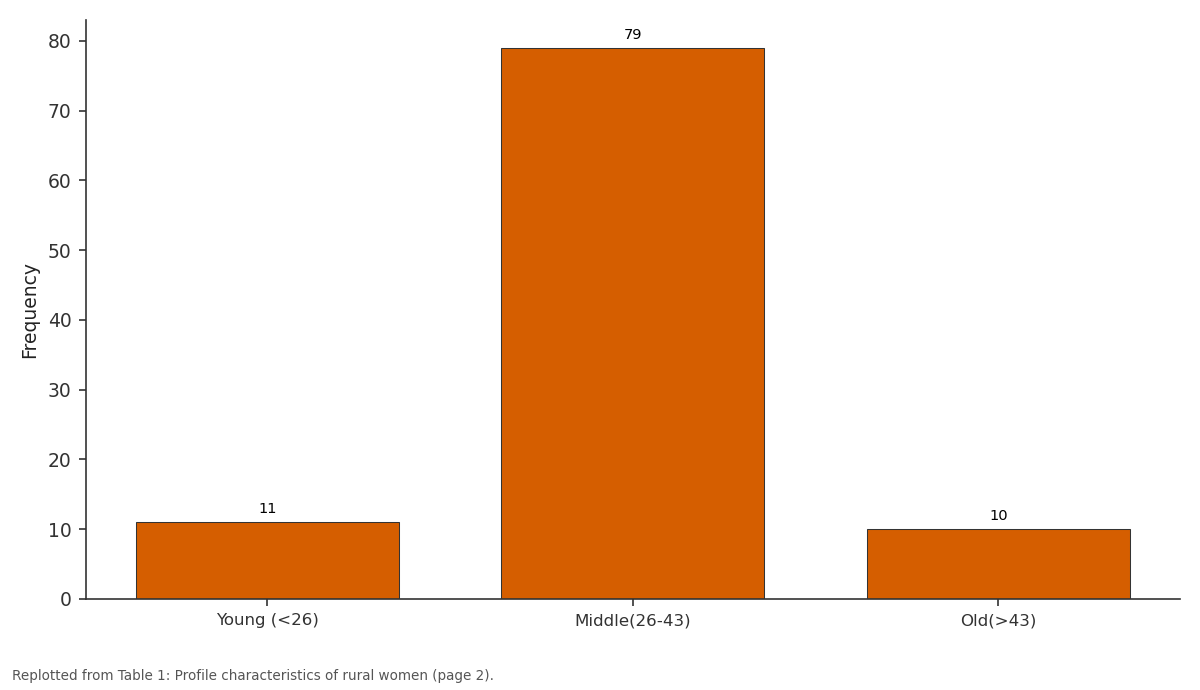
Frequency: Young (<26) vs Middle(26-43) vs Old(>43)
Replotted from Table 1 (page 2) of the original paper. Every bar is the paper's own table value.
View source evidence ↗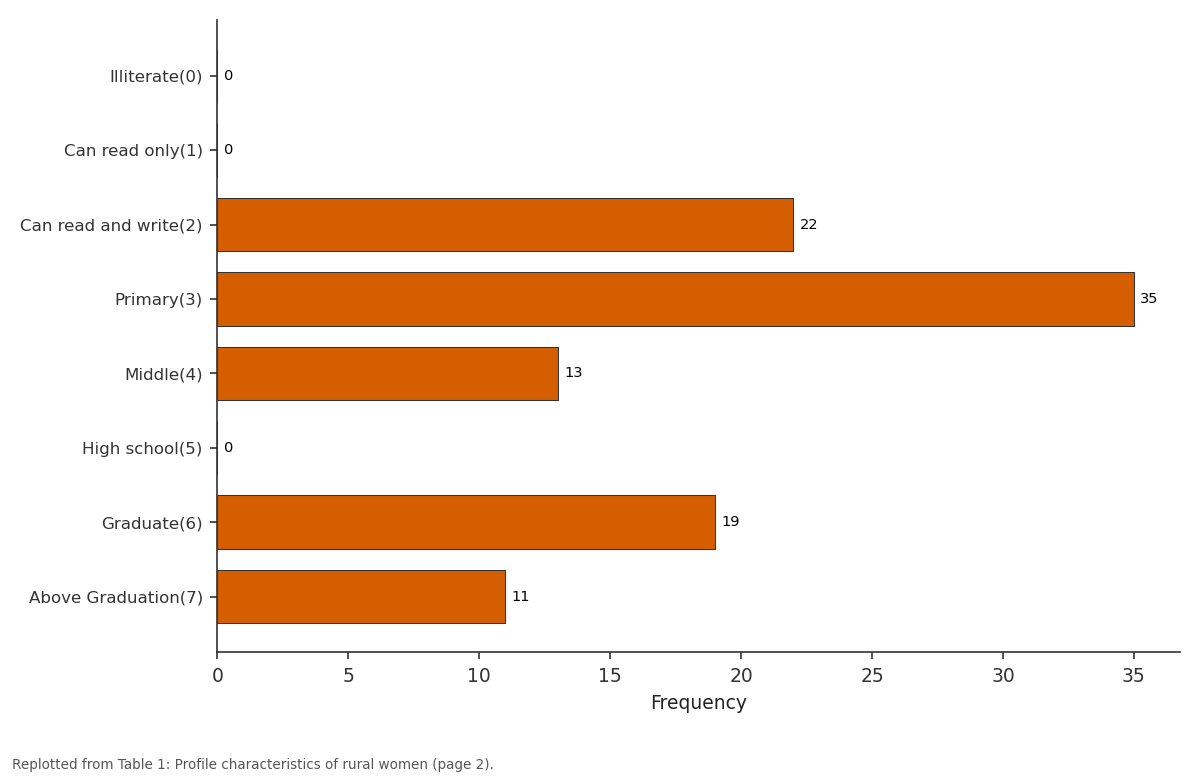
Frequency: Illiterate(0) vs Can read only(1) vs Can read and write(2) vs Primary(3) vs Middle(4)
Replotted from Table 1 (page 2) of the original paper. Every bar is the paper's own table value.
View source evidence ↗Figures & tables
From the original paper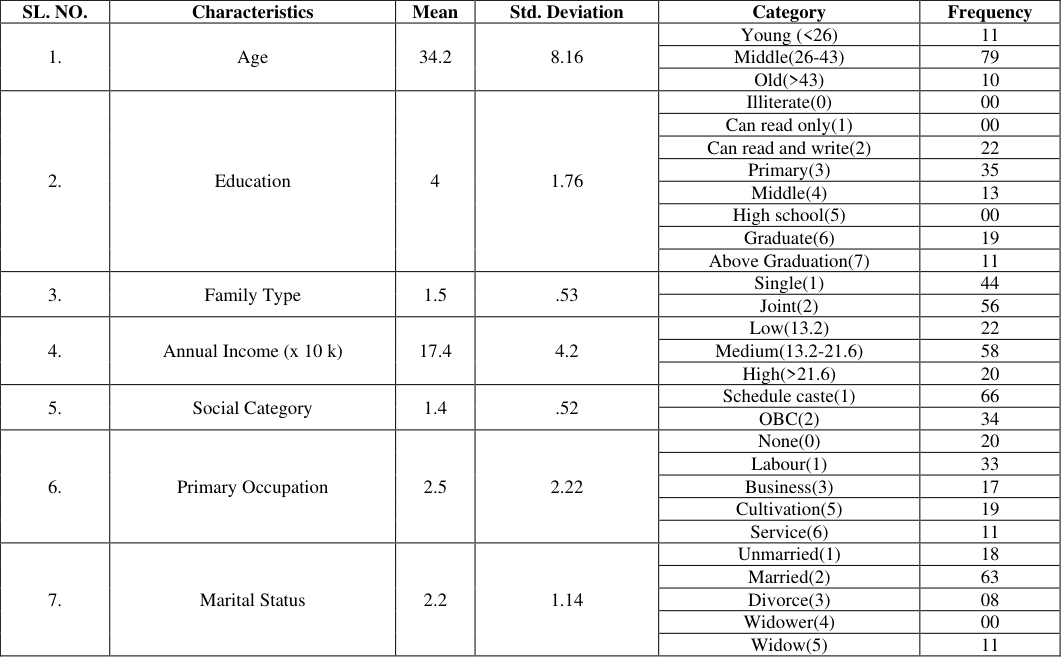 Table 1
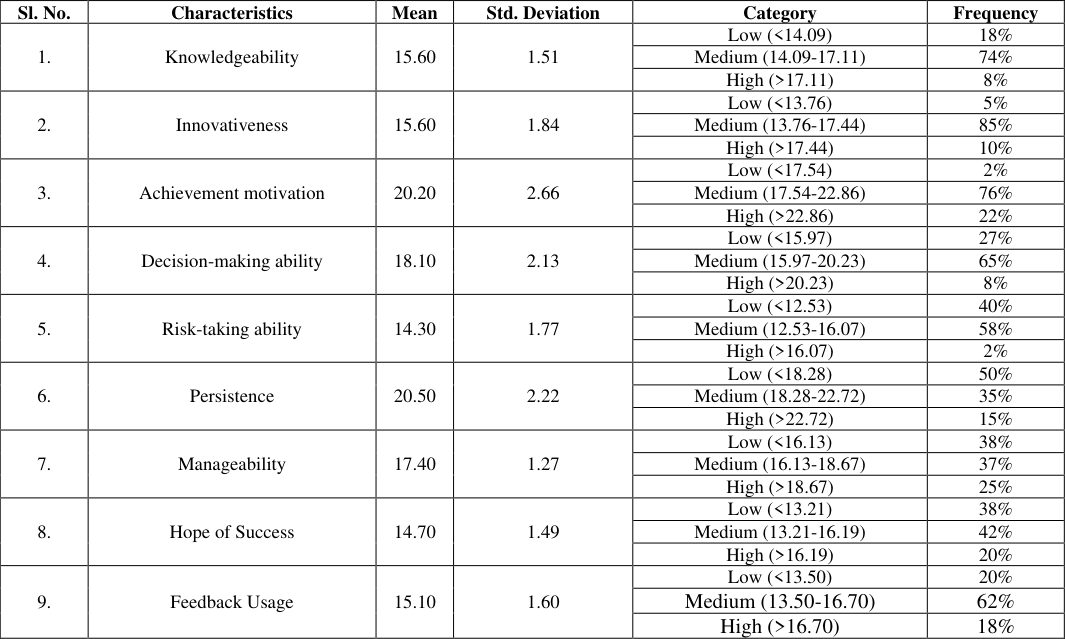 Table 2
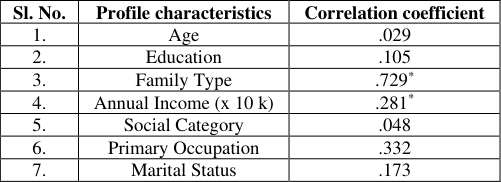 Table 3
Introduction
An entrepreneur is one who organizes, operates, and assumes the risk in a business venture with the expectation of making a profit. The word 'Entrepreneur' came from the French word 'Etreprendre', which means "to do something". Ahmed et al. (2010) [2] described entrepreneurs as people who have the goal to start a new business by using innovation as a tool to progress their business. Women have a natural skill by birth in managing and creativity which was not explored before. Beyond the romantic lens of rural women wearing colorful traditional clothes, traveling distances to carry pots of water to their homes, there is a new breed of ambitious women who dream to be the decision-makers generating incomes that feed their families and beyond their own. Entrepreneurship for rural women can be a game changer for them. Women entrepreneurs are playing a great role in society, especially women from the rural sector as they are not only giving job themselves but also to others which helps in the development of the society. Women entrepreneurs have huge potential to play a crucial role in an emerging economy like India taking advantage of globalization and a technology-driven ecosystem, women's entrepreneurship, in today's digital age, is a very important tool for development in rural areas.
Materials and Methods
The present study was conducted in Cooch Behar I and II blocks of the Cooch Behar district of West Bengal. The blocks in Cooch Behar district were selected purposefully as they have easy access. Two villages were selected purposively from the each selected block respectively and 25 rural women (respondents) were selected from each village randomly. In this way, total one hundred (100) in the study area constituted the sample for this study. The pre-tested interview schedule was used to get information on profile characteristics and entrepreneurial behaviour of rural women. Statistical tools such as frequency, percentage, arithmetic mean, standard deviation, co-efficient of correlation were used for analyze of data. Slightly modified scale of Chaudhary et al. (2007) [5] was used to measure the www.extensionjournal.com entrepreneurial behaviour of rural women. The scale is comprised of nine entrepreneurial components i.e. knowledgeability, innovativeness, achievement motivation, decision making ability, Risk-taking ability, Persistence, Manageability, Hope of Success and Feedback Usage.
Results and Discussion
Results and Discussion
Profile characteristics of rural women
The findings related to profile characteristics of rural women has been presented in Table 1. It shows that majority of the rural women (79%) belonged to middle age category, whereas, 11 per cent belonged to young age and 10 per cent belonged to old age category.
| SL. NO. | Characteristics | Mean | Std. Deviation | Category | Frequency |
|---|---|---|---|---|---|
| 1. | Age | 34.2 | 8.16 | Young (<26) | 11 |
| Middle(26-43) | 79 | ||||
| Old(>43) | 10 | ||||
| 2. | Education | 4 | 1.76 | Illiterate(0) | 00 |
| Can read only(1) | 00 | ||||
| Can read and write(2) | 22 | ||||
| Primary(3) | 35 | ||||
| Middle(4) | 13 | ||||
| High school(5) | 00 | ||||
| Graduate(6) | 19 | ||||
| Above Graduation(7) | 11 | ||||
| 3. | Family Type | 1.5 | .53 | Single(1) | 44 |
| Joint(2) | 56 | ||||
| 4. | Annual Income (x 10 k) | 17.4 | 4.2 | Low(13.2) | 22 |
| Medium(13.2-21.6) | 58 | ||||
| High(>21.6) | 20 | ||||
| 5. | Social Category | 1.4 | .52 | Schedule caste(1) | 66 |
| OBC(2) | 34 | ||||
| 6. | Primary Occupation | 2.5 | 2.22 | None(0) | 20 |
| Labour(1) | 33 | ||||
| Business(3) | 17 | ||||
| Cultivation(5) | 19 | ||||
| Service(6) | 11 | ||||
| 7. | Marital Status | 2.2 | 1.14 | Unmarried(1) | 18 |
| Married(2) | 63 | ||||
| Divorce(3) | 08 | ||||
| Widower(4) | 00 | ||||
| Widow(5) | 11 |
Table text extracted from the original PDF; superscript letters are shown inline. The original table image is below.
View original table image
The data regarding education of the rural women were 35 per cent were having primary education, followed by 22 per cent can read and write. Furthermore, 19 per cent rural women were belonged to graduates.11 per cent were belonged to above graduation category. Education helps the rural women to collect new information required for different enterprise. Generally, in rural areas, women are not allowed to higher education and indulged more in household activities. Thus, it can be concluded that mostly rural women were educated up to primary level of education which enable them to develop entrepreneurial competencies.
Regarding family type, 56 per cent rural women belonged to joint family followed by single family (44%). This might be due to the fact that rural family has many activities which cannot be managed by a single person. The results regarding annual income show that the majority of the respondents are under the medium income group category (58%) followed by low income group category (22%) and high income group category (20%).The result indicates that the majority of the respondents are from the medium income group family and economically disadvantaged and trying to improve their livelihood. The data related to social category show that majority of the rural women respondents belong to Schedule Caste category (66%) followed by OBC Caste (34%) in the study area. It is indicative that most of the respondents are belongs to SC category in the study area and they may get more services from the government sector in case of establishing agricultural enterprises. The results related to the primary occupation of the respondents depict that the majority of the respondents belong to labour (33%), followed by none (20%), cultivation (19%), business (17%), and service 11%). As the majority of the respondents are trying to improve their livelihood and are not associated with any specified work, they have ample potential to start any enterprise through individual or collective effort.
The findings related to marital status of respondents show that majority of the respondents belong to married (63%), followed by unmarried (18%), widow (11%) and divorce (8%). As majority of the respondents belong to the category married, they are trying to improve their family livelihood. www.extensionjournal.com
Entrepreneurial behaviour of rural women
Entrepreneurial behaviour of rural women is defined as the cumulative outcome of nine components viz. knowledgeability, innovativeness, achievement motivation, decision making ability, risk taking ability, persistence, manageability, hope of success,and feedback usage. Entrepreneurial behaviour of rural women was assessed for different components and presented in Table 2.
| Sl. No. | Characteristics | Mean | Std. Deviation | Category | Frequency |
|---|---|---|---|---|---|
| 1. | Knowledgeability | 15.60 | 1.51 | Low (<14.09) | 18% |
| Medium (14.09-17.11) | 74% | ||||
| High (>17.11) | 8% | ||||
| 2. | Innovativeness | 15.60 | 1.84 | Low (<13.76) | 5% |
| Medium (13.76-17.44) | 85% | ||||
| High (>17.44) | 10% | ||||
| 3. | Achievement motivation | 20.20 | 2.66 | Low (<17.54) | 2% |
| Medium (17.54-22.86) | 76% | ||||
| High (>22.86) | 22% | ||||
| 4. | Decision-making ability | 18.10 | 2.13 | Low (<15.97) | 27% |
| Medium (15.97-20.23) | 65% | ||||
| High (>20.23) | 8% | ||||
| 5. | Risk-taking ability | 14.30 | 1.77 | Low (<12.53) | 40% |
| Medium (12.53-16.07) | 58% | ||||
| High (>16.07) | 2% | ||||
| 6. | Persistence | 20.50 | 2.22 | Low (<18.28) | 50% |
| Medium (18.28-22.72) | 35% | ||||
| High (>22.72) | 15% | ||||
| 7. | Manageability | 17.40 | 1.27 | Low (<16.13) | 38% |
| Medium (16.13-18.67) | 37% | ||||
| High (>18.67) | 25% | ||||
| 8. | Hope of Success | 14.70 | 1.49 | Low (<13.21) | 38% |
| Medium (13.21-16.19) | 42% | ||||
| High (>16.19) | 20% | ||||
| 9. | Feedback Usage | 15.10 | 1.60 | Low (<13.50) | 20% |
| Medium (13.50-16.70) | 62% | ||||
| High (>16.70) | 18% |
Table text extracted from the original PDF; superscript letters are shown inline. The original table image is below.
View original table image
Knowledgeability
It is visible from Table 2 that, majority of the rural women (74%) had medium level of achievement motivation whereas 18 per cent had low level of achievement motivation and only 8 per cent had high level of knowledgeability. Women from the selected rural area were found to be in medium to low level of knowledgeability which indicated their low education level.
Innovativeness
The data in Table 2 shows that maximum number of respondents (85%) had medium level of innovativeness, followed by high (10%) and low (5%) level of innovativeness. It might be due to proper education.
Achievement motivation
The data in Table 2 shows that maximum number of rural women (76%) had medium level of innovativeness, followed by high (22%) and low (2%) level of Achievement motivation. Rural women were found to be in medium to high level of achievement motivation which characterized them as successful entrepreneurs.
Decision-making ability
It is apparent from the Table 2 that 65 per cent respondents had medium level of decision making ability, followed by 27 per cent who had low level of decision making ability and 8 per cent had high level of decision making ability.
Risk-taking ability
It is evident from the data in Table 2 that more than half of the rural women (58%) had medium risk orientation, whereas 40 per cent women had low risk orientation and 2 per cent had high risk orientation. Risk bearing ability of an individual depends on its socio-economic, personal and psychological aspects.
Persistence
It is apparent from the Table 2 that 50 per cent respondents had low persistence level, followed by 35 per cent who had medium persistence level and 15 per cent had high persistence level. Rural women were found to be in low to medium persistence level which indicated their low motivation level.
Manageability
The data in Table 2 shows that 38 per cent of rural women had low level of manageability, followed by medium (37%) and high (25%) level of manageability. Rural women were found to be in low to medium level of manageability which indicated their less knowledge about the management of available resources. www.extensionjournal.com
Hope of Success
The data in Table 2 shows that 42 per cent of rural women had medium level of manageability, followed by low (38%) and high (20%) level of manageability. Rural women were found to be in medium to low level of hope of success which indicated their low self confidence level.
Feedback Usage
The data in Table 2 shows that maximum number of rural women (62%) had medium level of Feedback Usage, followed by low (20%) and high (18%) level of Feedback Usage. Rural women were found to be in medium to low level of feedback usage.
Relationship between profile characteristics and Entrepreneurial behaviour of the respondents
Data related to relationship between profile characteristics and entrepreneurial behaviour of rural women are presented in Table 3. It revealed that family type and annual income had positive and significant relationship at 0.05 level of significance, whereas primary occupation had negative and non-significant relationship with entrepreneurial behavior. But age, education, social category, primary occupation and marital status had positive and non-significant relationship with entrepreneurial behaviour of rural women. It indicates that family type and annual income were highly correlated with entrepreneurial behaviour of rural women. Moreover, age and social category did not have much influence on entrepreneurial behaviour of rural women. It might be due to the reason that maximum respondents belong to joint family type. Family members cooperates in doing domestic as well as other farming work, helps in making best decisions, taking actions and boost selfconfidence of a rural woman. Annual income showed positive and significant relationship with entrepreneurial behaviour of rural women. It might be due to reason that economic motivation is a psychological condition of an individual which drives the respondents to strive hard and achieve higher income.
| Sl. No. | Profile characteristics | Correlation coefficient |
|---|---|---|
| 1. | Age | .029 |
| 2. | Education | .105 |
| 3. | Family Type | .729* |
| 4. | Annual Income (x 10 k) | .281* |
| 5. | Social Category | .048 |
| 6. | Primary Occupation | .332 |
| 7. | Marital Status | .173 |
Table text extracted from the original PDF; superscript letters are shown inline. The original table image is below.
View original table image
Conclusions
Entrepreneurial behaviour of a rural woman is depended upon knowledgeability, innovativeness, achievement motivation, decision making ability, risk taking ability, persistence, manageability, hope of success, feedback usage. Thus, effective entrepreneurship development programmes should be initiated on these parameters so that women can empower themselves. The results of the study showed that most of the rural women had medium to low innovativeness, achievement motivation. Therefore, efforts by Agricultural experts, extension agents should plan training programmes for enhancing their potential. The findings indicate that respondents were belong to OBC and SC category. Thus, efforts should be made to educate and aware women about subsidies and other government schemes which enable them to increase their entrepreneurship potential by mitigating economic risk over the investment. It is also inferred from the study that family type and annual income were positively related with entrepreneurial behaviour. The policy makers and training institutes on entrepreneurship should put more emphasis for designing training on these aspects.
Acknowledgement
AcknowledgementThe authors are thankful to the authority of universities for providing the necessary facilities to carry out this work.
References
4 in the original paper- Ahmed I, Nawaz MM, Ahmed Z, Usman A, Rahman W, Ahmed N. Determinants of students entrepreneurial career intentions: evidence from business graduates. European J. of Social Sciences. 2010;5(2):14-22.
- Balasaravanan K, Vijayadurai J. Entrepreneurial Behavior among Farmers -An empirical Study. IJEMR 2012;2(1):2249-2585.
- Kholiya M, Bhardwa N. Entrepreneurial behaviour of dairy farm women in Nainital district of Uttarakhand. Indian Journal of Dairy Science 2020;73(2):160-166.
- Ray M, Rahaman M. Role of socio-cultural and economic characteristics on fertility choices in Cooch Behar district, West Bengal. Asian Journal of Research in Social Sciences and Humanities. 2017;7(9):202-210.