
Research article · 2024 · Full text
International Journal of Agriculture Extension and Social DevelopmentConstraints and suggestions by the coconut growers in Tumkur district of Karnataka
Volume 7(6) · Pages 131–135 · DOI: 10.33545/26180723.2024.v7.i6b.679 ↗
Research areasAgricultural Economics and PracticesSocial and Economic Development in IndiaLivestock Management and Performance Improvement
Abstract
Author-writtenThe present study on Constraints and Suggestions by the randomly selected 120 coconut growers from Tiptur, Turuvekere, Chikkanayakanahalli and Sira taluks of Tumkur district was conducted during the year 2022-23. The research objective was to enlist the constraints faced by the coconut growers and to seek their suggestions to overcome them. Overall it was disclosed that coconut growers faced constraints majorly in pest & diseases attack in case of production constraints (Rank I) followed by high cost of inputs (Rank II) and then by poor irrigation facility (Rank III). In case of financial constraints inadequate credit was major constraint (Rank I) followed by insufficient repayment time (Rank II) and then followed by inadequate subsidy (Rank III). In the event of labour constraints major constraint was non-availability of climbers for carrying out plant protection & harvesting activities (Rank I) followed by high labour wages (Rank II) and then followed by non-availability of labours timely (Rank III). In the instance of market related constraints lack of remunerative price for coconut ranked first (Rank I) then next by lack of co-operative marketing (Rank II) and then followed by lack of market information (Rank III) were major constraints. In case of extension related constraints lack of timely technical advice on coconut farming (Rank I) followed by lack of farmer training programmes about coconut farming (Rank II) and then followed by insufficient extension activities like demonstrations, farmers group discussions, Kisan melas etc. by extension agency (Rank III) were major constraints experienced by the coconut growers. It was also found that among overall coconut growers significant number of coconut growers suggested providing good market prices which was seen ranked top (Rank I) followed by educating & make available cost effective simple technologies for pest and disease management (Rank II) followed by educating about the labour saving technologies like mulching, coconut climbing machineries (Rank III).
Summary
Source-checkedPlain-language reading of the full paper, prepared with AI and checked against the text. Each point links to the authors' own words.
Why it matters
- India is the global leader in coconut production, accounting for approximately 31% of the world's total output. View evidence ↗
- Tumkur district is a critical hub for coconut in Karnataka, providing nearly 30% of the state's production and 29% of its cultivation area. View evidence ↗
- Agricultural extension services can improve farming outcomes by identifying the specific constraints growers face and incorporating their suggestions. View evidence ↗
The question
- The study aimed to identify the various constraints encountered by coconut growers and gather their suggestions for overcoming these hurdles. View evidence ↗
What they did
- The researchers used an ex-post-facto research design in Tumkur district, Karnataka, during the 2022-23 period. View evidence ↗
- Constraints were categorized into five domains: production, finance, labour, market, and extension. View evidence ↗
What they found
- The primary production constraint was pest and disease attacks, followed by the high cost of inputs and poor irrigation facilities. View evidence ↗
- Financial hurdles were led by inadequate credit, followed by insufficient repayment time and inadequate subsidies. View evidence ↗
- The most significant labour constraint was the lack of available climbers for harvesting and plant protection, followed by high wages and lack of timely labour. View evidence ↗
- Market-related issues were dominated by a lack of remunerative prices, followed by a lack of co-operative marketing and insufficient market information. View evidence ↗
- Extension constraints were primarily the lack of timely technical advice, followed by a lack of training programs and insufficient extension activities like demonstrations. View evidence ↗
- Growers' top suggestions for improvement were providing better market prices, introducing cost-effective pest/disease management, and educating them on labour-saving technologies. View evidence ↗
What it means
- The authors conclude that collaborative efforts between growers, policymakers, and extension services are necessary to develop targeted interventions that empower farmers. View evidence ↗
Visual summary
3 visualsIllustrations explain the paper; charts are replotted from the paper's own table values.
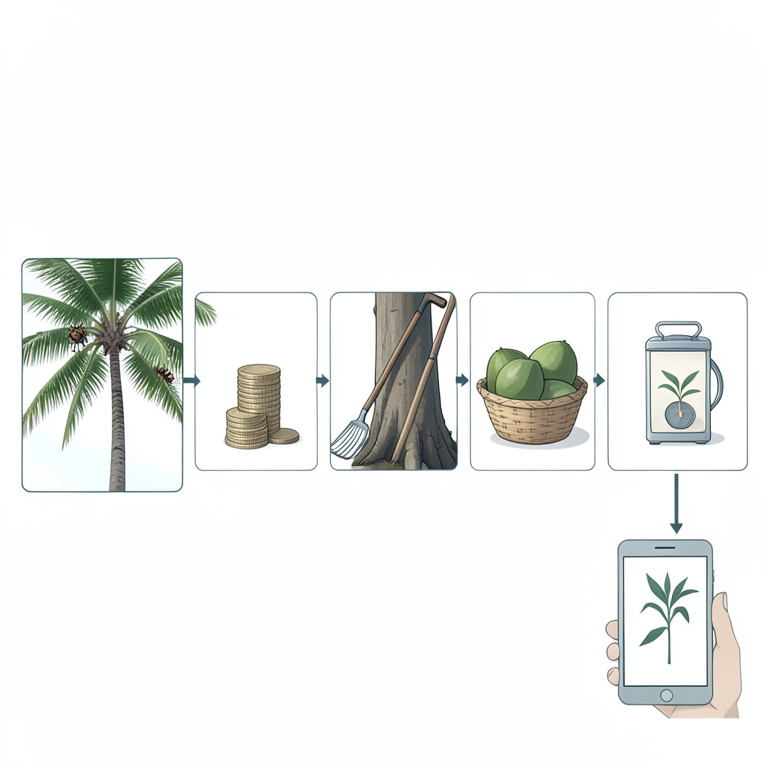
Categorized Constraints of Coconut Growers
AI-generated conceptual illustration (Coconut palm trees in a plantation). It explains the idea and does not show study data.
View source evidence ↗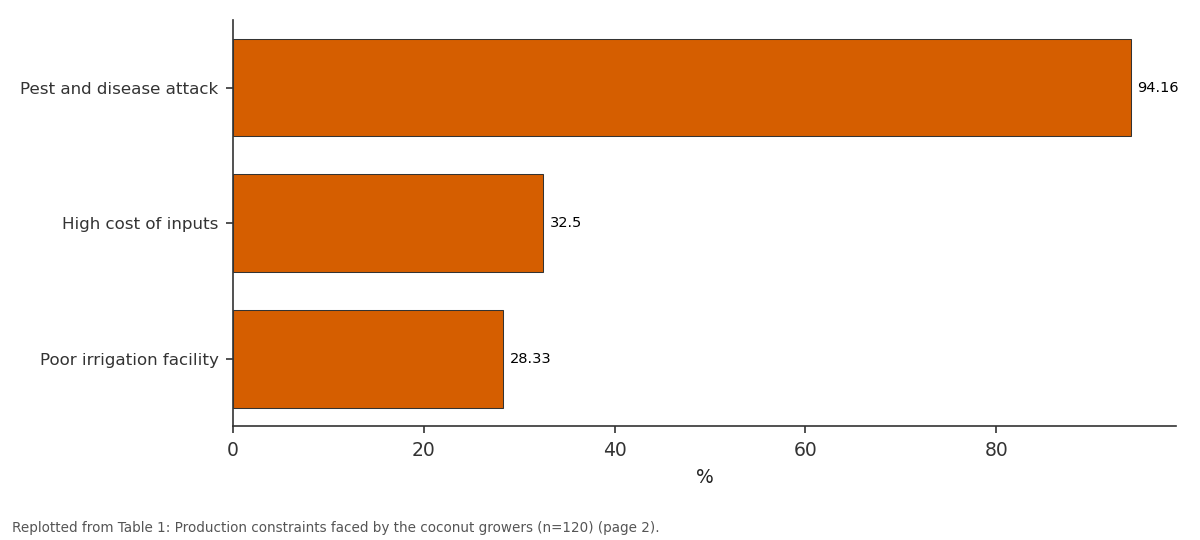
%: Pest and disease attack vs High cost of inputs vs Poor irrigation facility
Replotted from Table 1 (page 2) of the original paper. Every bar is the paper's own table value.
View source evidence ↗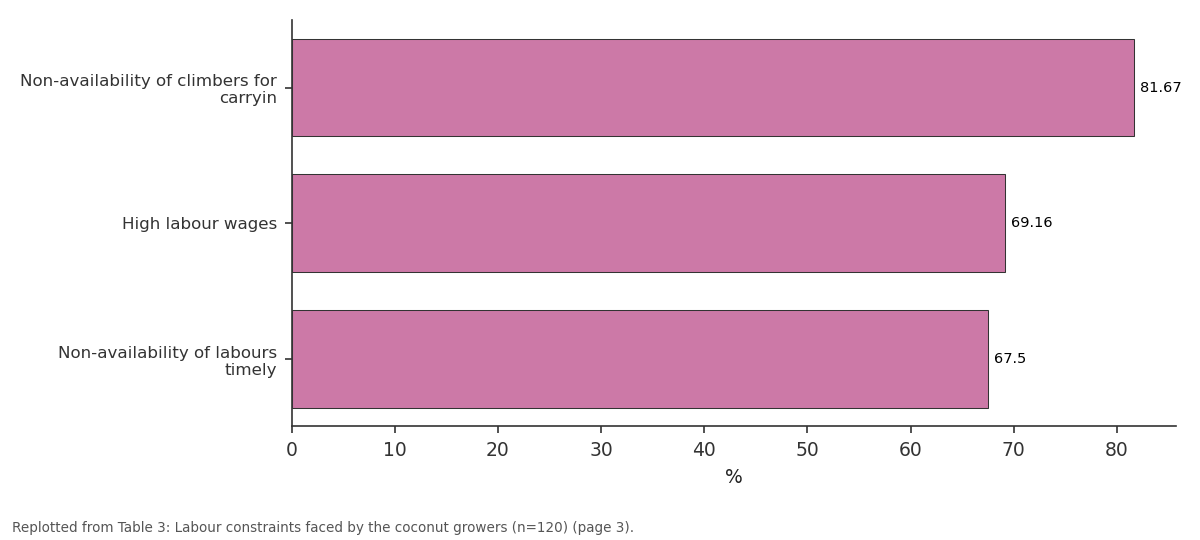
%: Non-availability of... vs High labour wages vs Non-availability of...
Replotted from Table 3 (page 3) of the original paper. Every bar is the paper's own table value.
View source evidence ↗Figures & tables
From the original paper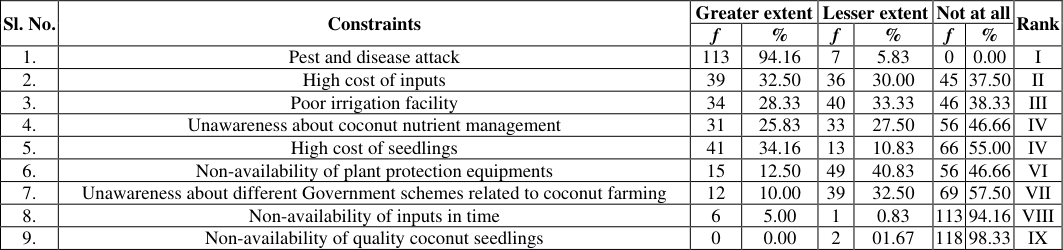 Table 1
 Table 2
 Table 3
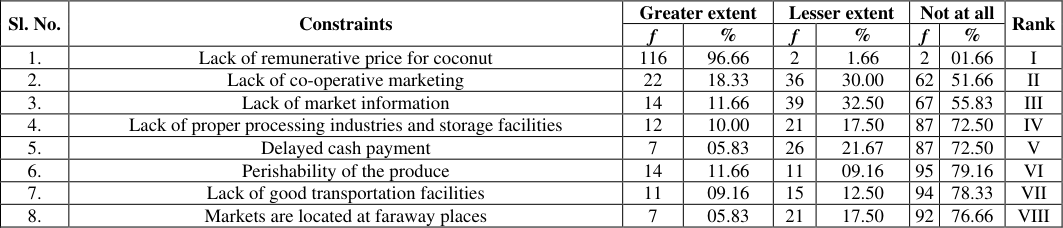 Table 4
 Table 5
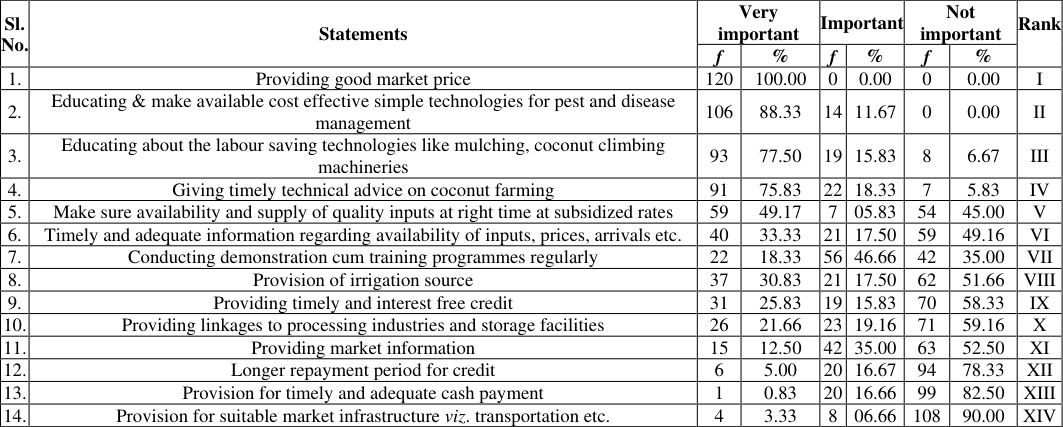 Table 6
Introduction
Agriculture serves as one of the important parts of India's economy, providing livelihoods for a significant portion of the population while contributing substantially to the nation's Gross Value Added (GVA). Plantation crops, in particular, stand as pillars of growth and development, contributing not only to economic prosperity but also fostering socio-economic advancement across various states. Among these crops, coconut cultivation holds a prominent position, symbolizing resilience, versatility and cultural significance within the agricultural landscape. In botanical terms, the coconut palm, scientifically known as Cocos nucifera, belonging to the monotypic genus Cocos within the Arecaceae family, holds a unique position as the only living species of its genus. Despite its colloquial classification as a "nut," the coconut fruit technically resembles a drupe. Its significance exceeds botanical classification, as the coconut holds cultural, economic and nutritional importance in India. India stands as the world's largest producer boasting nearly 31% share of global coconut production (Coconut Development Board 2021) [1] .
Within the Indian context, coconut cultivation assumes heightened significance, with Karnataka emerging as a prominent hub for coconut production. Tumkur district, often referred to as the 'Kalpatharu Nadu' or the 'Land of Coconuts,' stands at the forefront contributing significantly to the state's coconut output. This district alone contributes around 29% of the total coconut cultivation area and nearly 30% of production in the state (Coconut Development Board 2021-22) [2] . The district's coconut growers navigate a myriad of challenges and opportunities inherent in the cultivation of this multipurpose crop, impacting their livelihoods and the broader socio-economic development of coconut growers of the region. Here Agricultural extension services can become instrumental in driving positive change and fostering agricultural development by understanding the constraints, they face and soliciting their recommendations which are also crucial steps towards fostering agricultural sustainability and enhancing the well-being of farming communities by disseminating knowledge, offering technical assistance and advocating for best practices. www.extensionjournal.com With this backdrop, this research paper seeks to study the constraints encountered by coconut growers in Tumkur district and elicit their suggestions to overcome these hurdles. By shedding light on the challenges and suggestions of coconut farmers, this study aims to inform policy formulation, extension services and stakeholder interventions aimed at nurturing sustainable agricultural development in the region.
Materials and Methods
In the present investigation Ex-post-facto research design was used. The study was conducted in Tumkur district of Karnataka in the year 2022-23. Tumkur district was selected purposively, because it is one of the top coconut growing districts in Karnataka state and also coconut cultivation is being taken up in most of the taluks of the district. Out of ten taluks in Tumkur district, Tiptur, Turuvekere, Chikkanayakanahalli and Sira taluks were selected purposively considering the highest and lowest productivity. Thus, by using simple random sampling thirty coconut growers from each selected taluk were chosen. From four taluks a total sample constituted was 120 coconut growers. To enlist the constraints expressed by the coconut growers, the constraints were grouped into five sub headings like, production related constraints, finance related constraints, labour related constraints, market related constraints and extension related constraints. Then closed end questions with responses concerning to extent of constraint were asked. The scores of all respondents for individual constraints were summed and ranked using mean score under each sub heading. To document suggestions of coconut growers to overcome the constraints, closed end questions were asked and responses with respect to importance of suggestion were sought. The scores of all importance of suggestions for individual statements were summed and ranked using mean score.
Results and Discussion
Results and Discussion
Constraints faced by the coconut growers
The study identified the obstacles experienced by overall coconut growers in coconut farming. The limitations relating to various areas of coconut production were identified using individual respondent replies. The relevant information in this respect is presented in the following Tables.
A. Production related constraints
From Table 1, overall it was found that coconut growers faced constraints majorly in pest & diseases attack in case of production constraints (Rank I) followed by high cost of inputs (Rank II) and then by poor irrigation facility (Rank III). This might be due to lack of information among coconut growers about proper pest and diseases control, the need to purchase inputs from external sources can lead to price fluctuations, dependency on suppliers and increased costs and proximity to reliable water sources might vary among coconut growers, leading to disparities in irrigation capabilities. The important trends are in similarity with Anu (2017) [3] and Deepika (2015) [4] .
| Sl. No. | Constraints | Greater extent | — | Lesser extent | — | Not at all | — | Rank |
|---|---|---|---|---|---|---|---|---|
| f | % | f | % | f | % | |||
| 1. | Pest and disease attack | 113 | 94.16 | 7 | 5.83 | 0 | 0.00 | I |
| 2. | High cost of inputs | 39 | 32.50 | 36 | 30.00 | 45 | 37.50 | II |
| 3. | Poor irrigation facility | 34 | 28.33 | 40 | 33.33 | 46 | 38.33 | III |
| 4. | Unawareness about coconut nutrient management | 31 | 25.83 | 33 | 27.50 | 56 | 46.66 | IV |
| 5. | High cost of seedlings | 41 | 34.16 | 13 | 10.83 | 66 | 55.00 | IV |
| 6. | Non-availability of plant protection equipments | 15 | 12.50 | 49 | 40.83 | 56 | 46.66 | VI |
| 7. | Unawareness about different Government schemes related to coconut farming | 12 | 10.00 | 39 | 32.50 | 69 | 57.50 | VII |
| 8. | Non-availability of inputs in time | 6 | 5.00 | 1 | 0.83 | 113 | 94.16 | VIII |
| 9. | Non-availability of quality coconut seedlings | 0 | 0.00 | 2 | 01.67 | 118 | 98.33 | IX |
Table text extracted from the original PDF; superscript letters are shown inline. The original table image is below.
View original table image
B. Financial related constraints
In case of financial constraints shown in Table 2, inadequate credit was major constraint (Rank I) followed by insufficient repayment time (Rank II) and then followed by inadequate subsidy (Rank III). This could be because financial institutions often require collateral to provide credit. Many coconut growers might not possess the necessary assets to offer as collateral, making it difficult to secure loans. Fluctuations in coconut market prices, weather vagaries and lower crop yields can lead to income instability, making it difficult for growers to commit to strict loan repayment schedule. The subsidy might not be adequate to meet the farm needs. The important trends are in similarity with Anu (2017) [3] . If the supply of available labour is insufficient, growers might need to pay higher amount to find farm labours. The migration of labours to cities in search of other jobs limit the timely availability of labours. The important trends are in similarity with Anu (2017) [3] , Deepika (2015) [4] and Priyanka (2018) [5] .
| Sl. No. | Constraints | Greater extent | — | Lesser extent | — | Not at all | — | Rank |
|---|---|---|---|---|---|---|---|---|
| f | % | f | % | f | % | |||
| 1. | Inadequate credit | 27 | 22.50 | 28 | 23.33 | 65 | 54.16 | I |
| 2. | Insufficient repayment time | 16 | 13.33 | 18 | 15.00 | 86 | 71.66 | II |
| 3. | Inadequate subsidy | 12 | 10.00 | 17 | 14.16 | 91 | 75.83 | III |
| 4. | High interest rate | 9 | 7.50 | 13 | 10.83 | 98 | 81.66 | IV |
| 5. | Lack of financial institutions in the locality | 8 | 6.67 | 11 | 09.17 | 101 | 84.16 | V |
Table text extracted from the original PDF; superscript letters are shown inline. The original table image is below.
View original table image
D. Market related constraints
In case of market related constraints shown in Table 4, lack of remunerative price for coconut ranked first (Rank I) followed by lack of co-operative marketing (Rank II) and then followed by lack of market information (Rank III). We could say copra prices have fallen on an average by 31 per cent in the past six months in Karnataka (Deccan Herald, 13 th January 2023) [6] . Poor quality of copra due to rainfall, price manipulation by middlemen and increased import of palm oil have kept the price of coconut and related products low. Many coconut growers might not be fully aware of the benefits of co-operative marketing or might lack knowledge about how to initiate and manage co-operative pool of the farmers. Many coconut growers might not be fully aware about various social platform tools where they could access various market information thus hindering their reach to valuable market information. The important trends are in similarity with Priyanka (2018) [5] .
| Sl. No. | Constraints | Greater extent | — | Lesser extent | — | Not at all | — | Rank |
|---|---|---|---|---|---|---|---|---|
| f | % | f | % | f | % | |||
| 1. | Lack of remunerative price for coconut | 116 | 96.66 | 2 | 1.66 | 2 | 01.66 | I |
| 2. | Lack of co-operative marketing | 22 | 18.33 | 36 | 30.00 | 62 | 51.66 | II |
| 3. | Lack of market information | 14 | 11.66 | 39 | 32.50 | 67 | 55.83 | III |
| 4. | Lack of proper processing industries and storage facilities | 12 | 10.00 | 21 | 17.50 | 87 | 72.50 | IV |
| 5. | Delayed cash payment | 7 | 05.83 | 26 | 21.67 | 87 | 72.50 | V |
| 6. | Perishability of the produce | 14 | 11.66 | 11 | 09.16 | 95 | 79.16 | VI |
| 7. | Lack of good transportation facilities | 11 | 09.16 | 15 | 12.50 | 94 | 78.33 | VII |
| 8. | Markets are located at faraway places | 7 | 05.83 | 21 | 17.50 | 92 | 76.66 | VIII |
Table text extracted from the original PDF; superscript letters are shown inline. The original table image is below.
View original table image
E. Extension related constraints
In case of extension related constraints shown in Table 5, lack of timely technical advice on coconut farming (Rank I) followed by lack of farmer training programmes about coconut farming (Rank II) and then followed by insufficient extension activities like demonstrations, farmers group discussions, Kisan melas etc. by extension agency (Rank III) were major constraints experienced by the coconut growers. Agricultural extension services might be inadequately resourced or understaffed, resulting in a lack of timely and regular visits to all the coconut farms to provide technical advice. Also, the ability of extension organizations to successfully undertake training and outreach may be hampered by a lack of staff or poorly trained people. Agencies that provide extension services may have trouble reaching farmers in distant or difficult-to access locations where they are spread over considerable distances. The important trends are in similarity with Anu (2017) [3] and Priyanka (2018) [5] . Some other miscellaneous constraints expressed openly Some of the farmers even expressed few other problems related to ODOP loan problem and also the delay in NAFED amount payment. This might be due to the bureaucratic administration delays in the amount sanction.
| Sl. No. | Constraints | Greater extent | — | Lesser extent | — | Not at all | — | Rank |
|---|---|---|---|---|---|---|---|---|
| f | % | f | % | f | % | |||
| 1. | Lack of timely technical advice on coconut farming | 39 | 32.50 | 11 | 9.16 | 70 | 58.33 | I |
| 2. | Lack of farmer training programmes about coconut farming | 24 | 20.00 | 33 | 27.50 | 63 | 52.50 | II |
| 3. | Insufficient extension activities like demonstrations, farmers group discussions, kisan melas etc. by extension agency | 21 | 17.50 | 13 | 10.83 | 86 | 71.66 | III |
Table text extracted from the original PDF; superscript letters are shown inline. The original table image is below.
View original table image
Suggestions as expressed by coconut growers
Table 6 shows the suggestions expressed by coconut growers. It was found that among overall coconut growers significant number of coconut growers suggested providing good market prices ranked top (Rank I) followed by educating and make available cost effective simple technologies for pest and disease management (Rank II) followed by Educating about the labour saving technologies like mulching, coconut climbing machineries (Rank III).
| Sl. No. | Statements | Very important | — | Important | — | Not important | — | Rank |
|---|---|---|---|---|---|---|---|---|
| f | % | f | % | f | % | |||
| 1. | Providing good market price | 120 | 100.00 | 0 | 0.00 | 0 | 0.00 | I |
| 2. | Educating & make available cost effective simple technologies for pest and disease management | 106 | 88.33 | 14 | 11.67 | 0 | 0.00 | II |
| 3. | Educating about the labour saving technologies like mulching, coconut climbing machineries | 93 | 77.50 | 19 | 15.83 | 8 | 6.67 | III |
| 4. | Giving timely technical advice on coconut farming | 91 | 75.83 | 22 | 18.33 | 7 | 5.83 | IV |
| 5. | Make sure availability and supply of quality inputs at right time at subsidized rates | 59 | 49.17 | 7 | 05.83 | 54 | 45.00 | V |
| 6. | Timely and adequate information regarding availability of inputs, prices, arrivals etc. | 40 | 33.33 | 21 | 17.50 | 59 | 49.16 | VI |
| 7. | Conducting demonstration cum training programmes regularly | 22 | 18.33 | 56 | 46.66 | 42 | 35.00 | VII |
| 8. | Provision of irrigation source | 37 | 30.83 | 21 | 17.50 | 62 | 51.66 | VIII |
| 9. | Providing timely and interest free credit | 31 | 25.83 | 19 | 15.83 | 70 | 58.33 | IX |
| 10. | Providing linkages to processing industries and storage facilities | 26 | 21.66 | 23 | 19.16 | 71 | 59.16 | X |
| 11. | Providing market information | 15 | 12.50 | 42 | 35.00 | 63 | 52.50 | XI |
| 12. | Longer repayment period for credit | 6 | 5.00 | 20 | 16.67 | 94 | 78.33 | XII |
| 13. | Provision for timely and adequate cash payment | 1 | 0.83 | 20 | 16.66 | 99 | 82.50 | XIII |
| 14. | Provision for suitable market infrastructure viz. transportation etc. | 4 | 3.33 | 8 | 06.66 | 108 | 90.00 | XIV |
Table text extracted from the original PDF; superscript letters are shown inline. The original table image is below.
View original table image
Coconut growers are highly motivated by the need for better income and profitability. Good market prices directly impact their economic well-being and livelihood. Growers often seek affordable and accessible solutions to manage pests and diseases, as they can lower production costs and reduce income loss. There by developing and making accessible simpler cum cost effective disease and pest management technologies might help the coconut growers enhance their production as well as coconut farm returns. Labour scarcity addressing in coconut farming is also the need of the hour, so this can be done by developing simpler and accessible labour saving technologies like coconut climbing machineries and educating coconut growers about it might help in following good and recommended coconut cultivation practices likes pest and disease management there by enhancing yield and their farm returns. The important trends are in similarity with Rashmi (2018) [7] and Gulshan (2022) [8] . Some other miscellaneous suggestions expressed openly Some of the farmers also suggested to minimize the chemical application to the fields so that land degradation over the years can be reduced. Some of the farmers also suggested to provide them with training in Apiculture.
Conclusion
Thus, an understanding of the constraints and suggestions of the coconut growers underscores the significance of stakeholder engagement and participatory approaches in addressing the multifaceted challenges in coconut cultivation. By prioritizing stakeholders and through collaborative efforts between growers, policymakers, researchers and agricultural extension services, targeted interventions can be developed to provide practical solutions and empower coconut growers with the tools and knowledge needed to navigate obstacles effectively. Ultimately fostering resilience, innovation and sustainability within the coconut farming sector, we can pave the way for a brighter and more prosperous future for all stakeholders making coconut farming evergreen.
Figures and tables from the paper
| Sl. No. | Constraints | Greater extent | — | Lesser extent | — | Not at all | — | Rank |
|---|---|---|---|---|---|---|---|---|
| f | % | f | % | f | % | |||
| 1. | Non-availability of climbers for carrying out plant protection and harvesting activities | 98 | 81.67 | 14 | 11.67 | 8 | 06.66 | I |
| 2. | High labour wages | 83 | 69.16 | 26 | 21.66 | 11 | 09.16 | II |
| 3. | Non-availability of labours timely | 81 | 67.50 | 25 | 20.83 | 14 | 11.67 | III |
| 4. | Unskilled labour | 71 | 59.16 | 27 | 22.50 | 22 | 18.33 | IV |
Table text extracted from the original PDF; superscript letters are shown inline. The original table image is below.
View original table image
References
4 in the original paper- World -Area, Production and Productivity of Coconut in Major Coconut Growing Countries; c2021 [Internet]. [cited 2024 Apr 29]. Available from: https://coconutboard.gov.in/Statistics.aspx
- Coconut Area and production, coconut Statistics: Tumkur [Internet]. [cited 2024 Apr 28]. Available from: https://coconutboard.gov.in/presentation/statistics/statist ics.aspx
- Priyanka R, Srivastava JP, Jahanara. Adoption behavior and constraints in adoption of organic farming practices of coffee plantation in Dindigul district of Tamil Nadu. J Pharmacogn Phytochem. 2018;7(3):3575-3577.
- Copra prices crash by 31% over last six months in state [Internet]. [cited 2024 May 3]. Available from: https://www.deccanherald.com/india/karnataka/copraprices-crash-by-31-over-last-six-months-in-state1180835.html