
Research article · 2024 · Full text
International Journal of Agriculture Extension and Social DevelopmentConstraints experienced by the Kangayam cattle farmers of Tamil Nadu in adopting vermicompost technology
Volume 7(6) · Pages 122–126 · DOI: 10.33545/26180723.2024.v7.i6b.677 ↗
Research areasLivestock Management and Performance ImprovementAgricultural Systems and PracticesAgricultural Economics and Practices
Abstract
Author-writtenVermicomposting involves a basic biotechnological method of composting, employing specific earthworm species to facilitate waste conversion and yield a higher quality end product. A comprehensive cross-sectional study encompassed Coimbatore, Tirupur, Karur, and Erode districts of Tamil Nadu, involving a randomly selected sample of 240 Kangayam cattle farmers. Through collaboration with subject matter experts and drawing from previous studies, a list of 38 constraints across major domains viz., Technical, Economical, Institutional, Personal, and Social was compiled. Respondents were tasked with ranking these constraints based on perceived severity, utilizing the RBQ technique to identify the most critical constraint within each domain. A semi-structured interview schedule was developed to evaluate the challenges encountered by farmers, which underwent pretesting to ensure reliability and validity. Data collection relied on personal interviews and subsequent analysis was conducted using appropriate statistical methods. Among the five major constraint domains examined, Technical constraints emerged as the most significant (Mean RBQ value = 91.58) for Kangayam cattle farmers in adopting vermicomposting technology. Key challenges included the intricate nature of vermicompost technology requiring constant technical oversight, the financial burden associated with constructing vermicompost units and storage facilities, inadequate guidance/training on vermicomposting, the absence of a uniform and systematic training framework for vermicompost technology, and opposition from nearby farmers due to misconceptions about disease transmission and foul odors in vermicomposting sheds. Consequently, it is imperative to develop tailored extension programs to disseminate knowledge about vermicompost technology and enhance compost production in future farming conditions.
Summary
Source-checkedPlain-language reading of the full paper, prepared with AI and checked against the text. Each point links to the authors' own words.
Why it matters
- The process of vermicomposting uses earthworms and microbes to biologically degrade organic waste into a product rich in NPK, micronutrients, and plant growth hormones. View evidence ↗
The question
- The study aims to identify the specific challenges that hinder Kangayam cattle farmers in Tamil Nadu from adopting vermicomposting technology. View evidence ↗
What they did
- A list of 38 constraints was categorized into five domains: Technical, Economical, Institutional, Personal, and Social. View evidence ↗
- The study used the Relative Benefit-Cost (RBQ) technique to analyze the severity of constraints based on rankings provided by the farmers. View evidence ↗
What they found
- Technical constraints were the most severe (Mean RBQ = 91.58), followed by financial (88.16), personal (83.47), institutional (82.08), and social constraints (80.76). View evidence ↗
- The most significant technical constraint was the complex nature of the technology requiring constant supervision (RBQ = 97.81). View evidence ↗
- The primary financial barrier was the cost of constructing vermicompost units and storage facilities (RBQ = 96.20). View evidence ↗
- The leading personal constraint was a lack of proper guidance and training regarding vermicomposting (RBQ = 87.42). View evidence ↗
- The top institutional constraint was the absence of a uniform and systematic training system (RBQ = 84.60). View evidence ↗
- The primary social constraint was opposition from neighboring farmers based on misconceptions about foul odors and disease spread (RBQ = 81.76). View evidence ↗
What it means
- The authors conclude that multi-media awareness programs and systematic block-level training and demonstrations are needed to overcome farmers' psychological barriers. View evidence ↗
Visual summary
3 visualsIllustrations explain the paper; charts are replotted from the paper's own table values.
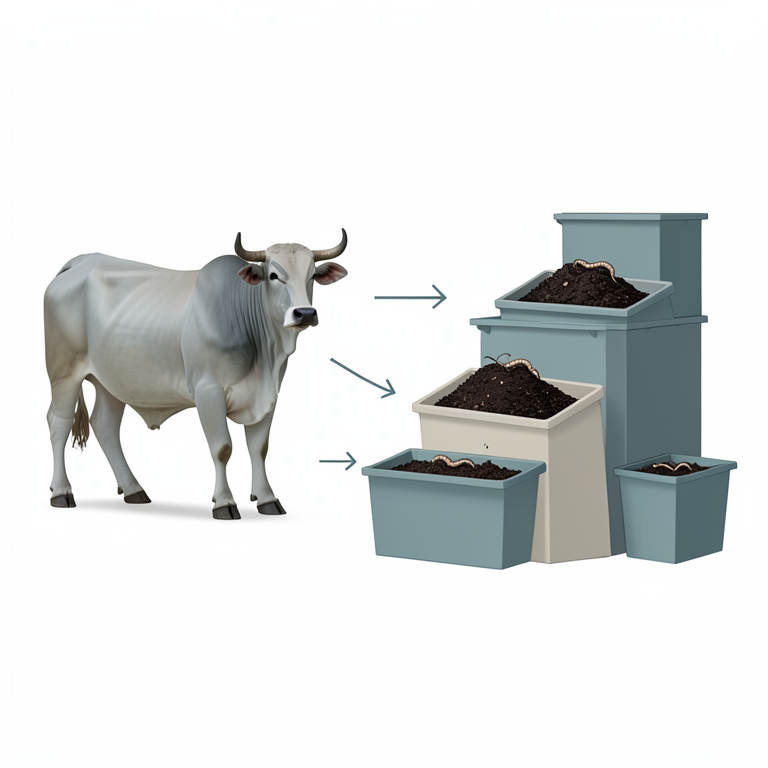
Hierarchy of Constraints
AI-generated conceptual illustration (Kangayam cattle and vermicompost bins). It explains the idea and does not show study data.
View source evidence ↗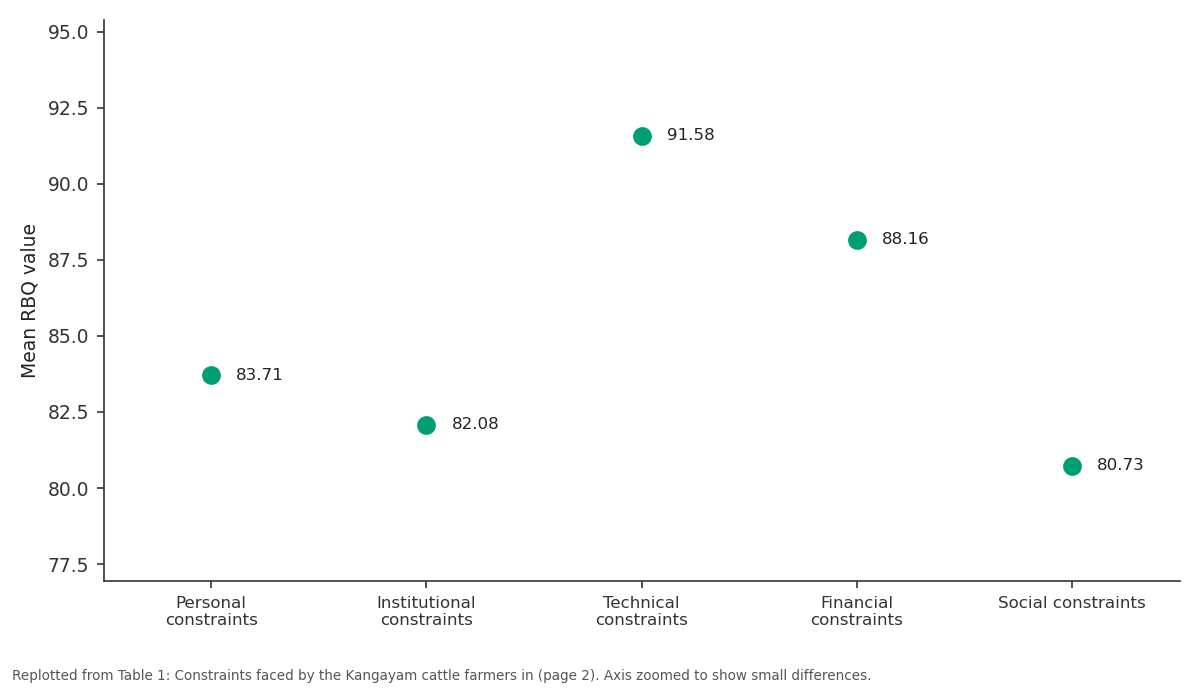
Mean RBQ value: Personal constraints vs Institutional... vs Technical constraints vs Financial constraints vs Social constraints
Replotted from Table 1 (page 2) of the original paper. Every bar is the paper's own table value.
View source evidence ↗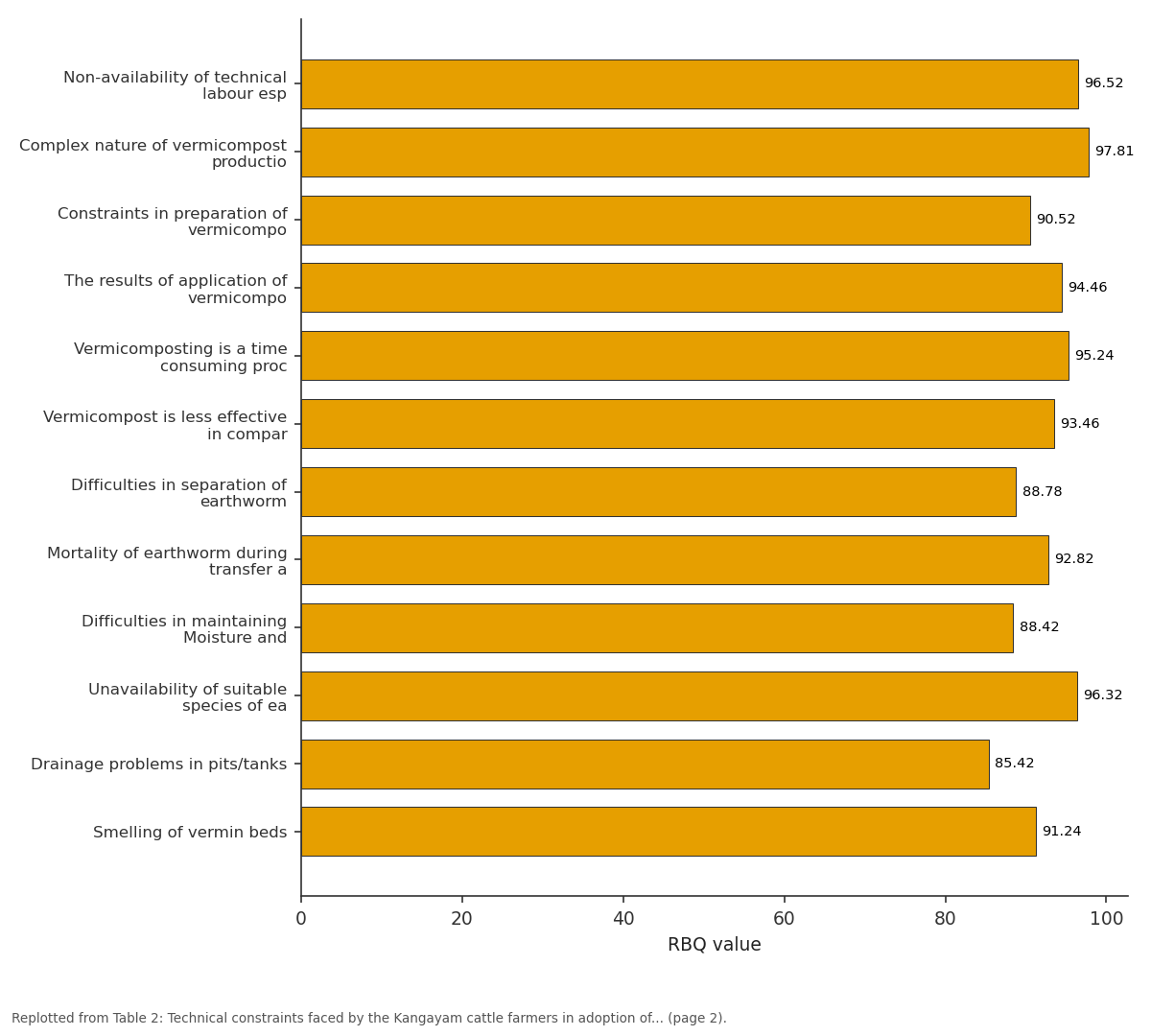
RBQ value: Non-availability of... vs Complex nature of... vs Constraints in... vs The results of... vs Vermicomposting is a...
Replotted from Table 2 (page 2) of the original paper. Every bar is the paper's own table value.
View source evidence ↗Figures & tables
From the original paper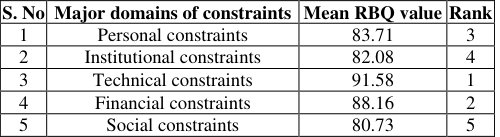 Table 1
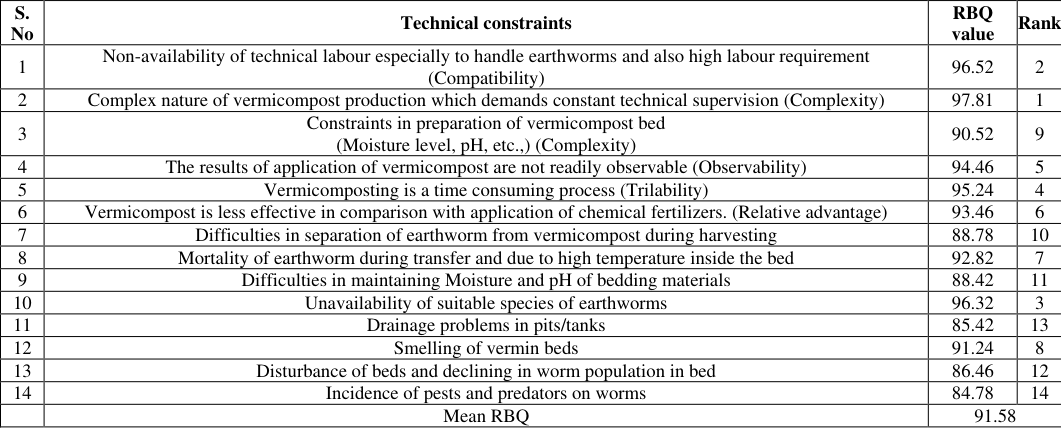 Table 2
 Table 3
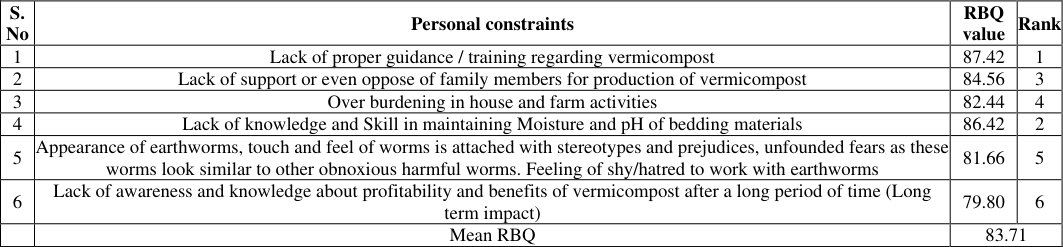 Table 4
 Table 5
 Table 6
Introduction
Vermicompost, known as "Manpuzhu Uram" in Tamil, is a completely natural and cost-effective alternative to chemical fertilizers, proving to be more economical and profitable for farmers. Abundant in NPK, micronutrients, beneficial soil microbes, plant growth hormones, and enzymes secreted by earthworms, vermicompost is produced through the process of vermicomposting, which involves the biological degradation and stabilization of organic waste with the assistance of earthworms and various microbes (Joshi and Chauhan, 2006) [2] . In today's organic farming practices, vermicompost plays a vital role and poses no harm to crops. It takes the form of stable, fine granular organic matter that enhances soil aeration and facilitates the slow release of organic carbon, allowing crops or plants to absorb nutrients effectively (Allen, 2016) [1] . The dissemination of vermiculture technology has been remarkably successful and widely embraced by the farming community, leading to tangible improvements in their economic well-being and offering self-employment opportunities to young individuals. The adoption of vermicompost technology is an integral aspect of integrated farming systems. Vermicomposting holds significant promise for transforming agricultural waste into valuable inputs for farming. By utilizing organic manures, crops can efficiently absorb chemical nutrients, thus enhancing soil health and mitigating the adverse effects of chemicals. The primary market for vermicompost lies within agriculture and horticulture. In India, there are over one lakh extension personnel and 45,000 agricultural scientists actively involved in disseminating innovations among farmers. However, despite these efforts, only 30 to 40 percent of recommendations are adopted by farmers (Kavithaa et al., 2020) [3] . Recognizing the need for increased vermicompost production and the lack of empirical studies on constraints faced by Kangayam cattle farmers in Tamil Nadu, this study aims to identify the challenges hindering the adoption of vermicomposting technology from their perspective.
Materials and Methods
A cross-sectional study was carried out in Coimbatore, Tirupur, Karur, and Erode districts of Tamil Nadu, purposively selected due to their significance as the breeding grounds for Kangayam animals. Specifically, two taluks, namely Pollachi and Anaimalai, were chosen from the eleven revenue taluks in Coimbatore district. Similarly, from the nine taluks in Tirupur district, Kangayam and Dharapuram taluks were selected. In Karur district, two taluks, Karur and Aravakurichi, were chosen from the seven available. Lastly, from the ten revenue taluks in Erode district, Gobichettipalayam and Sathyamangalam were selected. Thus, a total of eight taluks were randomly chosen for the study across the four districts. Within each of these selected taluks, 30 livestock farmers engaged in Kangayam cattle rearing for a minimum duration of ten years were randomly sampled, resulting in a total sample size of 240 Kangayam cattle farmers for the study. In this study, constraints refer to the problems or challenges encountered by the respondents in the production and adoption of vermicompost technology. After consulting with subject matter experts and reviewing previous studies, a list of 38 constraints was developed under five major domains: Technical, Economical, Institutional, Personal, and Social constraints. The objective was to assess the severity of constraints faced by the respondents in vermicomposting.
Respondents were asked to rank these constraints based on their perceived seriousness, and the RBQ technique was utilized to identify the most significant constraint within each domain. The ranks assigned by the respondents were converted into scores using the formula provided by Sabarathnam (2002) [7] as follows, Where, F i = Frequency of the respondents for the i th rank of the constraint. N = Number of respondents n = maximum number of ranks given for various constraints by a respondent The scores against each statement were compared to rank the statements in each category and the results were interpreted. [4] . This was followed by the fact that the results of application of vermicompost are not readily observable (RBQ = 94.46) www.extensionjournal.com means the farmers felt that this technology has low Observability value, Vermicompost is less effective in comparison with application of chemical fertilizers (RBQ = 93.46) means this technology has comparatively low relative advantage over the technology it supersedes and Mortality of earthworm during transfer and due to high temperature inside the bed (RBQ = 92.82) as Worms breathe through their skin which needs to be moist for better breathing. But if the beds become too dry, worms being not only dehydrating but also suffocating, will try to go away from the bed. These constraints were ranked from five to seven respectively. Smelling of vermin beds (RBQ = 91.24) was the eighth constraints exposed by the respondents. Addition of excess water in vermicompost beds made in pits or tanks creates anaerobic condition due to less airflow and beds become sour and stinky, not favourable for worm health. Addition of more food than the consumption capacity of earthworms present in bed (overfeeding) will lead to rotting food and rancid smells might be the reason for smelling of vermin beds. This was followed by difficulties in in preparation of vermicompost bed with proper Moisture level, pH, etc., (RBQ = 90.52) and Difficulties in separation of earthworm from vermicompost during harvesting (RBQ = 88.78) ninth and tenth level of constraints. These findings are in line with Sannigrahi (2016) [5] . It is evident from the data presented in Table 3 that Kangayam cattle farmers considered the cost of construction of vermicompost unit and storage facilities (RBQ = 96.20) as the prime financial constraints in in adoption of vermicomposting technology. Even though the vermicompost technology doesn't required much investment, small and marginal farmers experienced difficulties in starting up of a permanent vermicompost production unit and are also not becoming interested to take risk on initial investment. This finding is similar to that of Varalakshmi et al., (2012) [6] . High labour cost is considered as the second most important constraints (RBQ = 91.94) since for handling and management of worms and vermin beds, skilled laborers are required and obviously they are demanding more wages might be reason for this constraint. This was followed by lack of sufficient initial capital (RBQ = 89.70), constraints in access to credit (RBQ = 84.96) as banks are not showing much interest to give loan for mass production of vermicompost without becoming sure about returns, cost of earthworms (RBQ = 84.00) and poor economical advantage of vermicompost considered as not at all cost-effective (RBQ = 82.20) were the third to sixth financial constraints reported by the farmers. and income. Some farmers feel training or research on vermicomposting is not at all required. Sannigrahi (2016) [5] also reported the same through his study. Lack of support or even in some time oppose of family members for production of vermicompost (RBQ = 84.56) was considered as the third personal constraint followed by over burdening in house and farm activities as fourth (RBQ = 82.44) since daily attention is very essential to maintain moisture in the beds and to protect earthworms from predator like frog, ant, rat, etc make it as a cumbersome process. Appearance of earthworms, touch and feel of worms is attached with stereotypes and prejudices, unfounded fears as these worms look similar to other obnoxious harmful worms. Feeling of shy/hatred to work with earthworms was considered as fifth constraint (RBQ = 81.66) and lack of awareness and knowledge about profitability and benefits of vermicompost after a long period of time (Long term impact) was the sixth personal constraint with a RBQ of 79.80. [4] opined the same through their study. This was followed by lack of laboratory facility for chemical analysis of processed vermicompost as well as quality certified agency in rural setup (RBQ = 82.80), lack of marketing / infrastructure facilities to procure input like earthworms and to sell excess vermicompost (RBQ = 80.24) and Lack of Government's scheme, financing, training, subsidy etc., (RBQ = 79.22) as third to fifth institutional constraints for the by the Kangayam cattle farmers in adoption of vermicomposting technology. It could be observed from Table 6, the opposition from the nearby farmers due to wrong belief of disease spreading and foul smelling in vermicomposting sheds was the major social constraint (RBQ = 81.76) experienced by the farmers in adopting vermicompost technology. Even though lot of efforts were taken for popularizing vermicompost technology, still many farmers feel that it would be an easier way to use the farm wastes as such. Moreover, working with the cattle dung is not be fond of many farmers. This was followed by viewing the vermicompost technology as a low esteemed, low dignified work (RBQ = 80.67) and the fear of hand and leg injuries due to presence of sharp objects in the farm yard waste (RBQ = 79.78) were the second and third social constraints expressed by the respondents.
| S. No | Social constraints | RBQ value | Rank |
|---|---|---|---|
| 1 | Vermicomposting is considered to be attached with low esteem, low dignified work and least liked by family and society | 80.67 | 2 |
| 2 | Fear of hand and leg injuries due to presence of sharp objects in the farm yard waste | 79.78 | 3 |
| 3 | Opposition from the nearby farmers due to wrong belief of disease spreading and foul smelling in vermicomposting sheds. | 81.76 | 1 |
| Mean RBQ | 80.73 |
Table text extracted from the original PDF; superscript letters are shown inline. The original table image is below.
View original table image
| S. No | Financial constraints | RBQ value | Rank |
|---|---|---|---|
| 1 | Lack of sufficient initial capital | 89.70 | 3 |
| 2 | High labour cost | 91.94 | 2 |
| 3 | Cost of construction of vermicompost unit and storage facilities | 96.20 | 1 |
| 4 | Constraints in access to credit | 84.96 | 4 |
| 5 | Cost of earthworms | 84.00 | 5 |
| 6 | Poor economical advantage of Vermicompost – considered as not at all cost-effective. | 82.20 | 6 |
| Mean RBQ | 88.16 |
Table text extracted from the original PDF; superscript letters are shown inline. The original table image is below.
View original table image
Results and Discussion
Results and Discussion
Conclusion
From the findings, it can be concluded that, as far as the Farm waste management, Paradigm shift is the need of present time to look wastes as valuable resource materials for production of vermicompost. Each and every people as well as Government machinery in India have to be serious to remove constraints mentioned above and to spread Vermicomposting Technology at grass root level. More awareness programs in both Rural and Urban India with the help of Multi-Media as well as systematic Vermicomposting Training/Earthworm demonstration in block levels will help to remove psychological blocks from the minds of farmers. Efforts should be made to increase the awareness of farmers regarding advantages of vermicompost, training programmes should be conducted by State Government / SAUs regarding ideal vermicompost preparation, free of cost provision of literature pertaining to preparation of vermicompost to needy farmers, provision of excellent stains of worms at reasonable rate to needy farmers,
Acknowledgement
www.extensionjournal.com farmer's training and visits of successful vermicompost units, development of market infrastructure for vermicompost and financial support by Government for creation vermicompost sheds to small and marginal farmers.
Figures and tables from the paper
| S. No | Major domains of constraints | Mean RBQ value | Rank |
|---|---|---|---|
| 1 | Personal constraints | 83.71 | 3 |
| 2 | Institutional constraints | 82.08 | 4 |
| 3 | Technical constraints | 91.58 | 1 |
| 4 | Financial constraints | 88.16 | 2 |
| 5 | Social constraints | 80.73 | 5 |
Table text extracted from the original PDF; superscript letters are shown inline. The original table image is below.
View original table image
| S. No | Technical constraints | RBQ value | Rank |
|---|---|---|---|
| 1 | Non-availability of technical labour especially to handle earthworms and also high labour requirement (Compatibility) | 96.52 | 2 |
| 2 | Complex nature of vermicompost production which demands constant technical supervision (Complexity) | 97.81 | 1 |
| 3 | Constraints in preparation of vermicompost bed (Moisture level, pH, etc.,) (Complexity) | 90.52 | 9 |
| 4 | The results of application of vermicompost are not readily observable (Observability) | 94.46 | 5 |
| 5 | Vermicomposting is a time consuming process (Trilability) | 95.24 | 4 |
| 6 | Vermicompost is less effective in comparison with application of chemical fertilizers. (Relative advantage) | 93.46 | 6 |
| 7 | Difficulties in separation of earthworm from vermicompost during harvesting | 88.78 | 10 |
| 8 | Mortality of earthworm during transfer and due to high temperature inside the bed | 92.82 | 7 |
| 9 | Difficulties in maintaining Moisture and pH of bedding materials | 88.42 | 11 |
| 10 | Unavailability of suitable species of earthworms | 96.32 | 3 |
| 11 | Drainage problems in pits/tanks | 85.42 | 13 |
| 12 | Smelling of vermin beds | 91.24 | 8 |
| 13 | Disturbance of beds and declining in worm population in bed | 86.46 | 12 |
| 14 | Incidence of pests and predators on worms | 84.78 | 14 |
| Mean RBQ | 91.58 |
Table text extracted from the original PDF; superscript letters are shown inline. The original table image is below.
View original table image
| S. No | Institutional constraints | RBQ value | Rank |
|---|---|---|---|
| 1 | No uniform as well as systematic training system | 84.60 | 1 |
| 2 | Lack of laboratory facility for chemical analysis of processed vermicompost as well as Quality Certified Agency in rural setup | 82.80 | 3 |
| 3 | No systematic promotional approach from government or NGO side | 83.54 | 2 |
| 4 | Lack of Government’s scheme, financing, training, subsidy etc | 79.22 | 5 |
| 5 | Lack of marketing / infrastructure facilities to procure input like earthworms and to sell excess vermicompost. | 80.24 | 4 |
| Mean RBQ | 82.08 |
Table text extracted from the original PDF; superscript letters are shown inline. The original table image is below.
View original table image
References
6 in the original paper- Joshi PC, Chauhan A. Composting of some organic materials using Eisenia foetida and conventional microbial methods: A comparative study. Uttar Pradesh Journal of Zoology. 2006;26:212-125.
- Kavithaa NV, Vimalrajkumar N, Manivannan C, Manokaran S. Assessment of knowledge level and its determinants amongst Kangayam cattle farmers in vermicomposting. Int J Curr Microbiol App Sci. 2020;9(09):149-154.
- Vaidya AC, Macwan AR, Patel DD. Constraints perceived by the farmers in preparation of vermicompost. Gujarat Journal of Extension Education. 2014;25(2):126-129.
- Sannigrahi AK. Major constraints in popularising vermicompost technology in eastern India. Modern Environmental Science and Engineering. 2016;2(2):123-133.
- Varalakshmi R, ArunaKumari K, Anangamathi E. Vermicompost as a micro-enterprise to improve the economic status of self-help group women. Current Biotica. 2012;5(4):487-499.
- Sabaratnam M. IR in dialogue… but can we change the subjects? A typology of decolonising strategies for the study of world politics. Millennium. 2011 May;39(3):781-803.