
Research article · 2024 · Full text
International Journal of Agriculture Extension and Social DevelopmentExamining the effect on income, awareness, employment and financial aid through women SHGs
Volume 7(6S) · Pages 12–15 · DOI: 10.33545/26180723.2024.v7.i6sa.670 ↗
Research areasMicrofinance and Financial InclusionPoverty, Education, and Child WelfareGender, Labor, and Family Dynamics
Abstract
Author-writtenThis research deals with "Women Empowerment" a burning issue all over the world. "Women empowerment" and "women equality with men" is a universal issue. Self Help Groups, as micro financial institutions emerged as an impetus for community action. An informal supplementary credit delivery mechanism by lending at group level, there are many studies on women SHGs and its impact since, women SHGs are functioning well by influencing rural people in the income, employment, savings, investment etc. This study was conducted in rural Chhattisgarh, 219 respondents selected from two district of Chhattisgarh plains which were Rajnandgaon and Khairagarh. National Rural Livelihood Mission Rajnandgaon gave the guidance for producing and marketing of SHG products. According to our research there were significant increasing income, savings, awareness and rate of employment. Women Empowerment refers to increasing and improving the social, economic, political and legal strength of the women, to ensure equal-right to women, and to make them confident enough to claim their rights, such as: freely live their life with a sense of self-worth, respect and dignity.
Summary
Source-checkedPlain-language reading of the full paper, prepared with AI and checked against the text. Each point links to the authors' own words.
Why it matters
- Self Help Groups (SHGs) act as micro-financial institutions that drive community action. View evidence ↗
- The government of Chhattisgarh prioritizes gender equality in education, politics, and economic opportunities to address societal biases against women. View evidence ↗
The question
- The study aims to examine how Self Help Groups impact the socio-economic status of women. View evidence ↗
What they did
- The research was conducted in rural Chhattisgarh, surveying 219 respondents from the Rajnandgaon and Khairagarh districts. View evidence ↗
- Data was collected using a convenience sampling technique and structured schedules. View evidence ↗
- The researchers used Paired t-tests, ANOVA, and Correlation analysis to test their hypotheses. View evidence ↗
What they found
- The average monthly income of participants increased from 1782.19 Rs before joining an SHG to 2686.52 Rs after joining. View evidence ↗
- A paired t-test confirmed a statistically significant increase in income after joining SHGs (t-calculated = 28.21, p < 0.05). View evidence ↗
- ANOVA results indicated that women are significantly aware of the existence and functioning of SHGs in their districts (F-calculated = 3, p = 0.00). View evidence ↗
- There was a statistically significant increase in the employment rate of women after joining SHGs (F-calculated = 3.86, p = 0.00). View evidence ↗
- A significant, though moderate, correlation (Pearson r = 0.07, p = 0.00) was found between the number of SHG members and the financial aid they received. View evidence ↗
What it means
- The authors conclude that SHGs lead to significant increases in income, savings, awareness, and employment rates for women. View evidence ↗
Visual summary
1 visualsIllustrations explain the paper; charts are replotted from the paper's own table values.
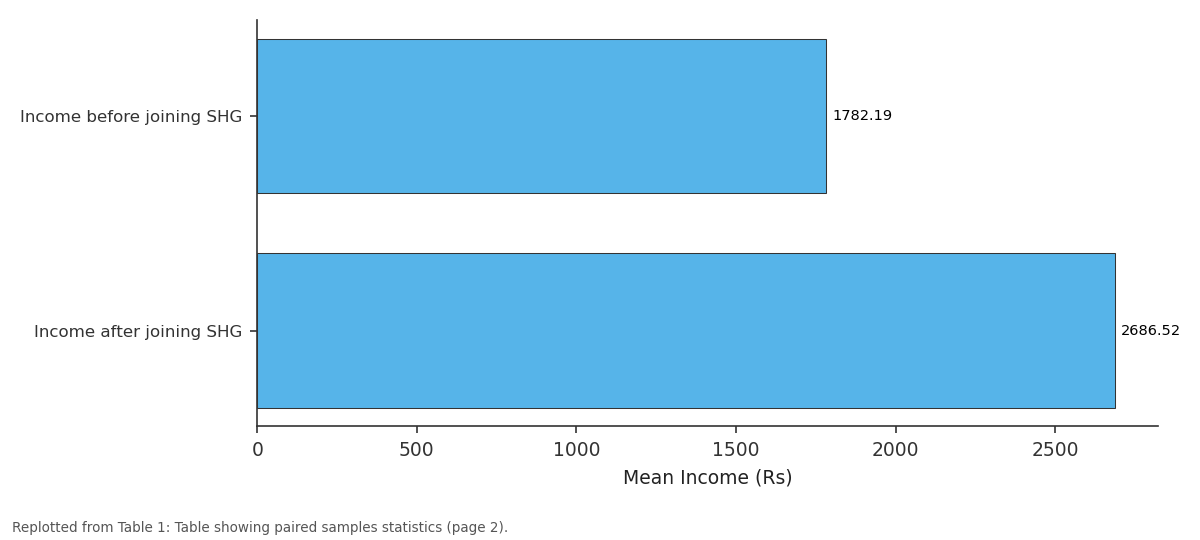
Mean: Income before joining... vs Income after joining SHG
Replotted from Table 1 (page 2) of the original paper. Every bar is the paper's own table value.
View source evidence ↗Figures & tables
From the original paper Table 1
 Table 2
 Table 3
 Table 4
 Table 5
 Table 6
 Table 7
Introduction
"Women empowerment" and "women equality with men" is a worldwide issue. Women empowerment refers to the making of a surrounding for women where they can make selections of their very own for their advantages in addition to for society. The status of women in society is a major cause of concern that influence biases against women, the Chhattisgarh government has accorded high priority in ensuring gender equality in education, political participation as well as in economic and employment opportunities. Several definitive measures have been taken by the state government for improving the status of women in society. An empowered woman is confident in her ability; she is capable of leading her life independently; she is socially as well as economically independent; she is opinionated, enlightened and has freedom from all sorts of domination; and finally she is someone who is capable of standing for her own rights. Empowerment is a degree of autonomy and self-determination in people and communities, which is enables them to represent their interest in a responsible way, acting on their own authority. It has to be change, It is important to understand that the feminine in the society is as important as masculine in the society. "Self Help Group is a small economically homogenous affinity group coming together to save small amount of money regularly, which is deposited to common fund to meet their members." The origin of SHGs can be traced in Grameen Bank of Bangladesh which is founded by Mohammed Yunus, he tried out a new approach to rural credit in Bangladesh. The success stories of Bangladesh Grameen Bank and experience of Indonesia, Nepal and Korea in participatory approach to the micro credit programme for poverty alleviation also provided momentum in India. In India the Self -Help Groups was initiated by NABARD in the year 1986-87, but the real progress of Self-Help Groups was started in the year 1991-92 from the linkage of Self-Help Groups with bank.
Specific objectives
1. To examine the impact of SHGs on socio economic status of women.
Methodology Hypothesis of the study H0:
There is no significant increase in income of women after joining SHGs. H1: There is significant increase in income of women after joining SHGs. H0: Women are not aware of the functioning and existence of selfhelp groups in their districts. H1: Women are aware of the functioning and existence of selfhelp groups in their districts. H0: There was no significant increase in the rate of employment of women even after joining SHGs. H1: There was a significant increase in the rate of employment of women after joining SHGs. www.extensionjournal.com H 0 : There is no significant relationship between number of members of SHGs and Financial aid taken by them. H 1 : There is a significant relationship between number of members of SHGs and Financial aid taken by them.
(C) Sampling design
Sampling Size Twenty SHGs were selected and 219 women of these SHGs were interviews for the study purpose. The details were as follow:
Sample size
Sample size
Sampling Technique
Convenience sampling technique was used in collection of data using structured schedules which was sent to the members of the self-help groups' functioning in Rajnandgaon and Khairagarh districts of Chhattisgarh.
Statistical tool analysis
The data was tabulated using percentages and the data was presented in the form of simple analytical tables for ease of analysis. In order to get a visual and clear understanding of certain data they were represented in the form of figures. MS excel was used for tabulations and conducting the various tests. Paired t-test, ANOVA and Correlation were used to test the hypothesis.
Results and Discussion
Hypothesis of the study Why India is still called as a developing country?-Poverty, illiteracy, malnutrition, unemployment, lack of awareness in women have been the major reasons. In the recent times, the woman has contributed to a great extent towards the development of the economy but not many are aware of this that they have the potential. The recent development has in the entrepreneurial activities undertaken by them.
Increase in income as a result of joining SHG
The analysis indicates the income difference from before joining SHGs to after joining SHGs in all the economic status statements and highest increasing difference was found in the statements of personal savings/ investments. Income is one of the main reasons for women joining the SHGs; all women work together and distribute their income.
In order to study the effects of income after joining SHGs, the researchers have formulated the following hypothesis and put to test using Paired t-test. H0: There is no significant increase in income of women after joining SHGs. H1: There is significant increase in income of women after joining SHGs. Table1 showing that the average income before joining SHGs and after joining SHGs were 1782.19 Rs/ month and 2686.52 Rs/ month. The standard deviation showed the deviation from mean which were 780.08 Rs/ month and 985.02 Rs/ month. The standard error was increasing after joining the SHGs due to many activities. The paired sample test (Table 2) showed that the participant's level of perceived support from their own income (Mean=904.33, SD=882.55, SE=59.63). The t tab value at standard p-value of 0.05 with df 218 is 1.96 and the t cal is 28.21 which is greater than the t tab value, null hypothesis reject, alternative hypothesis accept. Thus significant increasing in income of respondents after joining the SHGs.
| — | Mean | N | Standard deviation | Std. Error |
|---|---|---|---|---|
| Income before joining SHG | 1782.19 | 219 | 780.08 | 52.71 |
| Income after joining SHG | 2686.52 | 219 | 985.02 | 66.56 |
Table text extracted from the original PDF; superscript letters are shown inline. The original table image is below.
View original table image
Level of awareness of SHG programmes in the districts
Awareness is knowledge of something. It can be either selfreported or tested. Awareness is conceptualized in this work as the quality of being aware as it applies to people on the one hand, to enabling of technologies on the other and to the enhancing of awareness through people interacting with awareness-enabled and enabling technologies. SHGs schemes have been extensively used by NGOs over a long period of time to increase the level of awareness of such programmes among the rural poor. It includes awareness with various benefits through SHGs, such groups creating awareness about self-employment, savings, health, education and family welfare thereby making these women more empowered.
To test the awareness level, the following hypothesis was www.extensionjournal.com constructed and put to test. H0: Women are not aware of the functioning and existence of selfhelp groups in their districts. H1: Women are aware of the functioning and existence of selfhelp groups in their districts. A single factor ANOVA was conducted to find out the level of awareness the f tab value is 1 at 5% level of significance and f cal value is 3 with 00.00 p-value here f cal value is greater than f tab , null hypothesis reject, alternative hypothesis accept, it means women are aware of the functioning and existence of selfhelp groups in their districts.
Rate of employment through registered SHGs H0:
There was no significant increase in the rate of employment of women even after joining SHGs.
H1: There was a significant increase in the rate of employment of women after joining SHGs. A single factor ANOVA was conducted to find the rate of employment the f tab value is 1 at 5% level of significance and f cal value is 3.86 with 00.00 p-value here f cal value is greater than f tab , null hypothesis reject, alternative hypothesis accept, thus significant increasing in the rate of employment of women after joining the SHGs.
Correlation between numbers of members and financial assistance taken by its members
The correlation between two variables is termed as simple correlation and its general measures are Karl Pearson coefficient of correlation. To verify there exist a correlation between the financial assistance to its members and the number of members who has taken such assistance the following hypothesis was formulated and put to correlation. H0: There is no significant relationship between number of members of SHGs and Financial aid taken by them. H1: There is a significant relationship between number of members of SHGs and Financial aid taken by them. Correlation coefficient can never be greater than 1 and less than -1. Here Pearson correlation was 0.07; it means the moderate correlation between members and financial aid. The calculated P-value is equal to 00.00 which is more than the standard P-value of 0.05, thus we accept the alternative hypothesis and reject null hypothesis, and it means there was a significant relation among the members of the SHGs and financial assistance taken from these group by its members.
Conclusion
The average income before joining SHGs and after joining SHGs were 1782.19 Rs/ month and 2686.52 Rs/ month. The t tab value at standard p-value of 0.05 with df 218 is 1.96 and the t cal is 28.21which is greater than the t tab value, null hypothesis reject, alternative hypothesis accept. Thus significant increasing in income of respondents after joining the SHGs. A single factor ANOVA was conducted to find out the level of awareness the f tab value is 1 at 5% level of significance and f cal value is 3 with 00.00 p-value here f cal value is greater than f tab , null hypothesis reject, alternative www.extensionjournal.com hypothesis accept, it means women are aware of the functioning and existence of selfhelp groups in their districts. A single factor ANOVA was conducted to find the rate of employment the f tab value is 1 at 5% level of significance and f cal value is 3.86 with 00.00 p-value here f cal value is greater than f tab , null hypothesis reject, alternative hypothesis accept, thus significant increasing in the rate of employment of women after joining the SHGs. Here Pearson correlation was 0.07; it means the moderate correlation between members and financial aid. The calculated P-value is equal to 00.00 which is more than the standard P-value of 0.05, thus we accept the alternative hypothesis and reject null hypothesis, and it means there was a significant relation among the members of the SHGs and financial assistance taken from these group by its members.
Figures and tables from the paper
| Groups | Count | Sum | Average | Variance |
|---|---|---|---|---|
| Members | 219 | 24090 | 110 | 4015 |
| Mandays | 219 | 3821 | 17.44 | 26.37 |
| saving/month | 219 | 198050 | 904.33 | 225016.4 |
Table text extracted from the original PDF; superscript letters are shown inline. The original table image is below.
View original table image
| Source of Variation | SS | Df | MS | F | P-value | F crit |
|---|---|---|---|---|---|---|
| Between Groups | 1.04E+08 | 2 | 52053134 | 681.7467 | 1E-160 | 3.00 |
| Within Groups | 49934599 | 654 | 76352.6 | |||
| Total | 1.54E+08 | 656 |
Table text extracted from the original PDF; superscript letters are shown inline. The original table image is below.
View original table image
| Groups | Count | Sum | Average | Variance |
|---|---|---|---|---|
| Members | 219 | 24090 | 110 | 4015 |
| mandays/month | 219 | 3803 | 17.36 | 28.54 |
Table text extracted from the original PDF; superscript letters are shown inline. The original table image is below.
View original table image
| Source of Variation | SS | df | MS | F | P-value | F crit |
|---|---|---|---|---|---|---|
| Between Groups | 939640.1 | 1 | 939640.1 | 464.7606 | 1.07E-70 | 3.862875 |
| Within Groups | 881492.8 | 436 | 2021.772 | |||
| Total | 1821133 | 437 |
Table text extracted from the original PDF; superscript letters are shown inline. The original table image is below.
View original table image
| — | Members | Financial aid |
|---|---|---|
| members Sig. (2-tailed) n Pearson correlation | 1 219 0.07 | |
| financial aid Sig.(2-tailed) | 0.07 | 1 |
Table text extracted from the original PDF; superscript letters are shown inline. The original table image is below.
View original table image
References
9 in the original paper- Agrawal DD. An Empirical Study on Women Empowerment through Self Help Groups (Special Reference to Ujjain District of MP). Accent Journal of Economics Ecology & Engineering. 2020;5(1):1-8.
- Anand JS. Self-help groups in empowering women: Case study of selected SHGs and NHGs. Kerala Research Programme on Local Level Development Centre for Development Studies Thiruvananthapuram. 2002, 76.
- Anila A. Women Entrepreneurship through Self-Help Groups: A Case Study of Tirunelveli District, Tamil Nadu. International journal of research in commerce, Economics & Management. 2012;2(2):1-149.
- Esmaeil Zaei M, Kapil P, Pelekh O, Teimoury Nasab A. Does micro-credit empower women through selfhelp groups? Evidence from Punjab, Northern India. Societies. 2018;8(3):48.
- Minimol MC, Makesh KG. Empowering rural women in Kerala: A study on the role of Self Help Groups (SHGs). International Journal of Sociology and Anthropology. 2012;4(9):270.
- Nalini MS, Patil SS, Lokesha H, Deshmanya JB, Maraddi GN. Impact of self-help groups on rural economy in north east Karnataka. Karnataka Journal of Agricultural Sciences. 2014;26(2):220-223.
- Nayak P, Mahanta B. Gender Disparity and women empowerment in Assam. International Journal of Applied Management Research. 2016;3(1&2):1-22.
- Nichlavose PR, Jose J. Impact of SHG initiatives on socio-economic status of members. Asian Journal of Research in Business Economics and Management. 2017;7(6):209-216.
- Saravanan M. The impact of self-help groups on the socio-economic development of rural household women in Tamil Nadu-A study. International Journal of Research. 2016;4(7):22-31.
Cited by 1
From OpenAlex, OpenCitations and reference lists read by Scinovex
- Role of self-help group in socio-economic empowerment of women: A case study of Chhattisgarh
Priti Khobragade, AK Gauraha, Hulas Pathak, VK Choudhary · International Journal of Agriculture Extension and Social Development · 2024
Women empowerment is essential not just for meeting their economic demands, but also for a more comprehensive social and economic outlook. They urge women to take leadership roles in their homes, communities, and local democratic areas by making them to participate in decision-making. Thus, the present study was carried out with an objective to know about the features of women in Dondi block of District Balod of Chhattisgarh. All the members of Jai Maa Laxmi women SHG's were selected as respondents for the present study. The selected SHG namely – Jai Maa Laxmi SHG. Total number of members are