
Research article · 2024 · Full text
International Journal of Agriculture Extension and Social DevelopmentEstimating the performance effect of Jai Maa Sharda SHG: A case study of Khairagarh district
Volume 7(6) · Pages 25–28 · DOI: 10.33545/26180723.2024.v7.i6a.668 ↗
Research areasAgricultural Economics and PracticesIslamic Finance and Banking StudiesDiverse Scientific Research Studies
Abstract
Author-writtenThis study was conducted in rural area of Khairagarh district of Chhattisgarh, Jai Maa Sharda SHG was selected for the study purpose, there were 10 members. The total costs were found to be 34700 Rs on paper plate, 46000 Rs on dinner plate and 24500 Rs on cups. The net incomes were 45300 Rs from paper plate, 14000 Rs from dinner plate and 35500 Rs from cup. The benefit cost ratios were 1.30 for paper plate, 0.30 for dinner plate and 1.44 for cup. Maximum quantity sailed out through marketing channels- paper plate (wholesale, 54.68%), dinner plate (wholesale, 41.87%), cup (wholesale, 41.66%). Maximum quantity sailed out in wholesale market. These included fluctuations in the price of raw materials in the market, shortage of manpower for selling the products, fluctuations in the demand for their products, and a lack of advertisement. To address these constraints and enhance the SHGs' business performance, it is recommended to advertise their products on social media platforms and FM radio. Additionally, increasing the SHGs' loan amount and establishing links with local supermarkets can boost their operations. Organizing training programs to develop entrepreneurial capabilities and improving the quality of packaging and grading are also advised.
Summary
Source-checkedPlain-language reading of the full paper, prepared with AI and checked against the text. Each point links to the authors' own words.
Why it matters
- Women's Self-Help Groups (SHGs) are important because they positively influence rural populations by improving income, employment, savings, and investment. View evidence ↗
- The paper plate industry in Chhattisgarh is growing due to the demand for eco-friendly, cost-effective, and convenient options. View evidence ↗
What they did
- The research focused on the Jai Maa Sharda SHG, consisting of 10 members, located in a rural area of the Khairagarh district in Chhattisgarh. View evidence ↗
- The study used specific financial formulas to calculate the cost of production, net income, and the benefit-cost (B/C) ratio. View evidence ↗
What they found
- Monthly total costs for production were 34,700 Rs for paper plates, 46,000 Rs for dinner plates, and 24,500 Rs for cups. View evidence ↗
- Monthly net incomes were 45,300 Rs for paper plates, 14,000 Rs for dinner plates, and 35,500 Rs for cups. View evidence ↗
- The benefit-cost ratios varied by product, with cups being the most efficient at 1.44, followed by paper plates at 1.30, and dinner plates at 0.30. View evidence ↗
- Variable cost ratios were highest for dinner plates (76.66%) and lowest for cups (40.83%). View evidence ↗
- The total annual net returns for the SHG were 748,800 Rs, resulting in a per-member net return of 62,400 Rs. View evidence ↗
- Paper plates were the most profitable product, contributing 47.86% of the total annual net returns. View evidence ↗
- The wholesale market was the primary channel for all products, accounting for 54.68% of paper plate sales, 41.87% of dinner plate sales, and 41.66% of cup sales. View evidence ↗
- The SHG faced four main constraints: raw material price volatility, manpower shortages for sales, fluctuating demand, and insufficient advertising. View evidence ↗
What it means
- The authors recommend boosting performance through social media and FM radio advertising, increasing loan amounts, and establishing links with local supermarkets. View evidence ↗
- The authors suggest improving packaging and grading quality and organizing training to develop the members' entrepreneurial skills. View evidence ↗
Visual summary
3 visualsIllustrations explain the paper; charts are replotted from the paper's own table values.
Marketing Channel Distribution
AI-generated conceptual illustration (Paper plates and cups produced by a rural cooperative). It explains the idea and does not show study data.
View source evidence ↗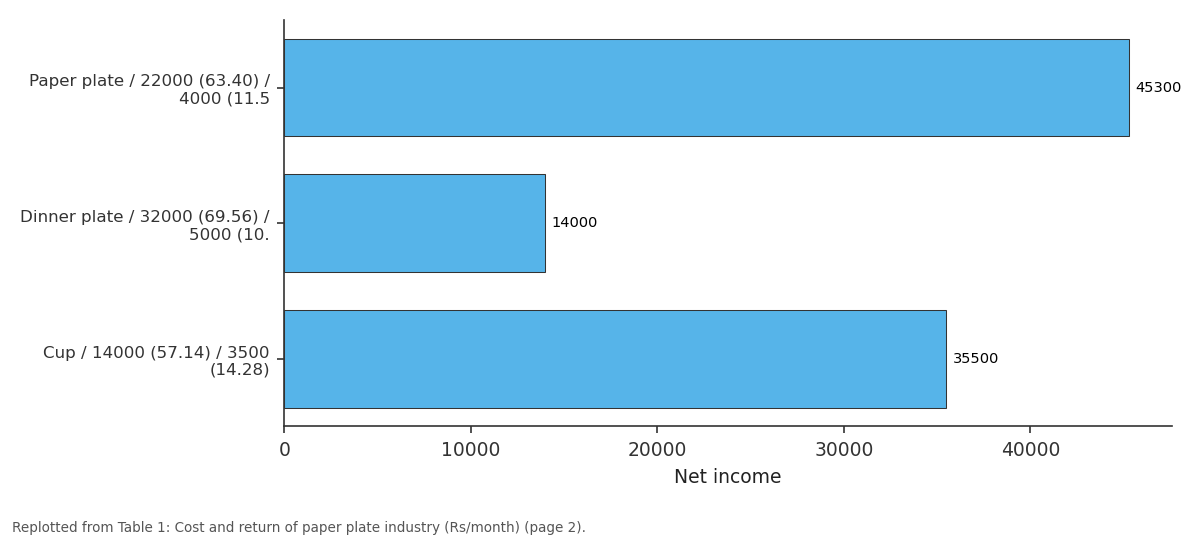
Net income: Paper plate / 22000... vs Dinner plate / 32000... vs Cup / 14000 (57.14) /...
Replotted from Table 1 (page 2) of the original paper. Every bar is the paper's own table value.
View source evidence ↗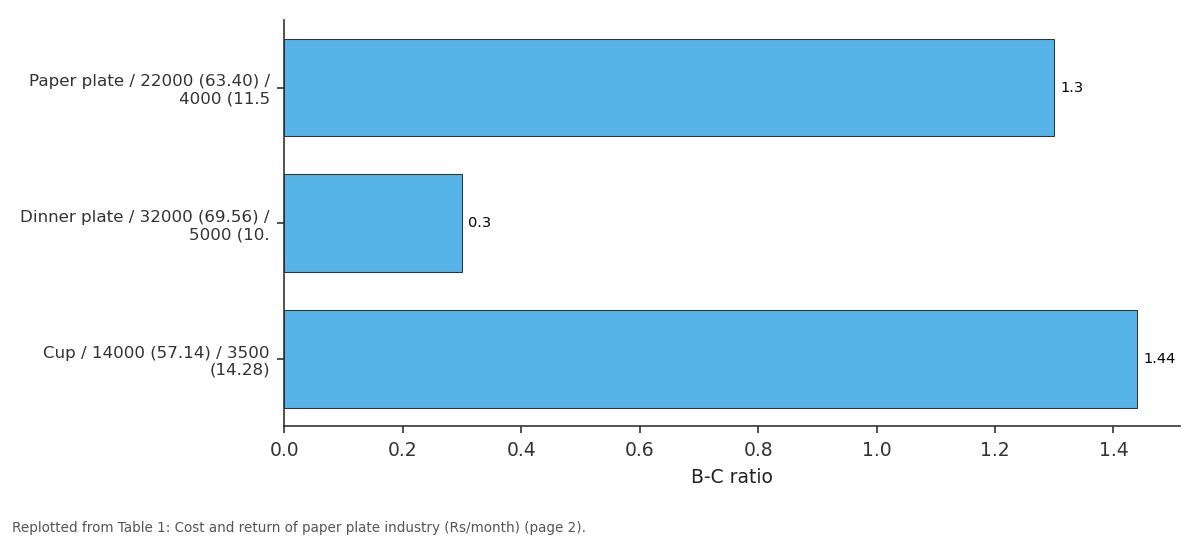
B-C ratio: Paper plate / 22000... vs Dinner plate / 32000... vs Cup / 14000 (57.14) /...
Replotted from Table 1 (page 2) of the original paper. Every bar is the paper's own table value.
View source evidence ↗Figures & tables
From the original paper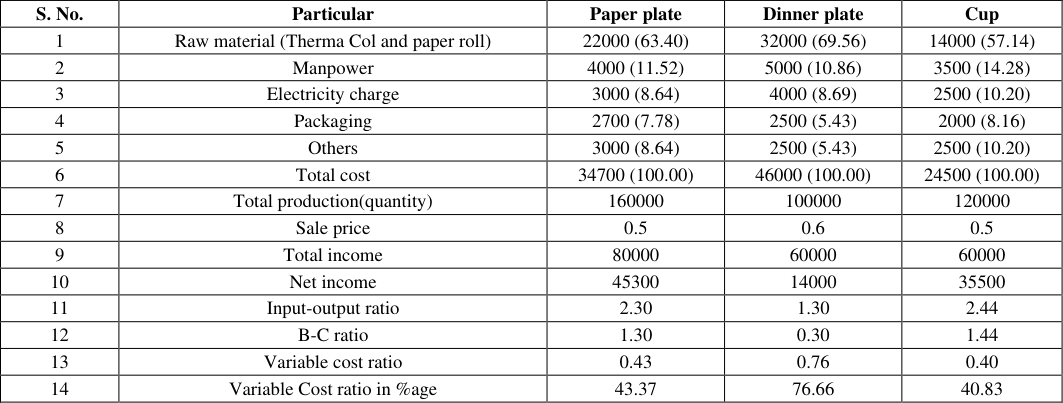 Table 1
 Table 2
 Table 3
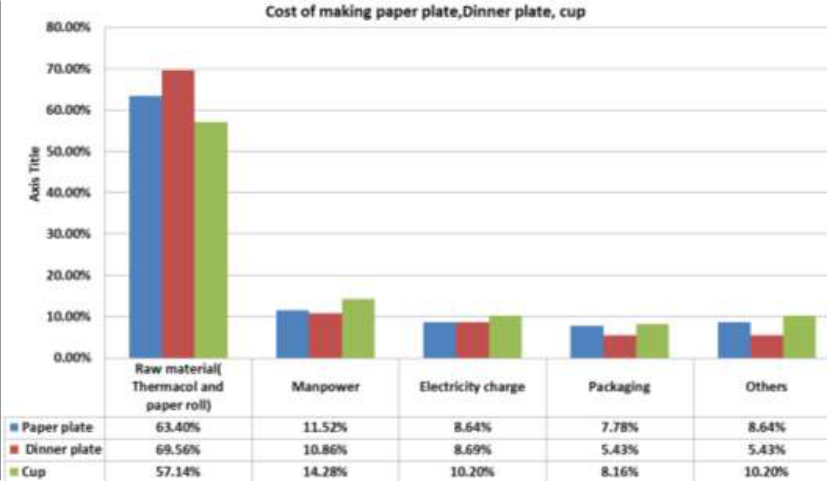 Figure 1
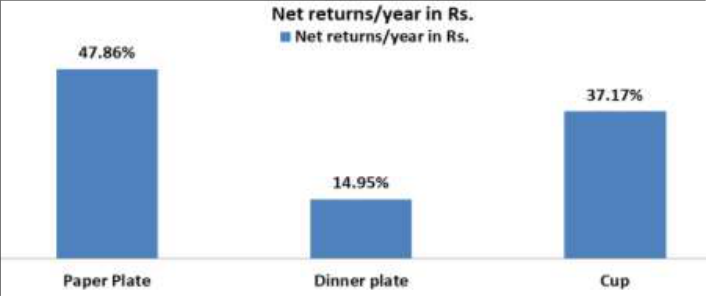 Figure 2
Introduction
An informal supplementary credit delivery mechanism by lending at group level, there are many studies on women SHGs and its impact since, women SHGs are functioning well by influencing rural people in the income, employment, savings, investment etc. "Self Help Group is a small economically homogenous affinity group coming together to save small amount of money regularly, which is deposited to common fund to meet their members." The origin of SHGs can be traced in Grameen Bank of Bangladesh which is founded by Mohammed Yunus, he tried out a new approach to rural credit in Bangladesh. The success stories of Bangladesh Grameen Bank and experience of Indonesia, Nepal and Korea in participatory approach to the micro credit programme for poverty alleviation also provided momentum in India. In India the Self -Help Groups was initiated by NABARD in the year 1986-87, but the real progress of Self-Help Groups was started in the year 1991-92 from the linkage of Self-Help Groups with bank. District Khairagarh-Chhuikhadan-Gandai was separated from the erstwhile Rajnandgaon district and came into existence as the 31st district on 03 September 2022. Known as Music City Khairagarh, the foundation of Asia's first art and music university and the first university
Materials and Methodology Cost of production
The expenditure incurred in producing a unit quantity of output is referred as cost of the production. The cost of production is a summation of Total Variable Cost and Total Fixed Cost.
Cost of Production = Total Variable Cost+ Total Fixed Cost
Variable Cost:
The variable cost includes of raw materials, labor charges, electricity charges, water charges, maintenance charges of machinery etc. And the summation of all the variable costs is called as Total Variable Cost.
Fixed Cost:
The fixed cost includes costs like taxes, insurance, land rent, infrastructure etc. And the summation of all the fixed costs is called as Total Fixed Cost.
Profitability
Profitability
Variable cost ratio (VC Ratio)
The variable cost ratio is an expression of a SHGs variable production costs as a percentage of sales, calculated as variable costs divided by total gross income.
VC Ration = (Variable cost / Gross income) ×100
With the help of this ratio the management will be able to plan how much gross income required covering the cost and how the profit is going to change with the production level. This can be used as a tool for future production, budget, pricing and profitability.
Results and Discussions
Jai Maa Sharda SHG Jai maa sharda SHG is popular group of members in this block, under this SHG 10 members work together with mutual help. Table 1 shows the cost and returns of paper plate industry Rs/month, the paper plate, dinner plate and cup were made by the Jai Maa Sharda SHG. The total costs were found to be 34700 Rs on paper plate, 46000 Rs on dinner plate and 24500 Rs on cups. The gross incomes were 80000 Rs from paper plate, 60000 Rs from dinner plate and 60000 Rs from cup. The net incomes were 45300 Rs from paper plate, 14000 Rs from dinner plate and 35500 Rs from cup. The input-output ratios were 2.30 for paper plate, 1.30 for dinner plate and 2.44 for cup. The benefit cost ratios were 1.30 for paper plate, 0.30 for dinner plate and 1.44 for cup. The Variable cost ratios in percentage were 43.37% for paper plate, 76.66% for dinner plate and 40.83% for cup.
| S. No. | Particular | Paper plate | Dinner plate | Cup |
|---|---|---|---|---|
| 1 | Raw material (Therma Col and paper roll) | 22000 (63.40) | 32000 (69.56) | 14000 (57.14) |
| 2 | Manpower | 4000 (11.52) | 5000 (10.86) | 3500 (14.28) |
| 3 | Electricity charge | 3000 (8.64) | 4000 (8.69) | 2500 (10.20) |
| 4 | Packaging | 2700 (7.78) | 2500 (5.43) | 2000 (8.16) |
| 5 | Others | 3000 (8.64) | 2500 (5.43) | 2500 (10.20) |
| 6 | Total cost | 34700 (100.00) | 46000 (100.00) | 24500 (100.00) |
| 7 | Total production(quantity) | 160000 | 100000 | 120000 |
| 8 | Sale price | 0.5 | 0.6 | 0.5 |
| 9 | Total income | 80000 | 60000 | 60000 |
| 10 | Net income | 45300 | 14000 | 35500 |
| 11 | Input-output ratio | 2.30 | 1.30 | 2.44 |
| 12 | B-C ratio | 1.30 | 0.30 | 1.44 |
| 13 | Variable cost ratio | 0.43 | 0.76 | 0.40 |
| 14 | Variable Cost ratio in %age | 43.37 | 76.66 | 40.83 |
Table text extracted from the original PDF; superscript letters are shown inline. The original table image is below.
View original table image
Business performance of Jai Maa Sharda SHG
The business performance of Jai Maa Sharda SHG is presented in Table 2. The total sales in a year were 1280000 paper plates, 800000 dinner plates, 960000 cups. Net returns/ year of Jai Maa Sharda SHG was 748800 Rs and per member net return was 62400 Rs. Maximum profit earned from the paper plates (47.86%) followed by others.
| Sr. No. | Particular | Total sale in a year | Net returns per units in Rs. | Net returns/year in Rs. | Per member net return |
|---|---|---|---|---|---|
| 1 | Paper Plate | 1280000 | 0.28 | 358400 (47.86) | 29866.67 |
| 2 | Dinner plate | 800000 | 0.14 | 112000 (14.95) | 9333.33 |
| 3 | Cup | 960000 | 0.29 | 278400 (37.17) | 23200 |
| Total | 748800 (100.00) | 62400 |
Table text extracted from the original PDF; superscript letters are shown inline. The original table image is below.
View original table image
Constraints
1. Price of raw materials in the market, 2. Shortage of manpower for selling the products, 3. Fluctuations in the demand for their products and 4. A lack of advertisement.
Conclusion
The paper plate industry is very popular now days in Chhattisgarh plains. The paper plate market is experiencing significant growth, driven by factors such as convenience, cost effectiveness and the increasing demand for ecofriendly option. They also save space and are many times lighter than porcelain plates. Paper plates also don't break if they accidentally fall on the floor. The total sales in a year were 1280000 paper plates, 800000 dinner plates, 960000 cups. Net returns/ year of Jai Maa Sharda SHG was 748800 Rs and per member net return was 62400 Rs. Maximum profit earned from the paper plates (47.86%) followed by others.
Suggestions
Suggestions
Figures and tables from the paper
| Particular | Quantity sale per year through different channels | — | — | — |
|---|---|---|---|---|
| Product | SHG-Retailer | SHG-Wholesaler | SHG-middlemen | Total |
| Paper plate | 200000 (15.62) | 700000 (54.68) | 380000 (29.68) | 1280000 (100.00) |
| Pattal | 255000 (31.87) | 335000 (41.87) | 210000 (26.25) | 800000 (100.00) |
| Cup | 320000 (33.33) | 400000 (41.66) | 240000 (25.00) | 960000 (100.00) |
Table text extracted from the original PDF; superscript letters are shown inline. The original table image is below.
View original table image
References
23 in the original paper- Agrawal DD. An Empirical Study on Women Empowerment Through Self Help Groups (Special Reference to Ujjain District of MP). Accent J Econ Ecol Eng. 2020;5(1):1-8.
- Chakraborty A, Kumar N, Kaur G, Kathuria G, Chakraborty D. Vulnerability of Self-Help Groups in Marketing their Products-Identification of the Key Factors for Enhanced Market Reach and Profitability. Indian J Agric Econ. 2022;77(1):179-193.
- Chandrakar AP, Pathak H, Gauraha AK. Constraints in production and marketing of vermi-compost product of Kamdhenu self-help group (SHG) of Mahasamund district of Chhattisgarh. Pharma Innovation J. 2021;10(8):640-643.
- Divya BA. Study on Income Generation Potential and Performance of Women Self-Help Groups In Tv Malai District, Tamil Nadu. 2017;5(4):1-8.
- Ekka T, Chandrakar MR, Shrey R. Business performance of self-help groups: A case study of Surguja district. Pharma Innovation. 2023;12(7):17151719.
- Fathima A, Senthil kumar CB, Radhika R, Kandeepan E. An Empirical Study on Self-Help Groups of Women Entrepreneurs: Determinants of Financial Performance Of micro-Enterprise. J Algebraic Stat. 2022;13(3):772783.
- Fazalbhoy S. Impact of Self-Help Groups on Growth of Women Entrepreneurs-A Review. Indian J Manage Sci. 2015;5(2):78.
- Geetha S, Babu S. Self-help group: An effective approach to women empowerment in India. Asian J Innov Res. 2016;1(2):22-28.
- Kumar K, Joshi SK, Sahu S, Chandrakar M. Business performance of women self-help groups under Godhan Nyay Yojna in model Gothan Bancharoda, Raipur district of Chhattisgarh. South Asian J Agric Sci. 2022;2(2):29-35.
- Kurrey P, Koshta AK, Gauraha AK, Sahu Y. To work out the business performance of various organic pesticides manufactured by gayatri self-help group (SHG). 2021;10(10):1298-1300.
- Pathak R, Verma N, Dubey M, Kumar S, Bharti P, Dixit H. Study on major problem faced by SHG members and their perception towards SHGPIS. Plant Archives. 2019;19:1080-1082.
- Raj RM, Samuel ADV, Masilamani P, Prabakaran K. Performance, Impact and Constraints of SHG in Namakkal District of Tamil Nadu. Ind. J Pure App Biosci. 2021;9(1):157-164.
- Sahoo A. Self-help group & woman empowerment: A study on some selected SHGs. Int J Bus Manage Invent. 2013;2(9):54-61.
- Sahu L, Singh SK. A qualitative study on role of selfhelp group in women empowerment in rural Pondicherry, India. Nat J Community Med. 2012;3(03):473-479.
- Sahu BL, Ghosh S. Effectiveness of self-help groups (SHGs) in improving livelihood of rural poor in Chhattisgarh. J Community Mobilization Sustainable Dev. 2015;10(2):177-189.
- Sahu S, Pathak H. To work out the business performance of various products of jai AMBE self-help group of Bemetara District. Pharma Innovation J. 2021;1214-1217.
- Saravanan M. The impact of self-help groups on the socio-economic development of rural household women in Tamil Nadu-A study. Int. J Res. 2016;4(7):22-31.
- Sathiyabama N, Saratha DMM. Women Empowerment and Self-Help Groups in Mayiladuthurai Block, Nagapattinam District, Tamilnadu. Chief Patron. 2011;2(9):113-118.
- Sharma M, Ansari. Socio-economic impact of SHG on tribal women. Int. J Res Appl Nat Soc Sci. 2014;2(6):143-148.
- Shivangini DA, Choudhary VK. Business performance of Navjagriti self help group (SHG): A case study of Kanker district of Chhattisgarh. Pharma Innovation J. 2021;210-212.
- Soni P. Women Empowerment through Self Help Group: A Study. Clear Int. J Res Commerce Manage. 2013;4(7):76.
- Sundaram A. Impact of self-help group in socioeconomic development of India. IOSR J Humanit Soc Sci. 2012;5(1):20-27.
- Varde G, Joshi SK, Pathak H, Sahu U, Handa T. Business performance of Vijayalaxmi self-help group: A case study of Raipur district of Chhattisgarh. 2021;10(9):801-803.