
Research article · 2024 · Full text
International Journal of Geography Geology and EnvironmentTo study the cost-benefit analysis of cash crops in Sangamner tehsil of Ahmednagar district (MS)
Volume 6(1) · Pages 379–383 · DOI: 10.22271/27067483.2024.v6.i1e.243 ↗
Research areasAgricultural Economics and Practices
Abstract
Author-writtenThe present research paper study and analyze the Cost-benefit analysis of cash crops at the macro level in Sangamner tehsil. This study is based on primary and secondary data collected from farmer's revenue records and district gazetteer offices. Cash crop production depended on physical, climate, socio-cultural, economic, technological and organizational factors. The Sangamner Tehsil covers 135780 hectares of land and has a population of 487939 in 171 villages as per the 2011 Census. The primary crops under consideration include Sugarcane, Onion, Vegetables and fruits, each analyzed in terms of various farming operations, labor, and input costs. The cost-benefit analysis for irrigated Onion showed a profit of Rs. 328200 per hectare. For irrigated Sugarcane, the profit was Rs. 285700 per hectare. The cash flow analysis revealed the percentage of cash outflows and inflows for each type of crop, helping to understand the income distribution and costs involved.
Summary
Source-checkedPlain-language reading of the full paper, prepared with AI and checked against the text. Each point links to the authors' own words.
Why it matters
- The production of cash crops is influenced by a variety of factors, including physical, climatic, socio-cultural, economic, technological, and organizational elements. View evidence ↗
- Performing a cost-benefit analysis of crops grown in the Sangamner Tehsil is considered a way to gain deeper insight into the challenges farmers face. View evidence ↗
- The study is motivated by the need to determine if water resources are available enough to ensure sustainable agriculture in the Sangamner Tehsil. View evidence ↗
The question
- The primary objective of the research is to conduct a cost-benefit analysis of cash crops within the Sangamner Tehsil of the Ahmednagar District in Maharashtra. View evidence ↗
What they did
- Primary data was gathered using questionnaires administered to at least 100 farmers for each of the selected crops. View evidence ↗
- The research utilized a combination of primary data and secondary data sourced from district gazetteer offices and farmer revenue records. View evidence ↗
- The cost analysis included final charges for various farming operations, such as seed, fertilizer, tillage, planting, weeding, and harvesting. View evidence ↗
What they found
- Irrigated onion cultivation costs Rs. 171,800 per hectare and earns Rs. 500,000 per hectare, resulting in a net profit of Rs. 328,200 per hectare. View evidence ↗
- For onion cultivation, the cash flow analysis indicates a profit of 65.64%, with a cash inflow of 22.20% and a cash outflow of 12.16%. View evidence ↗
- Irrigated sugarcane cultivation costs Rs. 119,300 per hectare and earns Rs. 405,000 per hectare, yielding a net profit of Rs. 285,700 per hectare. View evidence ↗
- For sugarcane cultivation, the cash flow analysis shows a profit of 70.54%, a cash outflow of 20.49%, and a cash inflow of 8.96%. View evidence ↗
What it means
- The authors conclude that sugarcane is a highly profitable cash crop (70.54%) primarily grown in the southern part of the Tehsil. View evidence ↗
- The authors state that the Tehsil benefits significantly from onion production compared to other crops because most of the production remains within the Tehsil. View evidence ↗
Visual summary
2 visualsIllustrations explain the paper; charts are replotted from the paper's own table values.
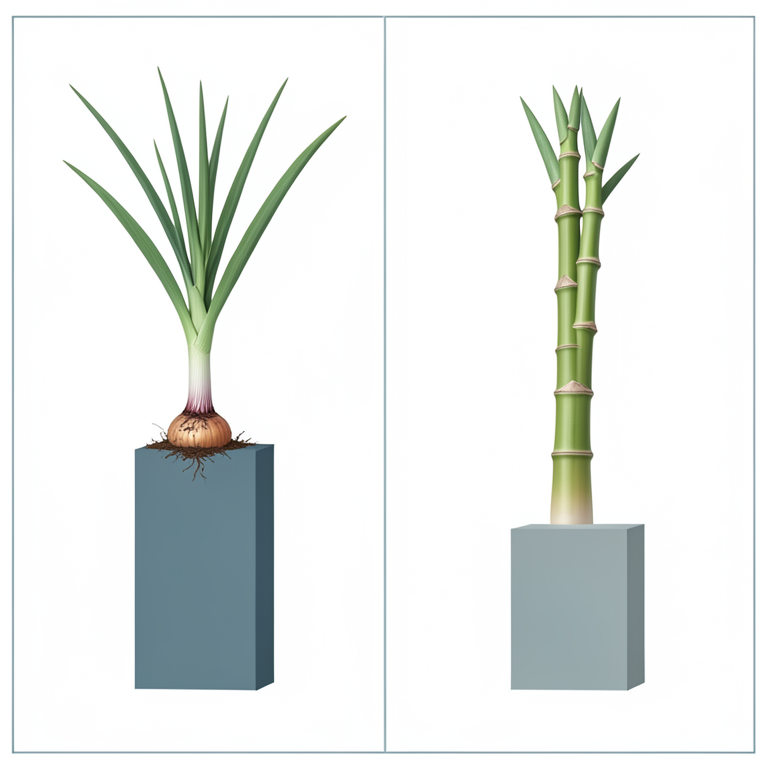
Profit Comparison
AI-generated conceptual illustration (Onion plants and sugarcane plants). It explains the idea and does not show study data.
View source evidence ↗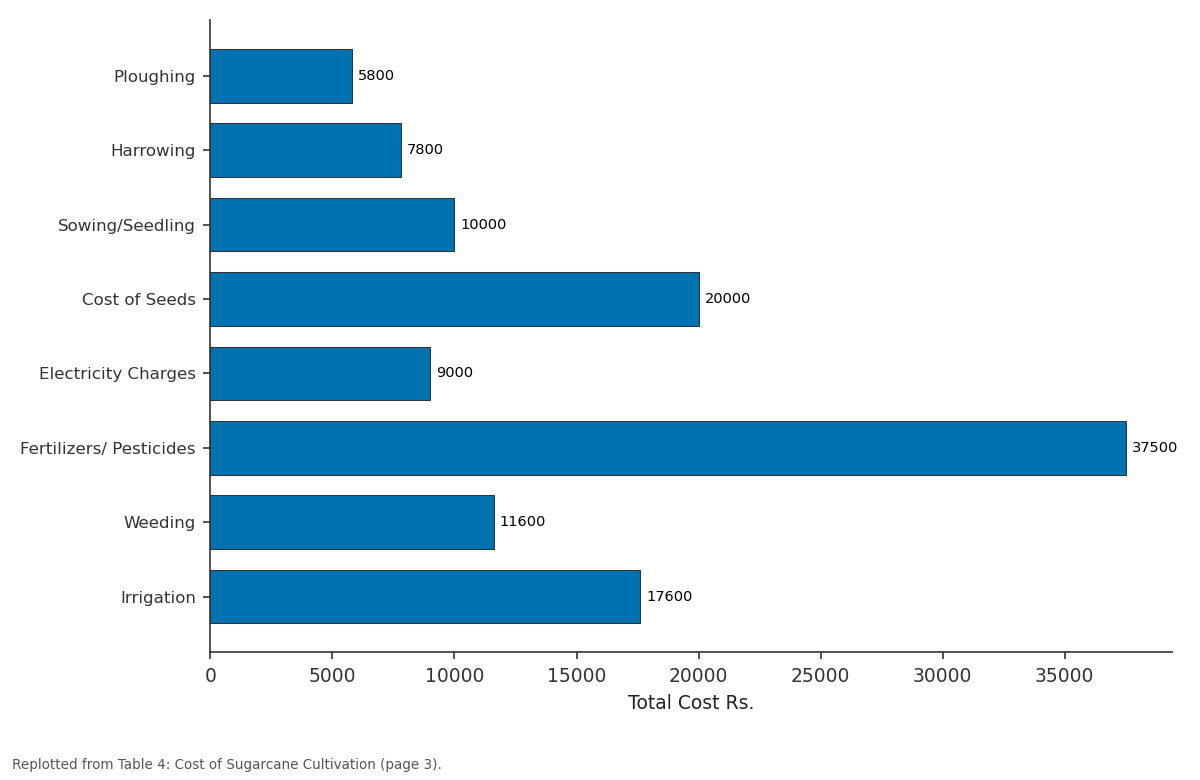
Total Cost Rs.: Ploughing vs Harrowing vs Sowing/Seedling vs Cost of Seeds vs Electricity Charges
Replotted from Table 4 (page 3) of the original paper. Every bar is the paper's own table value.
View source evidence ↗Figures & tables
From the original paper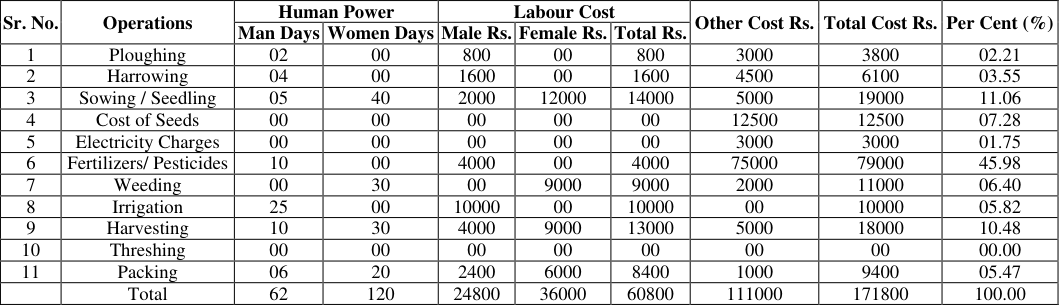 Table 1
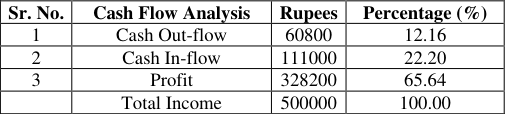 Table 3
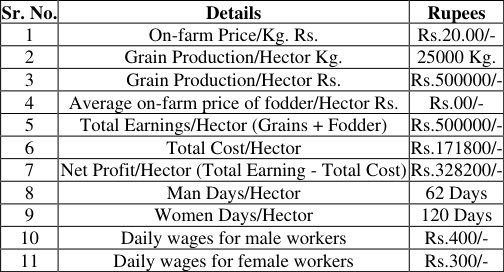 Table 2
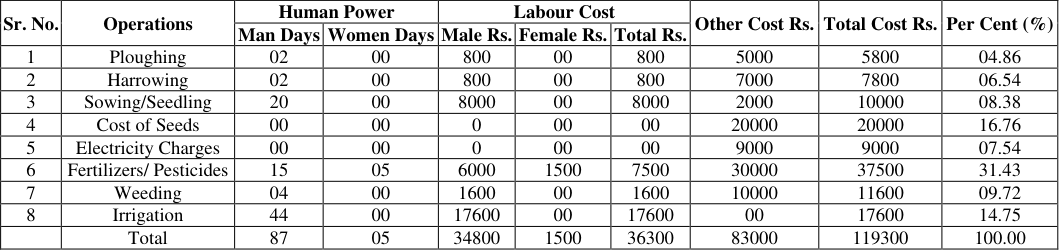 Table 4
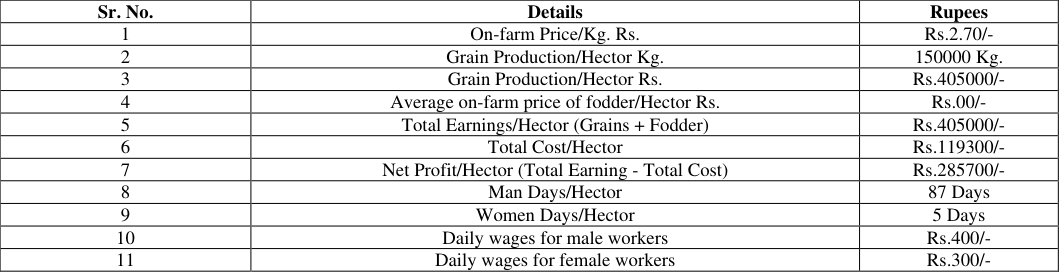 Table 5
 Table 6
 Table 7
Introduction
The dominant cropping pattern in the Tehsil is discussed in the research paper. At this juncture, it seems that the Cost-Benefit analysis of the various crops being grown in the Tehsil can provide more insight into the problems faced by the farmers. The cost-benefit analysis was carried out based on the sample survey information. The research paper is mainly devoted to discussing the problems of agriculture and farmers in the Tehsil as understood by the primary survey. The survey provides information on parameters related to agricultural benefits and production costs by the current cropping pattern. This and a similar kind of database are used to understand and analyze the spatial distribution. In the last few years, in various geographical studies, cost-benefit analysis techniques have been used by various geographers and these techniques are enormously useful for the study of agricultural geography, such as Prest and Turvey (1965) [13] , Joshi (1985) [14] , Saptarshi and Bairagi (1998) [1] and Saptarshi and Bhagat (2004) [15] . The efficient use of available water resources based on technology (Bhagat 2002, and Sonawane 2013) [16,17] , current employment status in rural areas (Jagdale, 2002) [18] , assessment of human resource development (Ugale, 2006) [19] , a strategy for sustainable development of agriculture, human resource development (Musmade, 2012) [20] , cost-effective use of water resources (Sonawane, 2013) [16] and a strategy for groundwater management for sustainable development of agriculture (Chavan, 2014) [21] . The present study aims to find out the availability of water resources for the sustainability of agriculture in the Sangamner Tehsil. Hence, the cost-benefit analysis of major cash crops in the Tehsil has been carried out. For this, the primary data was collected from at least 100 farmers cultivating each selected crop in the Tehsil based on the questionnaire. The sample points have been selected in such a way that they will be well distributed among the villages of the Tehsil in a circle-wise manner. Thus, after analyzing the basic database collected from the primary sources, the average values of the price of each crop are obtained. Comprehensive information regarding expenditure is given in the table
Objective
To study the Cost Benefit Analysis for cash crops in Sangamner Tehsil Ahmednagar District of Maharashtra.
Database and Methodology
The study is based on secondary data and field observations. Circle-wise crop data is obtained from village officers' (Talathi) records, APMC Market and Panchayat Samities records in Sangamner tehsil. Topographical maps and survey of India sheets are used for the physiographical study. Landuse data collected from the socio-economical abstract and Ahmednagar gazetteer and district census handbook in Ahmednagar district referred to collect related information.
Methodology
The 171 villages were divided according to 14 Revenue Circles. Information from more than 100 farmers from selected villages in 14 circles of the Tehsil has been collected. Well distributed to 14 villages randomly selected according to crop to collect primary information. Expenditure incurred for various operations like tillage, fertilizer, seed, planting, weeding, harvesting, etc. is considered as final charges. A summary of various operations has prepared to understand the cost per hectare for each major crop in the Tehsil. First of all, the cost of major cash crops in the Tehsil has been taken into consideration. The first step is to identify the major cash crops in the Tehsil. The major cash crops grown are mainly Onion and Sugarcane. Out of the net sown area in the Tehsil, only 25.74% of NSA is under irrigation. The highest irrigated area is 58.32% under Well irrigation, Canal 20.43%, Tube well 3.75%, and River 17.50%.
Cost Structure
To understand the cost of each crop based on a sample survey in randomly selected 8.18% of villages, A structured questionnaire has been developed to find out the cost of various operations ranging from planting to harvesting and selling in the market.
Cash Flow Analysis
The total income of the farmer has been analyzed to understand the cash flow after getting the statistics of expenditure on the cultivation of major crops in the study area. This type of cash flow analysis has been done in research over the last few decades (Saptarshi and Kale 1984, Sonawane 2013 and Chavan 2014) [22,16,21] . This technique is very useful to understand the economic system as a whole. In the present study, the following factors have been considered to cover the cost of cash flow.
Cash in Flow
1. Wages are given to women worker 2. Wages are given to the male worker 3. Profit margin earned by cultivators.
Cash-out Flow
1. Cost of seeds, fertilizers, and pesticides 2. Cost of packing material brought from the urban sector 3. Cost of fuel such as electric bill, diesel or hiring tractor, and technology Thus, the share of income that remains in the Tehsil and the share that goes out of the Tehsil estimated based on expenditure structure. This research has estimated for each village and the Tehsil. As discussed in the Onion crop is cultivated in the Tehsil during Rabbi and Kharip Season. In the above Table No.1 indicates, the cost of various operations in the field of Onion cultivation has calculated. The figures in the table show that the average total production cost of Onion cultivation is Rs. 171800/-. The total average cost of labor is Rs. 60800/while the other total expenditure is Rs. 111000/-. The cost structure of the Onion crop shows that most of the cost in various operations is on fertilizers, pesticides seeds, packing, sowing, and harrowing. The Table No. 2 indicates that the cost of Onion cultivation is Rs.171800/-per hect. and the net output from the Onion cultivation is Rs.500000/-per hect. The net benefit from the Onion cultivation is Rs.328200/-per hect. The field observation and statistical data show the requirement of employment per hect. Onion cultivation is 62 males and 120 females. In the Tehsil during 2022-23, the area under Onion cultivation is 10795 hect. The employment power requirement and generated is 669290 male days and 1295400 female days workers in the Tehsil. It is observed that the profit earned by the farmer due to the cultivation of Onion is about 65.64% (Table No. 3). The cash inflow in the case of Onion is 22.20%. The cash outflow in Onion cultivation is 12.16%. It shows most of the onion production goes inside the Tehsil. Therefore, the Tehsil benefits high from onion production as compared to other crops.
Cost of Onion Crop Cultivations
Cost of Onion Crop Cultivations
Cost of Sugarcane Cultivation
In the above Table No. 4 indicates, the cost of various operations in the field of Sugarcane cultivation has calculated. The figures in the table show that the average total production cost of Sugarcane cultivation is Rs. 119300/-per hector. The total average cost of labor is Rs. 36300/-while the other total expenditure is Rs. 83000/-. The cost structure of Sugarcane crops shows that most of the cost in various operations is on pesticides, fertilizers, seeds, irrigation, and sowing. Sugarcane is a good cash crop grown mainly in the southern part of the Tehsil and is highly profitable (70.54%). However, cash flow analysis has caught the attention of current workers as cash-outflows (20.49%) and cash-inflows (08.96%) are almost identical or have very little difference.
Cash Flow Analysis:
The cash flow analysis technique is very useful for understanding the crop-wise rupee incoming and outgoing in Tehsils. The cash flow analysis of cash crops in the study area was revealed in Table No. 7. The cash-out flow is observed higher in the crops is Onion (57.72%) and lower the Sugarcane (57.72%). Also, the cash out flow is higher in the case of crops like Sugarcane (75.36%). The profit is higher in the case of crops like Sugarcane (53.46%).
Conclusion
The research paper discusses the dominant cropping pattern in Sangamner tehsil, Maharashtra, focusing on cost-benefit analysis and agriculture-related problems. The study aims to understand the sustainability of agriculture by analyzing the cost-benefit of major cash crops in the region. Data was collected from over 100 farmers in a sample survey distributed across the villages in the tehsil. The primary crops under consideration are Sugarcane and Onion, and the study distinguishes between irrigated variants of these crops.
Onion
The total cost of irrigated Onion cultivation is Rs. 171800 per hectare, while the total earnings per hectare are Rs. 500000. This results in a net profit of Rs. 328200 per hectare. Employment requirements include 62 male and 120 female workdays per hectare. The study estimates that in 2022-23, 10795 hectares were cultivated with irrigated Onion, generating employment for 669290 male and 1295400 female workers in the tehsil. The cash flow analysis shows that cash inflow is 22.20%, cash outflow is 12.16%, and the profit is 65.64%.
Sugarcane
The total cost of irrigated Sugarcane cultivation is Rs. 119300 per hectare, while the total earnings per hectare are Rs. 405000. This results in a net profit of Rs. 285700 per hectare. Employment requirements include 87 male and 05 female workdays per hectare. The study estimates that in 2022-23, 13930 hectares were cultivated with irrigated Sugarcane, generating employment for 1211910 male and 69650 female workers in the tehsil. The cash flow analysis shows that cash inflow is 08.96%, cash outflow is 20.49%, and the profit is 70.54%. In summary, the research paper provides a detailed costbenefit analysis of various cash crops in Sangamner tehsil, highlighting the profitability and employment generation associated with different crops and irrigation practices.
Figures and tables from the paper
| Sr. No. | Operations | Human Power | — | Labour Cost | — | — | Other Cost Rs. | Total Cost Rs. | Per Cent (%) |
|---|---|---|---|---|---|---|---|---|---|
| Man Days | Women Days | Male Rs. | Female Rs. | Total Rs. | |||||
| 1 | Ploughing | 02 | 00 | 800 | 00 | 800 | 3000 | 3800 | 02.21 |
| 2 | Harrowing | 04 | 00 | 1600 | 00 | 1600 | 4500 | 6100 | 03.55 |
| 3 | Sowing / Seedling | 05 | 40 | 2000 | 12000 | 14000 | 5000 | 19000 | 11.06 |
| 4 | Cost of Seeds | 00 | 00 | 00 | 00 | 00 | 12500 | 12500 | 07.28 |
| 5 | Electricity Charges | 00 | 00 | 00 | 00 | 00 | 3000 | 3000 | 01.75 |
| 6 | Fertilizers/ Pesticides | 10 | 00 | 4000 | 00 | 4000 | 75000 | 79000 | 45.98 |
| 7 | Weeding | 00 | 30 | 00 | 9000 | 9000 | 2000 | 11000 | 06.40 |
| 8 | Irrigation | 25 | 00 | 10000 | 00 | 10000 | 00 | 10000 | 05.82 |
| 9 | Harvesting | 10 | 30 | 4000 | 9000 | 13000 | 5000 | 18000 | 10.48 |
| 10 | Threshing | 00 | 00 | 00 | 00 | 00 | 00 | 00 | 00.00 |
| 11 | Packing | 06 | 20 | 2400 | 6000 | 8400 | 1000 | 9400 | 05.47 |
| Total | 62 | 120 | 24800 | 36000 | 60800 | 111000 | 171800 | 100.00 |
Table text extracted from the original PDF; superscript letters are shown inline. The original table image is below.
View original table image
| Sr. No. | Cash Flow Analysis | Rupees | Percentage (%) |
|---|---|---|---|
| 1 | Cash Out-flow | 60800 | 12.16 |
| 2 | Cash In-flow | 111000 | 22.20 |
| 3 | Profit | 328200 | 65.64 |
| Total Income | 500000 | 100.00 |
Table text extracted from the original PDF; superscript letters are shown inline. The original table image is below.
View original table image
| Sr. No. | Details | Rupees |
|---|---|---|
| 1 | On-farm Price/Kg. Rs. | Rs.20.00/- |
| 2 | Grain Production/Hector Kg. | 25000 Kg. |
| 3 | Grain Production/Hector Rs. | Rs.500000/- |
| 4 | Average on-farm price of fodder/Hector Rs. | Rs.00/- |
| 5 | Total Earnings/Hector (Grains + Fodder) | Rs.500000/- |
| 6 | Total Cost/Hector | Rs.171800/- |
| 7 | Net Profit/Hector (Total Earning - Total Cost) | Rs.328200/- |
| 8 | Man Days/Hector | 62 Days |
| 9 | Women Days/Hector | 120 Days |
| 10 | Daily wages for male workers | Rs.400/- |
| 11 | Daily wages for female workers | Rs.300/- |
Table text extracted from the original PDF; superscript letters are shown inline. The original table image is below.
View original table image
| Sr. No. | Operations | Human Power | — | Labour Cost | — | — | Other Cost Rs. | Total Cost Rs. | Per Cent (%) |
|---|---|---|---|---|---|---|---|---|---|
| Man Days | Women Days | Male Rs. | Female Rs. | Total Rs. | |||||
| 1 | Ploughing | 02 | 00 | 800 | 00 | 800 | 5000 | 5800 | 04.86 |
| 2 | Harrowing | 02 | 00 | 800 | 00 | 800 | 7000 | 7800 | 06.54 |
| 3 | Sowing/Seedling | 20 | 00 | 8000 | 00 | 8000 | 2000 | 10000 | 08.38 |
| 4 | Cost of Seeds | 00 | 00 | 0 | 00 | 00 | 20000 | 20000 | 16.76 |
| 5 | Electricity Charges | 00 | 00 | 0 | 00 | 00 | 9000 | 9000 | 07.54 |
| 6 | Fertilizers/ Pesticides | 15 | 05 | 6000 | 1500 | 7500 | 30000 | 37500 | 31.43 |
| 7 | Weeding | 04 | 00 | 1600 | 00 | 1600 | 10000 | 11600 | 09.72 |
| 8 | Irrigation | 44 | 00 | 17600 | 00 | 17600 | 00 | 17600 | 14.75 |
| Total | 87 | 05 | 34800 | 1500 | 36300 | 83000 | 119300 | 100.00 |
Table text extracted from the original PDF; superscript letters are shown inline. The original table image is below.
View original table image
| Sr. No. | Details | Rupees |
|---|---|---|
| 1 | On-farm Price/Kg. Rs. | Rs.2.70/- |
| 2 | Grain Production/Hector Kg. | 150000 Kg. |
| 3 | Grain Production/Hector Rs. | Rs.405000/- |
| 4 | Average on-farm price of fodder/Hector Rs. | Rs.00/- |
| 5 | Total Earnings/Hector (Grains + Fodder) | Rs.405000/- |
| 6 | Total Cost/Hector | Rs.119300/- |
| 7 | Net Profit/Hector (Total Earning - Total Cost) | Rs.285700/- |
| 8 | Man Days/Hector | 87 Days |
| 9 | Women Days/Hector | 5 Days |
| 10 | Daily wages for male workers | Rs.400/- |
| 11 | Daily wages for female workers | Rs.300/- |
Table text extracted from the original PDF; superscript letters are shown inline. The original table image is below.
View original table image
| Sr. No. | Cash Flow Analysis | Rupees | Percentage (%) |
|---|---|---|---|
| 1 | Cash Out-flow | 83000 | 20.49 |
| 2 | Cash In-flow | 36300 | 08.96 |
| 3 | Profit | 285700 | 70.54 |
| Total Income | 405000 | 100.00 |
Table text extracted from the original PDF; superscript letters are shown inline. The original table image is below.
View original table image
| Sr. No. | Operations | Cash- Out Flow | % | Cash- In Flow | % | Profit | % | Total Income | % |
|---|---|---|---|---|---|---|---|---|---|
| 1 | Sugarcane | 60800 | 42.28 | 111000 | 75.36 | 328200 | 53.46 | 500000 | 55.25 |
| 2 | Onion | 83000 | 57.72 | 36300 | 24.64 | 285700 | 46.54 | 405000 | 44.75 |
| Total | 143800 | 100.00 | 147300 | 100.00 | 613900 | 100.00 | 905000 | 100.00 |
Table text extracted from the original PDF; superscript letters are shown inline. The original table image is below.
View original table image
References
13 in the original paper- Bairagi SI, Saptarshi PG. Cost benefit analysis of export and domestic market system for grapes: A case study of Pimpalgaon Baswant (Nashik). The Deccan Geographer Society. Pune. 1998;37(2):42-51.
- Bhugolshastra Sanshodhan Patrika. 2021;38(2):47-56.
- Chaudhari KC, Musmade AH. The role of wells to sustainable irrigation in Parner Tehsil of Ahmednagar District (MS): A systematic analysis. Bengal, Past and Present. 2022;118(I):90-98.
- Dwivedi RS, Sreenivas K, Ramana KV, Redy PR, Ravi Sankar G. Sustainable development of land and water resources using geographic information system and remote sensing. Journal of the Indian Society of Remote Sensing. 2006;34(4):351-368.
- Gregory S. The changing frequency of drought in India; c1989. p. 1871-1885.
- Prest AR, Turvey R. Cost-benefit analysis: A survey. The Economic Journal. 1965;75(300):683-735.
- Bhagat S, Black B, Blair M. Relational investing and firm performance. Journal of Financial Research. 2004;27(1):01-30.
- Bhagat RS, Kedia BL, Harveston PD, Triandis HC. Cultural variations in the cross-border transfer of organizational knowledge: An integrative framework. Academy of management review. 2002;27(2):204-221.
- Pawar AY, Sonawane DD, Erande KB, Derle DV. Terahertz technology and its applications. Drug invention today. 2013;5(2):157-163.
- Jagdale GB, Somasekhar N, Grewal PS, Klein MG. Suppression of plant-parasitic nematodes by application of live and dead infective juveniles of an entomopathogenic nematode, Steinernema carpocapsae, on boxwood (Buxus spp.). Biological Control. 2002 May 2;24(1):42-49.
- Musmade BB, Patre BM. Design decentralized sliding mode controllers with dynamic decouplers for TITO processes. In 2012 12 th International Workshop on Variable Structure Systems. IEEE; c2012 Jan 12. p. 105-110.
- Chavan S, Bray F, Lortet-Tieulent J, Goodman M, Jemal A. International variations in bladder cancer incidence and mortality. European urology. 2014;66(1):59-73.
- Kale SR. US industrial development incentives and manufacturing growth during the 1970s. Growth & Change. 1984;15(1):1-26.