
Research article · 2024 · Full text
International Journal of Research in AgronomyAssessment of agro-residues as biochar feedstock: Cotton stalk, soybean straw, and pigeon pea stalk
Volume 7(6S) · Pages 36–40 · DOI: 10.33545/2618060x.2024.v7.i6sa.809 ↗
Research areasAgricultural Innovations and Practices
Abstract
Author-writtenAgro residue generation is increasing globally due to the increase in agricultural crop area and cropping intensity. The increasing agricultural activities and modernization produces a lot of food processing waste, bio-waste and solid waste to meet the demands of food and energy for the growing population in the world. Improper disposal of biomass produced by the agricultural sector is a major challenge worldwide. conversion of agro residue into biochar helps to offset global warming gases emission and improve the soil health under changing climate. Converting agro residue into environmentally acceptable, low-cost biochar is not only a sensible recycling method, but also a cure for pollution control. Characterizing agro-residues involves detailed analysis of their physical, chemical and thermal properties to ensure they are suitable for biochar production. In India, the availability of diverse agro-residues presents a significant opportunity for sustainable biochar production, which can enhance soil health, sequester carbon, and provide an additional revenue stream for farmers. Biochar production from agricultural residues offers a sustainable solution for waste management and soil enhancement. This study assesses the potential of cotton stalk, soybean straw, and pigeon pea stalk as feedstock for biochar production. Comprehensive characterization was conducted through proximate and ultimate analysis, energy content evaluation. The findings indicate that each feedstock exhibits unique properties, influencing biochar yield and quality. The study highlights the comparative advantages and challenges of using these residues for biochar, aiming to optimize biochar production processes in agricultural systems.
Summary
Source-checkedPlain-language reading of the full paper, prepared with AI and checked against the text. Each point links to the authors' own words.
Why it matters
- The improper disposal of agricultural biomass is a significant global challenge. View evidence ↗
- Converting agricultural residues into biochar can help mitigate global warming gas emissions and improve soil health. View evidence ↗
- In the Vidarbha region of Maharashtra, farmers primarily grow cotton, pigeon pea, and soybean, often burning the cotton and pigeon pea residues. View evidence ↗
The question
- The study aims to evaluate whether cotton stalk, soybean straw, and pigeon pea stalk are suitable feedstocks for producing biochar. View evidence ↗
What they did
- Cotton stalk, soybean straw, and pigeon pea stalk samples were collected from the Dr. PDKV Akola field, air-dried, ground, and stored in airtight containers. View evidence ↗
- The researchers measured several physiochemical properties, including bulk density, angle of repose, moisture, volatile matter, ash content, fixed carbon, and calorific value. View evidence ↗
- Calorific value was determined using a bomb calorimeter following the ASTME-711 test code. View evidence ↗
What they found
- The bulk densities were 215.80 kg/m³ for cotton stalk, 220.18 kg/m³ for soybean straw, and 236.89 kg/m³ for pigeon pea stalk. View evidence ↗
- Moisture contents were 9.56% (cotton), 8.21% (soybean), and 9.43% (pigeon pea), all of which are below the 15% limit desired for pyrolysis. View evidence ↗
- The average volatile matter was 68.15% for cotton stalk, 69.41% for soybean straw, and 67.08% for pigeon pea stalk. View evidence ↗
- Average ash content was 5.13% for cotton stalk, 6.62% for soybean straw, and 5.82% for pigeon pea stalk. View evidence ↗
- Fixed carbon content was 17.16% for cotton stalk, 16.06% for soybean straw, and 17.67% for pigeon pea stalk. View evidence ↗
- The average calorific values were 3756 kcal/kg for cotton stalk, 3638 kcal/kg for soybean straw, and 3845 kcal/kg for pigeon pea stalk. View evidence ↗
What it means
- The authors conclude that cotton stalk, soybean straw, and pigeon pea stalk are all viable for biochar production. View evidence ↗
- Using these residues for biochar is recommended as an environmentally friendly alternative to burning waste and as a renewable energy source. View evidence ↗
Visual summary
3 visualsIllustrations explain the paper; charts are replotted from the paper's own table values.
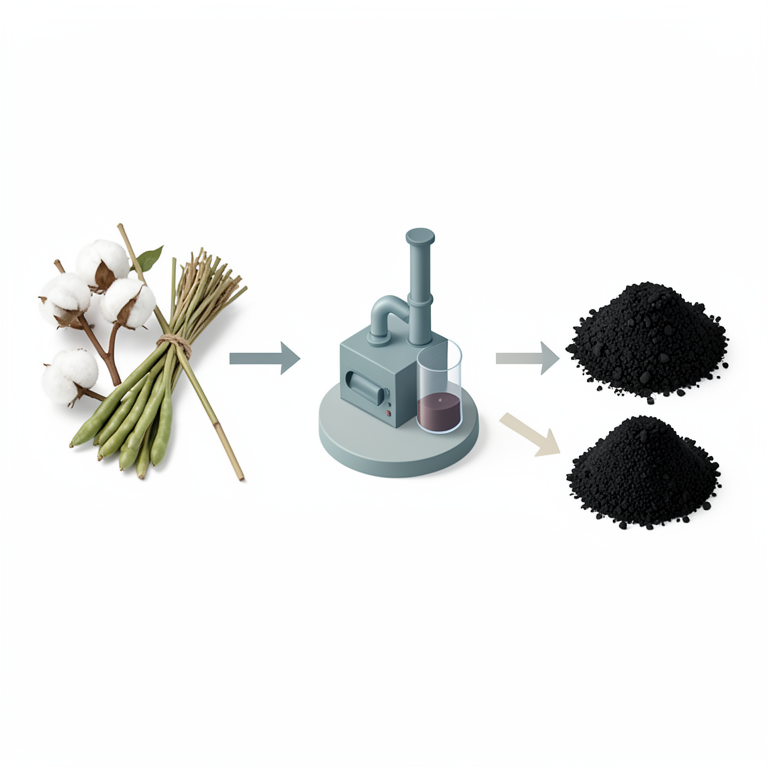
Biochar Feedstock Assessment Workflow
AI-generated conceptual illustration (Cotton stalks, soybean straw, and pigeon pea stalks). It explains the idea and does not show study data.
View source evidence ↗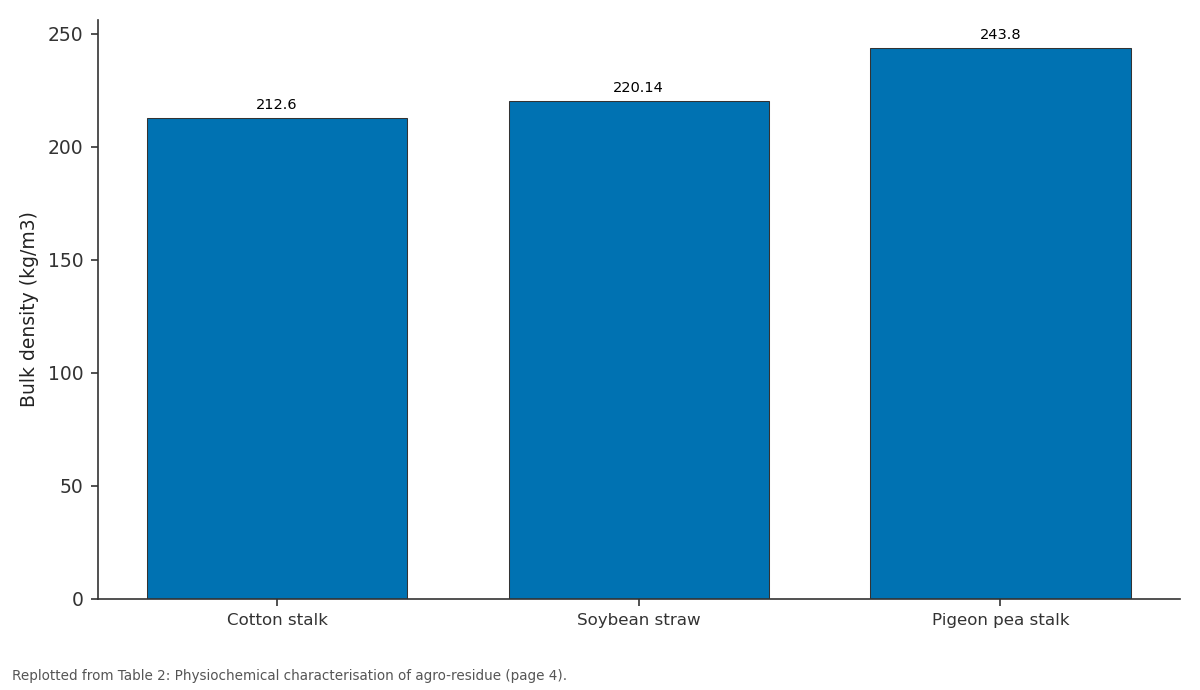
Bulk density (kg/m3): Cotton stalk vs Soybean straw vs Pigeon pea stalk
Replotted from Table 2 (page 4) of the original paper. Every bar is the paper's own table value.
View source evidence ↗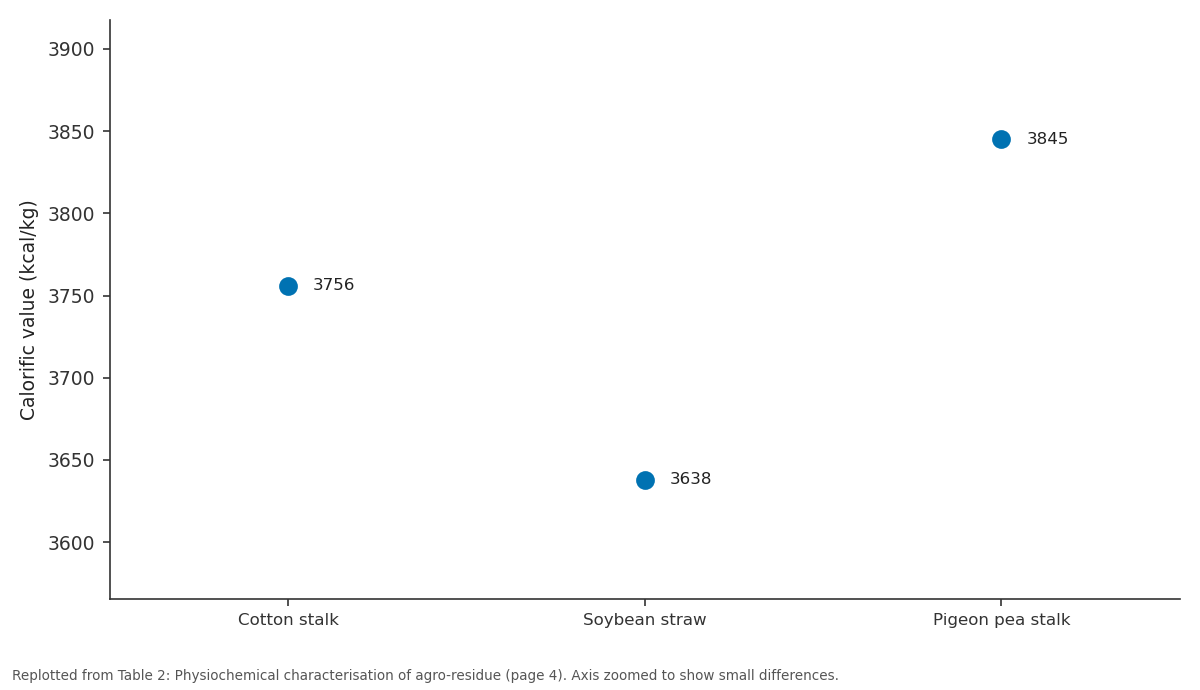
Calorific value (kcal/kg): Cotton stalk vs Soybean straw vs Pigeon pea stalk
Replotted from Table 2 (page 4) of the original paper. Every bar is the paper's own table value.
View source evidence ↗Figures & tables
From the original paper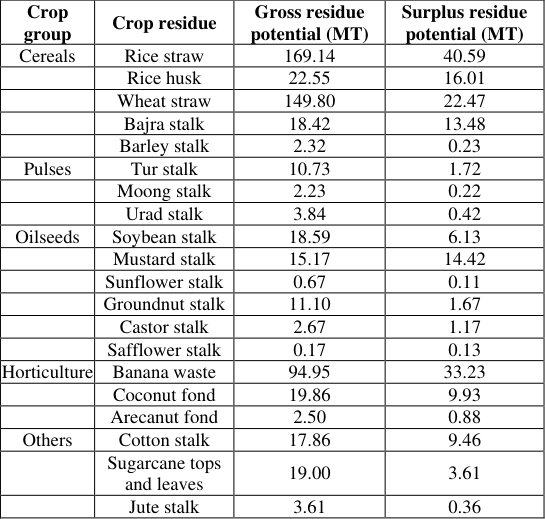 Table 1
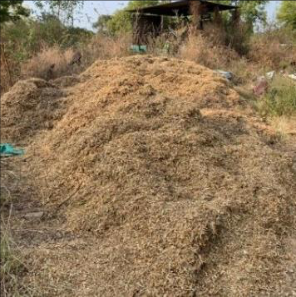 Plate 1
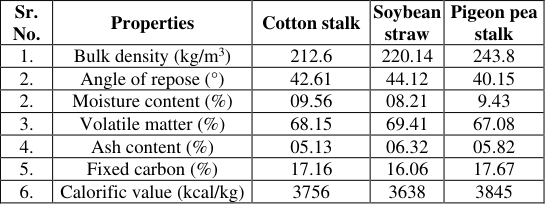 Table 2
Introduction
Biomass is any type of living or recently living organic material that comes from plants and animals (Danso-Boateng and Achaw 2022) [3] . Biomass is referred as an indirect source of solar energy and considered a source of stored energy. Negi et al. (2023) [8] stated that India is an agricultural powerhouse, having a net sown area of about 139.3 Mha (42.4%) from a total geographical area of 328.7 million hectares (Mha). Further, 54.6% of the total workforce of India is reported to be engaged in agricultural and allied sectors and accounts for 17.8% of the country's Gross Value Added. The agricultural production system is the main source of livelihood for one third of population of an India (Phadtare et al., 2023) [10] . Agro residue generation is increasing globally due to the increase in agricultural crop area and cropping intensity. The increasing agricultural activities and modernization produces a lot of food processing waste, bio-waste and solid waste to meet the demands of food and energy for the growing population in the world. Improper disposal of biomass produced by the agricultural sector is a major challenge worldwide. While agriculture produces food, it also produces waste known as agriculture residue or crop waste. Crop residue term is used for the biomass produced as by-products from harvesting and processing of agricultural crops (Yadav et al. 2017) [16] . Crop residue is classified as field-based residues and processing-based residues. Field based residues are generated in the field at the time of harvest. Processing based residue are coproduced during processing of agriculture produce. The total amount of agricultural waste generated annually in India is much greater than that in other countries.
According to the Ministry of New and Renewable Energy (MNRE) estimates, an average of 500 Mt of crop residue is generated in India each year, a majority portion of which is used as fuel for industrial and domestic purposes (Saxena et al. 2021) [12] . India produces more than 686 million tonnes (Mt) of crop residue every year, of which 368 Mt comes from cereal crops. Among cereal crops, rice and wheat are the dominating crops, contributing about 154 and 131 Mt, respectively, in the total crop residue production (Kumar et al. 2023) [6] . Table 1. represent the estimates potential amounts of gross residue and surplus residue of the crop residue (Deka et al. 2023) [4] . In developing countries farmers commonly use crop residue burning to rapidly clean arable land in order to boost production. The burning of crop residue produces in a waste incinerator harmful emission that result in climate change. Burning of crop residue potentially has adverse effects on soil health including huge loss of nutrients carbon, nitrogen, Sulphur etc (Shan et al., 2008) [13] . Farmers in the Vidarbha area of Maharashtra mostly cultivate cotton, pigeon pea and soybean crop. Farmers in Vidarbha region primarily burn cotton and pigeon pea residue. Also, many farmers are presently using soybean straw to feed cattle, with leftovers being burnt on the farm. Cotton stalk soybean straw and pigeon pea stalk agro residue, an abundant agricultural waste, is a promising feedstock for pyrolytic conversion to biochar. Cotton stalks are the residues remaining after cotton production, which are estimated to amount to 3.5-5 tons per ton of cotton crop. [10] . Characterizing agro-residues involves detailed analysis of their physical, chemical and thermal properties to ensure they are suitable for biochar production. In India, the availability of diverse agro-residues presents a significant opportunity for sustainable biochar production, which can enhance soil health, sequester carbon, and provide an additional revenue stream for farmers. Biochar production from agricultural residues offers a sustainable solution for waste management and soil enhancement. This study assesses the potential of cotton stalk, soybean straw, and pigeon pea stalk as feedstock for biochar production. Comprehensive characterization was conducted through proximate analysis, energy content evaluation.
| Crop group | Crop residue | Gross residue potential (MT) | Surplus residue potential (MT) |
|---|---|---|---|
| Cereals | Rice straw | 169.14 | 40.59 |
| Rice husk | 22.55 | 16.01 | |
| Wheat straw | 149.80 | 22.47 | |
| Bajra stalk | 18.42 | 13.48 | |
| Barley stalk | 2.32 | 0.23 | |
| Pulses | Tur stalk | 10.73 | 1.72 |
| Moong stalk | 2.23 | 0.22 | |
| Urad stalk | 3.84 | 0.42 | |
| Oilseeds | Soybean stalk | 18.59 | 6.13 |
| Mustard stalk | 15.17 | 14.42 | |
| Sunflower stalk | 0.67 | 0.11 | |
| Groundnut stalk | 11.10 | 1.67 | |
| Castor stalk | 2.67 | 1.17 | |
| Safflower stalk | 0.17 | 0.13 | |
| Horticulture | Banana waste | 94.95 | 33.23 |
| Coconut fond | 19.86 | 9.93 | |
| Arecanut fond | 2.50 | 0.88 | |
| Others | Cotton stalk | 17.86 | 9.46 |
| Sugarcane tops and leaves | 19.00 | 3.61 | |
| Jute stalk | 3.61 | 0.36 |
Table text extracted from the original PDF; superscript letters are shown inline. The original table image is below.
View original table image
Materials and Methods
The experiment work was undertaken at the Department of Unconventional Energy Sources and Electrical Engineering, College of Agricultural Engineering and Technology, Dr. PDKV, Akola.
Biomass collection and sample preparation
The agro residues cotton stalk, soybean straw and pigeon pea stalk were collected from field of Dr. PDKV Akola.The samples were air-dried, ground to a uniform particle size, and stored in airtight containers for further analysis. Plate 1 shows the raw cotton stalk, soybean straw and pigeon pea stalk.
Characterization of agro-residue
The physiochemical properties of cotton stalk, soybean straw and pigeon pea stalk including bulk density, angle of repose, moisture content, volatile matter, ash content, fixed carbon and calorific value and TGA were determined using standard procedures as follows
Physical Properties
The knowledge of physical properties such as bulk density of the biomass is of fundamental importance for proper design, manufacturing and operation of the pyrolizer.
Bulk density
It was determined by weighing the agro residues sample filled in a vessel of known volume and calculating the ratio of the weight of the agro residues sample to the volume of the vessel. The average of five trials was reported as the volume of the bulk density of the agro residues (Makavana et al., 2018) [7] .
Where, W=weight of the agro residues sample, kg V= volume of the vessel, m 3
Angle of repose
The angle of repose was measured with the help of cylinder arrangement. The cylinder was filled up to the top with the sample and then slowly lifted, thus a conical shape of the material resulted. By measuring the height of the cone angle of repose was calculated using following equation 3.1 (Sidhu and Sadhya 2015) [14] .
Where, α = Angle of repose, degree H = Height of cone, mm B = Base of the cone, mm
Proximate analysis
The proximate composition such as moisture, volatile matter, ash content and fixed carbon content of the agro-residue were calculated by American Society for Testing and Materials standards ASTM-D-3173-3175.
Moisture Content
Moisture Content
Fixed Carbon
The fixed carbon is the residue left after removing the volatile matter and the ash from the substance. The fixed carbon of agro residues sample was calculated by subtracting the sum of volatiles and ash content (%) from 100.
F. C. % = 100 -% of (MC+ VM + AC)
Calorific Value
Calorific value, also known as heating value, is one of the most important properties to consider when evaluating biochar for use as a fuel. Biochar has excellent potential for application in the energy. Calorific value measures the energy content of the agro residue. Calorific value is normally expressed as energy per kilogram of dry agro residues (kcal/kg) and it is dependent on the presence of moisture in the agro residues. A higher moisture content in the agro residues implies a decrease of the heating value because part of the energy is used to evaporate the water.
The calorific value of sample was determined by using bomb calorimeter. Bomb Calorimeter consists of a stainless-steel bomb, inside which the agro residues sample is burnt in rich oxygen environment. The bomb is provided with an oxygen inlet valve and two stainless steel electrodes. To one of the electrodes, a small ring is attached. In this ring, the stainlesssteel crucible is placed. The bomb is placed in a calorimeter which contains three fourth of water. The calorimeter is provided with a Beckmann thermometer and a stirrer. The calorimeter is surrounded by an air jacket and water jacket
Working of bomb calorimeter
The calorific value of sample was determined by using bomb calorimeter with ASTME -711 test code. A fine magnesium wire, touching the fuel sample, was stretched across the electrodes and then setup is kept inside the bomb. The bomb lid was tightly sealed and was filled with oxygen up to 25 atmospheric pressures of oxygen. The bomb was kept in the calorimeter. Initial temperature of water in the calorimeter was noted after thorough stirring. The electrodes were then connected to battery. The sample was fired electrically and the fuel sample in crucible burns with the evolution of heat. The heat evolved due to the combustion of the sample, raised the temperature of water in the calorimeter. The final temperature of water was noted. The heat evolved when unit mass of fuel is burnt is known as calorific value. The calorific value of sample using bomb calorimeter was determined by following formula CV =
Where, W = Weight of water, ml w = Water equivalent of calorimeter assembly, cal/°C T = Rise in temperature, °C E 1 = Correction for nichrome wire, cal = wt of wire, g × calorific value E 2 = Correction for cotton thread, cal = wt of thread, g × calorific value X = Weight of sample, g
Results and Discussion
The results obtained from physiochemical characterisation of the cotton stalk, soybean straw and pigeon pea stalk were discussed in this section.
Physiochemical properties of cotton stalk
The physiochemical characterisation of the cotton stalk, soybean straw and pigeon pea stalk were done to analyse the parameters such as bulk density, moisture content, volatile matter, ash content, fixed carbon, calorific value. Table 2 summarise the results physiochemical characterisation of agro residue. The bulk density of cotton stalk, soybean straw and pigeon pea stalk were found to be 215.80 kg/m 3 , 220.18 kg/m 3 and 236.89 kg/m 3 , respectively. Higher the density, more weight of biomass can be accommodated in same volume of reactor, higher the energy density and carbon content of biomass (Amer and Elwardany 2020) [2] . The average moisture content in cotton stalk, soybean straw and pigeon pea stalk were found to be 09.56 per cent, 8.21 per cent and 9.43 per cent, respectively which is below 15 per cent which is within desirable limit for agro residues to be used for pyrolysis (Fonseca et al., 2019) [5] . The average volatile matter in cotton stalk, soybean straw and pigeon pea stalk were found to be 68.15 per cent, 69.41 per cent and 67.08 per cent, respectively. The components of biomass that burn easily in the presence of oxygen; these usually consist of a mixture of short-and long-chain hydrocarbons, sulfur fumes, and aromatic hydrocarbons that develop during the thermal breakdown of biomass known as volatile matter. Condensable and non-condensable gases are created during the thermal decomposition of biomass to form volatile matter (Suárez-Ruiz and Ward 2008) [15] . The average ash content in cotton stalk, soybean straw and pigeon pea stalk were found to be 05.13 per cent, 06.62 per cent and 05.82 per cent, respectively. The average fixed carbon in cotton stalk, soybean straw and pigeon pea stalk were found to be 17.16 per cent, 16.06 per cent and 17.67 per cent, respectively. Fixed carbon content is an important factor in biomass as it affects combustion properties. Carbonization of raw materials can increase the fixed carbon content, resulting in improved calorific value (Ajimotokan et al., 2019) [1] . The average calorific value in cotton stalk, soybean straw and pigeon pea stalk were found to be 3756 kcal/kg, 3638 kcal/kg and 3845 kcal/kg, respectively. The physiochemical properties of agro residues used for pyrolysis process affect the yield and properties of biochar. The calorific value of biomass, also known as its heating value or heat of combustion, is the amount of energy stored in a unit mass of biomass. It's an important property of biomass that determines its energy value and the amount of heat energy generated from a given quantity of fuel.
| Sr. No. | Properties | Cotton stalk | Soybean straw | Pigeon pea stalk |
|---|---|---|---|---|
| 1. | Bulk density (kg/m3) | 212.6 | 220.14 | 243.8 |
| 2. | Angle of repose (°) | 42.61 | 44.12 | 40.15 |
| 2. | Moisture content (%) | 09.56 | 08.21 | 9.43 |
| 3. | Volatile matter (%) | 68.15 | 69.41 | 67.08 |
| 4. | Ash content (%) | 05.13 | 06.32 | 05.82 |
| 5. | Fixed carbon (%) | 17.16 | 16.06 | 17.67 |
| 6. | Calorific value (kcal/kg) | 3756 | 3638 | 3845 |
Table text extracted from the original PDF; superscript letters are shown inline. The original table image is below.
View original table image
Conclusion
Cotton stalk, soybean straw, and pigeon pea stalk in the Vidarbha region are promising feedstocks for biochar production due to their favourable moisture content, fixed carbon content, and calorific value. Utilizing these residues for pyrolytic conversion to biochar not only provides a renewable energy source but also offers an environmentally friendly alternative to burning agricultural waste. This practice can enhance soil fertility, sequester carbon, and contribute to sustainable agricultural practices in the region. It was discovered that the average moisture level of the stalks from cotton, soybeans, and pigeon peas was less than 15%, which is within the ideal range for using agricultural leftovers for pyrolysis. It was discovered that the average fixed carbon content of pigeon pea, soybean, and cotton stalks was 17.67%, 16.06 percent, and 17.16 percent, respectively. Fixed carbon content has a significant impact on the properties of combustion in biomass. Increased fixed carbon content from carbonisation of raw materials can lead to higher calorific value. It was discovered that the average calorific value of pigeon pea, soybean, and cotton stalks were 3845 kcal/kg, 3638 kcal/kg, and 3756 kcal/kg, respectively. The physiochemical properties of agro residues used for pyrolysis process affect the yield and properties of biochar. From the study it can be concluded that the cotton stalk, soybean straw and pigeon pea stalk can be used for the production of the biochar.
Acknowledgements
Acknowledgements
Figures and tables from the paper
References
0 in the original paperCited by 4
From OpenAlex, OpenCitations and reference lists read by Scinovex
- Cotton stalk derived lignin-based hydrogel and its therapeutic utility in diabetic retinopathy ↗
Pradip Nirbhavane, Sharad S. Kale, Sameer Kumar, Tejal Athare, Anuja Gajanan Magar, Shailesh S. Chalikwar et al. · Biochemical and Biophysical Research Communications · 2025
❝ 13 - Calorific Value, Ash Content and Moisture Cotton Stalk Bioenergy: A Renewable Approach for Sustainable Textile Manufacturing ↗
Samar Gogari · Sustainable textiles · 2026
❝ 0 - Life Cycle Analysis for Agricultural Residues and Related Products ↗
Penjit Srinophakun, Anusith Thanapimmetha, Nutchapon Chiarasumran, Khemmathin Lueangwattanapong, Maythee Saisriyoot · Advances in biochemical engineering, biotechnology · 2026
❝ 0 - Torrefaction-assisted synthesis of biochar from biomass residues for dye adsorption: adsorption isotherm and kinetics ↗
Pranita Nandanwar, Amrin Siddiqui, Renuka Ramteke, Vaishnavi Gomase, Ravin Jugade, Vijay M. Tangde · Surfaces and Interfaces · 2026
❝ 0