
Research article · 2024 · Full text
International Journal of Agriculture Extension and Social DevelopmentProblems faced by the ATMA personnel in planning and executing the programmes of ATMA
Volume 7(6) · Pages 09–14 · DOI: 10.33545/26180723.2024.v7.i6a.662 ↗
Research areasICT Impact and PoliciesMaritime Ports and LogisticsTransport and Economic Policies
Abstract
Author-writtenThe Agricultural Technology Management Agency (ATMA) is a registered society of key stakeholders involved in agricultural activities for sustainable agricultural development in the district. As the ATMA programme is under operation for the around last twenty years, the researchable questions that what are the problems faced by the ATMA personnel in planning and executing the programmes of ATMA. Keeping this view the objective of the present study to list out problems faced by the ATMA personnel in planning and executing the programmes of ATMA and the suggestions for improvement of bottom-up planning. The present study was conducted in two districts namely Kokrajhar and Bongaigaon of Assam during the year 2018-19. A multistage purposive cum random sampling method was followed for the selection of the respondents of the study. A total 242 nos. of GB, AMC, BTT and FAC members from two districts constituted the sample of respondents for the study. The findings highlighted that more than 70.00 percent of the GB and AMC members were faced the four problems like “Excessive work load besides the normal work of the Dept. like election, NRC and relief duty”, “Lack of mechanism/forum to discuss plans and actions of ATMA at District level”, “Overlapping of ATMA programmes with other programmes of the department” and “Inadequate fund for implementation of the programmes” in planning and executing the programmes of ATMA. Likewise the BTT and FAC members were also faced the different problems at different percent level in planning and executing the programmes of ATMA. Therefore, an effective policy and strategy on the parts of state coordinating unit and district ATMA could overcome these problems for efficiently planning and executing the different activities of ATMA by the extension personnel.
Summary
Source-checkedPlain-language reading of the full paper, prepared with AI and checked against the text. Each point links to the authors' own words.
Why it matters
- The Agricultural Technology Management Agency (ATMA) serves as a key organization for sustainable district-level agricultural development by integrating research and extension activities. View evidence ↗
- Because the ATMA program has been operational for approximately twenty years, there is a need to identify the specific problems personnel face during program planning and execution. View evidence ↗
The question
- The study aims to identify the problems ATMA personnel encounter when planning and executing programs and to provide suggestions for improving bottom-up planning. View evidence ↗
What they did
- The research was carried out in the Kokrajhar and Bongaigaon districts of Assam during 2018-19. View evidence ↗
- A total of 242 respondents, including members of the Governing Board (GB), ATMA Management Committee (AMC), Block Technology Team (BTT), and Farmers' Advisory Committee (FAC), were selected using multistage purposive and random sampling. View evidence ↗
- Data was collected through open-ended research schedules and personal interviews with FAC members. View evidence ↗
What they found
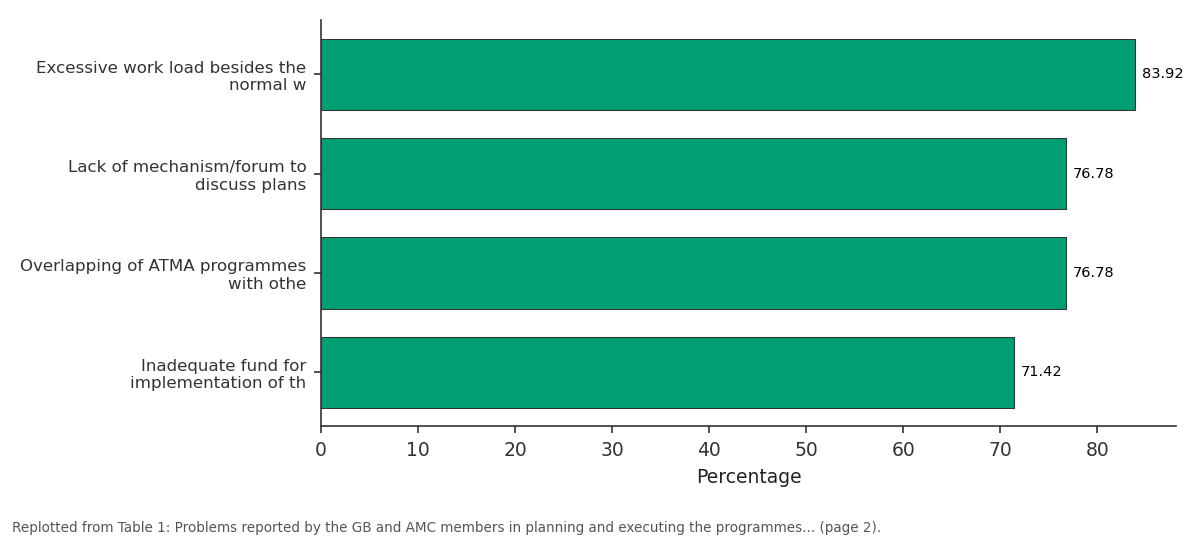
- For GB and AMC members, the most significant problem was excessive workload from non-departmental duties (such as election and relief duty), reported by 83.92% of respondents. View evidence ↗
- GB and AMC members also identified a lack of discussion forums at the district level and overlapping departmental programs as major issues, both cited by 76.78% of respondents. View evidence ↗
- The primary problem for BTT members was the irregular release of funds for development programs, reported by 92.85% of the group. View evidence ↗
- BTT members also reported four equally serious problems (83.34% each): funding constraints for farmer expectations, excessive non-departmental workload, insufficient technology materials, and untimely arrival of inputs for service centers. View evidence ↗
- The most critical issue for FAC members was the delay in fund transfers for the purchase of seeds and inputs by farmers, cited by 85.41% of respondents. View evidence ↗
- FAC members also highlighted insufficient training for knowledge upgrades and small scheme areas at the village level as major difficulties, both reported by 80.55% of respondents. View evidence ↗
What it means
- The authors conclude that the state coordinating unit and district ATMA must implement effective policies and strategies to overcome these operational hurdles. View evidence ↗
- To improve bottom-up planning, the authors suggest increasing farm information dissemination activities, such as exhibitions and Kisan Melas, to encourage farmer participation. View evidence ↗
Visual summary
2 visualsIllustrations explain the paper; charts are replotted from the paper's own table values.
Percentage: Excessive work load... vs Lack of mechanism/forum... vs Overlapping of ATMA... vs Inadequate fund for...
Replotted from Table 1 (page 2) of the original paper. Every bar is the paper's own table value.
View source evidence ↗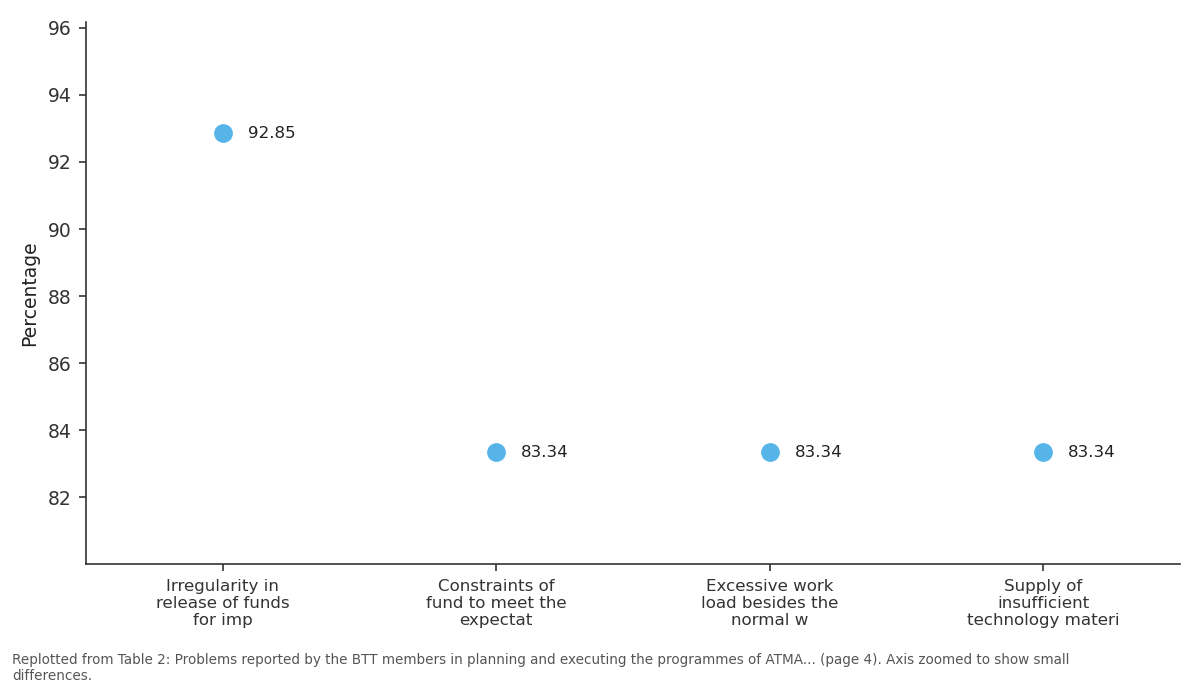
Percentage: Irregularity in release... vs Constraints of fund to... vs Excessive work load... vs Supply of insufficient...
Replotted from Table 2 (page 4) of the original paper. Every bar is the paper's own table value.
View source evidence ↗Figures & tables
From the original paper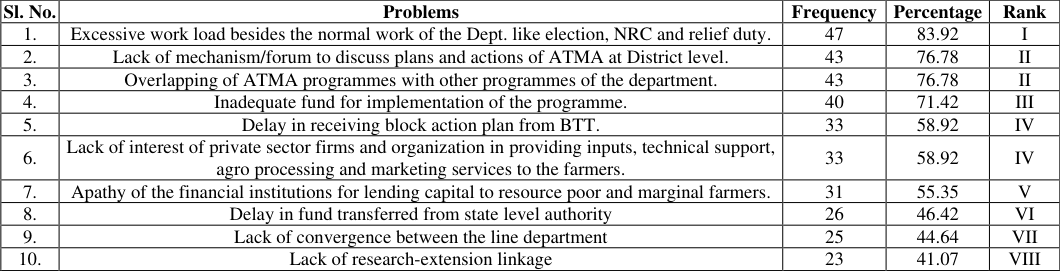 Table 1
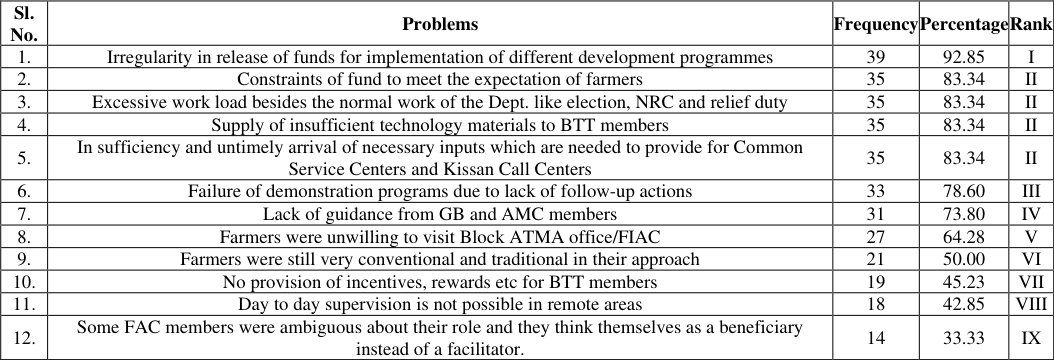 Table 2
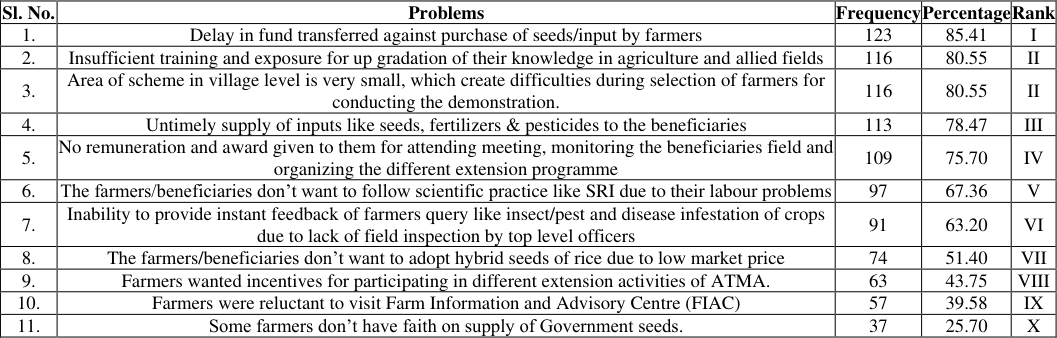 Table 3
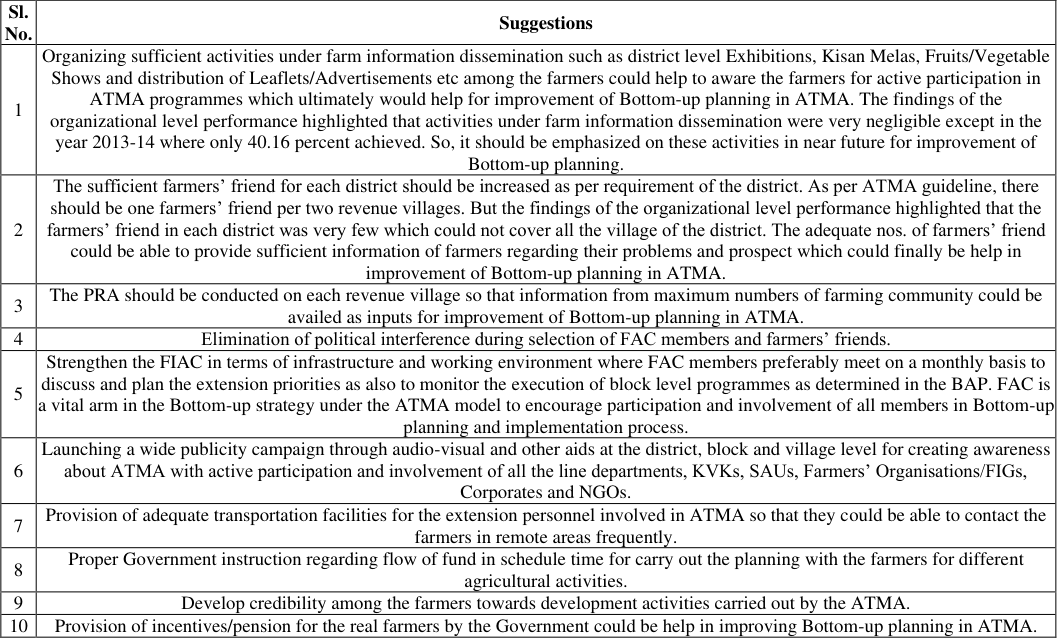 Table 4
Introduction
The Agricultural Technology Management Agency (ATMA) is a registered society of key stakeholders involved in agricultural activities for sustainable agricultural development in the district. It is a focal point for integrating research and extension activities and decentralizing day-today management of Agricultural Extension System. ATMA Governing Board (GB) is the apex body of ATMA which provides overall policy direction. ATMA GB is assisted by the District ATMA Cell comprising Project Director (PD) ATMA, Deputy PDs and Staff for the discharging of its functions. ATMA Management Committee is the executive body looking after implementation of the scheme. District Farmers' Advisory Committee (DFAC) is a body to provide farmers' feedback for district level planning and implementation. With dedicated staff provided for the ATMA, it becomes the district level nodal agency responsible for overall management of agriculture extension system within the district, including preparation of Strategic Research and Extension Plan (SREP). Extension intervention is based on the Strategic Research and Extension Plan (SREP) prepared after a Participatory Rural Appraisal (PRA) in each district.
The Farm Information and Advisory Centre (FIAC) is the physical platform at the block level where farmers, members of the private sector, and extension field staff members from each line department meet to discuss, plan, and execute extension programs. Two bodies at the Block level namely Block Technology Team (BTT) (a team comprising officers of Agriculture and all line departments within the block) and Block Farmers Advisory Committee (BFAC) (a group exclusively consisting of farmers of the block) function jointly (with the latter providing farmers' feedback and input). BFACs represent Farmer Interest Groups (FIGs) / Farmers' Organization (FOs) existing within the block on rotation basis to advise the BTT. The Block ATMA Cell consisting of these two bodies, Block Technology Manager (BTM) and Assistant Technology Manager (ATM) provide extension support within the Block, through preparation and execution of Block Action Plans (BAPs). As the ATMA programme is under operation for the around last twenty years, the researchable questions that what are the problems faced by the ATMA personnel in planning and executing the programmes of ATMA. Keeping this view the objective of the present study is to list out problems faced by the ATMA personnel in planning and executing the www.extensionjournal.com programmes of ATMA and the suggestions for improvement of bottom-up planning.
Materials and Methods
The present study was conducted in two districts namely Kokrajhar and Bongaigaon of Assam during the year 2018-19. A multistage purposive cum random sampling method was followed for the selection of the respondents of the study. From two selected districts 80 percent of GB and MC members (Extension Personnel) at district level and 60 percent of BTT members (Extension personnel) at block level were selected randomly. The eighty percent of GB and MC members accounts 30 nos. and 26 nos. of respondents from two districts respectively. Again the sixty percent of BTT members accounts 42 nos. from two districts. Altogether 98 extension personnel at the district and block level were selected as respondents from these two districts. On the other hand 60 percent of DLFAC and BFAC members were selected randomly from two selected districts. The sixty percent of DLFAC (24 nos.) and BFAC (120 nos.) members accounts 144 nos. of farmers members from the two districts. Thus, total 242 nos. of GB, AMC, BTT and FAC members from two districts constituted the sample of respondents for the study. The problems and constraints in this study refer to the difficulties those come on the way in the achievement of any goal or objective. In the operational terms, the problems referred to the difficulties that are being faced by ATMA personnel in district and block level in planning and executing the programmes of ATMAs. The respondents were asked to specify the problems in planning and executing their assigned roles / duties and to mention suggestions for improvement of Bottom-up planning in ATMA which they felt can overcome those problems or improve Bottom-up planning in ATMA. The number of problems and suggestions thereof, collected in this way varied in number. A list of all the different problems and their suggestions thereof, were prepared and respective frequencies and percentages were worked out. The problems and that claimed with less than 10 percent responses were discarded.
Results and Discussion
Problems faced by the ATMA personnel in planning and executing the programmes of ATMA The extension personnel viz., GB, AMC and BTT members and FAC viz., DLFAC and BFAC members of ATMA were asked to state the problems which they considered in planning and executing the programmes of ATMA. The problems faced by the respondents were collected using a research schedule that was circulated to each respondent, questions were open ended. Personal interview method was also followed to collect information regarding problems faced in planning and executing the programmes of ATMA by the FAC members. After collecting the responses from the each respondent, they were edited for making language corrections and combining responses with similar meaning. The different problems were expressed by respondents were different in words or in their ways of expressions but the similarities in the meaning and contents of the opinions were observed. They were coded and arranged in a standard form to give the exact meaning. Such way, on the basis of the problems expressed by the respondents, their frequencies and percentages were worked out. Based on the percentages, the problems were arranged in a descending order and presented in the Table 1 to Table
| Sl. No. | Problems | Frequency | Percentage | Rank |
|---|---|---|---|---|
| 1. | Excessive work load besides the normal work of the Dept. like election, NRC and relief duty. | 47 | 83.92 | I |
| 2. | Lack of mechanism/forum to discuss plans and actions of ATMA at District level. | 43 | 76.78 | II |
| 3. | Overlapping of ATMA programmes with other programmes of the department. | 43 | 76.78 | II |
| 4. | Inadequate fund for implementation of the programme. | 40 | 71.42 | III |
| 5. | Delay in receiving block action plan from BTT. | 33 | 58.92 | IV |
| 6. | Lack of interest of private sector firms and organization in providing inputs, technical support, agro processing and marketing services to the farmers. | 33 | 58.92 | IV |
| 7. | Apathy of the financial institutions for lending capital to resource poor and marginal farmers. | 31 | 55.35 | V |
| 8. | Delay in fund transferred from state level authority | 26 | 46.42 | VI |
| 9. | Lack of convergence between the line department | 25 | 44.64 | VII |
| 10. | Lack of research-extension linkage | 23 | 41.07 | VIII |
Table text extracted from the original PDF; superscript letters are shown inline. The original table image is below.
View original table image
Problems faced by the GB and AMC members in planning and executing the programmes of ATMA
As the GB and AMC are the policy making and implementing agency at the district level and more or less same personnel represent the GB and AMC. Therefore, the problems faced in planning and executing the programmes of ATMA by the extension personnel viz. GB and AMC members were grouped together. The Table 1 revealed that four problems were really serious as more than 70.00 percent of the respondents faced them. Within these problems "Excessive work load besides the normal work of the Dept. like election, NRC and relief duty" was rated first with 83.92 percents agreeing to it. This is an indication for un-comfort levels of GB and AMC members in planning and executing the programmes of ATMA. Convergence among the line departments as well as linkage between research and extension is essential to plan and execute any technology in the farmers' field more vibrantly. Therefore, the problems like "Lack of convergence between the line department" and "Lack of research-extension linkage" were found seventh (44.64%) and last but eighth rank (41.07%) respectively as major problems by the members.
Based on the responses given by the respondents (GB and AMC members), first four problems have been recognized as most serious which were expressed by more than 70.00 percent of the respondents, next three problems considered as serious (above 50.00%) and the last three problems considered as somewhat serious problems as those were expressed by less than 50.00 percent of the respondents.
Problems faced by the BTT members in planning and executing the programmes of ATMA
The problems faced by the BTT members were separately analyzed as they are only implementing team in block level. The Table 2 reveals that five problems were really serious as more than 80.00 percent of the respondents faced them. Within these problems "irregularity in release of funds for implementation of different development programmes" was rated first with 92.85 percent agreeing to it. This is an indication for un-comfort levels of BTT members in planning and executing the programmes of ATMA. Further, the result highlighted that two problems were serious as more than 70.00 percent of the respondents faced them. Within these problems "Failure of demonstration programs due to lack of follow-up actions" (78.60%) was rated as third serious problem because follow-up action is necessary for successfully conduction of any programmes in the farmer's field. But due to time constraint the BTT members could not able to go for regular follow-up actions of different programmes. The next problem "Lack of guidance from GB and AMC members" (73.80%) was rated as fourth serious problem where the district level officers are non-reluctant to help block level extension personnel.
| Sl. No. | Problems | Frequency | Percentage | Rank |
|---|---|---|---|---|
| 1. | Irregularity in release of funds for implementation of different development programmes | 39 | 92.85 | I |
| 2. | Constraints of fund to meet the expectation of farmers | 35 | 83.34 | II |
| 3. | Excessive work load besides the normal work of the Dept. like election, NRC and relief duty | 35 | 83.34 | II |
| 4. | Supply of insufficient technology materials to BTT members | 35 | 83.34 | II |
| 5. | In sufficiency and untimely arrival of necessary inputs which are needed to provide for Common Service Centers and Kissan Call Centers | 35 | 83.34 | II |
| 6. | Failure of demonstration programs due to lack of follow-up actions | 33 | 78.60 | III |
| 7. | Lack of guidance from GB and AMC members | 31 | 73.80 | IV |
| 8. | Farmers were unwilling to visit Block ATMA office/FIAC | 27 | 64.28 | V |
| 9. | Farmers were still very conventional and traditional in their approach | 21 | 50.00 | VI |
| 10. | No provision of incentives, rewards etc for BTT members | 19 | 45.23 | VII |
| 11. | Day to day supervision is not possible in remote areas | 18 | 42.85 | VIII |
| 12. | Some FAC members were ambiguous about their role and they think themselves as a beneficiary instead of a facilitator. | 14 | 33.33 | IX |
Table text extracted from the original PDF; superscript letters are shown inline. The original table image is below.
View original table image
On the other hand, the two problems were major problems as 50.00 percent or more than 50.00 percent of the respondent faced them. Within these problems "Farmers were unwilling to visit Block ATMA office/FIAC" (64.28%) and "Farmers were still very conventional and traditional in their approach" (50.00%) were rated as fifth and sixth major problems, respectively among all. Among the problems, two were very important as more than 40.00 percent of the respondents faced those problems. Within these problems, "No provision of incentives, rewards etc. for BTT members" (45.23%) and "Day to day supervision is not possible in remote areas" (42.85%) were rated as seventh and eighth as very important problems, respectively. Provision of incentives or rewards may create a zeal to hard work and success in any extension personnel mind leading to increase in their work efficiency which is lacking in ATMA and thereby cited this problem as very important by the BTT members. Due to more area of coverage by the BTT members, it was not possible for them to supervise their field frequently. So, they also cited this problem as very important.
The last problem "Some FAC members were ambiguous about their role and they think themselves as a beneficiary instead of a facilitator" (33.33%) was rated as ninth by the BTT members. Sometimes this problem creates a mystification during conduction of demonstration. www.extensionjournal.com The findings in the Table 3 revealed that first three problems were really serious as more than 80.00 percent of the respondents faced them. Within these problems "Delay in fund transferred against purchase of seeds/input by farmers" was rated first with 85.41 percents agreeing to it. So, it is difficult for the FAC members to convince the beneficiaries during implementation of ATMA programmes. Further, the next two problems "Insufficient training and exposure for up gradation of their knowledge in agriculture and allied fields" and "Area of scheme in village level is very small, which create difficulties during selection of farmers for conducting the demonstration" were rated as second with 80.55 percent agreeing to it. Due to lack of training and exposure, the FAC members were faced hurdle to tackle the problems of farmers in the field itself. Because of very few numbers of demonstration under the scheme in village level, the FAC members were faced hardship situation to identify the beneficiaries. The two problems were found as serious as more than 70.00 percent of the FAC members come across these problems. These were "Untimely supply of inputs like seeds, fertilizers and pesticides to the beneficiaries" (78.47%) and "No remuneration and award given to them for attending meeting, monitoring the beneficiaries field and organizing the different extension programmes" (75.70%) rated as third and fourth respectively. Time supply of inputs related to the technology demonstration is very essential as they feel for smooth planning and implementation of the demonstration in the farmer's field. On the other hand, FAC members feel if they get remuneration and award for their work, then they can devote their time more efficiently. The result also highlighted that two problems were found as major problems as more than 60.00 percent of the FAC members expressed those. Within these problems "The farmers/beneficiaries don't want to follow scientific practice like SRI due to their labour problems" (67.36%) and "Inability to provide instant feedback of farmers' quarry like insect/pest and disease infestation of crops due to lack of field inspection by top level officers" (63.20%) and placed them in the rank fifth and sixth respectively. It is known fact that presently in Assam, the crisis of agricultural labour is a serious issue. So, it is difficult to implement SRI like technology in the farmers' field which demand more labour without use of modern tools. Getting quick feedback regarding farmers quarry from top level officers definitely help the FAC members to solve the problems in field itself which the top level officers are not able to do so. The result also revealed that one most important problem that was "The farmers/beneficiaries don't want to adopt hybrid seeds of rice due to low market price" which faced 51.40 percent of the FAC members and placed in the rank seventh. The people of Assam don't prefer hybrid rice to take. So, in the market, it is difficult for the farmers to sale the hybrid rice. In this issue, the FAC members were faced hurdle to motivate farmers to adopt hybrid rice.
| Sl. No. | Problems | Frequency | Percentage | Rank |
|---|---|---|---|---|
| 1. | Delay in fund transferred against purchase of seeds/input by farmers | 123 | 85.41 | I |
| 2. | Insufficient training and exposure for up gradation of their knowledge in agriculture and allied fields | 116 | 80.55 | II |
| 3. | Area of scheme in village level is very small, which create difficulties during selection of farmers for conducting the demonstration. | 116 | 80.55 | II |
| 4. | Untimely supply of inputs like seeds, fertilizers & pesticides to the beneficiaries | 113 | 78.47 | III |
| 5. | No remuneration and award given to them for attending meeting, monitoring the beneficiaries field and organizing the different extension programme | 109 | 75.70 | IV |
| 6. | The farmers/beneficiaries don’t want to follow scientific practice like SRI due to their labour problems | 97 | 67.36 | V |
| 7. | Inability to provide instant feedback of farmers query like insect/pest and disease infestation of crops due to lack of field inspection by top level officers | 91 | 63.20 | VI |
| 8. | The farmers/beneficiaries don’t want to adopt hybrid seeds of rice due to low market price | 74 | 51.40 | VII |
| 9. | Farmers wanted incentives for participating in different extension activities of ATMA. | 63 | 43.75 | VIII |
| 10. | Farmers were reluctant to visit Farm Information and Advisory Centre (FIAC) | 57 | 39.58 | IX |
| 11. | Some farmers don’t have faith on supply of Government seeds. | 37 | 25.70 | X |
Table text extracted from the original PDF; superscript letters are shown inline. The original table image is below.
View original table image
The last three problems which encountered by the FAC members were "Farmers wanted incentives for participating in different extension activities of ATMA" (43.75%), "Farmers were reluctant to visit Farm Information and Advisory Centre (FIAC)" (39.58%) and "Some farmers don't have faith on supply of Government seeds" (25.70%) and those rated as eighth, ninth and tenth some what important problems among the all. It is fact that the resource poor farmers are completely depend on agriculture and for them spending more time to attend meetings hampered to carry out their agricultural activities. So, it is necessary to compensate their loss by providing incentives for attending different activities of ATMA. Again, farmers are not show their interest to visit the FIAC which create problem during planning and implementation of different programmes. On the other hand, many of the farmers have no faith on supply of Government seeds due to their bitter experience in earlier. In this case, it is also difficult to adopt some new technology in the farmers' field. www.extensionjournal.com
Suggestions for improvement of bottom-up planning in Atma
Based on analysis of the organizational level performance and expressed opinions of the respondents the following major suggestions for improvement of Bottom-up planning in ATMA were presented in the Table 4. Organizing sufficient activities under farm information dissemination such as district level Exhibitions, Kisan Melas, Fruits/Vegetable Shows and distribution of Leaflets/Advertisements etc among the farmers could help to aware the farmers for active participation in ATMA programmes which ultimately would help for improvement of Bottom-up planning in ATMA. The findings of the organizational level performance highlighted that activities under farm information dissemination were very negligible except in the year 2013-14 where only 40.16 percent achieved. So, it should be emphasized on these activities in near future for improvement of Bottom-up planning.
2
The sufficient farmers' friend for each district should be increased as per requirement of the district. As per ATMA guideline, there should be one farmers' friend per two revenue villages. But the findings of the organizational level performance highlighted that the farmers' friend in each district was very few which could not cover all the village of the district. The adequate nos. of farmers' friend could be able to provide sufficient information of farmers regarding their problems and prospect which could finally be help in improvement of Bottom-up planning in ATMA.
The PRA should be conducted on each revenue village so that information from maximum numbers of farming community could be availed as inputs for improvement of Bottom-up planning in ATMA. 4
Elimination of political interference during selection of FAC members and farmers' friends.
5
Strengthen the FIAC in terms of infrastructure and working environment where FAC members preferably meet on a monthly basis to discuss and plan the extension priorities as also to monitor the execution of block level programmes as determined in the BAP. FAC is a vital arm in the Bottom-up strategy under the ATMA model to encourage participation and involvement of all members in Bottom-up planning and implementation process.
6
Launching a wide publicity campaign through audio-visual and other aids at the district, block and village level for creating awareness about ATMA with active participation and involvement of all the line departments, KVKs, SAUs, Farmers' Organisations/FIGs, Corporates and NGOs.
7 Provision of adequate transportation facilities for the extension personnel involved in ATMA so that they could be able to contact the farmers in remote areas frequently.
8
Proper Government instruction regarding flow of fund in schedule time for carry out the planning with the farmers for different agricultural activities. 9
Develop credibility among the farmers towards development activities carried out by the ATMA. 10 Provision of incentives/pension for the real farmers by the Government could be help in improving Bottom-up planning in ATMA.
Conclusion
The findings highlighted that more than 70.00 percent of the GB and AMC members were faced the four problems like "Excessive work load besides the normal work of the Dept. like election, NRC and relief duty", "Lack of mechanism/forum to discuss plans and actions of ATMA at District level", "Overlapping of ATMA programmes with other programmes of the department" and "Inadequate fund for implementation of the programmes" in planning and executing the programmes of ATMA. Among the BTT members, more than 90.00 percent were faced the problem of "Irregularity in release of funds for implementation of different development programmes", more than 80.00 percent of them faced the four problems like "Constraints of fund to meet the expectation of farmers", "Excessive work load besides the normal work of the Dept. like election, NRC and relief duty", "Supply of insufficient technology materials to BTT members" and "In sufficiency and untimely arrival of necessary inputs which are needed to provide for Common Service Centers and Kissan Call Centers" and more than 70.00 percent of them were faced two problems like "Failure of demonstration programs due to lack of follow-up actions" and "Lack of guidance from GB and AMC members". Further, the findings highlighted that among the FAC members, more than 80.00 percent of them were faced three www.extensionjournal.com problems like "Delay in fund transferred against purchase of seeds/input by farmers", "Insufficient training and exposure for up gradation of their knowledge in agriculture and allied fields" and "Area of scheme in village level is very small, which create difficulties during selection of farmers for conducting the demonstration". Again, more than 70.00 percent of them were faced two problems like "Untimely supply of inputs like seeds, fertilizers & pesticides to the beneficiaries" and "No remuneration and award given to them for attending meeting, monitoring the beneficiaries field and organizing the different extension programmes". This implies that an effective policy and strategy on the parts of state coordinating unit and district ATMA could overcome this problem for efficiently planning and executing the different activities of ATMA by the extension personnel and FAC members. As well as the suggestions given by the respondents would also help the policy makers to make effective strategies for improvement of Bottom-up planning in near future.
Acknowledgement
AcknowledgementAuthors are grateful to the FAC members of the Kokrajhar and Bongaigaon district ATMA of Assam who provided valuable information, suggestions, enormous support, and cooperation throughout the entire study.
References
5 in the original paper- ATMA Guidelines, 2018 under Krishonnati Yojana. Support to State Extension Programmes for Extension Reforms (ATMA) Scheme. Directorate of Extension, Department of Agriculture, Cooperation & Farmers Welfare, Ministry of Agriculture & Farmers Welfare, Govt. of India, New Delhi; c2018.
- Bortamuly D, Khuhly BL. Constraints faced by block level extension functionaries in facilitating commodity interest groups and farm schools under ATMA in NE Indian states. Journal of Academia and Industrial Research. 2013;2(5):291-294.
- Sarat H, Neelam C, Kadia KS. Constraints under ATMA extension system and suggestions for its better performance: an explorative study of stakeholders of ATMA in Andhra Pradesh, India. Journal of Academia and Industrial Research. 2018;18(1):190-194.
- Kumar KA, Eswarappa G, Manjunatha BN. Constraints faced by stakeholders in implementation of agricultural technology management agency programme. Karnataka Journal of Agricultural Sciences. 2011;24(2):255-257.
- Naidu JYN, Philip H, Asokan M, Subramanian RB, Duraisamy MR. The present study was carried out in Andhra Pradesh state to explore the constraints faced by the extension functionaries at each level of decentralized management. Journal of Extension Education. 2016;28(4):5768-5774.