
Research article · 2024 · Full text
International Journal of Research in AgronomyDesign and development of a paddle operated groundnut decorticator for small-scale farmers
Volume 7(6S) · Pages 06–08 · DOI: 10.33545/2618060x.2024.v7.i6sa.789 ↗
Research areasAgricultural Engineering and MechanizationPeanut Plant Research StudiesAgricultural Economics and Practices
Abstract
Author-writtenShelling peanuts is a time-consuming and tedious task. This process provides less power, requires more effort from the user, and ultimately uses more energy. Therefore, the idea was developed to create a machine that requires less labor and less energy consumption. Performance evaluation of a pedal-operated peanut coring machine was evaluated using various treatment combinations of clearance and moisture content. The difference in the distance between the rotating drum and the friction plate, namely H.8 mm, 10 mm, 12 mm, and the water content of peanut pods is different. The peeling capacity, production capacity, peeling efficiency, unpeeled pod and kernel breakage were 92. 41 kg/h, 51.95 kg grains/h, 86. 37%, 13. 62%, and 15. 65%, respectively, at the best optimum values. The distance and moisture content combinations of 10 mm and 6. 53% were found, respectively. The total unit cost of developing a pedal-operated groundnut picker was ₹14,000 and the operating cost including fixed and variable costs was ₹90. 43/hour. The cost of shelling 1 kg of groundnut pods was estimated to be 0. 97 ₹. The developed pedal-operated groundnut coring machine is reliable and satisfactory for selected varieties of groundnuts.
Summary
Source-checkedPlain-language reading of the full paper, prepared with AI and checked against the text. Each point links to the authors' own words.
Why it matters
- Groundnut is a critical food and cash crop in India, where the country ranks as the second largest global producer and the crop accounts for over 60% of oilseed production. View evidence ↗
- Traditional peanut shelling is an inefficient process that is tedious, time-consuming, and requires significant user effort and energy. View evidence ↗
- Decortication is the most vital step in groundnut processing because it enables the subsequent use of kernels and shells for oil extraction or briquetting. View evidence ↗
The question
- The study aims to develop a mobile, pedal-operated groundnut decorticator based on existing hand-operated designs, focusing on high efficiency and low kernel breakage. View evidence ↗
What they found
- At optimum settings, the machine achieved a peeling capacity of 92.41 kg/h, a production capacity of 51.95 kg grains/h, and a peeling efficiency of 86.37%. View evidence ↗
- Under optimal conditions, the machine resulted in 13.62% unpeeled pods and 15.65% kernel breakage. View evidence ↗
- The optimal performance was achieved with a clearance distance of 10 mm and a moisture content of 6.53%. View evidence ↗
- The total cost to develop the pedal-operated machine was ₹14,000, with an hourly operating cost of ₹90.43. View evidence ↗
- The estimated cost for shelling 1 kg of groundnut pods using the machine is ₹0.97. View evidence ↗
- The material efficiency for a tested sample was calculated at 92.47%. View evidence ↗
What it means
- The authors conclude that the developed pedal-operated machine is a reliable and satisfactory solution for specific groundnut varieties. View evidence ↗
- The authors state that the bicycle-driven mechanism reduces costs by eliminating power requirements and saves both time and labor. View evidence ↗
Visual summary
1 visualsIllustrations explain the paper; they do not show study data.
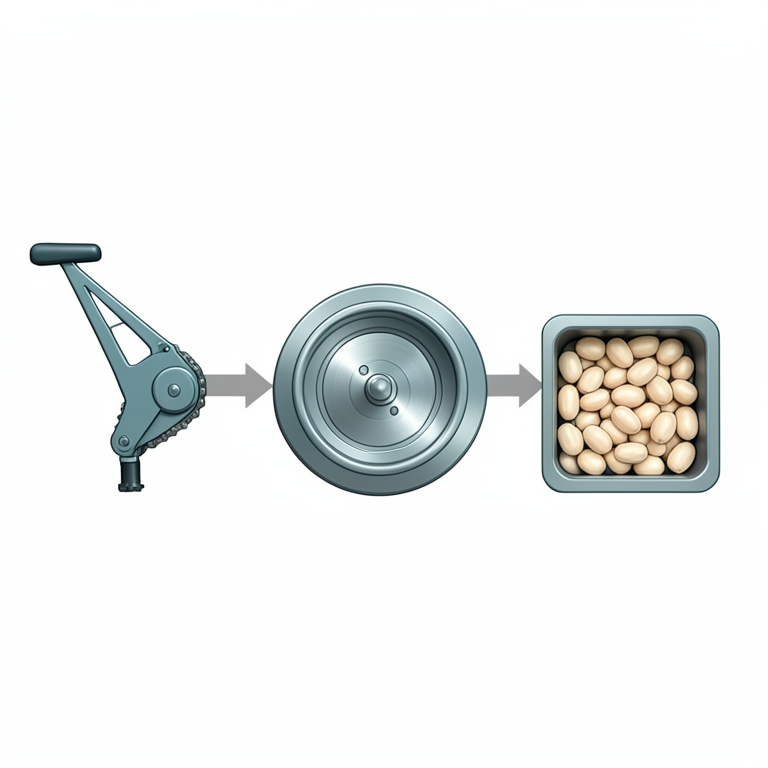
Conceptual Design of Pedal-Operated Decorticator
AI-generated conceptual illustration (pedal-operated groundnut decorticator machine). It explains the idea and does not show study data.
View source evidence ↗Figures & tables
From the original paper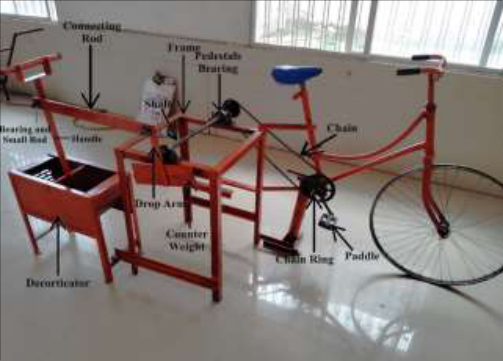 Figure 1
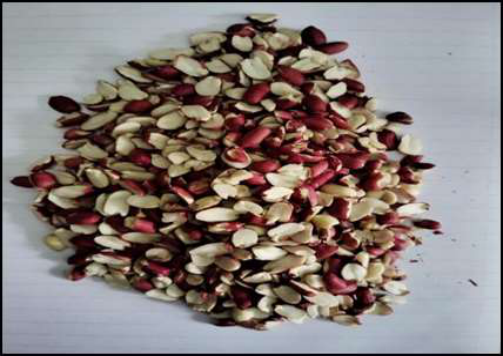 Figure 3
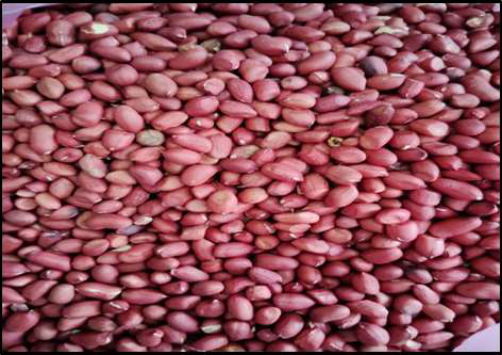 Figure 2
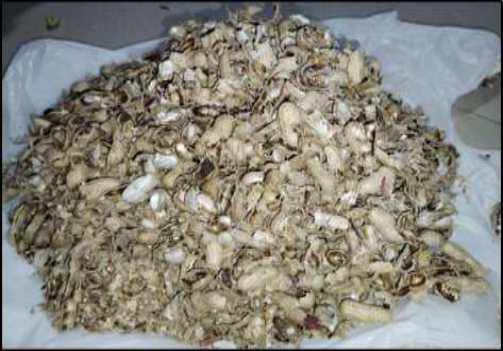 Figure 4
Introduction
Groundnut is believed to have originated in South America, from where cultivation of groundnut spread to Brazil, southern Bolivia and North-western Argentina. India is the second largest producer of groundnut in the world and it occupies an important position in the Indian agricultural economy. It is one of the most important food and cash crops of the country accounting for more than 40 % of area under oilseeds and 60 % of oilseed production. Groundnut is a valuable source of edible oil (43-55%) and rich source of high protein (25-28%) for human beings and also work as a fodder for livestock.
The main aim of this paper is to develop a mobile groundnut decorticator using the existing hand operated groundnut decorticator. Apart from this, the machine is designed to have good decorticating efficiency and low percentage breakage of peanuts. Groundnuts most important action in groundnut processing as it permits the kernels and shell to be used with other post harvesting methods that take place after harvest, such as oil extraction or shell briquetting. It is done either by stripping, rubbing and impact action or any combined arrangement of these methods.
Groundnut is about 1661 kg/ha yield and the production is about 0.98 lakh tonnes (D.P.D., 2018). Decortication is most important action in groundnut processing as it permits the kernels and shell to be used with other post harvesting methods that take place after harvest, such as oil extraction or shell briquetting. It is done either by stripping, rubbing and impact action or any combined arrangement of these methods. The objectives of this project are: Design and fabricate a low-cost paddle operated groundnut decorticator machine. To determine the efficiency of machine.
Study area The fabrication was carried out & performance study were carried out at Farm Machinery Workshop of BRSM College of Agricultural Engineering and Technology & Research Station, 2024; SP-7(6): 06-08 Jangre A Assistant Professor, BRSM CAET & RS, IGKV, Raipur, Chhattisgarh, India Kashup D UG Student, BRSM CAET & RS, IGKV, Raipur, Chhattisgarh, India Sahu L UG Student, BRSM CAET & RS, IGKV, Raipur, Chhattisgarh, India Mantri M UG Student, BRSM CAET & RS, IGKV, Raipur, Chhattisgarh, India Padhee D Assistant Professor, BRSM CAET & RS, IGKV, Raipur, Chhattisgarh, India Jangre A Assistant Professor, BRSM CAET & RS, IGKV, Raipur, Chhattisgarh, India https://www.agronomyjournals.com Cost analysis Mungeli, Indira Gandhi Krishi Vishwavidyalaya, Raipur (C.G.). S. No. Material No. of pieces Cost (Rs.) 01 Manual operated groundnut decorticator 1 2500 02 Bearing 2 80 03 Support bearing 2 500 04 Chain, Sprocket, Chain ring 1 350 05 Cycle Frame 1 500 06 Mild Steel Flat bar 4.5 (kg) 180 07 Mild Steel ‘L’ angle 20 (kg) 960 08 Mild Steel Round Rod 2.5 (kg) 110 Total 5180
Results
Percentage S. No. Materials Weight (kg) (%) 01 Total groundnut (Qt) 2.5 100 02 Weight of decorticate groundnut in kg (Qs) 1.595 63.8 02 Whole shelled groundnut (Qu) 1.475 59 03 Brokens (Qd) 0.120 4.8 04 Crushed shells (Qc) 0.842 33.68 05 Whole groundnut with shell retained in machine (Qr) 0.054 2.16 06 Damaged groundnut (Qp) 0.009 0.36
Conclusion
Fig 2: Shelled groundnut Essential components and actual view of machine Fig 3: Brokens Fig 1: Actual view of paddle operated groundnut decorticator https://www.agronomyjournals.com of Mechanical and Industrial Technology, Month: October 2014-2015, Vol. 2. 8. Smith AF. Peanuts, 1st edition, University of Illionis Press, Urbana and Chicago. 2002. 9. Rajurkar KT, Joshi BK, Sherkar BD, Singh HP.
Post Harvest Profile of Groundnut, Agricultural Marketing Information Network- AGMARKNET Report, Department of Agriculture and Cooperation, Government of India 2005, (http://agmarknet.nic.in/groundnut_profile.pdf). 10. Gitau AN, Mboya P, Njoroge BNK, Mburu M. Optimizing the 55 Performance of a Manually Operated Groundnut (Arachis hypogaea) Decorticator, Open Journal of Optimization. 2013;2:26-32. 11. Roshan Ghodkhande P, Nilesh Dhote D, Sandip Kadam J.
Design and Modification of Ground-Nut Decorticator, and Communication Engineering. 2015;3(12). 12. Kulbhushan Shejol M, Nitin Borkar B, Abhijit Bobade M. Fig 4: Crushed shells Calculations for sample of Groundnut 1. Decorticating efficiency: ((Qs+Qc+Qp)/Qt) x 100 = Design and Fabrication of Pedal Operated Groundnut Decorticator Machine, International OPEN ACCESS Journal of Modern Engineering Research (IJMER). 13.
Eagri.tnau.ac.in 14. CIAE Bhopal. CIAE Product Catalogue. Manually operated ((1.595+0.842+0.009)/2.5) x 100 = 97.84% 2.
Material efficiency: (Qu/(Qu+Qd)) x 100 = (1.475/(1.475+0.120)) x 100 = 92.47% 3. Overall Material efficiency: (Qs/Qt) x 100 = (1.595/2.5) x 100 = 63.8% 4. Mechanical damage: (Qd/(Qu+Qd)) x 100 = (0.120/ groundnut decorticator, equipment code: SDP02, SDP-03. (2007) 15. Sharma, D.
N. and Mukesh, S. Farm machinery design (1.475+0.120)) x 100 = 7.52% 5. Throughput capacity in 1 hour: (Qs/Tm) = (1.595/219) x principles and problems.3rd Edition, Jain brothers New Delhi- 110005: 2013. 56-57. 16. CIAE Bhopal, CIAE Product Catalogue.
Manually operated groundnut decorticator, equipment code: SDP02, SDP-03, 2007. 60 x 60 = 26.219 kg/hr
Conclusion
Established it's far decided that, the machine conducted groundnut decorticator plan is taller alternative to use producer alternatively help conducted. Bureaucracy is to bicycle conducted because skilled's no power use that wills promotes to lower the bill of results. This scheme furthermore saves occasion and laborers. If we proceed continuous paintings, we were likely a better amount in very brief period.
The occupied design concerning this apparatus is very plain, so skilled's no ability labour necessary to function a plan. Reference 1. Ravindra A, Rohit G, Saurav A, Khare GN. A Review on Design and Fabrication of Groundnut Shelling and Separating Machine; c2017. 2.
Maduako JN, Saidu M, Vanke I, Matthias P. Testing of an engine-powered groundnut shelling machine, Journal of Agricultural Engineering and Technology (JAET); 2006;14. 3. Abdulrahim AT, Oumarou MB, Oluwole FA. Development and performance evaluation of impact bambara groundnut Decorticating, In Agrophysics. 2007;21:269-264. 4.
Maduako J. N. And Hamman M. Determination of Some Physical Properties of Three Groundnut Varieties, Nigerian Journal of Technology. 2004;24(2). 5.
Ikachukwu CU, Okegbile OJ, Ikachukwu IB, John RT. Design and development of manually operated roasted groundnut seeds peeling machine. International Journal of Recent Development in Engineering and Technology. 2014;2(4):30-35. 6. Gitau N, Mboya P, Njoroge BNK, Mburu M.
Optimizing the Performance of a Manually Operated Groundnut (Arachis hypogaea) Decorticator, scientific research, Open Journal of Optimization, 2013. 7. Vishwakarma A, Tandale T, Kekan RH. Design and fabrication of groundnut decorticator, International Journal