
Research article · 2024 · Full text
International Journal of Research in AgronomyEffect of different quantities of NPK and plant spacing on plant growth, yield and quality of chilli (Capsicum annum L.)
Volume 7(6) · Pages 18–23 · DOI: 10.33545/2618060x.2024.v7.i6a.786 ↗
Research areasAgricultural Science and FertilizationAgricultural Practices and Plant GeneticsPineapple and bromelain studies
Abstract
Author-writtenA present investigation was carried out at the central research farm, Department of Horticulture, Naini Agricultural Institute, Sam Higginbottom University of Agriculture Technology and Sciences, Prayagraj, Uttar Pradesh during Rabi season, 2023-24 with a view to identify the effects of different level of NPK and its role in growth, yield and quality of Chilli variety Ghoomar F1. The experiment was laid in the randomized block design with 3 replications and 10 treatment. Different quantities of fertilizer used of NPK(120:80:80) recommended and I increased the quantity N:P:K 15:15:15 kg/ha, N:P;:K 20:20:20 kg/ha and N:P:K 25:25:25 kg/ha. From the above experimental finding it may be concluded that the treatment (T8) N:P:K 25:25:25 kg/ha and spacing (60x45 cm).was found to be best in the terms of growth, plant height, days to first flowering, days to 50% flowering, number of fruits per plant and in terms of yield, average fruit weight, Yield per Hectare and in terms of quality, TSS and Ascorbic acid.
Summary
Source-checkedPlain-language reading of the full paper, prepared with AI and checked against the text. Each point links to the authors' own words.
Why it matters
- Chilli is a significant cash crop in India, valued as both a vegetable and a spice for its aromatic flavor, pungency, and coloring properties. View evidence ↗
- Green chilli fruits are rich in antioxidants and vitamins A, C, and E, which are associated with cancer protection and pain relief. View evidence ↗
- The application of NPK fertilizers can directly impact the nutritional composition, quality, and market value of chilli by affecting its appearance, texture, and taste. View evidence ↗
The question
- The study aims to investigate how different levels of NPK fertilizers affect the growth, yield, and quality of chilli plants. View evidence ↗
What they did
- The research was conducted during the 2023-24 Rabi season at the Naini Agricultural Institute in Prayagraj, Uttar Pradesh, using the Ghoomar F1 chilli variety. View evidence ↗
- The experiment utilized a randomized block design consisting of 10 treatments with 3 replications. View evidence ↗
- Treatments ranged from a control group receiving the recommended dose of fertilizer (RDF) of NPK (120:80:80 kg/ha) to combinations of additional NPK (up to 25:25:25 kg) and various plant spacings, such as 60x45 cm. View evidence ↗
- Data analysis was performed using STATISTICA (7.0) software. View evidence ↗
What they found
- The highest number of branches at 60 and 90 days was observed in T8 (8 and 13 branches), compared to the lowest in T0 (3.33 and 7.67 branches). View evidence ↗
- The maximum fruit length was 19 cm in T8, while the minimum was 13.3 cm in the T0 control. View evidence ↗
- T8 achieved the maximum fruit weight of 26 g, whereas the T0 control had the minimum weight of 21.7 g. View evidence ↗
- The number of fruits per plant was highest in T8 (14.4) and lowest in T0 (9.2). View evidence ↗
- The maximum Total Soluble Solids (TSS) was 6 in T8, while the minimum was 3 in T0. View evidence ↗
What it means
- The authors conclude that treatment T8 (NPK 145:105:105 kg/ha and 60x45 cm spacing) is the most effective for optimizing growth, yield, and quality of chilli. View evidence ↗
Visual summary
2 visualsIllustrations explain the paper; charts are replotted from the paper's own table values.
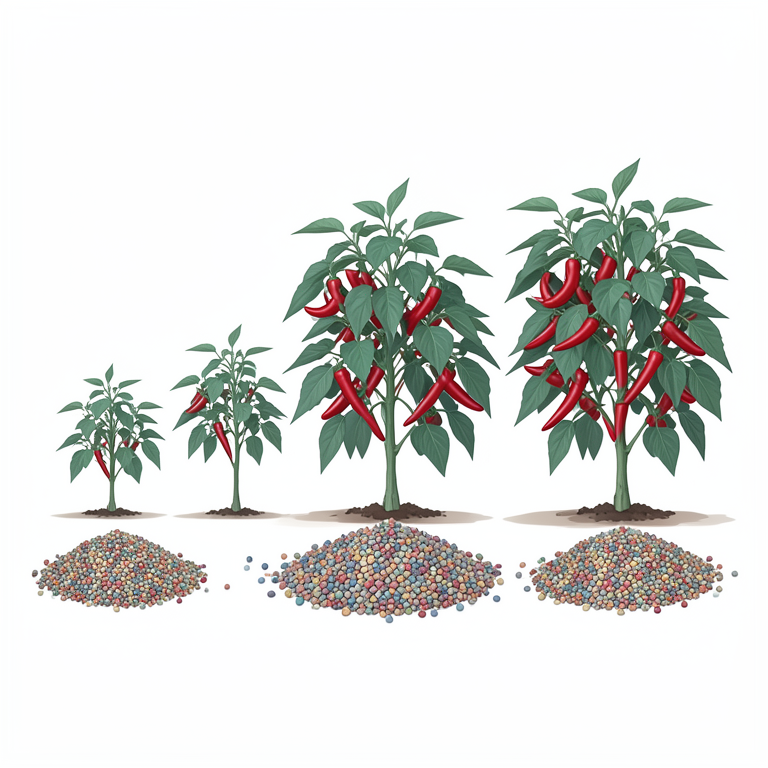
Experimental Variable Matrix
AI-generated conceptual illustration (chilli plants (Capsicum annum L.)). It explains the idea and does not show study data.
View source evidence ↗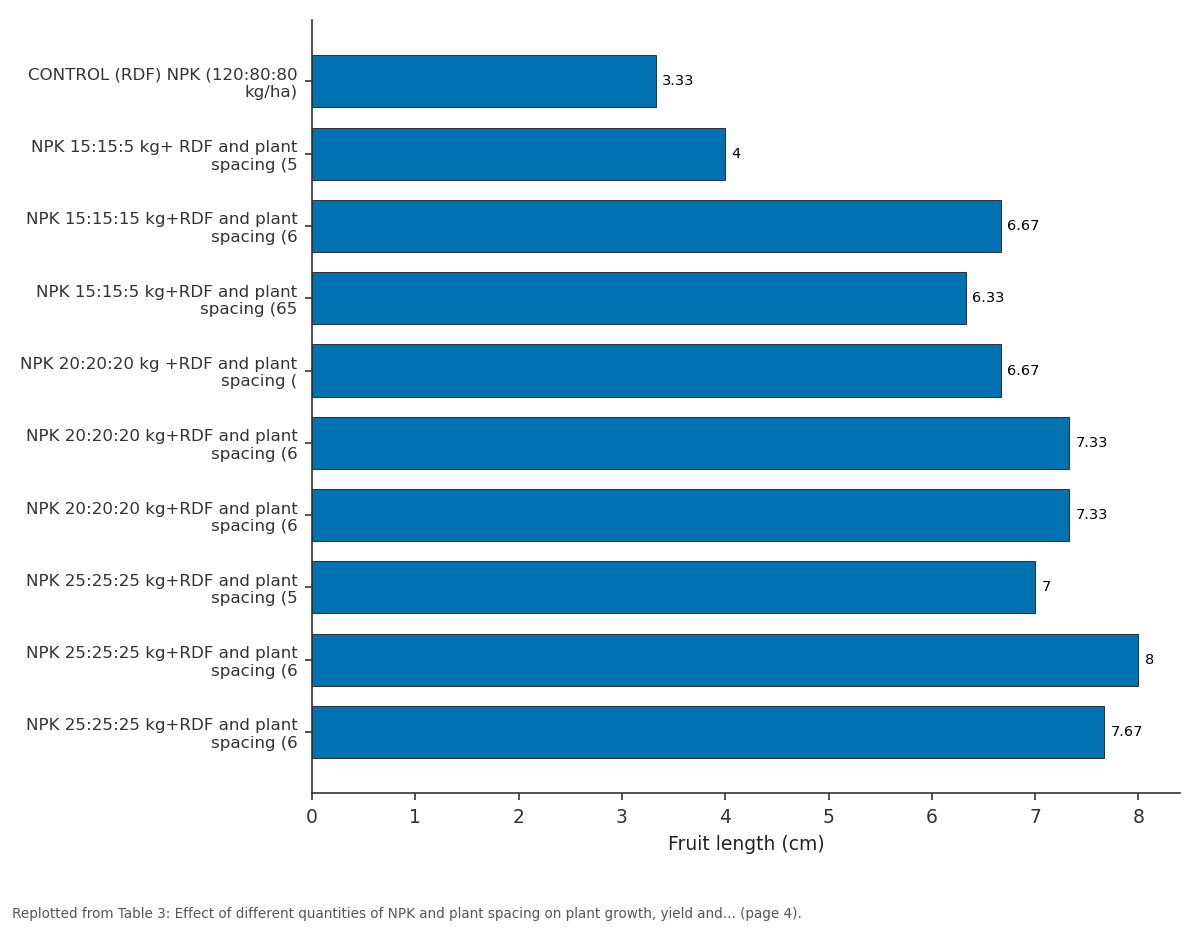
Number of branches: CONTROL (RDF) NPK... vs NPK 15:15:5 kg+ RDF and... vs NPK 15:15:15 kg+RDF and... vs NPK 15:15:5 kg+RDF and... vs NPK 20:20:20 kg +RDF...
Replotted from Table 3 (page 4) of the original paper. Every bar is the paper's own table value.
View source evidence ↗Figures & tables
From the original paper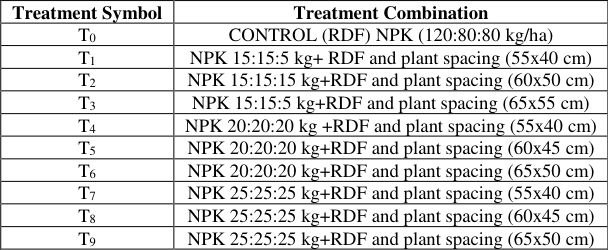 Table 1
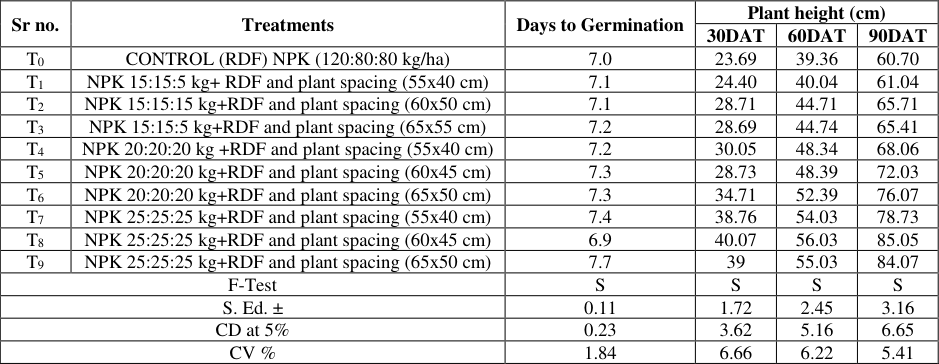 Table 2
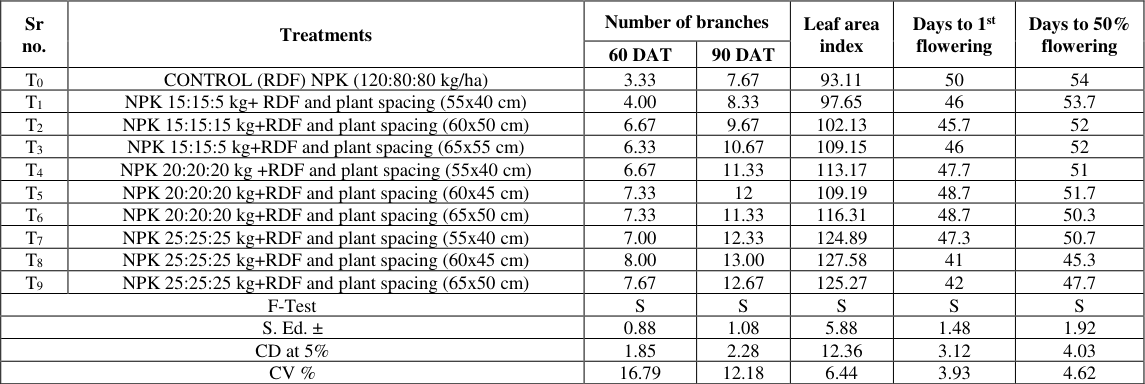 Table 3
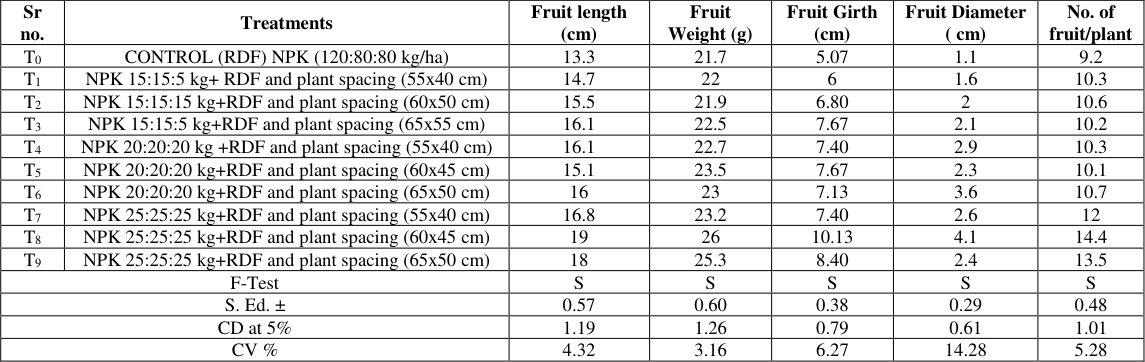 Table 4
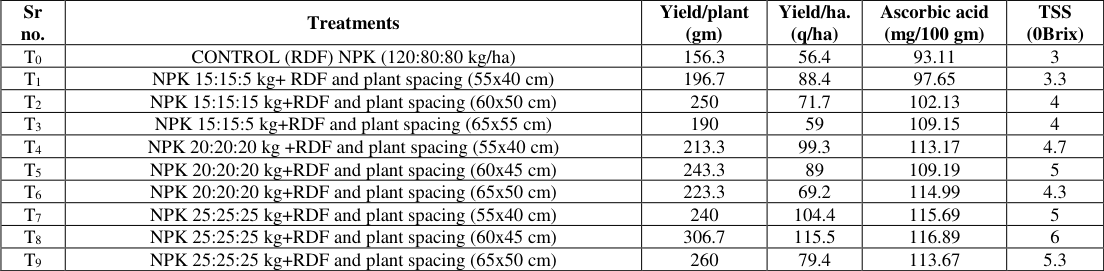 Table 5
Introduction
Chilli can be grown on a wide range of soils but well drained loamy soil rich in organic matter is best suited for its cultivation. It can not withstand water-logged conditions for more than a day. Although chilli can be grown on soils with a pH range of 5.0 to 8.0 but it performs best at a soil pH of about 6.5. Chilli is famous for its pleasant aromatic flavor, pungency and high coloring substance. It is vegetable as well as spice and one of the most important cash crops of India. It is used for industrial purpose due to extraction of oleoresin. Green fruit of Chilli and sweet peppers are one of the richest sources of anti-oxidants, vitamins such as Vitamin-A, C and E, these anti-oxidants in food protect occurrence of cancer and instant pain relief. One of the most expensive commercial annual spices grown in India is this one. Capsaicin is the compound that gives chillies their pungency. Despite the fact that chili is a highly prized item. Chilli has a great nutritious value. Oleoresins, which allow for a greater distribution of color and flavor in food than chili powder, have also grown in relevance in the food and beverage industries. In addition to being used as a culinary ingredient, chilli is also used for a number of medical conditions. The regular use of chillies promotes salivation, which aids in healthy blood circulation and efficient digestion. Pharmaceutical preparations and medications for heart disorders use the capsaicin derived from ripe dried fruits. Chilli pepper (Capsicum annuum L.) is an important spice and cash crop in many countries of the world. Growing vegetable demand could be achieved through bringing additional area under cultivation crops, using hybrid crops and adoption of improved agrotechniques. Protected cultivation of vegetables could be used to improve yield, quantity and quality3&13. Vegetables grown under field conditions are exposed to abiotic and biotic stress which affects productivity and quality. Protected cultivation has the potential to reduce biotic and abiotic stress. A low tunnel structure can modify environmental conditions with reduced labor. Understanding the impact of NPK fertilizers on chilli is not only crucial for farmers and growers but also for consumers.
The quality and nutritional composition of chilli can be directly influenced by the application of NPK fertilizers, ultimately affecting its taste, texture, appearance, and overall market value. Therefore, this research contributes to both agricultural practices and consumer 4 preferences, providing valuable knowledge for sustainable and efficient chilli production. Therefore, this thesis aims to investigate the effect of different levels of NPK fertilizers on the growth, yield, and quality of chilli. The study will evaluate the impact of varying concentrations of NPK fertilizers on the plant's physiological parameters such as height, leaf area, chlorophyll content, and biomass production. Additionally, the research will investigate the influence of NPK fertilizers on the quality and yirld of chilli, including its vitamin and mineral content. The findings of this study will provide valuable insights into the optimal use of NPK fertilizers for chilli production, allowing growers to maximize their yield and quality while minimizing environmental impact and production costs. In conclusion, investigating the effect of different levels of NPK fertilizers and plant spacing on chilli growth, yield, and quality is essential for optimizing agricultural practices, meeting consumer demands for nutritious food, and maintaining environmental sustainability. This thesis intends to bridge the existing knowledge gap, providing valuable insights into the application of NPK fertilizers in chilli production and serving as a foundation for further research in this field.
Materials and Methods
The present investigation entitled "Effect of different level of NPK and plant spacing on growth, Quality and yield of chilli (Capcicum Annuum L). will be carried out. The details of the materials to be used and methodology to be adopted during the course of study are mentioned below:-
Experimental Site
The experiment was conducted during kharif season of the year 2023-24 at Horticulture Research Farm, Department of Horticulture, Naini Agricultural Institute, Sam Higginbottom University of Agriculture Technology and Sciences, Prayagraj. The experimental site is located in the sub-tropical region which is located at 250. 271 N latitude, 810. 561 E longitude and 98 m above the mean sea level.
Climate
Prayagraj is situated at an elevation of 78 meters above sea level at 25.870 North latitude and 81.150 E longitudes. This region has a sub-tropical climate prevailing in the South-East part of U.P. with both the extremes in temperature, i.e., the winter and the summer. In cold winters, the temperature sometimes is as low as 2 °C in December -January and very hot summer with temperature reaching up to 50 °C in the months of May and June. During winter, frosts and during summer, hot scorching winds are also not uncommon. The average rainfall is around 1013.4 (cm) with maximum concentration during July to September months with occasional showers in winters Statistical analysis: the statistical analysis of the data was carried out using STATISTICA (7.0) software.
The fastest availability of nutrients, notably nitrogen, the primary nutrient of protein for the synthesis of protoplasm, which results in cell division and cell enlargement, may be the cause of the greatest plant height seen in the treatment T8 NPK (145:105:105 kg/ha and spacing 60x45 cm). When NPK is applied to chilli plants, it is absorbed by the leaves and moves through the plant's vascular system, where it acts on the plant cells by stimulating cell elongation and division. This can result in an increase in plant height, stem diameter, and leaf area. Similar findings were reported by Das et al. (2017). The influence of different NPK doses and spacing on the plant height shows statistically significant outcomes. That is much better from recommended RDF.
Number of primary branches
A significant difference was observed when various levels of NPK were applied to different treatment. The mean performance of the number of branches 6, 8 and 13. ment T8 NPK (145:105:105 kg/ha and spacing 60x45 cm) had the most branches, with 13 followed by T0 -NPK (120:80:80 kg/ha), with 2,3.33and 7.67, respectively. When NPK is applied to chilli plants, it is absorbed and increase the metabolic activities which further increases the number of branches by promoting the formation of new lateral shoots and inducing the formation of floral buds. Similar findings were reported by Sharma et al.
(2017) [11] . There were influenced by treatment shows that proper spacing and fertilizer dose make huge difference in the number of branches of chillii crop.
Numbers of fruits per plant
The significant effect of application of various quantities of NPK, a substantial change in the number of fruits per plant was seen. The range of the mean fruit per plant performance was 9.2 to14.4. The highest recorded number of fruits was 14.4 for treatment T8 NPK (145:105:105 kg/ha and spacing 60x45 cm) and T0 Control as shown in while the remaining treatments were moderate. NPK improve the chances of successful fruit set by increasing the amount of pollen produced by the plant and improving pollination efficiency. Similar findings were reported Khan et al. (2014) [7] . The influence by the treatment shows that if we maintain the production technology and add the treatment difference in our production method it will change the the number of fruit per plant also influence the yield.
Fruit length
When various quantities of NPK were applied, a substantial change in fruit length was seen. Fruit lengths varied in length on average from 13.3 cm to 19 cm. The longest fruit was measured under treatment T8 -NPK (145:105:105 kg/ha and spacing 60x45 cm) at 19 cm, The shortest fruit was measured under treatment T0 -Control at 9.2 cm as shown. Similar findings were seen in Length of the fruit directly influenced the weight of chilli. Directly affect the cost benefit ration of the crop and treatment T8 was recommended as per the research.
Fruit girth
The significant effect of application of various quantities of NPK, a substantial change in fruit diameter was seen. Fruit diameters ranged from 1.1 cm to 4.1 cm on an average. Maximum fruit girth was reported during treatment T8 -NPK (145:105:105 kg/hs and spacing 60x45 cm) at 5.07 cm While the focus might not be solely on fruit girth, it could include observations on fruit size as part of the overall assessment similar results were seen in the impact of N,P,K and spacing allow the crop to meat the maximum fruit grith. When plant spacing maintain properly it will help to plant proper vegetative growth and improve the quality of fruit.
Fruit weight
The application of various level of NPK, a substantial variation in average fruit weight was seen. Fruits ranged in weight from 21.7 g to 26 g. T8 -NPK (145:105:105 kg/h a and spacing 60x45 cm) had the largest fruit weight, 26 g and minimum fruit weight Treatment T0 -Control had the fruit length 21.7 g. Similar findings were seen in Sharma et al. (2017) [11] . The varying N,P,K doses and plant spacing shows significant affect. This can be explained by different substantial changes in the production technology help to the plant to properly grow and develop it will help maximum fruit bearing capacity of the plant also improve the fruit weight.
Yield/plant
With the application of various NPK levels, a substantial variation in yield and plant was seen. The range of the mean yield performance per plant was 156.
Yield/ha
With the application of various level of NPK, a substantial change in yield/ha was seen. The average production per hectare ranged from 56.4 to 115.5 q/ha were T8 -NPK (145:105:105 gh/ha and spacing 60x45 cm), with maximum value of 115.5 q/ha. The treatments with the lowest yield per hectare were T0 -Control, with a value of 56.4 q/ha. When applied to chilli plants, NPK can stimulate cell division and elongation, promote branching and lateral shoot growth, and delay the ripening of fruits. These effects can increase the overall size and weight of the plant, as well as the number of fruits produced. Similar findings were reported by Basumatary et al. (2016). Yield/ha change because of might be associated by the proper utilization of nutrient and spacing improve the growth, yield and quality of chilli.
TSS (0Brix)
When various levels of NPK were applied to TSS, a substantial difference was seen. With a mean of 3.66, the mean performance on TSS ranged from 3 to 6. TSS was reported as having a maximum of 6 for treatment T8 -NPK (145:105:105 kg/ha and plant spacing 60x45 cm) and a minimum of 3 for treatment T0 -NPK (120:80:80). In terms of TSS there is no huge different in the qualitative parameter influenced by different fertilizer application and spacing. In this table we observed that maximum germination are found in (NPK=25 kg:25 kg: 25 kg and S=65 cmx50 cm) (T9) i.e..7.7. and minimum germination are found in (NPK=25 kg:25 kg: 25 kg and S=60 cmx45 cm) (T8) i.e.. 6.9.
In this table we also observed that maximum plant height at 30,60 and 90 days is 40.07,56.03and 85.05 cm in (NPK=25 kg:25 kg: 25 kg and S=60 cmx45 cm) (T8) and minmium plant height at 30,60 and 90 days is 23.69,39.36 and 60.70 cm in T0 control (RDF).
Conclusion
From the results of the aforementioned experiment, it can be inferred that the NPK treatment T8 (145:105:105 kg/ha and spacing 60x45 cm) was best in terms of growth, including plant height, days until first flowering, days until 50% flowering, pod setting, and number of fruits per plant, as well as yield, including average fruit weight, yield per plant, yield per hectare, and quality, including TSS and fruit color, as well as physiological parameters, including. Economics-wise, the therapies T8, T7, T4, T5, and T1 perform better than the remaining T0, T1, T2, T3 and T9.
Figures and tables from the paper
| Treatment Symbol | Treatment Combination |
|---|---|
| T0 | CONTROL (RDF) NPK (120:80:80 kg/ha) |
| T1 | NPK 15:15:5 kg+ RDF and plant spacing (55x40 cm) |
| T2 | NPK 15:15:15 kg+RDF and plant spacing (60x50 cm) |
| T3 | NPK 15:15:5 kg+RDF and plant spacing (65x55 cm) |
| T4 | NPK 20:20:20 kg +RDF and plant spacing (55x40 cm) |
| T5 | NPK 20:20:20 kg+RDF and plant spacing (60x45 cm) |
| T6 | NPK 20:20:20 kg+RDF and plant spacing (65x50 cm) |
| T7 | NPK 25:25:25 kg+RDF and plant spacing (55x40 cm) |
| T8 | NPK 25:25:25 kg+RDF and plant spacing (60x45 cm) |
| T9 | NPK 25:25:25 kg+RDF and plant spacing (65x50 cm) |
Table text extracted from the original PDF; superscript letters are shown inline. The original table image is below.
View original table image
| Sr no. | Treatments | Days to Germination | Plant height (cm) | — | — |
|---|---|---|---|---|---|
| 30DAT | 60DAT | 90DAT | |||
| T0 | CONTROL (RDF) NPK (120:80:80 kg/ha) | 7.0 | 23.69 | 39.36 | 60.70 |
| T1 | NPK 15:15:5 kg+ RDF and plant spacing (55x40 cm) | 7.1 | 24.40 | 40.04 | 61.04 |
| T2 | NPK 15:15:15 kg+RDF and plant spacing (60x50 cm) | 7.1 | 28.71 | 44.71 | 65.71 |
| T3 | NPK 15:15:5 kg+RDF and plant spacing (65x55 cm) | 7.2 | 28.69 | 44.74 | 65.41 |
| T4 | NPK 20:20:20 kg +RDF and plant spacing (55x40 cm) | 7.2 | 30.05 | 48.34 | 68.06 |
| T5 | NPK 20:20:20 kg+RDF and plant spacing (60x45 cm) | 7.3 | 28.73 | 48.39 | 72.03 |
| T6 | NPK 20:20:20 kg+RDF and plant spacing (65x50 cm) | 7.3 | 34.71 | 52.39 | 76.07 |
| T7 | NPK 25:25:25 kg+RDF and plant spacing (55x40 cm) | 7.4 | 38.76 | 54.03 | 78.73 |
| T8 | NPK 25:25:25 kg+RDF and plant spacing (60x45 cm) | 6.9 | 40.07 | 56.03 | 85.05 |
| T9 | NPK 25:25:25 kg+RDF and plant spacing (65x50 cm) | 7.7 | 39 | 55.03 | 84.07 |
| F-Test | S | S | S | S | |
| S. Ed. ± | 0.11 | 1.72 | 2.45 | 3.16 | |
| CD at 5% | 0.23 | 3.62 | 5.16 | 6.65 | |
| CV % | 1.84 | 6.66 | 6.22 | 5.41 |
Table text extracted from the original PDF; superscript letters are shown inline. The original table image is below.
View original table image
| Sr no. | Treatments | Number of branches | — | Leaf area index | Days to 1st flowering | Days to 50% flowering |
|---|---|---|---|---|---|---|
| 60 DAT | 90 DAT | |||||
| T0 | CONTROL (RDF) NPK (120:80:80 kg/ha) | 3.33 | 7.67 | 93.11 | 50 | 54 |
| T1 | NPK 15:15:5 kg+ RDF and plant spacing (55x40 cm) | 4.00 | 8.33 | 97.65 | 46 | 53.7 |
| T2 | NPK 15:15:15 kg+RDF and plant spacing (60x50 cm) | 6.67 | 9.67 | 102.13 | 45.7 | 52 |
| T3 | NPK 15:15:5 kg+RDF and plant spacing (65x55 cm) | 6.33 | 10.67 | 109.15 | 46 | 52 |
| T4 | NPK 20:20:20 kg +RDF and plant spacing (55x40 cm) | 6.67 | 11.33 | 113.17 | 47.7 | 51 |
| T5 | NPK 20:20:20 kg+RDF and plant spacing (60x45 cm) | 7.33 | 12 | 109.19 | 48.7 | 51.7 |
| T6 | NPK 20:20:20 kg+RDF and plant spacing (65x50 cm) | 7.33 | 11.33 | 116.31 | 48.7 | 50.3 |
| T7 | NPK 25:25:25 kg+RDF and plant spacing (55x40 cm) | 7.00 | 12.33 | 124.89 | 47.3 | 50.7 |
| T8 | NPK 25:25:25 kg+RDF and plant spacing (60x45 cm) | 8.00 | 13.00 | 127.58 | 41 | 45.3 |
| T9 | NPK 25:25:25 kg+RDF and plant spacing (65x50 cm) | 7.67 | 12.67 | 125.27 | 42 | 47.7 |
| F-Test | S | S | S | S | S | |
| S. Ed. ± | 0.88 | 1.08 | 5.88 | 1.48 | 1.92 | |
| CD at 5% | 1.85 | 2.28 | 12.36 | 3.12 | 4.03 | |
| CV % | 16.79 | 12.18 | 6.44 | 3.93 | 4.62 |
Table text extracted from the original PDF; superscript letters are shown inline. The original table image is below.
View original table image
| Sr no. | Treatments | Fruit length (cm) | Fruit Weight (g) | Fruit Girth (cm) | Fruit Diameter ( cm) | No. of fruit/plant |
|---|---|---|---|---|---|---|
| T0 | CONTROL (RDF) NPK (120:80:80 kg/ha) | 13.3 | 21.7 | 5.07 | 1.1 | 9.2 |
| T1 | NPK 15:15:5 kg+ RDF and plant spacing (55x40 cm) | 14.7 | 22 | 6 | 1.6 | 10.3 |
| T2 | NPK 15:15:15 kg+RDF and plant spacing (60x50 cm) | 15.5 | 21.9 | 6.80 | 2 | 10.6 |
| T3 | NPK 15:15:5 kg+RDF and plant spacing (65x55 cm) | 16.1 | 22.5 | 7.67 | 2.1 | 10.2 |
| T4 | NPK 20:20:20 kg +RDF and plant spacing (55x40 cm) | 16.1 | 22.7 | 7.40 | 2.9 | 10.3 |
| T5 | NPK 20:20:20 kg+RDF and plant spacing (60x45 cm) | 15.1 | 23.5 | 7.67 | 2.3 | 10.1 |
| T6 | NPK 20:20:20 kg+RDF and plant spacing (65x50 cm) | 16 | 23 | 7.13 | 3.6 | 10.7 |
| T7 | NPK 25:25:25 kg+RDF and plant spacing (55x40 cm) | 16.8 | 23.2 | 7.40 | 2.6 | 12 |
| T8 | NPK 25:25:25 kg+RDF and plant spacing (60x45 cm) | 19 | 26 | 10.13 | 4.1 | 14.4 |
| T9 | NPK 25:25:25 kg+RDF and plant spacing (65x50 cm) | 18 | 25.3 | 8.40 | 2.4 | 13.5 |
| F-Test | S | S | S | S | S | |
| S. Ed. ± | 0.57 | 0.60 | 0.38 | 0.29 | 0.48 | |
| CD at 5% | 1.19 | 1.26 | 0.79 | 0.61 | 1.01 | |
| CV % | 4.32 | 3.16 | 6.27 | 14.28 | 5.28 |
Table text extracted from the original PDF; superscript letters are shown inline. The original table image is below.
View original table image
| Sr no. | Treatments | Yield/plant (gm) | Yield/ha. (q/ha) | Ascorbic acid (mg/100 gm) | TSS (0Brix) |
|---|---|---|---|---|---|
| T0 | CONTROL (RDF) NPK (120:80:80 kg/ha) | 156.3 | 56.4 | 93.11 | 3 |
| T1 | NPK 15:15:5 kg+ RDF and plant spacing (55x40 cm) | 196.7 | 88.4 | 97.65 | 3.3 |
| T2 | NPK 15:15:15 kg+RDF and plant spacing (60x50 cm) | 250 | 71.7 | 102.13 | 4 |
| T3 | NPK 15:15:5 kg+RDF and plant spacing (65x55 cm) | 190 | 59 | 109.15 | 4 |
| T4 | NPK 20:20:20 kg +RDF and plant spacing (55x40 cm) | 213.3 | 99.3 | 113.17 | 4.7 |
| T5 | NPK 20:20:20 kg+RDF and plant spacing (60x45 cm) | 243.3 | 89 | 109.19 | 5 |
| T6 | NPK 20:20:20 kg+RDF and plant spacing (65x50 cm) | 223.3 | 69.2 | 114.99 | 4.3 |
| T7 | NPK 25:25:25 kg+RDF and plant spacing (55x40 cm) | 240 | 104.4 | 115.69 | 5 |
| T8 | NPK 25:25:25 kg+RDF and plant spacing (60x45 cm) | 306.7 | 115.5 | 116.89 | 6 |
| T9 | NPK 25:25:25 kg+RDF and plant spacing (65x50 cm) | 260 | 79.4 | 113.67 | 5.3 |
Table text extracted from the original PDF; superscript letters are shown inline. The original table image is below.
View original table image
References
21 in the original paper- Shrivastava AK. Effect of fertilizer levels and spacing on flowering, fruit set and yield of sweet pepper (Capsicum annuum var. Grossum L.) cv. Hybrid Bharat. Advances in Plant Science. 1996;9:171-175.
- Ravanappa UG, Nalawadi, Shelavantar MN. Effect of plant density on growth and yield of green chilli. Karnatak Journal of Agricultural Science. 1998;11(2):543-445.
- Manchanda AK, Bhopal S, Singh B. Effect of plant density on growth and fruit yield of Bell pepper (Capsicum annuum L.). Indian J Agron. 1988;33(4):445-447.
- Essilfie ME, Dapaah HK, Boateng E, Damoah RJ. Age of transplant and row spacing effects on growth, yield and yield components of chilli pepper (Capsicum annuum L.). International Journal of Environment, Agriculture and Biotechnology. 2017;2(5):238920.
- Islam MR, Sultana T, Haque MA, Hossain MI, Sabrin N, Islam R. Growth and yield of chilli influenced by nitrogen and phosphorus. Journal of Agriculture and Veterinary Science. 2018;11(5):54-68
- Islam M, Satyaranjan SAHA, Akand H, Rahim A. Effect of spacing on the and yield of sweet pepper (Capsicum annuum L.). Journal of Central European Agriculture, 2011.
- Khan A, Shah SNM, Rab A, Sajid M, Ali K, Ahmed A, et al. Influence of nitrogen and potassium levels on growth and yield of chillies (Capsicum annuum L.). International Journal Farm and Sciences. 2014;3:260-26.
- Mahmud K, Hossain T, Mou TH, Ali A, Islam M. Effect of Nitrogen On Growth and Yield of Chili (Capsicum annuum L.) in Roof Top Garden. Turkish Journal of AgricultureFood Science and Technology. 2020;8(1):246-251.
- Dubey AK, Singh D, Rajput PS, Kumar Y, Verma AK, Chandraker SK. Effect of NPK on plant growth, yield and quality of Capsicum (Capsicum annum L.) cv Swarna Under Shade Net Condition. Int. J. Curr. Microbiol. App. Sci. 2017;6(3):1085-1091
- Edgar ON, Gweyi-Onyango JP, Korir NK. Plant row spacing effect on growth and yield of green pepper (Capsicum annuum L.) in Western Kenya. Archives of Current Research International. 2017, 1-9.
- Sharma R, Kumar R. Growth, flowering and yield of chilli, (Capsicum annuum L.) as influenced by spacing and growing conditions. Int. J Pure App. Biosci. 2017;5(5):524527.
- Thakre cm, Badole WP, Tiwari TK, Surede PB. Effect of different levels of sulphur, phosphorous and potassium on yield and quality of brinjal. J Maharashtra Agril. Univ. 2005;30(3):352-353.
- Suresh VV. Effect of nitrogen and potassium on yield and quality parameters of Byadagi chilli (Capsicum annuum L.). Univ. Agric. Sci. 2000, p. 49
- Singh R, Kohli UK, Sharma SK. Effect of nitrogen, phosphorus and potassium combinations on yield of tomato hybrids. Ann. Agril. Res. 2000;21:27-31.
- Shivakumar MS, Nagaraja BV, Kuligod VB. Comparative analysis of different levels of nutrient management in dry chilli production A case study. Indian J Fertilizer. 2010;6(8):12-16.
- Ramakrishna T, Palled YB. Effect of plant geometry and fertilizer levels on growth and yield of chilli. Karnataka J. Agril. Sci. 2005;18(4):892-895.
- Maya P, Natarajan S, Thamburaj S. Effect of plant density and nutrients on certain physiological parameters in sweet pepper. South Indian Hort. 1999;47(1-6):237-238.
- Hari GS, Rao PV, Reddy YN, Reddy MS. Effect of nitrogen and potassium levels on yield and nutrient uptake in paprika (Capsicum annuum L.) under irrigated conditions of northern Telangana zone of Andhra Pradesh. The Asian J Hort. 2007;2(1):193-196.
- Fatemi H, Aminifard MH, Aroiee H, Ameri A. Effect of plant density and nitrogen fertilizer on growth, yield and fruit quality of sweetpepper (Capsicum annuum L.). African J Agric. Res. 2012;7(6):859-866.
- Bhuvaneswari G, Sivaranjani R, Reeth S, Ramakrishnan K. Application of nitrogen and potassium efficiency on the growth and yield of chilli (Capsicum annuum L.). Int. J Curr. Microbiol. App. Sci. 2013;2(12):329-337.
- Ngupok O, Warade SD, Das S, Raghavan M. Effect of NPK on quality parameters of capsicum (Capsicum annuum L. var. Grossum) under protected condition. Int. J Chem. Studies. 2018;6(4):451-453.