
Research article · 2024 · Full text
International Journal of Veterinary Sciences and Animal HusbandryAnthelmintic evaluation of Carica papaya against gastrointestinal nematodes in goats
Volume 9(3) · Pages 401–404 · DOI: 10.22271/veterinary.2024.v9.i3f.1442 ↗
Research areasPapaya Research and ApplicationsHelminth infection and control
Abstract
Author-writtenThe research aimed to explore the effectiveness of an aqueous seed extract from Carica papaya in treating gastrointestinal helminths in goats. Goats with confirmed helminth infestations were chosen for the study, receiving the Carica papaya extract. Blood and biochemical parameters were analyzed. The Carica papaya extract led to a significant reduction in the average egg per gram (EPG) count in the infested goats. Over the course of treatment, the reduction in EPG was notable 84.9% on the third day, 96.6% on the seventh day, and 100% by the 14th day. Hematological parameters and biochemical parameters showed improvement, indicating that the extract had a positive impact on blood profiles. These findings suggest that the aqueous extract of Carica papaya possesses potent anthelmintic properties and could serve as an alternative treatment for gastrointestinal helminths in goats.
Summary
Source-checkedPlain-language reading of the full paper, prepared with AI and checked against the text. Each point links to the authors' own words.
Why it matters
- Gastrointestinal helminths cause economic losses in small ruminants by reducing their productivity and growth rates while increasing mortality. View evidence ↗
- The exclusive use of conventional anthelmintic drugs is unsustainable in tropical and subtropical regions due to widespread resistance among nematode parasites. View evidence ↗
- Benzylisothiocynate is identified as the primary anthelmintic agent found in Carica papaya seeds. View evidence ↗
The question
- The study aimed to evaluate how effective an aqueous seed extract from Carica papaya is for treating gastrointestinal helminths in goats. View evidence ↗
What they did
- The study used 10 goats aged 6 to 12 months with pre-treatment fecal egg counts (EPG) between 600 and 800. View evidence ↗
- Group A received 100 mg/kg of aqueous Carica papaya seed extract orally once daily for two days, while Group B received Albendazole at 7.5 mg/kg. View evidence ↗
- Anthelmintic efficacy was measured by analyzing fecal egg per gram (EPG) counts on day 0, and days 3, 7, and 14 after treatment. View evidence ↗
- The researchers collected blood samples to analyze the hematological and biochemical parameters of the goats. View evidence ↗
What they found
- In goats treated with the papaya extract, the mean EPG count dropped from 690 on day 0 to 0 by the 14th day. View evidence ↗
- Goats treated with the 100 mg/kg dose of papaya extract showed noticeable improvements in their body weight. View evidence ↗
- Mean hemoglobin levels in treated goats significantly increased from 6.33±0.45 before treatment to 8.41±0.38 on the 14th day. View evidence ↗
- The mean Packed Cell Volume (PCV) significantly rose from 19.60±1.34 before treatment to 25.58±1.07 by the 14th day. View evidence ↗
- The mean Total Erythrocyte Count significantly increased from 3.20±0.21 before treatment to 4.43±0.23 on the 14th day. View evidence ↗
- Serum aspartate aminotransferase (AST) levels decreased from 84.14±4.55 before treatment to 70.59±3.87 by the 14th day. View evidence ↗
- Total protein levels significantly increased from 4.59±0.13 before treatment to 6.50±0.14 on the 14th day. View evidence ↗
What it means
- The authors concluded that a 100 mg/kg oral dose of aqueous Carica papaya seed extract given once daily for two days is a highly effective anthelmintic. View evidence ↗
- The authors suggest that this extract has the potential to be a safe and cost-effective alternative to conventional anthelmintic drugs. View evidence ↗
Visual summary
2 visualsIllustrations explain the paper; charts are replotted from the paper's own table values.
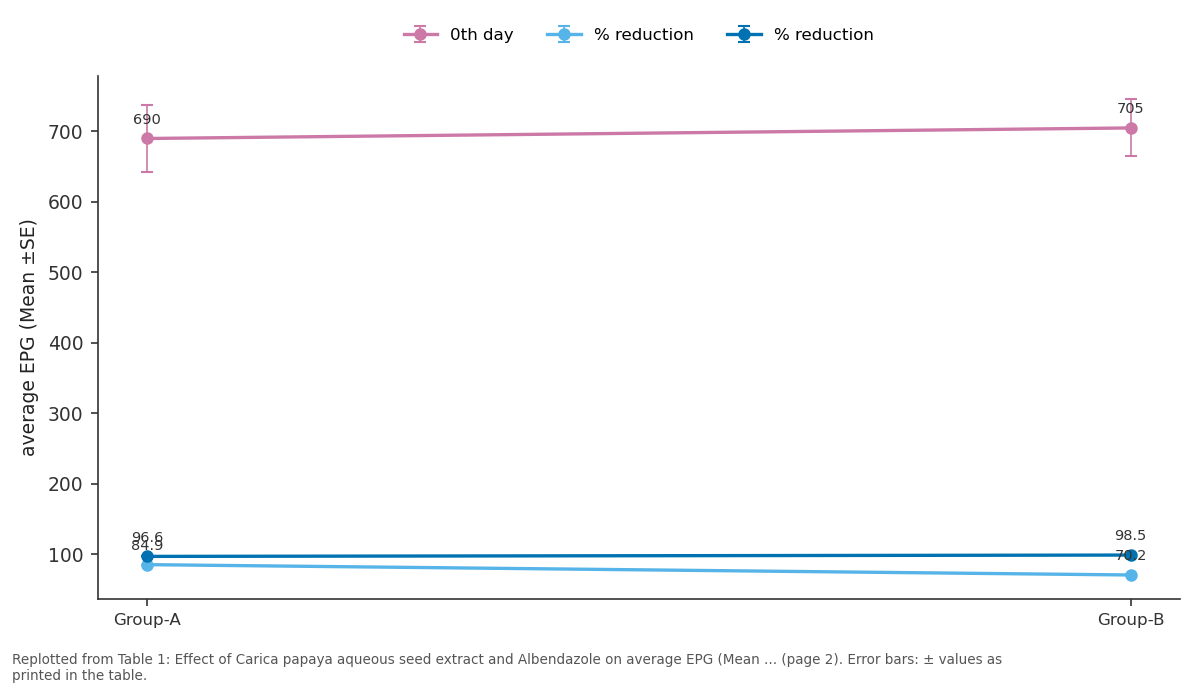
0th day and % reduction and more: Group-A vs Group-B
Replotted from Table 1 (page 2) of the original paper. Every bar is the paper's own table value.
View source evidence ↗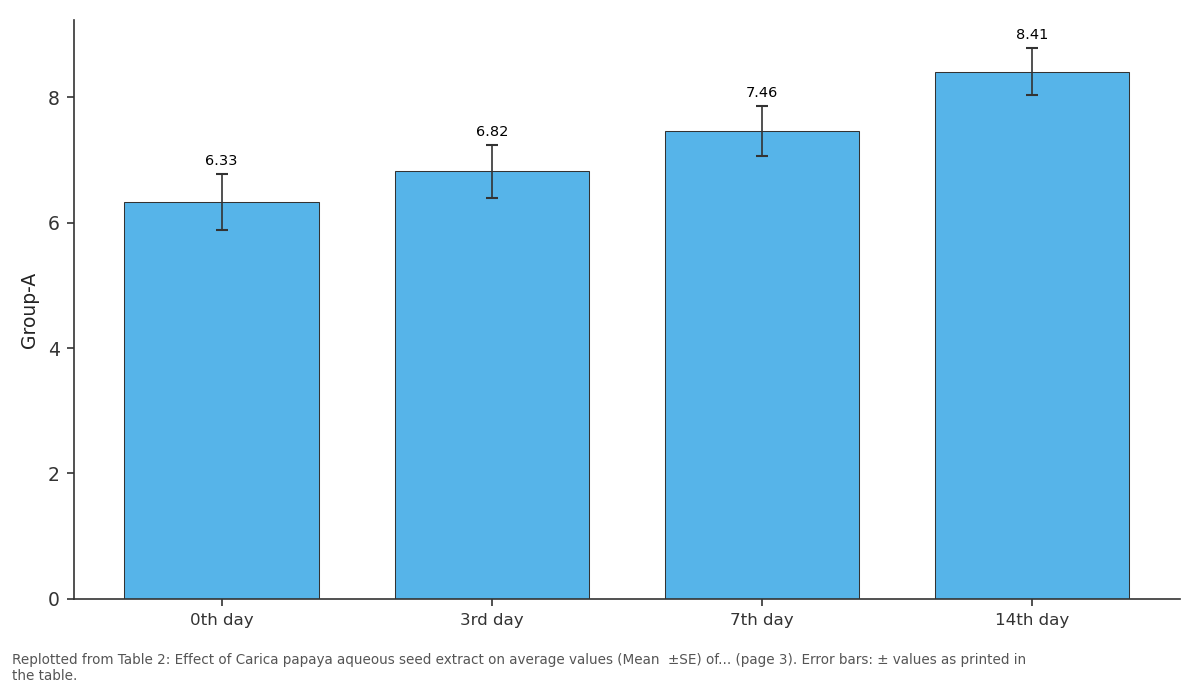
Group-A: 0th day vs 3rd day vs 7th day vs 14th day
Replotted from Table 2 (page 3) of the original paper. Every bar is the paper's own table value.
View source evidence ↗Figures & tables
From the original paper Table 1
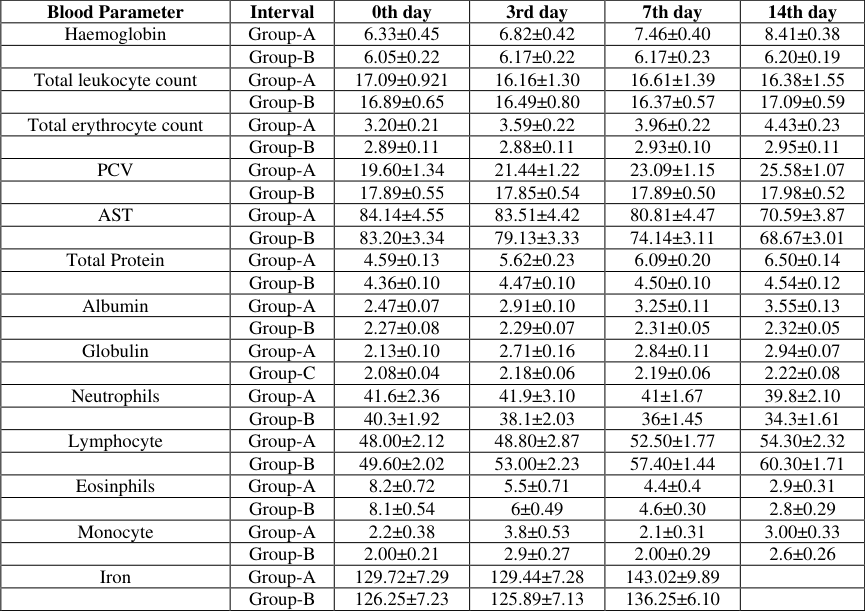 Table 2
Introduction
Gastrointestinal helminths pose significant economic challenges due to reduced growth rates, productivity, and increased mortality in small ruminants. Goats, in particular, are highly vulnerable to such infections due to their grazing behavior (Das et al., 2016) [7] . India, historically rich in medicinal plants, harbors a wealth of natural resources, particularly within its forests, which are abundant with medicinal and aromatic plants collected for various purposes, including drug manufacturing and perfumery (Joy et al., 1998) [9] . Relying solely on anthelmintic drugs for controlling internal parasites in livestock is not sustainable, especially in tropical and subtropical regions where high levels of anthelmintic resistance, especially among nematode parasites of small ruminants, are prevalent. Additionally, many farmers in these areas lack resources to afford or are hesitant to purchase drugs of potentially questionable quality (Krecek and Waller, 2006) [10] . Papaya (Carica papaya L.) is widely cultivated and esteemed as a fruit tree in tropical and subtropical regions across the globe. Utilizing dried papaya seeds combined with honey has demonstrated significant efficacy in treating human intestinal parasites, with minimal adverse effects. The primary anthelmintic agent in these seeds is Benzylisothiocynate, as identified by Vij and Prashar in 2015 [17] . Research suggests that the biochemical mechanism of action of Benzylisothiocynate, derived from Carica papaya, involves inhibiting glucose uptake and depleting glycogen content, as proposed by Kumar et al. in 2014 [11] . In this study, we assess the anthelmintic properties of an aqueous seed extract of Carica papaya against a variety of gastrointestinal helminths in goats.
Materials and Methods
Materials and Methods
Collection of plant materials and extraction
The seeds and its extract has been procured from National Ayurveda Research Institute for Panchkarma, Cheruthuruthy, Kerala, India.
Anthelminthic activity
The experimental doses of plant extracts used in this investigation were determined based on dosages reported to be effective in previous studies (Ameen et al., 2010; Effendy et al., 2014; Ameen et al., 2018) [2,8,4] . A total of 10 goats aged between 6 to 12 months, exhibiting eggs per gram of feces (EPG) ranging from 600 to 800 before treatment, were selected in two groups. Group A were administered the aqueous seed extract of Carica papaya (Papaya) at a dosage of 100 mg/kg body weight orally once daily for 2 consecutive days, and group B were received Albendazole @7.5mg/kg bw. The efficacy of the anthelmintic plant extract was assessed by examining fecal samples for EPG before treatment (day 0) and on the 3rd, 7th, and 14th days posttreatment. Additionally, the body weights of the goats were recorded on day 0 before treatment and on the 15th day after treatment.
Estimation of haematological and biochemical parameters
Hematological and biochemical parameters were assessed by collecting blood samples from the goats under study. Samples were obtained from the jugular vein of each animal using 5 ml syringes and 24 gauge needles, and then deposited into properly labeled EDTA and clot activated vials. Haematological and biochemical parameters were analyzed following the methods outlined by Sastry (1989) [14] .
Statistical analysis
Data was collected and analyzed statistically by application of two way Factorial Completely Radomized Design and Completely Randomized Design (Snedecor and Cochran, 1994) [15] Results and Discussions Table 1 summarizes the results of the Anthelminthic activity of C. Papaya seeds extract and Albendazole. The mean eggs per gram (EPG) count on day 0 was 690, which significantly decreased to 0 on the 14th day post-treatment with the aqueous seed extract of Carica papaya at a dose rate of 100 mg/kg once a day for 2 days. The progressive percentage decrease in EPG was noted as 84.9% on the third day, 96.6% on the seventh day, and 100% by the 14th daypost-treatment. Similar findings were reported by Ameen et al. (2010) [2] and Ameen et al. (2018) [4] , who also observed significant reductions in EPG count after administering aqueous seed extract of Carica papaya. They attributed this effect to the presence of papain and benzylisothiocynate, biologically active compounds found mainly in the seeds of Carica papaya.
| Interval | 0th day | 3rd day | % reduction | 7th day | % reduction | 14th day | % reduction |
|---|---|---|---|---|---|---|---|
| Group-A | 690±47.02 | 104.2±7.58 | 84.9 | 23.2±5.55 | 96.6 | 0±0 | 100 |
| Group-B | 705±40.45 | 210±63.60 | 70.2 | 10±6.67 | 98.5 | 0±0 | 100 |
Table text extracted from the original PDF; superscript letters are shown inline. The original table image is below.
View original table image
Administering the aqueous seed extract of Carica papaya (Papaya) at a dosage of 100 mg/kg body weight orally once daily for 2 days resulted in noticeable improvements in body weight in the treated goats. This increase in body weight could be attributed to the reduction of parasitic load facilitated by the plant extracts, thereby enhancing weight gain through improved digestion, absorption, and metabolism of feed nutrients.
Effect of C. papaya on haematological and biochemical values of goats
The blood profile, including parameters such as Hemoglobin, Packed Cell Volume, and Total Erythrocyte Count, of animals treated with the aqueous seed extract of Carica papaya at a dosage of 100 mg/kg body weight orally once daily for 2 days, demonstrated an increase following treatment, with the highest levels observed on the 14th day post-treatment. Detailed results of the haematological parameters are presented in Table 2.
| Blood Parameter | Interval | 0th day | 3rd day | 7th day | 14th day |
|---|---|---|---|---|---|
| Haemoglobin | Group-A | 6.33±0.45 | 6.82±0.42 | 7.46±0.40 | 8.41±0.38 |
| Group-B | 6.05±0.22 | 6.17±0.22 | 6.17±0.23 | 6.20±0.19 | |
| Total leukocyte count | Group-A | 17.09±0.921 | 16.16±1.30 | 16.61±1.39 | 16.38±1.55 |
| Group-B | 16.89±0.65 | 16.49±0.80 | 16.37±0.57 | 17.09±0.59 | |
| Total erythrocyte count | Group-A | 3.20±0.21 | 3.59±0.22 | 3.96±0.22 | 4.43±0.23 |
| Group-B | 2.89±0.11 | 2.88±0.11 | 2.93±0.10 | 2.95±0.11 | |
| PCV | Group-A | 19.60±1.34 | 21.44±1.22 | 23.09±1.15 | 25.58±1.07 |
| Group-B | 17.89±0.55 | 17.85±0.54 | 17.89±0.50 | 17.98±0.52 | |
| AST | Group-A | 84.14±4.55 | 83.51±4.42 | 80.81±4.47 | 70.59±3.87 |
| Group-B | 83.20±3.34 | 79.13±3.33 | 74.14±3.11 | 68.67±3.01 | |
| Total Protein | Group-A | 4.59±0.13 | 5.62±0.23 | 6.09±0.20 | 6.50±0.14 |
| Group-B | 4.36±0.10 | 4.47±0.10 | 4.50±0.10 | 4.54±0.12 | |
| Albumin | Group-A | 2.47±0.07 | 2.91±0.10 | 3.25±0.11 | 3.55±0.13 |
| Group-B | 2.27±0.08 | 2.29±0.07 | 2.31±0.05 | 2.32±0.05 | |
| Globulin | Group-A | 2.13±0.10 | 2.71±0.16 | 2.84±0.11 | 2.94±0.07 |
| Group-C | 2.08±0.04 | 2.18±0.06 | 2.19±0.06 | 2.22±0.08 | |
| Neutrophils | Group-A | 41.6±2.36 | 41.9±3.10 | 41±1.67 | 39.8±2.10 |
| Group-B | 40.3±1.92 | 38.1±2.03 | 36±1.45 | 34.3±1.61 | |
| Lymphocyte | Group-A | 48.00±2.12 | 48.80±2.87 | 52.50±1.77 | 54.30±2.32 |
| Group-B | 49.60±2.02 | 53.00±2.23 | 57.40±1.44 | 60.30±1.71 | |
| Eosinphils | Group-A | 8.2±0.72 | 5.5±0.71 | 4.4±0.4 | 2.9±0.31 |
| Group-B | 8.1±0.54 | 6±0.49 | 4.6±0.30 | 2.8±0.29 | |
| Monocyte | Group-A | 2.2±0.38 | 3.8±0.53 | 2.1±0.31 | 3.00±0.33 |
| Group-B | 2.00±0.21 | 2.9±0.27 | 2.00±0.29 | 2.6±0.26 | |
| Iron | Group-A | 129.72±7.29 | 129.44±7.28 | 143.02±9.89 | |
| Group-B | 126.25±7.23 | 125.89±7.13 | 136.25±6.10 |
Table text extracted from the original PDF; superscript letters are shown inline. The original table image is below.
View original table image
In terms of haematological parameters, the mean value of hemoglobin before treatment was 6.33±0.45, showing a significant increase to 8.41±0.38 on the 14th day posttreatment. Similarly, the mean value of Packed Cell Volume before treatment was 19.60±1.34, which significantly rose to 25.58±1.07 on the 14th day post-treatment. Additionally, the Total Erythrocyte Count mean value before treatment was 3.20±0.21, displaying a significant increase to 4.43±0.23 on the 14th day post-treatment. Conversely, the Total Leucocyte Count mean value before treatment was 17.09±0.92, showing a significant reduction to 16.38±1.55. Eosinophils exhibited a significant reduction from the 3rd to the 14th day, while monocyte levels increased on the 14th day. Neutrophil levels experienced a non-significant decrease from the 3rd to the 14th day. Lymphocyte levels showed a significant increase on the 7th and 14th days compared to pre-treatment levels. Similar results were documented by Ameen et al. (2010) [2] and Effendy et al. (2014) [8] regarding the efficacy of the aqueous seed extract of Carica papaya. Ameen et al. (2018) [4] observed analogous findings and attributed them to active compounds in Carica papaya seeds that stimulate the haemopoietic system. The significant increase in Total Erythrocyte Count values could be attributed to the stimulation of the haemopoietic system by minerals and vitamins contained in Carica papaya seeds, as suggested by Nwofia et al. (2012) [13] .
In terms of biochemical parameters, the initial serum aspartate aminotransferase level was 84.14±4.55 before treatment, which notably decreased to 70.59±3.87 by the 14th day after treatment. Similarly, the total protein level before treatment was 4.59±0.13, showing a significant increase to 6.50±0.14 on the 14th day post-treatment. Additionally, albumin levels rose from 2.47±0.07 to 3.55±0.13, while globulin levels increased from 2.13±0.10 to 2.94±0.07 after treatment on the 14th day. Mean iron levels also significantly rose from 129.72±7.29 to 143.02±9.89 by the 7th day of treatment. Similar observations were made by Kumar et al. (2014b) [11] , Effendy et al. (2014) [8] and Ameen et al. (2018) [4] . The increase in protein levels could potentially be attributed to certain antinutritional factors present in C. papaya seeds, such as trypsin inhibitors and oxalates. These enzymes inhibit trypsin and chymotrypsin activity in the gastrointestinal tract, thereby impeding protein digestion. Similarly, the decrease in AST levels after treatment may result from reduced traumatic damage to the abomasal and intestinal lining mucosa caused by adult parasites, as well as a decline in larval migration into hepatic cells. The study concluded that administering an oral dose of 100 mg/kg body weight of aqueous seed extract of Carica papaya once daily for 2 days proved highly effective as an anthelmintic, based on changes observed in body weight, fecal egg counts (EPG), and hematological and biochemical parameters. This suggests that identifying novel and promising anthelmintic plant extracts like Carica papaya could contribute significantly to the development of phytotherapeutic products. Such products could potentially offer greater cost-effectiveness, safety, accessibility, and reduced risk of resistance compared to conventional anthelmintic treatments currently in use.
Conclusion
In conclusion, the study highlights the remarkable anthelmintic efficacy of Carica papaya seed extract, as evidenced by significant reductions in fecal egg counts and improvements in hematological and biochemical parameters in treated animals. Notably, the administration of a 100 mg/kg oral dose of the extract for two days yielded impressive results, indicating its potential as a cost-effective and safe alternative to conventional anthelmintic treatments. These findings underscore the importance of exploring plant-based remedies like Carica papaya for developing effective phytotherapeutic products with reduced risks of resistance. This research contributes to the ongoing quest for novel solutions in combating parasitic infections in livestock, offering promising avenues for future developments in veterinary medicine and livestock management.
References
16 in the original paper- Adeneye AA, Olagunju JA, Banjo AAF, Abdul SF, Sanusi OA, Sanni OO, et al. The aqueous seed extract of Carica papaya L. prevents carbon tetrachloride induced hepatotoxicity in rats. International J Appl Res Nat Pro. 2009;2(2):19-32.
- Ameen SA, Adedeji OS, Ojedapo LO, Salihu T, Fabusuyi CO. Anthelmintic potency of pawpaw (Carica papaya) seeds in West African Dwarf (WAD) sheep. Global Veterinaria. 2010;5(1):30-34.
- Ameen SA, Azeez OM, Baba YA, Raji LO, Basiru A, Biobaku KT, et al. Anthelmintic potency of Carica papaya seeds against gastro-intestinal helminths in Red Sokoto goat. Ceylon J Sci. 2018;47(2):137-141.
- Amin MR, Mostofa M, Islam MN, Asgar MA. Effects of neem, betel leaf, devil's tree, jute and turmeric against gastrointestinal nematodes in sheep. J Bangladesh Agri Univ. 2010;8:259-263.
- Chakrabarthi A. Textbook of clinical Vet. Medicine. Edn 2, Kalyani Publishers, New Delhi, 1994, 81-134. 2012;11(1):126-130.
- Das AK, Kumar A, Sinha RK, Samantray S. Incidence of gastrointestinal helminth parasites in goats and their therapeutic management. Vet Sci Res J. 2016;7(1):62-65.
- Effendy MW, Suparjo NM, Ameen SA, Abdullah OA. Evaluation of anthhelmintic potential of pawpaw (Carica papaya) seeds administered in-feed and in-water for West African Dwarf (WAD) goats. J Bio Agri Health. 2014;4(16):29-32.
- Joy PP, Thomas J, Mathew S, Skaria BP. Medicinal plants. Kerala Agri. Uni, 1998, 3-8.
- Krecek RC, Waller PJ. Towards the implementation of the basket of options approach to helminth parasite control of livestock: emphasis on the tropics/subtropics. Vet Parasit. 2006;139:270-282.
- Kumar B, Sahni YP, Kumar N. Biochemical anthelmintic action of Carica papaya aqueous seed extract in Trichostrongylus colubriformis. World J Pharma Res. 2014;3(10):907-914.
- Nwangwa EK. Hepato-protective effects of aqueous extract of Carica papaya seed on liver function enzymes. Int J Bio Pharm Alli Sci. 2012;1(3):345-354.
- Nwofia GE, Ojimelukwe P, Eji C. Chemical composition of leaves, fruit pulp and seeds in some Carica papaya (L) morpho types. Int J Med Arom Plants. 2012;2(1):200206.
- Sastry GA. Veterinary Clinical Pathology. Edn 3, CBS Publishers and Distributors (Pvt.) Ltd., Delhi, India, 1989, 1-25.
- Snedecor GW, Cochran WG. Statistical methods. Edn 8, Oxford and IBH Publication, New Delhi, 1994, 591.
- Thamilbharathi LM, Radhika R, Priya MN, Binu Mani K, Anbarasu K, Devada K. Molecular identification of Haemonchus contortus in goats. Journal of Veterinary and Animal Sciences. 2021;52(2):183-186. DOI: https://doi.org/10.51966/jvas.2021.52.2.183-186.
- Vij T, Prashar Y. Review on medicinal properties of Carica papaya. Asian Pacific J Trop Dis. 2015;5(1):1-6.
Cited by 1
From OpenAlex, OpenCitations and reference lists read by Scinovex
- In vivo anthelmintic efficacy, hematobiochemical and antioxidant effects of Swertia chirata in Barbari goats naturally infected with Haemonchus contortus ↗
Ramakant, Tarun K. Sarkar, Prem Sagar Maurya, Arbind Singh, Vikas Jaiswal, Ayush Pal et al. · Tropical Animal Health and Production · 2026
❝ 0PDF