
Research article · 2022 · Full text
International Journal of Advanced Chemistry ResearchEnhancing the dyeing and functional properties of cotton fabric with the application of natural dyes and nanoparticles
Volume 4(2) · Pages 355–363 · DOI: 10.33545/26646781.2022.v4.i2e.183 ↗
Research areasDyeing and Modifying Textile FibersQuasicrystal Structures and PropertiesSynthesis of Organic Compounds
Abstract
Author-writtenNatural dyes are sustainable, non-hazardous, sustainable and eco-friendly in nature. In addition0to creating subdued shades but also offer the ability to create unique textile substrates with performance attributes like UV protection, deodorizing, antioxidant, antifeedant, and antibacterial qualities. In today's market, creating colorful textile items using natural colorants may increase consumer interest even more. Finding substitute natural degradable dyes has thus emerged as one of the industry's top initiatives in the current environment. Therefore, finding alternative natural degradable dyes has become one of the leading trends in this field in the present scenario. This study highlights the benefits of natural dyes over synthetic ones, which improves the functional properties of dyed cotton fabric with Punica granatum peel, turmeric, and henna natural dyes with the use of alum as mordant and nanoparticle for environmental benefits.
Summary
Source-checkedPlain-language reading of the full paper, prepared with AI and checked against the text. Each point links to the authors' own words.
Why it matters
- Natural dyes are considered a sustainable and eco-friendly alternative to synthetic dyes because they are non-hazardous. View evidence ↗
- The use of natural dyes is currently limited by challenges in standardization, including inconsistent shade repeatability and variable extraction quality based on the season or age of the plant. View evidence ↗
- Mordants are typically required for natural dyes to act as fixing agents that create a bond between the dye and the textile fiber. View evidence ↗
The question
- The study aims to improve the functional properties of cotton fabric dyed with Punica granatum peel, turmeric, and henna using alum as a mordant and nanoparticles. View evidence ↗
What they did
- Natural dye extracts (6% mass fraction) were prepared by extracting the materials in distilled water at a 1:30 liquor ratio at 100 °C for 30 minutes. View evidence ↗
- Dyeing was performed using 6% dye on sample weight with a 20:1 liquor-to-material ratio, starting at 50 °C for 10 minutes and ending with 45 minutes at boiling temperature. View evidence ↗
- Alum mordanting was tested using three methods: pre-mordanting (8% alum at 80 °C for 30 minutes), simultaneous mordanting, and post-mordanting. View evidence ↗
- Nanoparticle treatments involved applying a 1% solution of Cu or Zn dispersion to the fabric using an exhaust process with a 1:50 material-to-liquor ratio. View evidence ↗
What they found
- Punica granatum peel produced the highest color strength (K/S value), reaching 19.026 with pre-mordanting, compared to 8.80 without any chemical treatment. View evidence ↗
- Pre-treatment with nanoparticles increased color strength; for Punica granatum peel, K/S values rose to 14.389 (Cu) and 12.902 (Zn) compared to 8.800 for untreated fabric. View evidence ↗
- Henna-dyed fabrics exhibited superior washing fastness compared to other dyes, maintaining ratings of 4 for both color change (CC) and color staining (CS) across most treatments. View evidence ↗
What it means
- The authors conclude that combining natural dyes with alum mordants and nanoparticle treatments significantly enhances the dyeing performance of cotton fabrics. View evidence ↗
- The authors recommend the integration of natural dyes with nanoparticle treatments as a promising path for sustainable and environmentally friendly textile production. View evidence ↗
Visual summary
3 visualsIllustrations explain the paper; charts are replotted from the paper's own table values.
Dye-Fiber Binding Mechanism
AI-generated conceptual illustration (cotton fabric fibers and metallic nanoparticles). It explains the idea and does not show study data.
View source evidence ↗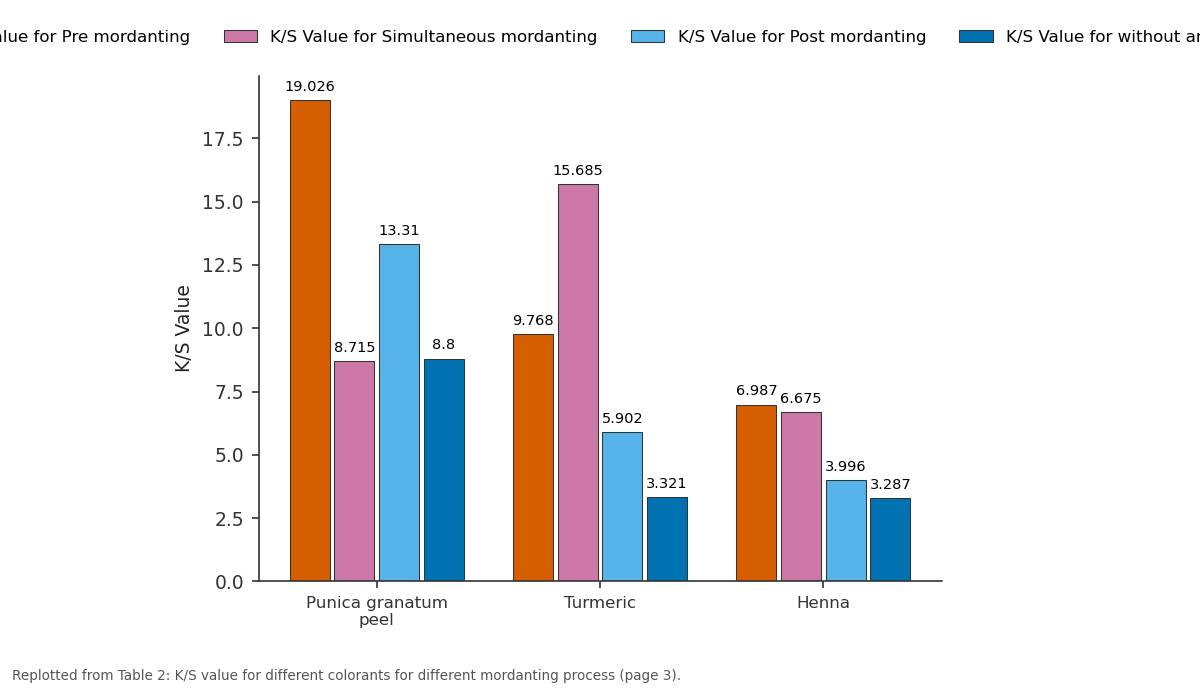
K/S Value for Pre mordanting and K/S Value for Simultaneous mordanting and more: Punica granatum peel vs Turmeric vs Henna
Replotted from Table 2 (page 3) of the original paper. Every bar is the paper's own table value.
View source evidence ↗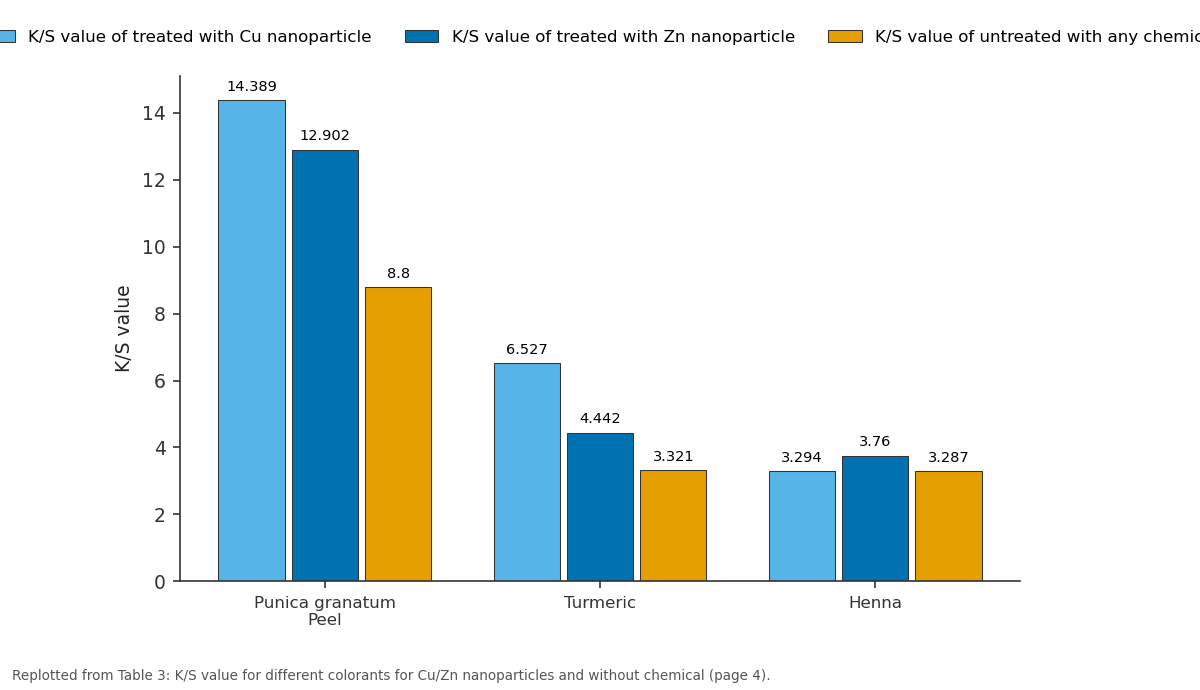
K/S value of treated with Cu nanoparticle and K/S value of treated with Zn nanoparticle and more: Punica granatum Peel vs Turmeric vs Henna
Replotted from Table 3 (page 4) of the original paper. Every bar is the paper's own table value.
View source evidence ↗Figures & tables
From the original paper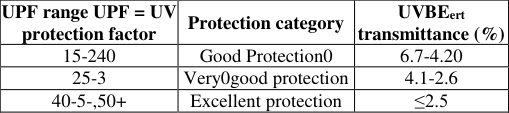 Table 1
 Table 2
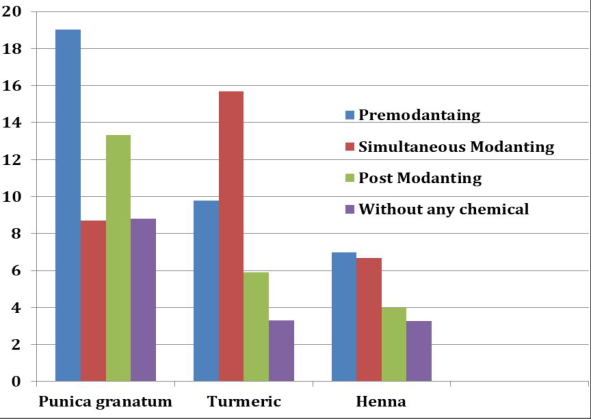 Figure 1
 Table 3
 Table 4
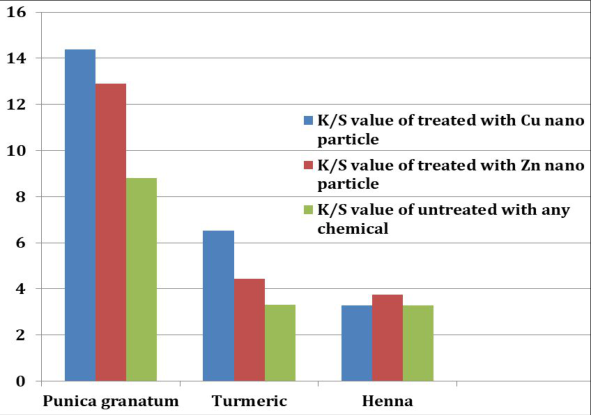 Figure 2
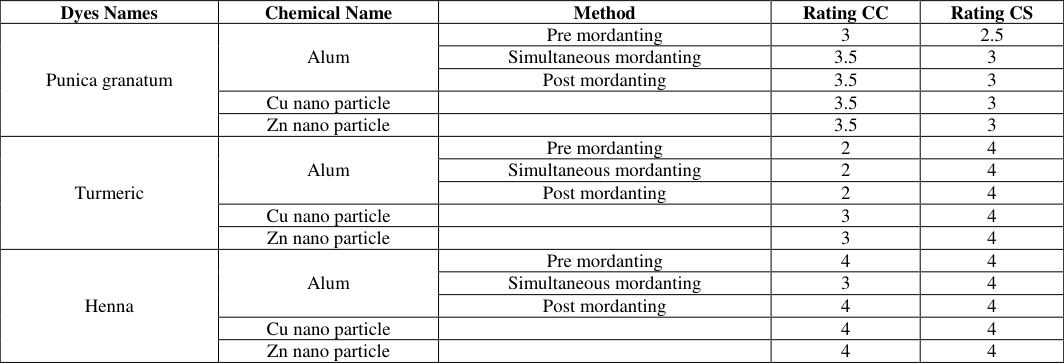 Table 5
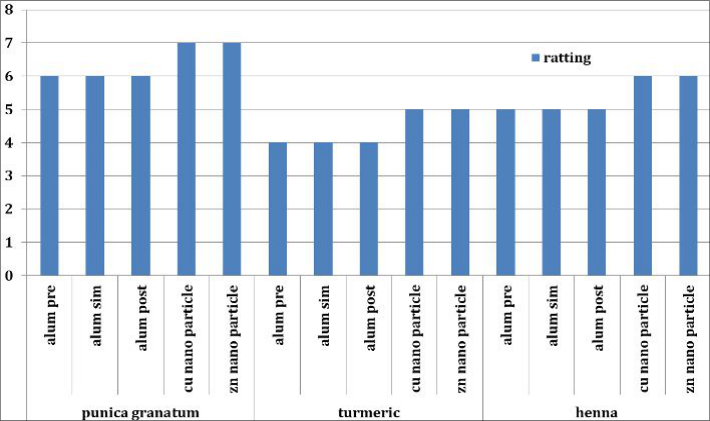 Figure 3
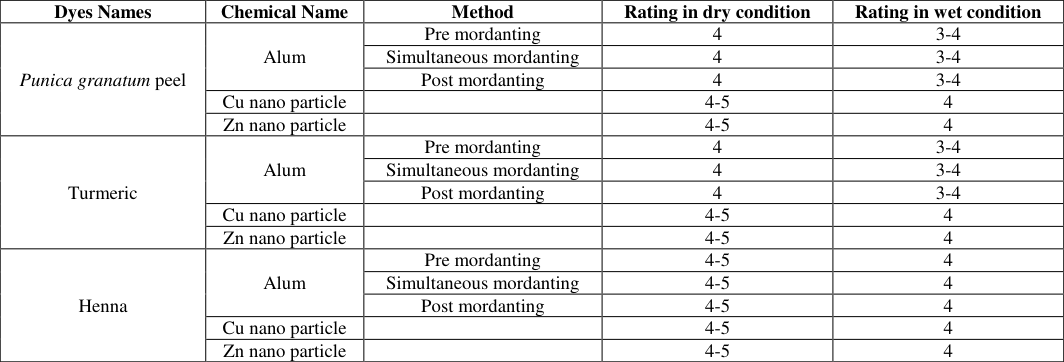 Table 6
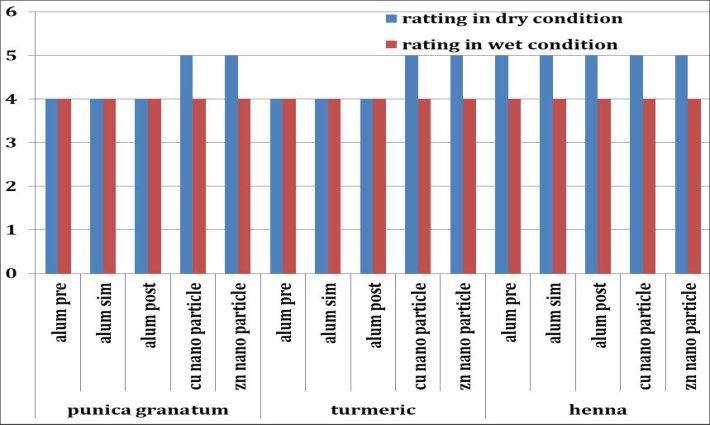 Figure 4
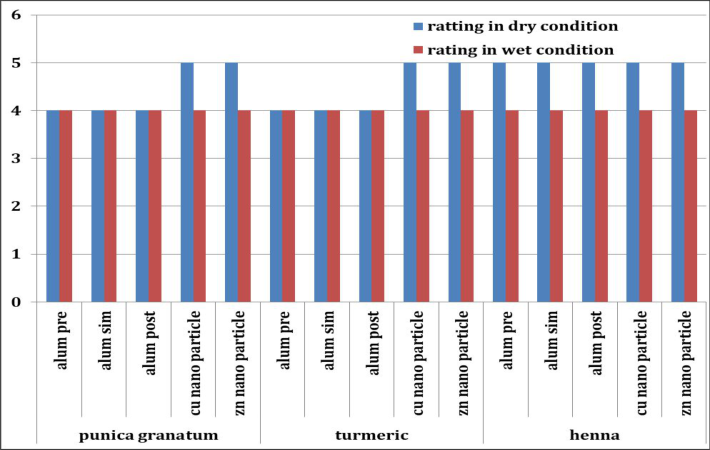 Figure 5
 Table 7
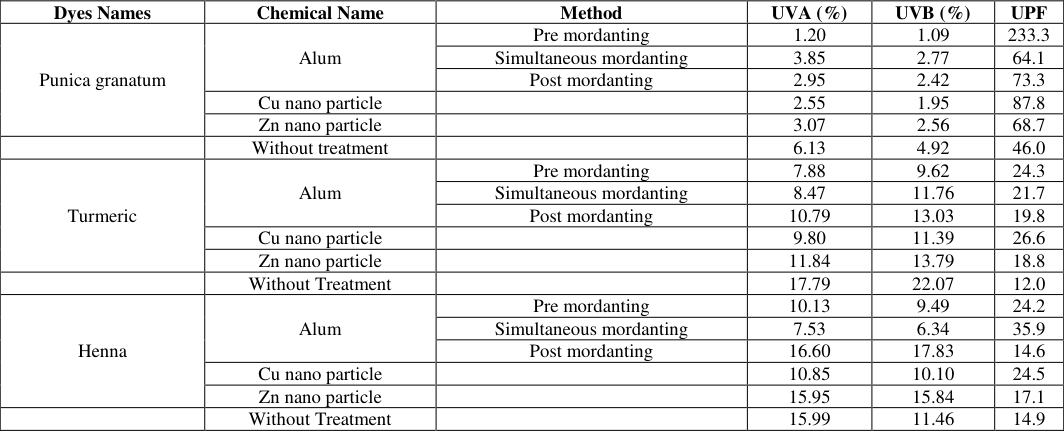 Table 8
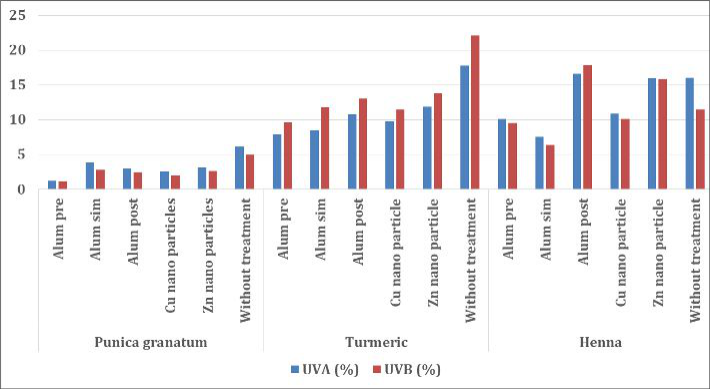 Figure 6
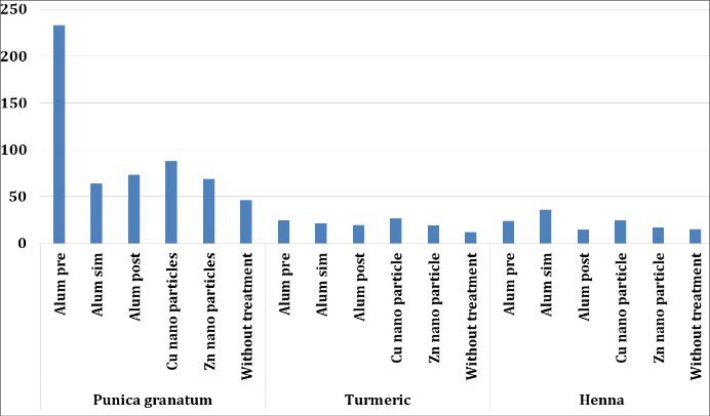 Figure 7
Introduction
In general, natural 0 dyes are more environmentally friendly and have superior biodegradability. They are created without the use of chemicals from raw plant or animal components; therefore they are non-toxic, non-allergic, and non-carcinogenic (Pruthi et al., 2008) [13] . Natural dyes are multi component extracts of unknown concentrations out of which structure of only main component is determined (Singh and Parmar, 1998; Khan, et al. 2005) [17,10] . In prehistoric time natural colorants were typically derived from berries, flowers, bark, and roots and these are made without the use of any chemicals. Natural dyes come from various plant parts, leftovers from animals, and certain minerals (Shiva, 2007; Adeel et al., 2019) [16,1] . They come from a variety of sources, including flowers, leaves, insects, bark roots, etc., but they must be extracted and are not easily accessible. They were applied to the fiber without any pretreatment of the dye-material or the textile (Carvalho and Santos, 2016) [3] . As synthetic colors became more widely available in the middle of the nineteenth century, the use of natural dyes started to decline. Because of their many benefits, natural dyes are currently a more desirable alternative than synthetic ones. Natural0dyes have several0 benefits, including the ability to be easily extracted into different hues by boiling plants, berries, leaves, bark, or flower heads in water; they are also non-toxic, biodegradable, and visually pleasing, which can lead to the creation of jobs and the use of waste land (Vankar, 2007; Samanta, 2020) [19,15] . Even with these benefits, natural dye use is limited to specific regions. These include commercial activities like block printing, boutique work, and artistic forms like Kalmkari. This can be linked to the restrictions placed by these dyes, such as the inability to guarantee shade repeatability, the time-consuming and expensive extraction process, and the variability in the quantity and quality of extraction based on the age and season of the plant, tree, leaves, or fruit, making standardization challenging. Most of the natural dyes require mordant, which serves as a dye-fixing agent and creates a bond between the dye and the fiber. As a result, it facilitates the production of quicker hues by combining dye and mordant to form an insoluble complex inside the fiber.
Alum (Aluminum potassium sulfate), chrome (Potassium dichromate), copper (Copper sulfate), iron (ferrous sulfate), and tin (Stannous chloride) are among the common mordants which are used in natural dyeing processes. In the immersion dye process, mordants are added at different times: as a pre-mordant, concurrently with the dyeing process, or after the dyeing process (Samanta and Agarwal, 2009) [14] . The metal ions can act as electron acceptors to electron donor to form coordinate bonds with the dye molecules, which are insoluble in water (Thet et al., 2020) [20] . Nano particles such as silver, Zink and copper on cotton fabrics improve various characteristics including antimicrobial dyeing, dyeing and UV protection. Dyeing behavior reported when silver nano particles treated fabric dyed with direct dyes (Chattopadhyay and Patel, 2010; Bhandari et al., 2021; Chakrabarty and Jasuja, 2022) [4,2,5] . The results showed that the application of nano-Ag treatment to cotton, wool, and silk textiles coloured with direct dyes improves the fabric's resistance to microbial assault, light fastness, and washing strength (Perumalraj 2012) [12] . Due to stratospheric ozone depletion, researchers0have been focusing more and more on how0to raise the amount of UV radiation (280-400 nm) that reaches the Earth's surface. The effectiveness of a fabric's defence against the dangers of UV radiation is indicated by its UV protection factor (UPF). The level of protection provided by the fabric increases with its UPF value. Fabrics are ranked according to their level of sun protection by the Australian/New Zealand standard, which was the original and is currently the most widely used classification system. Lighter colors tend to reflect solar radiation better than darker ones, which allow energy to enter the cloth through reflection. The greater the shade of a cloth with the same construction and dyestuff, the higher its UV protection factor (UPF). Very light pastel colors only slightly increase fabric UPF; black, navy blues, dark greens, etc., greatly increase it. However, due to unique transmission and absorption properties, different hue dyes can have very different UV protection levels Chakrabarty and Jasuja 2022) [5] . These results mostly relate to artificial dyes. Below attached table reports (Perumalraj 2012) [12] on the scant research that examined the UV protection capabilities of natural dyes applied to cotton. Commercially available Mercerised and bleached ready for dye 100 percent cotton0twill fabric was used for dyeing with Punica granatum peel, turmeric powder and henna in presence and absence of alum as mordant.
Method 2.2.1 Pomegranate peel extraction
Pomegranate peels were gathered from nearby vendors selling fresh fruit juice at the neighbourhood market, washed, dried at room temperature (20-25 °C), and crushed into a powder. Pomegranate peel extract (6% mass fraction) was made by extracting the crushed peel in distilled water at a liquor ratio of 1:30 in a water bath at 100 °C for 30 minutes. The mixture was filtered and refrigerated to produce natural colouring.
Turmeric extract
The grocery store in the local Kanpur, Uttar Pradesh market was the source of the pure turmeric powder that was employed in this study as a source of dyes. A distilled water and ground turmeric liquor ratio of 1:30 was extracted in a water bath at 100 °C for 30 minutes to provide a 6% mass fraction of turmeric extract. The mixture was refrigerated and filtered to produce natural colouring.
Henna extract
Fresh henna leaves were collected from the campus of UPTTI, cleaned, and then allowed to dry at room temperature (20-25 °C) before being ground into a powder. To create henna extract with a mass fraction of 6%, ground henna was extracted in distilled water at a liquor ratio of 1:30 in a water bath at 100 °C for 30 minutes. The mixture was cooled and filtered to create natural coloring.
Dyeing of cotton with Punica granatum peel, Turmeric, Henna without any chemical
All dyeing was done in a lab dyeing machine using 6% dye on the sample weight with liquor to material ratio of 20:1 at 50 °C for 10 minutes. After 30 minutes of gradual temperature increase, the dyeing process was kept at a boil for an additional 45 minutes. Samples were cleaned for thirty minutes under cold running water.
Dyeing of cotton with
Punica granatum peel, Turmeric, Henna using alum as a Mordant: All dyeing was done in a lab dyeing machine using 6.0% dye on the sample weight, with liquor to material ratio of 20:1. Three steps are involved in the mordanting procedure. 1. Premordanting: Firstly, materials were treated with 8% alum weight at 80 °C for 30 minutes, and then rinsed under cold running water. Following that, dyeing is done.
Simultaneous mordanting: 8% alum was applied
during the dyeing process. 3. Postmordanting: in this procedure, dyeing was done before mordanting.
The sample was treated for 10 minutes at 50 °C. After 30 minutes of gradual temperature increase, the dyeing process was kept at a boil for an additional 45 minutes. Samples were cleaned for 30 minutes under cold running water.
Dyeing of cotton with
Punica granatum peel, Turmeric, Henna using nanoparticles
2.2.6a Nano Cu Treatment on the Cotton Fabric
Using the exhaust process, the produced nano Cu dispersion was applied to cotton fabric. 1 ml of Cu dispersion in 100 ml of water to generate a 1% solution by using a material to liquor ratio of 1:50, weigh 1% of the cloth at 40 °C. The treated0fabric samples were0completely cleaned and then the temperature was raised to 80 °C during a 30-minute period after one hour. Every dyeing process was done in a lab dyeing machine with a liquor to material ratio of 20:1, using 6% dye based on the sample weight. The sample underwent a 10-minute treatment at 50 °C. After 30 minutes of gradual temperature increase, the dyeing process was kept at a boil for an additional 45 minutes. Samples were cleaned for 30 minutes under cold running water.
2.2.6b Nano Zn Treatment on the Cotton Fabric
Using 6.0% dye on the sample weight, all dyeing was done in a lab dyeing machine with liquor to material ratio of 20:1. For ten minutes, the sample was treated at 50°C. After 30 minutes of gradual temperature increase, the dyeing process was kept at a boil for an additional 45 minutes. Samples were cleaned under cold running water for 30 mins. Every dyeing process was done in a lab dyeing machine with a liquor to material ratio of 20:1, using 6% dye based on the sample weight. The sample underwent a 10-minute treatment at 50 °C. After 30 minutes of gradual temperature increase, the dyeing process was kept at a boil for an additional 45 minutes. Following sample washed under cold running water.
Evaluation of Dyed Samples
The effect of nano Cu and Zn treatment on the dyeability of natural dyes on cotton fabric in terms of K/S was measured on computer colour matching system (Spectra Scan 5100 (RT)) spectrophotometer inter-phased.
2.2.7a
Fastness Testing: Following a 24-hour period of partial exposure to a xenon arc lamp, the light fastness of the dyed samples was assessed using a fad-o-meter, and the color change was rated. Using a lounder-o-meter (Digi. wash, Paramount Scientific Instruments, India), the samples' wash fastness was tested in accordance with ISO-2 test procedures. The samples were assessed based on how much their color changed.
Results and Discussion
3.1 Dyeing behaviour of cotton fabric using alum as mordant: Colour strength in terms of K/S value of dyed cotton fabrics for untreated, mordanted with alum, and treated with nanoparticles are shown in table 1 and also in Fig. 1. From the table 2 it is observed that K/S values of dyed fabrics without mordant are 8.8, 3.32, 3.28 for Punica granatum peel, turmeric, henna colorants respectively. It indicates that Punica granatum peel colourants gives highest K/S value of cotton fabric followed by turmeric and henna without any mordanting/treatment. It is further observed that the K/S value improves significantly for dyed cotton fabric after post mordanting using alum as a mordant in Punica granatum peel. However, cott0nfabric dyed0with turmeric dye shows higher K/S value in simultaneous mordanting method using0alum as a mordant. The cotton fabric dyed with henna colorants gives higher K/S value using alum mordant than without mordanting. and the results were compared to the untreated samples. The K/S values of cotton dyed samples using different colorants pre-treated with nano particles samples0are shown in table 3 and also in Fig 2 . It is observed that pre-treated fabric samples with Cu and Zn nanoparticle and subsequently dyed with natural colourants have higher K/S value than the corresponding untreated dyed cotton fabrics. Since the presence of nano metal particles increases the dye's affinity for cotton fibers, they operate as a mordant, as seen by the higher K/S values of the coloured samples treated with nanotechnology. Tiny particles serve as filler or cross-linking agents by getting in between the molecules of the cotton polymer. This causes the cotton fibers' propensity for dye to grow. The polarity that the induction of polarity in the metal particles produced in the negatively charged dye anions likely drew them to the fiber, improving the binding between the dye and the fiber ((Chattopadhyay and Patel 2010) [4] . When utilizing 2 g/l non-ionic detergent to wash out materials that had been treated or left untreated and dyed, the Cu-Zn nano treated and dyed sample remained nearly untouched by the process. Therefore, the copper nano pretreatment enhanced both the color strength and the fastness, which addresses a significant issue with most dyes' color fastness. However dyeing with henna using Cu/Zn nanoparticles does not show any change in K/S value of dyed cotton samples (Gulrajani 2001) [8] reported that colour fastness properties of henna powder moderate to good, similar results are also obtained (Mittal et al. 2015) [11] .
| Dyes name | K/S value of treated with Cu nanoparticle | K/S value of treated with Zn nanoparticle | K/S value of untreated with any chemical |
|---|---|---|---|
| Punica granatum Peel | 14.389 | 12.902 | 8.800 |
| Turmeric | 6.527 | 4.442 | 3.321 |
| Henna | 3.294 | 3.760 | 3.287 |
Table text extracted from the original PDF; superscript letters are shown inline. The original table image is below.
View original table image
| Dyes name | K/S Value for Pre mordanting | K/S Value for Simultaneous mordanting | K/S Value for Post mordanting | K/S Value for without any chemical |
|---|---|---|---|---|
| Punica granatum peel | 19.026 | 8.715 | 13.31 | 8.80 |
| Turmeric | 9.768 | 15.685 | 5.902 | 3.321 |
| Henna | 6.987 | 6.675 | 3.996 | 3.287 |
Table text extracted from the original PDF; superscript letters are shown inline. The original table image is below.
View original table image
| UPF range UPF = UV protection factor | Protection category | UVBEert transmittance (%) |
|---|---|---|
| 15-240 | Good Protection0 | 6.7-4.20 |
| 25-3 | Very0good protection | 4.1-2.6 |
| 40-5-,50+ | Excellent protection | ≤2.5 |
Table text extracted from the original PDF; superscript letters are shown inline. The original table image is below.
View original table image
Washing fastness
The results of washing fastness of different cotton dyed fabrics are shown in table 5 and also in Fig. 3 among the different dyes used for cotton dyeing, the cotton fabric dyed with henna has shown very good washing fastness for mordanted with alum as well as pre-treated Cu/Zn nanoparticles. Dyed0cotton fabric using Punica granatum peel after mordanting with alum and pre-treatment with Cu/Zn nanoparticles has shown good to very good washing fastness properties. However, cotton fabric0dyed with turmeric0natural colourants has shown fair washing fastness for alum mordanted and good for pre-treated with Cu/Zn nanoparticles. From the above discussion it could be concluded that henna and Punica granatum peel natural dye have superior washing fastness properties than turmeric natural dye using alum mordant as well as Cu/Zn nanoprticle as pre-treatment. Turmeric and Punica granatum peel colorants act as direct dyes (Iqbal et al. 2008) [9] .
| Dyes Names | Chemical Name | Method | Rating CC | Rating CS |
|---|---|---|---|---|
| Punica granatum | Alum | Pre mordanting | 3 | 2.5 |
| Simultaneous mordanting | 3.5 | 3 | ||
| Post mordanting | 3.5 | 3 | ||
| Cu nano particle | 3.5 | 3 | ||
| Zn nano particle | 3.5 | 3 | ||
| Turmeric | Alum | Pre mordanting | 2 | 4 |
| Simultaneous mordanting | 2 | 4 | ||
| Post mordanting | 2 | 4 | ||
| Cu nano particle | 3 | 4 | ||
| Zn nano particle | 3 | 4 | ||
| Henna | Alum | Pre mordanting | 4 | 4 |
| Simultaneous mordanting | 3 | 4 | ||
| Post mordanting | 4 | 4 | ||
| Cu nano particle | 4 | 4 | ||
| Zn nano particle | 4 | 4 |
Table text extracted from the original PDF; superscript letters are shown inline. The original table image is below.
View original table image
Rubbing fastness
The rubbing fastness of cotton dyed fabrics using with Punica granatum peel, turmeric, henna colourants using alum as a mordant as well as Zn/Cu nanoparticles shows, Table 6 and also Fig. 5, good to very good rating in both dry and wet conditions. It could be concluded that dyeing with natural colour from Punica granatum peel, turmeric and henna using alum mordant and Cu/Zn nanoparticles produced colour on cotton fabric resists to rubbing action in dry and wet states. [7,6] . [7] .
| Dyes Names | Chemical Name | Method | Rating in dry condition | Rating in wet condition |
|---|---|---|---|---|
| Punica granatum peel | Alum | Pre mordanting | 4 | 3-4 |
| Simultaneous mordanting | 4 | 3-4 | ||
| Post mordanting | 4 | 3-4 | ||
| Cu nano particle | 4-5 | 4 | ||
| Zn nano particle | 4-5 | 4 | ||
| Turmeric | Alum | Pre mordanting | 4 | 3-4 |
| Simultaneous mordanting | 4 | 3-4 | ||
| Post mordanting | 4 | 3-4 | ||
| Cu nano particle | 4-5 | 4 | ||
| Zn nano particle | 4-5 | 4 | ||
| Henna | Alum | Pre mordanting | 4-5 | 4 |
| Simultaneous mordanting | 4-5 | 4 | ||
| Post mordanting | 4-5 | 4 | ||
| Cu nano particle | 4-5 | 4 | ||
| Zn nano particle | 4-5 | 4 |
Table text extracted from the original PDF; superscript letters are shown inline. The original table image is below.
View original table image
Discussion
The study emphasizes the advantages of natural dyes over synthetic ones, including their eco-friendliness and nontoxicity as well as their biodegradability. Natural dyes drew researchers in traditional and varied applications to develop efficient eco-friendly and cleaner process technologies as awareness of eco-friendly materials from sustainable resources increased. This discussion is on the potential for integrating natural dyes with innovative techniques like nanoparticle treatment to create fabrics with improved functionality and environmental benefits. The results point to a possible path for environmentally friendly textile dyeing techniques.
The study discovered that, when dyed with pomegranate peel using alum as a mordant, pomegranate peel offers the strongest color (K/S value), followed by henna and turmeric. K/S values were further enhanced by cu/Zn nanoparticle treatment.
Fastness Properties also improves the use of mordants and nanoparticles with the dyed fabrics. The study also looked into the dyed fabrics' ability to block UV rays. Punica granatum peel-dyed fabrics treated with0alum and nanoparticles demonstrated superior UV protection.
Conclusion
This study highlights the benefits of using natural dyes over synthetic dyes, focusing on their eco-friendliness, nontoxicity, and biodegradability. The research demonstrates that natural dyes, particularly when used in conjunction with mordants like alum and nanoparticle treatments, can significantly enhance the dyeing performance of cotton fabrics.
Key findings include 1. Color Strength (K/S Value):
The Punica granatum peel dye produced the highest color strength, followed by henna and turmeric. The application of alum as a mordant and the use of Cu and Zn nanoparticles further enhanced the K/S values, indicating improved dye affinity and color strength. 2. UV Protection: Fabrics dyed with Punica granatum peel and treated with alum and nanoparticles showed superior UV protection, suggesting potential for creating textiles with added functional benefits.
Fastness Properties:
The study found that the use of mordants and nanoparticles improved the fastness properties of the dyed fabrics. Specifically, henna and Punica granatum peel dyes exhibited superior washing fastness compared to turmeric.
Environmental Impact:
The integration of natural dyes with innovative techniques like nanoparticle treatment offers a promising pathway for developing environmentally friendly textile dyeing processes.
These findings suggest that combining natural dyes with mordants and nanotechnology can create high-performance, eco-friendly textiles suitable for various applications. This approach not only leverages the inherent benefits of natural dyes but also enhances their functional properties, contributing to more sustainable and environmentally conscious textile production.
Figures and tables from the paper
| Dyes Names | Chemical Name | Method | Rating |
|---|---|---|---|
| Punica granatum | Alum | Pre mordanting | 6 |
| Simultaneous mordanting | 6 | ||
| Post mordanting | 6 | ||
| Cu nano particle | 7 | ||
| Zn nano particle | 7 | ||
| Turmeric | Alum | Pre mordanting | 3-4 |
| Simultaneous mordanting | 3-4 | ||
| Post mordanting | 3-4 |
Table text extracted from the original PDF; superscript letters are shown inline. The original table image is below.
View original table image
| UPF range UPF = ultraviolet protection factor | Protection category | UVBEeryt transmittance (%) |
|---|---|---|
| 15-24 | Good protection | 6.7-4.2 |
| 25- | Very good protection | 4.1-2.6 |
| 40-50,50+ | Excellent protection | ≤2.5 |
Table text extracted from the original PDF; superscript letters are shown inline. The original table image is below.
View original table image
| Dyes Names | Chemical Name | Method | UVA (%) | UVB (%) | UPF |
|---|---|---|---|---|---|
| Punica granatum | Alum | Pre mordanting | 1.20 | 1.09 | 233.3 |
| Simultaneous mordanting | 3.85 | 2.77 | 64.1 | ||
| Post mordanting | 2.95 | 2.42 | 73.3 | ||
| Cu nano particle | 2.55 | 1.95 | 87.8 | ||
| Zn nano particle | 3.07 | 2.56 | 68.7 | ||
| Without treatment | 6.13 | 4.92 | 46.0 | ||
| Turmeric | Alum | Pre mordanting | 7.88 | 9.62 | 24.3 |
| Simultaneous mordanting | 8.47 | 11.76 | 21.7 | ||
| Post mordanting | 10.79 | 13.03 | 19.8 | ||
| Cu nano particle | 9.80 | 11.39 | 26.6 | ||
| Zn nano particle | 11.84 | 13.79 | 18.8 | ||
| Without Treatment | 17.79 | 22.07 | 12.0 | ||
| Henna | Alum | Pre mordanting | 10.13 | 9.49 | 24.2 |
| Simultaneous mordanting | 7.53 | 6.34 | 35.9 | ||
| Post mordanting | 16.60 | 17.83 | 14.6 | ||
| Cu nano particle | 10.85 | 10.10 | 24.5 | ||
| Zn nano particle | 15.95 | 15.84 | 17.1 | ||
| Without Treatment | 15.99 | 11.46 | 14.9 |
Table text extracted from the original PDF; superscript letters are shown inline. The original table image is below.
View original table image
References
16 in the original paper- Adeel S, Rehman FU, Rafi S, Zia KM, Zuber M. Environmentally friendly plant-based natural dyes: Extraction methodology and applications. In: Plant and Human Health. Springer. 2019;2:383-415.
- Bhandari V, Yadav S, Rose N. Optimization of nanoparticle treatment for cotton fabric and dyeing with ecofriendly natural dye. The Pharma Innovative Journal. 2021;10(12):95-104.
- Carvalho C, Santos G. Sustainability and Biotechnology -Natural or Bio Dyes Resources in Textiles. J Textile Sci. Eng. 2016;6(1):1-5.
- Chattopadhyay DP, Patel HB. Effect of Nanosized Colloidal Copper on Cotton Fabric. J Eng. Fibers Fabrics, 2010, 5(3).
- Crews PC, Kachman S, Beyer AG. Influences on UVR transmission of undyed woven fabrics. Textile Chemist and Colorist. 1999;31(6):17-26.
- Grifoni D, Bacci L, Zipoli G, et al. Laboratory and Outdoor Assessment of UV Protection Offered by Flax and Hemp Fabrics Dyed with Natural Dyes. Photochem. Photobiol. 2009;85:313-320.
- Gulrajani ML. Present Status of Natural Dyes. Indian J Fibre Text Res. 2001;26:191-201.
- Iqbal J, Bhatti L, Shaheed A. Effect of UV radiation on dyeing of Cotton Fabric with extract of henna leaves. Indian J Fibre Text Res. 2008;33:157-162.
- Khan MA, Khan M, Srivastava PK, Mohammad F. Extraction of natural dyes from Myrobalan, Gallnut and Pomegranate and their application on wool. Colourage. 2005;LII(12):53-59.
- Mittal S, Singh RD, Goyal V. Application of Copper Nanoparticles on Cotton Fabric to Improve Dyeing Properties with Punica granatum. Am Int. J Res. Formal. Appl. Nat Sci. 2015;343(55):58.
- Pruthi N, Chawla GD, Yadav S. Dyeing of silk with barberry bark dye using mordant combination. Nat Prod Radiance. 2008;7(1):40-44.
- Samanta AK, Agarwal P. Application of Natural Dyes on Textiles. Indian J Fibre Text Res. 2009;34:384-399.
- Siva R. Status of Natural Dyes and Dye-Yielding Plants in India. Curr. Sci. 2007;92:916-925.
- Singh K, Parmar SS. Are natural dyes safer than synthetic dyes? Textile Trends. 1998;40(11):23-27.
- Aung TT, Htoo NN, Lwin HP. Investigation on the Effect of Natural Mordants on Dyeing Properties of Cotton Fabric with Natural Dye. Am J Multidiscip. Res. Dev. 2020;2(2):46-52.
- Thet NT, Mercer-Chalmers J, Greenwood RJ, Young AE, Coy K, Booth S, et al. SPaCE swab: Point-of-care sensor for simple and rapid detection of acute wound infection. ACS sensors. 2020 Jul 31;5(8):2652-2657.
Cited by 1
From OpenAlex, OpenCitations and reference lists read by Scinovex
- Antibacterial properties and phytochemical composition of Ficus iteophylla Linn leaves ↗
Tsague Marthe Valentine, Nyemb Nyunaï · International Journal of Chemical Research and Development · 2022
This study investigates the antibacterial properties and phytochemical composition of Ficus iteophylla Linn leaves, a plant traditionally used in herbal medicine. Employing methods such as Gas Chromatography-Mass Spectrometry (GC-MS) for phytochemical analysis and disk diffusion and broth dilution assays for antibacterial testing, the study aims to scientifically validate the medicinal claims associated with these leaves. The research focuses on identifying