
Research article · 2024 · Full text
International Journal of Veterinary Sciences and Animal HusbandryFeeding and management practices of non-descript buffaloes in Raigad district of Maharashtra state
Volume 9(3S) · Pages 165–169 · DOI: 10.22271/veterinary.2024.v9.i3sc.1429 ↗
Research areasLivestock Management and Performance ImprovementAgricultural Economics and PracticesAgricultural Systems and Practices
Abstract
Author-writtenThe investigation was planned to study the feeding and management practices of non-buffaloes in Raigad district of Maharashtra state. A three stage stratified sampling procedure was used to select the animals and households. The concentrate feeding was practiced by 93 percent non-descript buffalo farmers and only 7 percent farmers not providing concentrate to the buffaloes. The floor of house mostly in Kaccha type (52.5%), made up of soil and dung and the buffalo farmers provide 47.5 percent in pucca type of floor to buffaloes, which are made up of cement concrete floor and roof was 83.00 percent pucca, made by cement, iron, still pratra used as roof and 17.00 percent Kaccha roof, made by red soil (Kaularu Chhat) of plates. The Households were well aware about the vaccination for preventive diseases. Vaccination of buffalo against infectious disease was done by 65.40 percent farmers and 34.60 did not vaccination buffalo against infectious disease. The separate housing residence was 70.00 percent as well as it was extension to the residence 30 percent. Closed and semi-closed type of house was 23.00 and 77.00 percent, respectively in Raigad district. Buffalo farmers to be carried out 70.00 percent deworming to the buffalo calves, heifers and adult animals and other 30.00 percent buffalo farmers did not deworming. The treatment of buffaloes, 81.00 percent farmers treated to animals by veterinarians and 19.00 percent farmers treated to unskilled persons. The large percentages of the households were adopting the various management practices to a great extent of Maharashtra state.
Summary
Source-checkedPlain-language reading of the full paper, prepared with AI and checked against the text. Each point links to the authors' own words.
Why it matters
- Buffaloes are important for the rural economy in India because they are well-adapted to the region's hot and humid climate. View evidence ↗
- Animal husbandry practices and housing conditions significantly impact the health, behavior, and production levels of livestock. View evidence ↗
The question
- The study aimed to document current feeding and housing practices among buffalo farmers in the Raigad district of Maharashtra to help promote scientific management. View evidence ↗
What they did
- The researchers used a three-stage stratified random sampling procedure to select the animals and tahsils for the study. View evidence ↗
- The total sample size consisted of 200 buffalo owners and 400 non-descript buffaloes. View evidence ↗
- Data was gathered from the buffalo owners using a pre-tested questionnaire. View evidence ↗
What they found
- The average ration for non-descript buffaloes consisted of 72.5% paddy straw, 13.5% green fodder, 7.00% jowar straw, and 7.00% grasses. View evidence ↗
- A vast majority of farmers (93.00%) practiced concentrate feeding, while only 7.00% did not. View evidence ↗
- Regarding housing, 77.00% of farmers used semi-closed housing and 23.00% used closed housing. View evidence ↗
- Flooring types were split between Kaccha (soil and dung) at 52.5% and Pukka (cement concrete) at 47.5%. View evidence ↗
- Most farmers (83%) provided Pucca roofs made of cement, iron, or steel Patra, while 17% used Kaccha roofs. View evidence ↗
- Deworming for calves, heifers, and adults was practiced by 70.00% of farmers, with 30.00% not following regular deworming. View evidence ↗
- Most sick animals (81.00%) were treated by veterinarians, while 19.00% were treated by unskilled persons. View evidence ↗
- Drainage systems were 52.00% Kaccha and 48.00% Pucca, and overall sanitization was rated as good by 53.5% and poor by 46.5% of farmers. View evidence ↗
What it means
- The authors conclude that because green fodder is unavailable in summer, the preference for concentrate mixtures has led to better milk production performance for non-descript buffaloes in the area. View evidence ↗
Visual summary
1 visualsIllustrations explain the paper; they do not show study data.
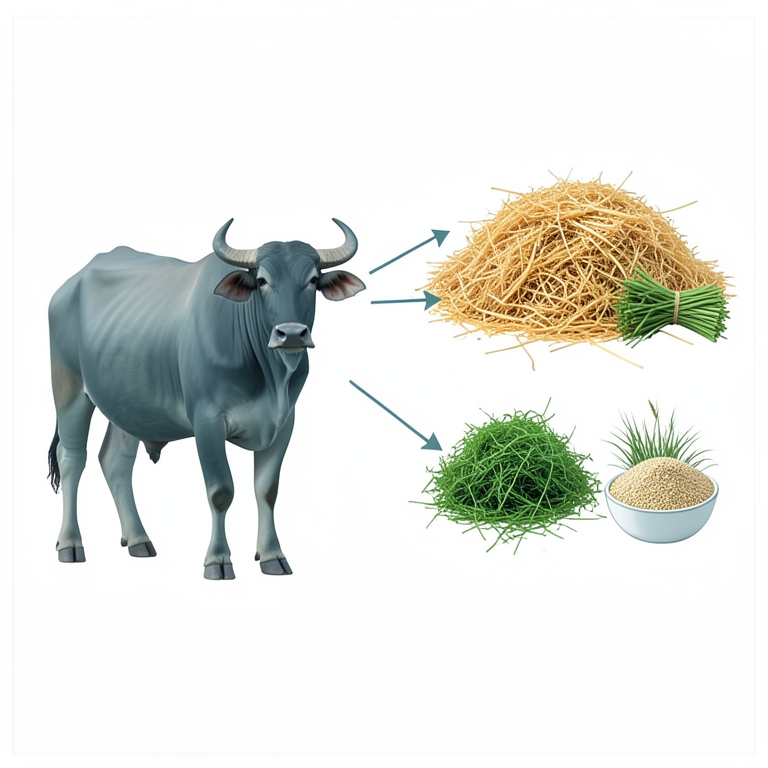
Buffalo Diet Composition
AI-generated conceptual illustration (non-descript water buffaloes). It explains the idea and does not show study data.
View source evidence ↗Figures & tables
From the original paper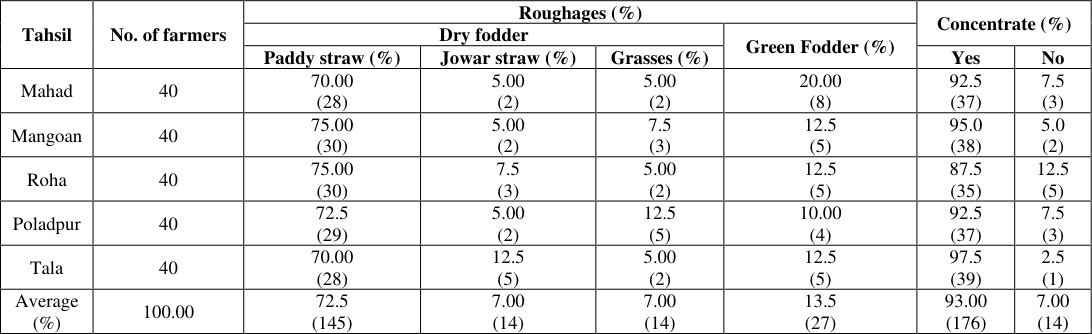 Table 1
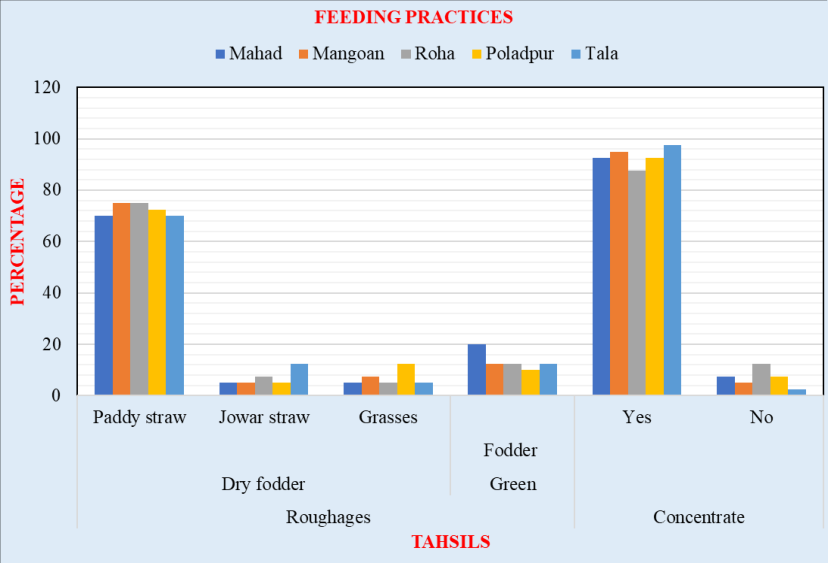 Figure 1
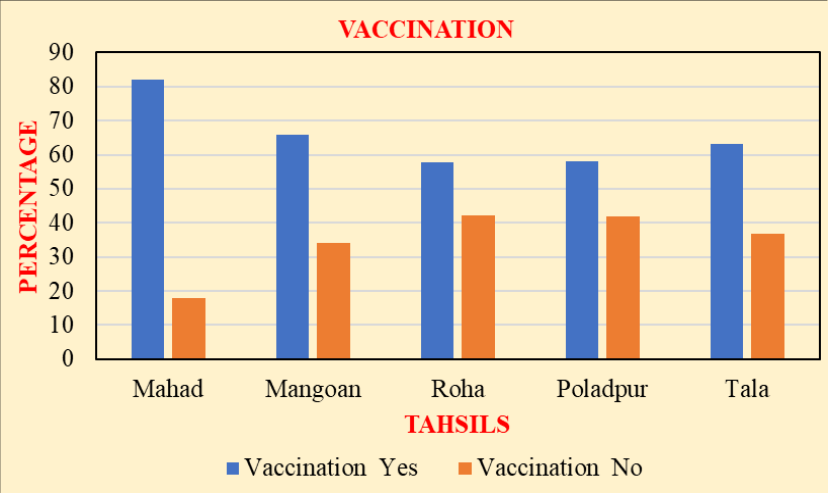 Figure 2
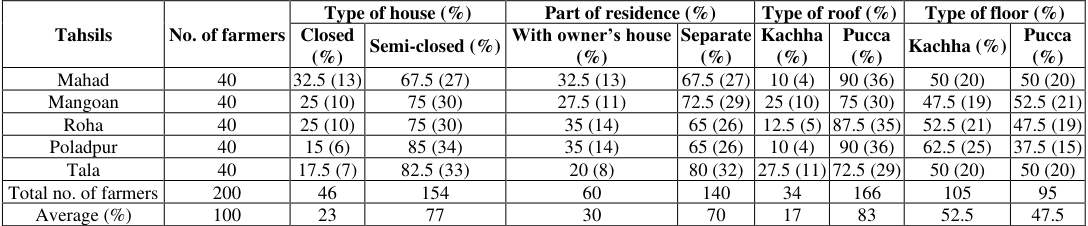 Table 2
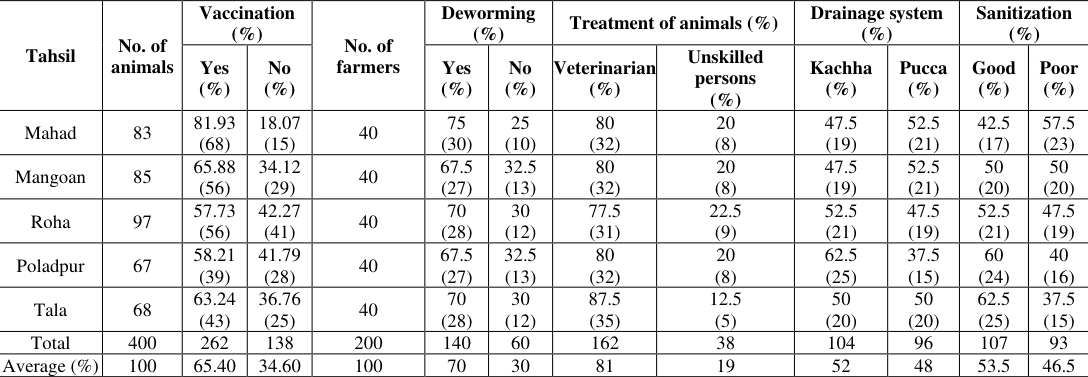 Table 3
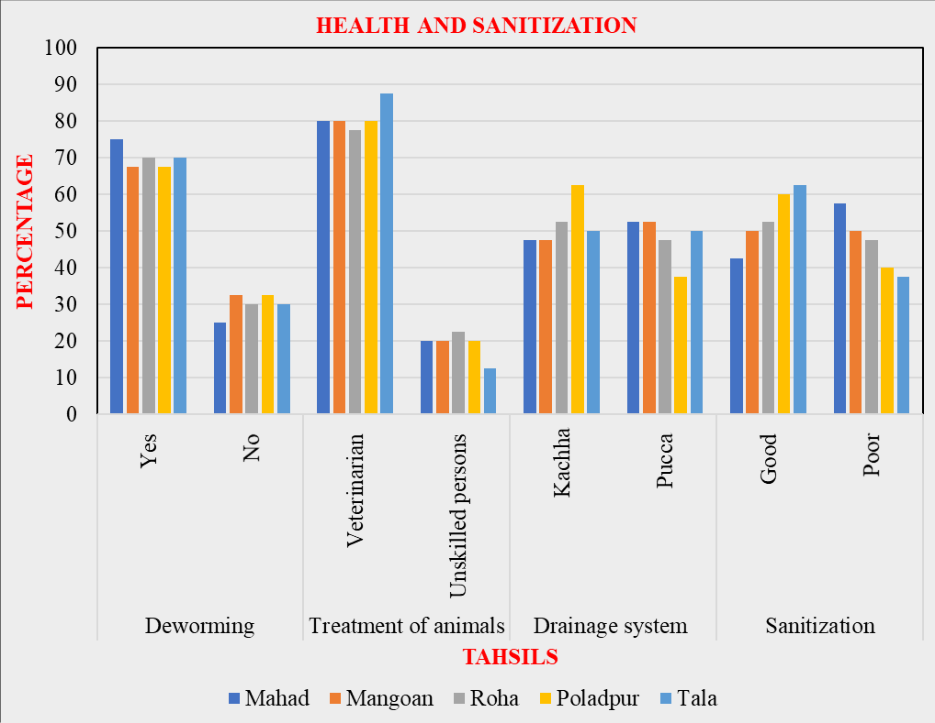 Figure 3
Introduction
Buffaloes are well adapted to the hot and humid climate of India and play a distinct role in improving the rural economy which is primarily based on agricultural production sector. Livestock housing conditions and all animal husbandry practices exert a considerable influence on animal behaviour, health and production. Integrating various aspects such as improved housing, nutrition, breeding and milking together are known to produce remarkable improvements in growth, reproduction and production performance. (Patel et al., 2019) [3] . Buffaloes plays as an important role in alternative livestock production. To increase the total milk production, breeding programme associated with improve the management practices, improving the genetic management in regional herd, the taking into account of morphological information. (Ramos et al., 2006) [4] . Housing along with feeding management plays a very significant role in exploiting real potential of dairy animals. A well-organized dairy farm management is incomplete without a well arrangement and adequate housing. Proper house with well ventilation, lighting, and proper flooring provides a comfortable atmosphere to livestock; thus, have a major effect on dairy animal production. Further, healthcare practices like vaccination, deworming, udder hygiene, management of sick animals are equally important for improving the status of dairy farms. Proper housing and management, along with the healthcare of animals, facilitate best comfort for dairy animals, which is required for quality and quantity production. (Rathva and Sorathiya, 2020) [5] . Balanced and proper feeding results in better utilization of nutrients and optimum milk production. To utilize the feeding material more efficiently, housing management becomes an important factor. As per national level during 2017-2018, the average yield of milk per day per animal is given as indigenous buffalo 6.19 kg/day and non-descript buffalo 4.21 kg/day. (Anonymous, 2019) [1] . The poor productivity of non-descript buffalo is mainly due to lack of proper knowledge for balance feeding. Farmers belongs to rural area feed their buffaloes with roughages and concentrate but they should not have consciousness about quality and quantity of feed and also should not follow proper management practices which lead the dairy business uneconomical. The present study was undertaken to gather information regarding existing housing and feeding practices adopted by the buffalo farmers of Raigad district in Maharashtra state and to provide help in adoption of scientific management practices in this area.
Materials and Methods
A three stage stratified random sampling procedure was used for selection of animals and tahsils. At first stage, from proposed district under study i.e., Raigad district five (5 tahsils) tahsils were selected having maximum non-descript buffalo population and from each tahsil ten (10 villages) villages were selected randomly in second stage. In the third stage, four (4 farmers) farmers having buffalo from each selected village were selected randomly. Thus, total sample size was two hundred (200 hundred) buffalo owners and 400 non-descript buffaloes. All farmers who were rearing at least one or more than two non-descript buffalo were selected for the study. Desired information was collected from buffalo owners with the help of a pre-tested questionnaire. The data collected were properly arranged, grouped and were analysed by using suitable statistical techniques i.e., least square method to avoid non-orthogonally of the data. All the available data on information of feeding and managemental practices in the particular area was subjected to tabulation and analyzed.
Results and Discussion
Results and Discussion
Feeding practices
In the Raigad district, mostly paddy straw, jowar straw, grasses and green fodders fed to the animals. Ration constituted 72.5 paddy straw, 7.00 jowar straw (Kadbakutti), 7.00 grasses and 13.5 percent green fodder, respectively for non-descript buffaloes. The animals were mainly fed with paddy straw and grasses during summer season. Concentrate feeding was practiced by 93.00 Percent farmers and remaining 7.00 percent farmer not provided concentrate mixture have been summarized in Table No. 1 and Fig No . 1 During rainy season green roughages were available. However, in other seasons, green fodder was not available hence buffalo farmers feed more rice straw and grasses to the buffaloes. The results are in line with the Thalkar (2012) [7] reported that feeds and fodders constituted 76.50 straw, 17.50 grass and 6.00 kadbakutti percent, respectively. Concentrate feeding was practiced by 7.00 Percent farmers and remaining (93%) farmer not provided concentrate mixture to the nondescript cattle in the Raigad district.
Housing management
In Raigad district most of the buffalo farmers (77.00%) were semi-closed housing for non-descript buffaloes while (23.00%) buffalo farmers closed type of housing to the animals. It shows in Table No [6] reported that close type of house was provided by 98 percent most of the tribal farmer. Kaccha type of floor provided by 87 percent of house. Earthen platue with thached roof present in 94 percent percent of animal shed and wooden poles use to support roof in 85.5 percent of the house. Same as result in Thalkar (2012) [7] reported that most of the respondents (69.00%) were providing housing for cattle while (31.00%) farmers did not provide housing to the animals. Most of the farmers provided separate housing (70%) whereas (30%) farmers had made arrangements for housing of cattle by providing extension to the residence.
Health management
In Raigad district, all the buffalo owners followed health and sanitation measures such as cleaning of milking utensils, cleaning of shed before milking, washing of udder, and floor before milking. Vaccination of buffalo against infectious disease was done by 65.40 percent farmers and 34.60 did not vaccination buffalo against infectious disease. It shows in Table No. 3 and Fig No . 2. Similar observations were made by Rathva and Sorathiya (2020) [5] observed that 90% of farms practiced regular vaccination for Foot and Mouth Disease and Haemorrhagic Septicaemia disease in Urban and Peri-Urban Dairy Farms of Navsari District, Gujarat State. Buffalo farmers to be carried out 70.00 percent deworming to the buffalo calves, heifers and adult animals and other 30.00 percent buffalo farmers did not followed regular deworming. A finding in agreement with Kalyankar et al. (2008) [2] observed that deworming was done in few cases only in South Konkan Coastal Zone (SKCZ), North Konkan Coastal Zone (NKCZ), Western Ghat Zone (WGZ), Sub Mountain Zone (SMZ), Central Vidarbha Zone (CVZ) and Eastern Vidarbha Zone (EVZ), while it was common practice in rest of the zones. Sivaji et al. (2018) studied that deworming of buffaloes was ranked 5 th with adoption index of 28 percent. It was observed that deworming practice was not a preventive measure and whenever there is a severe health problem occurs. The treatment of buffaloes, 81.00 percent farmers treated to animals by veterinarians and 19.00 percent farmers treated to unskilled persons in Table No. 3 and Fig No. 3. These findings are in consonance with the findings of Rathva and Sorathiya (2020) [5] observed that 62.50% of farms got their sick animals treated by para veterinarians (livestock inspectors-L.I.), whereas 37.50 percent called qualified veterinarians (V.O.) in Urban and Peri-Urban Dairy Farms of Navsari District, Gujarat State.
Sanitization
In Raigad district, all the buffalo owners followed health and sanitation measures such as drainage system and sanitization. It is observed in Table No. 3 and Fig No. 3 that the drainage system in that Kaccha and Pucca were done by 52.00 percent and 48.00 percent farmers and sanitization in that good and poor were done by 53.5 percent and 46.5 percent farmers. However, the present study was contrary to the findings of Sabapara et al. (2010) [6] reported that Pukka drainage facility for drainage of urine found only in 6 percent animal shed while remaining (94%) had no drainage facility and urine soaked in earthen floor of animal shed of dairy animals in the tribal area of South Gujarat.
Conclusion
It was observed that farmers providing housing to the animals. Farmers reported to use sanitation measures viz., vaccination of animals and treatment of animals against diseases, cleaning of shades before milking, washing of udder and floor before milking, etc. Most of the buffalo owners followed health and sanitation measures such as drainage system and sanitization. In Raigad district, mostly paddy straw, Jowar straw, dry grass and green fodder fed to animals. Green fodder is not available during hot weather and summer season. So, maximum farmers were preferred to the concentrate mixture mostly that's why the non-descript buffaloes was better milk production performance in this area.
Acknowledgement
AcknowledgementThe authors are greatly thankful to the farmers whose necessary information helps us to complete the research work successfully.
Figures and tables from the paper
| Tahsils | No. of farmers | Type of house (%) | — | Part of residence (%) | — | Type of roof (%) | — | Type of floor (%) | — |
|---|---|---|---|---|---|---|---|---|---|
| Closed (%) | Semi-closed (%) | With owner’s house (%) | Separate (%) | Kachha (%) | Pucca (%) | Kachha (%) | Pucca (%) | ||
| Mahad | 40 | 32.5 (13) | 67.5 (27) | 32.5 (13) | 67.5 (27) | 10 (4) | 90 (36) | 50 (20) | 50 (20) |
| Mangoan | 40 | 25 (10) | 75 (30) | 27.5 (11) | 72.5 (29) | 25 (10) | 75 (30) | 47.5 (19) | 52.5 (21) |
| Roha | 40 | 25 (10) | 75 (30) | 35 (14) | 65 (26) | 12.5 (5) | 87.5 (35) | 52.5 (21) | 47.5 (19) |
| Poladpur | 40 | 15 (6) | 85 (34) | 35 (14) | 65 (26) | 10 (4) | 90 (36) | 62.5 (25) | 37.5 (15) |
| Tala | 40 | 17.5 (7) | 82.5 (33) | 20 (8) | 80 (32) | 27.5 (11) | 72.5 (29) | 50 (20) | 50 (20) |
| Total no. of farmers | 200 | 46 | 154 | 60 | 140 | 34 | 166 | 105 | 95 |
| Average (%) | 100 | 23 | 77 | 30 | 70 | 17 | 83 | 52.5 | 47.5 |
Table text extracted from the original PDF; superscript letters are shown inline. The original table image is below.
View original table image
References
6 in the original paper- Anonymous. 20 th Livestock census 2019. All India Report. Ministry of Agriculture. Dept. of Animal Husbandry, Dairying and Fisheries. Government of India; c2019.
- Kalyankar SD, Chavan AA, Khedkar CD, Kalyankar SP. Studies on management practices of buffaloes in different agro-climatic zones of Maharashtra. Indian J Anim. Res. 2008;42(3):157-163.
- Patel NS, Patel JV, Parmar DV, Ankuya KJ, Patel VK, Madhavatar MP, et al. Survey on housing practices of buffaloes owners in Patan district of Gujarat, India. J Entomol. Zool. Stud. 2019;7(2):635-640.
- Ramos A de A, Malhado CHM, Carneiro PLS, Goncalves HC, Azevedo DMMR. Phenotypic and genetic characterization of the milk yield and calving interval in buffalo of the Murrah breed. Pesq Agropec. Bras Brasília. 2006;41(8):1261-1267.
- Rathva AL, Sorathiya LM. Prevailing Housing and Healthcare Management Practices in Urban and PeriUrban Dairy Farms of Navsari District, Gujarat State. Ind. J Vet Sci. Biotech. 2020;15(4):15-18.
- Sabhapara GP, Desai PM, Singh RR. Housing and feeding management practices of Dairy animals in the tribal area of south Gujarat. Indian J Anim. Sci. Res. 2010;8(10):1022-1027.