
Research article · 2024 · Full text
International Journal of Agriculture Extension and Social DevelopmentRole of psychological capital assessment in strengthening handloom weavers
Volume 7(5S) · Pages 81–84 · DOI: 10.33545/26180723.2024.v7.i5sb.653 ↗
Research areasMechanics and Biomechanics Studies
Abstract
Author-writtenPsychological capital assessment is essential for promoting individual well-being, enhancing performance and productivity, fostering resilience and supporting organizational goals. The study aimed to know the role of psychological capital assessment in strengthening handloom weavers. Exploratory research design was used in the study. The saree handloom weavers who were working with pit loom were purposively selected for the study. Psychological capital scale developed by Luthans was used to gather the information on four components self-efficacy, optimism, hope and resilience. The findings of various components of the psychological capital revealed that majority (36.67%) of the employees were confident in analysing a long-term problem to find a solution, felt confident contacting people to discuss problems. Majority 43.33% of weavers agreed that they are optimistic about what will happen in the future as it pertains to work. Majority of the weavers (40.83%) agreed that they energetically pursuing work goals, and last resilience component shows that handloom weavers are ready to face with difficulties at work. The study concluded that 65 percent of the handloom weavers have medium level of psychological capital whereas 35 percent has high level of psychological capital.
Summary
Source-checkedPlain-language reading of the full paper, prepared with AI and checked against the text. Each point links to the authors' own words.
Why it matters
- Assessing psychological capital is considered vital for improving an individual's well-being, productivity, and performance, while also supporting organizational objectives. View evidence ↗
- Psychological capital is recognized as a significant resource, ranked as the fourth most important capital after material, human, and social capital. View evidence ↗
- As a high-level construct of psychological resources, psychological capital helps reduce stress, anxiety, and depression while improving overall life satisfaction and mental health. View evidence ↗
The question
- The research aimed to determine how assessing psychological capital could be used to strengthen handloom weavers. View evidence ↗
What they did
- The study employed an exploratory research design and was carried out in the state of Andhra Pradesh in South India. View evidence ↗
- The sample consisted of 120 handloom weavers who specifically worked with pit looms to create sarees. View evidence ↗
- Data was collected using the Luthans Psychological Capital Questionnaire (PCQ), which measures self-efficacy, optimism, hope, and resilience via a 5-point Likert scale. View evidence ↗
What they found
- Regarding self-efficacy, 36.67% of the weavers felt confident in their ability to analyze long-term problems to find solutions. View evidence ↗
- In terms of optimism, 43.33% of the weavers agreed that they were optimistic about their future work prospects. View evidence ↗
- For the resilience component, 38.33% of weavers agreed that they were undiscouraged and ready to face difficulties at work. View evidence ↗
- The overall assessment showed that 65% of the handloom weavers possessed a medium level of psychological capital, while 35% had a high level. View evidence ↗
What it means
- The authors conclude that assessing psychological capital is a valuable tool for improving the motivation, resilience, well-being, and socio-economic status of handloom weavers. View evidence ↗
Visual summary
2 visualsIllustrations explain the paper; charts are replotted from the paper's own table values.

Components of Psychological Capital
AI-generated conceptual illustration (handloom weavers at traditional wooden looms). It explains the idea and does not show study data.
View source evidence ↗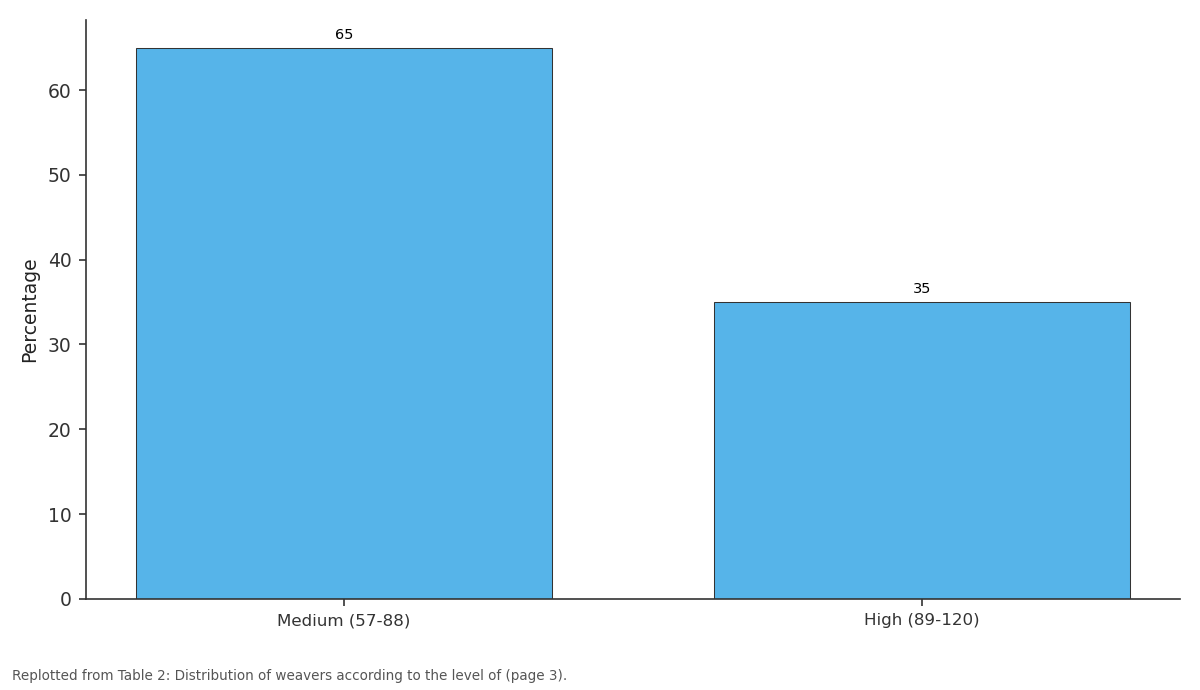
Percentage: Medium (57-88) vs High (89-120)
Replotted from Table 2 (page 3) of the original paper. Every bar is the paper's own table value.
View source evidence ↗Figures & tables
From the original paper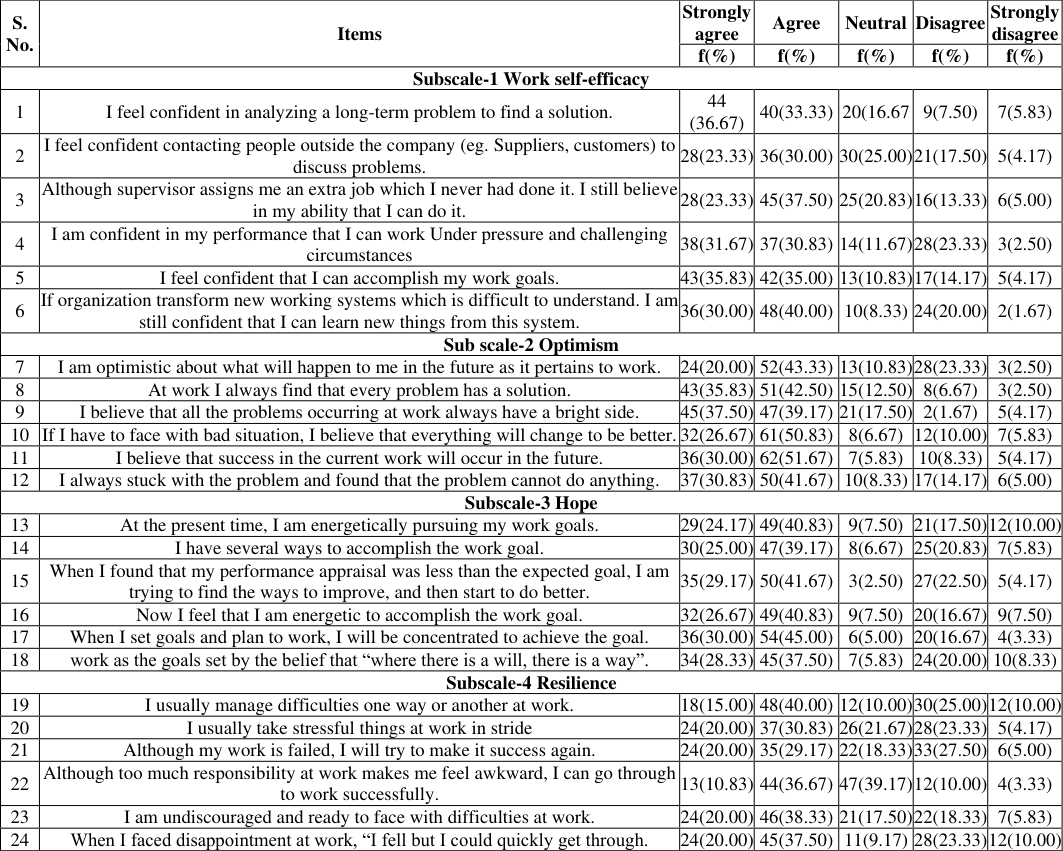 Table 1
 Table 2
Introduction
With the advent of globalization, psychological capital is becoming an increasingly significant and integral part of the management of most public and private organizations worldwide. Psychological capital is defined as an individual's positive psychological state of development (Avey et al., 2009; Dawkins et al., 2018) [1,6] . Hope is the sense of agency that people can achieve their goals and have determined alternative pathways to accomplish defined goals (Harms et al., 2018) [9] ; optimism is the act of fostering positive global expectations of success (Ertosun et al., 2015) [7] ; resilience is the positive psychological capability that allows people to face or recover positively from adversity, uncertainty, risk, or failure (Luthans et al., 2014) [11] . Self-efficacy is the belief and thoughts about one's own abilities to achieve success in challenging tasks (Liao and Liu, 2016) [10] . Psychological capital a higher-order construct of psychological resources is essential for reducing personal stress, anxiety, and depression as well as for enhancing mental health, well-being and life satisfaction. Psychological capital is the fourth greatest capital after material, human, and social capital with a great deal of attention in every field. According to Peterson et al. (2011) [14] and Parent-Rocheleau et al. (2020) [13] , the four psychological capital factors provide a high level of psychological capital that enables a person to concentrate on carrying out tasks and achieving success. Keeping in view, the study aimed to know the role of Psychological Capital Assessment in Strengthening Handloom Weavers Review of Literature Sajad (2017) [17] investigated on how psychological capital affects athletic coaches individual life satisfaction. The findings showed that life satisfaction and the psychological capital aspects of self-efficacy, hope, optimism, and resilience have a positive association (r=0.68, p<.001). The findings also showed that there is no gender difference in Psychological capital and Life Satisfaction. Athletic coaches with higher Psychological capital scores were happier with their lives than those with lower scores. The study's findings imply that an individual's subjective well-being will rise with the development of positive psychological skills. Ayey et al. 2010 [2] opined that Psychological Capital is associated to a number of employee behavioral, performance, and attitude outcomes. The study examined the relation between two measures of psychological wellbeing and the Psychological Capital levels of employees (N = 280). The outcomes showed a significant relationship www.extensionjournal.com between the PsyCap of employees and the two well-being measures. Psychological Capital was found to account for increased variance in the well-being measures over time. The feasibility and preliminary efficacy of a brief intervention to enhance psychological capital and reduce health risk behaviors of homeless female youths (N=80) were examined by Rew et al. 2017 [16] . The findings showed that the psychological capital, hope, resilience, and selfefficacy of the intervention participants to abstain from alcohol and drugs had significantly improved. Azimi (2014) [3] studied the significance of Psychological Capital in forecasting the Mental Health and Well-Being of female employees (N=280). Data were collected using the Luthans Psychological Capital Questionnaire, Diener Life Scale Satisfaction, and Goldberg Mental Health Questionnaire. The results revealed a positive association between Psychological Capital and Mental Health and between Psychological Capital and Well-Being. Tripathi and Pankaj (2011) [18] investigated the impact of psychological capital on employee well-being and life satisfaction of the insurance industry employees. The data was collected using the Psychological Capital Scale (Luthans et al., 2007) [11] , the Employee Well-Being Scale (Ryff's, 1985) [20] The study's findings showed that psychological capital is a more accurate indicator of workers' life satisfaction and well-being. Bin Li et al. 2014 [5] studied the role of Positive Psychological Capital (PPC) in the connection between Subjective Well-Being (SWB) and Social Support (SS). The findings demonstrated the favorable relationship between PPC, SS, and SWB. The findings indicated that PPC mediated the link between SS and SWB.
Methodology
Exploratory research design was used to collect the information. The study was conducted in Andhra Pradesh State of South India. A total number of 120 pit loom saree handloom weavers were exclusively selected for the study. Psychological capital questionnaire covering the parameters such as self-efficacy, optimism, hope and resilience (PCQ) developed by Luthans et al. (2007) [11] was adopted and a simple 5-point Likert Scale was used for each item of PCQ in which responses of the employees were as follows: "strongly disagree-1, disagree-2, Neutral-3, agree-4 and strongly agree-5".
Results and Discussion 1. Work self-efficacy
The outcomes of the handloom weavers job self-efficacy is the first dimension of psychological capital are shown in Table 1. The statement, "I feel confident in analysing a long-term problem to find a solution," was found to be agreed upon by the majority of employees (36.67%), with only a small minority (5.83%) strongly disagreeing. "I feel confident contacting people outside the company to discuss problems" was the second statement. A maximum of thirty percent of the workers agreed, followed by twenty-five percent of the weavers who disagreed, and twenty-three percent who strongly agreed. "Even though my supervisor gives me an extra task that I've never completed," was the third statement. I continue to have faith in my capacity to succeed.
| S. No. | Items | Strongly agree | Agree | Neutral | Disagree | Strongly disagree |
|---|---|---|---|---|---|---|
| f(%) | f(%) | f(%) | f(%) | f(%) | ||
| Subscale-1 Work self-efficacy | ||||||
| 1 | I feel confident in analyzing a long-term problem to find a solution. | 44 (36.67) | 40(33.33) | 20(16.67 | 9(7.50) | 7(5.83) |
| 2 | I feel confident contacting people outside the company (eg. Suppliers, customers) to discuss problems. | 28(23.33) | 36(30.00) | 30(25.00) | 21(17.50) | 5(4.17) |
| 3 | Although supervisor assigns me an extra job which I never had done it. I still believe in my ability that I can do it. | 28(23.33) | 45(37.50) | 25(20.83) | 16(13.33) | 6(5.00) |
| 4 | I am confident in my performance that I can work Under pressure and challenging circumstances | 38(31.67) | 37(30.83) | 14(11.67) | 28(23.33) | 3(2.50) |
| 5 | I feel confident that I can accomplish my work goals. | 43(35.83) | 42(35.00) | 13(10.83) | 17(14.17) | 5(4.17) |
| 6 | If organization transform new working systems which is difficult to understand. I am still confident that I can learn new things from this system. | 36(30.00) | 48(40.00) | 10(8.33) | 24(20.00) | 2(1.67) |
| Sub scale-2 Optimism | ||||||
| 7 | I am optimistic about what will happen to me in the future as it pertains to work. | 24(20.00) | 52(43.33) | 13(10.83) | 28(23.33) | 3(2.50) |
| 8 | At work I always find that every problem has a solution. | 43(35.83) | 51(42.50) | 15(12.50) | 8(6.67) | 3(2.50) |
| 9 | I believe that all the problems occurring at work always have a bright side. | 45(37.50) | 47(39.17) | 21(17.50) | 2(1.67) | 5(4.17) |
| 10 | If I have to face with bad situation, I believe that everything will change to be better. | 32(26.67) | 61(50.83) | 8(6.67) | 12(10.00) | 7(5.83) |
| 11 | I believe that success in the current work will occur in the future. | 36(30.00) | 62(51.67) | 7(5.83) | 10(8.33) | 5(4.17) |
| 12 | I always stuck with the problem and found that the problem cannot do anything. | 37(30.83) | 50(41.67) | 10(8.33) | 17(14.17) | 6(5.00) |
| Subscale-3 Hope | ||||||
| 13 | At the present time, I am energetically pursuing my work goals. | 29(24.17) | 49(40.83) | 9(7.50) | 21(17.50) | 12(10.00) |
| 14 | I have several ways to accomplish the work goal. | 30(25.00) | 47(39.17) | 8(6.67) | 25(20.83) | 7(5.83) |
| 15 | When I found that my performance appraisal was less than the expected goal, I am trying to find the ways to improve, and then start to do better. | 35(29.17) | 50(41.67) | 3(2.50) | 27(22.50) | 5(4.17) |
| 16 | Now I feel that I am energetic to accomplish the work goal. | 32(26.67) | 49(40.83) | 9(7.50) | 20(16.67) | 9(7.50) |
| 17 | When I set goals and plan to work, I will be concentrated to achieve the goal. | 36(30.00) | 54(45.00) | 6(5.00) | 20(16.67) | 4(3.33) |
| 18 | work as the goals set by the belief that “where there is a will, there is a way”. | 34(28.33) | 45(37.50) | 7(5.83) | 24(20.00) | 10(8.33) |
| Subscale-4 Resilience | ||||||
| 19 | I usually manage difficulties one way or another at work. | 18(15.00) | 48(40.00) | 12(10.00) | 30(25.00) | 12(10.00) |
| 20 | I usually take stressful things at work in stride | 24(20.00) | 37(30.83) | 26(21.67) | 28(23.33) | 5(4.17) |
| 21 | Although my work is failed, I will try to make it success again. | 24(20.00) | 35(29.17) | 22(18.33) | 33(27.50) | 6(5.00) |
| 22 | Although too much responsibility at work makes me feel awkward, I can go through to work successfully. | 13(10.83) | 44(36.67) | 47(39.17) | 12(10.00) | 4(3.33) |
| 23 | I am undiscouraged and ready to face with difficulties at work. | 24(20.00) | 46(38.33) | 21(17.50) | 22(18.33) | 7(5.83) |
| 24 | When I faced disappointment at work, “I fell but I could quickly get through. | 24(20.00) | 45(37.50) | 11(9.17) | 28(23.33) | 12(10.00) |
Table text extracted from the original PDF; superscript letters are shown inline. The original table image is below.
View original table image
Merely 5 percent of weavers highly agreed with the statement, compared to 37.5% who strongly agreed. The fourth statement, "I am confident in my performance that I can work under pressure and challenging circumstances," was strongly agreed upon by 31.67% of the weavers. In contrast, 23.33 percent of the workers said they didn't agree with it. Regarding the statement "I feel confident that I can accomplish my work goals," the majority (35.83%) strongly agreed. "If organization transform new working systems which is difficult to understand," was the sixth work selfefficacy statement. Forty percent of the weavers agreed that they could learn new things from this approach, while eighty-three percent responded in a neutral manner and twenty percent disagreed.
Optimism
The findings of the psychological capital's second dimension, optimism, showed that most of the weavers, 43.33 percent agreed and just 2.50% disagreed with the statement, "I am optimistic about what will happen to me in terms of work in the future." The second thing I said was, "I always find a solution at work for every problem." Fewer than 6.67% strongly disagreed with the remark, whereas the majority (35.83%) strongly agreed and 42.50% agreed with it. The statement "I think there's always a bright side to all the problems at work" was agreed upon by 39% of the weavers. Merely 10% disapproved, with 5.83 percent strongly disapproving. Regarding the statement. Of the weavers, 51% agreed and just 4.17% disagreed with the statement, "If I have to face with bad situation, I believe that everything will change to be better." the majority of the weavers, 17.50% disagreed and 41.67 percent agreed with the proposition. I have persistently pursued the issue and discovered that it is powerless to solve.
Hope
The majority of the weavers (40.83%) agreed with the first statement, "At the moment, I am energetically pursuing my work goals," and only 10% strongly disagreed, according to the third dimension of psychological capital, or hope. Regarding the second statement, "I have multiple methods to achieve the work objective," approximately one-fourth of respondents disagreed and 39.17% agreed. The third statement, "When I found that my performance appraisal was less than the expected goal, I am trying to find the ways to improve and then start to do better," was accepted by the majority, 41.67 percent, while 22.50 percent disagreed. The fourth statement, "Now I feel that I am energetic to accomplish the work goal," was agreed with by 40% of the weavers, while just a small percentage disagreed (16.67%) and responded in a neutral manner (7.5%). The fifth statement, "When I set goals and plan to work, I will be concentrated to achieve the goal," was agreed upon by nearly half (45.00%), while 16.67% disagreed. Regarding the last statement, "Achieve the goals set forth by the belief that "where there is a will, there is a way," more than onefourth, or 28.33%, strongly agreed, 37.5% agreed, and 20% disagreed.
Resilience
Resilience, the final psychological capital dimension consists of six statements. According to the results, 40% of www.extensionjournal.com respondents agreed with the first statement, "I usually manage difficulties at work," while only 10% and 10% of respondents strongly disagreed and reacted in neutral. Regarding the second statement, "I typically handle stressful situations at work with grace," over one-fourth of respondents, or 30.83 percent, agreed, 21.67% were neutral, and 23.33% disagreed. The third was, "Even though my work has failed, I will try to make it succeed again," to which more than 29.17% of respondents agreed and 27.50% disagreed. Only 10.83 percent strongly agreed, over 39.17% had a neutral attitude, and only 3.33% disagreed with the statement. Even though I feel uncomfortable when I have too much responsibility at work, I can still complete my tasks successfully. About 40% of respondents agreed with the statement "I am discouraged and ready to face difficulties at work," whereas 18.33% disagreed and just 5.83 percent strongly disagreed. Twenty percent of the weavers strongly agreed with the last statement, "When I faced disappointment at work, "I fell but I could swiftly get through", while only ten percent strongly disagreed.
Figures and tables from the paper
| S. No | Psychological capital level | Frequency | Percentage |
|---|---|---|---|
| 1 | Medium (57-88) | 78 | 65% |
| 2 | High (89-120) | 42 | 35% |
Table text extracted from the original PDF; superscript letters are shown inline. The original table image is below.
View original table image
References
19 in the original paper- Avey JB, Luthans F, Youssef CM. The additive value of positive psychological capital in predicting work attitudes and behaviors. J Manag. 2009;36:430-452.
- Avey JB, Luthans F, Smith RM, Palmer NF. Impact of positive psychological capital on employee well-being over time. J Occup Health Psychol. 2010;15(1):17.
- Azimi T. The role of psychological capitals in predicting mental health and well-being of female employees in the education of Dehdasht. Indian J Fundam Appl Life Sci. 2014;S4:1297-304.
- Azimi T. The role of psychological capitals in predicting mental health and well-being of female employees in the education of Dehdasht. Indian J Fundam Appl Life Sci. 2014;4.
- Bin L, Ma H, Guo Y, Xu F, Yu F, Zhou Z. Positive psychological capital: A new approach to social support and subjective well-being. Soc Behav Pers Int J. 2014;42:135-44.
- Dawkins S, Martin A, Scott J, Sanderson K, Schüz B. A cross-level model of team-level psychological capital (PsyCap) and individual-and team-level outcomes. J Manag Organ. 2018;27:1-20.
- Ertosun GO, Erdil O, Deniz N, Alpkan L. Positive psychological capital development: A field study by the Solomon four group design. Int Bus Res. 2015;8:10211.
- Gaungyi L, Shanshan Y. Research on psychological capital intervention strategy of enterprise employees. Can Soc Sci. 2016;12(4):46-50.
- Harms PD, Krasikova DV, Luthans F. Not me, but reflects me: Validating a simple implicit measure of psychological capital. J Pers Assess. 2018;100:551-562.
- Liao R, Liu Y. The impact of structural empowerment and psychological capital on competence among Chinese baccalaureate nursing students: A questionnaire survey. Nurse Educ Today. 2016;36:3136.
- Luthans F, Avolio BJ. Brief summary of psychological capital. J Leadersh Organ Stud. 2014;21:125-129.
- Parent-Rocheleau X, Bentein K, Simard G. Positive together? The effects of leader-follower (dis)similarity in psychological capital. J Bus Res. 2020;110:435-44.
- Peterson SJ, Luthans F, Avolio BJ, Walumbwa FO, Zhang Z. Psychological capital and employee performance: A latent growth modeling approach. Pers Psychol. 2011;64:427-450.
- Rahimnia F, Mazidi A, Mohammadzadeh Z. Emotional mediators of psychological capital on well-being: The role of stress, anxiety, and depression. Manag Sci Lett. 2013;3:913-26.
- Rew L, Powell T, Brown A, Becker H, Natasha S. An intervention to enhance psychological capital and health outcomes in homeless female youths. West J Nurs Res. 2017;39(3).
- Sajad AB. Psychological capital as related to life satisfaction among sports coaches. Natl J Multidiscip Res Dev. 2017;2(3):300-302.
- Tripathi, Pankaj. Employee well-being: Role of psychological capital. Amity J Appl Psychol. 2011;2(1):18.
- Youssef-Morgan CM, Luthans F. Psychological capital and well-being. Stress Health. 2015;31:180-188.
- Ryff CD. Adult personality development and the motivation for personal growth. In D. Kleiber & M. Maehr (Eds.), Advances in motivation and achievement: Motivation and adulthood. Greenwich, CT JAI Press. 1985;4:55-92.